This blog post is NOT about the St. Louis Cardinals

Though sport has been a part of the human experience for about as long as history has been recorded, the concept of professional team sports is relatively recent. Until industrialization came along, people simply didn’t have time for much leisure activity, but  the mid-1800’s saw the emergence of the first professional football leagues (that’s “soccer” to all us uncultured Americans).

Then in 1876 professional sports, specifically baseball, arrived in the US with the establishment of the National League. The American League joined the fun in 1901. The NHL, with a slightly more complicated history, can trace its origin to 1909. 1920 brought us the NFL and the NBA started in 1946.

And with the rise of all these professional athletes came the rise superstition in sports. Why is this, you might ask? Well, historians have often noted that superstition is most pronounced in times when people feel they have little control over the outcome of their own lives. Professional athletes capable of competing at the highest level of their sport find themselves competing against others who are more or less equally capable.

The result of this kind of competition is, more often than we would like, dependent less on pure talent than on circumstance. Often miscommunication, questionable calls by officials, and poorly timed injuries make the difference between winning and losing. How can a team protect itself from such unforeseen problems? The answer is obviously to conjure the most luck.

Teams do this all the time. NHL teams famously refuse to touch their Conference Champion Trophies for fear it will bring them bad luck in their quest for the Stanley Cup and often the members of a baseball team will not shave during a post season run. My favorite team ritual by far, though, is that of professional rugby team, The All Blacks who perform a traditional war chant in front of the opposing team before each game.

But whereas team rituals can be attributed to increasing team camaraderie, the personal superstitions of many professional athletes are just plain bizarre. They range from the unwillingness of baseball players to change places in the batting order, to rubbing the head of the bat boy, or commonly the refusal or insistence of stepping on particular markings on the field of play. It seems there’s no end to what rituals professional athletes will try in an attempt to give themselves a slight edge. But not all players put much stock in such behaviors.

Babe Ruth, who once famously said, “I have only one superstition. I touch all the bases when I hit a homerun,” penned an article that ran in the Pittsburgh Post Gazette on May 28th of 1929, about his response to a fan’s suggestion that Ruth was wearing the wrong number. That year the Yankees became the first team to consistently wear numbers on the back of their jerseys and the Bambino wore the number 3 on his. The concerned fan, a self-identified numbers expert, explained that according to his observations of Ruth (who was in a minor hitting slump at the time), the player should be wearing the number 7. If he made the change, the fan insisted, he would have a great season. If not, Lou Gehrig, who sported the number 4 on his jersey (the appropriate number for him according to the “expert”) would certainly outhit Babe.

In response, Babe had only this to say: “Somehow I’ve got a sneaking hunch that the number on a fellow’s back doesn’t have much to do with his hitting one way or another—and I’m a lot more interested in getting my eye on the ball right now than I am in picking out lucky numbers or studying the stars.” Turns out Babe Ruth probably didn’t do any harm by disregarding the fan’s suggestion. In 1929, he hit 46 homeruns, drove in 154 runs and had an overall batting average of .345. Not bad; and, notably, better than #4 Lou Gehrig.

English: Babe Ruth and Lou Gehrig at United St...

The Yankees did have an off year, though. Their pitching struggled terribly and even with heavy hitters at the plate, they weren’t able to pull off a third consecutive championship, finishing up in second place behind the Philadelphia Athletics. If I know anything about baseball fans, I’m guessing numbers guy wasn’t surprised.

Because if professional athletes sometimes depend on a particular routine or good luck charm in an attempt to influence those factors that are largely out of their control, that is nothing compared to what their fans do. Fans are, after all, stuck on the sidelines, in front of the television, or tuned in to the game updates when our focus really should be elsewhere. Fans have no real control over the outcome of the game. All we can do is wish and hope and stress out.

So fans don good luck charms, eat specific foods, perform elaborate celebration dances, and generally engage in all manner of charm casting. Pretty much anything goes, because as a recent Bud Light commercial expresses: “It’s only weird if it doesn’t work.”

So for example, a practical historian known for rational thought and witty discourse (perhaps for her beauty and charm as well, but who can say) might convince herself that it is essential that she wear the same piece of jewelry every day of the playoffs as long as a certain flock of baseball playing birds from an undisclosed Midwestern city are still in contention. She might seek comfort during tense playoff moments by tightly hugging a plush toy of the team mascot. And perhaps she would even refuse to blog about her team until their postseason run is over. It wouldn’t be weird, though because it’s totally going to work.

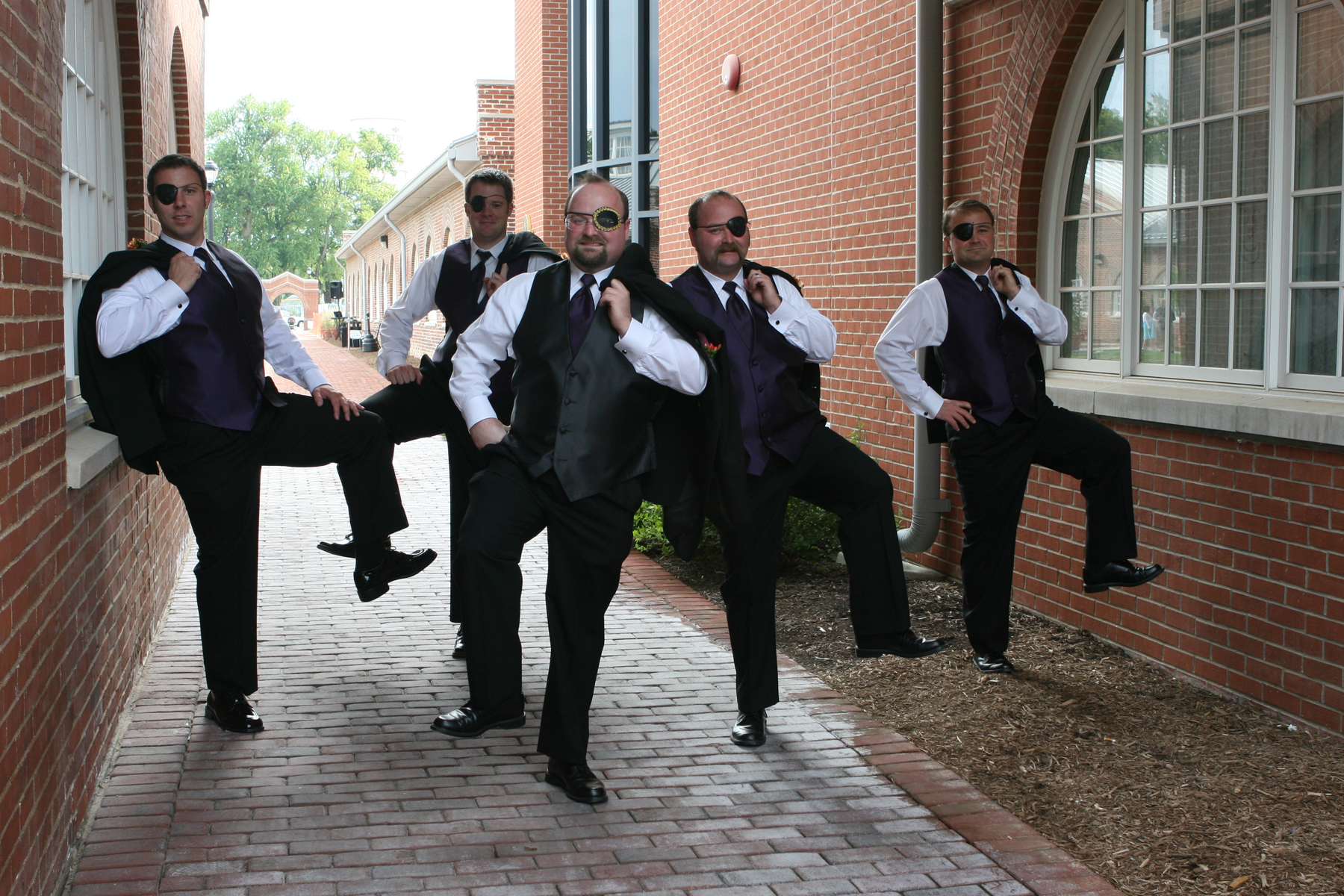
Avast Ye Wedding Lubbers

Multnomah Falls

On a recent family excursion to Multnomah Falls, a place I’ve been too few times, I noticed a sign along the trail that I hadn’t read before, probably because I assumed it had something to do with rock formations and/or water volume as most of the signs do.

But this one was different. It described an event from September of 1995 when a boulder weighing 400 tons (according to the sign that is approximately the same weight as a school bus filled with concrete, and go ahead and disprove that) fell from the rock face next to upper Multnomah Falls, plunging 225 feet into the pool at the bottom. Upon entering the water the school bus boulder produced a 70-foot splash that washed over the observation bridge, completely dousing a wedding party that had been posing for pictures. Now, I may not care much about geology, but I am a big fan of wedding photos.

In case you haven’t been to the falls, though, let me just provide a little background. Located on Interstate 84, just outside of Portland, Multnomah Falls drops a total of 620 feet, making it the highest waterfall in the Columbia River Gorge and the second highest year-round waterfall in the United States. Between the upper and lower portion of the falls spans Benson Bridge, constructed in 1914.

And if geology is your thing, Multnomah Falls is allegedly a fascinating place to visit because rumor has it you can see something like six different lava flows, evidence of flooding that occurred thousands of years ago, and probably even some really interesting differences in rates of erosion that have led to the tiered formation of the falls and the occasional plunging school-bus-sized rock. Personally, I just care that it’s pretty.

In fact, all those impressive geological goings-on coupled with the well-placed bridge in the middle make the easily accessible Multnomah Falls an ideal spot for all your magical wedding photo needs. Then there’s the tragic and super romantic mythological accompaniment that I didn’t even mention yet.

According to one Native American legend, the chief of the Multnomah people had a beautiful and beloved daughter. He arranged for her to marry a strong young chief from the neighboring Clatsop people and planned many days of feasting and celebration during which tragedy struck. A terrible sickness descended on the wedding festivities. The only solution, as determined by an honored medicine man, was for an innocent maiden to sacrifice herself. The idea was that her sacrificial love would impress the Great Spirit and the sick would recover. When her betrothed fell ill, the young maiden took it upon herself to save her people. She climbed up to the high cliff and leapt to her death. As a token of her loving sacrifice, a spring welled up on the cliff top, the water descending as a lasting bridal gown testimony to the young maiden.

I don’t know about you, but had I gotten married in Oregon, I think we would have made the effort to get that picture. But even though the myth lends a certain wild sentimentality to the photo op, I have to wonder if it ultimately makes a lot of sense to get fancied up in tuxedoes and ball gowns and go for a hike. Assuming here that your daily wear is somewhat less formal, don’t the memories painted by such pictures just ring a little false?

Yet as anyone who has ever tried to make small talk with relative strangers for hours at a wedding reception while waiting for the bridal party to arrive knows, couples do this kind of thing all the time. In fact, my husband was a groomsman at the beginning of this summer and while I’ve not yet seen the photographic evidence, it sounds like things may have gotten a little out of hand. Let’s just say there are some modern art sculptures on an undisclosed Midwestern college campus that are probably feeling a little violated. What that has to do with the celebration of marriage, well, you’d have to ask the couple. No one else seems willing to talk about it.

So the sign at the falls got me thinking about wedding photos and it happens that a few days ago some good friends of mine celebrated their wedding anniversary. It’s one of those that I always remember not only because I was a bridesmaid (and I actually liked the dress, and yes, I have even worn it since), but also because they had the foresight to get married on International Talk like a Pirate Day.

They’re a great couple and I am honored to be featured in their wedding photos, in which I never once posed with any modern art sculptures. But as I was looking back through the pictures, I realized that along with the lined up bridal party, the first kiss as husband and wife, and the gathered family, were some of the other kinds of photos as well: the ones in which excessively well-dressed people are deliberately posed in unnaturally casual ways.

Clearly these men are pirates. You can tell by the way they are standing.

Ultimately, though, I think these are the ones I like best because it says a lot about a photographer (and how well they know the couple whose wedding they are trying to capture) and even more about the couple themselves, because if the photo didn’t somehow resonate with who they are, then it never would have made the wedding album. For my friends, their memories will forever include a nod to the internationally celebrated holiday with which they share their special day. And because of their willingness to embrace it, their friends will never forget to leave a heartfelt message on their Facebook pages: “Arr. Ye be havin a jolly anniversary ye old scurvy dogs.”

I am happy to report, too, that the Multnomah Falls wedding deluge resulted in no major injuries. In an interview after the wedding, the bride said of the event, “We got the tragedy out of the way and now we’re home free.” That’s a great attitude that I assume has led to many years of happily ever after. I just hope someone managed to snap a picture of the splash.

Just a bunch of well-dressed people casually hanging out in a courtyard, cuz that’s how we roll.

Wedding photos by Layne Aumann Photography. www.aumannphotography.com/

These wedding pictures are used by permission and may not appear elswhere without consent, lest ye be wantin to walk the plank.

Something Kind of Awesome

Gulf Shores, Alabama. Beach.
Gulf Shores, Alabama. Beach. (Photo credit: Wikipedia)

As Hurricane Isaac slammed into the Gulf Coast causing evacuations, flooding, property damage, fear, and all the terrible things a hurricane can bring with it, something kind of awesome happened, too. On a thin little stretch of Alabama beach that reaches between Gulf Shores and Fort Morgan on the east side of Mobile Bay, Isaac’s fury revealed a shipwreck, about 136 feet long and previously burned, from days gone by.

English: Map of Bon Secour National Wildlife R...

If you’re unfamiliar with the location, glance at a map of Alabama, concentrating on that little southern piece that meets the Gulf of Mexico. And then look more closely because you probably missed it the first time. It’s not much more than a single main road lined by bits of the Bon Secour National Wildlife Refuge and beach front vacation homes.

Every couple of years for as long as I can remember a portion of my family vacations there. It’s always the laid back family reunion sort of vacation where folks may come and go as they can and you’re always sure to see some cousins, aunts, uncles, and friends you haven’t seen for a while along with a few new faces, too. There’s never much of an agenda beyond a little beach wiffle ball (in the water is probably a homerun; if you cause someone to plunge into the surf chasing your ball, you’re a hero) and inside someone is always cooking something wonderful.

And at the risk of sounding like a court mandated BP commercial, it’s really beautiful. If you’re a beach vacation kind of a person, it’s worth giving a try. I don’t always make it for the big family gathering, but I have been there several times over the years and I have managed to take both of my sons as well. Sometime in the coming  years, I’m sure we’ll return because we love it.

So when my cousin (via my aunt) brought the story of this discovery to my attention, I immediately pulled out vacation photos and explained to my 5-year old son that an old ship had been found upon the very beach where he played in the sand as a small babe. His eyes as big as saucers, he whispered, “You mean a shipwreck?”

I can only imagine what was going through his head: images of sharks chasing frightened little fish through portholes, peg-legged pirates running wildly to save their damaged ship, a prince floating adrift in the open sea awaiting rescue by a pretty singing mermaid. And why not? Don’t we all love a good historical mystery?

But even though this was the first time I’d ever heard of the ship, it’s not the first time it has ever been seen. Hurricanes in 1969, 1979, and even 2004 all revealed parts of the wreck in the sand, but Isaac has shown us more of it than has been seen in a long time. In 2004, when Hurricane Ivan uncovered a smaller portion, there was enough of the wreck visible to get historians really going, trying to figure out just what ship they were looking at.

The list pretty quickly got whittled down to just three good possibilities:

  1. The 136 foot Monticello was a Confederate blockade runner that failed to outrun a Union navy gunboat and burned to the keel.
  2. At close to 150 feet, the schooner Rachel was run aground with a load of lumber (and rumor has it, illegal booze) in 1923 by a tropical storm. The ship was later burned, for unclear reasons, though local legend chalks it up to insurance fraud.
  3. A captured rum runner, Aurora, carrying around 1400 cases of liquor (toward the end of prohibition) was being towed toward Mobile by the US Coast Guard when it caught fire and sank somewhere near Fort Morgan.

Kanawha "cutting out a blockade runner fr...

Though these wrecks each bear some resemblance to the mystery boat, there are a few clues that have pointed historians to their final conclusion. First, the wreckage contains woven steel cables, not used in shipbuilding during the Civil War era. The beam construction of the ship, too, points to a design that was more useful for stability than for speed, so it’s not likely that this was the blockade runner Monticello or any of the other many sunken Confederate Blockade runners that might have been contenders for consideration.

There’s also some evidence that suggests that the wrecked ship was a steam-powered vessel, and though little is known about the Aurora, its 8 crew members were safely aboard the Coast Guard vessel when it burned and 8 seems to historians a pretty small crew to be operating a steam vessel of that size.

This leaves us then with the Rachel (not just a popular 90’s hairstyle). I confess I am a little disappointed. Historians have pretty much all agreed that this was just a working lumber ship that fell under some trouble. Thankfully, her crew made it to safety. But they never were very forthcoming about her cargo so if she was smuggling booze, well, we’ll never know for sure. And whether she was burned intentionally in order to cash in on insurance we can only guess. So maybe there is still a little mystery.

And who knows?  Maybe the crew was rescued by a singing mermaid. They never said they weren’t.

Do you smell coconut?

Pod of Hippos (Hippopotamus amphibius) in Luan...

Summer is drawing to a close. The nights are getting cooler and the kids finally head back to school next week. In another month or so, the rainy season will descend upon us here in the Pacific Northwest and so with our last days of yummy summer sun, the boys and I have been doing our best to enjoy the great outdoors while we still can.

But because I have pale-skinned children, this means a thorough slathering in sunscreen before we head into the sunshine, and not only because it makes them smell like coconuts. That’s just a nice bonus.

So I was pretty upset when I started looking into sunscreen guidelines and found the Internet lit up with accusations that sunscreen causes skin cancer. Really? It upset me because it meant that Kurt Vonnegut was in fact wrong in the commencement address he neither wrote nor delivered to the 1997 graduating class of MIT. You probably remember the speech. Originally a column by Mary Schmich of the Chicago Tribune, it became a hit song beloved by graduates everywhere. The column begins with unquestionably sound advice: “wear sunscreen.”

Wear Sunscreen

So I felt misled. I decided to do a little digging into this substance we call sunscreen. There are a few references to innovative sun protection throughout history. Historians think the Ancient Greeks used sand and oil to protect their skin from sun damage as early as 400 BC and quite a few years later, sun block gets another blurb when Christopher Columbus journals about the paint the natives use to protect their skin from the sun.

The first widely used chemical sunscreen was invented by Benjamin Green, whose “Red Vet Pet” was worn by soldiers in the Pacific during WWII. Green’s early attempt would later become a Coppertone product. A handful of others invented basic sunscreens around the same time and they all had one thing in common. They didn’t work particularly well.

So now skip ahead thirty or forty years of growth and development in the industry and a huge increase in the rate of use in the general public. The other thing you will find is an increase in the rates of melanoma skin cancer.

So if sun exposure causes skin cancer and sunscreen causes skin cancer and we’d really rather think of ourselves as the slim, athletic, outdoorsy type with a healthy sunny glow instead of the overweight, unhealthy, couch potato that most of us probably really are, then what do we do with this information?

First we need to examine exactly what we know. There really haven’t been reliable studies that have shown more than a correlation between the use of sunscreen and an increase in the occurrence of melanoma skin cancer, meaning that what we are probably seeing is that with greater sunscreen use, comes greater overconfidence.

What people tend to forget is that sunscreen is not recommended as the frontline defense for harmful sun exposure, but rather avoidance is the key. Current recommendations from the American Academy of Pediatrics state that kids (and their parents) should wear tight-weave clothing in the sun, avoid spending much time in the sun during peak hours, wear hats with brims that shade the face and don sunglasses that offer broad spectrum protection.

Sunscreen with a minimum SPF of 15 (and higher is better) is a good idea, too, but studies do show that most of us don’t use it the way we should and relying on it too heavily may encourage people to make poor decisions about sun exposure. It’s more likely those poor decisions that are the real culprits of higher cancer rates. Sunscreen is not designed to be absorbed into the skin and so harmful chemicals leeching into our systems seems improbable and sunscreen in the US is regulated by the FDA, and so is subjected to the same level of testing as the newest drugs for say hypertension, depression, or birth control.

BUT if you still don’t trust it because you can’t pronounce the ingredients, I don’t blame you. A wise physician once said that the best sunscreen is the one a patient will actually use and there may be some more natural options out there.

The most promising natural sunscreens come from the study of biomimicry (imitating nature’s best ideas). It’s pretty ingenious actually. Basically there are some problems that arise from living on this planet and a lot of natural adaptations that make it easier to cope. Biomimicry suggests that nature may already hold some of the best answers to our most perplexing challenges.

In Part 2 of Man vs. Wild’s Indonesia, the Castaway episode, adventure survivor Bear Grylls introduces the use of a mucous produced by the mushroom coral as sunscreen. In the show, Grylls simply picks up one of these unanchored corals, tips it a bit to catch some of the slime, and places the animal gently back into the water, no harm done.  He goes on to slather his already sunburned shoulders with the stuff while explaining that it has an SPF rating of somewhere around 50. And experts agree. It’s great stuff, but given that the mushroom coral is endangered, large quantities might be hard to come by.

Another promising option may come from hippos. These deceptively adorable creatures (they’re actually quite deadly) produce an oily red secretion, referred to as “hippo sweat” that not only provides protection from the sun, but may also serve as a highly effective insect repellant and antibiotic. The main problem with it, of course, is that it’s difficult to pick up a hippo and pour off its sweat.

On an episode of Dangerous Encounters, Brady Barr (National Geographic’s resident crazy animal guy) devised a scheme to collect the allegedly useful “sweat”. Wearing a nearly 200 pound reinforced hippo decoy suit, Barr attempted (spectacularly unsuccessfully) to get close enough to wild hippos to collect a sample. And since a fair few of you probably don’t have a reinforced hippo suit hanging in your closet, this may not be the ideal solution either, but then, I guess, luck favors the prepared.

Still, perhaps the biggest obstacle in marketing “hippo sweat” sunscreen is that it apparently smells like, well, a hippo. Considering that these large animals spend most of their days literally up to their eyeballs in mucky water, I’m guessing they smell less than fresh. At least for now, I’d rather smell like coconut.

By the way, if you would like some better information about skin cancer, check out this great blog created by Katie Wilkes, a 20-something melanoma survivor I recently had the pleasure of meeting. And, yes, I’m pretty sure she smelled like coconut, too.

http://www.prettyinpale.org/

The Trouble with Wallabies

A week or two ago, a suspiciously happy circle cropped up on a hillside near my home. This constitutes my only first-hand experience with a crop circle so I was delighted to discover that in the great state of Oregon where I live, this is not a terribly uncommon occurrence.

Though the vast majority of crop circles in the 20th century have been located in southern England there are examples from 26 nations throughout the world. Circles have been reported in forty-seven out of the fifty US states. And yes in 1991, Puerto Rico even got into the action when a group of concentric rings turned up on a rocky plateau near the city of Ajuntas.

Oregon ranks 11th among the fifty states with 19 reported circles by 2008 (Not quite as impressive as the 23 boasted by my native home state of Illinois, but not too shabby). Ohio claims the title for most reported crop circles in a single US state with a whopping 42, confirming what researchers have long suspected: there really is very little to do in Ohio.

This data comes from the Independent Crop Circle Researchers’ Association (ICCRA) which describes itself as a cooperative of researchers with a wide variety of interests in crop circles dedicated to objective data collection, independent of individual theories about crop circle formation. And it’s a good thing it exists because it’s a heated debate, contributed to (according to Wikipedia) by paranormal enthusiasts, ufologists (I can’t help but wonder if this field of study requires post graduate work), and anomalistic investigators. For some reason practical historians didn’t make the list.

Many of these enthusiasts, investigators, and ‘ologists have come to different conclusions as to the cause of crop circles. Which makes me wonder how exactly the large happy face appeared because there are a number of possibilities to consider.

The first good picture we have of crop circles comes from a 17th-century English woodcut pamphlet entitled Mowing-Devil on which appears the story of a farmer who said he’d rather have the devil himself mow his field than to pay the high price demanded by a laborer. Apparently no one ever told him to be careful what he wished for because that night, his field appeared to catch fire and the next day it was perfectly cut (at a rather higher price I assume). The accompanying picture includes the image of the devil cutting a circle into the field with a scythe. Of course, since he went on to cut the entire field, and because I don’t usually think of the devil as a particularly happy chap, I don’t think this explains my mystery circle.

1678 pamphlet on the "Mowing-Devil".

The more modern crop circle phenomenon took off a few years after a curious event near the city of Tully in Queensland, Australia. In 1966, a farmer by the name of George Pedley reported hearing a strange hissing noise. Looking toward the sound, he saw a saucer ascend from the nearby swamp. When he investigated the area, he found a circular depression in the vegetation, about 30 feet in diameter. Officials determined the cause to be vaguely related to a dust devil. The saucer sighting was “officially” overlooked.

Then in the 1970’s, circles began popping up all over the English countryside. Most of these would turn out to be the handiwork of pranksters Doug Bower and Dave Chorley who patterned their initial circles on the Tully “saucer nest.” The two later claimed over 200 circles, many of which sparked at least a little bit of serious scientific study.

In 1980, a meteorologist and physicist by the name of Terence Meaden weighed in with a complicated theory that the circles were caused whirlwinds bouncing around the unique topography of the southern English countryside. The theory gained some momentum, even garnering a tentative endorsement from Physicist Stephen Hawking who said that it was a plausible explanation if  the circles weren’t just part of some elaborate hoax. When Bower and Chorley finally came clean, I imagine Meaden’s response was something like: “Or it could all just be part of some elaborate hoax.” It is, however, worth noting that a lot of cereologists (one who has a post graduate degree in the study of crop circles, or maybe Cheerios) claim that crop circles which can be attributed to hoaxes are in fact promoted by governments as a way to discredit the true origin of others.

My favorite explanation for the appearance of crop circles, though, comes from Lara Giddings, then Deputy Premier of Tasmania, whose theory appears in a June 2009 article from the BBC. To give a little background here, Australia produces about 50% of the world’s legally grown poppies for use in the pharmaceutical industry. Australia also has wallabies. Giddings apparently said the following: “We have a problem with wallabies entering poppy fields, getting high as a kite and going around in circles. Then they crash. We see crop circles in the poppy industry from wallabies that are high.”

So I guess that explains it.

Except as far as I know, there are no wild (high as a kite) wallabies in Oregon. And while I can’t completely discount alien visitation, this particular hill is highly visible from a pretty busy road and I haven’t heard any reports of UFO sightings in the area. So maybe, just maybe, there’s a mystery artist or two out there having a little fun and spreading a little joy. But I should probably report it to the ICCRA just to be safe.

Red necked wallaby (picture taken in Australia)

Note: I know that some of you are probably still thinking about the Mowing-Devil and just can’t let it go because technically a crop circle is created by bending crops and not mowing them. I understand your concern, but the way I see it, if visitors from another planet decide to use lawn mowing equipment to communicate with us then who are we to cry foul? Just to be clear, though, I don’t think it’s a good idea for gorked wallabies to be operating heavy machinery.

Na na na nana na na. Nana na na…

We have a bad (or awesome) case of Olympic fever at our house this week. It’s not a terrible bug to have except for the fatigue. The late nights are definitely starting to wear on me, but it’s only a couple weeks every four years. And when I’m faced with the decision to either go to bed or to watch one more gymnastics apparatus or swim race, well, the choice is obvious.

The swimming is by far the hardest for me to turn off because I’ve always been a swimmer myself. I like to think I just missed qualifying for the US team (by 15 to 20 years and at least 10,000 hours in the pool). Okay so my strokes are inefficient (just means I work harder and burn more calories, right?) and my flip turns would make Rowdy Gaines guffaw, but still, I have always enjoyed my time in the pool.

As a teenager and into my early twenties while working at summer camps, I kept up my lifeguarding certification, completing the entire American Red Cross course twice as well as participating in refresher courses and in-service trainings. So even though I’m pretty sure I couldn’t out-swim Missy Franklin, if she were to cramp up in the water and need assistance, I could probably rescue her (and if she panicked and tried to drown me, I could totally break her nose and pull us both to safety. Thank you, Red Cross!)

And if the Olympics ever included an event in which athletes had to swim with their head out of the water supporting 150 pounds of dead weight on a large red buoy through the water and then up and over a rescue board, perhaps I could have been a contender. Alas, the Olympic Games have never included such a competition.

Or so I thought. But then what is a practical historian to do when she’s awake in the middle of the night in between events, waiting for the commentators to complete their super-informative interviews in which they ask hard-hitting questions like: “So, do you like Justin Bieber?” The answer to that question is that she Googles eliminated Olympic sports (as for the Bieber question, shockingly, I don’t hate him).

It turns out the 1900 Paris games featured a 200 m obstacle swimming event. True it included neither large red buoys nor rescue boards, but had it occurred 100 years later under the day’s official Red Cross guidelines, I’ve no doubt it would have. During the race, male swimmers (women didn’t compete in Olympic swimming events until 1912 because it’s hard to swim fast in an ankle length dress) climbed over a pole, over a row of boats, and under a second row of boats all while contending with the current of the River Seine. Gold was claimed by (probably not surprisingly) Australian swimmer Frederick Lane. I’m not sure why the event was discontinued after its brilliant debut. Maybe it just wasn’t Olympic-y enough.

And though the event never appeared in the games again (lucky for Lane who forever remains the Olympic record holder), a similar event does continue on the worldwide stage. Resurrected in 1955 again in Paris (though not in the Seine), a similar competitive event was organized by the Fédération Internationale de Sauvetage Aquatique or FIS (originally founded in 1910 with 18 member nations dedicated to water safety and rescue). The event, designed to encourage and celebrate the improvement of aquatic lifesaving skills, continued (somewhat sporadically) in pools throughout the world, until the organization merged with the World Life Saving organization (WLS), which focused largely on ocean and beach safety. In 1993, the International Life Saving Federation (ILSF) formed from the merger and the Lifesaving World Championship was born.

The event now occurs regularly every two years and one source I found claims that the ILSF supports the only worldwide athletic competition that truly serve a humanitarian purpose. That’s pretty noble, but I’m not sure it’s really true. But to defend my argument I’m afraid I’ll have to reference The Beatles.

You see I recently got into some small bit of trouble on Facebook by complaining about the inclusion of Paul McCartney’s “Hey Jude” performance at the opening ceremonies in London. I should stress that I have nothing against Paul McCartney or The Beatles. I appreciate their many contributions to the world of music (I mean they’re no Bieber or anything, but folks seem to like their music well enough) and I sing along to most of their collection just like everyone else. I just happen to hate that one song in particular because it doesn’t end definitively and so it sticks in my head. Badly. For days (or even weeks) at a time.

Seriously, I am only prolonging the agony by writing about it, but it’s worth mentioning because in the midst of the (mostly) friendly FB discussion/argument, I asked what the theme of the song had to do with the Olympic Games anyway. My brilliant (and occasionally snarky) niece replied: “In a world that lives in the midst of constant struggle and conflict, the Olympics serves as an opportunity to lay all of that aside and to come together through sport, thus it ‘take[s] a sad song and make[s] it better’” Okay, I can’t (or won’t because really it will only further drag out the incessant na na na’s in my head) argue with that. But then through that lens, Olympic competition sounds pretty humanitarian, doesn’t it?

So maybe 200 m obstacle swimming is pretty Olympic-y after all. I know I’d stay up to watch it.

One big puddle

About 7,700 years ago Mt. Mazama blew its top. While I am no expert volcanologist, I’m reasonably sure that this was not your average eruption. Actual volcanologists tell us that the eruption was around 42 times greater than that of Mt. St. Helens in 1980, and since 42 isn’t a round number, I have to assume they aren’t just randomly guessing.

But the exciting thing (if an explosion of molten rock out of the top of a mountain isn’t enough for you) is that this volcano just kept going until the entire thing had collapsed in on itself forming an impressively large caldera where a mountain top once stood. Over the years the steam vents sealed themselves off and the deep caldera became a giant bowl for catching precipitation and snow melt. Since the area receives an average of 44 FEET of snow per year (along with a measly 66 inches of rain), well, let’s just say that’s one big puddle!

Today, nestled in 286 square miles of national park in the middle of Oregon, this former mountain peak is known as Crater Lake. At somewhere around 2000 feet deep, it is the deepest lake in the United States and ranks seventh in the world. Of course since geologists can tend to be a quarrelsome bunch, it should come as no surprise that some have argued for naming it the ninth deepest in the world. I’m sure there’s a strong case for that, but, frankly, I lost interest.

What really matters to me, is that with an approximate volume of 4.49 cubic miles of water, there’s more than enough room to comfortably support the Crater Lake Monster. It’s true that Crater Lake’s elusive pleisiosaur doesn’t have the vast following or pizzazz of its more publicity crazed Scottish cousin Nessie, but then given that the volume of Loch Ness is a mere 1.8 cubic miles, it makes sense that Nessie would be observed more frequently.

Actually there have been shockingly few sightings of the monster in Crater Lake. To some skeptics out there, that might seem like good evidence that there is no such thing as the Crater Lake Monster. From where would it come after all? With no way in or out of the lake and no naturally occurring fish, it doesn’t at first seem like the ideal habitat for a sea monster.

But at least one witness has come forward in the recent past with a compelling monster story. Mattie Fletcher of Albany, Georgia, recounted her terrifying tale in a May 2002 issue of her local newspaper. When the now adult Ms. Fletcher was a young child boating on Crater Lake, she recalls, she observed a shadowy something swimming beneath her rowboat. She says it resembled a dragon, which, if you’ve ever seen the 1977 B movie The Crater Lake Monster (and who hasn’t?) you recognize as a pretty accurate description, though she forgot to mention that it was slow moving and made of paper mache.

And Ms. Fletcher is not the only person ever to claim that Crater Lake is home to a monster. Though numerous Native American legends surround the unusual body of water, the most consistent version tells of a battle between Llao (the god of the underworld) and Skell (the god of the sky). The story explains the massive eruptions of Mt. Mazama and how a demon soldier of Llao may have come to dwell in the depths of the lake.

Regardless which version of the legend though, Native American tribes consistently viewed Crater Lake as ominous and guides generally led exploration parties around the area, avoiding the lake altogether. As a result it wasn’t discovered by pioneers until 1853 when a group of miners looking for gold stumbled upon it.

I can kind of see why the lake might be a little unsettling. I recently visited the national park for the first time and the impossibly blue, incredibly deep waters that are difficult to access even in the height of summer do inspire awe. It’s the kind of place one expects to find a monster and to snap a picture of a long slender neck peaking up to say hello. Perhaps it’s only a matter of time until this monster has a cult following and a catchy nickname of its own.

So maybe I do care if I ever get back.

On April 18, 1981, the night before Easter that year, young David Craig attended a baseball game in Pawtucket, Rhode Island, at the invitation of his uncle, Dennis Craig, the home plate umpire. Little did he know that the Triple-A game between the Pawtucket Red Sox and the Rochester Red Wings would make baseball history as the longest professional baseball game ever played.

With a start time of 8:25 p.m., the game began as a regular pitching duel, scoreless for six innings. The Red Wings finally scored a run in the 7th; the Red Sox answered in the 9th. Next came another 11 scoreless innings (yes, you read that right). So then in the 21st inning, when the Red Wings scored, only to have Pawtucket’s Wade Boggs drive in the tying run in the bottom of the inning, no one was particularly happy about it (least of all Boggs). The players endured another 11 scoreless innings until league president Harold Cooper heard about it and demanded the suspension of play at the conclusion of the 32nd inning (at 4:07 a.m.!).

At this point, the crowd had dwindled from 1,740 to a mere 19 (excessively loyal) fans, each of whom received, for their devotion, season passes to the stadium. Not included in the count is David Craig, who by this time, was fast asleep. To the best of his uncle’s knowledge, David Craig has never since been to another baseball game.

And, as much as I love baseball, I can’t say I blame him.

I recently attended a game that had me questioning my own devotion to the sport. On Sunday, June 17th (Father’s Day), my family went to a game at Busch Stadium in St. Louis (a rare treat now that we live on the West Coast) between the Cardinals and the Kansas City Royals.

First, I should explain a little about my own relationship to Cardinal baseball. I am a fan by birth. More specifically, my maternal grandparents were fans. My father (originally just another frustrated Cubs follower) became a dedicated fan by marriage. My siblings are fans. My husband and most of his family are fans. And now the next generation (with the exception of one nephew, who hasn’t been alive long enough yet to fully grasp that the Cubs are never going to win) is made up of Cards fans. Cardinal baseball is entwined with some of my most precious memories of childhood and family.

I am not the person who is going to recite for you the names and stats of every player who has ever worn a Cardinals jersey, but I catch the games when I can and generally follow the team’s ups and downs. I celebrated their World’s Series victories in 1982, 2006, and 2011 and my heart broke those years when they were close enough to taste it, but were ultimately unsuccessful. I follow them closely enough to proudly proclaim that they have the most championship wins of any team in baseball (because the Yankees don’t count).

Still, I have to admit, I wasn’t really that upset to see them lose the Father’s Day game to Kansas City. With the exception of a couple of back-to-back homeruns by Cardinals Matt Holliday and Alan Craig in the 6th, it was a relatively boring game. The Cards were up by 1 in the top of the 9th; their closer Jason Motte was on fire, throwing fast balls the Royals couldn’t see, let alone hit. There were two outs, two strikes, and I was already packing up my kiddos (a little bored, though they had hung in pretty well for little guys) when disaster struck in the form of a solo shot homerun by Kansas City’s Billy Butler.

Inwardly I groaned, but I was fairly confident that the Cardinals would score to end the game. They didn’t. Instead it went on for 6 more innings. Each team had chances to win. Neither did. And the thing about extra inning baseball is that it’s rarely good, because nine innings of baseball is enough to tire most players out. After about 11 or so, the fatigue begins to show. And by 14(when there really should be another stretch because a sing-along might help lift everyone’s spirits), has caught a big case of the Please just let it ends.

The crowd thinned more and more after each half inning until it was pretty much just us and the Kansas City fans. The organist got stuck in a rut of weary charge riffs. And we debated. Even nearly left a couple of times, but you just don’t travel 2000 miles to go to a baseball game and not see it through to the end. By the time it was finally over, the game had lasted around 5 hours. When Kansas City’s Yunieski Bettencourt hit a 2-run homer the 15th, I am ashamed to admit, I was sort of hoping a little bit that the Cards wouldn’t recover (though I would have happily cheered for a three-run homer if one happened to come their way).

I am also a little ashamed to admit how truly upset I was that St. Louis swept the Royals in Kansas City the very next weekend, not, of course, because they won, but because they didn’t win when I was there to see it.

And I have to wonder just how long we would have stayed at the ballpark. Certainly (okay, probably) not 32 innings. The Pawtucket-Rochester game was continued, by the way. The next time the two teams were scheduled to play in Pawtucket, on June 23, in front of a sellout crowd of 5,746, play resumed. In one inning (just under 18 minutes of play), the Red Sox won it in the bottom of the 33rd inning. David Craig wasn’t there to see it.

FACT: This blog post is about vampires.

Abraham Lincoln wielding his ax at Lincoln’s New Salem State Park

In March of 2010, author Seth Grahame-Smith revealed to the world disturbing truths about the 16th president of the United States. By now you have probably heard of his book, Abraham Lincoln, Vampire Hunter. It has spawned a movie by the same name that will be released to theaters this Friday.

Personally I am fascinated by the concept of it for a couple of reasons. First of all, I am originally from Illinois, proudly nicknamed the “Land of Lincoln.” I grew up in a small town barely thirty miles from the capitol city of Illinois (NOT Chicago!) in which you can find: the Lincoln Presidential Museum, the Lincoln Depot, Lincoln’s tomb, Lincoln’s law office, Lincoln’s home, Lincoln Memorial Gardens, and the Abraham Lincoln Presidential Museum. If you swing by Springfield’s First Presbyterian Church (and why wouldn’t you?), you will even be treated to a glimpse of the very pew purchased by the Lincoln family. A quick 25 minute drive takes you to Petersburg, IL where you can walk through Abraham Lincoln’s New Salem State Park, a replica of the village where Lincoln spent several years as a not-so-successful small businessman. Amazingly, I’m pretty sure this list is not exhaustive.

As an elementary school student and Girl Scout, I pretty much toured them all, with the exception of the Presidential Museum, which only opened in 2005. I have, however, been to the museum multiple times as an adult and can unapologetically state that it is worth a visit. Make sure you don’t miss the “Ghosts of the Library” show. Tell them the practical historian sent you. They won’t know what you’re talking about, but I’ll appreciate the plug anyway.

The point is, like all kids from Illinois (except for maybe those from Chicago), I know a thing or two about Abraham Lincoln. I did not, however, know he was a successful vampire hunter.

The other reason that I find Grahame-Smith’s book so fascinating is that I also write historical fiction and so what he has done here presents a really interesting look at what writers can (or should) and cannot (or should not) do with (or to) history. The book begins with three “Facts”:

  1. For over 250 years, between 1607 and 1865, vampires thrived in the shadows of America. Few humans believed in them.
  2. Abraham Lincoln was one of the gifted vampire hunters of his day, and kept a secret journal about his lifelong war against them.
  3. Rumors of the journal’s existence have long been a favorite topic among historians and Lincoln biographers. Most dismiss it as myth.

I’d like to take a closer look at these three statements.

1. In 1607, the British merchant ship Cormorant set sail from Portsmouth, England under the direction of Captain Horatio Wheeler. Aboard the ship was a sailor by the name of Andrew Oglethorpe who’d had an unfortunate run-in with a vampire just prior the journey. Vampirism spread like wildfire through this “ship of the dead.” Its newly undead crew, furious with Wheeler for allowing a vampire to join the crew in the first place, immediately mutinied and elected a much more capable (and seemingly curse-resistant) captain by the name of Jack Sparrow whose obsession with treasure led them eventually toward the islands of the Caribbean. So that date checks out.

Where Grahame-Smith makes his mistake, however, is with his end date of 1865. In actuality (assuming we can trust the information trudged up in a random Google search, and I think we all agree that we can), Abraham Lincoln was far from the last US president who dealt with the American vampire problem.

According to my sources, it was President Ulysses S. Grant who established the Federal Vampire and Zombie Agency in 1869, which functioned as a branch of the US military. McKinley later added a department of scientific research to the agency and the search for a vampirism cure began. Increased public support for vampire rights (a grassroots movement begun by some guy from Louisiana by the name of Lestat) caused FDR to restructure the FVZA as a secret, underground program. It wasn’t until 1963 that President Kennedy finally, in a Rose Garden ceremony declared the war on American vampires officially won and in 1974 Gerald Ford pulled the plug on FVZA (Or did he?)

2. Grahame-Smith also claims that Abraham Lincoln was “one of the gifted vampire hunters of his day.”  According to the FVZA website (surprisingly informative for a website representing a completely legitimate, entirely secret government agency), the most famous American vampire hunter was a man by the name of John “Red Jack” Averill, a contemporary of Abraham Lincoln, credited with over 4000 vampire kills. If we assume that Grahame-Smith’s book is a more or less accurate representation of Lincoln’s hunting activities, I estimate the president killed no more than a few dozen vampires during his lifetime, making him somewhat less than mediocre as far as vampire hunters of the mid-19th century go.

3. And now for this rumored secret journal.  A quick Internet search (frankly, all the time I’m willing to commit to such a project) has revealed to me no credible references to the supposed journal. Though I guess since I am not privy to the dinner conversations of many historians or Lincoln biographers, I cannot say for certain that the journal is not a favorite topic among them. I’ll give the author the benefit of the doubt on this one.

Still, the facts don’t entirely hold up. And this one question remains: Was Abraham Lincoln a vampire hunter? I don’t know. What I can say with relative certainty is that living most of my life in the heart of the Land of Lincoln, I never once encountered a vampire so either there really are no vampires (highly unlikely, I know) or the name of Lincoln still inspires fear among the vampire population. Of course, I also haven’t run into one in the nearly two years I have been living in Oregon, sandwiched between the heartthrob vampires of Forks, WA in the north, and the Lost Boys of Santa Carla, CA in the south.

What does Seth Grahame-Smith have to say for himself in regard to his use of history to tell a story that seems suspiciously less than entirely true? “You have to have reverence for the real history,” he told an audience at the screening of the Abraham Lincoln, Vampire Hunter movie trailer, presented onsite at the Abraham Lincoln Presidential Museum. “The man was a real man who is still extraordinarily revered…That, to me personally, was the line: Never make this guy look like an idiot.”

Well said, Mr. Grahame-Smith. And well done. The book is a fun read.

The movie promises to be full of graphically violent scenes with (I’m guessing) lots of comically exaggerated blood spatter. Too gory for me, but I’m sure it will be thoroughly enjoyed by any true fan of vampires, or probably also by a true fan of Abraham Lincoln, because, let’s face it: even a widely beloved historical figure only becomes more awesome when he is hunting vampires.

Sarah Angleton Officially Pulls Out of the Race

This post was supposed to be about vampires. I know what you are thinking and yes, you’re right, that would be fun to read about. I’ll get back to them. But for now, I want to talk to you about an even more pressing public safety issue. Obviously I have the authority to do this because I turn 35 in October, making me eligible to be a write-in candidate for US president this November (please don’t vote for me).

For my first action in my new position of authority, I am declaring the official “Don’t let Your Kid Fall out of a Window Day.” Apparently this is an epidemic, which, I am hoping, a lot of you may have already known. I didn’t. Until my kid fell out of his second-story bedroom window a couple of days ago (seriously, don’t vote for me).

On what will live in my memory as one of the scariest afternoons in my life, my youngest son (soon to be 5) went up to his bedroom to play while I remained downstairs with his brother, debriefing from the school day. E and I were talking, thinking about snacks, unloading his backpack, etc. Then J screamed. This in itself is not necessarily heart-stopping (or at least it wasn’t) since he screams all the time and most often for no reason at all. But there was something more urgent in this scream and I ran to find him, which I couldn’t right away because, unbeknownst to me, he was no longer in the house.

The windows (including his) were open to allow a cool breeze to blow through the house and I finally (really probably only a few seconds later, but the space of time keeps growing in my mind) put it together that he was outside. Surprising, as I had still assumed he was inside, but still not yet particularly alarming until (in pretty much the same moment in my memory): I saw him lying on the bark dust under the tree that sits beneath his bedroom window, I registered that a bent-up window screen lay crumpled next to him, and our sixteen-year-old neighbor boy from across the street arrived at a sprint and declared that he’d seen J fall out of the window. At that point I said some words that I am not proud of saying in front of my sixteen-year-old neighbor (or my 4-year-old son) and my heart stopped.

Thankfully, mommy adrenaline kicked in and I knelt next to my son to try to calm him and prevent him from moving while more neighborly help arrived (I seriously live around some of the best people in the world). I’m not sure how long the emergency response time was, but as I can only measure it in moments spent trying to prevent a distressed, normally active child from moving, I’m guessing it was around 4 milliseconds (I seriously live near some of the best emergency personnel in the world).

The next few hours are something of a blur. Superneighbor offered to take E. I hopped into the ambulance with my back-boarded little one (talk about a frightening sight). My husband met us at the hospital (thanks to a phone call from Superneighbor) and after lots of X-rays and an ultrasound, the doctors determined that my son sustained only a minor fracture in one arm and a scrape/bruise on one cheek. We headed home that night a few minutes before ten (just barely in time to grab some Subway because none of us had eaten and that is little J’s favorite), about six hours after the original accident. Rumor has it that six hours from injury to release is pretty good for a trauma in the ER and I certainly can’t complain. I would have happily stayed a lot longer for a (mostly) clean bill of health.

And I have to say I am so proud of my boys who were both so brave and patient through the whole process. I’m a little proud of me, too. I managed to hold it together pretty well. When we finally got home, I looked up at the window from which my little boy had fallen and I cried. When I closed my eyes to try to sleep that night, I kept seeing the image of his little body on the bark dust. Eventually I had to sleep in the same room with him because I needed to know that if I opened my eyes, I would be able to see him safe in bed.

In fact the only reason I can be light-hearted about this event at all is because everything worked out okay. I don’t allow myself to think about what could have happened, but you parents out there go ahead and let your minds wander if it helps convince you to take care of your upstairs windows. Join me in celebrating “Don’t Let Your Kid Fall Out of a Window Day” by heading to the hardware store and loading up on the stuff you need to keep your kiddos safe. How about we make it this Saturday (June 16th)? Though feel free to celebrate early if you have to work that day. Here’s a helpful link:

http://www.safekids.org/safety-basics/safety-resources-by-risk-area/falls/how-to-install-a-window-guard.html

Thank you for sticking with me for a more serious post. Don’t worry, the vampires are coming. On second thought, maybe that should make you worry. This is exactly why you shouldn’t vote for me for president. I have no proper sense of priorities. I do have it on pretty good authority that our most beloved presidents spent a great deal of energy addressing the serious problems presented by American vampires. But that’s a topic for another day…