At Least it Didn’t Take Eighty Years

In 1872, Dr. François Merry Delebost was serving as the chief physician for the Bonne Nouvelle prison in Rouen, France when he had a pretty great idea. Every day about nine hundred prisoners engaged in hard, often messy, labor that left them each in desperate need of a bath. Unfortunately, the prison didn’t have very many tubs and the water was changed infrequently, so most prisoners came out just as dirty as they went in. 

I forgot to take a before picture, but trust me, it didn’t look much better than this.

Concerned about the risk for the spread of disease in these conditions, Delebost devised a series of individual cubicles in which a prisoner would have warm, clean water to be pumped and sprinkled over his head to wash away the grime of the day.

This wasn’t the first time anyone had taken a shower of course. Presumably clever people have pretty much always stood under waterfalls to get clean, Egyptians used jugs to pour water over their heads, Greeks and Romans may have even had rudimentary showers as a part of some public baths. 

In 1767, an English stovemanker by the name of William Feetham invented contraption that pumped water up from a basin to dump it on a bather’s head over and over again as the water got dirtier and dirtier. An anonymous invention, known simply as the English Regency Shower improved on this somewhat in the early 1800s, and even Charles Dickens got in the action in 1849 when he commissioned an outdoor shower making use of a waterfall on his family’s vacation home on the Isle of Wight. 

But the true hero in bringing the modern shower to the masses was most likely Dr. Delebost, whose prison shower system caught on, finding its way into gymnasiums, army barracks, and insane asylums. It did, however, take a while for the shower to make a splash in private homes.

As nice as the new shower is, my favorite part of the renovation is the hand towel fixture securely attached to the non-poop-colored wall.

Having recently almost completed a bathroom renovation, I kind of understand that. As I’ve previously mentioned, we are in the process of moving from the suburbs into the country, to a house that will make a much easier commute for my husband. The new old house that we bought needs a lot of work, but we also needed to do a project in our other house, because nearly thirteen years ago now, we moved in saying that while the house is extremely nice, something had to be done about the lackluster master bathroom.

I mean the cramped and stained shower was usable and I think we may have soaked in the over-sized Jacuzzi tub once or twice. I definitely didn’t love the dark brown walls, convenient, I suppose, for hiding any additional bathroom staining that might come up, and the screw that held the peacock themed hand towel fixture was literally pulling from a gaping hole in the poop-colored wall. For twelve years. 

Of course, as one does when they are about to sell a house, we decided we finally ought to take on the project of making it nice—for someone else, who very well could appreciate our design choices as much as we have enjoyed the gold-trimmed shower door that’s almost impossible to clean.

Just ignore the plastic wrap on the bathtub. The project is almost finished.

Still, in the hopes that a prospective buyer who might otherwise say, “Well, this has to be completely redone,” and offers us ten grand less than our asking price, will instead say, “Ooh, this is nice. We should probably offer above asking just to be safe,” we decided to take on the renovation. Oh, also because we’ve got some skills and a professional bid came in at about thirty grand more than we were willing to spend, we decided to do it ourselves.

In early February, we figured out a way to cram all of our bathroom belongings into the much smaller bathroom we would have to learn to share with our son, and destruction began. This week, at the beginning of September, I finally got to take a shower in the almost complete, newly renovated bathroom. 

I admit it was a longer process than I had hoped, but we’re busy, and juggling two houses, and I can be awfully patient when it comes to saving thirty thousand dollars. Also, it’s worth the wait because whether a new homeowner loves it or not, we will get to enjoy it for a few more months. At least it didn’t take quite the seventy or eighty years it did for Dr. Delebost’s genius innovation to arrive in most homes.

It’s Out There

Lately the hubs and I have been on something of a quest. For the last dozen years or so we’ve lived happily in a rapidly growing suburb of St. Louis. It’s been a great community for us with excellent schools for our sons, easy access to the city and its amenities, by which I mean baseball, and some of the best neighbors ever.

I’m really not in that much of a hurry. There are definitely some parts of moving that I’m not excited about. Image by jacqueline macou from Pixabay

But our youngest son is a senior in high school and almost a year ago, the hubs took a job that requires an hour long commute, so not too distantly in the future, it might be time for us to settle on a new home base.

We’ve been casually searching. Fortunately, we don’t have to be in a hurry, but I admit we’ve looked at quite a few properties and I’m starting to get a little frustrated. We’d like a bit more elbow room—space for a larger garden, a few fruit trees, and some chickens.

If we find a great plot of land and have to build a house, that would be okay, but ideally there’s a pretty little old farmhouse out there somewhere with a wood-burning fireplace and a good settin’ porch. Most importantly, though, it just has to feel right. Around every corner of windy country road, I hope that we’re going to spot this as-yet-unidentified perfect future home for us.

You just never know what might be waiting for you around the next bend in the road.

And it could happen, because you never know what a windy road will reveal. Last spring, on a family trip to Chattanooga, Tennessee, we rounded the corner of a windy road on Signal Mountain and discovered a UFO.

Actually, as much as it surprised me, I did have a pretty good idea what it was, because I had read about Futuro Houses, designed by Finnish architect Matti Suuronen in 1968. These structures were prefabricated plastic homes constructed to resemble the Hollywood version of a flying saucer. Designed to be easily portable and to fit seamlessly into any terrain, the small houses contained a fireplace, a kitchen, a bathroom, and a bedroom, all behind a hatch door.

About one hundred of the UFO houses landed around the earth by the time the oil crisis of 1973 made the plastic structures cost-prohibitive to build. It also seems unlikely to me that there were ever more than a hundred people on Earth that might want to live in one.

A Futuro House just fitting in seamlessly with its surroundings. Henning Schlottmann (User:H-stt), CC BY-SA 4.0 https://creativecommons.org/licenses/by-sa/4.0, via Wikimedia Commons

About sixty or so of the Futuros still exist around the world today, but I was surprised to discover that the flying saucer house on Signal Mountain just outside of Chattanooga isn’t one of them. Constructed in 1972, the Signal Mountain spaceship house certainly comes from the same cultural era as the Futuros, but with three bedrooms, two bathrooms, a full bar, plenty of custom curved furniture, and around 2,000 square feet worth of floor plan, there’s a lot more space in this spaceship. And as it’s constructed of bizarre building materials like steel and concrete, it’s probably less likely to actually take flight.

Much like its plastic Finnish cousin, to say that the flying saucer house of Signal Mountain fits seamlessly into its environment might be a stretch. Perhaps it would be better if it had a nice settin’ porch, and were located on a pretty piece of land in Missouri. I’m convinced it’s out there.

A Little More Magical

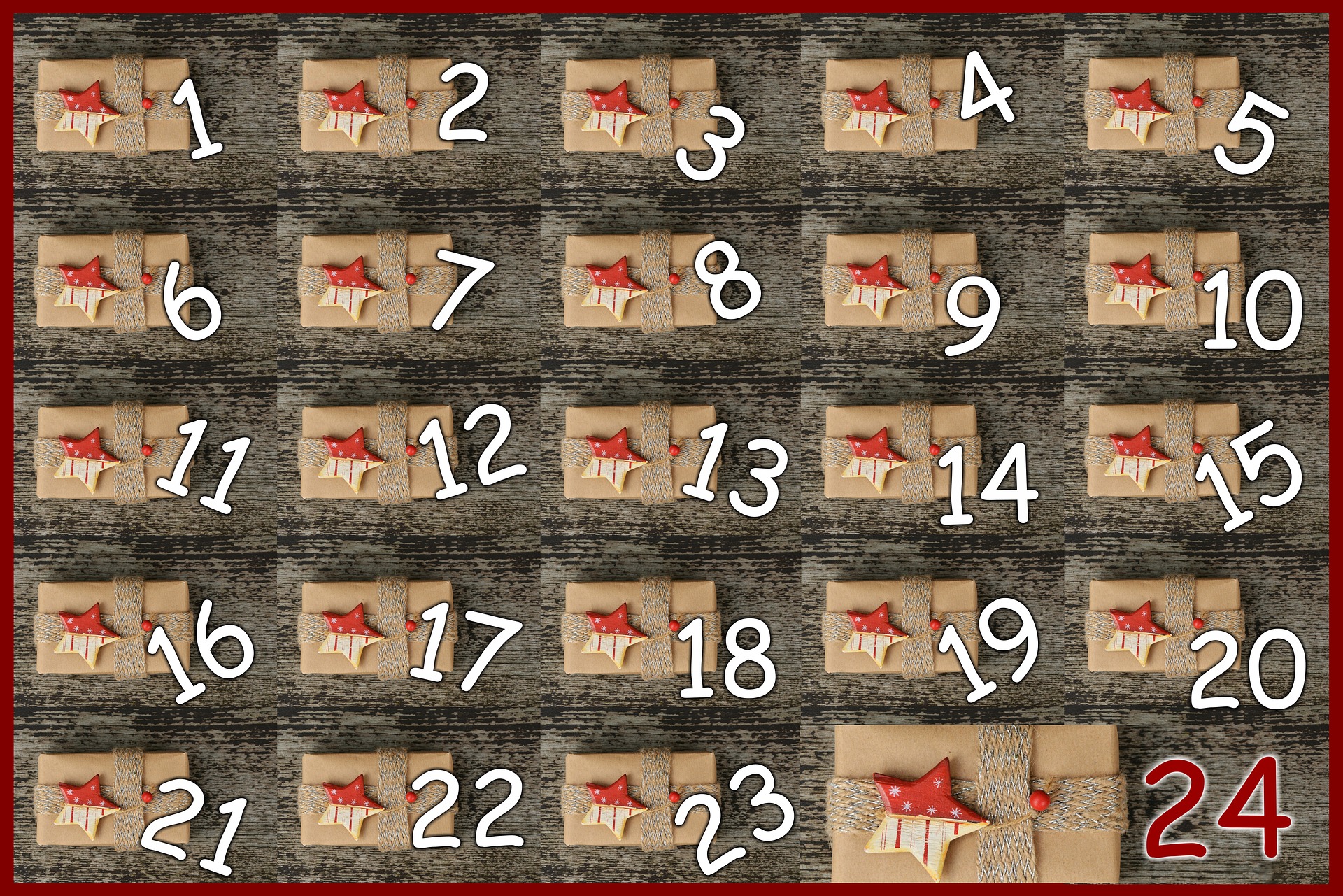
During the season of Advent in about 1880 or so, the mother of Gerhard Lang made her young son a cardboard calendar featuring twenty-four sweets, one per day, with which to mark off the time until Christmas. She surely wasn’t the only mother to do something like this for her child.

Image by congerdesign from Pixabay

Advent was introduced as a four-week (give or take) period of preparation leading up to Christmas by Pope Gregory I in the early seventh century. It took a while to catch on, but by the nineteenth century, German families in particular were finding clever ways to keep track of the days. Some used tear-away pages or tally marks on doorframes. Others lit candles or placed markers on ladder rungs.

But it was Gerhard Lang who is generally given credit for popularizing the advent calendar style most people use today, as a direct result of the creativity of his mother and his resulting magical childhood. When Gerhard grew up and became a printer, he remembered the calendar his mother had made for him and began mass producing a twenty-five-day calendar with doors to be opened each day leading up to Christmas in the month of December. Behind each door was a picture or Bible verse.

I guess that’s one way to make your holiday season a little more magical, but I think I’d rather have the chocolate.

Then in 1958, Cadbury began producing Advent calendars with twenty-four chocolate treats to be enjoyed one at a time from December first to somewhere around December fourth, which is about as long as any chocolate Advent calendar has ever lasted for me.

But like Gerhard Lang, I had a pretty magical childhood. Not only did my dad usually purchase an inexpensive chocolate Advent calendar for me and for each of my siblings from the local high school German club’s annual fundraiser, but my mom also made a calendar for the family that we took turns opening.

Behind each door of the homemade version, my mom would write tasks we needed to do to get ready for Christmas. This included things like decorating the Christmas tree, making Christmas cards, or baking Christmas cookies. Sometimes our tasks were service projects for others or chores that needed to be done before Santa could come. Other times we found them more fun, like driving to look at Christmas lights or visiting with the big jolly elf himself. Seriously, my childhood was magical.

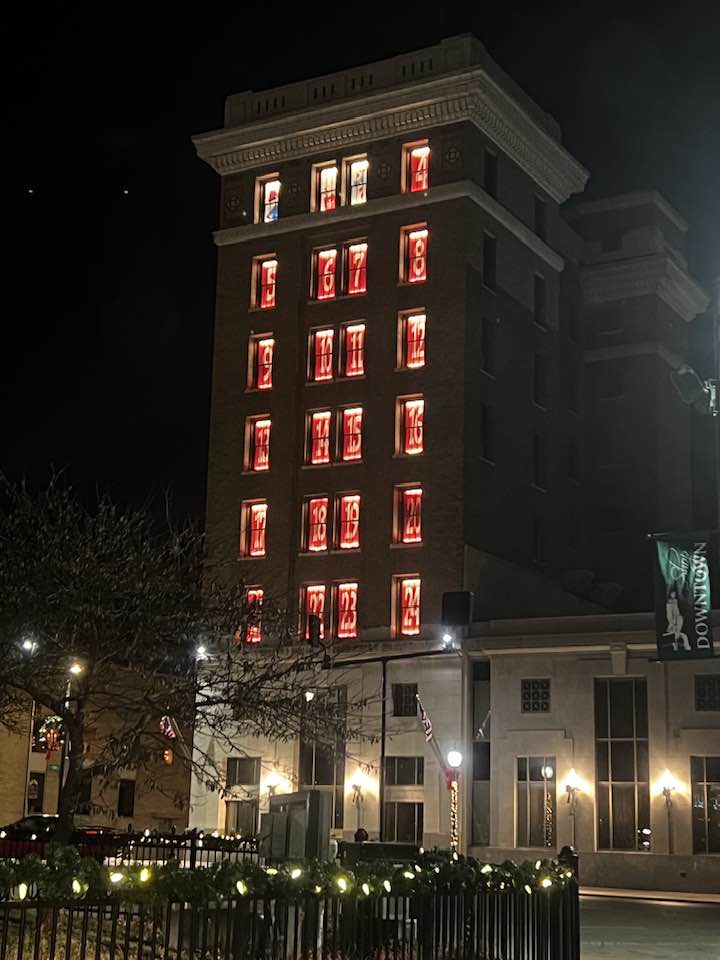
As far as anyone has found, this is the world’s tallest Advent calendar. (Thank you to my sister for the picture. I haven’t gotten there to see it for myself yet.)

And this year, in my hometown, the season has gotten even a little bit more magical. A few months ago, one of my favorite former teachers (who gets credit for my appreciation of The Great Gatsby) was in the town square and happened to notice something. He looked up at a tall brick Farmer’s Bank building that has stood guard over the old downtown for more than a century and counted the windows. On one side, there are exactly twenty-four of them.

An idea was born. The teacher solicited some help from around town (including the artist who designs my book covers) and approached the bank to ask if they might make what they believed would be the world’s tallest Advent calendar. The answer was an enthusiastic yes.

And that’s how Christmas in my corner of the world became a little more magical.

Mothman by Day, Mole Man by Night

Sometime around September 25, 1924 the streets of Washington D.C.’s Dupont Circle district opened up and swallowed a truck. I imagine that was quite a shock for the truck driver who suddenly found himself in the literal dark underbelly of his nation’s capital. It was also a surprise to nearly everyone in the city, especially when it was discovered that the reason for the sinkhole was an elaborate series of tunnels dug beneath the area.

Harrison Gray Dyar. Mothman by day, Mole Man by night. Unidentified photographer, Public domain, via Wikimedia Commons

Speculation quickly suggested nefarious plots involving spy rings and bootlegger operations, neither of which turned out to be true. To the best of anyone’s knowledge, the tunnels didn’t lead to a great Masonic treasure, either.

The explanation finally came from a former resident of the neighborhood, Harrison Dyar, a fifty-eight-year-old, independently wealthy and highly respected entomologist who spent most of his career at the Smithsonian Institution. There he was the custodian of the Lepidoptera. In case you aren’t up on your bugs, that’s the order of insects that includes butterflies and moths.

If moths do happen to be your thing, then Dyar’s name might be familiar to you. He’s the rock star entomologist behind Dyar’s Law, which is a ratio that can be used to identify larval stages based on insect head width, a fact I’m sure you already knew. He’s also the inspiration for the genus of moth once known as Dyaria. That name has since been changed to Coenodomus, which is harder to pronounce, but is also much easier to say with a straight face.

But that’s not all Dyar is known for because, when he was done looking at insects all day, he also had an unusual hobby. For years, the man spent an enormous amount of his free time digging tunnels that snaked from his home through the ground beneath Washington D.C. When asked why he did this, he replied that he did it for exercise.

Oops. Accidental discovery (by cave-in) of a tunnel built by Harrison G. Dyar. Dupont Circle, Washington D.C. Herbert A. French, Public domain, via Wikimedia Commons

His children and their friends played in the tunnels, some of which were reinforced with concrete, lined with ceramic tiles, and included ladders, archways, decorative animal sculptures, and strings of electric lights. The whole thing allegedly started one day when Dyar dug a garden for one of his wives (because there’s more than moths to this historical figure) and then he just kept digging until, a decade and a half later, a truck fell through the streets of Washington D.C. Oops.

Dyar’s tunnels are all filled in or bricked off today, but of course rumors abound that there are plenty of underground tunnels and bunkers throughout the city. Some claims are substantiated. A few such spaces are even open to the public.

Others remain little more than whispers, though I doubt anyone would be surprised to find that Washington D.C. has its fair share of dark, cavernous secrets and an unstable underbelly created by the custodians of all manner of Dyaria.

A Bridge to Nowhere

Beginning on March first of 1938, the Los Angeles region experienced one of its largest floods in history, caused by the convergence of two Pacific storms that generated a year’s worth of rain in the matter of a few days. The flooding killed more than a hundred people, caused $78 million in damage (in 1938 dollars), and completely washed out an ongoing road project that would have connected the San Gabriel Valley to Wrightwood, about seventy or so miles northeast of LA.

There’s no doubt the East Fork Road would have been a pretty drive, cutting through some of the most gorgeous scenery the gorgeous state of California has to offer and crossing over the East Fork of the San Gabriel River on a picturesque truss arch bridge that is 180 feet long and stands 120-feet over the riverbed below.

After the flood the road project was abandoned and today still lies in ruins, with only the occasional bit of asphalt visible. But the bridge remains as something of an oddity in the California wilderness. Locals call it the “Bridge to Nowhere” and it can be reached by a somewhat treacherous 10-mile roundtrip hike.

Though I probably would, I’ve never visited, so all I can tell you about the hike is what I’ve read online. Apparently, it involves a good bit of river fording, an activity which has been responsible for quite a few deaths of adventurous people over the years. There’s a lot of bouldering required, too, and some steep climbs. One description of the trail I read says that at one point you get to choose between two additional water crossings (some of which are apparently waist-deep) or a hefty climb followed by a rope-assisted descent down a steep rock wall. And if that’s not enough adventure for you, there’s also a company that will let you bungee jump off the bridge once you get there.

Despite the difficult nature of the trail, almost every description I read cautioned that the trailhead would probably be busy for this very popular hike. The bridge serves no real purpose, but apparently, people love a bridge to nowhere.

And I think I get it, because I have a recently acquired a bridge to nowhere of my very own in my back yard. Mine didn’t come from an abandoned construction project of course. It was a leftover decoration from a picture backdrop for a prom in a small-town high school in 1969.

If you’ve followed this blog for a long time, or if you’ve read my book Launching Sheep & Other Stories, then you may recall that my dad is a retired high school math teacher. In that role, he happened to be the class sponsor for the class of 1970, who as juniors were responsible for planning the senior prom of 1969. The students decided they wanted a foot bridge and so they got some help from the art teacher to design one. Then when prom was over, no one knew what to do with it. My dad, who had a pretty big backyard and a couple of little kids at the time, said it could be stored there.

It never really served much of a purpose in the yard, but my brother and sister loved clomping over it, jumping off of it, and playing Billy Goats Gruff. It became a fixture of their childhood and eventually of mine and my other brother’s as well. Over the years, it was borrowed again and again for ceremonies, dances, and community and school plays. Between each use, it was repainted barn red and returned to our backyard where it was kind of an oddity that also became a fixture of childhood for a series of grandchildren.

Family Bridge to Nowhere. Ozzie is a fan.

It’s sustained damage over time and been rebuilt a lot. There’s not likely a single original board in it, but it’s always been the same design and it’s always (unless loaned out) been in my parents’ backyard. That is until now.

Not too long ago, a storm brought a large tree down on the bridge, leaving it in pretty bad shape. My dad, whose grandchildren are now beyond the Billy Goats Gruff stage of life, decided maybe it was time to just let it go, but before he did, he asked us if we wanted it.

It turns out, I’m pretty fond of bridges to nowhere. We loaded it up and delivered it to a new home in our backyard where we rebuilt it and gave it a fresh coat of barn red paint. I’m sure our neighbors are scratching their heads at our new backyard oddity, but if they want to come check it out, it’s a pretty easy hike to get to it. There are no rivers to ford or rope-assisted descents over rock faces. If it makes them happy, they can even jump off of it, no bungee cord required.

And if one of the local high schools needs a bridge for a dance or a play, they’ll know where to find it. It’s in my backyard, going nowhere.

So, About King George . . .

That’s a pretty great porch. Ewing Galloway, Public domain, via Wikimedia Commons

1774 was a pretty big year for George Washington. He co-authored a call for the recognition of the fundamental rights of colonial British citizens in the midst of fallout from the Boston tea party. He did some important Continental Congressing. And he built a pretty fantastic porch onto his ever-expanding house.

Washington designed the two-story piazza at Mount Vernon to look out over the Potomac and catch a breeze off the river on a hot Virginia summer day. It’s where he often welcomed guests and served lemonade to friends seated in Windsor chairs, while grumbling about King George III.

The piazza was not an entirely unique structure. The iconic columns were based on the designs of Englishman Batty Langley, and the idea of an expansive outdoor space connected to a home has roots in Ancient Greece. But prior to Washington’s porch addition, such an expansive space was uncommon in America. It inspired some copycats.

The popularity of the porch has waxed and waned a bit throughout the history of the United States, reaching its height between 1880 and through the 1920s, when people sat in the evening to catch a cool breeze, wave hello to a neighbor strolling by, or even invite a friend to sit for a spell and enjoy a glass of lemonade while the kids played together in the front yard.

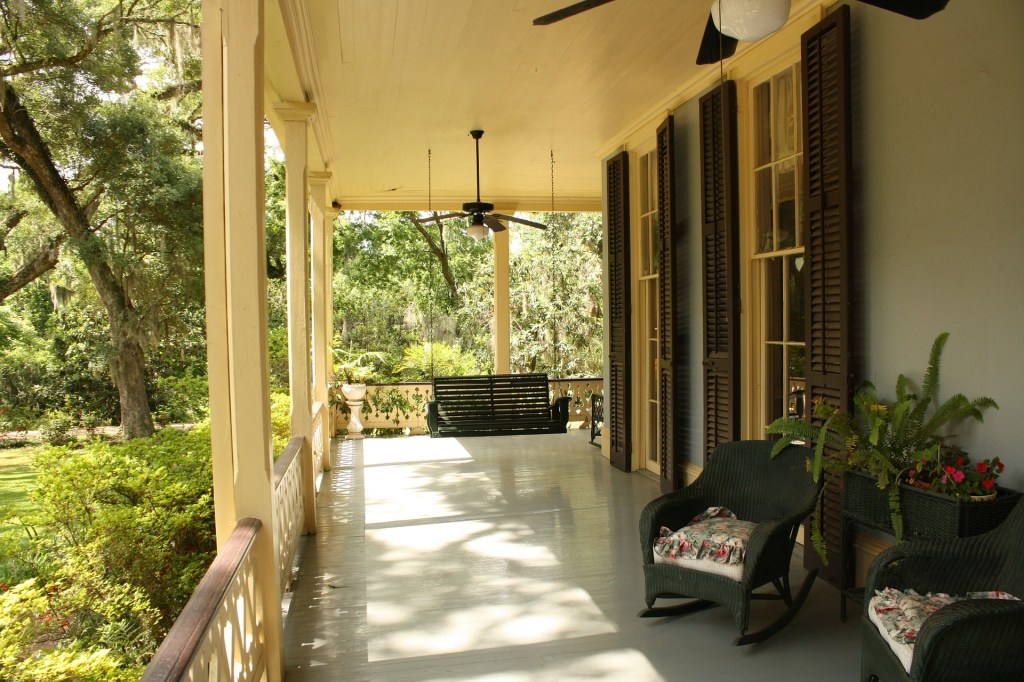
Another great porch!
Image by Gretta Blankenship from Pixabay

Then as the family began to gather in the evenings around the radio and later the television, porches began to sit empty a little more often. Pretty soon, house designs became less likely to feature a front porch, or at least certainly not a wide one with columns and a porch swing, or even a collection of simple Windsor chairs. Still, although we may have gotten a little distracted, I don’t think the appeal of the front porch has ever really gone away.

I have an embarrassing confession to make. I love watching real estate shows on HGTV. I’m sure you know the ones. I heard them described once as those shows where people want to buy a house and then they do. There are a lot of versions—House Hunters, Tiny House Hunters, Hunters Off the Grid, My First Place, Lakefront Bargain Hunt, House Hunters on Vacation, etc.

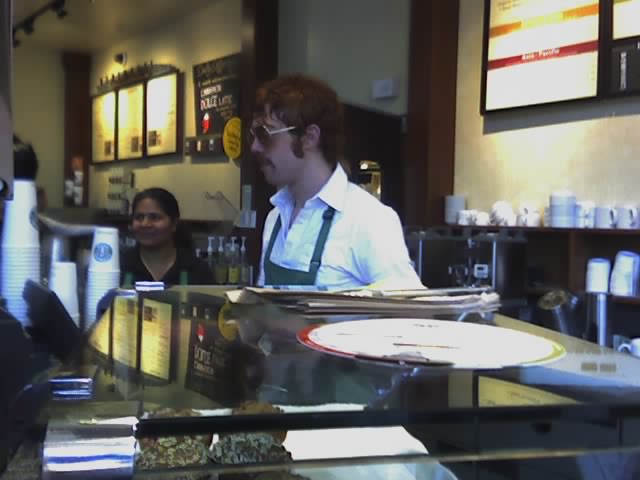
I have to assume the show just fails to mention that at least one of the buyers is also the sole heir to the fortune of his elderly Uncle Moneybags. I hope. photo credit: Gino Barista via photopin (license)photo credit: Gino Barista via photopin (license)

I love them all, from the introduction in which we’re told that she’s a preschool teacher and he’s a part-time barista at Starbucks and that they have a budget of $4.7 million for their second home in Southern California, to the moment this couple with highly questionable financial judgement makes the wrong choice.

I love seeing the houses and thinking about the priorities of the buyers. I appreciate seeing how home considerations vary in different parts of the world. And though I’m happy with my home, I like dreaming about what I might be looking for in a house several years from now when my family enters a different phase of life.

I’ve noticed one thing that remains fairly consistent in the episodes. The majority of these home buyers, regardless of budget or location, are looking for great views, outdoor space, and a gathering spot. In all the episodes I’ve watched (a truly embarrassing number), not once have I seen a potential home buyer make a negative comment about a porch. In fact, they are overwhelmingly positive about such spaces and often spin dreams of hosting friends and neighbors on mild summer evenings with glasses of lemonade while the kids play together in the front yard.

I could go for some of that.
Image by graywendya from Pixabay

My current house doesn’t have much of a front porch, but many of the homes in my neighborhood do, and over the last many months of pandemic and social distancing, I’ve seen more neighbors sitting on them, waving hello to passersby.

The front porch seems to be experiencing a resurgence, I think probably because we humans miss each other. Social distance, that has at times felt more like isolation, has made us realize that even if we don’t always agree or sometimes get annoyed by one another, we really benefit from face-to-face interaction.

And outdoor spaces remain some of the safest places to spend time with others. A great big, expansive porch with simple, individual Windsor chairs will fit the bill. So, grab a glass of lemonade and sit on the porch with me. We probably still can’t share a swing, but we’ll catch a breeze and chat. We might even complain about King George and that ridiculously catchy song from Hamilton that’s been stuck in our heads for months.

Everybody . . .

More Brains than Any Two Engineers

January 18, 1865 Washington Roebling, a colonel in the Union army and a trained engineer, married his sweetheart Emily Warren. Then when the war ended, the two went on a honeymoon tour of Europe with a slightly nerdy twist.

Emily Roebling
Emily did give birth to the couple’s only son in 1867 so I suppose engineering wasn’t the ONLY thing they did on their honeymoon. Carolus-Duran / Public domain

Washington’s father, John Augustus Roebling, had built a pretty big name for himself in the field of suspension bridge construction and his plan to span the East River between Manhattan and Brooklyn had been given the green light by the State of New York. Washington and his new bride decided that while they were honeymooning, they might as well do some research into the newfangled caissons that were all the rage among European engineers.

In case, like me, you didn’t spend your honeymoon studying engineering, a caisson is a watertight container that allows work to be completed underwater by pumping in compressed air and keeping water out. It’s awfully useful for building the foundation of a bridge over a river.

While the newlyweds picked up some pointers, the elder Roebling worked on finishing up his measurements before construction could begin. Unfortunately, he sustained an injury in the process and required amputation of a foot. And that led to the tetanus infection that quickly killed him.

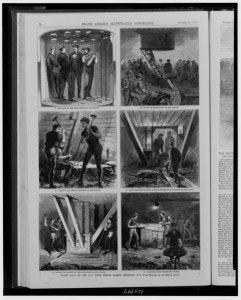
It also brought an end to a fairytale engineering tour of Europe. Washington rushed home to take his father’s place as head engineer on the Brooklyn Bridge project. He was great at it, too, leading his men by working alongside them, even taking his turn in the caissons, where he soon realized that working in compressed air can prove dangerous.

caisson
Inside views of the East River Bridge caisson, Brooklyn, N.Y. 1870. Miscellaneous Items in High Demand, PPOC, Library of Congress / Public domain

He suffered with what divers, and presumably also those in the bridge construction business, now know as the bends, or decompression sickness, in which your body doesn’t react particularly well to the large amount of nitrogen dissolved in your blood after breathing compressed air for a while.

Decompression sickness can be prevented, now that we know what it is and what causes it, but Washington didn’t have the benefit of that information and wound up partially paralyzed, most likely the victim of multiple strokes, and unable to fulfil his role as lead engineer on the project.

That left only one Roebling, armed with a pretty good education for a woman of her day (which still wasn’t a great deal of education) and what relevant bridge-building knowledge she had managed to pick up on her honeymoon, to take up the charge.

Emily accepted the challenge.

She became the chief engineer, allegedly relaying daily instructions from her husband to the job site, updating and schmoozing with politicians, defending her husband’s position from competing engineers angling to take the project over, and soaking in all the knowledge she could about stress analysis and cable construction.

rooster
Maybe the rooster was a lucky bridge-crossing companion because he already had so much experience crossing the road? via Pixabay

When the Brooklyn Bridge finally opened on May 24, 1883 the first carriage to cross it carried Emily Warren Roebling with a lucky rooster held on her lap. Though she never publicly claimed to be anything more than a mouthpiece for her husband, in a private letter to her son she wrote: “I have more brains, common sense, and know-how generally than any two engineers, civil or uncivil, that I have ever met.”

And she was probably right. In the years following the Brooklyn Bridge project, Emily Roebling earned a law degree and became active in numerous organizations, always seeking ways to promote women’s education and women’s equality.

tacoma bridge
A suspension bridge built by engineers not supervised by Emily Warren Roebling. Tacoma Narrows Bridge failure (1940).

But I came across her while researching the opening location of my novel Smoke Rose to Heaven, which occurs briefly in the shadow of a burgeoning bridge that would become, for a time, the longest structure of its kind in the world. I first met Emily Roebling as the Chief Not-Technically-An-Engineer who successfully completed the project begun by her father-in-law and who now has a street block in Brooklyn named in her honor.

She was my kind of woman—the kind who does what she needs to do to get done what needs to get done and doesn’t bother asking anyone whether or not she can. She’s the kind of woman I want to be and the kind I want to celebrate this upcoming Sunday March 8 when we recognize International Women’s Day. Fortunately, I know a lot of women like her.