A Writer’s Tour on Wyatt Earp’s Birthday

Mr. Earp will just have to wait for his feature post. Maybe next birthday.
Mr. Earp will just have to wait for his feature post. Maybe next birthday. Licensed under Public Domain via Wikimedia Commons – http://commons.wikimedia.org/wiki/File:Wyatt_Earp.jpg#/media/File:Wyatt_Earp.jpg

On March 19th, 1848 in the little town of Monmouth, Illinois, the gunslinger who would one day become the central figure in the famous shootout at the OK Corral, Wyatt Earp came screaming into the world.

But I’m not going to write about Earp this week. In fact, I’m not going to write about any historical figure at all, because a while back, a fellow blogger was kind enough to extend an invitation for me to participate in a writer’s tour.

So, first, I want to thank Camille Gatza of Wine and History Visited for including me on the tour. I have been enjoying Camille’s blog almost since I started out blogging myself.  Her posts often detail her travels through the US including wonderful background on historic sites and national and state parks. Along the way she always seems to discover unique restaurants and wineries and over the years, she has taught me pretty much everything I pretend to know about wine.

So here are the questions put forward on the tour:

What are you currently working on?

I’m always researching for both my blog and my fiction projects. The blog jumps through time and space from week to week, through the stories that I find interesting at any given time, with really very little rhyme or reason. I find that kind of research, which is admittedly not always very thorough, to be kind of a refreshing break from the research I do for my fiction projects. That is thorough and time consuming and while interesting, doesn’t always yield the kind of lighter stories I like to share in this space.
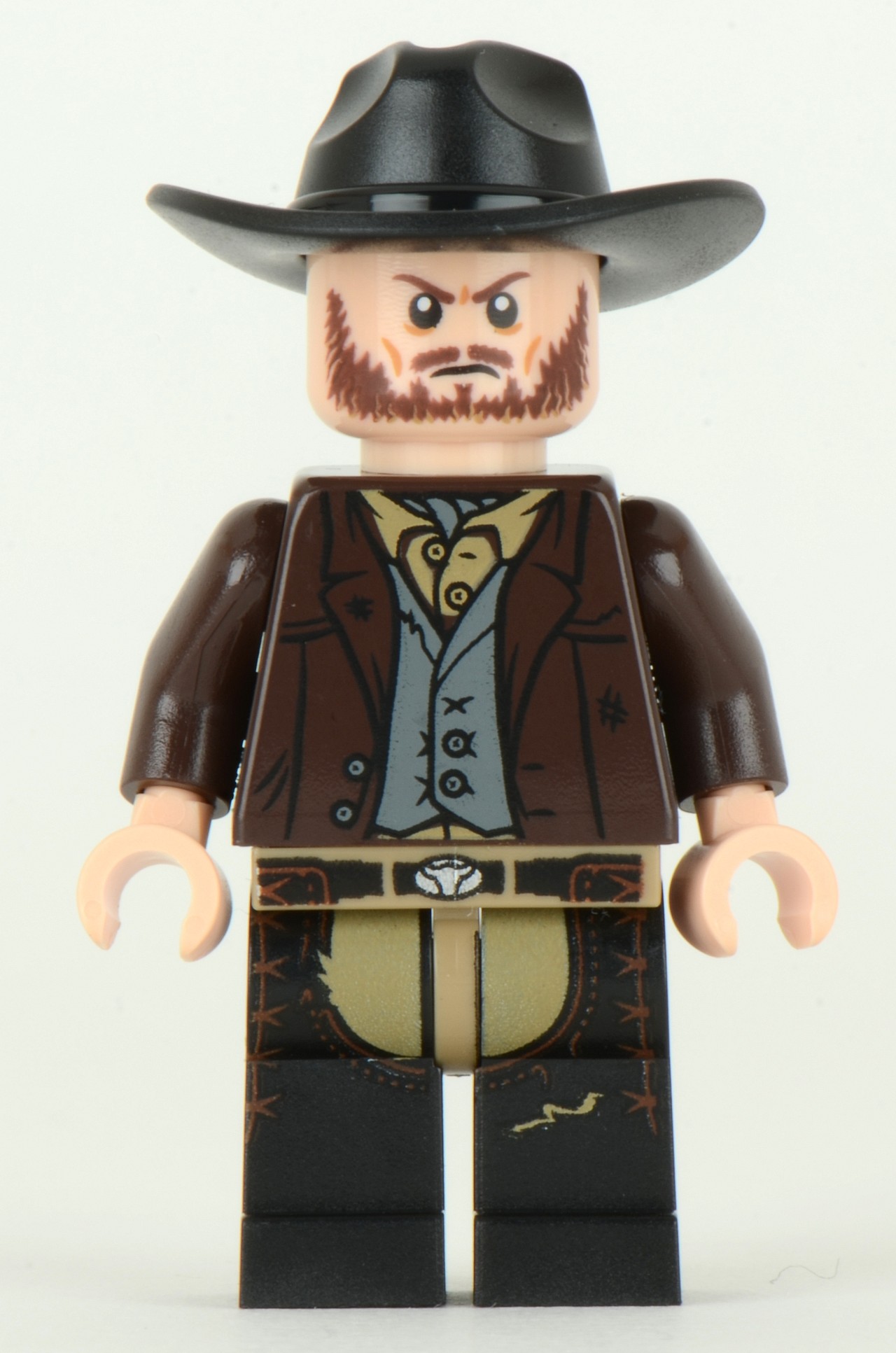
Okay, okay. Next week. I promise.   photo credit: 79109 Colby City Showdown via photopin (license)
Okay, okay. Next week. I promise. photo credit: 79109 Colby City Showdown via photopin (license)

Currently as a blogger, I am looking into the story behind LEGOS because this weekend my family and I will be attending the traveling LEGO Festival as it visits St. Louis. In my other “writerly” role, I am working through a first full draft of a novel that will hopefully serve as a companion to my first that was recently accepted for publication (!). As part of that process I am reading everything I can get my hands on about the Pennsylvania canal system in 1833, which, while interesting, and will supply wonderful historical details for the novel, is not exactly good material for this particular blog.

How does your work differ from others in your genre?

A lot of history blogs I read (and I do read a lot of them) are very information dense. Often they cite references and speak with a good deal of authority within a fairly narrow scope. I love that. And those kinds of blogs are exactly what history blogs should be.

But this isn’t that kind of blog. In fact I hesitate sometimes to even call it a history blog, because in some ways that’s not what it is. I do share stories from history, and I do spend a good amount of time (or at least some) researching my chosen topic in an attempt to provide readers with tidbits worthy of sharing at cocktail parties. But there’s also a lot of me on the pages of this blog. There’s a lot about my life and the things I find funny, or interesting, or just worthwhile. I try not to claim a great deal of authority in this space, because, frankly, I have none to claim.

But I do hope the posts are fun to read. I have a great time writing them.

Why do you write what you do?

When I was younger, history always seemed either dull or tragic to me. I’ve never been very good at memorizing dates and it seemed all I ever learned about in history class was how one group of people exploited another group of people to become the dominant people. And, really, human history can be boiled down to that if you let it be. But as I grew older and studied more literature, I began to see history through a different lens. When fleshed out with the little details that make up the experiences of individuals, suddenly each moment in history becomes many moments with many perspectives and far-reaching implications. In other words, it becomes a story. And a story, our story, is worth telling.

That realization led me to writing historical fiction, a genre that I fell in love with very quickly as a reader as well as a writer. And this blog is an extension of that. As this wonderful article in The Onion so eloquently points out, there are more stories within the history of human experience than I can possibly tell, or that any of us can possibly tell or ever know. But with this blog, each week, I get to take a stab at illuminating a little bit more.

How does your writing process work?

photo credit: Tapping a Pencil via photopin (license)
Some weeks are just like that. photo credit: Tapping a Pencil via photopin (license)

For the most part, I write what’s on my mind. If I have experienced or will be experiencing a particular event, I may use that as a jump-off for some historical research, and often the structure of the post itself will reveal that. Some weeks, something I come across in the news sends me down a trail I think might be worth sharing. And, of course, like anyone else, I have weeks when I struggle to find something to say.

Typically I start out with a very general idea of what I want to write and just start typing because I never know exactly what I’m going to want to write until I’ve already written it. After that I polish it up, trim the word count, insert what I hope are a few clever lines, throw in a few pictures, and post. Then I just sit back and wait for millions of thoughtful comments to come rolling in.

Well, okay, so that last part doesn’t really happen, but I realize that this blog is a little hard to categorize and it is sure to appeal to a fairly specific kind of reader. I am delighted that so many of you quirky, creative, thoughtful people have found it. Thank you!

And now on with the tour!

For the next stops on the tour, I’ve chosen two writers whose blogs I appreciate very much. They also both happen to be writers of historical fiction, but they each approach blogging differently than I do. I doubt they’ll be writing about Wyatt Earp this week either (although you never know). Still, I hope you’ll visit their sites, and maybe read their books as well, because it will be well worth the effort.

sam

Samuel Hall grew up in the American Heartland.
He lives with his wife near Salem, Oregon. Their three adult children continue to teach him about family relationships and authenticity, core subjects of his novel.

Visit his website at www.samhallwriter.com.

Sign up for the newsletter at www.ashberrylane.com to hear the latest about Sam’s book, Daughter of the Cimarron.

blogtourphotoAdrienne Morris lives in the country, milks goats, chases chickens and sometimes keeps the dogs off the table while writing books about the Weldon and Crenshaw families of Gilded Age Englewood, New Jersey. Her first novel, The House on Tenafly Road was selected as an Editors’ Choice Book and Notable Indie of the Year by The Historical Novel Society.


As You Wish: A Book Giveaway of True Love and High Adventure

This little history blog tends to skip around a lot through time. From week to week, I am as likely to share a story from the middle of the 20th century as I am to relate a tale of ancient man. And still, you the readers are kind enough to follow me down the rabbit hole. So this week, I am hoping you’ll allow me to push the already very wide historical boundaries I have informally set for myself. I’m going to hop into the way back and arrive many many years ago, at the height of 1980s America.

Specifically, I’m turning my attention to October 9, 1987. I had recently turned ten and the greatest movie I would ever see was released into theaters. But I didn’t see it. In fact, like most people, I didn’t see it for another year or two, when my older brother brought it home from the video store one day.

Even though The Princess Bride has since been included in the list of 100 Greatest Love Stories by the American Film Institute, the list of 100 Funniest Movies by Bravo, and the list of top 100 screenplays ever produced by The Writers Guild of America, it initially fell kind of flat.

Even after 27 years, we're all suckers for a good story well told.
Even after 27 years, we’re all suckers for a good story well told.

Because as a “classic tale of true love and high adventure” the film is difficult to categorize, it also proved difficult to market. And so, until people began to watch it in their homes on so-and-so’s recommendation, the film that would eventually appeal to almost everyone, was seen by almost no one. Leading man Cary Elwes recently commented that for years it was “mostly dead.”

He’s making reference, of course, to that wonderful scene in which Miracle Max, determines that Westley is only mostly dead, which is important, because “with all dead, there’s usually only one thing you can do…go through his clothes and look for loose change.”

On the off chance that you’ve not seen the film (and if you haven’t, you really should), I’ll quickly set the scene. In the course of mounting a rescue, the hero Westley has been murdered by the prince who wishes to wed Westley’s true love. The body is recovered by two of his enemies-turned-friends who are seeking his help in exacting revenge against one of the prince’s evil agents for another past murder.

Elwes has referred to this project as a love letter to the fans of the movie. And it really does have a lot of heart.

The two men take Westley’s body to Miracle Max, played brilliantly by Billy Crystal, made up to look approximately 900 years old, and in one of the funniest movie scenes ever, Max, with the assistance of his wife Valerie (played equally brilliantly by Carol Kane), decides to make a miracle pill, coated in chocolate, to revive Westley. The hero unsurprisingly turns out to be a quick healer and has little trouble then defeating the prince and saving the girl.

I’ve written about this film once before, in a more historical context. A couple years ago much of the cast reunited at the New York Film Festival to celebrate the 25th anniversary of the release. It’s my all-time favorite movie, filled with quirky characters, witty dialogue, thrilling adventure, and just plain fun. So the 25th anniversary brought back to mind the experience of falling in love with it. Of course I couldn’t attend the celebration screening and Q & A, but I felt I had to write about it to express my love in a practical history sort of way.

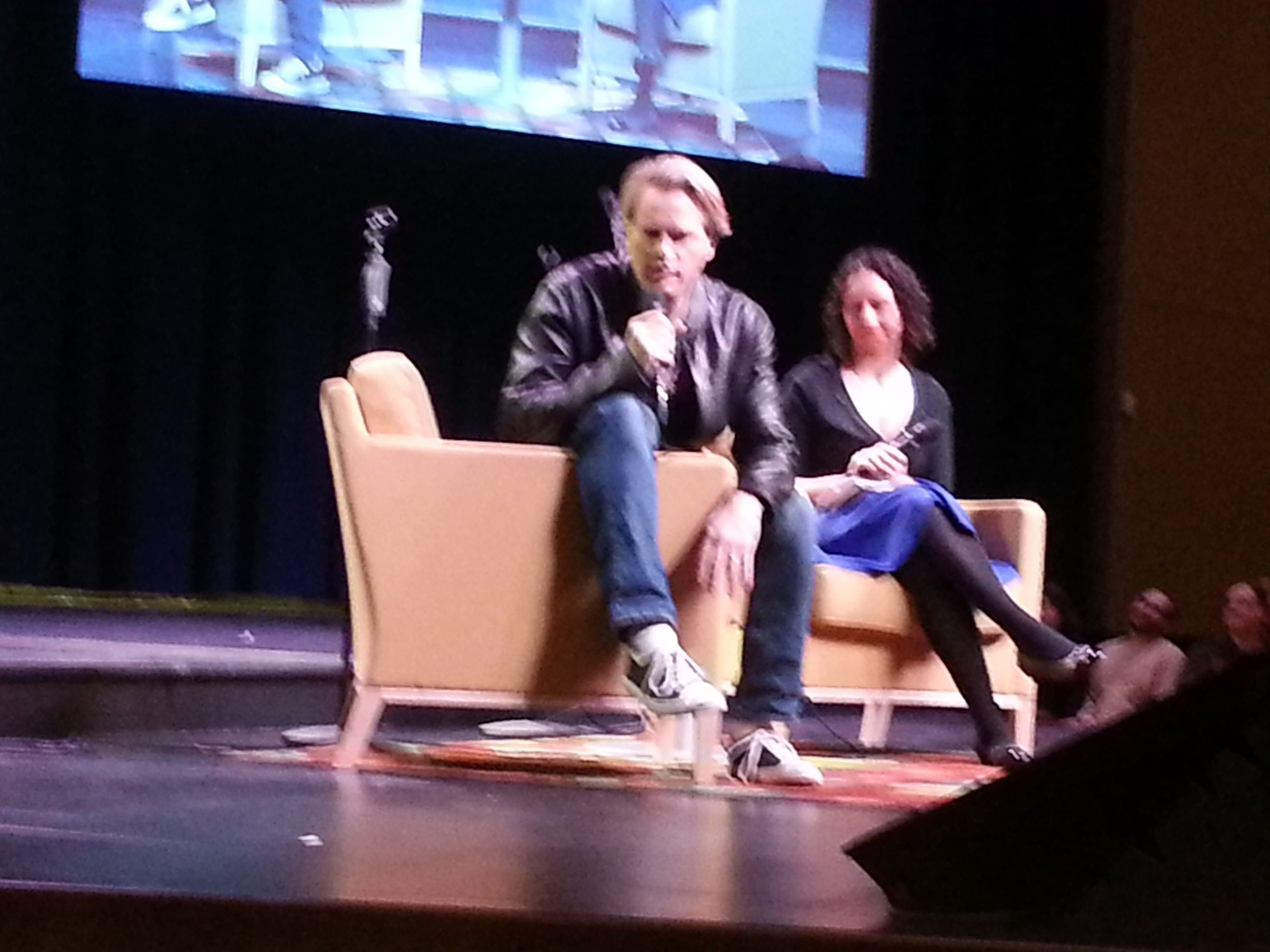
Elwes, a natural storyteller complete with spot-on impressions, gets comfortable with the large crowd of enthusiastic fans.

It turns out my reaction was similar to that of Cary Elwes (Westley). After the Film Festival and flood of memories, he decided to write a memoir about the making of the film that was both his first big Hollywood break and the one that will in some ways forever define his career. The result was As You Wish: Inconceivable Tales from the Making of The Princess Bride.

If you’re a fan of the movie (and there’s a pretty good chance you are), you’ll find the book delightful. It will have you watching the film again, searching for hints of the behind-the-scenes stories. You’ll learn that Westley’s hurried skipping along the ravine floor leading into the fire swamp is the least awkward way Elwes could run after breaking the snot out of his toe not long before the take.

You’ll discover what gave Elwes, Mandy Patinkin, and Andre the Giant such a terrible case of giggles on top of the castle wall. And you’ll find remembrances from many members of the talented cast and crew that brought to life the story and characters we have all come to love.

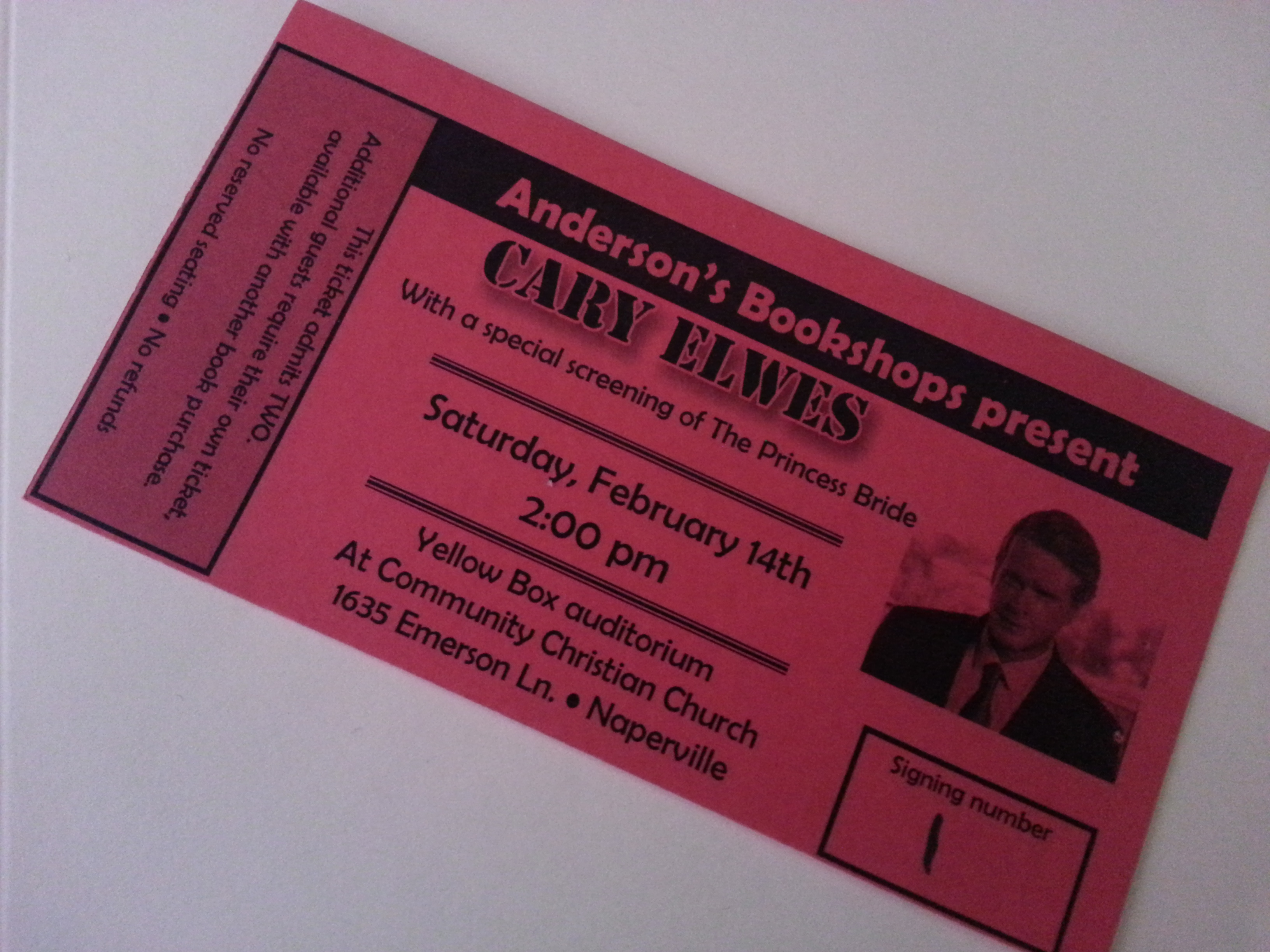
Why yes, that is ticket number 1. It's nice to know people who understand and accept your crazy. ast people who know people.
Why yes, that is ticket number 1. It’s nice to know people who understand and accept your crazy.

Now, two years ago it was inconceivable that I would go to New York to celebrate the film’s anniversary, but a month or so ago, my friend Michelle let me know that a friend of hers is an events coordinator for Anderson’s Bookshop, a large independent bookstore in Naperville, IL (southwest of Chicago), and that she had just booked Cary Elwes for a signing on Valentine’s Day. I told her I was in.

With traffic, Naperville is probably a little over a five-hour drive from where I live near St. Louis. I met Michelle on the way for a crazy-fun, if slightly ridiculous road trip and I met the man in black himself, who, I have to say, seems a decent fellow.

Of course the book has been out since October, long before the planned road trip and so I already owned a copy. But with such a large name coming in, the bookstore had to make this a ticketed event, and, as is customary, the ticket was the price of a reserved book. That means I now have an extra copy of As You Wish: Inconceivable Tales from the Making of The Princess Bride, signed by the author.

You can't tell this from the picture, but 12-year-old me just fainted.
You can’t tell this from the picture, but 12-year-old me just fainted.

So here’s what I’d like to do. I’d like to give it away to one of you. If you are a fan of the movie and think you would enjoy the book, simply like my author page on Facebook or follow me on Twitter (which you can do from the sidebar of this page) and share this post. If you’ve already connected with me on one of those platforms and would like a chance to win, just share and drop me a comment to let me know you want in. Make sure you enter by noon (12:00 pm, US Central Time) on Wednesday, February 25.

I’ll announce the randomly selected winner on my regular Thursday blog post, which I promise will contain much (or slightly) more practical history, from way back in the years before 1987.


Writing My Hyde Off: A NaNoWriMo Adventure

One fall night in 1885, Mrs. Fanny Stevenson was awakened by the terrified screams of her dreaming husband. Concerned, she quickly roused him, to which he responded, “Why did you wake me? I was dreaming a fine bogey tale.”

What Scottish-born writer Robert Louis Stevenson had been conjuring in his dream was the transformation of the upstanding Dr. Jekyll into the monstrous Mr. Hyde. When he put pen to paper to tell the story, his wife claimed it took him just six days to complete it.

Stevenson
Robert Louis Stevenson looking a little haggard. Like maybe he has TB. Or a cocaine problem. Or nightmares. Or maybe he just wrote a beloved classic novella in SIX DAYS.

Probably suffering from undiagnosed tuberculosis for most of his life, Stevenson was quite ill when The Strange Case of Dr. Jekyll and Mr. Hyde came tumbling out of him. Some have suggested the feverish pace with which he wrote the novella came from a cocaine binge, but his family insisted that it was simply the frustrated workings of bedridden genius.

Whatever spurred him, Stevenson seems to have mirrored his characters, stepping outside of himself for those six days to indulge the part of him that had a story to tell, maybe a brilliant allegory of addiction, and certainly a classic story of the capacity for both good and evil inside each of us.

I’m sure you’re at least somewhat familiar with the story, but even so, it’s a quick read and well worth it if you’ve never opened it up. Maybe knowing that the initial draft was written in only six Hyde-like days makes it all the more chilling. And maybe inspiring.

Because it’s November, which means that it’s that time of year when writers of all walks of life, some experienced and some not, step outside of themselves and write a novel.

I swear I'll get started on those 50,000 words as soon as I make this really important sign for my office door.
I swear I’ll get started on those 50,000 words as soon as I make this really important sign for my office door.

National Novel Writing Month (NaNoWriMo) began in 1999 with the decision of 21 friends in the San Francisco Bay Area to set themselves a ridiculous goal to each write a novel within a month. It sounds crazy at first, because, well, we’re talking about a novel here. It’s a long project full of research and imagination. Some of the greatest novels ever written took years or even decades to complete. And some of the worst novels did, too. Snoopy wrote for fifty years and never made it past his opening line.

But it turned out there was purpose in the madness of the plan, even if the original participants didn’t realize it at first. The group had such a good time with the challenge, they opened it up to a wider community the next year and 140 people participated. The year after that it was around 5,000. In November of last year, 310,000 adult writers and 89,000 young writers, from all over the world, participated in NaNoWriMo.

Not all of them completed the 50,000-word goal, but 400,000 people stepped outside of themselves to indulge that part of them that had a story to tell. What started as a silly little writing challenge has blossomed now into a huge network of encouragement, with resources for writers at every stage of the game before, during, and long after that initial, probably terrible, first 50,000-word draft.

stevewriting
The Strange Case of Dr. Jekyll and Mr. Hyde is around 26,000 words, initially written in just six days, which gives me 24 days to write my additional 24,000 words. No problem.

I heard about NaNoWriMo for the first time a few years ago through my local library that was sponsoring a series of “write-in” events in conjunction with it. I’ve since had lots of friends participate in the event. So, this year, I’m finally doing it. I’ve researched, planned, and outlined what I hope will be become 50,000 revision-worthy words. In December, I’ll have to drink my potion and let Dr. Jekyll take back over to do the real work of revision, revision, and still more revision. But for now, I am stepping outside of myself and indulging my Mr. Hyde (minus the cocaine) because he’s got a story to tell.

Good luck to all my fellow NaNoWriMos out there! Obviously I’m glad you stopped by, but seriously, stop reading blog posts and get to work. You have a novel to write!


Young Love, Teenage Angst, and One Very Angry Goat

On October 6, 1945, a Chicago tavern owner named William Sianis went to Wrigley Field to watch his beloved Cubs play in game 4 of the World Series against the Detroit Tigers. Sianis opened his tavern in 1934, naming it The Billy Goat Tavern after a goat that had presumably fallen off the back of a passing truck and wandered into the place. “Murphy” the goat became the tavern’s mascot and “Billy Goat” Sianis’s good luck charm.

This is also where fans of Saturday Night Live can order a "Cheezeborger, Cheezeborger, Cheezeborger, NO PEPSI, and a Coke." photo credit: jpellgen via photopin cc
This is also where fans of Saturday Night Live can order a “Cheezeborger, Cheezeborger, Cheezeborger, NO PEPSI, and a Coke.” photo credit: jpellgen via photopin cc

So like all good baseball fans (who are known for their quirky superstitions), Sianis wanted to share some of his good luck with the team. He bought two tickets, one for himself, and one for Murphy the Goat. Trouble was, Wrigley Field had a strict “no goats” policy. Sianis went so far as to appeal to Cubs owner P.K. Wrigley who also denied Murphy’s entrance, saying simply, “The goat stinks.”

Murphy was offended. Right then and there Sianis raised his hands and declared: “The Cubs ain’t gonna win no more.” The Cubs lost Game 4 to Detroit and went on to lose the series, after which Sianis sent a telegram to P.K. Wrigley that read, “Who stinks now?”

As a St. Louisan and devoted Cardinals fan, I find this kind of hilarious, but I don’t know that I buy into the whole idea of curses. Still, there’s no denying that the Chicago Cubs started out as a solid ball club that more often than not was a force to be reckoned with. And that since that 1945 loss, have had the most rotten luck in baseball, having gone to the postseason only a few times since and with their mathematical elimination from contention this past weekend, have now experienced a 107 year stretch without a world series title.

Isn't this a great cover?
Isn’t this a great cover?

But even though this season panned out, well, kind of like most of them, I recently found some hope for the Cubbies in the form of a charming little book called Caught Between Two Curses by Margo L. Dill.

In this YA romance with a touch of magic, Chicago girl Julie is a typical teenager facing the beginning of senior year, torn between a sex-obsessed jerk of a boyfriend and a hot best guy friend who it turns out is a lot less of a jerk. But Julie’s situation is even more complicated than that. She’s been raised by her aunt and uncle since the tragic death of her parents. And now her uncle has become mysteriously ill as well, leading her aunt to reveal the secret of the curse upon the men involved in Julie’s family, a curse that is intricately intertwined with the famous curse of the billy goat inflicted on the Cubs by William Sianis and Murphy.

Much like the people (who I think can honestly lay claim to the title “most dedicated fans in baseball”) who have made several attempts to break the curse, from bringing Murphy’s descendants into Wrigley Field, to organizing an international “Reverse the Curse” aid program that provides goats to impoverished families in underdeveloped nations, and even to hanging a severed goat’s head from a statue in front of the ballpark, Julie sets out on a mission to break the curse.

Rumor has it the curse will only lift when Cubs fans come to truly appreciate goats and welcome them in their midst. photo credit: Tc Morgan via photopin cc

The stakes are high, with her uncle’s life hanging in the balance and the future health of either her jerky boyfriend or the not-so-jerky love of her life endangered, but Julie is determined. She sets aside her own teenage angst (which rings embarrassingly true to life) and her indifference to baseball to cheer the Cubs to victory, the likes of which they haven’t seen in 107 years.

So, fear not, Cubs fans. 2014 wasn’t your year, but if Dill  can convince us that a teenage girl has within her the power to reverse the curse, then I believe there’s still hope. Even if you’re not a baseball fan, you should read the book. I think you’ll enjoy it. If you happen to be a Cubs fan then maybe you should read it to a goat. In Wrigley Field. Because there’s always next year.

Literacy and the Racist Kangaroo

Though I wasn’t born until more than twenty years later, one of the most important moments of my childhood occurred on this day in history. You see, on the fifteenth of May, in the Jungle of Nool, in the heat of the day, in the cool of the pool, he was splashing…enjoying the jungle’s great joys…when Horton the elephant heard a small noise.

hortonbook
photo credit: CCAC North Library via photopin cc


Dr. Seuss’s Horton Hears a Who! was published in 1954 and it was by far my favorite in our family’s collection of children’s books. The reason is simple. It was my dad’s favorite, too. In fact I can’t remember a single time when I climbed up on his lap to read a book that he didn’t begin with those oft-recited lines, regardless of what book I had brought him. The joke never got old.

But it wasn’t just that my dad loved the book so much. I think, in retrospect, the famous line, “A person’s a person, no matter how small,”resonated with me, the youngest child in a family of high achievers. And, the part of me that has always been a little bit writerly appreciated that Dr. Seuss so gracefully pulled off an obvious plot hole when Horton searches the clover field for the Whos that then beg him to take care of them when, really, if they’d just been allowed to rebuild in the clover field they’d have been perfectly safe.

That doesn't look like such a bad place to land.   photo credit: ajari via photopin cc
That doesn’t look like such a bad place to land. photo credit: ajari via photopin cc

Looking back, I get now why he couldn’t do that. If he had, the allegory would have broken down. Maybe. Of Theodore Seuss Geisel’s many books most have been scrutinized for subversive meanings. Some of them Dr. Seuss explained during his lifetime. Horton Hears a Who!, he didn’t. Still, neither he nor his widow ever refuted the widely held assumption that the book was an allegory for the post WWII relationship between the United States and Japan.

Politically, Dr. Seuss was an active Democrat, a believer in large governments taking care of small, and with one glaring exception, was outspoken against racism. Turns out, he wasn’t much of a good friend to the Japanese. He strongly supported internment camps for Japanese Americans, refusing to differentiate them from citizens of Japan.

He made his opinion very clear with a series of terribly stereotypical political cartoons that sought to dehumanize the Japanese and foster fear and animosity toward them. Had he tweeted them he might have been banned for life from the NBA or at least fined by the NFL and forced to apologize.

Um...Dr. Seuss?
Um…Dr. Seuss?

But by 1954, Dr. Seuss’s perspective changed. Hitler’s Axis had been defeated, Japan’s population had suffered terribly at the hands of the United States and its atomic bombs, and for the most part, the US postwar occupation of Japan had drawn to a close with a flourishing democracy and the promise of a bright future (with robots).

After the war, Dr. Seuss had the opportunity to visit the country. While there he was impressed with the culture and people he had previously belittled in his cartoons. In Kyoto he befriended a professor named Mitsugi Nakamura to whom he dedicated Horton Hears a Who!

So just as the people of Japan faced the threat of annihilation by atomic weapons, the citizens of Whoville face a deadly bath in boiling beezlenut oil. In a parallel to the US effort to protect and guide a postwar Japan, it is through a combination of a strong protector and the tremendous effort of a proud people that the Whos are saved.

photo credit: daveparker via photopin cc

In the end, a racist kangaroo that has worked tirelessly to spread anti-Who propaganda, villainized anyone who would stand up for the little guys, and has even attempted to ignore the Whos’ very existence is redeemed in a dramatic turnaround. And the little kangaroo in her pouch learns a big lesson, too.

I doubt very much that Dr. Seuss intended for many of his readers to get all of that from Horton’s adventure with the Whos of Whoville. He claimed he never wrote from a moral because “kids can see a moral coming a mile off,” but admitted “there’s an inherent moral in any story.” He was also a big believer in giving people in general and children in particular the tools to become great thinkers.

So I don’t think he would be bothered by the fact that when as a child I read, “A person’s a person no matter how small,” I assumed he was talking about me. I think he’d be glad to know that this book, more than any other, launched me toward literacy. And I hope it would bring a smile to his face to know that even now, the fifteenth of May makes me think of cuddling up with my dad and a good book and of Horton and the Whos and of the redemption of a racist kangaroo.

photo credit: Tatters ❀ via photopin cc


Monstrous Highs and Record Lows

You may have heard that the Midwestern United States has experienced a bit of a cold snap this week. I realize that there are parts of the world where people live (if you can call it living) with subzero temperatures and unimaginable wind chills on a regular basis. But Missouri is not one of them.

390358153
Weather only a penguin would love.

Our forecast for this past Monday included a morning temperature/wind chill that was nearly identical to that of the Amundsen-Scott South Pole Station in Antarctica! At those temperatures, you can literally throw a cup of boiling water into the air and watch it turn to snow before it hits the ground. And, yes, we tried it, because what else are you going to do on an impossibly cold day stuck at home with the kids.

So there was no school for the kids and most activities that could be cancelled, were. Even my Tuesday morning Coffee & Critique writers’ group decided not to meet, mostly because driving on sort of clear roads in reluctantly running cars seemed like a bad idea to most of us. When an ice road trucker gets stuck in the cold, he grumbles, pulls out his chains and goes about his business. When it happens to a Missourian, he gets hypothermia and his fingers fall off.

For a Missourian, this would be a problem.

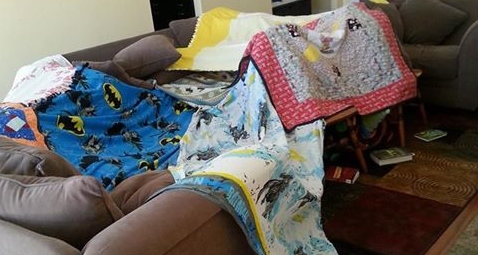
But a weather-induced slow-down is not necessarily a bad thing for a group of writers. In fact, those among us who didn’t spend the time making a giant blanket fort that enveloped the entire living room will probably have better polished or lovely new pieces to show for it. That’s what writers do when the weather doesn’t accommodate our plans. We write. And build blanket forts. But mainly, we write.

That’s what happened anyway in “the summer that never was” of 1816. For several years prior the earth had experienced a series of volcanic eruptions, culminating in the devastating eruption of Indonesia’s Mount Tambora. Together these events spilled enough volcanic ash into the atmosphere to lower temperatures and depress crop production throughout much of the world.

It also affected the vacation plans of friends Mary Godwin (later Mary Shelley), Percy Bysshe Shelley, Lord Byron, and John Polidori who had hoped to spend a delightful summer together at Villa Diodati on Lake Geneva in Switzerland. Finding the chilly weather hopelessly dreary the group abandoned its plans for a friendly jet-ski competition and turned instead to the building of blanket forts and the sharing of scary stories, inspired by the ominous weather and accompanying depression.

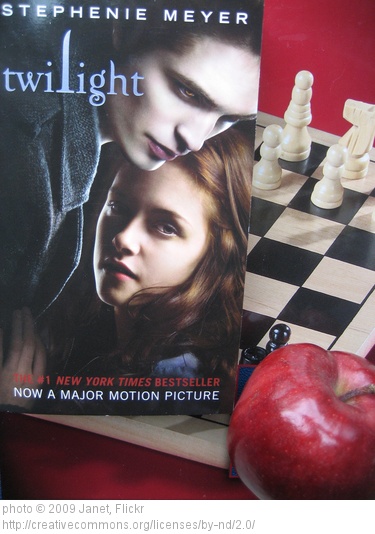
What resulted was a story that would become Mary Shelley’s masterful Frankenstein. Also the offerings of Lord Byron who produced a bit of vampire lore he picked up while traveling served as the inspiration for Polidori’s The Vampyre. This work led to the romantic vampire literary genre without which New Orleans would be safe from the voracious appetite of the overindulged undead and Forks, Washington would have just a little less love and sparkle.

I guess we have to blame Mount Tambora for this, then.

So, you see, great things can come from strange weather and from groups of writers getting together to share their creativity. I have been the very fortunate member of two active writing critique groups, first in Oregon and now in Missouri. Both include members with a wide range of gifts, writing in a multitude of genres with a variety of writing goals. But each has given me great opportunities for growth within my craft.

I don’t know that we’ll establish a new genre or redefine the collective imagination of the monstrous, but I am looking forward this Tuesday to seeing what the cold weather and forced inside time has produced. I might have something to share, too, if my kids ever go back to their (frozen?) school. For now, I just have an incredible blanket fort in my living room.

I may not be getting much writing done, but this is a fun place to hang out.

FACT: This blog post is about vampires.

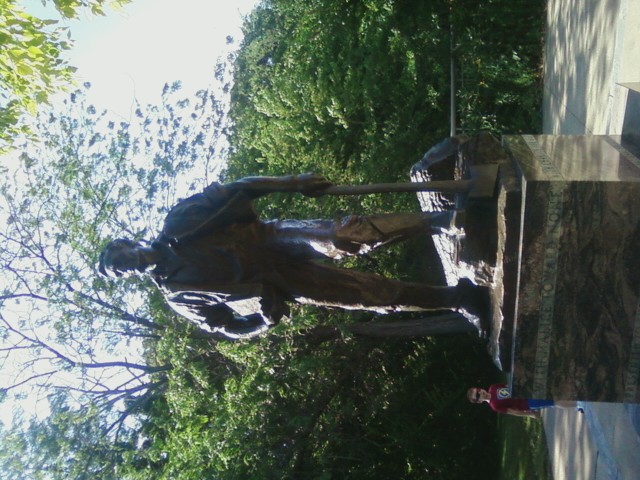
Abraham Lincoln wielding his ax at Lincoln’s New Salem State Park

In March of 2010, author Seth Grahame-Smith revealed to the world disturbing truths about the 16th president of the United States. By now you have probably heard of his book, Abraham Lincoln, Vampire Hunter. It has spawned a movie by the same name that will be released to theaters this Friday.

Personally I am fascinated by the concept of it for a couple of reasons. First of all, I am originally from Illinois, proudly nicknamed the “Land of Lincoln.” I grew up in a small town barely thirty miles from the capitol city of Illinois (NOT Chicago!) in which you can find: the Lincoln Presidential Museum, the Lincoln Depot, Lincoln’s tomb, Lincoln’s law office, Lincoln’s home, Lincoln Memorial Gardens, and the Abraham Lincoln Presidential Museum. If you swing by Springfield’s First Presbyterian Church (and why wouldn’t you?), you will even be treated to a glimpse of the very pew purchased by the Lincoln family. A quick 25 minute drive takes you to Petersburg, IL where you can walk through Abraham Lincoln’s New Salem State Park, a replica of the village where Lincoln spent several years as a not-so-successful small businessman. Amazingly, I’m pretty sure this list is not exhaustive.

As an elementary school student and Girl Scout, I pretty much toured them all, with the exception of the Presidential Museum, which only opened in 2005. I have, however, been to the museum multiple times as an adult and can unapologetically state that it is worth a visit. Make sure you don’t miss the “Ghosts of the Library” show. Tell them the practical historian sent you. They won’t know what you’re talking about, but I’ll appreciate the plug anyway.

The point is, like all kids from Illinois (except for maybe those from Chicago), I know a thing or two about Abraham Lincoln. I did not, however, know he was a successful vampire hunter.

The other reason that I find Grahame-Smith’s book so fascinating is that I also write historical fiction and so what he has done here presents a really interesting look at what writers can (or should) and cannot (or should not) do with (or to) history. The book begins with three “Facts”:

  1. For over 250 years, between 1607 and 1865, vampires thrived in the shadows of America. Few humans believed in them.
  2. Abraham Lincoln was one of the gifted vampire hunters of his day, and kept a secret journal about his lifelong war against them.
  3. Rumors of the journal’s existence have long been a favorite topic among historians and Lincoln biographers. Most dismiss it as myth.

I’d like to take a closer look at these three statements.

1. In 1607, the British merchant ship Cormorant set sail from Portsmouth, England under the direction of Captain Horatio Wheeler. Aboard the ship was a sailor by the name of Andrew Oglethorpe who’d had an unfortunate run-in with a vampire just prior the journey. Vampirism spread like wildfire through this “ship of the dead.” Its newly undead crew, furious with Wheeler for allowing a vampire to join the crew in the first place, immediately mutinied and elected a much more capable (and seemingly curse-resistant) captain by the name of Jack Sparrow whose obsession with treasure led them eventually toward the islands of the Caribbean. So that date checks out.

Where Grahame-Smith makes his mistake, however, is with his end date of 1865. In actuality (assuming we can trust the information trudged up in a random Google search, and I think we all agree that we can), Abraham Lincoln was far from the last US president who dealt with the American vampire problem.

According to my sources, it was President Ulysses S. Grant who established the Federal Vampire and Zombie Agency in 1869, which functioned as a branch of the US military. McKinley later added a department of scientific research to the agency and the search for a vampirism cure began. Increased public support for vampire rights (a grassroots movement begun by some guy from Louisiana by the name of Lestat) caused FDR to restructure the FVZA as a secret, underground program. It wasn’t until 1963 that President Kennedy finally, in a Rose Garden ceremony declared the war on American vampires officially won and in 1974 Gerald Ford pulled the plug on FVZA (Or did he?)

2. Grahame-Smith also claims that Abraham Lincoln was “one of the gifted vampire hunters of his day.”  According to the FVZA website (surprisingly informative for a website representing a completely legitimate, entirely secret government agency), the most famous American vampire hunter was a man by the name of John “Red Jack” Averill, a contemporary of Abraham Lincoln, credited with over 4000 vampire kills. If we assume that Grahame-Smith’s book is a more or less accurate representation of Lincoln’s hunting activities, I estimate the president killed no more than a few dozen vampires during his lifetime, making him somewhat less than mediocre as far as vampire hunters of the mid-19th century go.

3. And now for this rumored secret journal.  A quick Internet search (frankly, all the time I’m willing to commit to such a project) has revealed to me no credible references to the supposed journal. Though I guess since I am not privy to the dinner conversations of many historians or Lincoln biographers, I cannot say for certain that the journal is not a favorite topic among them. I’ll give the author the benefit of the doubt on this one.

Still, the facts don’t entirely hold up. And this one question remains: Was Abraham Lincoln a vampire hunter? I don’t know. What I can say with relative certainty is that living most of my life in the heart of the Land of Lincoln, I never once encountered a vampire so either there really are no vampires (highly unlikely, I know) or the name of Lincoln still inspires fear among the vampire population. Of course, I also haven’t run into one in the nearly two years I have been living in Oregon, sandwiched between the heartthrob vampires of Forks, WA in the north, and the Lost Boys of Santa Carla, CA in the south.

What does Seth Grahame-Smith have to say for himself in regard to his use of history to tell a story that seems suspiciously less than entirely true? “You have to have reverence for the real history,” he told an audience at the screening of the Abraham Lincoln, Vampire Hunter movie trailer, presented onsite at the Abraham Lincoln Presidential Museum. “The man was a real man who is still extraordinarily revered…That, to me personally, was the line: Never make this guy look like an idiot.”

Well said, Mr. Grahame-Smith. And well done. The book is a fun read.

The movie promises to be full of graphically violent scenes with (I’m guessing) lots of comically exaggerated blood spatter. Too gory for me, but I’m sure it will be thoroughly enjoyed by any true fan of vampires, or probably also by a true fan of Abraham Lincoln, because, let’s face it: even a widely beloved historical figure only becomes more awesome when he is hunting vampires.