Clubbin’ with the Bookworms

In 1634, troublemaking Puritan Anne Hutchinson and her husband William boarded a ship bound for the Massachusetts Bay Colony. Along the way, Anne began a group gathering she continued once she landed that September in the New World. The group consisted of women (and eventually some men, too) engaging in intellectual discussions about the weekly sermons delivered to them. As you can probably imagine, such activity made a little trouble for our heroine.

anne_hutchinson_on_trial
Anne Hutchinson on Trial for having the audacity to think. Book clubs are dangerous. Public Domain, via Wikimedia Commons.

Though not exactly a book club, scholars often point to Hutchinson’s gathering as an early example of such. It was at least a precursor to similar groups that grew up at times under the likes of 18th century essayist and women’s rights advocate Hannah Crocker, 19th century African American freedom fighter Sarah Mapps Douglass, and 20th century media queen Oprah Winfrey.

Some of these clubs focused primarily on the discussion of writings presented by the group members themselves, while others turned their attention to upscale fiction with questions in the back and memoir of a somewhat dubious nature. But they all had the same goal: to stimulate intellectual growth. And they haven’t always been just for women, either.

Plenty of prominent men, including Benjamin Franklin, Ernest Hemingway, and at least one of my uncles have been known to participate in formal book discussion gatherings. It’s true (or at least it says so on the Internet) that somewhere between 70 and 80 percent of American book clubs have an entirely female membership, and about 93% of all book club participants are women.

Still, according to the New York Times, more than 5 million Americans belong to a book club. Even if the menfolk only make up 7%, that’s still a fair number of men gathering to discuss books. At least in the US. And that estimate doesn’t include the clubs that exist online, which is an ever-growing number of both guys and gals.

book club
Clearly cartoon men participate at a higher rate than their live action counterparts. Image courtesy of Pixabay

So why do all of these readers get together to talk about what they’ve read? Some of the earliest women’s groups did it because it was a way to become better informed, better educated people when for them to do so wasn’t exactly encouraged by society. And I suspect that’s not so different than the reason any book club has decided to meet.

Sure, for the clubs of today, part of the motivation might be more social—to share a cup of coffee or a glass of wine with friends. Or we might dive into Oprah’s latest pick because we know everyone else will have read it and we don’t want to be left out of cocktail party conversations. We might even join in simply because there are more than a million books published every year in the United States alone and it’s nice if someone will please tell us which ones we should read.
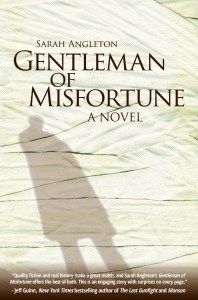
gofm-frontcoveronly
If you’re having trouble, might I make a suggestion? It even comes with questions for discussion, suitable for book club gatherings.

But I also think people who read a lot tend to understand that there is value in forming and articulating deeper thoughts about the words we pour into our brains. I’ve had the great honor of attending a few clubs that chose to read my books and invite me into their conversations, and I am also an active member of a monthly book club. I don’t always like the books we read. In fact, most of them are in a genre I never sought out before joining and probably wouldn’t were I to quit attending.

I don’t go because I love every book, though I happily admit I have fallen in love with quite a few of the selections. I participate because to do so forces me to read outside my comfort zone, which expands my knowledge base, challenges my assumptions, and stimulates my curiosity.

It’s also good for me as a writer (the lone representative in my club of that peculiar breed of human) because I can tend to fall into the trap of reading in a particular way. I pick apart books to see what makes them tick. I incessantly analyze (and sometimes harshly judge) the use of adverbs, the pacing of scenes, the development of themes and subplots. Sometimes I get so concerned with craft that I forget to just let myself get swept up in the story.
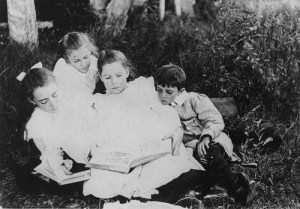
reader group
It’s fun to read with friends. photo credit: State Library of Queensland, Australia Group of children sitting on the grass reading books, 1900-1910 via photopin (license)

Then I go to book club and I am reminded that readers don’t read just for deep intellectual stimulation or for controversial learning or for engaging in theological debates that could one day get them excommunicated from their Puritan communities. They also read because they like to gather with friends and enjoy a cup of coffee or a glass of wine and talk about what they liked or didn’t like about a book—how it made them feel, or think, or grow in surprising ways. And I think that’s a pretty good reason.

Are you part of a book club?
That Thing I Just Had

The other day, I stumbled across an article posted by Smithsonian Magazine about an Ancient Egyptian sock. This toddler-size, striped sock has been a part of the collection of the British Museum for more than a century, but recently it has resurfaced as an object of interest for researchers.

The sock was originally discovered in 1913 or 14 by Englishman John de Monins Johnson during an excavation in the ancient city of Antinopolis on the east bank of the Nile. Described in the article as a papyrologist, Johnson was most likely hoping to find examples of ancient writing that he could spend years poring over. He wasn’t looking for a sock.

single sock
I also can’t stop wondering what happened to the other sock.

But if Johnson was a parent, I can imagine he wasn’t terribly surprised by the discovery. There’s no way I could count the number of times I’ve been looking for that thing I just had* and found instead a kid’s carelessly discarded sock(s).

I have great kids. I really do. My boys are now eleven and thirteen and they both work hard at school, and are kind and generous and respectful. At this point in their young lives they can claim quite a few life skills, too. They are capable of doing laundry, preparing a few recipes, or mowing the lawn.

socks
These are not my keys.

But they are both guilty of constantly kicking off their socks and leaving them for their exasperated mother to find. Their stinky socks are crammed in between the couch cushions, left under the kitchen table, wedged under mattresses, and crumpled on the floorboard of the car. Occasionally I even find them in the back yard. It’s enough to drive any mama completely mad.

Please don’t tell me if I’m wrong, but I suspect this source of aggravation is universal. The Egyptian mama whose little kiddo lost her stripy toe sock (that was probably worn with sandals, which presumably also got lost), was surely exasperated that for the three hundred and eighty-third time that day, little Ahhotep had kicked off her booty.

toes
When your toes are this cute, socks are optional. photo credit: light2shine Feets via photopin (license)

Of course, no parent wants to leave a trail of socks wherever they go, but when kids are little, it’s also kind of cute to see them wiggle and struggle until those adorable chubby toes are exposed for all the world to enjoy. When they’re tween/teenagers, it’s less cute.

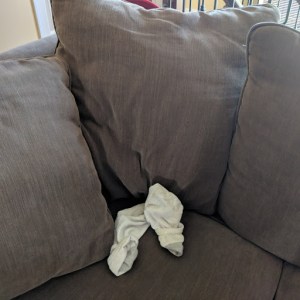
So when I read what should really be a fascinating article about researchers using a noninvasive scanning technique to learn about the types of dyes used in the manufacturing of Ancient Egyptian clothing, all I could think about was that stupid lone sock, stuffed into the couch cushions at the British Museum for the last hundred years.

It’s possible I lost the point. I’m pretty sure I just had it and then set it down somewhere. I’ll have another look at the article and see if I can pick it up again. But I’ll probably just find that same cast-aside sock.
*This could be (but is certainly not limited to): keys, book, purse, pen, phone, remote control, scissors, shoe, grocery list, my marbles

Long Overdue

In 1939, a very dedicated librarian at the New York Society Library, while rifling through a pile of forgotten trash in the basement, discovered a leather-bound ledger from the years 1789-1792. The ledger came from an era when the library was the only one in New York City and it shared a building with the office of the POTUS, who evidently had borrowing rights.

GeorgeWashington
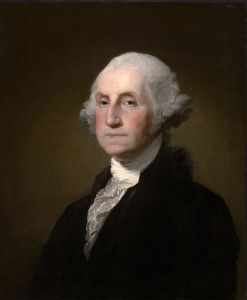
You gotta watch out for this guy. He chops down cherry trees. He doesn’t return library books. What a jerk. By Gilbert Stuart – Public Domain, via Wikimedia Commons

Up until May 20, 2010, if you’d walked into the New York Society Library looking for a copy of The Law of Nations by Emmerich de Vattel (which if you did, I’d have to assume you are a well-read and interesting person), you wouldn’t have found it. Of course that happens sometimes. Libraries are wonderful places with enormous resources that we all share for the betterment of society, but sometimes things go missing. And, more commonly, the book you need is already checked out to someone else, which can be kind of irritating.

That’s especially true if it’s checked out and overdue, because that means some selfish person is standing in the way of your reading pleasure, or your research project, or your self-betterment. That self-absorbed, inconsiderate jerk couldn’t even finish with the book you need, though he’s had it for nearly a month, or in the case of The Law of Nations, for more than two hundred years. But, you know, if he’s George Washington, it’s probably cool.

According to the ledger, Washington checked out two books on October 5, 1789. The other was Volume 12 of the Common Debates, a collection of transcripts from the House of Commons, from which presumably the president hoped to learn the proper usage of the phrases, “Right Honorable Git” and “cheeky fellow.” Also I assume he was a well-read and interesting person.

stack
Two weeks you say? Maybe I’ll just grab one more…

I love libraries. I spend a lot of time in them. When I can manage it, I enjoy getting lost in a big, kind of creepy academic library, the type that smells a little bit like musty, old paper and includes dark, dusty corners where grad students pore over primary sources.

I also love the smaller, local libraries where readers from all walks of life come to browse the shelves, check their email, learn a new skill, or catch an author presentation. Over the past few weeks I’ve even had the pleasure of presenting at a couple such libraries, which has been a lot of fun. Of course if I’m in the library, I’m going to look at books. If I have borrowing privileges, I’m going to take a few with me.

librarybook
Now that is an exciting find. Did you know many libraries will consider purchasing requests from patrons? Requesting that your local library purchase a book is a great way to help an author out.

And there’s a pretty good chance I will check out more than I can possibly read during the two week lending period. I do, however, promise that if when I go to renew, I discover that you have placed a request on one of the books in my stack I’ll immediately bring it back so you can have your turn. Well, unless I’m at the good part. Then I’ll probably take a day or two extra to finish it and just pay the fine. But I won’t wait two hundred years.

George Washington’s fine has been estimated to be around $300,000. The staff at Mt. Vernon couldn’t find the books, but did replace The Law of Nations with a copy purchased for $12,000 and the library graciously waved the rest of the fine. So the book is there now in the New York Society Library collection, where come to think of it, I’m pretty sure you still can’t check it out. At least now that’s no longer George Washington’s fault.

Celebrating Crack the Code Day with 17 Kitten Gifs

In 1799 a French soldier by the name of Pierre-Franҫois Bouchard, while serving in the Egyptian campaign of the Napoleonic Wars, discovered a repurposed slab built into Fort Julien, just outside the city of Rosetta. Though the slab had been relegated to the role of common brick, it seemed to Bouchard like the writing on it might have some greater significance.

He was right. What Bouchard had discovered would keep scholars busy for many years and essentially usher into existence the field of Egyptology. With his discovery, we finally had a translation of Egyptian hieroglyphs.

rosetta
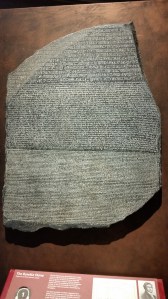
The Rosetta Stone has been on display in British Museum nearly continuously since 1802. This is a copy that was on temporary exhibit at the St. Louis Science Center. Still just as readable as the original.

The stone featured the same royal proclamation in three languages: Hieroglyphics, Demotic, and Greek. Nobody could really read the first two, but if the third were placed within the proper historical context, it could be understood.

At the French defeat in Egypt, the Rosetta stone, along with most of the antiquities gathered by Napoleon’s men, passed into possession of the British where it has remained since, but it was a Frenchman that finally cracked the code.

Jean-Franҫois Champollion was a child prodigy with an insane gift for languages. Before the tender age of eleven he had conquered Latin, Greek, Hebrew, Arabic, and Chaldean as well as a few others. Upon discovering Egyptian hieroglyphs, young Jean-Franҫois declared to the brother who raised him that he would one day be the man to translate them. Nearly twenty years later, he figured out how to do it.

As I’m sure you already know (because it’s got to be a bank holiday somewhere), today marks the 196th anniversary of the day Champollion announced his discovery to the world in a letter read before the Académie des Inscriptions et Belles Lettres in Paris. Basically he explained that Hieroglyphs, like the Egyptian demotic language, contained both phonetic and symbolic parts, and by understanding how to distinguish between those methods of operation in the language, he could crack the code.

Of course he didn’t probably give enough credit to Englishman Thomas Young, whose previous work on Demotic had demonstrated the combination approach and the similarity between Demotic and Coptic, a language at the time still spoken in some Orthodox pockets, and you guessed it, by brilliant linguist Jean-Franҫois Champollion. Young, and frankly the rest of his countrymen, didn’t appreciate that very much, which led to the carving of some choice pictures into the bathroom stall doors of their hallowed institutions.

Jean-François_Champollion,_by_Léon_Cogniet
Jean Francois Champollion. Not so good about sharing credit, but brilliant nonetheless. By Léon Cogniet – Musée du Louvre, Public Domain, via Wikimedia Commons

But Champollion was the one to finally put it all together, and within just a few years, he’d translated a great many hieroglyphic texts, opening up a whole new world of Egyptology. Finally everyone who was anyone who cared in the slightest (and there were probably at least a dozen or so of them) could know that when the ancient Egyptians carved “bird, foot, snake,” what they meant was, “kegger tonight at Zezemonekh’s house.” That’s loosely translated of course.

It was a big deal. Basically Champollion was to Egyptology what Urban Dictionary and good text translation sites are for today’s parents. Because I don’t know about you, but I don’t know what the heck these kids are talking about.

I have two sons, one of whom is a teenager with a cell phone and a lot of friends who communicate primarily in gifs and emojis. I do monitor his phone usage with a parental spy app (yes, he’s totally aware of this and understands that it’s just part of the deal of still being a kid and having protective parents), and I sometimes scroll through his texts. Though one can only take so much.

kitten
So. Sleepy. I like you too much to make you look at seventeen of these. But one is pretty cute.

I am aware that sometimes texts are not exactly what they appear to be, which is why I’m grateful for the genius linguists who can cut through the pictures to derive some sort of meaning. Because I can’t make heads or tails of your average Egyptian stele or that series of seventeen kitten gifs sent to my son by some girl in his science class.

If you’re thankful, too and you want to celebrate what I’m choosing to dub “Crack the Code Day,” in honor of the contributions of Jean-Franҫois Champollion, you can pick up a copy of Gentleman of Misfortune, in which the genius Frenchman gets a nod. Or if you prefer, you could just enjoy some

pizza emoji
Note: This could be a slice of pizza or it could refer to any kind of food one might especially enjoy since everyone likes pizza. Unless you don’t.

Because Reading is Good: Gentleman of Misfortune

February 19, 1843, Ms. Charlotte Haven visited the Nauvoo, Illinois home of Lucy Mack Smith, mother of Mormon prophet Joseph Smith. For a small fee, Mrs. Smith invited Charlotte to follow her up a staircase to a dark attic room where several Egyptian mummies waited to welcome them.

According to the accounts of many visitors, the mummies were somewhat unpleasant to look at, with little of their original wrappings remaining. They couldn’t have been in great shape, either because, according to Charlotte, Mrs. Smith held up a detached appendage of one of them and said, “This is the leg of Pharaoh’s daughter—the one who saved Moses.”

Britishmuseummummy
I’m not sure I would want to store this in my attic. By Ibex73 – Own work, CC BY-SA 4.0, https://commons.wikimedia.org/w/index.php?curid=66245615

The back story Charlotte and other visitors received was that the four mummies in Mrs. Smith’s possession included “King Onitus,” two of his daughters, and one poor unknown Egyptian who was spending his afterlife a long way from home.

The four mummies, as well as can be traced, arrived in the US from somewhere near Thebes, in the spring of 1833 along with seven others and at least a couple of scrolls covered in hieroglyphs no one in the US could yet read.

A man named Michael Chandler, armed with an unsubstantiated story about being the nephew and heir of Egyptologist Antonio Lebolo, claimed the shipment and spent the next two years exhibiting what was the largest collection of mummies to have yet toured the United States. He lost a few here or there along the way and eventually sold the final four to the early Mormon church in Ohio.

But Chandler wasn’t the nephew of Antonio Lebolo, at least not as far as any scholar has been able to find, and if Pharaoh’s daughter—the one who saved Moses—lost her leg in the afterlife, it didn’t happen in Nauvoo, Illinois.

Mummies have a strange history in the US, where they’ve found themselves displayed in parlors, ground into medicine, and used by painters to get that just right shade of mummy brown. They were unrolled before curious audiences, occasionally stripped so their linen could be recycled into paper, and yes, sometimes they were the unwitting mouthpieces of showmen and religious leaders.

The “lives” of mummies in 19th century America, thousands of miles from where, in life, they had planned to rest for eternity, was strange indeed. Strange enough even, that when I first began to learn about the Lebolo mummies and Michael Chandler, I thought there’s a great book in that.

I often have that thought as I’m researching. And once in a while I act on it.

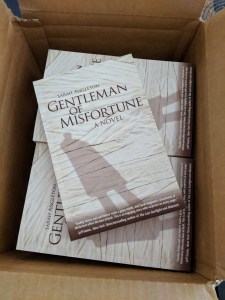
bookboxes
Books just waiting for some readers to come along.

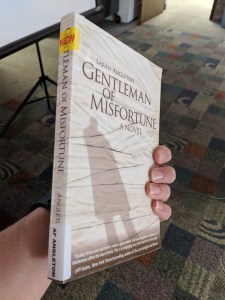
My new novel Gentleman of Misfortune follows the story of the Lebolo mummies and the imposter who stole them. In my story, his real name is Lyman Moreau, a clever gentlemanly criminal, who hatches a plan, assumes an identity, and finds himself caught up in a dangerous journey that will bring him face to face with love and loss, and will force him to consider his own mortality. His adventure takes him through several states, along the Erie Canal, across the paths of several historical figures, and to the doorstep of a prophet. He doesn’t quite get all the way to Mrs. Smith’s attic. But there’s probably a great book in that, too.

You can check out a brief excerpt of Gentleman of Misfortune here. If it sounds like your kind of book, please consider one (or more) of the following:

1. Buy yourself the book. Reading is good for you, and you deserve it.

2. Buy a friend the book. Reading is good for your friend, and s/he deserves it.

3. Request that your library order the book. Reading is good for everyone, and libraries are wonderful places.

4. Help spread the word so others can discover the book. Because reading is good. For example, you could:

    • Share/re-blog this post. Less work for you.
    • Post about the book on Facebook. Watch the “likes” roll in.
    • Put a picture of yourself holding the book on Instagram. #GreatReads
    • Recommend the book on Bookbub. Be an influencer.
    • Snapchat yourself with the book. Give yourself some kitty ears. It’s fun!
    • Tell your neighbor about the book. You can borrow a cup of sugar while you’re at it.
    • Tweet about the book. You can even just click one (or more) of the ready-made tweets below.

tweet-graphic-3Gentleman of misfortune is a dark tale of mummies, mischief, and murder. Perfect for fall! #tbrlist #historicalfiction #newbook https://amzn.to/2Q47em1

19th century gentleman swindler Lyman Moreau finds his next big scheme and loses his heart among a collection of mummies bound for the most successful prophet in US history. #historicalfiction #tbrlist #newbook https://amzn.to/2Q47em1

From author Sarah Angleton comes a new historical novel—a dark tale of eleven mummies, a scoundrel, a seductress, and a prophet. #historicalfiction #tbrlist #fallreads https://amzn.to/

And if you do read and enjoy the book, please consider leaving a review. It helps a lot. Thank you!


A Few Quiet Moments Under a Mattress

On April 24, 1874, after waiting through a nine-year engagement and defying the wishes of her parents, Zee Mimms donned a white silk dress, walked into her sister’s parlor, and stood beside her waiting groom. It might have been a beautiful scene typical of the era—an intimate wedding in a family home, a pretty young woman marrying her handsome cousin.

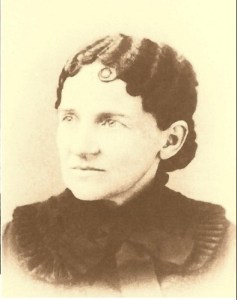
Zerelda_(Zee)_Mimms_James
The real Zerelda “Zee” James. By Unknown – James Farm Museum, Kearney, Missouri, Public Domain

But before the couple could say “I do,” a warning arrived and the bride found herself whisked from the room and hidden under a feather mattress. The groom, notorious outlaw Jesse James, rushed out of the house and took off on horseback leading pursuing detectives on a wild chase through the woods.

He returned to the house a little more than an hour later and made Zee his wife. With little time to celebrate, the newlyweds dashed off into a future that would involve a lot of evading, some assuming of false identities, a fair amount of heartache, and deep and undeniable love.

I have to assume it’s not easy to love an outlaw. If detectives had crashed my wedding, I might have taken those few quiet moments under the mattress to reconsider the choices that had led to my current predicament. But not Zee.

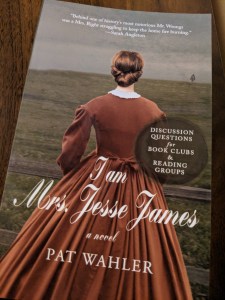
That’s hard for me to imagine. And thankfully I don’t have to, because author Pat Wahler has done that for me. Her new book, I Am Mrs. Jesse James, is out this week and if you’re a fan of historical fiction like I am, I think you’ll enjoy it. The book tells the story of Zee James, no small task given the scant records the James family left behind, and the little scholarly research that has been focused specifically on her.

I Am Mrs. Jesse James
The fictional Zee James. Also you may recognize the author whose insightful quote graces the cover.

The story of Zee hiding under the mattress comes from the writings of Stella McGown James, daughter-in-law to Zee and Jesse. When I asked Pat to share with me her favorite true story from Zee’s life, this is the one she chose. And rightly so. Just picture it.

Weddings can be stressful events, and brides worry about a lot of things, but being forced into hiding under a mattress is probably not often one of them. Then again, I would guess these days just as few women marry famous outlaws as marry their first cousins. Neither of those options seems very wise. But Zee certainly made her choice with her eyes wide open and her heart full of longing. Her story makes for a delightful read.

Also, if you like historical fiction, and you are looking for a good read, in just SEVEN MORE DAYS my new historical novel, Gentleman of Misfortune (sneak peek here), hits the shelves (mostly metaphorically—you will probably have to order it). By then, you should be just about finished with I Am Mrs. Jesse James.

Knight of the Medieval Umbrella

It was at the tail end of August in 1839, after a year of planning and rehearsing, that thirteen valiant knights took to a muddy field near Eglinton Castle in Ayrshire, Scotland, and pretended to joust. Identified by silly names, such as “Knight of the Burning Tower,” “Knight of the Dolphin,” and “Knight of the Saturday Fever” (only one of which I made up), the men were all that remained of the original one hundred and fifty volunteers.

runwayknights
Thus began a long tradition of the very serious portrayal of Medieval knights throughout British culture.

Decked out in their Medieval-est finery, the knights wore period-appropriate armor while battling a torrential downpour and knocking fruit from one another’s helmets with mops and broomsticks. One participant even carried a not-so-medieval umbrella.

The Eglinton Tournament was the project of Archibald Montgomerie, the 13th Earl of Eglinton, who wished to raise interest in the Romanticism of Britain’s past at a time when the Whigs sought to stamp out any idealization of the monarchy.

Thanks to the uncooperative weather, the event was not the success it could have been. Lord Eglinton himself admitted to “the manifold deficiencies in its exhibition,” but the tournament undoubtedly left a lasting impression on the imaginations of the British people. It attracted more than 100,000 period-clad spectators from all walks of life and sparked a surge of Romantic art, Gothic writings, and reenactments of a more chivalrous age, which presumably went a little more smoothly than the Eglinton Tournament. But probably yielded just as much giggling.

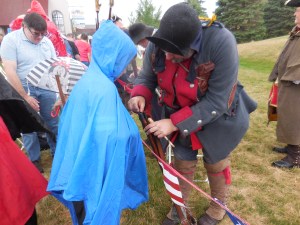
Cass River Colonial Reenactment poncho
We attended our reenactment in period-appropriate plastic ponchos.

In fact, this somewhat failed instance of a historical reenactment may have even been an important catalyst in the rise of a kind of quirky, vaguely ridiculous hobby for the most fascinating of amateur historians here in the United States as well.

I attended my first reenactment a few weeks ago as my family and I road tripped our way through Michigan. My youngest son is a connoisseur of all things military history and so when we realized we would be passing through the town of Frankenmuth during the weekend of the Cass River Colonial Encampment, we couldn’t pass it up.

Reenactment Celebration
Huzzah!

And I’m glad we didn’t. Though I can honestly say I have never had a particular desire to see one, I found the whole thing fascinating. It was as wonderfully absurd as I thought it might be, with otherwise regular people camping out using replica 18th century tents and tools, eating Subway sandwiches around the campfire, and loading the muzzles of their muskets with gunpowder poured from plastic packages.

But despite the anachronisms and general goofiness, I found a lot to love. My son wandered the grounds and met the camp physician who offered to balance his humors, talked with General George Washington who attempted to recruit him, and marched to the rhythm of the drum and fife as a friendly British officer invited him to fall in. The re-enactors were kind and knowledgeable and very much aware that they looked a little silly in their wool uniforms on a drizzly, 85-degree afternoon in 2018.

fallen reenactor
Most of the fallen soldiers managed to stumble into the shelter of the covered bridge before breathing their last, but others were especially devoted to their craft. And wearing authentic orange, rubber ear protection.

We watched several demonstrations of military drills, musket firing, and a couple of full battles from two different conflicts in American history. We cheered as the American rebels surged and wrested control of the covered bridge from their British enemies, and we applauded the re-enactors dedicated enough to their craft to play dead in a puddle in the middle of the road. Sure there were manifold deficiencies in the exhibition, but we left better informed and more curious. And maybe giggling just a little.

It’s just 28 days until the publication of Gentleman of Misfortune, my debut historical novel! You can get a peek at a book trailer here: https://www.facebook.com/sangletonwrites/

Fun with Elvis in the Toilet Paper Capital of the World

Between the hours of 1 and 7 am on August 8, 1977, about one week before his death, superstar Elvis Presley rode his favorite roller coaster back to back to back to back. I don’t know about you, but that makes me feel a little sick.

I actually love roller coasters, and have since I was a kid, but I have my limits. Given the chance, my younger self could have ridden (and probably did) just about any coaster an easy ten times in a row, though I imagine six hours of mostly continuous riding would have been a bit much even then. At forty (the same age Elvis was in 1977), I’m confident my threshold would now be much lower. I can even admit that within the past few years this coolest of aunts has ridden a few coasters with enthusiastic nieces only to discover that I spent most of the ride contemplating the very real possibility of my own immediate death.

zippinpippin
The kind of coaster that makes you want to gyrate your hips a lot. Apparently.

But there are definitely some coasters I like better than others. I have a strong preference for the hilly, wooden variety, the ones that feel a little rickety, zip down big hills, squeal around the corners, and don’t require a rider to wear a five-point harness. So if I were ever going to ride a coaster for several continuous hours, I would gravitate toward one like Elvis rode.

Summer is winding down around these parts with only a couple weeks now until school starts. This past weekend we got back from our annual summer family road trip and a couple days ago we bought school supplies. It’s time, then, to reflect on the adventures of the season. One of those adventures involved a trip that my youngest son and I took to Green Bay, Wisconsin.

I needed to do a little research and we have family in the area, so the two of us took off to Titletown (also, I recently discovered, known as the Toilet Paper Capitol of the World) to eat some squeaky cheese curds and ride Elvis’s Zippin’ Pippin roller coaster at the Bay Beach Amusement Park.

Elvis Presley
Something tells me this man never kept his hands on the lap bar. Image via Pixabay

In 1977, the Zippin’ Pippin was the coolest ride at Libertyland in Memphis and Presley was a frequent visitor, usually renting out the park to enjoy the ride unmolested by adoring fans. And that’s why he was there between 1 and 7 am, with just a handful of friends and family and plenty of time to give himself what I imagine was probably a terrible bellyache.

One of the oldest wooden coasters operating in the United States, the Pippin, which didn’t start zippin’ until the 70s, was built between 1912 and 1917. It’s 2,865 feet long and travels between 20 and 40 miles per hour, the ride lasting just 90 seconds. Its largest drop is seventy feet, and like most good ol’ wooden coasters, is best enjoyed with your hands in the air and a scream on your lips.

The coaster was dismantled after Libertyland closed in 2005. In 2010, the Toilet Paper Capital of the World purchased and refurbished the ride for $3.8 million. I rode it for a dollar. And it was money well spent. Though I don’t think it’s a six hours in a row kind of good, the Zippin’ Pippin is a pretty good ride. I’d go again. And maybe again. But after that I’d probably have a bellyache.

Also, only 35 days until publication day!

Laying off the Rice and Fish: A Summer of Spontaneous Combustion

On a bright spring morning in 1731 a maid knocked, to no avail, on the bedroom door of the Italian countess Cornelia Zangari, grandmother to the future Pope Pius VI. Receiving no answer, the maid pushed open the door to discover an alarming scene. In between the lady’s bed and the window were the bottom halves of two legs, a few pieces of skull, a small pile of ashes, and some yellowish goo.

spontaneous combustion
photo credit: Lynn Friedman Dept of Spontaneous Combustion via photopin (license)

The countess was no more, but what happened was anyone’s guess. There were several theories put forward, but the one that carried the day was that of the Reverend Giuseppe Bianchini, who theorized that the vapors from the alcohol bath she had taken before bed combined with the gases in the countess’s system and caught fire. Since she apparently liked to get her drink on, this explanation seemed pretty legit, and by the time Bianchini’s report of the event was translated into English and reached a wider audience, quite a few scientists looking at similarly odd cases, were willing to think he was more or less right.

If the good reverend were correct, then one could avoid spontaneous combustion by living a more temperate and careful life. That was good news for the 18th century masses, which would rather not die in a burst of flames. It’d be good news, too, for us here in the Midwestern US, because we’re in the middle of a good ol’ fashioned Midwestern summer in which the heat index is regularly well over a hundred degrees and if, God forbid, we have to get into our cars after they’ve been parked for an hour on a blacktop parking lot, we are pretty sure we’ll burst into flames.

flames
Pretty much what it feels like to live in the Midwest in July. Image by geralt, via Pixabay

Of course maybe we will, because even nearly three hundred years later, the scientific community isn’t in agreement about the causes, or even the reality, of spontaneous combustion. Over the years there have been numerous explanations for the phenomenon, from the ridiculous notion that such fires likely came from a nearby external source, to the claim that the fires result from a diet too high in rice and fish.

Regardless of whether we need to worry about suddenly disappearing in a flame of glory, events that fire investigators and nosy neighbors can’t figure out how to explain are few and far between. In fact we might not even know much about them at all if the case of the Italian countess hadn’t been made famous by Charles Dickens, who used the event as inspiration for the death of Mr. Krook in Bleak House.

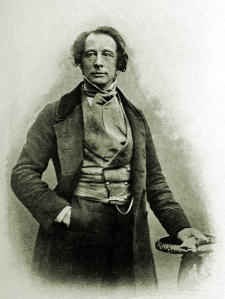
Charles_Dickens_by_Antoine_Claudet,_1852
No way is this man going to let the truth get in the way of good fiction. Charles Dickens by Antoine Claudet, 1852. Public Domain, via Wikimedia Commons.

Dickens’s readers bought the scene, trusting the author who gave it to them, but at least one critic did not. Amateur physiologist, as well as literary critic and friend of Dickens, George Henry Lewes was highly vocal in his insistence that the author’s use of spontaneous combustion as a means to an end was “beyond the limits of acceptable fiction.”

And this is where I take Dickens’s side, because fiction is fiction and fire is fire. When the two meet, anything can happen. A drunken rag and bottle merchant can dissolve into a puddle of ash and goo. Or a Midwestern writer can burst into flames in the middle of the grocery store parking lot. Fortunately, truth has higher standards than fiction. It turns out cases of “spontaneous” combustion take place more often in winter, when people tend to keep closer company with fire. So I suspect I’ll be okay. As long as I don’t go too crazy with the rice and fish.

Black Bears on the Move: Suburban Shock and Awww

On November 14, 1902 US president, outdoor enthusiast, and big game hunter Theodore Roosevelt experienced a profound moment of awww when he refused to shoot a young black bear. The president was the only member of a hunting party near Onward, Mississippi who had yet to bag a bear when one of his assistants decided, appropriately enough, to assist. The man cornered a young bear and somehow managed to tie it to a tree with a length of rope.

TheodoreRooseveltTeddyBear
I mean, who could shoot that? [Public domain], via Wikimedia Commons
But the president refused to shoot the animal, claiming that to do so just wouldn’t be sporting. Awww. I find that a fairly endearing story, but Roosevelt had to endure a little bit of ribbing from the company of, evidently, less sporting men who asked him to hand over his man card.

Of course, the press also got hold of the story. Then it wasn’t long until political cartoonist Clifford Berryman chronicled President Roosevelt’s mushy side for the Washington Post. And that was fun. Everyone had a nice chuckle at the soft-hearted leader of the free world.

It also gave one man a great idea. Morris Michtom, candy seller and maker of stuffed animals for children, decided it would be a good idea to make a sweet stuffed bear dedicated to the president. People loved the bears, and when Michtom asked President Roosevelt for permission to name the toy in his honor, as he no longer possessed a man card anyway, he agreed. Teddy’s bear was born, and in the years since has become the prolific teddy bear, beloved by children throughout the world, teaching all of them that bears are soft and squishy and should be given lots of hugs.


bears
Super huggable.


But it turns out that might not be entirely accurate, because as cute as they are, and they are CUTE, hugging black bears isn’t a great idea. At all.

Fortunately, in my corner of the world, we don’t have to think about it too much. Or at least that’s what I thought before a recent story broke in which a representative from the Missouri Department of Natural Resources calmly discussed the wild black bears now rambling their ways through the suburbs of St. Louis.

Much like Mississippi, the great state of Missouri was once home to a large population of black bears, and in the last few years, the dwindled population has been making a comeback. They’re out there. On one hand that’s great. Predators are an important part of ecosystems and their presence or absence is a good gauge of ecological health. But Missouri bears rarely take up residence in the suburbs.

black bear in the suburbs
Look at that cutie being all cute. But from a distance, okay? photo credit: RickyNJ Black Bear via photopin (license)

These haven’t. Allegedly they are just passing through and the experts have asked everyone to please keep calm. They’ve also asked us all not to feed or shoot the bears. And though to the best of my knowledge no one has said this specifically, I don’t think we’re supposed to try to give them squishy hugs, either.

I have seen a few videos of the critters as they make their way west, through suburban yards, and toward bear-appropriate wilderness. As far as I know, no people, pets, or bears have been hurt along the way, but there’ve been plenty of people surprised to see them, and once the shock has passed, a fair bit of awww.