Study Shows VD is Good for Your Heart

Tomorrow we celebrate “love,” on that most romantic of days commemorating a couple of martyrs, a massacre, some very poorly behaving Romans, awkward relationship moments, and heart-shaped boxes of chocolate candies filled with who knows what. As you can probably gather, we’re not big celebrators of Valentine’s Day around here, although, I have to admit, I will likely make a heart-shaped casserole for dinner because I received a heart-shaped pan as a wedding gift and honestly when else am I going to use that?

Despite my own reluctance to celebrate VD, my children have been busy designing and filling out valentines to give to their classmates. They’re excited mostly, I think, to see the pile of candy they will bring home.
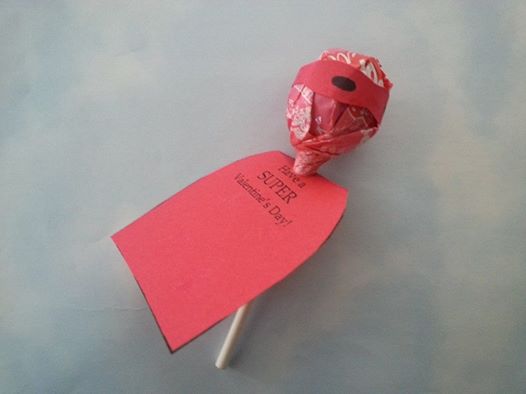
If you must celebrate, at least do so Pinterest style, right?

But I am delighted with their teachers and with their school because both classes are also trying to make this kind of silly holiday meaningful on a larger scale than simply fretting over cryptic Conversation Hearts bearing messages such as: “DARE YA,” “GOT CHA,” and “URS 4EVR.”

My oldest son’s third grade class will be spending at least some of their party time making therapy pillows to be donated to a local children’s cardiac unit. And my first grader’s class will be participating in Jump Rope for Heart.

I’m especially pleased about that because in fifth grade I participated in the program myself and not to brag, but I had some pretty mad skill. Over the years the Jump Rope for Heart Program has raised hundreds of millions of dollars for the American Heart Association all while promoting heart-healthy activity and an attitude of service among elementary students.

It might just be me, but I'm pretty sure the conversation hearts of my youth were more innocent.
It might just be me, but I’m pretty sure the conversation hearts of my youth were more innocent.

Because though it’s a ton of fun, jump roping is hard work. Some historians even trace the roots of the sport back precisely to hard work in Ancient Egypt and China from where the earliest twisted or braided ropes are believed to have come. The theory is that rope-makers had to jump the strands as part of the process of twisting them together to make rope and that in imitation of them, their children developed a game of it.

Whether or not the theory has any merit, rope jumping games certainly did take hold early in China. There’s also evidence that similar jumping activities developed early among the Aboriginal population in Australia. But it is most likely the Dutch we have to thank (or blame) for the modern sport of jump rope.

When early Dutch settlers brought jump roping to New Amsterdam (later New York) in America, the English thought it was the most ridiculous thing they’d ever seen. When Dutch children doubled it up, the English (who were obviously jealous of the mad skills) knew they had been wrong and that this “Double Dutch” accompanied by silly sing-song rhymes was, in fact, the most ridiculous thing they’d ever seen.

Mad Skill
Mad Skill

The sport’s been though some highs and lows in its history, enjoying a resurgence in the 1970’s with the NYPD’s Double Dutch outreach to inner city youth that included the slogan “Rope, Not Dope,” a “rope skipping” campaign begun in Colorado by PE teacher Richard Cendali, and the Jump Rope for Heart program started in 1978 by Milwaukee PE teacher Jean Barkow.

And now, all over the United States, elementary students jump their hearts out around this time of year in order to do some good in the world and prove that Valentine’s Day, for all the angst and disturbing candy messages, can actually be pretty good for your heart.

jumpropeforheart

So in the interest of exhaustive (or at least exhausting) research, I felt it necessary to dust off my mad skills and jump a little rope. In the process I learned a few things:

  1. I am not at quite the same level of physical conditioning as my fifth grade self.
  2. My “Jumping Rope” list on iTunes needs more Pointer Sisters, Van Halen, and Kris Kross (sure to make me jump jump).
  3. I don’t know if this proves the Englishmen of New Amsterdam right, but my attempt to jump rope is probably the most ridiculous thing anyone could ever see. But won’t. Ever.
  4. Jumping rope is a fantastic way to work off all the empty calories in the heart-shaped box of chocolates filled with who knows what that I’ll probably scarf down in honor of Valentine’s Day.
The things I do for you.

What the Fabulous Fox Says

In 1904, then twenty-five-year-old William Fox bought himself a nickelodeon in Brooklyn. Born in Hungary as Wilhelm Fried, Fox worked largely in the fur and garment industry before catching the movie bug. And it turned out he was pretty good at it his new chosen profession. As the popularity of silent films grew, so did young Fox’s influence. By 1913 he had opened a string of nickelodeons and was making a name for himself with his own production company.

large__4261638740

He had a keen eye for the future of entertainment and a knack for discovering and developing the next big trend. As head of the Fox Film Company, William Fox pioneered organ accompaniment during film showings, promoted a number of bright stars, acquired patent rights to the Swiss-developed sound-on-film process, built great movie palaces, and generally rocked the cinematic world.

Alas, his success was not to last. Just as he was attempting to take over MGM, Fox became the center of an anti-trust investigation and when the stock market crashed in 1929, his domination of the movie industry began to crash along with it. When he died in 1952, not a single representative of the movie industry turned out to mourn him.

But, of course, Fox’s name lives on. His production company merged with 20th Century Pictures to become 20th Century-Fox and later mergers led to the formation of the Fox Network. Also the name of William Fox can still be found gracing the marquis of several movie palaces he had built at the height of his career in the late 1920’s, each decorated in what he called the“Eve-Leo” style.

The ceiling in the lobby. "Eve Leo" style at its best.
The ceiling in the lobby. “Eve Leo” style at its best.

Because his wife Eve Leo Fox had a flare for ostentatious décor, placing side-by-side objects reminiscent of artwork found in Hindu temples, Egyptian sculpture, and pretty much anything else that struck her as glitzy on her travels.

It might be fair to describe these theaters as gaudy. Or garish. Or kind of gorgeous if you’re into sensory overload and aren’t terribly concerned about the general consensus of good taste.

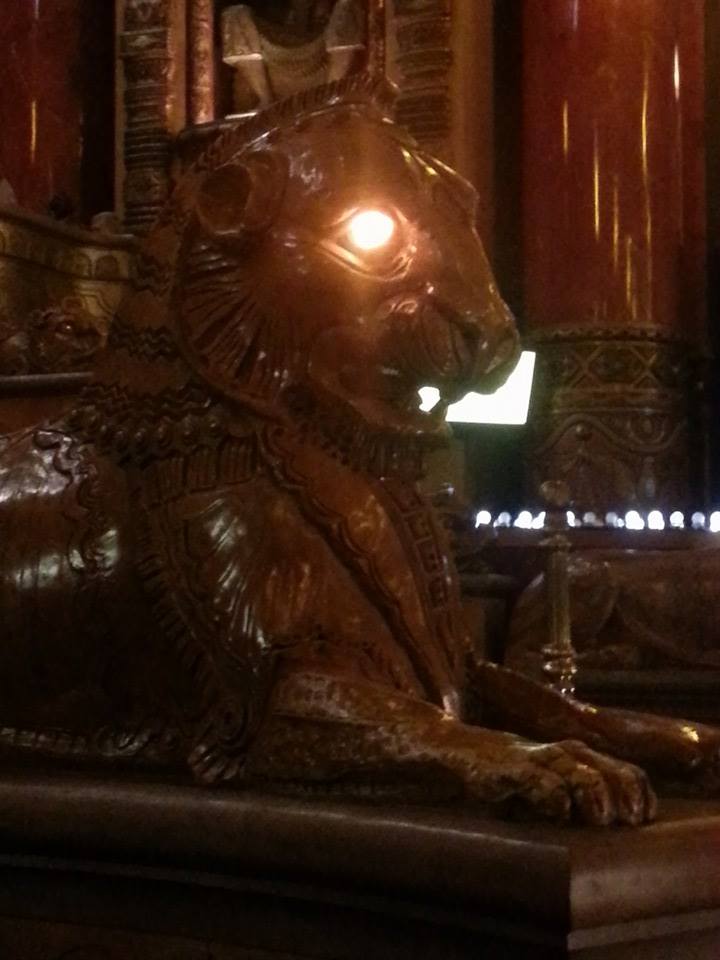
Clearly I will not be ascending the stairs this guy is guarding.

Which brings me to date night this past Saturday. My husband and I enjoy live theater. Now that we live close enough to grandparents to make an occasional late night possible, we’ve tried to make it to several shows, including some really wonderful productions of Broadway musicals and other such highfalutin entertainment. Some of these fancy date nights have been spent at St. Louis’s Fabulous Fox, built by William Fox in 1929 and restored in 1982.

I love fancy date night!

The venue rarely functions as a movie palace these days, instead offering a range of upscale shows in the performing arts and, as we learned this past weekend, the occasional flatulent sock puppet.

We went to see Alton Brown, famous science-y, gadget-y, know-it-all food expert of Food Network fame. His tour Alton Brown Live! made a stop for a sold-out show at the Fox and I was lucky to have purchased tickets for my husband’s birthday way back last summer.

This man taught me everything I know about yeast. And sock puppets. Alton Brown Photo By Lawrence Lansing [CC-BY-3.0 (http://creativecommons.org/licenses/by/3.0)]
This man taught me everything I know about yeast. And sock puppets. Alton Brown Photo By Lawrence Lansing [CC-BY-3.0 (http://creativecommons.org/licenses/by/3.0)%5D
To describe this show to you would be next to impossible, except to say that the gaseous nature of yeast represented by unapologetic sock puppets played a smallish part. And that the show was charming, funny, occasionally juvenile, sort of educational, and gorgeous if you’re into sensory overload and aren’t terribly concerned about the general consensus of good taste.

I admit, the chandelier is just whimsical and fun.

I don’t know that the visionary that lent his name to the industry he loved long after it had left him behind and who ushered sound into the movies and the movies into grand palaces had this in mind when he lavishly decorated his “Eve-Leo” style theater. But I suspect that the echoes of belching sock-puppet “yeast” bouncing off elephant carvings and gargoyles might have made him smile. You know, because it’s obviously the next big trend in entertainment.

Monstrous Highs and Record Lows

You may have heard that the Midwestern United States has experienced a bit of a cold snap this week. I realize that there are parts of the world where people live (if you can call it living) with subzero temperatures and unimaginable wind chills on a regular basis. But Missouri is not one of them.

390358153
Weather only a penguin would love.

Our forecast for this past Monday included a morning temperature/wind chill that was nearly identical to that of the Amundsen-Scott South Pole Station in Antarctica! At those temperatures, you can literally throw a cup of boiling water into the air and watch it turn to snow before it hits the ground. And, yes, we tried it, because what else are you going to do on an impossibly cold day stuck at home with the kids.

So there was no school for the kids and most activities that could be cancelled, were. Even my Tuesday morning Coffee & Critique writers’ group decided not to meet, mostly because driving on sort of clear roads in reluctantly running cars seemed like a bad idea to most of us. When an ice road trucker gets stuck in the cold, he grumbles, pulls out his chains and goes about his business. When it happens to a Missourian, he gets hypothermia and his fingers fall off.

For a Missourian, this would be a problem.

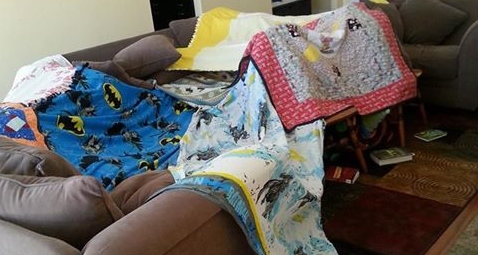
But a weather-induced slow-down is not necessarily a bad thing for a group of writers. In fact, those among us who didn’t spend the time making a giant blanket fort that enveloped the entire living room will probably have better polished or lovely new pieces to show for it. That’s what writers do when the weather doesn’t accommodate our plans. We write. And build blanket forts. But mainly, we write.

That’s what happened anyway in “the summer that never was” of 1816. For several years prior the earth had experienced a series of volcanic eruptions, culminating in the devastating eruption of Indonesia’s Mount Tambora. Together these events spilled enough volcanic ash into the atmosphere to lower temperatures and depress crop production throughout much of the world.

It also affected the vacation plans of friends Mary Godwin (later Mary Shelley), Percy Bysshe Shelley, Lord Byron, and John Polidori who had hoped to spend a delightful summer together at Villa Diodati on Lake Geneva in Switzerland. Finding the chilly weather hopelessly dreary the group abandoned its plans for a friendly jet-ski competition and turned instead to the building of blanket forts and the sharing of scary stories, inspired by the ominous weather and accompanying depression.

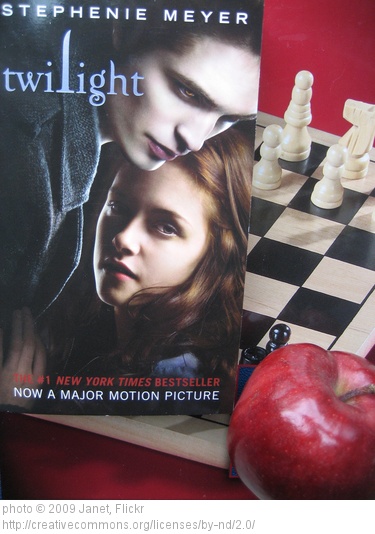
What resulted was a story that would become Mary Shelley’s masterful Frankenstein. Also the offerings of Lord Byron who produced a bit of vampire lore he picked up while traveling served as the inspiration for Polidori’s The Vampyre. This work led to the romantic vampire literary genre without which New Orleans would be safe from the voracious appetite of the overindulged undead and Forks, Washington would have just a little less love and sparkle.

I guess we have to blame Mount Tambora for this, then.

So, you see, great things can come from strange weather and from groups of writers getting together to share their creativity. I have been the very fortunate member of two active writing critique groups, first in Oregon and now in Missouri. Both include members with a wide range of gifts, writing in a multitude of genres with a variety of writing goals. But each has given me great opportunities for growth within my craft.

I don’t know that we’ll establish a new genre or redefine the collective imagination of the monstrous, but I am looking forward this Tuesday to seeing what the cold weather and forced inside time has produced. I might have something to share, too, if my kids ever go back to their (frozen?) school. For now, I just have an incredible blanket fort in my living room.

I may not be getting much writing done, but this is a fun place to hang out.

Looming Rainbows

Another year has come and gone. Looking back at my blog post from a year ago, I see that I resolved to learn to teleport. This was because I had recently returned from a trip during which I spent a significant amount of time on an airplane with lots of strangers and their germs. I wrote that I was sick with “the worst cold of my adult life.”

Frankly I have my doubts. I honestly would not have remembered said illness if I hadn’t blogged about it. Besides, I clearly have the worst cold of my adult life right now, just at the start of 2014.

Tissue Box Cozy
Tissue Box Cozy: What I should have requested for Christmas. (Photo credit: María Magnética)

I can’t even blame this one on air travel because that wasn’t a part of our holiday plans this year as we now live so much closer to our families. There was a great deal of togetherness spread over the holidays, on both sides of the family. Food was eaten, games were played, germs were shared, and rainbows were loomed.

If you happen to have an American grade schooler in your life, you no doubt understand what I’m talking about, but in case this phenomenon has not reached your corner of the world, I’ll explain.

The latest craze to hit grade school is these bracelets made by linking together small colorful rubber bands. There’s a special loom you have to buy and then there’s about a gazillion patterns you can make. And like all of these fad kid crafts, the more complicated the pattern, the greater the cool points.

Rainbow Loom Bracelets for Sale
The way to a third grader’s heart, for now. (Photo credit: Shopping Diva)

When my third grader first mentioned it, I didn’t know what he was talking about (By third grade standards, I am apparently not cool.) Then I walked into a craft store and the first thing I saw was a mountainous display of the looms, accompanied by the sign: “No Coupons or other discounts may be applied to Rainbow Loom products. Limit of 20 looms per customer transaction.”

First of all, WHAT?! Just who is trying to buy more than 20 of these things? I bought one, which earned me a few cool points with my son.

It turned out his cousin also received rainbow looming gear for Christmas and so the holiday saw all of us adults sporting a lot of rubber bands as the cousins got to work sharing looming secrets and exchanging highly sought after colors.

Besides being a source of endless entertainment and a continuing supply of stylish jewelry (and possibly a vector for contagion), the rubber bands did also spark controversy. My son has in his toolbox of bands a color that is clearly purple, another that is clearly blue, and one that is somewhere in between. My husband tried to call it indigo, to which my son replied: “Oh, so that’s indigo.”

Because no one knows what color that really is. And I do mean no one.

English: Extract of Indigo plant applied to paper
Extract of Indigo plant applied to paper. I’m not saying it isn’t a color. Even Crayola (the gold standard of all things color) has an indigo. I’m just saying, I don’t see it in the rainbow. (Photo credit: Wikipedia)

Rainbows have been formally studied since Aristotle. Likely it was Shen Kuo of 11th century China who first more or less accurately explained how rainbows occur. But it is Isaac Newton we have to thank for this most troublesome of colors indigo. In 1672 he published a study detailing the color spectrum. His initial description included five colors and then, a few years later, he added orange and indigo because he thought it would be “pretty neat-o” to have the same number of colors as there are musical notes, days in the week, and known heavenly bodies.

Newton's color circle, showing the colors corr...
Neat-O! Newton’s color circle, showing the colors correlated with musical notes and symbols for the planets (Photo credit: Wikipedia)

And it would have been, except that we now know that there are nine planets in our solar system (just back off, all you Pluto-haters!) and that, really, Newton has just gotten us into a whole mess of disagreement. It even turns out, when we talk about indigo, we probably aren’t talking about the same color Newton was describing. What we call indigo, he called blue and what he called blue is more what we think of as cyan (or blue green if, like me, you prefer the Crayola color spectrum).

So why is indigo still there? I think we have to blame Mr. Roy G. Biv for that. Of course we owe him a lot. Without Mr. Biv we would have a terribly difficult time remembering the order of the color spectrum and I love a good pneumonic as much as the next gal, but I think I have a solution for that. How about Ronnie Only Yodels Great Big Vocals? It’s a work in progress. I’m certainly open to family-friendly suggestions.

But I think with a little tweaking it could take off, just like the way we all learned the order of the planets in our solar system: My Very Educated Mother Just Served Us Nine Pizzas (or as the Pluto-hating scientists would prefer: My Very Evil Mother Just Served Us Nothing).

Pizza
Pizza: way better than nothing. (Photo credit: Wikipedia)

So here are my predictions for this new year:

  1. I will not learn to teleport.
  2. The rainbow loom will go out of fashion and the braided embroidery thread friendship bracelet will make a comeback.
  3. Indigo will at last be expelled from the rainbow.
  4. Pluto will be reinstated as a planet thanks to the hard work of the advocacy group Very Educated Mothers for Pluto.
  5. I will have the worst cold of my adult life on the dawn of 2015.

Please don’t look at me like that.

On Christmas morning 1902, young brothers Quentin and Archie Roosevelt revealed a holiday surprise to their parents. As the first family entered the White House room where they were to open their gifts, the boys threw open a set of closet doors to reveal a small decorated Christmas tree.

English: A Christmas Tree at Home
Surprise! There were too many trees in the yard anyway. (Photo credit: Wikipedia)

The tree had been cut from the White House grounds and with a little assistance from staff had been wired for electric lights. The trouble was that President Theodore Roosevelt had specifically banned White House Christmas trees the previous year.

A dedicated outdoorsman and environmentalist, Roosevelt had listened to the increasing public concern over unnecessary forest destruction and come to the decision that his family would not participate in the holiday tradition.

Now, please believe me when I say that I am not a Christmas tree hater. I recognize that for many of the folks out there who celebrate Christmas, the season just simply would not be the same without a freshly cut tree. But I don’t have a real tree in my home.

Primarily this is because I have a family member who is terribly allergic to evergreen, but I also appreciate that artificial trees don’t need to be watered, rarely burst into flame, and possess bendy branches that are quite convenient for whimsical ornament placement. Best of all, when Christmas is over, I don’t have to worry about how to dispose of my tree.

christmas tree recycling dropoff 4
Oh. Right there? OK. (Photo credit: sdminor81)

At least I thought that was an advantage, until I moved to Oregon, which produces more live Christmas trees than any other state in the United States. Sometime during the week following our first Oregonian Christmas, a young lady knocked on our door and explained that her glee club, chess team, cheerleading squad, or something was raising funds by recycling Christmas trees for people. When I told her that we had an artificial tree, the perky smile slid from her face.

She recovered quickly, the ends of her mouth turning up, a look of disbelief in her shining eyes as she shifted to try to see around me into my home. The “tree” was easy to spot in the front room.

“Oh, okay. Thanks anyway.” She turned to walk back down the driveway, her shoulders sagging, as if I had just explained how I’d accidentally run over her puppy.

Puppy-sam
Let me be perfectly clear about this. I did NOT run over anyone’s puppy. (Photo credit: Wikipedia)

But now we’re back in the Midwest where real trees cost nearly as much as the artificial ones and no one seems to take it as a personal affront that we prefer unpacking our tree from a box in the basement to strapping it to the roof of our car.

Still, my time in the Pacific Northwest has given me a new perspective on the advantages of real Christmas trees:

1.      Real evergreen trees make your house smell lovely and if anyone is allergic to them, his or her airway will soon clog enough to not smell them anyway so everyone wins.

2.      Real trees introduce a new crop of spiders into your home that soon take up residence and can become beloved pets for your children.

3.      Real trees spread their needles over the floor to be tracked all over the place, giving your entire home a fresh green Christmas-y feel.

4.      Real trees produce plenty of sap to coat your family’s treasured ornaments and protect them from potential breakage.

5.  When a young lady shows up on your doorstep offering to recycle your Christmas tree as a fundraiser for the annual honors orchestra trip to Boise, you don’t have to inform her that you have just run over her puppy.

And it turns out the Roosevelt family discovered a new perspective on their live Christmas tree, too. According to the story, the president was not particularly angry with his young sons, but decided that this was a teachable moment. He invited his friend and adviser Gifford Pinchot who would later serve as Chief of the United States Forest Service to explain to the boys the problems of deforestation and the use of trees for decorative purposes. Instead, Pinchot told them that sometimes the selective harvesting of older trees could be beneficial to a forest.

Christmas Tree Lot (#2548)
I’d like the one with the fewest bald spots and the most spiders, please.(Photo credit: regan76)

There’s no record of trees being reincorporated into the Roosevelt Christmas celebrations in the White House, but many reforestation laws and environmental acts came out of Theodore Roosevelt’s presidency. Today, most of the Christmas trees in the United States are farm raised with highly sustainable farming practices.

So go ahead all you holiday traditionalists out there. Gather with your family around your real Christmas tree and sing Dr. Seuss’s “Welcome Christmas” or whatever it is you do to celebrate. I will be with my family, passing out the gifts left under our perfectly shaped, green plastic Christmas “tree” complete with occasional clusters of small fake pine cones. In a few days, I will pull off the branches and stuff them back into the box in the basement. And I promise I will try not to run over your puppy.

Merry Christmas!

One Lovely Blog Post

One Lovely Blog Award

Let me first say that this post is long, long overdue. Way back in September, a fellow blogger was kind enough to pass on the One Lovely Blog Award to me. I am so very grateful and frankly ashamed that it has taken me this long to officially accept it. The rules as I understand them are:

1. Thank the blogger who nominated you and provide a link to his or her blog.
2. Share seven pieces of random information about yourself.
3. Nominate and link to seven more lovely blogs.

So first, thank you very much to Bruce Goodman (aka Bernhard Piers-Gûdmӧnd) whose blog A Story A Day is far lovelier than mine. You will enjoy Bruce’s blog because he really does write an amazing new story EVERY DAY!

The second part of the award is what has been giving me a little pause because this blog isn’t really about me. Well, okay, it’s sort of about me, but it’s mostly about history, and sometimes a little silly stuff I made up. So I decided that it is in this tradition that I will share my seven things, with a little history, a little of me, and maybe a little silliness sprinkled in.

1. In 1860, then teenager Joshua Slocum decided that a life of boot-making and babysitting a growing brood of brothers and sisters wasn’t the life for him. He struck out on his own, taking to life on the sea and eventually becoming in 1898 the first man to successfully complete a solo sail around the world. Slocum wrote a bestselling book about his adventure. Then nine years later, vanished while out to sea because he had never bothered to learn to swim.

My first job as a teenager was as a summer camp counselor and it provided me with the opportunity to earn my Red Cross Basic Sailing certification, which came in handy a few years later when I worked as a program director at a different camp on a much larger and MUCH windier lake. Thankfully part of the training is learning how, in the middle of a choppy body of water, to right a “turtled” boat (that means completely upside down in case you haven’t yet earned your Red Cross Basic Sailing certification), a skill I used often enough that I don’t think I will be writing a bestseller based on my sailing adventures anytime soon. But fortunately I do know how to swim.

November 14, 1909: Yachtsman Joshua Slocum and...
Yep, I could probably even turtle that one. (Photo credit: Wikipedia)

2. Cuban violinist and composer Enrique Jorrin introduced the world to his song “La Engañadora” in 1951. It’s believed to be the first cha-cha-cha ever composed and it ushered in a new dance style that soon took the world by storm. Nearly fifty years later my husband and I performed a cha-cha for our first dance as a married couple. Then we took the world by storm.

3. In 1804 Meriwether Lewis and William Clark struck out on a great adventure to explore Thomas Jefferson’s Louisiana Purchase, leaving from the newly acquired city of St. Louis for the eventual destination of Fort Clatsop in what would become Northern Oregon. With the help of the local Native Americans, the exploration party survived a tremendously dismal winter during which only twelve days failed to bring rain. On January 1, 1806, Lewis wrote in his journal: “The expedition is homesick. The rain goes on and on.”

Likewise in August of 2010, our family struck out on a great adventure from just east of the Mississippi River and moved to Oregon. Like Lewis & Clark, we found beauty beyond our imaginations and met friendly Oregonians without whom I’m not sure we would have survived. But after a couple of tremendously dismal winters, our expedition grew homesick and in February of 2013 we returned to St. Louis. Lewis and Clark were told upon their return, “It is like you have just returned from the moon.” Our friends and family in the Midwest expressed much the same sentiment.

Ft Clatsop Oct2001
Cozy Ft Clatsop. It looks to me more like Lewis & Clark returned from the forest moon of Endor. (Photo credit: Wikipedia)

4. In 1846, after improving the designs of the bass clarinet and developing a series of valved bugles that would eventually lead to the widely beloved flugelhorn, Belgian instrument maker Adolphe Sax received a patent in Paris for his newfangled instrument that he oh-so-cleverly called the “saxophone.” Several years later in 1988, an unflinchingly patient band director named Mr. B. put an alto saxophone into my hands and despite his growing headache, listened to me squeak out a few notes with an encouraging smile plastered across his face. I played regularly for the next nine years and I’m happy to report I got better. In fact the famous composer Hector Berlioz, a good friend of Adolphe Sax, once described him as “a man of lucid mind, far-seeing, tenacious, steadfast, and skilled beyond words…” which is probably pretty much what my band directors said about me.

5. Born in Poland in 1867, Maria Sklodowska, remembered most often as Marie Curie, was the youngest child of two teachers. For many years her father Vladislav taught mathematics and physics and her mother Bronislawa ran a prestigious girls’ boarding school. Of the couple’s five children, four survived into adulthood. One became a teacher. Two became physicians. And one became a twice awarded Nobel Prize winner in both physics and chemistry. Like Madame Curie I am the youngest child of two teachers and I have three quite successful older siblings. I haven’t been awarded my Nobel Prizes yet, but there’s still time.

6. Originally a gold coin depicting King John II of France on a horse, the franc was first introduced in 1360 and was used to pay the ransom of the king who had been captured by the English during the 100 Years War. Over the years, France’s monetary system stabilized and though the currency itself changed, the name stuck and with the exception of a period of about 150 years, was used in France up until the complete changeover to the euro January 1, 2002. It happened that I arrived in Paris on that day to find long lines as vendors struggled to calculate exchanges between the old currency and the new. I didn’t ransom any kings on that snowy New Year’s Day. Instead I used my shiny new euros to buy a chocolate crepe and an overpriced stocking cap.

La tour en hiver
The next time I decide it would be a good idea to visit Paris in the middle of winter, I’ll buy a stocking cap at the local Farm & Fleet before I go. (Photo credit: Wikipedia)

7. Young Joseph Banks enrolled at Oxford University in 1760 and determinedly pursued as much natural history study as he could manage. A few years later in 1768 he departed with Captain James Cook’s first voyage to the South Pacific aboard the HMS Endeavor. Along with botanist Daniel Solander and artist Sydney Parkinson, Banks collected and documented over 1,000 animal species and more than 3,500 plant species, many of which were previously unknown to science.

I also studied as much natural history as I could while in college, earning a Bachelor of Science degree in zoology in 2000, after which, I worked in the camping industry and went back to school to study literature. Okay, so maybe I haven’t contributed as much “scientific discovery” to the world as Sir Joseph Banks, but I do sometimes harbor a secret desire to sail away to some exotic island and discover a never-before-seen subspecies of newt. I bet with my intensive training in the art of basic sailing, I can probably make that happen.

English: Smooth Newt or Common Newt, Lissotrit...
“Angleton’s Newt” has a nice ring to it, I think. (Photo credit: Wikipedia)

And finally, the third part of the award is the super fun part, because I get to nominate not one, but seven lovely blogs. These are a little varied in their scopes, but each is lovely in its own way. I hope you’ll think so, too. The nominees are:

Bad Anemone Press

Surgically Surreal

Christopher De Voss

A Skeptical Designer

Life In Russia

Diana Staresinic-Deane

TheReporterandTheGirlMinusTheSuperman

On Dasher. On Dancer. On Prancer. On Vixen. On Dominick, on Snoopy, on Baron von Richthofen.

It’s beginning to look a lot like Christmas here in the Angleton home. As is tradition for our family, we decorated the tree the day after Thanksgiving (alas, I missed out on all the Black Friday deals) and the Christmas geese are shining brightly in the front yard.

It’s also beginning to sound an awful lot like Christmas, as it has become our new tradition to crank up the volume on the Christmas iTunes list to sing and dance our way through dinner prep and homework in the evenings. My six-year-old has taken to shuffling through the songs to find what he most wants to hear, which means that we skip over Bing Crosby’s “White Christmas” and instead listen to Lou Monte’s “Dominick the Donkey” A LOT. It also means that homework is taking a little longer these days.

But I can’t complain too much because even though there are some great songs we’re missing out on, the kid has some pretty good taste. One that he has been particularly enjoying is The Royal Guardsmen’s 1967 “Snoopy’s Christmas.”

Both of my boys like this one, which makes a practical historian mama proud, because the song indirectly honors what has to be one of my favorite moments in all of human history. It’s a follow-up to “Snoopy vs. the Red Baron,” a 1966 release that tells the tale of Charles Schultz’s lovable cartoon beagle who in October of 1965 began fantasizing about engaging the WW I German flying ace often known as the Red Baron in a dogfight.

Snoopy as "the World War I flying ace&quo...
Snoopy as “the World War I flying ace”, flying his Sopwith Camel. (Photo credit: Wikipedia)

The Red Baron’s real name was Manfred von Richthofen. He emerged from the defunct cavalry division of the German Imperial Army to train as a pilot, apparently with a fair amount of natural talent. With nearly eighty confirmed kills and most likely over a hundred in all, he was the most successful fighter pilot of the war, becoming something of a legend to both sides of the struggle.

Of course because he is such a legendary figure, there is some controversy surrounding his eventual death. Richthofen was wounded and went down (remarkably gracefully, according to reports) over France on April 21, 1918. He died from the shot to his chest, moments after landing. The trouble is that it has proven difficult to know who shot him.

Manfred von Richthofen from Sanke card #450. T...
Manfred von Richthofen (Photo credit: Wikipedia)

The kill was long credited to Canadian pilot Captain Arthur Brown, but there is a good deal of evidence that the fatal shot came from the ground.  Several historians have assigned credit to various anti-aircraft gunners who were in the area at the time. Still others believe that it was in fact Snoopy perched atop his flying doghouse that drove the Baron to the ground where he survived the wound and went on to start a highly successful frozen pizza business.

The problem with that last theory is that if we assume a certain degree of historical accuracy in the well-researched work of The Royal Guardsmen, then Snoopy and the Red Baron met one more time, on Christmas Eve.

This encounter ended very differently than the first. The Red Baron had Snoopy in his sights and instead of moving in for the kill, forced him to the ground for a friendly Christmas toast, after which the two parted ways peacefully.

I regret to inform you that there is no record of this encounter in the history books, nor of a similar one involving Richthofen, but there is a truly wonderful occasion documented in the history of WW I on which primarily British and German troops fighting in the trenches of the Western Front called a spontaneous truce and celebrated together on Christmas of 1914.

Accounts describe German soldiers beginning to sing carols on Christmas Eve and placing small, lighted trees along the edge of the trenches. Soon makeshift signs expressing Christmas greetings and suggesting a temporary peace started appearing on both sides and by morning, soldiers emerged to cross no-man’s land and shake hands. All day (and according to some accounts, for several after) soldiers took time to bury fallen comrades, exchange small gifts, and even play football (soccer) together.

This “Christmas Truce” was not government sanctioned and in fact followed a flat rejection on both sides of a December 7th suggestion from Pope Benedict XV that a temporary ceasefire be declared in honor of the holiday. Of course eventually the fighting started again and the war raged on for four more bloody years.

Never again in World War I nor in any conflict since has a similar truce been effectively carried out, but for one brief shining moment in history, the commonality of basic humanity triumphed over the absurdity of war. And Snoopy and the Red Baron shared a Christmas toast. I think that’s something worth singing about, even if it means I can’t always dream of a white Christmas as much as I’d like.

Merry Christmas (Bing Crosby album)
It may not appeal to the six-year-old crowd, but it’s still the greatest Christmas album of all time. (Bing Crosby album) (Photo credit: Wikipedia)

The Practical Historian Takes the Day Off

NOTE: I generally post on Thursdays, but have decided this week to post a little early so that I can spend the Thanksgiving holiday with my family, the way it was meant to be spent. Last year, I wrote about my absolute disgust that retailers were open for Black Friday sales on the Thursday of Thanksgiving, which meant that their employees were not able to spend the holiday at home with their families. Apparently, the retailers didn’t get my message as an even greater number of them are engaged in the practice this year. So, I’m going to try again, with this (slightly) revised post. I hope that you enjoy it and I welcome your comments, but please note that I will not be responding until Friday. This practical historian is taking the day off.

English: Oven roasted turkey, common fare for ...
Mmmm…smells like Thanksgiving. (Photo credit: Wikipedia)

Some Sincere and Honest Suggestions

Happy National Day of Thanksgiving on this the fourth Thursday of November when we here in the United States traditionally feel particularly thankful. But that wasn’t always when we celebrated as a nation. For much of our history, Thanksgiving was sporadically celebrated, with governors occasionally calling for state wide days of thankfulness.

It wasn’t until Abraham Lincoln that we had a national celebration. In 1863 as a gesture of unity for a nation at the height of civil war, Lincoln issued a presidential proclamation declaring the last Thursday of November the official day. Not surprisingly, the holiday was still not uniformly celebrated until 1870, when the war was finally over and Reconstruction was well under way.

After that, every year, part of the president’s responsibility was to declare the official day. And for many years that worked well, with each president following in Lincoln’s footsteps and proclaiming Thanksgiving to be on the last Thursday in November.

Then along came The Great Depression and Franklin Roosevelt. Listening to the appeals of concerned retailers who feared a late Thanksgiving would result in more sluggish Christmas sales, FDR decided to change Thanksgiving to Thursday, November 23, 1939.

Franklin Delano Roosevelt, 1933. Lietuvių: Fra...
Franklin Delano Roosevelt, the man who hated Thanksgiving. (Photo credit: Wikipedia)

What FDR hadn’t counted on, however, was the wrath of a nation determined to celebrate thankfulness on the traditional day. Though larger retailers were grateful for the change, smaller merchants, calendar makers, sports teams, and schools with already set schedules were just plain upset. Angry letters streamed into the White House from concerned citizens like Shelby O. Bennett of Shinnston, West Virginia who wrote the president with a few “sincere and honest suggestions” of other changes he might make including:

1. Have Sunday changed to Wednesday;

2. Have Monday’s to be Christmas;

3. Have it strictly against the Will of God to work on Tuesday;

4. Have Thursday to be Pay Day with time and one-half for overtime;

5. Require everyone to take Friday and Saturday off for a fishing trip down the Potomac.

Despite the outcry, FDR continued to ask the nation to celebrate Thanksgiving one week early and in December of 1941, Congress passed a law naming the fourth Thursday in November the official National Day of Thanksgiving. So at long last Americans were guaranteed more than 24 shopping days leading up to Christmas and as public anger faded, everyone was happy.

Then came Thanksgiving 2013 when, concerned about sluggish sales and with only a measly 27 days of Christmas shopping left to the American public, large retailers took it upon themselves to cancel the holiday altogether, declaring instead that “Black Friday” would begin on Thursday, November 28.

The First Thanksgiving, painting by Jean Louis...
A painting depicting Native Americans and early European settlers camped outside the Best Buy to get a great deal on an 84-inch flat screen.(Photo credit: Wikipedia)

In response, I have drafted a letter of my own:

Dear Retailers,

Though some may feel a little put off by your tenacity, personally I think it’s a great idea to begin your holiday sales extravaganza a little early this year. In fact, I have some suggestions for other changes you might consider as well.

  1. To get people excited for the holidays, start piping Christmas music into your stores in the last half of April.
  2. Offer free holiday gift wrapping for purchases of $50 and above after July 4th.
  3. Promote T.G.I.F. doorbuster deals beginning at 4 AM every Thursday all year long.
  4. In the month of October replace the traditional zombie, superhero, and princess Halloween costumes available in your stores with Santa suits, reindeer antlers, and elf tights.
  5. Open bright and early on Christmas morning to accommodate the returns and exchanges from those customers whose families open just one present on Christmas Eve.

Hoping that as I sit at home in my pajamas watching the Macy’s Thanksgiving Day Parade with my family, enjoying the aroma of a roasting turkey, and dreading the moment when I will finally have to start thinking about my holiday shopping, you will consider these sincere and honest suggestions, I remain,

Yours very truly,

Sarah Angleton

Check out Shelby O. Bennett’s letter to FDR here:

http://docs.fdrlibrary.marist.edu/thanksg.html#doc

I Bet Ghost Stories are Even Scarier in Pig Latin

Sometime near the end of the first century Pliny the Younger, a magistrate of Rome, heard a scary story. Presumably he was no stranger to fear. His father died when Pliny was only eight, and just a little over ten years later he was a witness to the eruption of Mount Vesuvius, which resulted in the death of the uncle who had been largely responsible for raising him.

Eruption of Vesuvius. Painting by Norwegian pa...
Eruption of Vesuvius. Much scarier, I would I think, than a little old ghost story. Painting by Norwegian painter I.C. Dahl (1826)

But he was also a relatively successful man. Well educated and known as an eloquent speaker who had served as a military tribune before entering into politics, Pliny rose well above his station. History remembers him most as a writer of letters. He wrote to his friends, to influential politicians, and likely with the intention of publication. He wrote about natural curiosities, daily life, and love. And he wrote about ghosts.

He began a letter to Licinius Sura: “I am extremely desirous to know your sentiments concerning spectres, whether you believe they actually exist and have their own proper shapes and a measure of divinity, or are only the false impressions of a terrified imagination?” Of course he didn’t write in English, but my Latin is a little rusty (though I do pretty much ockray at igpay atinlay).

English: illustration from Leech's comic latin...
Pig Latin: The language of the truly well-educated.(Photo credit: Wikipedia)

The first thing I find interesting about Pliny’s letter is that 2000 years later, we are still asking the same question, especially around this time of year. Television programming which within weeks will fill with family friendly specials featuring Santa Claus and good works is right now little more than an obstacle course of blood and terror feeding some fascination with the horrible, and a curiosity about the unexplained.

I’m not exactly complaining. In general I’m fond of Halloween. I enjoy helping the kids carve Jack-o-lanterns while the lightly seasoned pumpkin seeds burn to a crisp in the oven. And I like seeing all of the adorable children turned into begging hyper zombies just as much as the next mom. But I have to admit, I don’t really like scary stories.

It's that time of year once again, Halloween u...
Terrifying, no? (Photo credit: Wikipedia)

When I (very) occasionally see a scary movie or watch a TV special about a haunted house or hear a frightening tale around a campfire, it follows me. My mind lingers over the details of it for sometimes weeks afterwards, returning to me at the most unexpected moments and sending a shiver down my spine. And I think that’s what happened to Pliny, too.

In his letter he relates three separate stories of ghost encounters, but the longest and most detailed is the most interesting to me because it sounds so familiar. The tale begins with an old abandoned house, deemed uninhabitable because of the strange appearance of a shackled specter. Then one day the brave philosopher Athenodorus purchased the house, determined to live peacefully there.

Maybe the rumors got to him because he didn’t head to bed that first night in his new house and instead tried to occupy his time and thoughts with his writing. When at last the chained ghost approached, Athenodorus didn’t look at him, but instead motioned for him to wait a minute (because the best ghost stories have a funny moment to temporarily relieve some of the tension).

Cover of "Groundhog Day/Ghostbusters/Stri...
Athenodorus would have been able to sleep if only he’d remembered who he was supposed to call.

Obviously, the ghost didn’t like being put off and began to rattle his chains more aggressively (singing a rousing chorus of “Marley and Marley,” like a couple of grumpy old muppets) until finally the philosopher sighed and shouted “What!?” A little startled at the blunt response and frankly a little hurt at being ignored for so long, the ghost sheepishly led Athenodorus outside and disappeared.

The philosopher marked the spot where the ghost vanished and the next morning had the place excavated only to find human remains entangled in chains. He gave the remains a proper send-off. And the ghost never bothered him or anyone again.

Of the ghost stories that I haven’t managed to avoid, this is pretty much the plot of most of them. And Pliny’s may have been the first to provide a written description of ghosts as spirits in need of help to complete a task (it’s also likely that Athenodorus was the first to say “I see dead people”).

He claims in his letter that this is a story he heard about and he wants to get to the bottom of it. The concept of ghosts doesn’t fit, it seems, into his well-educated mind, and he’s trying to figure out if the story has merit, the same way we do every time we tune in to one of those ghost hunting shows, read the latest collection of stories about this or that city’s haunted past, or book the hotel room where that grisly murder allegedly took place a hundred years ago.

haunted house in illinois - HDR
I think if you willingly decide to buy a house that looks this creepy, you probably deserve to be haunted.(Photo credit: Jovan 2J)

Pliny ends his letter admitting that Sura is likely to answer with ambiguous logic, but imploring him to offer a true opinion instead. Pliny has heard the prevalent stories that are either conclusive proof of ghosts haunting the mysterious places of earth or wildly imaginative mass hallucinations. Like most of us, especially on Halloween as our thoughts dwell on the frightening, he wants to know for sure.

Unfortunately  we don’t know Sura’s answer or Pliny’s conclusion, but we do have 2000 years of stories to weigh as we puzzle out whether or not ghosts really do exist. And we may never find a conclusive answer. But the one thing I do know for sure is that I would rather watch a heartwarming Christmas special.

Iconic screen shot from the movie It's a Wonde...
Admittedly still a little scary. (Photo credit: Wikipedia)

No Shoes Required: My Life as Well-Traveled Sock Monkey

Just over thirteen years ago, a young newlywed couple moved into their first home together in the small city of Rockford, Illinois. You could say that it was the beginning of a wonderful journey on which they would earn a couple of degrees, begin careers, change jobs a few times, travel the world a little bit, have a couple of amazing kids, and own homes at various times in three different states. But theirs wasn’t the only journey to have begun in Rockford, Illinois.

The Swedish-born inventor John Nelson immigrated to the US in 1852 and settled in Rockford where he worked as a carpenter and cabinet maker before establishing several manufacturing businesses of his own. But it turns out what captured Nelson’s attention the most was the quest for a comfy pair of socks (and who could blame him?). He sold his other manufacturing plants and invested all of his energy into producing a machine that could manufacture everyday work socks for the everyday working man.

The Symbol, a large piece of modern art sculpt...
“The Symbol.” at Rockford’s Riverfront Park. It’s nice, but I think a giant sock monkey would have been even better. (Photo credit: Wikipedia)

After partnering with fellow inventor W. W. Burson, Nelson patented his first knitting machine in 1870 and by 1873, the two had created the world’s first seamless sock produced by an automated process. The partnership between Burson and Nelson dissolved, Nelson founded the Nelson Knitting Company, and then he died in 1883.

But the quest of sock perfection continued with his three sons. The Nelson boys started Forest City Knitting Company, eventually merging with Nelson Knitting to become the world’s dominant sock producer.

Business was humming along, but over the years the industry had attracted a number of competitors, all of them producing brown work socks with a tan toe, top, and heel. To distinguish the original and best out there, Nelson Knitting decided to get a little wild. In 1932 it introduced to the world what it called the “De-Tec-Tip” sock, which was a brown work sock with (and I’m sorry if this sounds a little shocking to more delicate readers) a RED heel.

It was certainly a risky move, but the world was ready for it. Within an hour of the first red-heeled socks hitting the pages of Sears & Roebuck, craft bloggers had begun sewing the first sock monkeys, photographing each step to include with painfully detailed instructions. History has forgotten who was first to pin it to their Pinterest page, but Nelson Knitting was rewarded the patent for everyone’s favorite stuffed animal in 1955.

All buckled up and ready for takeoff!

No worries, however, for the craft bloggers out there because the patent expired in 1970 and since then sock monkeys have been popping up everywhere. And that’s where our two stories come together.

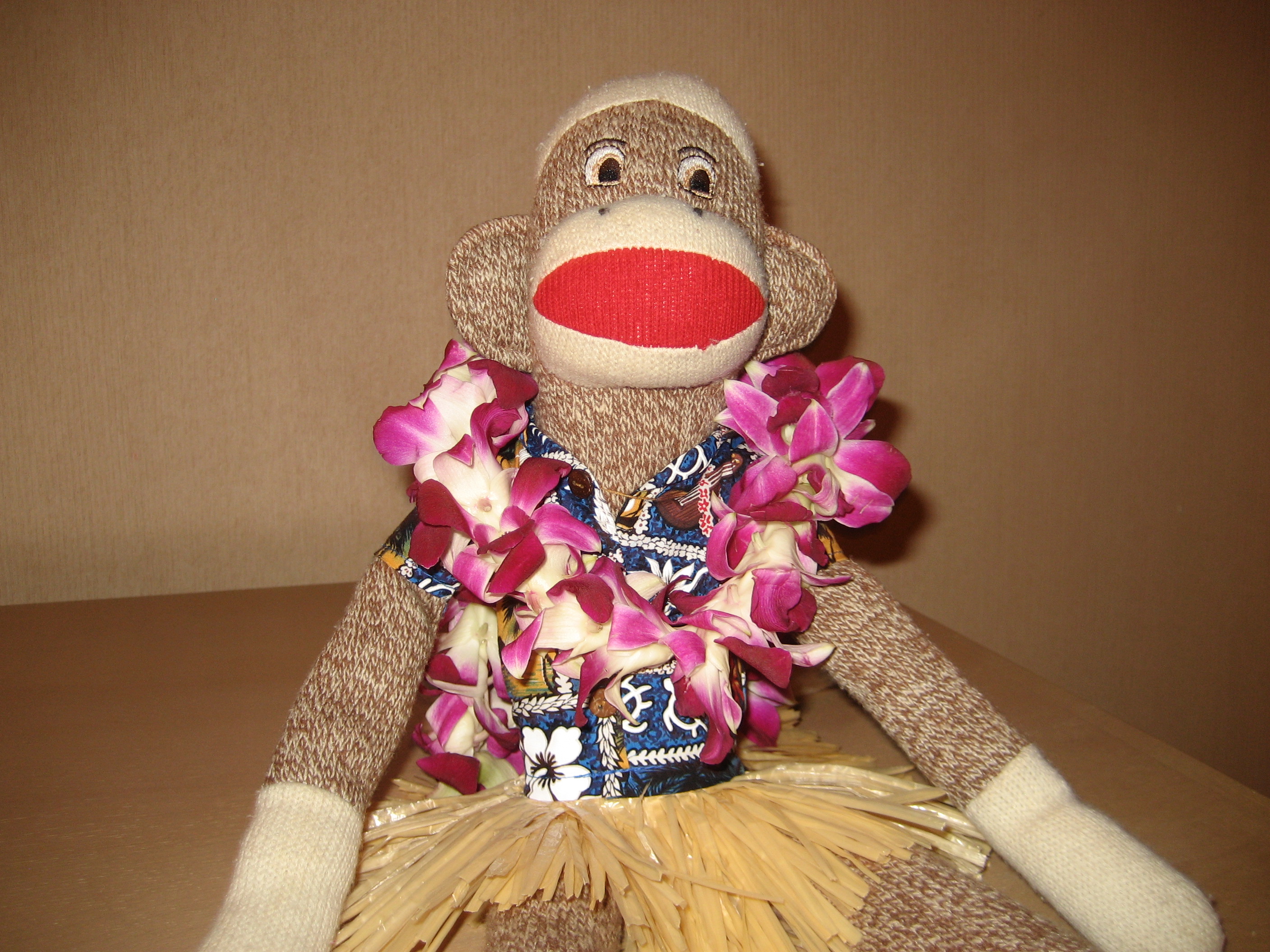
A few Christmases ago, when our sons were very small, my husband received a sock monkey (alas I am not a craft blogger so this one was not homemade). The boys named him “Steve” and he became a permanent fixture in our family culture, taking on quite a mischievous personality (because he is, after all, a monkey).

So fast forward a few months. The not quite as young and not quite as newlywed couple got the opportunity to leave their two young children with Grandma and Grandpa and take off for a week together in Hawaii.

We had gone away for a weekend a few times, but this was the longest I had ever planned to spend away from my little guys. So I was trying to figure out a way to help them know they were on our minds and feel like they were in some way part of our trip. It was my wonderful mother-in-law (and yes, I do mean that sincerely) who suggested that we photograph a favorite stuffed animal along the way and post the pictures so the boys could follow our adventure. We stuffed Steve in a suitcase and we were off.

Steve kicks back at a luau and sips some "pineapple juice."
Steve kicks back at a luau and sips some “pineapple juice.”

Steve has been our family’s travel mascot ever since. When either “Mom” or “Dad” heads out for a conference, Steve travels with us. He always shows up on family vacations. He kept family and friends posted during our cross-country move this past year.

Most recently Steve and I attended the Ozark Creative Writers Conference in Eureka Springs, Arkansas. If you’ve never been there, just trust me when I tell you that a lady walking around taking pictures of her sock monkey doesn’t really garner much attention. At one point I posted a picture of Steve sitting behind a friend’s book table at the conference and captioned it: “Steve is hoping to sell some copies of his self-published memoir entitled No Shoes Required: My Life as a Well-Traveled Sock Monkey.”

The crazy thing is that I’ve had several people tell me they would be happy to buy the book. Now, I’m fond of Steve. And I am delighted to know that his journey and ours began in the same place long before our paths crossed and we started to travel together. But I don’t want to get pigeonholed into the sock monkey genre (Worldcat lists 33 new sock monkey entries for 2013-2014) and I do NOT have time to ghostwrite for a stuffed animal.

I do apologize to Steve’s many fans out there. A blog post will just have to do.

The ladies sure do love him.