Down the Creek Without a Paddle

It’s been a big couple of weeks in the house of practical history. If you’ve followed this blog for long you’re probably aware that I have two sons. When I started this thing way back once upon a time they were pretty small, just starting school, giving me, their mommy, bits of time to devote to something like blogging about history and nonsense.

As children do, they’ve gone and grown up now. My youngest graduated from high school last spring, turned eighteen this summer, and left this week on a great adventure. I won’t go into the specifics because he is an adult with sole possession of his own stories. I will say that I’m really proud of him and I miss him already.

It was a beautiful trip.

My oldest son spent the summer away on an adventure of his own, returning about a week and half before his brother’s planned departure, and so as a family we decided to spend a little fun time together. We chose to take a quick getaway in the middle of the week to canoe down part of the North Fork of the White River in Southern Missouri. It’s a beautiful little river and the state has experienced plenty of rain this spring and summer. The occasional low spots one might sometimes experience were nicely covered over and the current was swift.

My husband and I used to be pretty experienced canoeists; my sons, not so much, but after spending the summer apart, they wanted to catch up and canoe together. No mother could say no to that. Of course, we as the the more experienced, took the cooler and strapped the dry bag to our boat.

They worked together really well, communicating through the tougher spots where rocks and debris made the steering (and staying dry) a little more challenging. Despite more experience and twenty-five years of marriage, we didn’t do quite as well. The problem wasn’t our lack of communication exactly. It was more our admittedly slower reflexes and slightly poorer eyesight that got us. And also a fallen tree that we didn’t manage to skirt on an outside bend the way we needed to.

The current was fast where it happened. When the canoe dumped, my husband managed to hold onto it and ride with it several bends downstream, while I grabbed onto the first thing that came to hand, which was the cooler. I clutched it tightly and rode the current, feet first, until I got to a place I could safely stop myself, very near where my husband had finally managed to bring the canoe to shore.

A couple of kind strangers helped him empty the water while our sons chased down all of the wayward objects that had once been in our boat. They found everything except for one paddle. The dry bag was still fairly dry, the cooler that had so beautifully kept me afloat, was no worse for wear, and they even managed to grab my favorite baseball cap that had been swept off my head.

I’m pretty sure this happened yesterday.

Other than a couple scrapes and bruises, we were unhurt, although the strap of one of my husband’s sandals broke during the ordeal leaving him with only one functioning shoe, and of course, there was the beating we took to our egos. That only got worse when shortly after the incident, our just grown sons decided that for our safety, they should each take one of us. And we agreed. Ouch.

Though I don’t think we were at any serious risk of injury in this shallow river, the reality was that for a few minutes there, we were up a creek without a paddle, a phrase that though surely older in conversation, began showing up commonly in American print in the mid to late nineteenth century.

So there we were, divided up between our children, my husband with only one shoe and me without a paddle, each being steered down the river by one of the boys whose lives used to more or less take the direction we chose for them. I suppose now we get to watch them navigate the currents of their own lives.

They were good boys. They are good men. I guess that’s just how life flows.

This Post is Fire. No Cap.

Lately I’ve been feeling my age pretty keenly. It’s not that I’m old, but I am solidly middle-aged, not yet quite to the morning/evening pill divider, but well beyond the days of waking up without back pain. For the most part, I don’t mind too much. Getting older, after all, beats the alternative, but I do sometimes marvel at the fact that I have no idea what the young’uns are talking about.

I mean, I’m definitely young enough to enjoy a good birthday cake, but I’m also old enough there’s no way anyone is lighting that many candles. Image by Marco Apolinário from Pixabay

Because middle age also falls somewhere between no longer being able to hear what the kids are saying and no longer understanding it. This, more than anything except perhaps for the regularity with which I ask my sons to help me fix whatever stupid thing I’ve done to my computer, makes me aware of my age.

It doesn’t help that I celebrated a birthday last week, in that way middle aged mothers do. The hubs, bless him, slaved away over the grill to make me a special meal that we ate alone because my teenage sons each made plans to not celebrate their mother’s birthday.

That’s fine because they’re sigmas with rizz and they got that drip, so it stands to reason they’d have plans extending beyond their dad’s bussin steak. Too bad for them because it slapped. No Cap.

Yeah, I don’t know what I just wrote, either, though I’m fairly certain I used every bit of that gen Z slang just a little bit incorrectly.

I find myself longing for the good old days when we said logical things like “totes magotes.” Image by Chräcker Heller from Pixabay

And that’s kind of what it’s for anyway. The term slang has existed since at least the 1740s when it referred to the speech of thieves and beggars rather than teenagers, but I’m betting the concept has been around pretty much since the dawn of speech, with each generation’s drive to distinguish itself just a little bit from its elders.

Personally, I used to really enjoy slang. I was a totally rad preteen in the 1980s. Then as a teenager in the 90s I was all that and a bag of chips. I chillaxed through my twenties in the 2000s, and in the 2010s this thirty-something was a little bit extra.

But now in the 2020s, I’m mostly just tired of all this skibidi Ohio brain rot. As far as I’m concerned all these sus kids are delulu. But now I’m just talking out of pocket.

I think.

Lemons for Christmas

I’m a big fan of lemons. I don’t mean that I cut them open and suck on them like a crazy person. I acknowledge that they are sour and, on their own, pretty gross. But I do use lemons quite a bit when I cook, to cut that fishy flavor this corn-fed Midwestern gal doesn’t always appreciate, or to add a bit of acidic zing when the mood strikes and I want to feel a little fancy and channel my inner Food Network star.

Last year for Christmas my husband even got me a couple of small lemon trees in pots to grow in a sunny spot off to the side of my kitchen. Over the summer, the trees enjoyed the hot soupy atmosphere of our Missouri back deck (as did I), and now that it’s turned cold again they have settled back indoors, leafier and prettier, and probably no closer to actually producing fruit.

That’s okay. They’ll get there. Or they won’t. I’ll have fun trying anyway, and in the meantime, I can always buy a nice California lemon at the grocery store. I pick them out carefully. I like my lemons on the larger side, heavy for their size with a slight give when gently squeezed and with a nice fragrance.

I’m good at picking out lemons. Both at the grocery store and, unfortunately, at the car lot. I posted once before about our 2020 Subaru Outback, not long after it left us stranded on the side of the interstate while on family vacation with about twenty thousand miles on the odometer and a transmission that had catastrophically failed, leaving us down a vehicle for more than a month. I wish I could say that after the transmission issues the car hasn’t given us any more problems. Alas, it’s been something of a lemon. And not the kind that makes fish taste better.

It’s been a lemon more in that way that a mid-nineteenth century guy might have referred to a tart or undesirable woman. Or like the way a person in the early part of the twentieth century might refer to getting a rotten deal. Or an awful lot like when, according to Mental Floss, a used car dealer was said in the Oakland Tribune in 1923 to be pleased that he’d finally gotten rid of a lemon.

Not my dog. Or my car. Image by AI ART made in Germany to produce images for people from Pixabay

To be fair, the salesman who sold us our Outback probably did not knowingly sell us a lemon. It was brand new at the time, and Subarus have a reputation of being solid, reliable cars that hold onto their value. I mean their ads tend to feature good looking adventurous people driving into rugged landscapes with their good looking adventurous dogs, tails wagging and tongues and ears flapping happily out the rolled down windows. “Love,” they say, “Is what makes a Subaru a Subaru.”

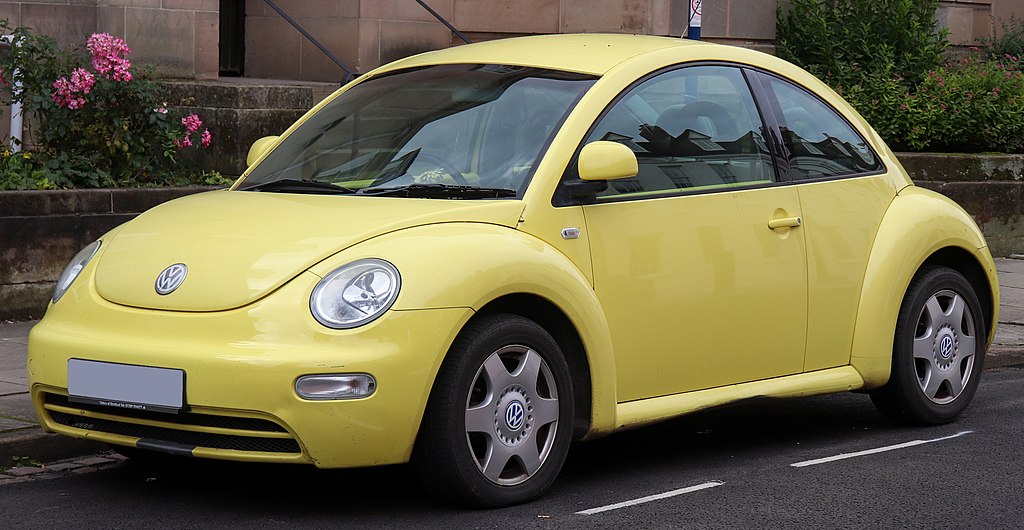
They certainly don’t label their vehicles as lemons, like Volkswagen decided to do in 1960. The printed ad displayed the image of a new, seemingly perfect (though vaguely ridiculous as the VW Beetle has always been), car labeled: “Lemon.” The ad copy went on to explain that an imperfection in the chrome strip on the glove compartment that wouldn’t likely have been noticed by the consumer, had caught the attention of one of the 3,389 quality inspectors, and that the car had been deemed unfit to sell until the problem could be corrected.

The yellow ones even kind of look like lemons. Vauxford, CC BY-SA 4.0 https://creativecommons.org/
licenses/by-sa/4.0, via Wikimedia Commons

The conclusion of course, is that a company with this level of attention to detail could be trusted to produce a car that will not only hold its value, but will also probably not result in a mandatory programming recall, a not-yet-covered-by-recall $1400 repair to its engine, a class action lawsuit regarding a parasitic battery problem the company has yet to find a solution to, an inexplicable break down at the intersection four blocks from home the day before Thanksgiving, and a family stranded on the side of the interstate when they should be on their way to the lake.

Despite being the project car of Adolf Hitler, Volkswagen and its Beetle enjoyed a good reputation among American consumers for a long time following the lemon ad campaign, though feelings toward the company have maybe soured a little since it got caught cheating on its emissions testing a few years back.

Subaru also has inspired a lot of consumer loyalty with its reputation for quality and service. I know that because every time I mention how frustrated I am with this car, I am flooded with comments from other Subaru drivers who absolutely love their cars. Even the tow truck driver on the day before Thanksgiving when mechanic shops are preparing to close down for the long weekend, told me how much he loves Subarus as he loaded my incapacitated car onto the back of his truck and a police officer directed traffic around us.

I realize it’s not Christmas yet, but this really couldn’t wait. When the day arrives, we’ll put a bow on it or something and pretend to be surprised.

And I get it. Sort of. We owned a previous Subaru Outback and it was a great car. We had lots of adventures in it with our good looking dog whose ears and tongue flapped happily out the rolled down window. Well, before he got carsick anyway. He’s not a great traveler.

But this year for Christmas (and for many Christmases and birthdays and anniversaries to come I suspect), instead of lemons, which I’m almost confident my trees will one day produce, we have traded in our 2020 Subaru Outback and purchased a Honda CR-V. The car has a great reputation, and I’m feeling hopeful that this Christmas, I’m not getting a lemon.

In Praise and Laudation of the Most Excellent and Illustrious Roget

Today represents an important day in the annals of history. I could even say it is hugely significant, or momentous, or earthshaking.  It is a day I believe should be a major holiday of great consequence. Because today is the 169th anniversary of the publication of the life’s work of Peter Mark Roget.

The guy had spent a long career as a physician, tutor, and inventor. He’d written numerous papers on health and physiology, served twenty-one years as secretary of the Royal Society, and was the founder of the Society for the Diffusion of Useful Information. But his biggest, most consequential contribution that should not be overlooked, sneezed at, or considered chopped liver resulted from an early habit of making lists.

Beginning in 1805, at the age of sixteen, Roget started making lists of words and phrases, grouping them together into a classification system based on their rough meanings. By the time he retired from medicine in 1840, he had a really long list. I mean like it was extensive and far-reaching and at times probably seemed interminable.  

And so, he spent his retirement collecting, gathering, assembling, and scraping together a book for “those who are painfully groping their way and struggling with the difficulties of composition.” He called it Thesaurus of English Words and Phrases Classified and Arranged so as to Facilitate the Expression of Ideas and Assist in Literary Composition, because as good as he was with words, Roget was not so swell with snappy titles.

Today it’s just known as Roget’s International Thesaurus. It’s in its eighth edition and has been continuously in print, aiding and assisting, helping and supporting painfully groping writers since April 29, 1852.

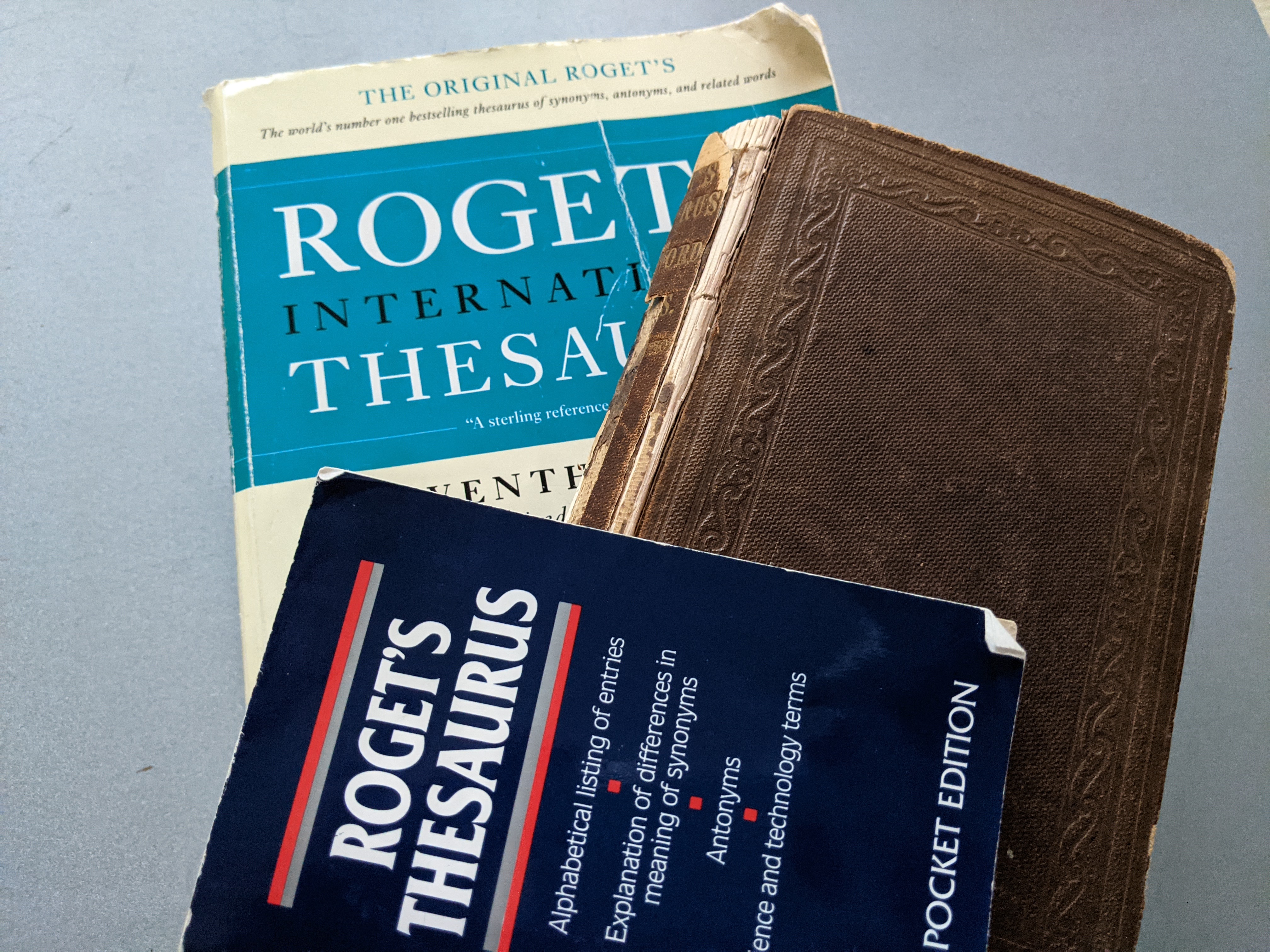
Even Sylvia Plath, who was pretty good with words, once referred to her thesaurus as the book “which [she] would rather live with on a desert isle than a bible.” I’m not sure I’d go that far, or exaggerate that much, or hyperbolize in quite that way, but I do appreciate a good thesaurus. I own three and I use them extensively.

One is an early edition from 1866, great for looking up nineteenth century phraseology, circumlocution, or idiocism. The second is a pocket edition, useful for carrying in a purse, bag, clutch, or tote. And the third is the seventh edition of Roget’s International Thesaurus, which contains more than 325,000 words and phrases and consists of 1,282 pages of sizeable, colossal, and monumental awesomeness.

Okay, I admit I may be a little bit obsessive, affected, or overly-stricken by my plethora, or in other words superabundance of thesauri (or thesauruses because apparently either is acceptable) and with the contribution to the world of lexicography by Peter Mark Roget. But as a painfully groping writer, I plan to celebrate, make merry, and paint the town red. I might even splurge and buy myself an eighth edition Roget’s International Thesaurus just to mark the day.

Don’t Steal My Thunder! (Please)

John Dennis was not a very successful playwright in the early days of the 18th century. I would say he wasn’t very good, but as I’ve not actually read any of his plays, I can’t fairly make that claim. What I do know is that if it remembers him at all, history tends to paint him as more of a critic, and also maybe a little bit of a hothead who was once dismissed from college for wounding a fellow student with a sword.

He looks so grumpy because someone stole his thunder. Jan (John) Vandergucht, Public domain, via Wikimedia Commons

He was also apparently a pretty clever problem solver because when, in 1704, he needed a good rumble of thunder for the production of his play Appius and Virginia, at London’s Drury Lane Theatre, Dennis came up with a new way to make it happen.

I do enjoy a good rumble of thunder. My family and I have lived in the St. Louis area in the Midwestern US for about eight years now, but our previous home was in the Willamette Valley of the Pacific Northwest where we were for just a few years.

We loved a lot about that area. We really did. The friendly people, the warmer temperatures, the ability to grow almost anything without much effort were all great things, not to mention that we could be either playing in the snow on a mountain or fishing for crab on a beach in a little more than an hour on a Saturday morning.

But it almost never thundered. Oh, it rained. A lot. It rained those tiny, swirling droplets that coat everything and against which an umbrella is useless. It just didn’t really storm. Having grown up in the Midwest where the rain means business and often comes with high winds, hail, huge flashes of lighting, and loud cracks of thunder, I missed it.

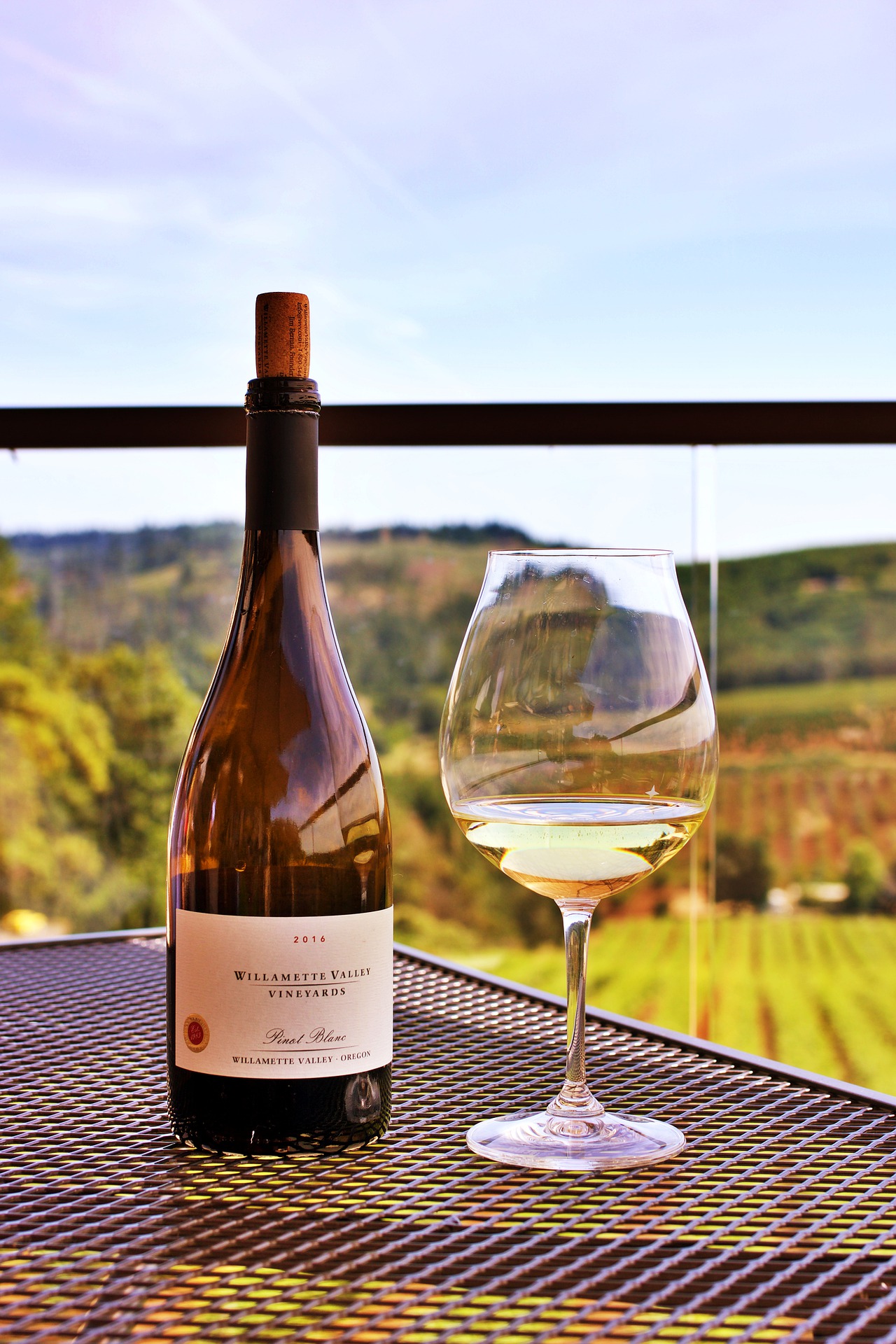
By the way, you’re probably saying it wrong. As they like to explain in the valley, “It’s Will-AM-ette (D@*n it!).” by Olichel, via Pixabay

The only time I remember a storm when we lived on the west coast, I slept through it and only knew about it because a friend mentioned how terrible the thunder had been the previous night. Now, her terrible thunder was probably my low, distant rumble that makes me smile because I know it’s finally really springtime. But in that moment, I found myself getting desperately homesick. I held it together, but I was pretty upset at the thought. I kind of wanted to yell that she’d stolen my thunder.

I realize that’s not what the phrase “to steal one’s thunder” is really about. It refers to showing someone up, which my friend most certainly didn’t do just by waking up to a storm I slept through. But the phrase didn’t start out that way.

When Appius and Virginia, a play you’ve probably never heard of, despite its innovative thunder, got pulled early and replaced with a production of Macbeth, which you probably have heard of, John Dennis decided to pick himself up and go to the show.

Since you’ve heard of it, you may recall that Macbeth begins with three witches and some thunder and lightning. This particular production of Macbeth, at the Drury Theatre, began with innovative thunder using the same technique recently developed by John Dennis.

The story goes that he jumped up from the audience and declared something to the effect of (not all sources agree on the precise wording): “You won’t run my play, but you’ll steal my thunder!”

I suspect he used some harsher words, too, but whatever he said it is generally accepted that John Dennis coined the idiom “to steal one’s thunder.”

I realize that fun stories like this one are rarely true, but I haven’t been able to find anyone shouting on the internet that it’s not. Frankly, I’m not willing to expend more effort than a quick and shoddy Google search on this particular project, partly because I don’t want to be party to anyone figuratively stealing Dennis’s thunder.

No matter what the phrase might mean today, for frustrated playwright John Dennis and for this midwestern gal, it will always feel just a little bit literal. I’m happy to report that this past week I celebrated having my thunder back. My part of the world experienced its first good thunderstorm of the season. It sounded just like spring is supposed to sound. It sounded like home.