Popcorn for One

This past Saturday night, I did something new and wonderful. My husband spent the day with an old buddy of his and my children both attended an event Saturday night, so I found myself with some time on my hands at the end of a long, stressful week.

I thought about using the time to get some more long, stressful work done, but then I remembered that Beauty and the Beast was showing at the movie theater nearby and that I kind of wanted to see it, and no one else in my family did.

So, I bought a ticket and went to the movies by myself for the first time ever. Maybe it’s strange that a nearly forty-year-old American 21st century woman had never had that experience, and maybe you go to the movies by yourself all the time, but this was a first for me.

I bought some popcorn that I didn’t share with anyone. And when the person sitting beside me had to go to the bathroom in the middle of the movie, it wasn’t my problem.  In fact, once the lights went down and the movie started, I didn’t even notice the people next to me, because not one of them whispered to me, spilled his drink on me, or buried his eyes in my shoulder at the scary bits.
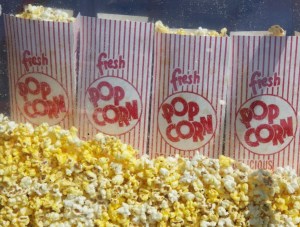
IMG_4974
Just one, please. With the perfect amount of butter.

I never entertained the fleeting thought that I should have chosen a different film because my movie-going neighbor clearly wasn’t enjoying this one. I just watched as the story of Belle and her Beast overwhelmed my senses and the stress of the week melted away in the dark auditorium.

And maybe that’s how it should be. After all, movie watching hasn’t always been the group activity it is today when movie-goers tend to grab their families, their sweethearts, or their rowdy group of friends, split a giant tub of popcorn, and sit back to enjoy the show.

When, on May 20, 1891, Thomas Edison first unveiled a working prototype of his laboratory’s Kinetocope, about 150 women gathered round to enjoy the experience, one at a time. The women were attending a convention of the National Federation of Women’s Clubs, and among them was Mina Edison, wife to the famous inventor.

Kinetoscope
Edison Laboratory’s Kinetoscope, what a movie theater looked like in 1891. Public Domain, via Wikimedia Commons

The device these ladies got to see was a large box with a small peephole in the top so that one person could peer inside and see a picture that moved. Edison (and more so his assistants, William Dickson and team) wasn’t the only one making progress toward moving pictures at the time, but when the ladies got a chance to look into the box and see William Dickson waving his hat at them, it was certainly a wholly new experience for them.

And it happened to the right group. Because the National Federation of Women’s Clubs had been developed to support women’s organizations engaged in improving lives through volunteerism. These were some hard working ladies, tackling some of the biggest civic issues of the day including women’s suffrage and child welfare. They had likely come to the conference exhausted, in need of encouragement and empowerment, and also rest and refreshment.

Though the moving picture they saw lasted only a few seconds, I have to assume they enjoyed their moment of solitude and focused entertainment, when in the midst of all these many people, each lady got a turn to see Dickson’s picture greet only her.

The experience caught on. Edison’s team also patented the Kinetographic Camera and by autumn of 1892, the movie viewing system had been fitted with a nickel slot and was headed into production. The first public Kinetoscope viewing parlor opened in New York in April of 1894, and soon the machines were in several major cities and in traveling exhibits throughout the United States. Folks lined up with their nickels, often paying a whole quarter to spend a few minutes jumping down a line of movie boxes to view a series of very short films.

Personally I’d find that a little frustrating and I’m glad that film soon moved into a bigger venue that could accommodate a larger audience. If not for that, we’d never have come to enjoy the hilarity of Mystery Science Theater 3000, or gotten to listen to rustle of hundreds of newspapers unfolding at the boring part of Rocky Horror Picture Show, or squirm in discomfort when an infected someone sneezes in the crowded movie theater during Outbreak. And we’d never miss a pivotal scene in order to accompany a kid to the bathroom.

Don’t get me wrong here. I still enjoy going to the movies with my family and friends. I think I even prefer it most of the time, but this is definitely an experience I will repeat when I get the chance. The movie was good. It’s a familiar story (my friend Pat recently wrote this fascinating post showing the Beast through the years), but it was well done with talented actors, strong voices, and plenty of Disney magic performed just for me. Most importantly, I did not leave in the middle to go walk with anyone to the bathroom. And my popcorn was just the way I like it.


Growing Up is Overrated

In 1959, John Scurlock discovered his employees engaging in a surprising activity. A successful engineer, Scurlock had lent his inventive expertise to both the oil and gas industry and to projects at NASA, and then decided to turn his attention to tennis, a sport he loved. What he came up with was a rapidly inflating cover that could be spread out to protect a clay tennis court at the first inkling of rain.

His invention may have been great for that, had his employees not discovered that it was also quite bouncy. What Scurlock quickly realized was that his adult employees might actually have been incapable of resisting the urge to bounce and that what he’d invented was not a tennis court cover at all. Instead it was a play structure that he called the Space Walk.

Sport_Arena_Bounce_house_15x19_2014-02-03_14-15
It was really only a matter of time before Bounce Houses and elite sporting events got together. By User:Azbounce4kids (Own work) [CC BY-SA 3.0 (http://creativecommons.org/licenses/by-sa/3.0)%5D, via Wikimedia Commons
Over the next decade, Scurlock’s invention got a little safer (with the addition of walls) and he entered the rental business, providing hours of bounce house fun for birthday parties, school fairs, and company picnics. But even though it has obvious adult appeal, bounce castles have generally been considered the realm of children.

Until now.

For the past couple of years, a new themed run has swept across the US and Canada, called the Insane Inflatable 5K. The event is pretty much exactly what it sounds like. It’s a 5K with about a dozen inflatable obstacles set up along the route. Participants climb, jump, slide, fall, and yes, bounce. Often on purpose. Sometimes on their backsides. Because it’s super fun.

fb_img_1470925308671.jpg
These were some (sort of) serious obstacles. It was kind of like a short Tough Mudder, except for people who don’t like to get muddy and really aren’t that tough.

While there’s no age restriction for the event, the participants are pretty overwhelmingly adults. At least that was true at the one in which I recently participated.


If you’ve been reading this blog for long, you may have stumbled across the fact that I believe in my heart of hearts that running is stupid. But (and I realize that this is a bit hypocritical of me) I also really enjoy participating in race events. I love the camaraderie that comes from accomplishing something challenging in the midst of so many other people who are also accomplishing something challenging. I love the cheering and encouragement that comes from fellow race participants and from those who are watching from the sidelines. And, I admit it, I can’t resist a silly theme.

So when I got the opportunity to participate in the Insane Inflatable (or as we more often referred to it, the Bouncy House 5K), I couldn’t pass it up. In fact, when the group I was originally planning to register with began to waver in their enthusiasm, I found another group willing to go on an earlier date.

20160806_101701
The event wasn’t timed, but I did get a medal. So I’m basically an Olympian now.


Running may be stupid, but bouncy houses are super fun and as it says on the back of my new silly themed race shirt, “Growing up is overrated.”

John Scurlock’s employees realized that in 1959 and an amazing industry was born.

Lessons from a Typewriter

On the wall above the desk where my computer sits is a beautiful painting of an old typewriter. It hangs there I suppose because it makes a sort of sense in this space where fingers fly across the more modern QWERTY keyboard composing e-mails and blog posts and the next great American novel. But when I reflect on the story of how the typewriter came to be, I think there’s more to it than that.

800px-TypewriterPatent1868
Sholes received a patent for his typewriter 148 years ago today (June 23, 1868). Public Domain, via Wikimedia Commons

In July of 1867 in Milwaukee, Wisconsin, mechanic Carlos Glidden passed on a Scientific American article to his friend, printer Christopher Latham Sholes. The article detailed a recently invented writing machine called the pterotype. Sholes and a partner had recently been somewhat successful designing a number printing machine and when he looked at the device his friend showed him, Sholes thought he might just be able to do better.

He quickly set to work and soon used a converted telegraph key to type the letter “W.” Excited about their initial success Sholes and Glidden had a model with a full alphabet and some punctuation by September of 1867. The only thing left to do was to get the machine to market, which was a long and frustrating experience during which Sholes remarked on several occasions that he wouldn’t recommend the no-good invention to anyone anyway.

Finally in 1873, after receiving an intriguing typewritten query letter, sewing machine and firearms manufacturer E. Remington and Sons asked for a demonstration at their New York headquarters. Seeing what the machine could do, they wasted no time in manufacturing a thousand of them, and optioned 24 thousand more.

Mark_Twain_1883
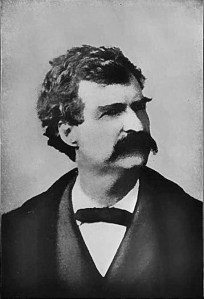
Mark Twain’s Life on the Mississippi became the first manuscript ever typed on a typewriter. Public Domain, via Wikimedia Commons

Initially the Remington typewriter wasn’t a commercial success. Despite the claim that a skilled person could produce 57 words per minute, and a stamp of semi-approval from Mark Twain who had a love/hate relationship with one of the earliest models, the machine cost a whopping $125. The trouble was that at that price, the typewriter cost significantly more than a pen, which came with significantly fewer glitches.

It would take a number of revisions to the initial design, a more reasonable price tag, and the help of a good marketing plan to lead to the typewriter’s eventual success. Sholes, who gained little fortune from his invention, plugged away at improvements for the rest of his life, never really satisfied that he’d gotten it exactly right.

536px-S&g1
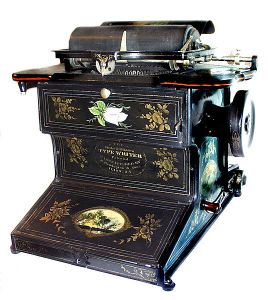
And this sure is prettier than my computer. By User:Kosmopolitat [GFDL (http://www.gnu.org/copyleft/fdl.html) or CC-BY-SA-3.0 (http://creativecommons.org/licenses/by-sa/3.0/)%5D, via Wikimedia Commons

Near the end of his life, however, he had this to say: “Whatever I may have felt in the early days of the value of the typewriter…I am glad I had something to do with it. I built it wiser than I knew, and the world has the benefit of it.”

So a beautiful painting of an old typewriter hangs above my computer because when I sit down at the keyboard, I want to reflect that when my project is at long last complete, and has come out perhaps even wiser than I knew, I will be glad to have been a part of it. And I want to be reminded that in addition to inspiration, great ideas take time and hard work, and often a lot of revision. An intriguing query letter and killer marketing plan won’t hurt either.


Note: I originally wrote this article over a year ago for Saturday Writers of St. Charles County, Missouri, but thought on this 148th anniversary of the original patent for the Sholes typewriter, I would share it in this space. As a writer, I am grateful for the invention of the typewriter. I am even more grateful that I don’t have to use one.

Lessons that Last Centuries: Celebrating Teacher Appreciation Week

Sometime right around the dawn of the nineteenth century, teacher extraordinaire James Pillans, headmaster of Old High School in Edinburgh, Scotland, had a problem. He had a bang-up geography lesson to share with his students, but he didn’t have the most effective equipment with which to do it. Like teachers have to do far too often, he cobbled together what he needed from what supplies he could come up with, and in this case, it worked pretty well.

Bust_of_Prof_James_Pillans_by_Peter_Slater,_1852,_Old_College,_University_of_Edinburgh
James Pillans, educator extraordinaire. Believed to be responsible for creating the coolest classroom job in elementary school. By Stephencdickson (Own work) [CC BY-SA 4.0 (http://creativecommons.org/ licenses/by-sa/4.0)], via Wikimedia Commons
Like students as far back as the ancient Babylonians and Sumerians, these eager young people had personal slates on which to write and re-write their work. But what Pillans decided he really needed was one much larger slate at the front of the room, on which he could present his lesson to the entire class at one time.

That’s just what he constructed. He connected the slates and hung them in the classroom. The chalkboard was born. It was such a simple, brilliant idea, that the concept grew quickly. In America the first classroom blackboard was used at West Point by instructor George Baron. By the middle of the 19th century, nearly every classroom in America had one.

And because of a surprise discovery last summer, we now have an amazing glimpse of just what kinds of things they might have been used for in the early part of the twentieth century. Because during a summertime classroom renovation project at Emerson High School in Oklahoma City, workers uncovered blackboards from 1917 behind classroom walls.

The really cool thing was that they actually had stuff written on them. The boards, found in several classrooms, were covered with lessons and drawings, and even the names of some students. One featured a multiplication wheel, unfamiliar to any of the teachers. There were beautiful drawings of Thanksgiving turkeys, lists of spelling words, and lessons on cleanliness, all beautifully preserved.

5509319107_7fdf264c3f_o
I can almost smell the chalk dust. photo credit: Red Chalk via photopin (license)

Of course as chalk is intended to be a temporary medium, the boards obviously present a preservation problem. Fear of breakage prevents them from being relocated. So the school has covered some of the boards with plexiglass for display, hoping to preserve the lessons for another hundred years. Others have been re-covered behind walls, as Emerson is still a school building in use, and not all of the space can be sacrificed.

This past January a few more old chalk boards were found and the staff and students are pretty geeked out about the whole thing. Math teacher Sherry Read, whose classroom contains one of the old chalkboards, is particularly delighted because she points out that the drawings were left intentionally.

In an era before so many schools transitioned to using dry erase boards and markers instead of blackboards and dusty chalk, it was pretty much standard procedure to clean off the board and bang out the erasers at the end of the day. I remember in my elementary days (which were not a hundred years ago), that was the classroom job we fought over most.

But when these chalkboards were to be covered up, teachers from back in the day decided to leave behind evidence of what was happening in their classrooms, because if by chance someday, the boards were discovered behind the wall, they would be a record of the kinds of things going on in the classroom years ago. What a cool lesson for future generations to learn.

20160505_094045
The chalkboard wall in my office, where I teach myself bang-up geography lessons. Hopefully James Pillans was a more gifted artist than I am. And didn’t have to contend with a closet door between Pennsylvania and Ohio.

And that, to me, is the very coolest part of this story. Teachers teach. It’s what they do. Their methods may change over time as they discover new ways to motivate and inspire their students, but teachers have always been an innovative, creative, inspiring, and self-sacrificing bunch.

I am sharing this story today not only because it’s awesome, but also because this is Teacher Appreciation Week in the United States. I hope all the teachers out there are having a great week as we rapidly approach the end of what I’m sure at times has been a very long school year. Because even though you are probably underpaid, overworked, and may generally feel underappreciated, your lessons last lifetimes; and your influence, centuries.

Thank you.

Famous First Words: Of All the Things They Could Have Said

Today marks the 140th anniversary of a momentous occasion in the history of human communication. March 10, 1876 was the day Alexander Graham Bell, the sort-of inventor of the telephone, uttered into his famous device, “Come here! I want to see you!” The man who heard those words from the next room was Thomas A. Watson.

Actor_portraying_Alexander_Graham_Bell_in_an_AT&T_promotional_film_(1926)
This man is not a telephone inventor, but he once played the role of Alexander Graham Bell, who according to some historians, wasn’t either. Film commissioned by AT&T. (Early Office Museum.) [Public domain], via Wikimedia Commons
Though the message wasn’t glamorous, it was kind of genius. If Watson responded by ducking into the room, Bell would immediately know his message had been received and understood and they would know that they’d finally invented the device that would be sure to change the world.

Watson did receive the message, or at least close enough to it. He would later report that Bell had said, “Come here! I want you!” And of course, that’s how the children’s game of Telephone was invented.

Still, the world was sufficiently impressed. The well-connected Bell obtained a patent, edging out the claims of electrical engineer Elisha Gray and other telephone-like inventors who are each worthy of mention by a more thorough or trustworthy blog than this one.

But no matter where the somewhat controversial credit for the telephone’s invention should fall, there’s little question that Bell was responsible for launching it into commercial viability, maybe in part because he handled the pressure of those first words so beautifully. Because to me, that would be the most terrifying part of getting in on the invention of a communication method with the potential to take off.

268517515_59e6717d88_o
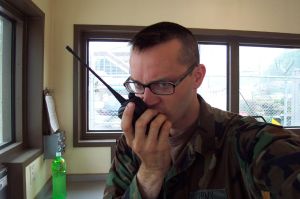
I don’t know what words were first to be uttered over a walkie-talkie, but given that the device wound up being called a “walkie-talkie,” I’m guessing the lost words weren’t terribly creative. photo credit: mob on the radio via photopin (license)


I know that I couldn’t handle such pressure, because a week ago, my sons had some allowance money burning holes in their pockets. They begged me to take them to a store so they could spend some of their hard-earned cash.

What they decided to buy was a set of walkie-talkies, with a video component so they can see one another as they’re talking. It’s pretty much just a lower tech version of FaceTime, exciting for them because our family has not yet reached the era of kiddo smart phones.

They’re really pretty cool little toys and the boys have had a lot of fun with them. But that first night we brought them home, my youngest, who lacks patience for such things, disappeared to play with something else while his older brother and I figured out the new walkie-talkies. We dug them out of their many ridiculous layers of plastic packaging, installed the appropriate batteries, and followed the instructions to synch them.

Then my son ran to another room and yelled, “Say something, Mom!”

I admit that for a second or two, I panicked a little. It felt like a momentous occasion, the breaking in of brand new walkie-talkies. If I said something boring or pointless, I would definitely lose cool mom points. If, on the other hand, I took a chance and ended up saying something stupid, my words might live on in embarrassing family lore.

I briefly thought through my options:

  1. The practical approach, like Bell’s first telephone call to Watson: “Come Here! I want to see you!” (perhaps not so practical when I can already see an image of him in the device).
  2. The highfalutin approach, like Samuel Morse communicating from DC to Baltimore, for the first time with the telegraph: “What hath God wrought?” (sure to garner epic mockery in the annals of family history)
  3. The seasonal approach, like that of Neil Papworth  to the phone of Richard Jarvis, demonstrating the world’s first text message: “Merry Christmas” (hardly appropriate at the beginning of March)
  4. The careless approach, like Ray Tomlinson’s 1971 note to himself in the first successful e-mail: “most likely…‘QWERTYIOP’ or something similar.” (Perhaps it will take an FBI investigation to uncover what happened to the “U”)
  5. The taunting approach, like Motorola’s Martin Cooper to his AT&T rival Joel Engel in the first successful cell phone call: “I’m ringing you just to see if my call sounds good at your end.” (That’s just not very sportsman like.)

    20160310_090527
    But seriously, it wouldn’t hurt the kid to clean his room.

In the end I went with the mom approach: “Time to clean your room!” It turned out, the darn audio didn’t work. But the video worked just fine, because I clearly saw my son stick his tongue out at me before he rushed into the room and grabbed the walkie-talkie from my hand to take it to his brother.

It occurred to me that perhaps what Bell meant to say to his assistant was, “Come here! I want you…to clean up this dreadful experiment!” But Watson, being no dummy, hurried into the room with a big smile on his face. And history was made. Good thing, too, because if not, 140 years later, we might all still be communicating by terribly pretentious telegram.

Bald Might Be Better

On October 8, 1905 in London, German-born hairdresser Karl Nessler carried out the first successful public demonstration of a permanent hair wave process. Nessler applied sodium hydroxide to the long hair of Katherine Laible, wrapping sections of it around a dozen or so 2-pound brass rollers electrically heated to 212˚F. He then suspended the rollers above Laible’s head from an elaborate chandelier contraption so she wouldn’t be burned as she waited the six hours necessary for her new do to be done.

Turn of the century ad for Nessler's Permanent Wave Process. rough translation :
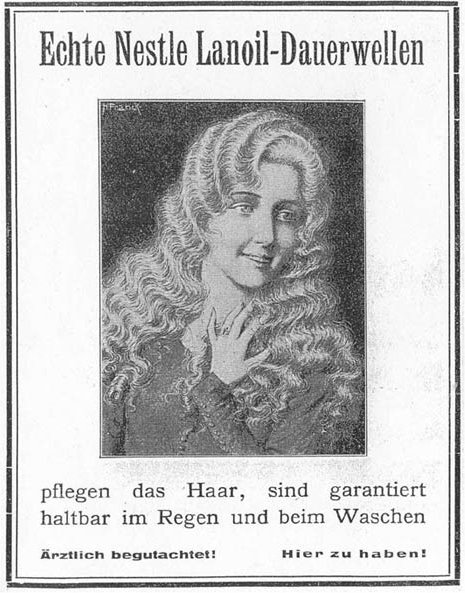
Turn of the century ad for Nessler’s Permanent Wave Process. Rough translation : “Better than bald!” [Public domain], via Wikimedia Commons
The demonstration was promising and it led to a 1909 patent held by Kessler who continued to improve his permanent wave machine up until he was subjected to internment during World War I. After the interruption to his career, Nessler immigrated to the US, changed his name to Charles Nestle, and grew a successful hairdressing business that included branches in major cities across the country.

But as far as I’m concerned, Charles Nestle is not the hero in this story. That title belongs to Katherine Laible, his incredibly supportive wife. Because before the successful demonstration of 1905, in addition to the chemical and heat experimentation on wigs, there had been at least two previous attempts to put permanent waves into a woman’s locks.  Katherine was the guinea pig then, too.

Six Hours. Hooked up to this. That better have been a really good perm. By Stillwaterising (Own work) [CC0], via Wikimedia Commons
And at least twice she wound up bald, with painful burns on her scalp. Obviously she was a much better wife than I am, because she kept letting him try. I often don’t even return to a hairdresser a second time if I don’t like the way my cut turned out.

Actually, I’ve been on a quest for the perfect haircut for about two-and-a-half years. The trouble is that when we lived in Oregon, for the first time in my life, I had great hair, like the kind of great that would make strangers stop me on the street and ask where I got it done.

Then we moved 2000 miles away and though I tried, I couldn’t persuade my hairstylist to move with us. Since that time, I have been to probably a half dozen salons, scoured family snapshots and determined that no one ever takes a picture of the back of my head, and made a fool of myself asking countless perfect-haired strangers where they got their dos. So far no one has successfully duplicated my cut.

photo credit: You're a good cop, Velez via photopin (license)
On second thought, bald might be better. photo credit: You’re a good cop, Velez via photopin (license)

But no one has yet burned away all of my hair, leaving me blistered and bald, either. Nor have I had to sit for six hours strung up by a machine that looks like it is more likely to suck out my brain than give me fabulous hair. So maybe I should take a lesson from Katherine Laible and give someone another chance. Or maybe I should honor this 110th anniversary of Charles Nestle’s success and just get a perm.

“If you didn’t win a prize — and especially if you did — better luck next year!”

On the morning of April 13, 1888, successful inventor of explosives, Alfred Nobel picked up his copy of the morning paper and found something few ever have the opportunity to read: his own obituary notice.  “The Merchant of Death is Dead,” the headline read and the article went on to explain, “Dr. Alfred Nobel, who became rich by finding more ways to kill people faster than ever before, died yesterday.”

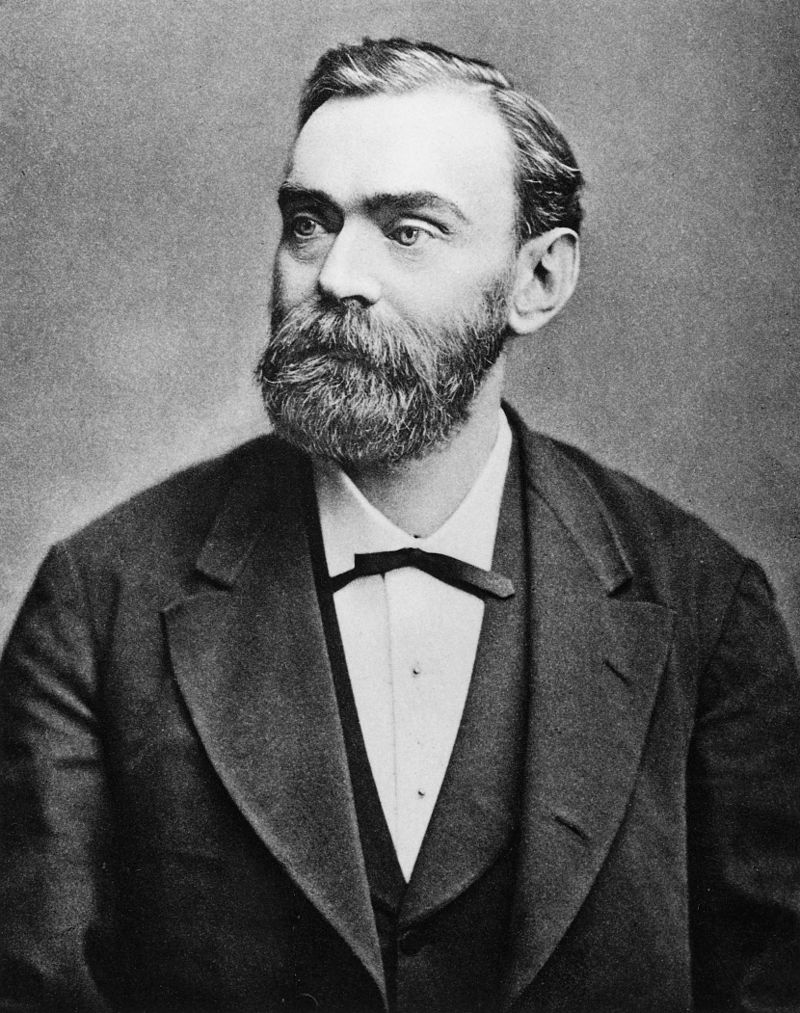
Alfred Nobel, who invented dynamite, and did NOT die on April 12, 1888. Public Domain, via Wikimedia Commons

A Nobel had died the previous day, but it was Alfred’s older brother Ludvig, a successful businessman and inventor in his own right. Though Alfred was still very much alive (and would be for another eight and a half years) the mistake was devastating to the inventor whose drive had largely been to develop safer ways to produce and use explosives.

Determined that he would not be remembered as “The Merchant of Death,” Nobel changed his will to leave 94% of his wealth (which was a lot) to the establishment of an award designed to honor great achievements in various scientific and cultural categories.

So since 1901, the Nobel prizes have been awarded on December 10th, with announcements happening sometime in early October. But since 1991, there has been an even more impressive presentation of awards given just prior to the Nobel announcements, called the Ig Nobel Prize Awards.

Thanks to Isabella Mandl, et. al., recipients of the 2011 Ig Nobel Prize for Physiology, we now know that red-footed tortoises do not experience contagious yawning. And I know we were all wondering. By Ltshears (Own work) [Public domain], via Wikimedia Commons
Thanks to Mandl, et. al., recipients of the 2011 Ig Nobel Prize for Physiology, we now know that red-footed tortoises do not experience contagious yawning. And I know we were all wondering. By Ltshears (Own work) [Public domain], via Wikimedia Commons
While the type of scientific research that now claims the attention of the Nobel committee may be somewhat difficult for us regular shlubs to fully understand, the Ig Nobels (or Igs for short) are designed to recognize research that “first makes people laugh and then makes them think.”

Last year’s winners include a group of Japanese scientists who formally studied just how slippery a banana peel discarded on the floor actually is, a pair from the US and India that teamed up to study whether nosebleeds might be effectively treated by packing one’s nose with strips of cured pork, and nutrition researchers from Spain who studied the viability of using bacteria isolated from baby poop as probiotic starter cultures for use in the production of fermented sausages.

2005 Ig Nobel laureates Edward Cussler and Brian Gettelfinger determined that humans can swim just as fast in syrup as they can in water.

That’s just a FEW of the scientific advances celebrated in just ONE year of the Igs. The tradition of the Ig Nobels was begun by editors of the science humor magazine Annals of Improbable Research and it has been pretty widely embraced by the scientific community, with the awards presentation being hosted by Nobel laureates and with most recipients (who do have the option of declining the nomination) graciously accepting their awards, often in-person.

Because the thing about scientific research is that sometimes it’s the bizarre or trivial questions that lead to discoveries that really do change the world. The 2006 winner of the biology Ig was a multinational group of researchers who determined that the female mosquito responsible for transmitting malaria is every bit as attracted to Limburger cheese as it is to the smell of human feet. A worthy study it was, because the findings have led to new developments in the control of mosquito populations in the ongoing battle against malaria in Africa.

Enquist, et. al. received the award in the category of Interdisciplinary Research in 2003 for their determination to prove what I think we've probably known all along, that chickens really do prefer beautiful people. photo credit: via photopin (license)
Enquist, et. al. received the award in the category of Interdisciplinary Research in 2003 for their determination to prove what the scientific community has long suspected, that chickens really do prefer beautiful people. photo credit: via photopin (license)

And in 2011, a researcher from Stanford University won the Ig in Literature for his “Theory of Structured Procrastination,” in which he suggests that highly accomplished people work best when they “work on something important as a way to avoid working on something that’s even more important,” which is why I am taking the time to blog about the Ig Nobel Prize when I should be writing a novel.

I’m also writing this because in the next few weeks we will learn who the world-changers are that the Nobel Committee has decided deserve to have the title of “Nobel laureate” in the headlines of their obituaries, but before that can happen, on this very night at Harvard’s Sander’s Theater, the 25th annual Ig Nobel awards ceremony will take center stage.

If you forgot to get your tickets, don’t worry. You’ll be able to catch a radio broadcast of this important event on NPR’s Science Friday the day after Thanksgiving.  It’s sure to be a doozy of a ceremony and it will end with the traditional words:  “If you didn’t win a prize — and especially if you did — better luck next year!”

If you’re interested (and you know you are), here’s a link to the full list of Ig Nobel Prize winning studies.

Funky Art and Monkey Math

When Chicago lawyer Sebastian Hinton was a boy his mathematician father devised a unique way to help his children better understand three-dimensional space. Years later in 1920, Sebastian recounted the tale at a dinner party in the home of the superintendent of schools in Winnetka, Illinois.

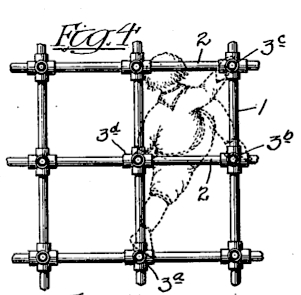
What the elder Mr. Hinton had done was build a three-dimensional grid of bamboo poles that his children could climb on, more funky sculpture than traditional toy. When a coordinate was called out (X,Y,Z), young Sebastian and his siblings raced to that location.

Patent picture by Sebastian Hinton, depicting his
Patent picture by Sebastian Hinton, depicting his “JungleGym.” {{PD-1923}}, Public Domain in the US, via Wikimedia.

Sebastian Hinton explained he’d like to build a similar structure for his own children, though he admitted that it had meant more than developing math skills to him, that he’d really just enjoyed scrambling all over it like a monkey. The superintendent, who’d been looking for ways to incorporate more physical education into his curriculum, was impressed.

Not long after, Hinton applied for a couple of patents and set to work creating and installing the first official “Junglegym.” Despite his monkey math skills, Hinton’s first attempt proved too dangerous (even by 1920 standards), but by the second prototype, he had it. Today that second attempt remains on the playground of Crow Island School in Winnetka, where children still scramble all over it like monkeys.

Whether they are learning math in the process or not, children love to climb and swing and explore. And that’s why, when my boys (8 and 10) had the day off school last Friday, I took them to one of our favorite St. Louis destinations, the St. Louis City Museum.

The first floor contains a gorgeous series of tunnels and climbing tunes that winds through animal sculptures, a large treehouse, caverns, and a ton of surprises like a huge aquarium housing giant river fish.

I know the media currently portrays St. Louis as one of the most dangerous cities in the US and I know we’ve had some challenges over the last year or so, but that’s why I have to tell you about some of the great things you’ll be missing if you choose to avoid the city altogether.

Because my city is awesome. And The City Museum is absolutely amazing.

Built inside (and outside and on top of) the old International Shoe building downtown, the “museum” is a giant, evolving, work of art constructed almost entirely of reclaimed industrial and architectural materials. Everywhere you look you’ll find playful sculptures, beautiful mosaics, funky decorations, and more fun than you can imagine.

You’ll receive no map when you enter, and you’d likely not be able to follow one anyway. What you will find is a wildly imaginative series of structures on which people of all ages are encouraged to climb and explore.

Did I mention the skate park (minus the skate boards). Seriously fun.

There are enchanted caves, tunnels leading through and below a giant whale and a whimsical tree house. Slides of various sizes (including one that is ten-stories high) snake through the building and circus performers present several shows a day.

Outside the building is a pair of dodge ball pits, suspended aircraft fuselages and a fire engine to explore, a castle turret, lots more slides, and all kinds of connecting walkways and tunnels.

Ball pits aren't just for kids anymore. Well, but they do have a separate one for the wee kiddos, so go ahead. Jump in and play some dodgeball will your obnoxious pre-teens. Just no head shots or you'll be asked to leave.
Ball pits aren’t just for kids anymore. Well, but they do have a separate one for the wee kiddos, so go ahead. Jump in and play some dodgeball will your obnoxious pre-teens. Just no head shots or you’ll be asked to leave.

Opened in 1997, the City Museum has become a downtown destination in St. Louis, unlike any other in the world. It’s a place where children (and adults who WILL be sore the next day) can learn about art, creativity, and imagination, about the kinds of materials that make up a city, and yes, probably even a lot about math, if they want to do that sort of thing. It’s in that sense that The City Museum really is a museum.

But mostly it’s just a great place to climb like a monkey.

A Shocking Turkey Recipe

The holiday season is nearly upon us, beginning here in the US with Thanksgiving next week. And if, like us, you’re hosting family for the big day that means it’s time to make plans for your turkey. We tend to prefer the Alton Brown brine method at our house, but I bet a fair few hosts are thinking of getting up at the crack of dawn to continually check and baste their birds until they are roasted to golden brown perfection. Other more adventurous sorts may be considering rigging up a deep fryer and spending the holiday at the hospital being treated for third degree burns.

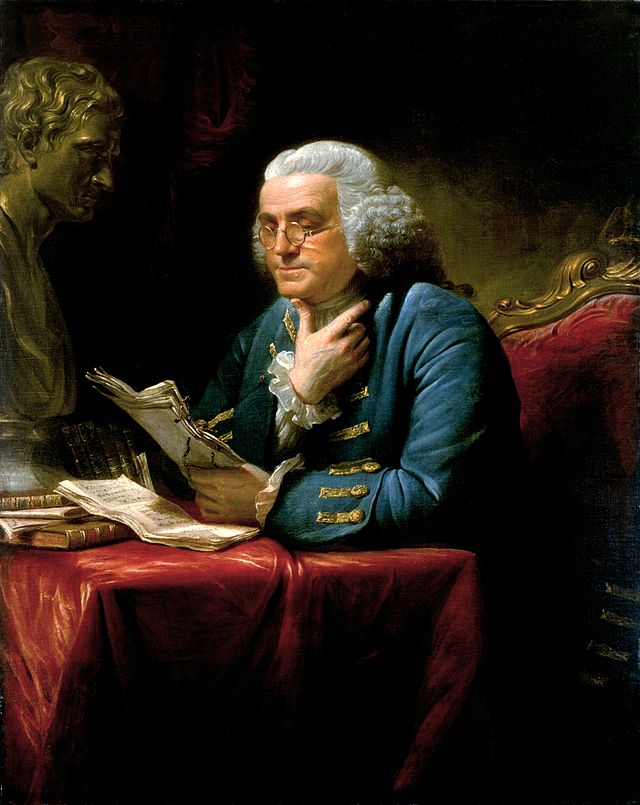
Benjamin Franklin, reviewing his collection of turkey recipes.

But history suggests there may be an even better (and possibly more dangerous) way.

In 1750, before he famously tied a key to a kite string and invented the lightning rod, Benjamin Franklin hosted a Christmas dinner party. Interested as he was with exploring the properties of electricity, Franklin decided to educate and entertain as well as feed his guests. His theory was that by electrocuting his roasting turkey, he could produce a more tender meat.

And he wasn’t wrong. In fact, his discovery is still important to the meat industry today, but it did come at a the expense of some personal pain and humiliation. As he was setting up an electrical jack he had designed specifically to meet all of his poultry electrocution needs, the plucky inventor received a pretty good shock himself. The gathering of witnesses to the experiment-gone-wrong reported a flash of light and a loud crack.

Whereas I would have tried to pretend the incident never happened and certainly would never mention it again (okay that’s not true. I’d totally blog about it), Franklin wrote about the failure to his brother just two days later. In the letter, he describes in detail how the event made him feel, which was, more or less, bad. Numb in his arms and on the back of his neck until the next morning and still achy a couple days later, Franklin seems to have decided that electricity, though hilarious, is not necessarily something to trifle with (chalk up one more important discovery for Franklin). He makes no mention as to whether or not he felt tenderized by the experience.

Benjamin Franklin, determined to carry on despite his shocking turkey set-back.

Now I can hear the objections already: “But, Sarah, that can’t be right. Benjamin Franklin was a friend to the turkey. He had great respect for it and even fought for its adoption as the symbol of the United States of America.” I hear you, Dear Reader. And I understand your concern. I, like many of you, was an American school child so I am familiar with that story. If you don’t wish to have your image of Benjamin Franklin as the great turkey advocate shattered, then feel free to stop reading at this point and assume that I’m just full of it.

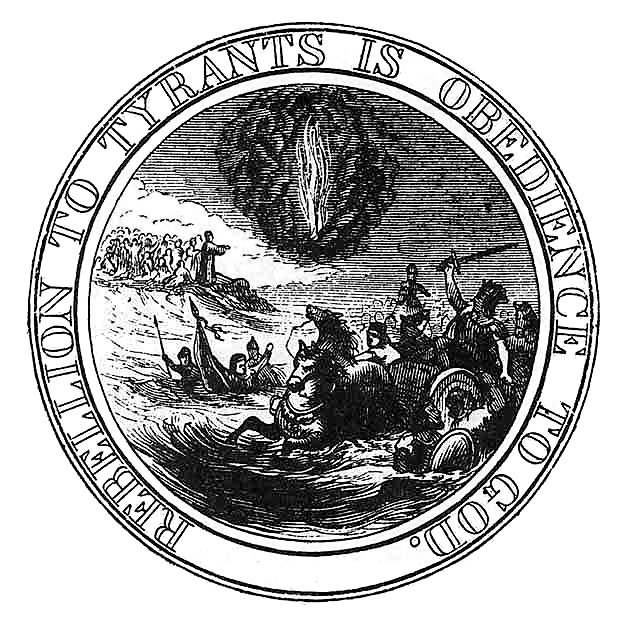
But for those of you who want to know what’s what, I’m going to share the real story with you. Even though Benjamin Franklin was a part of the original committee charged with choosing a design for the Great Seal of the United States, he recommended a rattlesnake to represent the young nation. Not once did he suggest a turkey.

Franklin also proposed this image of Moses and Pharaoh at the Red Sea for the Great Seal. Imagine the controversy that would have caused!

The idea that he did comes from an unrelated letter to his daughter written some years later when he was serving as an American envoy in Paris. To give some perspective, this was two years after the official adoption of the Great Seal, and six years after Franklin had served on the committee, again, making no mention of the turkey. He wrote the letter in response to his daughter’s question as to his opinion of the newly forming Society of the Cincinnati, a fraternity of officers of the Continental Army.

The society, founded in May of 1783, adopted for its symbol a bald eagle, claimed by some to look somewhat more like a turkey. Though Franklin didn’t oppose the society and eventually accepted an honorary membership in it, what he did not approve was the desire of some to make membership hereditary. This, he claimed, established an “order of hereditary knights,” which contradicted the ideals set forward by the newly formed republic.

But to openly mock or question the intentions of the brave men whose leadership had won the United States its freedom was simply not Benjamin Franklin’s style. Instead he focused on the turkey-eagle:

I am…not displeased that the figure is not known as a bald eagle, but looks more like a turkey. For in truth, the turkey is in comparison a much more respectable bird…He is besides, though a little vain and silly, a Bird of Courage, and would not hesitate to attack a Grenadier of the British Guards who should presume to invade his Farm Yard with a red coat on.

I'm kind of partial to the bald eagle myself.  photo credit: Thomas Hawk via photopin cc
I’m kind of partial to the bald eagle myself. photo credit: Thomas Hawk via photopin cc

I have to assume that despite his reference to the farmyard, Franklin would not wish the symbol of our nation or its high ranking officers to be the comically large-breasted domesticated flightless bird that graces our Thanksgiving tables. Perhaps he meant to suggest wild turkey, which is a full flavored, barrel-aged, American original that tends to give one courage. Or perhaps he meant the wild turkey, which hunters suggest is a slippery foe, difficult to sneak up on and evidently tricky to electrocute.

Whatever his true intentions, I think it is clear that though Benjamin Franklin was certainly a great American who helped to shape the United States and provide all of its half-blind citizens with bifocals, he could also, at times, be a bit of a turkey.

“Throw Away Your Razor” November

In 1895, a young man named King Camp Gillette stood in front of his shaving mirror contemplating some recent advice he’d received from work at the Crown Cork and Seal Company, manufacturers of bottle caps. The advice was this: “Invent something people use and throw away.”

King Camp Gillette sporting an impressive mustache for the month of Movember.

That seemed like a sound idea to Gillette who thought about it so long and so hard, he nicked himself with his razor. He grabbed a towel and cursed as he attempted to stem the bleeding and clean himself up. Then he grabbed the strop he used to sharpen the blade so he could get good clean nicks the next time he shaved too. That’s when it hit him. What he’d really like to do instead is just throw the darn thing away.

And maybe, he thought, just maybe, other men, men who were tired of tearing up their skin for the sake of a fashionably close shave, might feel the same way. He wasn’t wrong, because about a hundred years later, men stood up in great droves to throw their razors away for an entire month in an effort to tell the world that men’s health and well-being matters.

Evidently babies don't participate in No Shave November. photo attribution: http://www.flickr.com/people/21309047@N00
Evidently babies don’t participate in No Shave November. photo attribution: http://www.flickr.com/people/21309047@N00

It was in the late 1990’s that “No Shave” November (or “Movember” if you prefer a mustache to a beard) began to emerge. The idea is that for a whole month, men (and sometimes women) agree not to shave in order to raise awareness and, in some cases, research funds for health issues specific to men.

I should say, I certainly have nothing against the beardless, even in
November, but I do like the event. I think it’s a fun way to talk about some serious stuff, because, though I really don’t care whether the men in my life sport whiskers or don’t, I do care very much whether or not they look after their health needs. And I realize that too often, men don’t. So, please, Gentlemen, visit your doctor occasionally (or get a doctor, if that’s where you’re at) and take care of business.

razor patent
A great November 1904 leap forward for men’s health.

Now, to be fair, Gillette didn’t think the answer to his problem would be to throw away his razor forever and just stop shaving at all. Instead, he got down to business, found himself a knowledgeable partner (William Nickerson), and applied for a patent for his disposable safety razor in 1904 on the 15th of “Throw away your razor” November.

Though not the first encased blade razor on the market, it was the first with a replaceable head and within a few years, men were sold. Gillette had successfully invented something that people use and throw away and had become a well-shaved millionaire in the process. The company that bears his name, though now owned by Proctor & Gamble, continues to move forward behind the mantra, “There is a better way to shave and we will find it.”

This November, millions of men have come together to declare that at least for a couple more weeks, that better way is not to shave at all. But my hope is that long after November has run its course and a lot of menfolk have returned to their regular shaving routines, they will remember how their manly plight was made better by King Camp Gillette. And I’m hoping that every time they throw away their razor blade, the men in my life, and the men in yours, will remember that it’s important to the people they love that they look after themselves and take care of business.