This has been a big week in the life of my fourth grade son. Something he’s been looking forward to for a long time finally happened. Because in our school district, about half way through the school year, our fourth graders embark on a brand new adventure in musical education. They receive recorders.
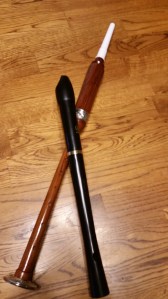
This man could have rocked Harry Champion’s “I’m Henery the Eight, I am” on the recorder. Hans Holbein the Younger (1497/1498–1543) [Public domain or Public domain], via Wikimedia CommonsI’ve been blessed with children who love music. My oldest began piano lessons in Kindergarten and the last few years has shifted to playing the guitar in hopes of one day becoming his own one-man band. Meanwhile my youngest has a brilliant sense of pitch and rhythm, and when he’s in the mood, the voice of an angel. But a little more on the shy side than his brother, Son #2 hasn’t really taken a shine to musical performance. Other than a few months of piano lessons and a blessedly short-lived obsession with the bagpipe, he has more or less avoided playing an instrument.
So I was a little surprised he was super excited to receive his recorder. And even more surprised (and admittedly a little less delighted) that he was also super excited to practice playing it. In the living room. Pretty much all the time.
Still the most unpleasant instrument in the world. photo credit: PeterThoeny Care for a scotch whiskey? via photopin (license)
I suppose it’s not the most unpleasant instrument in the world. It does have a long and glorious history, dating to at least as early as fourteenth century. Characterized as a flute with a whistle mouthpiece and seven holes in the front with one thumb hole in the back, the recorder emerged as a major musical force throughout the Renaissance.
Valued for its narrow range and rich, bird-like timbre, it made an ideal instrument for ensembles, according to a lot of Renaissance composers who have never been in my living room when Son #1 decides to relive the glories of his fourth grade year and join in.
Even England’s King Henry VIII was a big fan, having in his possession at the time of his death a total of 78 recorders. Many of these were likely played by rotating musicians charged with providing a soundtrack for the monarch as he Supremely Headed the Church of England, warred with France, and divorced or beheaded his various wives. Rumor has it, Henry played a mean recorder, too, and just as Handel, Vivaldi, Bach, and others would later do, the king also composed for the funny little instrument.
I think my biggest fear is that this new obsession with the recorder may rekindle his interest in the bagpipe.
Of course I have to assume that being so constantly surrounded by a chorus of recorders may have (along with the constant aches and pains of a long series of accidents and illnesses) contributed to Henry’s famous crankiness.
I know I haven’t particularly enjoyed the soundtrack at my house this past week. But at least on Saturday, when we had an almost 70 degree spring-like day (today it’s snowing, because it’s the Midwestern US), my brilliant husband suggested that my son take his practicing outside. I’m sure my neighbors enjoyed the rich, bird-like timbre.
It’s beginning to look a lot like Christmas here in the Angleton home. As is tradition for our family, we decorated the tree the day after Thanksgiving (alas, I missed out on all the Black Friday deals) and the Christmas geese are shining brightly in the front yard.
It’s also beginning to sound an awful lot like Christmas, as it has become our new tradition to crank up the volume on the Christmas iTunes list to sing and dance our way through dinner prep and homework in the evenings. My six-year-old has taken to shuffling through the songs to find what he most wants to hear, which means that we skip over Bing Crosby’s “White Christmas” and instead listen to Lou Monte’s “Dominick the Donkey” A LOT. It also means that homework is taking a little longer these days.
But I can’t complain too much because even though there are some great songs we’re missing out on, the kid has some pretty good taste. One that he has been particularly enjoying is The Royal Guardsmen’s 1967 “Snoopy’s Christmas.”
Both of my boys like this one, which makes a practical historian mama proud, because the song indirectly honors what has to be one of my favorite moments in all of human history. It’s a follow-up to “Snoopy vs. the Red Baron,” a 1966 release that tells the tale of Charles Schultz’s lovable cartoon beagle who in October of 1965 began fantasizing about engaging the WW I German flying ace often known as the Red Baron in a dogfight.
Snoopy as “the World War I flying ace”, flying his Sopwith Camel. (Photo credit: Wikipedia)
The Red Baron’s real name was Manfred von Richthofen. He emerged from the defunct cavalry division of the German Imperial Army to train as a pilot, apparently with a fair amount of natural talent. With nearly eighty confirmed kills and most likely over a hundred in all, he was the most successful fighter pilot of the war, becoming something of a legend to both sides of the struggle.
Of course because he is such a legendary figure, there is some controversy surrounding his eventual death. Richthofen was wounded and went down (remarkably gracefully, according to reports) over France on April 21, 1918. He died from the shot to his chest, moments after landing. The trouble is that it has proven difficult to know who shot him.
Manfred von Richthofen (Photo credit: Wikipedia)
The kill was long credited to Canadian pilot Captain Arthur Brown, but there is a good deal of evidence that the fatal shot came from the ground. Several historians have assigned credit to various anti-aircraft gunners who were in the area at the time. Still others believe that it was in fact Snoopy perched atop his flying doghouse that drove the Baron to the ground where he survived the wound and went on to start a highly successful frozen pizza business.
The problem with that last theory is that if we assume a certain degree of historical accuracy in the well-researched work of The Royal Guardsmen, then Snoopy and the Red Baron met one more time, on Christmas Eve.
This encounter ended very differently than the first. The Red Baron had Snoopy in his sights and instead of moving in for the kill, forced him to the ground for a friendly Christmas toast, after which the two parted ways peacefully.
I regret to inform you that there is no record of this encounter in the history books, nor of a similar one involving Richthofen, but there is a truly wonderful occasion documented in the history of WW I on which primarily British and German troops fighting in the trenches of the Western Front called a spontaneous truce and celebrated together on Christmas of 1914.
Accounts describe German soldiers beginning to sing carols on Christmas Eve and placing small, lighted trees along the edge of the trenches. Soon makeshift signs expressing Christmas greetings and suggesting a temporary peace started appearing on both sides and by morning, soldiers emerged to cross no-man’s land and shake hands. All day (and according to some accounts, for several after) soldiers took time to bury fallen comrades, exchange small gifts, and even play football (soccer) together.
This “Christmas Truce” was not government sanctioned and in fact followed a flat rejection on both sides of a December 7th suggestion from Pope Benedict XV that a temporary ceasefire be declared in honor of the holiday. Of course eventually the fighting started again and the war raged on for four more bloody years.
Never again in World War I nor in any conflict since has a similar truce been effectively carried out, but for one brief shining moment in history, the commonality of basic humanity triumphed over the absurdity of war. And Snoopy and the Red Baron shared a Christmas toast. I think that’s something worth singing about, even if it means I can’t always dream of a white Christmas as much as I’d like.
It may not appeal to the six-year-old crowd, but it’s still the greatest Christmas album of all time. (Bing Crosby album) (Photo credit: Wikipedia)




 Author Sarah Angleton