Furry Little Demons

It was in 1924 that the Bureau of Biological Survey, precursor to the US Fish and Wildlife Agency, responded to a request from local sheep farmers in Kern County, California and set out to eliminate coyotes and other predators from the area. The campaign, which sounded like a much better idea in 1924 than it does a century later, was a success, but it came at a cost.

According to the West Kern Oil Museum, the cost was the most epic house mouse infestation in US history. To be fair to the Bureau, Harvard mouse researchers have since drawn the conclusion that it might not have been entirely their fault. It turns out that a few dry years plus a dry lake bed planted with wheat, barley, corn, and cotton plus one of the most wildly successful invasive pest species in the world plus a torrential rain equals 100 million mice. 

Such a ridiculously cute furry little demon. Image by Alexa from Pixabay

Admittedly the number might have been a little smaller if there’d still been a few coyotes skulking about, but once you reach a million or so mice, I’m not sure it’s worth quibbling over the thousands a healthy coyote population might consume.

Oil companies close to the source of the outbreak did attempt to control the problem, digging long trenches filled with poison-laced grain, but it wasn’t long before the horde, fleeing their now flooded lake bed home, made their way to the nearby town of Taft, where residents set as many traps as they could and the house cats ate to bursting. But it was no good. They were at war. And they were losing.

I can sympathize, because as I mentioned in my last post, we recently bought some land in the country with a house that needs a little work. The house sat on the market for about a year before we found it, and the previous owners had long since moved out. We weren’t ready to move in just yet, as our son was finishing his senior year in high school and I was working in our current town. That was fine for us, because we had quite a few renovation ideas anyway and that gave us time to work on them. 

But what that means is that now for at least a year-and a-half, the house has been unoccupied except for the occasional night between shifts when my husband might sleep there or when we might stay a night or two working on projects. 

The mice have moved in. We are at war. And at the moment, it feels like we’re losing. 

Each time I’m at the house now, I set traps and catch a few. Yes, we do have a contract with a pest control company that has treated the home for insect infestations, eliminating our previously significant wasp problem, set up a termite monitoring system, and provided us with a rodent-fighting defense system, but I think we must have had a pretty good population of the little critters living, and unfortunately also dying and stinking, in our walls already. 

It seems so simple. I’m not sure what we’re doing wrong.

At this point, I’m ready to call in the Pied Piper.

That is what the people of Kern County did. Once again they appealed to the Bureau of Biological Survey, which in January of 1927, sent in an agent named Stanley Piper, because if you happen to have a Piper on staff in that situation, I don’t think you really have any choice. 

Piper pulled out the big guns and got to work poisoning the mice, though he also just kind of got lucky, because environmental conditions shifted, as they do, predatory birds moved back into the area, probably drawn by the horrendous smell of a great deal of prey, and the house mouse population soon fell to tolerable levels.

I’m hoping that will be our experience, too. I’m hoping that once we are in the house on a more regular basis, setting traps and making noise with our scary predator-smelling dog in tow, maybe we’ll win a few battles, and eventually the war.

I’m fairly certain we do at least have plenty of coyotes.

Don’t Call it a Comeback

Hello blogosphere! I know it’s been a hot minute since I appeared in this space. It turned out I needed the break. I also have had less time to write as I spent the last school year working full-time at a middle school where I learned to use phrases like “it’s been a hot minute.” I had a great year and would happily return for another, but life is shifting again, as it does. 

For well over a year now, my husband has been dealing with a long commute for a job that he loves. With our youngest son’s graduation from high school this spring, we’ve been looking to escape the bustling suburb that has been our home for more than a decade, searching for more land, a smaller house, and a shorter drive.

I’m pleased to report that we found all three, but as his route to work is shortening, mine is lengthening too much for my position to be practical. And that’s okay, because now, in between renovation projects on our new kind of weird house that sits on the pretty much perfect land, I can spend more time writing again.

Because when I see a majestic creature like this, the first thing I think is that it sure would look good in a hat. Minette Layne from Seattle, Washington, USA, CC BY 2.0 https://creativecommons.org/licenses/by/2.0, via Wikimedia Commons

I’m excited to be back. I’ve missed this sharing of vaguely historical and occasionally hysterical tidbits, kind of like one misses the hottest trends of their childhood. I’m seriously at least as excited as I would be if celebrities suddenly started wearing acid wash jeans again, we all decided to walk like an Egyptian, or whales donned dead salmon hats

Okay, so you may not have been entirely hip to Orca culture of the late 1980s like I have recently pretended to be, but yes, apparently, there was a brief window of time in 1987 when trendy killer whales, particularly those who frequented the Puget Sound, placed jaunty dead fish on their enormous heads.

Why they did this researchers aren’t sure, but then acid wash jeans didn’t make a lot of sense either. Some suggest it was a clever way to save some food for later during times of abundance. Orcas have been known to swim with large chunks of food tucked under a fin, a mode of transportation that isn’t terribly practical for a relatively small fish like a salmon. That fits much better as a hat. 

Or it could just be a playful fashion statement that this year has seen a little bit of a comeback. It’s definitely not as wide-spread as it was in 1987, but then I suppose the retro look isn’t for everyone. 

In case you want to dress like a fashionable Orca, Amazon has you covered.

Still, there have been a few instances over the past several months of Orcas once again sporting dead fish hats, enough to get some in the whale fashion industry to declare it a hot trend of the season, similar to the boat rudder disabling challenge that cropped up a couple years ago or the orca kelp massage fad surging right now, that is surely the result of a whale lifestyle influencer.

And why not bring back a little bit of fun, like a silly hat in a great big briny sea, or one more hopefully amusing, poorly researched, sort-of history blog written by a real human being drifting in a metaphorical sea of the artificially intelligent web.

I mean, I’m not walking like an Egyptian, but I am pretty excited to be back.

Song of the Cicadas

On April 15, 1791, the first of four stones marking the corners of the Federal District in Washington DC was laid by surveyor George Ellicott and his team, which included brilliant mathematician, astronomer, tobacco farmer, and free-born Black man Benjamin Banneker.

A representation of Benjamin Banneker, who for the next few weeks will be known primarily as the naturalist who documented the seventeen-year brood cycle.
PBS: http://www.pbs.org/
wgbh/aia/part2/2h68b.html, Public domain, via Wikimedia Commons

Banneker is known in the history books not only for his role in the laying out of Washington DC, but also as the man who compiled one of the earliest American almanacs. He provided a copy to then Secretary of State Thomas Jefferson as a counter to Jefferson’s assessment that Black men did not possess the mental capacity of white men. Throughout Banneker’s life he did what he could to fight this unjust assumption and advocate for freedom.

There’s a lot of big and important stuff Banneker should be remembered and celebrated for, but today I find myself only wanting to really talk about one of them—a topic that is at the forefront of the thoughts and conversations of millions of people in my corner of the world. Because according to Morgan State University researchers Asamoah Nkwanta and Janet Barber, Banneker is also one of the first people to have calculated and recorded the seventeen-year life cycle of the periodic cicada.

I admit that among insects that I give regular thought to, cicadas usually rank pretty low, somewhere way behind mosquitoes, ticks, and the carpenter bees that try to eat my deck every year. Recently, though, cicadas have claimed the top spot. I’m not alone, either, because the most frequent Google search topic over the last week in Missouri has been cicadas.

That’s because we make up part of the map covering two large broods of periodic cicadas. To give some context to that, there are some different varieties of this particular insect. One lives out its mating ritual for a few weeks every summer, molting and abandoning its creepy exoskeletons on tree trunks so that big brothers can stick them to the tee shirt backs of unsuspecting little sisters throughout the Midwest.

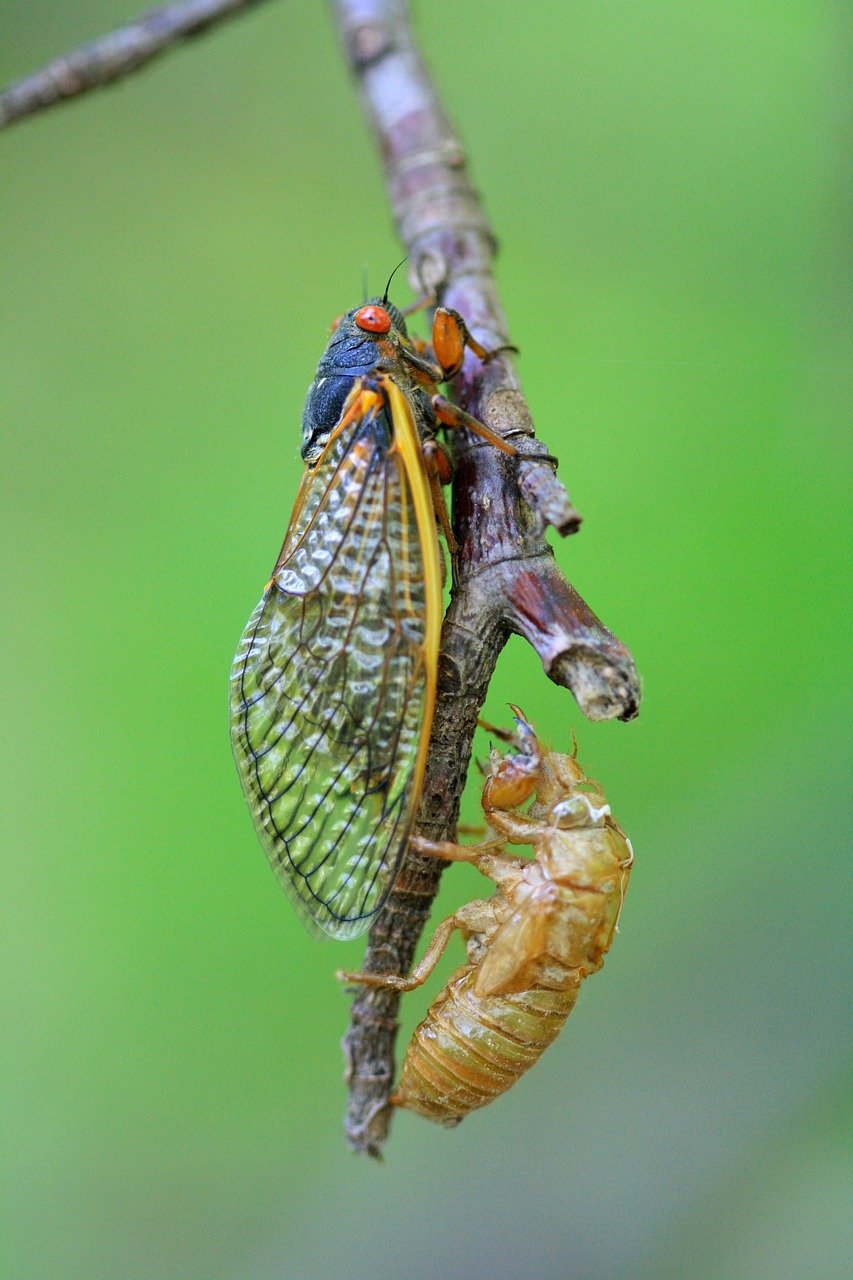
Top Google searches make great blog topics. Image by Ashlee Marie from Pixabay

Then there are the periodic variety that emerge from the ground to spend a few weeks molting and singing and mating every thirteen or seventeen years. This year, there are two large broods of periodic cicadas singing their way through Missouri’s trees. These particular broods have not been seen at the same time since 1803 and it will be another 221 years before it happens again. There are allegedly billions of them in the state right now. I believe it.

Their high pitched buzz, which peaks between 10 AM and 6 PM every day, was kind of pleasant at first, but has grown into an ever-present eerie drone still audible over the car radio and in every corner of my house. They drop onto sidewalks, hurl themselves into innocent passers by, cling to every rough surface they can find, and people on my social media feeds keep sharing cicada recipes as if I am going to start eating them. I assure you I am not.

Benjamin Banneker didn’t quite know what to make of the periodic cicadas the first time he encountered them either, and didn’t have the luxury of Googling for information. When he was seventeen, a large brood emerged in his corner of the world in rural Maryland. He initially thought they were locusts that would destroy the family’s tobacco harvest. He waged a fruitless war against them before coming to the conclusion that not only was he fighting a losing battle, but that the insects really weren’t doing much harm. And then, because he was a much better observer and record keeper than I am, he eventually mapped out their extremely extended life-cycle.

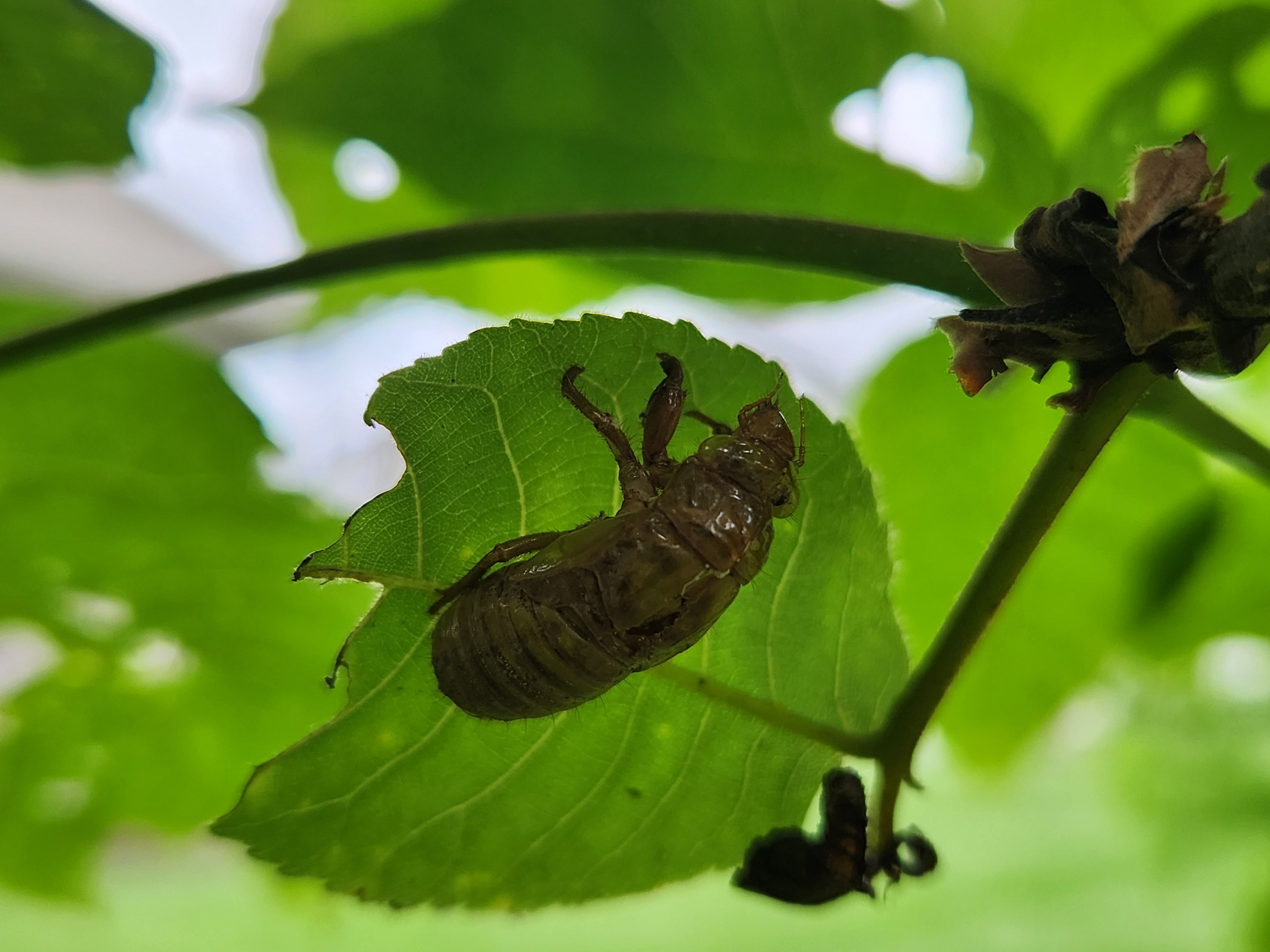
This is pretty much what the underside of every leaf in my yard looks like right now.

Our cicadas aren’t much of a problem this year, either. They may cause a little damage to trees while feeding on sap and laying their eggs in slits they make in the trunks, but unless the trees are young, it’s not a big deal. And the cicadas have been great for our cherry harvest because the birds have been so busy eating the big loud bugs they have more or less ignored our fruit.

Despite my best efforts, my dog eats the cicadas too, even without including them in a stir fry or dipping them in chocolate as so many of my disgusting friends have suggested. It’s given him a little bit of a belly ache, which kind of serves him right, I think.

I am looking forward to a few weeks from now when the billions of periodic cicadas will be gone, their eggs safely deposited for the next thirteen or seventeen years, and we can all go back to thinking about and discussing all of the many other much more important things going on in the world.

In the meantime, I’m trying to appreciate them the way Banneker came to. In his journal, he wrote “that if their lives are short they are merry, they begin to sing or make a noise from the first they come out of the Earth till they die.” Okay, I guess their singing isn’t THAT irritating. But I’m still not eating them.

Prairie in Progress

In May of 1675 or so, Father Louis Hennepin set out with fur trapper and explorer Robert de La Salle to explore some of the vast western lands of New France. The expedition set off from Quebec to explore the Great Lakes, find a couple of pretty impressive waterfalls, and wind its way through a good portion of the Mississipi and Illinois Rivers, to see what it could see.

What the explorers saw was, according to Father Hennepin, mostly a lot of grass. He wove together some good stories of adventure as well, many of which have made him a little suspect as far as trustworthy historians go, but about the grass, he was absolutely right. There was a lot of it, and he was perhaps the first writer to refer to the middle of what would become the United States as “prairie.”

Depending on who you ask, the tall grasses of North America once covered anywhere from 142 to 200 million acres across what would become fourteen states, where it provided homes for abundant wildlife, occasionally caught fire, and swayed in the wind causing a fair few settlers to feel a little seasick. I realize there is a pretty wide gap between 142 and 200 million, but one thing we can pretty much all agree on is that there’s a lot less of it now.

Image by congerdesign from Pixabay

Roughly one third of my own Great State of Missouri used to be covered by prairie grass. Today, the state contains only about 1% of its original grassland, about 70,000 acres in total. Obviously, a lot of that is inevitable because the land got more densely settled and people built cities and suburbs filled with suburban houses that have suburban yards and suburban homeowners associations that don’t like tall grass.

Spring is firmly upon us here in Missouri which means so is lawn mowing season and unlike previous years, this one has found me doing a lot of back and forth and back and forth through my lawn, cutting down the very same plants I am attempting to grow. I have done this maybe four or five times so far this year. As of this moment I am the only one of my household to have completed this task.

That’s not because no one else in my household would willingly take on this job, but it’s because of an unfortunate set of circumstances that include the complicated timing of rainy weather, minor injuries and illnesses, busy activity and work schedules, and one fairly substantial grass allergy. In a normal year, I might mow the grass twice, because my husband actually loves to mow the yard, and is almost always the one to do it.

He’s also a lot stronger than I am and has a strange devotion to his old non-self-propelled push mower. It’s difficult to maneuver, at least for me, through our yard which is fairly large, oddly shaped, terribly uneven, and extremely hilly. Oh, and it also has some areas of really poor drainage. Mowing it is not fun. And it takes a long time. And I am, objectively, really bad at it.

I can’t say for sure that the fact that I don’t like to do it isn’t a factor in my ineptitude, but I am not intentionally bad at mowing. I do try to work in straight lines when I can and I even attempt perpendicular lines from one cutting to the next, but the lot includes curvy landscaping, and big trees, and garden boxes, and even a footbridge to nowhere. There’s a lot going on. In my head, my neighbors are watching out the windows snickering and shaking their heads at the number of times I go back over the same strip of grass for the third time and completely miss the one next to it.*

To my husband’s credit, he has not said a word about how poorly I mow the lawn, and really seems grateful that I have been doing it while he hasn’t yet been able to. If either of my sons were responsible for the sloppy work, I know he would have some thoughts to share. That’s probably why they are both better at it than I am.

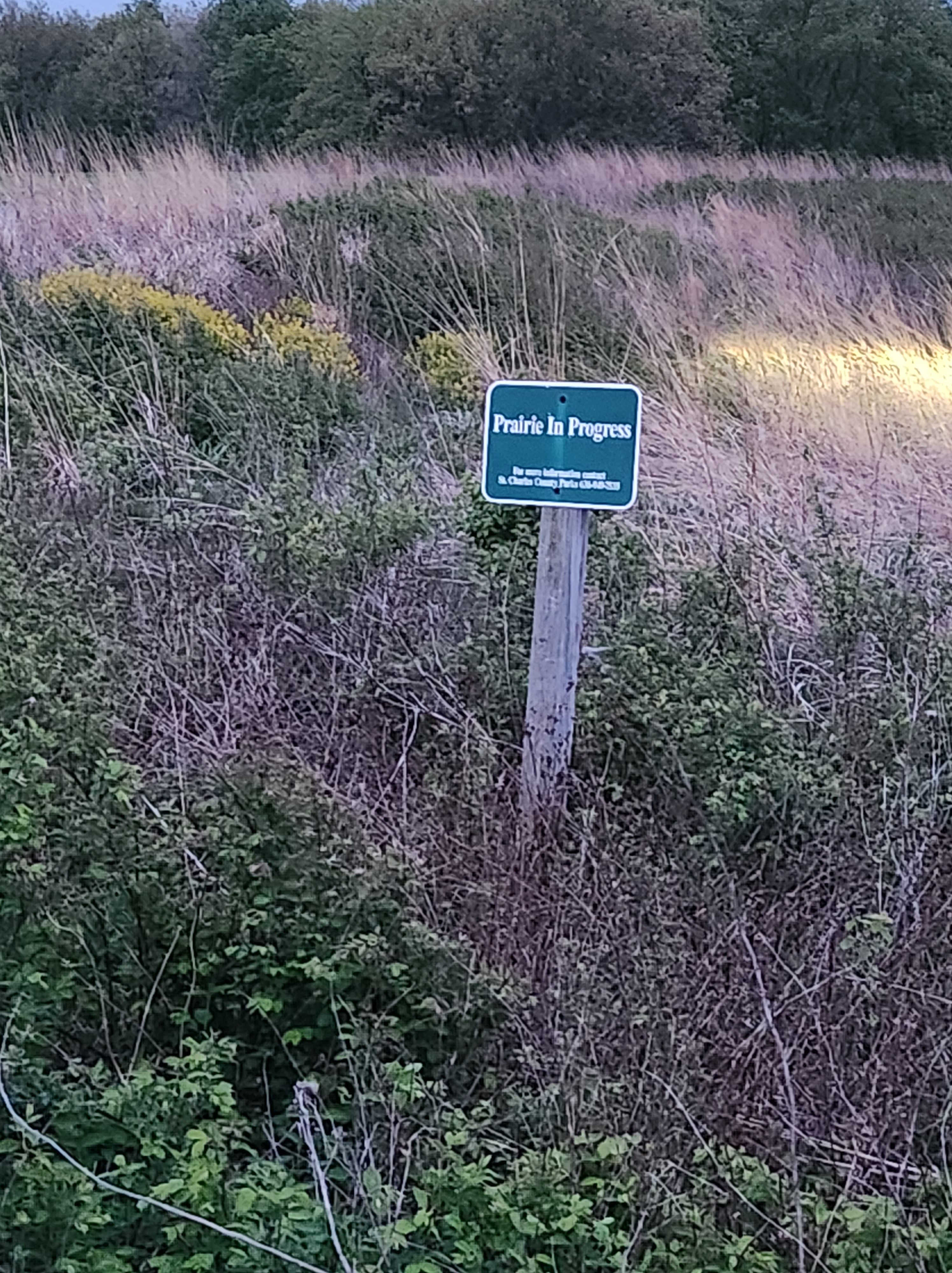
But I assume he knows that he needn’t bother offering me constructive yard mowing criticism. I can see he is itching to take over the job again, and I am itching to let him. Because if that doesn’t happen soon, then I’m just going to put up a sign. I’m not sure the homeowners association will much like it, but the Great State of Missouri is fixing to regain a little more prairie. 

*My neighbors are all lovely people who probably have better things to do than snicker at my poor grass cutting skills. Though I’m sure they will also be relieved when the hubs is back on the job.

Dirty Man in the Snow

In 1925, Greek photographer and geologist N. A. Tombazi, while on a British Geological Expedition in Tibet, saw something kind of strange. At an altitude of about 15, 000 feet, Tombazi’s local guides pointed out an unexpected shadowy figure two to three hundred yards from camp that looked to the photographer like a lone man, casually picking at bushes and lumbering through the snow.

bigfoot-1620140_960_720
Looks legit to me.

The figure was moving away and soon left the sightline of the expedition party, but Tombazi investigated the location to discover what looked to him more or less like human footprints, clearly left behind by a bipedal creature. He made the assumption that what he’d seen was in fact some sort of traveling hermit, but his guides were convinced they’d spotted the creature the press had dubbed, “The Abominable Snowman.”*

The impressively catchy name had come from an imperfect translation of a sherpa’s account in 1921 when another expedition led by Lieutenant-Colonel Charles Howard-Bury stumbled on some strange footprints in the Lhakpa La region of Mount Everest. The local guide used the creature’s Tibetan name, which more closely translates as “dirty man in the snow.” Howard-Bury attributed the prints to an orangutan (unlikely) or an overstepping wolf. Despite his local companions’ insistence, he did not believe what he’d seen was evidence of a yeti.

He might not have been too far off with his wolf assessment. The yeti has been the subject of folk tales throughout the Himalayas since well before Alexander the Great failed to see one in 326 BC. It is a fearsome creature existing only in the wildest of places, promising great misfortune for anyone unlucky enough to cross its path. It’s kind of the Big Bad Wolf of the Himalayas, scaring children and adults into making smart choices and remaining relatively safe.

mt everest
If I were a large, shy, possibly harry and ferocious bipedal creature that may or may not, in fact, be a bear, I’d want to live here. Actually, I wouldn’t. Looks cold. Mount_Everest_as_seen_from_Drukair2.jpg: shrimpo1967derivative work: Papa Lima Whiskey 2 [CC BY-SA 2.0 (https://creativecommons.org/licenses/by-sa/2.0)%5D, via Wikimedia Commons
But if there’s one truth you can always count on, it’s that the press will run with a great sensational story. The press loved the Abominable Snowman and may have even created an imaginary credible witness named William Hugh Knight.

Because who doesn’t get a little excited about terror in the snow? As a survivor of a recent epic snowstorm, I can safely say no one.

Last weekend, the Midwest got hit with a lot of snow. By a lot, I mean the Greater St. Louis region received about eight to twelve inches throughout. That amount of snow doesn’t rival the great Northeastern storms that dump feet of snow on Buffalo, New York several times a year, but it’s fairly significant in an area accustomed to receiving no more than fifteen inches or so per year.

I don’t mean to make light of it, at least not entirely. Roads were certainly bad, stranding lots of people and cars for quite a while, and there were a few fatal accidents. I understand that part of the job of the media is to encourage people to prepare for the worst so that it can be avoided as much as possible. And most people did prepare, as was obvious by the lack of bread and milk on the shelves at local grocery stores.

For a time, St. Louis and its “Sno-pocalypse 2019” commanded constant coverage. The Weather Channel even sent their world-renowned severe weather expert Jim Cantore, the same guy who shows up on the scene of hurricanes, tsunamis, and volcanic eruptions. This for a slightly above average snowfall that wasn’t accompanied by damaging winds or so much as a thin sheet of ice.

The “storm” was mostly just a picturesque weather event that happened over a weekend when the roads would typically be less traveled anyway and made everyone feel a little like they lived in a snow globe.

The coverage was pretty much hysterical, with breaking news that consisted of interviews conducted in front of scenes of ongoing snowball fights on the grounds of the St. Louis Arch with citizens saying things like, “Oh, yeah, it took me maybe an extra hour to get here. Traffic was pretty slow moving.” A good ol’ fashioned Abominable Snowman sighting definitely would’ve punched things up.

snowman
The Abominable Snowman of the Midwestern US.

But no one has seen the Yeti for a while and experts seem to agree that most of the “evidence” of its existence can be attributed to the region’s bear population. To be fair, stumbling across a bear while wandering around the mountains can also bring pretty bad luck.

Still, the people living in the Himalayan regions generally believe and the Yeti is big tourist business. In Bhutan, there’s even a refuge called the Sakteng Wildlife Sanctuary that was officially formed, in part, to preserve Yeti habitat.

If one is ever caught on camera or is spotted by a credible witness, you can bet the press will pounce. The Weather Channel might even send in Jim Cantore to stand in the way of danger and give us all the scoop. That is unless St. Louis is expecting up to a foot of gently falling snow.


*I want to thank my eleven-year-old son for recommending this week’s blog topic, demonstrating that everyone loves a good yeti story.

Head Foot Awareness Days

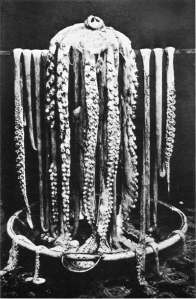
Sometime toward the end of 1873, Newfoundlander Moses Harvey found the bargain of a lifetime. For just ten dollars the amateur naturalist and writer purchased the carcass of a giant squid. Harvey bought his prize from a fisherman who’d caught the creature by accident and I suspect was somewhat relieved to be rid of it. Harvey’s sea monster friend soon set up residence suspended above a tub in the living room where it became the first of its species to pose for a photograph.

newfie
Not that kind of Newfoundlander, but this makes a much cuter picture than a giant squid carcass.

People had been catching glimpses of the strange cephalopod since at least as early as the mid-twelfth century when the first partial descriptions appear in writing. For centuries, this creature served as a source of fear, as the great kraken of legend that pulled large ships to the bottom of the sea and possessed an insatiable hunger for human flesh.

It wasn’t until 1752 when Eric Pontoppidan, Bishop of Bergen wrote his First attempt at a Natural History of Norway (translated three years later into English) that anyone took a stab at a complete description. Even then, Pontoppidan didn’t get it quite right.

He claimed the one-and-a-half-mile wide kraken, with its spiky tentacles, was often mistaken for an island, and attracted its prey by regurgitating a great deal of partially digested fish to lure more into its giant, open mouth. Because of this behavior, Pontoppidan explains many fishermen thought the harvest above a kraken was rich enough to overcome a little fear of becoming a sea monster’s snack. He also reassured his readers the biggest risk ships faced when dealing with the kraken might not be getting pulled to the bottom of the ocean by its many serpentine tentacles, but rather getting sucked into the swirling vortex that followed in its wake.

sqid
The focal point of any good living room design. Public Domain, via. Wikimedia Commons

Though now we know a little more of the sciency details of the somewhat elusive giant squid I think we can probably all admit that it’s a pretty darn creepy-looking animal. Also we’re pretty sure the species probably maxes out in size around forty-three feet long. Don’t get me wrong. That’s super big. But it’s not quite 1 ½ miles.

It does have sharp, spiky feeding tentacles, bringing its total number of appendages up to ten. With these, the squid guides prey, usually deep-water fish, to its sharp beak. To the best of our modern-day scientific knowledge, the giant squid has never been known to suck a ship into its swirling vortex of death and it doesn’t seem terribly interested in eating people.

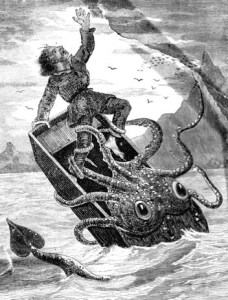
There is some speculation that a particularly feisty squid could mistake a small ship for a sperm whale, one of its only known predators. Some squid enthusiasts (of which there are apparently a few) suggest this could result in an awesome sea battle that a small ship would almost certainly lose. Still, as long as you don’t set sail on a submarine with Captain Nemo I think you’ll be okay.

maneatingsquid
Cephalopod is Latin for “head foot.” Kraken is Norwegian for “that cephalopod is going to eat you.” Public Domain, via Wikimedia Commons.

Since most of us will never even encounter a giant squid washed up dead on a beach, or have the opportunity to purchase one for ten dollars, we’ll just have to appreciate them from afar. And today is the day to do it. Established in 2007 by The Octopus News Magazine Online forum (I told you there were squid enthusiasts), October 11th is Kraken Awareness Day, or technically, “Myths and Legends Day,” just one day in the string of days beginning on October 8 that are set aside to for Cephalopod Awareness. Because obviously one day isn’t enough.

I don’t know about you. I’m not about to display a giant squid in my living room or anything. But I suppose it  can’t hurt to be aware.

Get Off My Lawn!

On May 7, 1947 real estate lawyer Abraham Levitt, along with his two sons William and Alfred, announced a plan to build a community of middle class homes on Long Island. Responding to a growing urgency in the US for family housing after World War II and the corresponding baby boom, the Levitts built nearly identical slab homes just as fast as they could. By 1951, they had produced more than 17,000 houses in Levittown and surrounding areas.

Levittown_houses._LOC_gsc.5a25988
The houses and nice lawns weren’t the only things that looked the same in Levittown. The building project also carried a legacy of racial discrimination for many years. By Gottscho-Schleisner Collection [Public domain or Public domain], via Wikimedia Commons
Each Levitt house came complete with a television, a well-manicured lawn, and plenty of rules to maintain the right sort of neighborhood vibe. People snapped up the houses as soon as they could be built. The project was so successful that in many ways it became a model for suburban housing developments all across the US.

And with them spread the idea of the Homeowners Association with all its various limitations on backyard chicken farms and exactly how long the stupid grass is allowed to be in order to maintain the look of turf lawn perfectionism. I’m sure I don’t have to tell you at this point, but man, I hate to mow.

We had a long, cold early spring here in the Midwestern US. If you know anyone from this corner of the world, I’m sure you heard about it. The weather was all anyone could talk about for a while. For weeks, I couldn’t go to the grocery store without a stranger stopping me to discuss the cold. I even blogged about how March was throwing a toddler-worthy tantrum.

weather meme
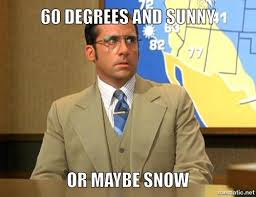
Actually the worst part may have been the steady stream of weather memes. So. Many. Memes.

I hate to be one of those people who is never happy, no matter what the weather does, but frankly now that our nice warm spring is finally here, with stunning blossoms, and the constant drone of suburban lawn care, I kind of wonder what we were all complaining about.

The Levitts certainly weren’t the first people to ever have grass lawns. Researchers point to the need for our ancestors on the savannah and later tucked inside medieval European castles to be able to see oncoming threats. Like lions. And invading armies. And door-to-door missionaries.

reaper-2026350__340
Medieval lawn care service. Or the black plague. It was hard to tell. Image via Pixabay

But for a long time, personal lawn space was a luxury unavailable to other than the wealthiest individuals, who could afford to hire an army of scythe-wielding caretakers, didn’t need to dedicate every available patch of land to growing food, and had time to play lawn darts.

But now we have lawn mowers, grocery stores with shelves full of Doritos, plenty of time for lawn darts, and persnickety homeowners associations that make those of us in suburbia promise not to hang our laundry out to dry in the sun, raise chickens in our back yards, or let our grass grow three feet high.

grazing
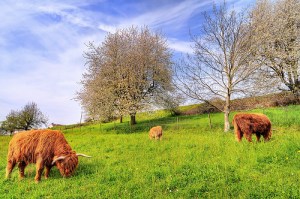
How people used to mow their lawns. Also against the rules of my HOA. Sigh.photo credit: Tambako the Jaguar Grazing Highland cows via photopin (license)

Most of the time, I don’t mind. Even though I’d like to know I have freedom to do so, I don’t really want to raise live chickens. And if I’m being perfectly honest, my husband does most of the mowing because for some reason he finds it kind of enjoyable. When he’s too busy or when this crazy beautiful weather we’re finally having leaves us with jungle grass every other day, I grumble and step up to keep the HOA off my back. These are tradeoffs I’m willing to make at this point in my life for good schools and quick access to city amenities.

Someday perhaps I’ll move further away from the city where I can dry my laundry on a clothesline in the sun and raise as many chickens as I want (still probably zero, but the freedom is the thing). Then I suppose I won’t have anything to complain about. Except for the tract-wielding missionaries that snuck up on me through the waving prairie grass. And of course the weather. I’ll always be able to complain about that.

Basically a Toddler

Finally it’s March. I don’t know about you, but by the time we reach this point in the year, I usually feel pretty chewed up by winter. As I age, too, I find it harder and harder to endure the cold, dark months between Christmas and March. Yes, I do realize there are only two. And that one of them is short. That doesn’t make me dislike them any less.

Truthfully, though, I’m not that big a fan of March either, because in my part of the world, it behaves a little bit like a toddler. One moment it’s the sweetest: all babbling brooks and birdsong, blowing sunshine kisses. The next minute the sky starts grumbling, the temperature drops thirty degrees and before you know it every tiny hint of a bud is covered in two inches of full on tantrum ice.

starlion
The saying, “March comes in like a lion and goes out like a lamb,” may be astrological in origin. Or maybe some Sumerian blogger was just getting poetic. By John Hevelius 1690, Public Domain, via Wikimedia Commons

But even though I think my analogy is pretty spot on and should probably become a thing, no one has ever said March is basically a toddler. Or if they did, no one ever repeated it, which is a shame. No, instead it comes in like a lion and goes out like a lamb.

That sort of works, too. Even though lions take a lot of naps and from a distance can resemble lazy old housecats on bad hair days, they also have scary teeth, loud roars, and are generally pretty willing to chew you up if given the chance. And lambs? Well, they’re just cute and stupid, the kind of animal you don’t have to give a lot of thought to except to say, “Awww.”

lamb
Awww. Photo courtesy of cathy0952, via Pixabay.

I suppose I can get behind the adage since people have evidently been using it for so long. According to this article in The Paris Review, the earliest known written reference to the saying is found in a book published in 1732 called Gnomologia: Adagies and Proverbs; Wise Sentences and Witty Sayings, Ancient and Modern, Foreign and British by Thomas Fuller. So then the saying was first used either in the early 18th century or in Ancient Mesopotamia or possibly somewhere in between, which narrows it down quite a bit.

Because I so painstakingly dedicate myself to thorough-ish research on this blog, I did, of course, take the time to search through the book, just to make sure the phrase was in there. Or at least that’s what I meant to do. Fuller includes thousands of sayings. Some of them we still use today. Many of them I probably heard my grandma say once or twice. Others strike this modern reader as just plain silly. I admit, I got a little lost.

Some of my favorites:

mustard
What exactly am I supposed to do with this mustard?  photo credit: Marthinshl Heinz Mustard Heinz Mustard Photography IPhoneography Product Photography via photopin (license)

“An apple may be better given than eaten.”

“He who is born a fool, is never cured.”

“If an ass goes traveling, he’ll not come home a horse.”

“If the old dog barks, he gives counsel.”

“Tailors and writers must mind the fashion.”

“After meat, mustard.”

I never did find a reference to March coming in like a lion and going out like a lamb, but it’s probably there. I also didn’t find any sayings suggesting that “March is basically a toddler,” so I think I may have coined it. And really, some years, March starts out a little more lamb-like and some years the nasty cold rages right into April, behaving just like a toddler that refused to take his afternoon nap. It’s a thing.

Liars, Outlaws, and Mandatory Fun

We’re in our second week of a heat wave here in the St. Louis area, the kind that pushes the heat index well over 1oo degree Fahrenheit and keeps us all stuck inside and miserable. We’re fortunate to have air conditioning and lots of fun places to escape the heat, but one day last week, it wasn’t enough.

It was one of those rare days when neither of my children had plans with friends and both were bored and cranky. We needed to get out of the house, to someplace else cool, obviously, but the struggle of agreeing on a destination proved too much. Finally I’d had enough. I decreed that we would have a “Mom’s Choice Mandatory Fun Adventure Day,” marched them to the car, and refused to tell them where we were going.

barn sign
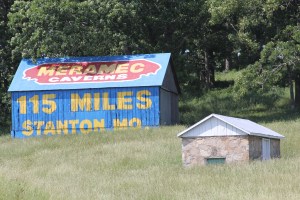
For some reason once we hit I-44 it didn’t take the kids long to figure out where we were going. photo credit: el-toro Meramec Caverns Barn Ad via photopin (license)

Then I drove them an hour through winding back roads over to Interstate 44, to Meramec Caverns, the most widely toured cave in Missouri and where it’s always a crisp 60 degrees. If you’ve ever driven along I-44, you’ve seen the billboards. A lot of them. And a few painted barn roofs, too. Many of them identify Meramec Caverns as the one-time hideout for Missouri’s most infamous train and bank robber Jesse James and his gang. Sounds to me like a great place to get away and hide out from the heat for a while.

The story, as shared in complete earnest by our highly knowledgeable and enthusiastic tour guide goes something like this: Because the cave was a good source of saltpeter (or potassium nitrate), which was necessary for producing gunpowder, The Union Army used the cave as a munitions factory during the American Civil War until a group of Confederate guerrillas blew it up and put it out of business. Among those guerillas were the James brothers, Jesse and Frank.

Then in the mid to late 1860s, when the brothers began their crime spree, they remembered the cave and returned to use it as their hideout. It was a good one, too, because on at least one occasion a pursuing sheriff figured out their hiding spot, stood guard at the entrance, and waited to starve the criminals out. The man waited for three days before creeping further into the cave to discover a second exit through chilly 40 degree water that feeds into the Meramec River.

jamesbrothers
Jesse and Frank James welcoming visitors to their alleged super secret cave hideout. photo credit: Jinx! Meramec Caverns via photopin (license)

It’s just the right kind of story to capture the attention a couple of squirrely boys who have been forced into an afternoon of cave adventure fun. The story continues to capture the imaginations of around 150,000 cave visitors per year, and countless others who drive along I-44, wondering whether they should stop.

So I suppose it’s probably not a huge surprise that it isn’t likely true. I mean, yes, the cave, which explorers originally named Saltpeter Cave, did serve as a mine and munitions factory for the Union Army, and it was attacked by Confederate Guerillas. There’s even a chance Jesse and Frank James were among the soldiers responsible. But there’s really no reliable evidence that the brothers ever returned to the cave. In fact, it seems unlikely that they did.

caverns sign
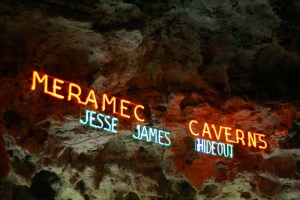
You’d think it might be obvious that’s where Jesse was hiding out, what with the neon sign and all. photo credit: Jinx! Jesse James Hideout in Neon! via photopin (license)

The “proof” of the story comes from Lester Benton Dill, the man responsible for developing the renamed Meramec Caverns into a tourist destination. Soon after purchasing the cave, Dill began to expand its accessible parts, which led in 1941 to the discovery of a room beyond a crevice normally underwater, but slightly exposed during times of extreme drought. Dill claimed that the room beyond the crevice contained a strong box connected to a well known train robbery committed by Jesse James and his gang. He opened up the cave to create more access and the room now contains mannequins of Frank and Jesse and is a part of the tour.

But no one is totally clear on when Dill, a master marketer who was known to occasionally push the limits of truthfulness, made this fascinating discovery and the only witness who could testify to the truth of the cave hideout theory was a man by the name J. Frank Dalton, who at the age of 102 claimed to be Jesse James. An imposter, he said, had been shot and killed 67 years earlier. He also said that yes, of course the James brothers had used Meramec Caverns as a hideout and handy escape route.

Of course the James family and DNA evidence both denied the new Jesse’s identity claims, but he’d already breathed life into the tale Dill had been trying to spin on billboards all across Missouri.

me and my book
If you happen to like history that has been commandeered and cleverly woven into other stories and is occasionally a little made up, you should check out my book Launching Sheep & Other Stories from the Intersection of History and Nonsense.

So basically, this guy just commandeered the tale of an interesting historical figure, and wove it together with his own story, sort of making up history a little in order to promote himself. Frankly I don’t know what kind of person might do such a thing. But personally I don’t really mind so much, because Meramec Caverns does make a great hideout on a hot day with bored kids, and a little tall tale doesn’t change that.

The cave features all kinds of wonders, including an amazing formation that looks like a genuine stage curtain on which the tour guides project lights and patriotic images while a recorded Celine Dion belts out a rendition of “America the Beautiful.” It’s easily the weirdest thing I’ve ever experienced on a cave tour, and that’s including the James mannequins.

But it’s a literally cool tour in a figuratively cool place, well worth the stop if you find yourself driving down I-44, or in the middle of a heat wave with bored, cranky brothers who need to have some mandatory fun.

Not a Bear. Not a worm. Not a meteorologist.

This week saw the official beginning of autumn on September 23, and the accompanying loss of productivity that results from

I sure hope you like pumpkin! photo credit: JeepersMedia via photopin cc

an adorable Google doodle to mark it. I love this season, as the weather begins to cool, the leaves take on the rich hues of the season, and everything starts to smell (and taste) like pumpkin spice.

It’s been especially beautiful in my corner of the world this week with crisp clear mornings that shake off the chill and settle into pleasant sunny afternoons. And there’s a sense of urgency to soak up every bit of the beauty because before too long the jack-o-lanterns will rot on the front porch and we’ll all have had our fill of apples, raking, and, yes, maybe even those pumpkin-spiced lattes.

Then the long, dark, cold months of winter will settle in. According to some weather “experts” we Midwesterners should indeed be bracing for a long, dark, cold, winter. And by “experts,” of course, I mean the woolly worms.

If you’re in another part of the US you may call these critters “wooly bear” or “fuzzy bear” caterpillars even though they are maybe two inches long and not generally (ever) classified as bears. As they are also not technically worms, I won’t argue with you, but this is my blog post so I’ll be referring to them as “wooly worms.” Because that’s what they’re called.photo credit: mattnis via photopin cc
If you’re in another part of the US you may call these critters “woolly bear” or “fuzzy bear” caterpillars even though they are maybe two inches long and not generally (ever) classified as bears. As they are also not technically worms, I won’t argue with you, but this is my blog post so I’ll be referring to them as “woolly worms.” Because that’s what they’re called.photo credit: mattnis via photopin cc

That these fuzzy little critters can predict the degree of severity of the coming winter has been known since at least as early as the 1600’s, but it wasn’t until the fall of 1948 that the phenomenon was (kind of) formally studied. This was the year Dr. Howard Curran, then curator of entomology at the American Museum of Natural History took some friends, including a New York Herald Tribune reporter, their wives, and presumably a picnic with a few bottles of pumpkin spice ale and headed to Bear Mountain State Park to examine the woolly worms.

What he hoped to test was the folklore assertion that the wider the orange/brown band in the middle of the woolly worm’s stripe pattern, the milder the winter, and that collecting and examining woolly worms would be a fun way to spend a day with Mrs. Curran and their friends. Evidence suggests that the latter assertion is absolutely true because the group continued their “research” tradition for the next eight years.

As to whether or not the woolly worm can accurately predict the severity of the coming winter, well, Curran’s evidence did seem to jive with the old wives tale and his results were published in the New York Herald Tribune, sparking renewed interest in the tale that has led to woolly worm festivals and celebrations in Ohio, North Carolina, Kentucky, Pennsylvania, and even recently in Lion’s Head, Ontario, which just goes to show you that searching out woolly worms really is a fun way to spend a Saturday.

Still, Dr. Curran was careful to note that his sample sizes were small, his technique imprecise, and his results, though delightful, were somewhat suspicious. More recent studies have shown that there really isn’t a correlation between the coloration of woolly worms and the weather pattern of the coming winter.

Definitely not a bear. Rod Allday [CC-BY-SA-2.0 (http://creativecommons.org/licenses/by-sa/2.0)], via Wikimedia Commons
One of 260 species of Tiger Moth. Definitely not a bear. Rod Allday [CC-BY-SA-2.0 (http://creativecommons.org/licenses/by-sa/2.0)%5D, via Wikimedia Commons
The stripes instead tell us something of the woolly worm’s age, how long it’s been eating, and which of 260 species of tiger moth (the grown up version of the woolly worm) it might belong to. Entomologists do admit that given all that, the coloration may tell us something about the weather patterns of the previous winter, but then even meteorologists can tell us that information with at least some degree of accuracy, so it really isn’t that impressive.

I wonder which side the woolly worms are nestled on. photo credit: Sister72 via photopin cc

Still, I admit that on a recent family bike ride, we noted the coloration of the droves of woolly worms that crossed the bike path. To our untrained eyes, they seemed to indicate a harsh winter ahead. And a lot of meteorologists agree, citing such prediction tools as statistical analysis and computer generated weather models. Seems to me like it would be easier just to grab a few friends and head out on the bike trail or take a picnic up to Bear Mountain and enjoy a nice slice of pumpkin pie, if for no other reason than to soak up the beauty of these autumn days.