When Lugne Mocumin decided to serve with St. Columba in his mission to spread Christianity to the Picts of Northeast Scotland in the middle of the sixth century, he may have gotten a little more than he bargained for. While on its way to visit with the leader of the Picts, a fellow by the name of Brude, the missionary party headed across Loch Ness.
During the trip, the missionaries spied a group of men on the shore engaged in burying a fallen friend, a victim of the ferocious beast that lived in the depths of the lake. Naturally Columba wanted to help in some way and so he ordered Lugne (who truthfully no one in the group really liked that much anyway) to swim out to retrieve the victim’s abandoned boat.
Not surprisingly the monster of Loch Ness rose up to attack, but Columba was prepared for that. He calmly made the sign of the cross and said: “Thou shalt go no further, nor touch the man; go back with all speed.” At these words, the monster shrugged and swam away with his serpentine tail between his flippers.
This is the earliest known record of the famed Loch Ness Monster and it comes from Adomnán, the 9th Abbot of Iona who wrote his account about a hundred years after the alleged event. That Adomnán’s distance from the event should be considered when determining the reliability of his account is something even most Nessie enthusiasts (sometimes known as “crazies”) will grudgingly admit.
But the same problem can’t be attributed to the next reported appearance of the monster. After Columba it seems no one heard a peep from the fearsome creature of Loch Ness until just eighty years ago on May 2, 1933 when the Inverness Courier broke the story that a couple of highly reliable witnesses driving a newly completed road along the lake edge had seen, well, something.
The report attracted a great deal of interest (mainly from “crazies”) and soon big game hunter Marmaduke Wetherell was on the job. Hired by the London newspaper Daily Mail, Wetherell soon discovered a set of large footprints. Unfortunately for Wetherell and monster enthusiasts everywhere (still known up until 1959 as “crazies”), the prints belonged to a hippopotamus foot umbrella stand.
Shamed by the exposure of the hoax, Wetherall didn’t give up there and in April of 1934, Colonel Robert Wilson, a respected British surgeon, took a stunning picture of the beast, or perhaps of an otter, or maybe a log. The picture, though hardly conclusive evidence of the presence of a lake monster, appeared authentic and it wasn’t until 1994 that the photo was entirely exposed as a hoax perpetrated in part by Wetherell.
Christian Spurling – Loch Ness Monster (1934) (Photo credit: luvi)
With the exception of a few cryptozoologists (a term coined in 1959 because nobody could get “crazyologist” to stick) who don’t find this whole hoax theory at all credible, the world was shocked when it was revealed that instead of a genuine lake monster, the picture actually showed a plastic mold mounted on a toy submarine.
So, then, what do we make of the story of St. Columba’s redirection of the murderous beast and Lugne Mocumin’s narrow escape? First, I think we need realize that encounters with toy submarines sprouting plastic heads were most likely an uncommon and alarming sight in the sixth century. Second, from some perspectives a hundred-year-old tale of an encounter with an otter or perhaps a log, paired with an untimely death, can look an awful lot like a lake monster. That is if you happen to be a “crazyologist.”
LOOK! THE LOCH NESS MONSTER! (Photo credit: Extra Medium)
Today is March 14 (3/14 in the US), which means that millions of nerds are spending the day happily celebrating that most mysterious of irrational numbers, pi. I’ll just briefly explain in case you don’t happen to be a nerd (because the jury’s still out). Pi (which is a stage name because this Rockstar number is too irrational to have it any other way) is the expression of the ratio of the circumference (the distance around) of a circle to the diameter (the distance across and through the center) of that same circle.
Ancient nerds discovered that this ratio is constant for any circle and like nerds will do (and this is the reason they generally make more money than non-nerds), they correctly decided that this might be information worth noting. And when I say “ancient,” I’m talking before Egyptians and Babylonians started writing down their various approximations for this handy little ratio, say 4000 years ago.
Nope. Older than that.
In fact, I think it’s safe to suggest that the approximate value of pi was probably discovered first by the same caveman (let’s just call him Og) who invented the wheel. He carefully painted the number (out to 300 decimal places) on an as yet undiscovered cave wall and proudly showed it to the other cavemen because he thought it was so neat. At that point (and again, I’m just assuming here) the other cavemen gave Og a wedgie.
This is an artist’s approximation as it is believed that Og never sat for a portrait. It’s pretty good, I think.
Don’t fret, though. Og didn’t suffer in vain because humankind has been using his handy little observation ever since, and has spent thousands of years approximating the constant. After the Egyptians and the Babylonians, who each found the number to be a little more than 3, pi shows up in the history of India and China (where again it was found to be a little over 3).
It also gets a nod in the Hebrew Bible (in 1 Kings 7:23) where it is calculated to be 3. This has (believe it or not) been a source of great controversy for Hebrew scholars, but what I think it indicates is that God isn’t all that impressed by our efforts to calculate pi out to well over 10 trillion places. This may also be illustrated by the fact that if one were to calculate the circumference of a circle that enclosed the entire known universe (you know, just for fun), using just 39 decimal places of pi would yield an answer with a maximum error equal to the radius of a hydrogen atom.
Still, I suppose it’s nice that thanks to computers, we can now calculate that the value of pi is a little bit over 3. Most of us (at least those of us who aren’t mathematicians by trade) never bother with much more than 3.14. So on March 14 we release our inner nerd (some more inner than others) to celebrate by baking and eating pie because if we can’t be bothered with all those extra decimal places, we sure aren’t going to be concerned by an extra (delicious) “e” at the end.
One question that remains for me, though (because my inner nerd is actually more interested in symbol origins than in geometry), is why is this super important irrational constant referred to by the Greek letter π? The answer is pretty simple. Before it had a stage name to call it’s own, pi was referred to most often as “quantitas in quam cum multiflicetur diameter, proveniet circumferencia” or “the quantity which, when the diameter is multiplied by it, yields the circumference.” Admittedly this name is highly descriptive, but probably a little cumbersome written into an equation.
In 1706, a Welsh math teacher by the name of William Jones first introduced π as the now universally recognized symbol for this precise meaning. Though Jones isn’t well remembered for any other contributions to mathematics, Leonhard Euler (who was a heavy hitter in the field) adopted and popularized the symbol. It was chosen simply because in Greek, π is the first letter of the word for perimeter.
William Jones. Not nearly as famous as Leonhard Euler, nevertheless important to pie-loving nerds everywhere.
And I suspect that it was chosen because no one could figure out what to eat in order to celebrate Yielding the Circumference Day. Whatever you call it, it’s a day for all of us nerds (and, yes, if you stuck with this post until the very end, the jury is done deliberating) to enjoy a piece of piE. I’m thinking cherry.
A week or two ago, a suspiciously happy circle cropped up on a hillside near my home. This constitutes my only first-hand experience with a crop circle so I was delighted to discover that in the great state of Oregon where I live, this is not a terribly uncommon occurrence.
Though the vast majority of crop circles in the 20th century have been located in southern England there are examples from 26 nations throughout the world. Circles have been reported in forty-seven out of the fifty US states. And yes in 1991, Puerto Rico even got into the action when a group of concentric rings turned up on a rocky plateau near the city of Ajuntas.
Oregon ranks 11th among the fifty states with 19 reported circles by 2008 (Not quite as impressive as the 23 boasted by my native home state of Illinois, but not too shabby). Ohio claims the title for most reported crop circles in a single US state with a whopping 42, confirming what researchers have long suspected: there really is very little to do in Ohio.
This data comes from the Independent Crop Circle Researchers’ Association (ICCRA) which describes itself as a cooperative of researchers with a wide variety of interests in crop circles dedicated to objective data collection, independent of individual theories about crop circle formation. And it’s a good thing it exists because it’s a heated debate, contributed to (according to Wikipedia) by paranormal enthusiasts, ufologists (I can’t help but wonder if this field of study requires post graduate work), and anomalistic investigators. For some reason practical historians didn’t make the list.
Many of these enthusiasts, investigators, and ‘ologists have come to different conclusions as to the cause of crop circles. Which makes me wonder how exactly the large happy face appeared because there are a number of possibilities to consider.
The first good picture we have of crop circles comes from a 17th-century English woodcut pamphlet entitled Mowing-Devil on which appears the story of a farmer who said he’d rather have the devil himself mow his field than to pay the high price demanded by a laborer. Apparently no one ever told him to be careful what he wished for because that night, his field appeared to catch fire and the next day it was perfectly cut (at a rather higher price I assume). The accompanying picture includes the image of the devil cutting a circle into the field with a scythe. Of course, since he went on to cut the entire field, and because I don’t usually think of the devil as a particularly happy chap, I don’t think this explains my mystery circle.
The more modern crop circle phenomenon took off a few years after a curious event near the city of Tully in Queensland, Australia. In 1966, a farmer by the name of George Pedley reported hearing a strange hissing noise. Looking toward the sound, he saw a saucer ascend from the nearby swamp. When he investigated the area, he found a circular depression in the vegetation, about 30 feet in diameter. Officials determined the cause to be vaguely related to a dust devil. The saucer sighting was “officially” overlooked.
Then in the 1970’s, circles began popping up all over the English countryside. Most of these would turn out to be the handiwork of pranksters Doug Bower and Dave Chorley who patterned their initial circles on the Tully “saucer nest.” The two later claimed over 200 circles, many of which sparked at least a little bit of serious scientific study.
In 1980, a meteorologist and physicist by the name of Terence Meaden weighed in with a complicated theory that the circles were caused whirlwinds bouncing around the unique topography of the southern English countryside. The theory gained some momentum, even garnering a tentative endorsement from Physicist Stephen Hawking who said that it was a plausible explanation if the circles weren’t just part of some elaborate hoax. When Bower and Chorley finally came clean, I imagine Meaden’s response was something like: “Or it could all just be part of some elaborate hoax.” It is, however, worth noting that a lot of cereologists (one who has a post graduate degree in the study of crop circles, or maybe Cheerios) claim that crop circles which can be attributed to hoaxes are in fact promoted by governments as a way to discredit the true origin of others.
My favorite explanation for the appearance of crop circles, though, comes from Lara Giddings, then Deputy Premier of Tasmania, whose theory appears in a June 2009 article from the BBC. To give a little background here, Australia produces about 50% of the world’s legally grown poppies for use in the pharmaceutical industry. Australia also has wallabies. Giddings apparently said the following: “We have a problem with wallabies entering poppy fields, getting high as a kite and going around in circles. Then they crash. We see crop circles in the poppy industry from wallabies that are high.”
So I guess that explains it.
Except as far as I know, there are no wild (high as a kite) wallabies in Oregon. And while I can’t completely discount alien visitation, this particular hill is highly visible from a pretty busy road and I haven’t heard any reports of UFO sightings in the area. So maybe, just maybe, there’s a mystery artist or two out there having a little fun and spreading a little joy. But I should probably report it to the ICCRA just to be safe.
Note: I know that some of you are probably still thinking about the Mowing-Devil and just can’t let it go because technically a crop circle is created by bending crops and not mowing them. I understand your concern, but the way I see it, if visitors from another planet decide to use lawn mowing equipment to communicate with us then who are we to cry foul? Just to be clear, though, I don’t think it’s a good idea for gorked wallabies to be operating heavy machinery.
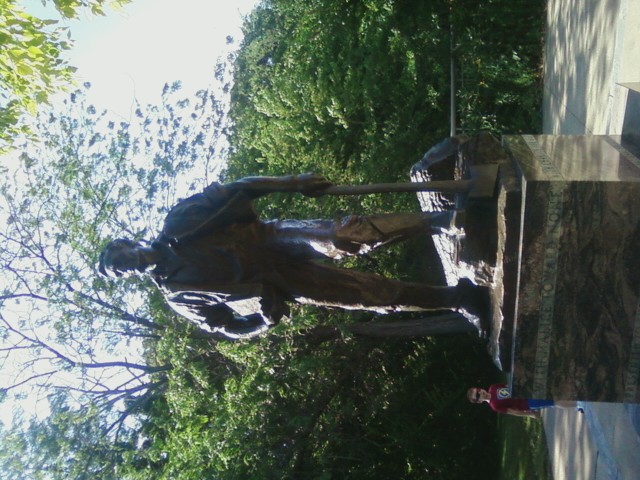
Abraham Lincoln wielding his ax at Lincoln’s New Salem State Park
In March of 2010, author Seth Grahame-Smith revealed to the world disturbing truths about the 16th president of the United States. By now you have probably heard of his book, Abraham Lincoln, Vampire Hunter. It has spawned a movie by the same name that will be released to theaters this Friday.
Personally I am fascinated by the concept of it for a couple of reasons. First of all, I am originally from Illinois, proudly nicknamed the “Land of Lincoln.” I grew up in a small town barely thirty miles from the capitol city of Illinois (NOT Chicago!) in which you can find: the Lincoln Presidential Museum, the Lincoln Depot, Lincoln’s tomb, Lincoln’s law office, Lincoln’s home, Lincoln Memorial Gardens, and the Abraham Lincoln Presidential Museum. If you swing by Springfield’s First Presbyterian Church (and why wouldn’t you?), you will even be treated to a glimpse of the very pew purchased by the Lincoln family. A quick 25 minute drive takes you to Petersburg, IL where you can walk through Abraham Lincoln’s New Salem State Park, a replica of the village where Lincoln spent several years as a not-so-successful small businessman. Amazingly, I’m pretty sure this list is not exhaustive.
As an elementary school student and Girl Scout, I pretty much toured them all, with the exception of the Presidential Museum, which only opened in 2005. I have, however, been to the museum multiple times as an adult and can unapologetically state that it is worth a visit. Make sure you don’t miss the “Ghosts of the Library” show. Tell them the practical historian sent you. They won’t know what you’re talking about, but I’ll appreciate the plug anyway.
The point is, like all kids from Illinois (except for maybe those from Chicago), I know a thing or two about Abraham Lincoln. I did not, however, know he was a successful vampire hunter.
The other reason that I find Grahame-Smith’s book so fascinating is that I also write historical fiction and so what he has done here presents a really interesting look at what writers can (or should) and cannot (or should not) do with (or to) history. The book begins with three “Facts”:
For over 250 years, between 1607 and 1865, vampires thrived in the shadows of America. Few humans believed in them.
Abraham Lincoln was one of the gifted vampire hunters of his day, and kept a secret journal about his lifelong war against them.
Rumors of the journal’s existence have long been a favorite topic among historians and Lincoln biographers. Most dismiss it as myth.
I’d like to take a closer look at these three statements.
1. In 1607, the British merchant ship Cormorant set sail from Portsmouth, England under the direction of Captain Horatio Wheeler. Aboard the ship was a sailor by the name of Andrew Oglethorpe who’d had an unfortunate run-in with a vampire just prior the journey. Vampirism spread like wildfire through this “ship of the dead.” Its newly undead crew, furious with Wheeler for allowing a vampire to join the crew in the first place, immediately mutinied and elected a much more capable (and seemingly curse-resistant) captain by the name of Jack Sparrow whose obsession with treasure led them eventually toward the islands of the Caribbean. So that date checks out.
Where Grahame-Smith makes his mistake, however, is with his end date of 1865. In actuality (assuming we can trust the information trudged up in a random Google search, and I think we all agree that we can), Abraham Lincoln was far from the last US president who dealt with the American vampire problem.
According to my sources, it was President Ulysses S. Grant who established the Federal Vampire and Zombie Agency in 1869, which functioned as a branch of the US military. McKinley later added a department of scientific research to the agency and the search for a vampirism cure began. Increased public support for vampire rights (a grassroots movement begun by some guy from Louisiana by the name of Lestat) caused FDR to restructure the FVZA as a secret, underground program. It wasn’t until 1963 that President Kennedy finally, in a Rose Garden ceremony declared the war on American vampires officially won and in 1974 Gerald Ford pulled the plug on FVZA (Or did he?)
2. Grahame-Smith also claims that Abraham Lincoln was “one of the gifted vampire hunters of his day.” According to the FVZA website (surprisingly informative for a website representing a completely legitimate, entirely secret government agency), the most famous American vampire hunter was a man by the name of John “Red Jack” Averill, a contemporary of Abraham Lincoln, credited with over 4000 vampire kills. If we assume that Grahame-Smith’s book is a more or less accurate representation of Lincoln’s hunting activities, I estimate the president killed no more than a few dozen vampires during his lifetime, making him somewhat less than mediocre as far as vampire hunters of the mid-19th century go.
3. And now for this rumored secret journal. A quick Internet search (frankly, all the time I’m willing to commit to such a project) has revealed to me no credible references to the supposed journal. Though I guess since I am not privy to the dinner conversations of many historians or Lincoln biographers, I cannot say for certain that the journal is not a favorite topic among them. I’ll give the author the benefit of the doubt on this one.
Still, the facts don’t entirely hold up. And this one question remains: Was Abraham Lincoln a vampire hunter? I don’t know. What I can say with relative certainty is that living most of my life in the heart of the Land of Lincoln, I never once encountered a vampire so either there really are no vampires (highly unlikely, I know) or the name of Lincoln still inspires fear among the vampire population. Of course, I also haven’t run into one in the nearly two years I have been living in Oregon, sandwiched between the heartthrob vampires of Forks, WA in the north, and the Lost Boys of Santa Carla, CA in the south.
What does Seth Grahame-Smith have to say for himself in regard to his use of history to tell a story that seems suspiciously less than entirely true? “You have to have reverence for the real history,” he told an audience at the screening of the Abraham Lincoln, Vampire Hunter movie trailer, presented onsite at the Abraham Lincoln Presidential Museum. “The man was a real man who is still extraordinarily revered…That, to me personally, was the line: Never make this guy look like an idiot.”
Well said, Mr. Grahame-Smith. And well done. The book is a fun read.
The movie promises to be full of graphically violent scenes with (I’m guessing) lots of comically exaggerated blood spatter. Too gory for me, but I’m sure it will be thoroughly enjoyed by any true fan of vampires, or probably also by a true fan of Abraham Lincoln, because, let’s face it: even a widely beloved historical figure only becomes more awesome when he is hunting vampires.


 Author Sarah Angleton