A Nice New Pair of Gloves

It was in the 5th century when St. Brigid of Kildare brought a problem of inequality to the attention of St. Patrick, who may not have particularly cared. Brigid’s complaint was on behalf of all the single ladies who kept waiting and waiting and waiting for a man to propose marriage.

It’s also said that St. Brigid once prayed for God to make her less beautiful just so she wouldn’t be pressured to marry, so the St. Patrick proposal stories may be a little off brand. Glaaaastonbury88, CC BY-SA 4.0 https://creativecommons.org/
licenses/by-sa/4.0, via Wikimedia Commons

St Patrick set down his shamrock, swallowed the last of his green beer, rolled his eyes, and graciously suggested that every four years (except in years divisible by 100, but not by 400), when February 29th rolled around, it was okay with him if the womenfolk wanted to go ahead and propose to the men.

In one version of the story, a thankful St. Brigid immediately dropped to one knee and proposed to St. Patrick, but he was too busy driving the snakes out of Ireland to notice. Also the lives of Brigid and Patrick didn’t overlap that much, making her maybe five years old when this event allegedly took place and him not more than a few years from the end of his life. The story, either version, is a bit dubious.

But the strange tale got even stranger when in the year 1288 Irish monks brought the tradition to Scotland where Queen Margaret cemented into law that if a woman proposed marriage to a man on February 29th then he’d better either say yes or compensate her for her disappointment with a pretty silk dress or a nice new pair of gloves. That just sounds to me like a great way to get a free dress and gloves.

I could always use a nice new pair of gloves.
Image by 378322 from Pixabay

Of course Queen Margaret was at most only five years old when the law would have been written and there’s no record of any such law having ever existed. But regardless of where the tradition of women proposing marriage to men on leap day might have come from, there’s no question that the notion has been around for a long time in western culture.

The tradition showed up in the United States in the 18th and 19th centuries where it mostly became the subject of ridicule. Today of course it feels a little silly because women in western cultures have more agency than ever and incidences of proposals from women to men are on the rise at any time of year.

I’ll really be spending my leap day preparing for the launch of my new historical mystery in just seven weeks. Watch this space next week for the full cover reveal.

Still, it feels like this strange day that has been popping up on our calendars more or less every four years, with only a few necessary tweaks, since 46 BC should be marked as special in some way. If nothing else, it feels like a stolen extra day and I for one want to make the most of it.

As a woman who has been happily married for going on twenty-four years now, it would probably be pretty inappropriate for me to propose marriage to anyone, but I guess I wouldn’t say no to a pretty silk dress or a nice new pair of gloves. I’ll just have to shop for them myself.

What are you doing with your extra February day?
Shaking the House

In 1864, abolitionist and women’s rights activist Lydia Maria Child wrote in what is known as a drudgery journal that she “swept and dusted the sitting room & kitchen 350 times. Filled lamps 362 times. Swept and dusted chamber & stairs 40 times.” I assume she did not do this all at once, although I’m sure that some days it felt like it.

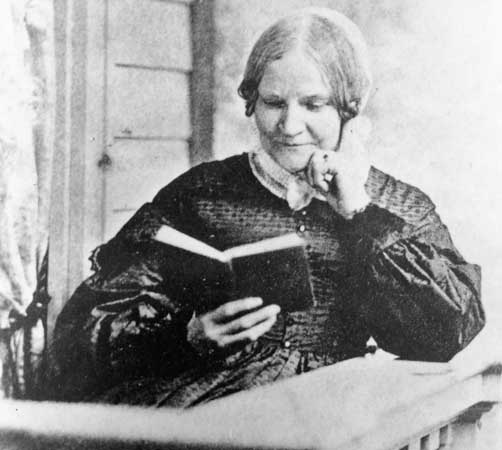
Lydia Maria Child taking a much deserved break from the drudgery of shaking up her house. See page for author, Public domain, via Wikimedia Commons

I’ll be the first to admit I am not a great housekeeper. I do attempt to at least clean the bathrooms regularly and keep the kitchen surfaces more or less sanitary, but beyond that it’s a little bit of a battle. Because there’s always something more interesting to do or write about or both.

I am, however, a spring cleaner. And it turns out I’m in really good company because a recent survey found that about 74% of Americans engage in deep cleaning in the springtime. Psychologists tell us that may be because with the return of longer days, our natural melatonin levels decrease and we are more energized. What better way to spend that extra energy than by laundering the drapes or mopping behind the refrigerator?

Historians tend to believe that this compulsion to clean every spring is rooted in an awful lot of human tradition that reaches back thousands of years to at least three distinct cultures. First, there is the Iranian celebration of Nowruz, or New Year that occurs on March 21, and includes a cleaning tradition called khane tekani, which translates as “shaking the house.” This strikes me as pretty much a perfect phrase for the occasion.

I mean, it’s still drudgery, but once in a while it’s just got to be done. Image by svklimkin from Pixabay

Another possible source of the tradition is found in the Jewish remembrance of Passover. Also in the springtime, this involves the purging of leavening agents from the home and tends to include a great deal of cleaning. And then in Chinese culture, it’s pretty common practice to scrub and sweep any potential bad luck from the home before it can carry into the new year in late January or early February, when the days are just beginning to noticibly lengthen.

It doesn’t seem like there’s a particularly strong case that any of these traditions is totally responsible for inspiring the human habit of spring cleaning. Instead, they seem to be evidence that it’s just a thing that we humans, or at least 74% of us or so, like to do.

I think for most of us, the day-to-day process of keeping a clean-ish home probably feels a lot like drudgery. I for one can’t even recall the last time I filled the lamps or dusted the sitting room. But over the last few weeks I have been shaking my house, and I gotta say, it feels pretty good.

Are you a spring cleaner?

Keeping Eggstra Busy

Lately I have discovered that life as the mother of a burgeoning adult about to graduate from high school and head off to college is busy. It involves college visits and research into housing options and fraternity opportunities. It requires increased organization and skillful prodding as the end looms ever closer and senior-itis casts long shadows over deadlines that threaten derailment of plans if allowed to pass by unanswered. There’s also the financial planning and the dogged encouragement to apply for just one more scholarship and the editing of essays penned by a person with little interest in revising yet one more time.

This was the egg hunt I provided for my children last year. Not long ago one of my sons asked if we were doing the same fun thing again this year. Mom for the win!

At our house it also includes long hours and dedication to a robotics team that will soon travel to compete for the second year in a row on the world stage, and the fundraising efforts that allow said team to take advantage of such an honor.

There are smaller senior trips as well and an upcoming last high school prom to prepare for. Graduation announcements need sending and a party needs planning and there’s family summer that needs scheduling around a new set of obstacles. And then there are all of the Easter eggs that need to be stuffed with treats.

This last one I thought was behind me as my children are both teenagers now and are not generally all that concerned about the Easter bunny. Alas, being the mother of a senior and also apparently somewhat of a sucker, I have found myself volunteering on the parent committee to throw a Grad Night celebration for the graduates.

In case you’re unfamiliar with Grad Night, it’s an over-the-top fun, all-night, drug and alcohol-free lock-in event designed to help burgeoning adults with not-yet-fully-developed brains celebrate and also avoid making stupid decisions that may get them hurt or worse on the night of graduation. Similar events are held all across the United States, including several very large ones at the Disney parks in both Florida and California.

Ours is not taking place at Disney World, but it will be fun. And it does take a lot of planning and an enormous fundraising effort to make it happen, which is why I find myself among a small group of moms, who are also suckers, busily stuffing thousands of candy-filled plastic Easter eggs.

Ozzie is not going to be helping deliver eggs, but he does make a super bunny ear model.

Because Easter eggs are a big deal.

People have been decorating eggs for millennia, predating Christ by a long shot, but the tradition of hunting for decorated eggs as part of an Easter celebration is generally traced to 16th century Germany, and possibly even to Martin Luther. Maybe. It does at least seem that eggs became a celebratory Easter treat largely because they were forbidden during Lent, and that Easter egg hunts, then, as now, were fun.

The tradition spread to England via the German-born mother of Queen Victoria who later continued egg hunts with her own children. In the United States, too, it was German immigrants who brought with them the egg hunt, which quickly spread across the young nation where eventually people figured out that eggs, while enjoyable to eat, are just eggs, but that hollow plastic eggs can contain candy, which is even more fun.

And then the idea for the Egg My Yard fundraiser was born. It’s turned out to be a really popular idea that finds me spending a lot of time mindlessly stuffing eggs so that my senior and I can don bunny ears and join with lots of other bunnies this Saturday to provide a fun Easter surprise for hundreds of families throughout our school district and surrounding area.

Image by Cindy Parks from Pixabay

It should be a great event. Grad night will be, too, and so will prom, and the robotics world championship, and the upcoming craft fair and two trivia night fundraisers that still stand between me and the end of the school year.

It’s a lot. But with the end of the year rapidly approaching, and the day looming when my burgeoning adult son will become a recent high school graduate moving into student housing and onto bigger and better things, I find I don’t really mind keeping busy.

Prognosticator of Prognosticators

On February 2, 1887, exactly one year after Punxsutawney Spirit newspaper editor Clymer Freas suggested the idea of an official Groundhog Day, a group of well-dressed and maybe just a little bit silly local businessmen who referred to themselves as the Punxsutawney Groundhog Club began a tradition that has to go down as one of the most ridiculous annual ceremonies I actually pay attention to.

I refer of course to that preferably not so bright Candlemas morning when the world’s most famous rodent named Phil appears before an adoring public to make an official statement regarding the amount of winter weather that remains to be endured.

The groundhog, aka woodchuck is an animal that is at least as good at long-range weather forecasting as it is at chucking wood, which it would probably do a lot of if it could. Image by Mona El Falaky from Pixabay

Officially known as Punxsutawney Phil, Seer of Seers, Sage of Sages, Prognosticator of Prognosticators, and Weather Prophet Extraordinaire, Phil is allegedly the oldest groundhog on record at the whopping age of 136. That’s approximately 130 years longer than the expected lifespan of a groundhog.

Phil’s “Inner Circle,” which includes the world’s only human speaker of Groundhogese, explains that his exceptionally long life can be attributed to a life elixir he takes every summer, the side effects of which can cause him to occasionally change his physical appearance somewhat dramatically.

Okay, it’s quirky. Maybe even just plain weird, but the Groundhog Day celebration draws as many as thirty to forty thousand visitors to the tiny town of Punxsutawney, Pennsylvania every February second. Hordes of groundhog enthusiasts flock to Gobbler’s Knob, the site of Phil’s proclamation near Downtown Punxsutawney, and probably spend a fair bit of cash while visiting the community.

The movie that put Punxsutawney and Phil on the map was actually filmed in Woodstock, Illinois, which also has stupid cold February mornings. Public Domain, via Wikimedia Commons

And so, it makes perfect sense to have continued the event since the 1993 film Groundhog Day forced Bill Murray to live the day over and over again, and let the world know about this silliest of festivals. What makes less sense is that the annual tradition occurred for one hundred and six years before that. I somehow doubt that the members of the original Punxsutawney Groundhog Club foresaw a day when Hollywood would come knocking on Phil’s burrow.

Then again, they do have a connection to the Seer of Seers, and his accuracy in predicting whether spring is right around the corner or we will experience six more weeks of winter, is about 36%. For those of you keeping track at home, that’s less accurate than a coin flip.

But he is just a really old rodent. And groundhogs have not always been a part of such predictions. The Candlemas long-range forecasts themselves are actually much older, with a general acceptance that “If Candlemas Day is clear and bright, Winter will have another bite.”

Looking at this halfway point between the winter solstice and vernal equinox as a predictor of weather patterns coming into spring even predates Candlemas as a part of the Celtic celebrations of Imbolc. Groundhogs didn’t get mixed up with it until German immigrants brought the tradition with them to Pennsylvania and made it their very own.

Phil, looking super thrilled to be here. Chris Flook, CC BY-SA 4.0 https://creativecommons.org/
licenses/by-sa/4.0, via Wikimedia Commons

But I guess it’s okay that they’re mixed up with it now. Punxsutawney Phil’s festival in Gobbler’s Knob has inspired at least thirteen similar festivals throughout the Eastern United States, because I guess it’s something to do while we wait out the last six or so weeks of winter. So, here we go again.

I have been known from time to time to be delighted by silly traditions and I confess that I have a fair few bizarre events on my bucket list. Groundhog Day in Punxsutawney, dear reader, is not one of them, mostly because February mornings in Pennsylvania are really stupid cold. For you, however, I did watch the livestream of Phil’s pronouncement this morning from the comfort of my warm living room while still in my pajamas.

I may not have been there, but Miss Pennsylvania was, and so was the governor of the state, as well as a large number of reporters who were probably questioning their career choices. The top hat-clad president of the Punxsutawney Groundhog Club was there, too. He had a lengthy conversation with a rodent, who I’m sad to say, predicted six more weeks of winter, and there’s only a 64% chance he’s wrong.

Happy Groundhog Day!

Advice for Avoiding Goblins and Drummers

A few days ago, on January first, I took down my Christmas decorations. I did this for a few reasons. First, as much as I love the holiday season, after six weeks of it, I do get tired. And it really is six weeks at our house. We decorate the day after Thanksgiving, more or less without fail and remain decorated until at least the new year.

If you’ve been reading this blog for a long time, then you may recall that our version of decorating is no small task. It involves nine feet of Christmas tree, snowflake throw pillows, much garland wrapping, and lighted geese in the front yard. This is nowhere near an exhaustive list, but it gives you an idea. As it says on our seasonal welcome mat, we’re like really into Christmas.

Second, after a Christmas spent with the deep freezer working overtime, the Midwest offered up a miraculous sixty-degree, sunny day perfect for pulling up lantern stakes from the yard and removing light strings from the roof. If I could ignore the coming two-and-a-half months of cold that remain this winter, it felt a bit like a spring cleaning kind of day.

I’m talking about the kind of day in which one might take a minute organize the Christmas storage boxes in the basement instead of continuing to shove the reindeer salt and pepper shakers into the same box as that string of broken lights that may offer up some replacement bulbs for the ones we used to use that looked kind of similar, except they included purple bulbs in addition to red, green, blue, and yellow.* That’s right. Not only did I put away our cherished Christmas decorations. I threw away a bunch of old, broken ones we no longer use. I was basically on fire.

The 2022 calculated cost of the gifts in Twelve Days of Christmas is $45,523.27. In case you needed another inflation index, that’s up 10.5% from 2021. Image by wal_172619 from Pixabay

And obviously the third reason I took down the Christmas decorations promptly on January first is because I didn’t want to risk, depending on who you ask, a case of bad luck, a possible goblin invasion, or the shock of hosting twelve drummers drumming in my home.

Because evidently Christian tradition dating back to the sixth century suggests that holiday decorations are perfectly acceptable at least until Epiphany, the day the wise men arrive on scene and twelfth and final day of Christmas. To leave them up any longer is, for many, a holiday faux pas that might just bring you bad luck or goblins or at the very least a disgruntled homeowners association.

I’m not sure I fully understand. Outside of singing the song about giving someone an alarming number of birds, I have never observed the twelve days of Christmas. Most of the traditions I grew up with and have continued in my own home occur in the lead up to and on the day of Christmas itself, which is why by the twelfth day of Christmas, on January 5th or 6th (depending on particular brand of Christianity or perhaps counting habits), I’m plum tired out.

I didn’t even put them away in a wadded mess this year. Image by Wokandapix from Pixabay

Right now, I’m looking around my bland, non-Christmas-decorated house on a day that is neither sixty degrees nor sunny, and I’m grateful to have gotten all the work out of the way several days ago. I’m also happy to report that there doesn’t seem to be a penalty for taking the decorations down early.

But if yours are still up, then today might just be the day. I tell you this because I care and because I don’t want to see your home invaded by goblins. Or drummers.

*I wish I could honestly claim this isn’t a real example from my life, but it is.

Rockefeller Around the Christmas Tree

On December 24,1931 a construction crew was hard at work on a twenty-two-acre building site between 48th and 51st Streets in Midtown Manhattan. Two hundred twenty-eight buildings had been razed, forcing the relocation of several thousand tenants for what was originally meant to be the new site of the Metropolitan Opera.

James G. Howes, Attribution, via Wikimedia Commons

The stock market crash of 1929 and the economic depression that followed made the planned move impossible. John D. Rockefeller, Jr., who had leased the land from Columbia University for the Opera’s use quickly reformulated a plan to build up a mass media entertainment complex with Radio Corporation of America and its subsidiaries. Over the next several years it would develop into the Rockefeller Center with nineteen buildings and a sunken square annually featuring an iconic ice rink guarded by a humongous Christmas tree passed by half a million people per day.

But on Christmas Eve of 1931, the public wasn’t yet thrilled with the plans for the space and there was still a lot of zoning red tape in the way. The Italian-American crew, however, was hopeful. They had work, when so many did not, and the promise of much more on the horizon. And it was the night before Christmas. What they needed was a great big tree.

The workers and their families chipped in to purchase a twenty-foot-tall balsam fir that they erected in the middle of the muddy construction site and decorated with cranberries, paper, and tin cans. I’m sure the tree wouldn’t have looked all that impressive alongside the fifty-footer that two years later officially became what the Rockefeller Center’s website refers to as “a holiday beacon for New Yorkers and visitors alike.”

Daniel Dimitrov, CC BY-SA 4.0 https://creativecommons.org/licenses/by-sa/4.0, via Wikimedia Commons

Even fifty feet seems tiny when compared to the trees now used, which typically range between seventy-five and eighty-five feet tall, and once even as much as one hundred feet. The decorating of this beast of a tree takes dozens of workers more than a week to complete before the nationally broadcast lighting ceremony that takes place every year after Thanksgiving.  

Still, I think twenty feet is pretty impressive, if not even a little bit excessive. Many years ago, when my family and I lived in a different house in a different state, our living room had a high, vaulted ceiling. My husband, who pretty much loves all things Christmas, decided we needed a bigger Christmas tree to better fit our space than the measly seven-and-a-half-footer we’d been getting by with.

I couldn’t find a picture of our twelve-foot tree, but it pretty much looked like this, except three feet taller.

I took some convincing, but he found a good deal on an artificial (due to family allergies and general disdain of sap and spiders) tree that was twelve feet tall and since he was willing to move the ladder around to decorate the top five feet, I agreed to the purchase.

That first year the tree was a little sparsely decorated with our seven-and-a half-feet worth of ornaments and I can see why the construction workers at Rockefeller Center would have resorted to using tin cans to fill the space. The tree was gorgeous, and it made my husband very happy. I did, however, feel a little bit like I was living in a shopping mall. Or maybe at Rockefeller Center.

It didn’t completely break my heart when the next house came with lower ceilings and we had to trade down. Over the years we’ve managed to reach a compromise and now put up a nine-footer, which is still awfully pretty, but doesn’t require nearly as much ladder manipulation to decorate.

I do see him staring at it sometimes, though, probably thinking he could fit another several inches beneath the ceiling. Maybe someday we will. It is, after all, a holiday beacon for us and for visitors alike.

A Little More Magical

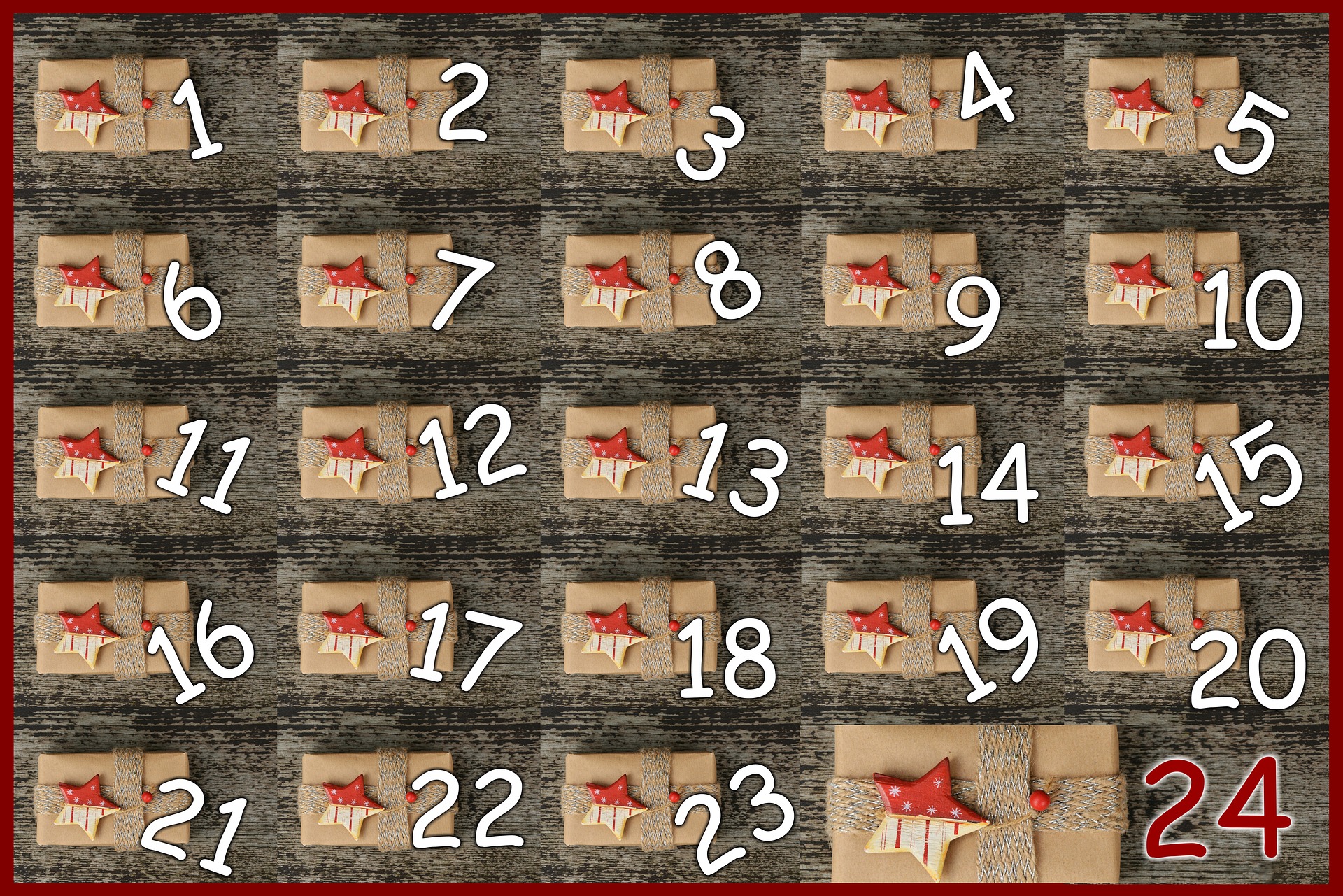
During the season of Advent in about 1880 or so, the mother of Gerhard Lang made her young son a cardboard calendar featuring twenty-four sweets, one per day, with which to mark off the time until Christmas. She surely wasn’t the only mother to do something like this for her child.

Image by congerdesign from Pixabay

Advent was introduced as a four-week (give or take) period of preparation leading up to Christmas by Pope Gregory I in the early seventh century. It took a while to catch on, but by the nineteenth century, German families in particular were finding clever ways to keep track of the days. Some used tear-away pages or tally marks on doorframes. Others lit candles or placed markers on ladder rungs.

But it was Gerhard Lang who is generally given credit for popularizing the advent calendar style most people use today, as a direct result of the creativity of his mother and his resulting magical childhood. When Gerhard grew up and became a printer, he remembered the calendar his mother had made for him and began mass producing a twenty-five-day calendar with doors to be opened each day leading up to Christmas in the month of December. Behind each door was a picture or Bible verse.

I guess that’s one way to make your holiday season a little more magical, but I think I’d rather have the chocolate.

Then in 1958, Cadbury began producing Advent calendars with twenty-four chocolate treats to be enjoyed one at a time from December first to somewhere around December fourth, which is about as long as any chocolate Advent calendar has ever lasted for me.

But like Gerhard Lang, I had a pretty magical childhood. Not only did my dad usually purchase an inexpensive chocolate Advent calendar for me and for each of my siblings from the local high school German club’s annual fundraiser, but my mom also made a calendar for the family that we took turns opening.

Behind each door of the homemade version, my mom would write tasks we needed to do to get ready for Christmas. This included things like decorating the Christmas tree, making Christmas cards, or baking Christmas cookies. Sometimes our tasks were service projects for others or chores that needed to be done before Santa could come. Other times we found them more fun, like driving to look at Christmas lights or visiting with the big jolly elf himself. Seriously, my childhood was magical.

As far as anyone has found, this is the world’s tallest Advent calendar. (Thank you to my sister for the picture. I haven’t gotten there to see it for myself yet.)

And this year, in my hometown, the season has gotten even a little bit more magical. A few months ago, one of my favorite former teachers (who gets credit for my appreciation of The Great Gatsby) was in the town square and happened to notice something. He looked up at a tall brick Farmer’s Bank building that has stood guard over the old downtown for more than a century and counted the windows. On one side, there are exactly twenty-four of them.

An idea was born. The teacher solicited some help from around town (including the artist who designs my book covers) and approached the bank to ask if they might make what they believed would be the world’s tallest Advent calendar. The answer was an enthusiastic yes.

And that’s how Christmas in my corner of the world became a little more magical.

A Small Fault in These Parts

On April 10, 1567, Englishman Ralph Adderly wrote a letter to soldier and politician Sir Nicholas Bagnall. In it, Adderly described his brother-in-law John Bagot in an almost flattering way. The original excerpt is in pre-uniform English spelling, but translated to meet a more modern reader’s expectations it says this:

“I do assure you he is unsuspected of any untruth or other notable crime (except a white lie) which is taken for a small fault in these parts.”

Image by Gerd Altmann from Pixabay

According to the Oxford English Dictionary, this is the first known reference to the phrase “white lie,” largely held to be a lie that’s not so bad—one that is told in order to avoid conflict, forestall embarrassment, or to protect the recipient, and is more or less benign in nature.

Of course, one man’s bent truth is another man’s vicious load of . . . well, you get the idea. Still, most of us have probably told the occasional white lie when the plain old truth might be needlessly hurtful or when we’re writing a blog post and our research has been somewhat less than thorough because man has it been a week.

I mean, I would never do such a thing, but I assume a lot of you probably have.

I know that the students and faculty of my youngest son’s high school have done so. It’s homecoming week here which means this coming weekend will be packed with football, parading, and dancing. The weekdays, too, have been filled with powderpuff football, pep rallies bursting with team spirit, and themed dress-up days.

Truth. (-ish)

My favorite so far has been “white shirt/white lies day.” On this day, students and teachers wore white tee shirts on which they had written a white lie. Some of the shirts I saw included: “I’m a people person,” “I’ll pay you back,” “I’m not smarter than you,” “I don’t seek validation,” and my personal favorite, “Just because I’m blonde doesn’t mean I’m dumb.”

I’m not entirely sure that the school should be promoting lying of any kind, just as I am entirely certain that some parent will be complaining about it at the next schoolboard meeting. It won’t be me, because I thought it was awfully clever, and in a way, kind of perfect for this particular school’s homecoming celebration.

And then there’s the pretty dresses and the corsages. Image by Stacey Kennedy from Pixabay

The notion of homecoming at my son’s school is itself a little bit of a white lie, as this is only the school’s second year in existence and the first year there will be a graduating class. What this means is that technically speaking, there is literally no one to come home to this school.

But every high school has homecoming football and pep rallies and dances and parades and spirit days. It’s too much fall fun to miss. So, what if it’s all a little bit of a lie? It’s not hurting anyone, and the decision to do all the homecoming things for the benefit of all the nonexistent alumni avoids the conflict that would arise from not doing it, which would also surely find its way to the next schoolboard meeting.

In the wise words of some guy named Ralph Adderly, it seems like nothing more than a small fault in these parts.

Harpin’ Boont on the Bucky Walter

It was somewhere around 1862 when John Bregartes arrived in the Anderson Valley of California, a little more than a hundred miles north of San Francisco, and founded the little town of Boonville. And it wasn’t long after that when the farmers, ranchers, and loggers who came to live in this fairly isolated community started to develop a language of their own.

Frank Schulenburg, CC BY-SA 4.0 https://creativecommons.org/licenses/by-sa/4.0, via Wikimedia Commons

Of course, every region’s got one to some extent. If you come to my corner of the world here in St. Louis, for example, you might drive farty-far to get some t-ravs, go to the laundromat to warsh your clothes, and then grab a concrete for a treat. If someone accidentally bumps into you along the way, you’ll likely hear them say “Ope!” and they’ll expect you to respond with a friendly, “You’re fine.”

We’ve all got our little quirks, maybe made slightly more accessible by the mingling and spreading of regional expressions across the internet where I learned not so long ago that a take-a-plate dinner in New Zealand is the same thing as a potluck supper in the Midwestern US.

But what Boonville, California has going is much more than a few quirky expressions that rose up over time. By the dawn of the twentieth century, it had an entire language all its own.

I’m not sure what the Boontling word is for potluck. U.S. Army Space and Missile Defense Command (SMDC), Public domain, via Wikimedia Commons

Though Boontling is based on English, it contains more than a thousand unique words and expressions that show influence from Scottish Gaelic, Irish, Spanish, and Indigenous languages and is peppered with the names and experiences of generations of Boonters.

So, Bucky Walter is a payphone, because bucky is the word for nickel and a guy named Walter was the first person in town to have a telephone. To me this sounds a little like getting directions from a local that include turning left at the corner of the field Fred used to own that once had that big red barn that burned down thirty years ago. Except it’s a whole language with standardized grammatical patterns and there’s no GPS to guide you to the right address.

No one is quite sure why the small town invented its own language, though there are plenty of stories. Most suggest that it was a convenient way for one group of people to speak secretly about another group (wives gossiping about husbands, elders wanting to exclude youngsters, or vice versa), which led eventually to the tightknit residents of Boonville using it to keep themselves to themselves when strangers came to town.

Where St. Louis goes to eat its frozen custard concretes. Philip Leara, CC0, via Wikimedia Commons

The real mystery to me, however, is why it has persisted for so long. This peculiar language which has never traveled much outside of the Anderson Valley and has probably never been spoken by more than a thousand people at any time its history, has existed for nearly a century and a half. How cool is that?

Unfortunately, the number of fluent speakers has dwindled in recent years to include only a handful of people. Over the years it has generated lots of interest for linguists, but not as much for the youngest generations of Boonters. One source I found laments the fact that the elementary school no longer teaches Boontling, which indicates that at one time it did.

The Anderson Valley Historical Society would like to keep the language alive a little bit longer and has provided a nice glossary to get you started if you’ve a mind to learn to harp Boont on the Bucky Walter. Maybe you can even get together with your apple head, pike to grab aplenty bahl steinberhorn, and have yourself the bahlest harpin’ session you ever had. Or you could just stick to English and go out for concretes.

A Blog Post for the Rest of Us

I am a big fan of holiday tradition. My family has a lot of them, from watching Christmas Vacation on the day after Thanksgiving to eating cinnamon rolls for breakfast on Christmas day. Some of them are pretty normal, like spending an evening driving around to look at Christmas lights or eating a special dinner before attending church on Christmas Eve. Others are a little more unique like topping our Christmas tree with a star that is in turn topped with a candy cane or donning new pajamas after church on Christmas Eve before going to the movies.

Here’s a tradition I can get behind.

But I like to think that none of our traditions are quite as out there as the one observed in the O’Keefe household on December 23. It was sometime around 1966 when author Daniel O’Keefe introduced his family to a new kind of celebration, one that marked the anniversary of his first date with his wife and took a moment to step away from the commercialism of the Christmas season.

O’Keefe called the family celebration “Festivus,” and when his mother died ten years later, they continued to celebrate the day as a unique little holiday “for the rest of us,” meaning those who were still alive to enjoy it.

Some traditions are not worth keeping alive, like chestnuts roasting over an open fire. Turns out they’re kind of gross.

The observance of Festivus in the O’Keefe household involved a simple family meal, a clock placed in a bag that was then nailed to the wall, the airing of grievances, recognition of the mundane as the miraculous, and feats of strength.

Actually, it’s not entirely clear to me whether all of these elements existed in the original O’Keefe Festivus celebration or if some of them come only from the Seinfeld episode that launched this quirky family tradition into the mainstream in 1997. Daniel O’Keefe’s son Dan was a writer for the sitcom and allegedly he didn’t want the tale of Festivus explored in an episode, but was overruled by his fellow writers who heard about it and thought it was hilarious.

The holiday looked a little different on the small screen than it had in the O’Keefe household. The clock and bag nailed to the wall (for what reason, no one can say) was replaced by an unadorned aluminum Festivus pole, and the airing of grievances began with George’s father Frank Costanza announcing, “I got a lotta problems with you people and now you’re going to hear about it!” after a fairly generic meatloaf dinner. Feats of strength became a wrestling match with the head of the household, the pinning of whom signaled the end of the celebration. And the inconvenient coincidences and misunderstandings worthy of any good sitcom episode became Festivus miracles.

There it is, in all its high strength to weight ratio aluminum glory, right next to the leg lamp from A Christmas Story.

When asked by Mark Nelson, the writer behind FestivusWeb.com and Festivus! The Book!, the definitive work on the holiday, whether Dan O’Keefe still observes Festivus, he answered. “No.” But thanks to the Seinfeld episode, lots of people now do. Festivus poles have adorned the Wisconsin’s governor mansion, the Florida State Capitol building, and, I recently discovered, the holidays through the ages tree display at the “Christmas Traditions” festival in St. Charles, Missouri.

It’s worth noting, too, that as I type this, editing software has no problem with the word “festivus,” as long as I capitalize it. And if for some reason you hop on Twitter today, I’ve no doubt #Festivus and #AHolidayForTheRestOfUs will be trending.

But Festivus will probably not be a big part of my day. In preparation for writing this post, I revisited the Seinfeld episode (“The Strike,” season 9) with my 14-year-old who said, “Well, that’s stupid.” He’s not wrong. It is stupid, but come to think of it, I do have a few grievances to air:

  1. Yesterday, I ended up on a group text with literally no one whose name is saved in my phone and endured an hour or so of twenty unidentifiable people wishing all of us a merry Christmas while I was trying to use my phone to listen to an audio book.
  2. Missouri drivers continue to ignore the basic stop sign rule of stop first, go first, and instead, insist on waving on the other drivers at a 4-way stop. I’m especially annoyed when I get waved on and it is actually my turn. Because I know the rule and don’t need the prompt.
  3. My children continue to leave a trail of dirty socks and dishes everywhere they go. I do not know how to make this stop.
If I managed to serve a meatloaf that my children would eat, that would be a Festivus miracle. Image by valtercirillo, via Pixabay

Also, though it doesn’t seem likely that I will wind up wrestling anyone today, my youngest son has recently become obsessed enough with working out that he has created a fitness schedule for all of us through winter break and I’m pretty sure it’s leg day. I’m going to say that counts as my feat of strength.

And then there’s the fact that in the midst of all the other silly, but somehow important, Christmas traditions around my house, I managed to post to my blog just two days before the big day. That is something of a Festivus Miracle.

So, dear reader, Happy Festivus. I guess. Enjoy your meatloaf. Feel free to air your grievances in the comments.