This blog post is NOT about the St. Louis Cardinals

Though sport has been a part of the human experience for about as long as history has been recorded, the concept of professional team sports is relatively recent. Until industrialization came along, people simply didn’t have time for much leisure activity, but  the mid-1800’s saw the emergence of the first professional football leagues (that’s “soccer” to all us uncultured Americans).

Then in 1876 professional sports, specifically baseball, arrived in the US with the establishment of the National League. The American League joined the fun in 1901. The NHL, with a slightly more complicated history, can trace its origin to 1909. 1920 brought us the NFL and the NBA started in 1946.

And with the rise of all these professional athletes came the rise superstition in sports. Why is this, you might ask? Well, historians have often noted that superstition is most pronounced in times when people feel they have little control over the outcome of their own lives. Professional athletes capable of competing at the highest level of their sport find themselves competing against others who are more or less equally capable.

The result of this kind of competition is, more often than we would like, dependent less on pure talent than on circumstance. Often miscommunication, questionable calls by officials, and poorly timed injuries make the difference between winning and losing. How can a team protect itself from such unforeseen problems? The answer is obviously to conjure the most luck.

Teams do this all the time. NHL teams famously refuse to touch their Conference Champion Trophies for fear it will bring them bad luck in their quest for the Stanley Cup and often the members of a baseball team will not shave during a post season run. My favorite team ritual by far, though, is that of professional rugby team, The All Blacks who perform a traditional war chant in front of the opposing team before each game.

But whereas team rituals can be attributed to increasing team camaraderie, the personal superstitions of many professional athletes are just plain bizarre. They range from the unwillingness of baseball players to change places in the batting order, to rubbing the head of the bat boy, or commonly the refusal or insistence of stepping on particular markings on the field of play. It seems there’s no end to what rituals professional athletes will try in an attempt to give themselves a slight edge. But not all players put much stock in such behaviors.

Babe Ruth, who once famously said, “I have only one superstition. I touch all the bases when I hit a homerun,” penned an article that ran in the Pittsburgh Post Gazette on May 28th of 1929, about his response to a fan’s suggestion that Ruth was wearing the wrong number. That year the Yankees became the first team to consistently wear numbers on the back of their jerseys and the Bambino wore the number 3 on his. The concerned fan, a self-identified numbers expert, explained that according to his observations of Ruth (who was in a minor hitting slump at the time), the player should be wearing the number 7. If he made the change, the fan insisted, he would have a great season. If not, Lou Gehrig, who sported the number 4 on his jersey (the appropriate number for him according to the “expert”) would certainly outhit Babe.

In response, Babe had only this to say: “Somehow I’ve got a sneaking hunch that the number on a fellow’s back doesn’t have much to do with his hitting one way or another—and I’m a lot more interested in getting my eye on the ball right now than I am in picking out lucky numbers or studying the stars.” Turns out Babe Ruth probably didn’t do any harm by disregarding the fan’s suggestion. In 1929, he hit 46 homeruns, drove in 154 runs and had an overall batting average of .345. Not bad; and, notably, better than #4 Lou Gehrig.

English: Babe Ruth and Lou Gehrig at United St...

The Yankees did have an off year, though. Their pitching struggled terribly and even with heavy hitters at the plate, they weren’t able to pull off a third consecutive championship, finishing up in second place behind the Philadelphia Athletics. If I know anything about baseball fans, I’m guessing numbers guy wasn’t surprised.

Because if professional athletes sometimes depend on a particular routine or good luck charm in an attempt to influence those factors that are largely out of their control, that is nothing compared to what their fans do. Fans are, after all, stuck on the sidelines, in front of the television, or tuned in to the game updates when our focus really should be elsewhere. Fans have no real control over the outcome of the game. All we can do is wish and hope and stress out.

So fans don good luck charms, eat specific foods, perform elaborate celebration dances, and generally engage in all manner of charm casting. Pretty much anything goes, because as a recent Bud Light commercial expresses: “It’s only weird if it doesn’t work.”

So for example, a practical historian known for rational thought and witty discourse (perhaps for her beauty and charm as well, but who can say) might convince herself that it is essential that she wear the same piece of jewelry every day of the playoffs as long as a certain flock of baseball playing birds from an undisclosed Midwestern city are still in contention. She might seek comfort during tense playoff moments by tightly hugging a plush toy of the team mascot. And perhaps she would even refuse to blog about her team until their postseason run is over. It wouldn’t be weird, though because it’s totally going to work.

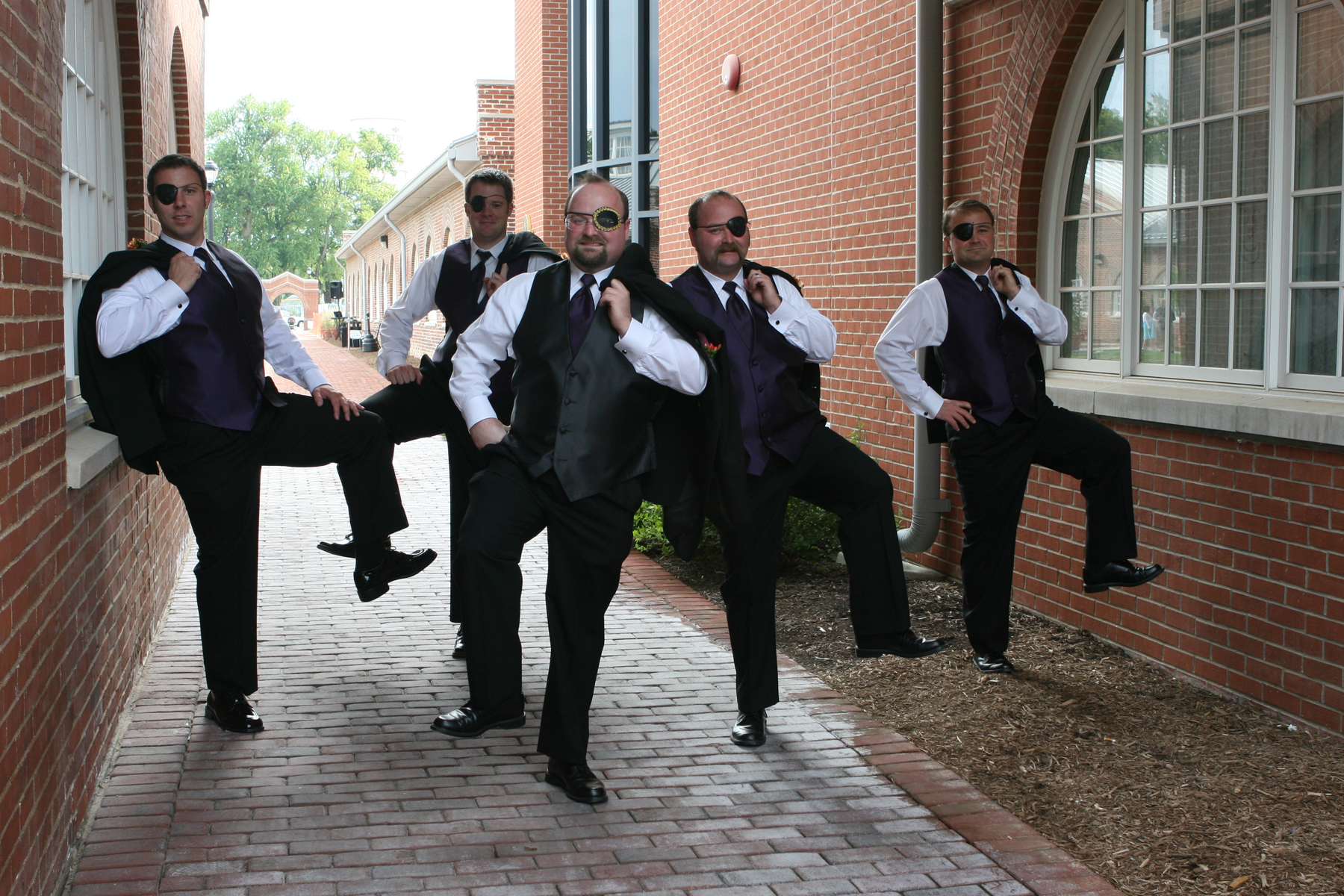
Avast Ye Wedding Lubbers

Multnomah Falls

On a recent family excursion to Multnomah Falls, a place I’ve been too few times, I noticed a sign along the trail that I hadn’t read before, probably because I assumed it had something to do with rock formations and/or water volume as most of the signs do.

But this one was different. It described an event from September of 1995 when a boulder weighing 400 tons (according to the sign that is approximately the same weight as a school bus filled with concrete, and go ahead and disprove that) fell from the rock face next to upper Multnomah Falls, plunging 225 feet into the pool at the bottom. Upon entering the water the school bus boulder produced a 70-foot splash that washed over the observation bridge, completely dousing a wedding party that had been posing for pictures. Now, I may not care much about geology, but I am a big fan of wedding photos.

In case you haven’t been to the falls, though, let me just provide a little background. Located on Interstate 84, just outside of Portland, Multnomah Falls drops a total of 620 feet, making it the highest waterfall in the Columbia River Gorge and the second highest year-round waterfall in the United States. Between the upper and lower portion of the falls spans Benson Bridge, constructed in 1914.

And if geology is your thing, Multnomah Falls is allegedly a fascinating place to visit because rumor has it you can see something like six different lava flows, evidence of flooding that occurred thousands of years ago, and probably even some really interesting differences in rates of erosion that have led to the tiered formation of the falls and the occasional plunging school-bus-sized rock. Personally, I just care that it’s pretty.

In fact, all those impressive geological goings-on coupled with the well-placed bridge in the middle make the easily accessible Multnomah Falls an ideal spot for all your magical wedding photo needs. Then there’s the tragic and super romantic mythological accompaniment that I didn’t even mention yet.

According to one Native American legend, the chief of the Multnomah people had a beautiful and beloved daughter. He arranged for her to marry a strong young chief from the neighboring Clatsop people and planned many days of feasting and celebration during which tragedy struck. A terrible sickness descended on the wedding festivities. The only solution, as determined by an honored medicine man, was for an innocent maiden to sacrifice herself. The idea was that her sacrificial love would impress the Great Spirit and the sick would recover. When her betrothed fell ill, the young maiden took it upon herself to save her people. She climbed up to the high cliff and leapt to her death. As a token of her loving sacrifice, a spring welled up on the cliff top, the water descending as a lasting bridal gown testimony to the young maiden.

I don’t know about you, but had I gotten married in Oregon, I think we would have made the effort to get that picture. But even though the myth lends a certain wild sentimentality to the photo op, I have to wonder if it ultimately makes a lot of sense to get fancied up in tuxedoes and ball gowns and go for a hike. Assuming here that your daily wear is somewhat less formal, don’t the memories painted by such pictures just ring a little false?

Yet as anyone who has ever tried to make small talk with relative strangers for hours at a wedding reception while waiting for the bridal party to arrive knows, couples do this kind of thing all the time. In fact, my husband was a groomsman at the beginning of this summer and while I’ve not yet seen the photographic evidence, it sounds like things may have gotten a little out of hand. Let’s just say there are some modern art sculptures on an undisclosed Midwestern college campus that are probably feeling a little violated. What that has to do with the celebration of marriage, well, you’d have to ask the couple. No one else seems willing to talk about it.

So the sign at the falls got me thinking about wedding photos and it happens that a few days ago some good friends of mine celebrated their wedding anniversary. It’s one of those that I always remember not only because I was a bridesmaid (and I actually liked the dress, and yes, I have even worn it since), but also because they had the foresight to get married on International Talk like a Pirate Day.

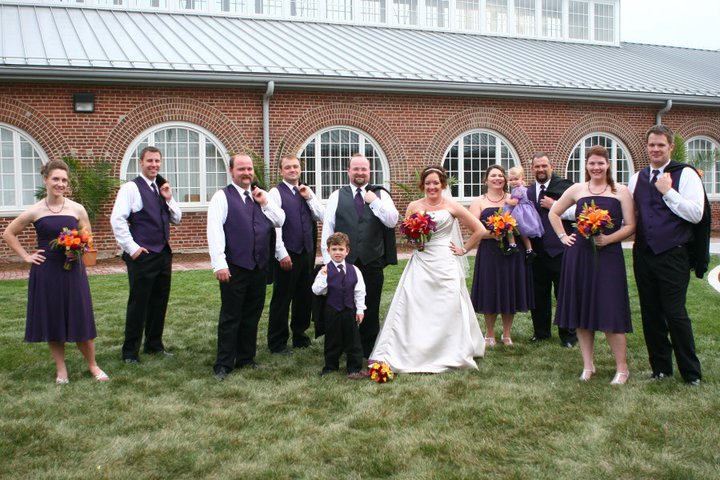
They’re a great couple and I am honored to be featured in their wedding photos, in which I never once posed with any modern art sculptures. But as I was looking back through the pictures, I realized that along with the lined up bridal party, the first kiss as husband and wife, and the gathered family, were some of the other kinds of photos as well: the ones in which excessively well-dressed people are deliberately posed in unnaturally casual ways.

Clearly these men are pirates. You can tell by the way they are standing.

Ultimately, though, I think these are the ones I like best because it says a lot about a photographer (and how well they know the couple whose wedding they are trying to capture) and even more about the couple themselves, because if the photo didn’t somehow resonate with who they are, then it never would have made the wedding album. For my friends, their memories will forever include a nod to the internationally celebrated holiday with which they share their special day. And because of their willingness to embrace it, their friends will never forget to leave a heartfelt message on their Facebook pages: “Arr. Ye be havin a jolly anniversary ye old scurvy dogs.”

I am happy to report, too, that the Multnomah Falls wedding deluge resulted in no major injuries. In an interview after the wedding, the bride said of the event, “We got the tragedy out of the way and now we’re home free.” That’s a great attitude that I assume has led to many years of happily ever after. I just hope someone managed to snap a picture of the splash.

Just a bunch of well-dressed people casually hanging out in a courtyard, cuz that’s how we roll.

Wedding photos by Layne Aumann Photography. www.aumannphotography.com/

These wedding pictures are used by permission and may not appear elswhere without consent, lest ye be wantin to walk the plank.