Lemons for Christmas

I’m a big fan of lemons. I don’t mean that I cut them open and suck on them like a crazy person. I acknowledge that they are sour and, on their own, pretty gross. But I do use lemons quite a bit when I cook, to cut that fishy flavor this corn-fed Midwestern gal doesn’t always appreciate, or to add a bit of acidic zing when the mood strikes and I want to feel a little fancy and channel my inner Food Network star.

Last year for Christmas my husband even got me a couple of small lemon trees in pots to grow in a sunny spot off to the side of my kitchen. Over the summer, the trees enjoyed the hot soupy atmosphere of our Missouri back deck (as did I), and now that it’s turned cold again they have settled back indoors, leafier and prettier, and probably no closer to actually producing fruit.

That’s okay. They’ll get there. Or they won’t. I’ll have fun trying anyway, and in the meantime, I can always buy a nice California lemon at the grocery store. I pick them out carefully. I like my lemons on the larger side, heavy for their size with a slight give when gently squeezed and with a nice fragrance.

I’m good at picking out lemons. Both at the grocery store and, unfortunately, at the car lot. I posted once before about our 2020 Subaru Outback, not long after it left us stranded on the side of the interstate while on family vacation with about twenty thousand miles on the odometer and a transmission that had catastrophically failed, leaving us down a vehicle for more than a month. I wish I could say that after the transmission issues the car hasn’t given us any more problems. Alas, it’s been something of a lemon. And not the kind that makes fish taste better.

It’s been a lemon more in that way that a mid-nineteenth century guy might have referred to a tart or undesirable woman. Or like the way a person in the early part of the twentieth century might refer to getting a rotten deal. Or an awful lot like when, according to Mental Floss, a used car dealer was said in the Oakland Tribune in 1923 to be pleased that he’d finally gotten rid of a lemon.

Not my dog. Or my car. Image by AI ART made in Germany to produce images for people from Pixabay

To be fair, the salesman who sold us our Outback probably did not knowingly sell us a lemon. It was brand new at the time, and Subarus have a reputation of being solid, reliable cars that hold onto their value. I mean their ads tend to feature good looking adventurous people driving into rugged landscapes with their good looking adventurous dogs, tails wagging and tongues and ears flapping happily out the rolled down windows. “Love,” they say, “Is what makes a Subaru a Subaru.”

They certainly don’t label their vehicles as lemons, like Volkswagen decided to do in 1960. The printed ad displayed the image of a new, seemingly perfect (though vaguely ridiculous as the VW Beetle has always been), car labeled: “Lemon.” The ad copy went on to explain that an imperfection in the chrome strip on the glove compartment that wouldn’t likely have been noticed by the consumer, had caught the attention of one of the 3,389 quality inspectors, and that the car had been deemed unfit to sell until the problem could be corrected.
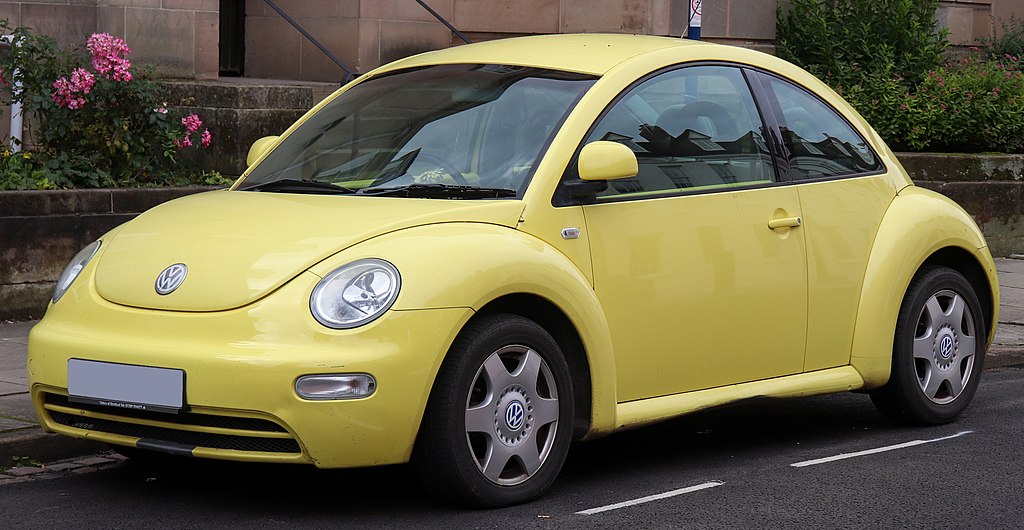
The yellow ones even kind of look like lemons. Vauxford, CC BY-SA 4.0 https://creativecommons.org/
licenses/by-sa/4.0, via Wikimedia Commons

The conclusion of course, is that a company with this level of attention to detail could be trusted to produce a car that will not only hold its value, but will also probably not result in a mandatory programming recall, a not-yet-covered-by-recall $1400 repair to its engine, a class action lawsuit regarding a parasitic battery problem the company has yet to find a solution to, an inexplicable break down at the intersection four blocks from home the day before Thanksgiving, and a family stranded on the side of the interstate when they should be on their way to the lake.

Despite being the project car of Adolf Hitler, Volkswagen and its Beetle enjoyed a good reputation among American consumers for a long time following the lemon ad campaign, though feelings toward the company have maybe soured a little since it got caught cheating on its emissions testing a few years back.

Subaru also has inspired a lot of consumer loyalty with its reputation for quality and service. I know that because every time I mention how frustrated I am with this car, I am flooded with comments from other Subaru drivers who absolutely love their cars. Even the tow truck driver on the day before Thanksgiving when mechanic shops are preparing to close down for the long weekend, told me how much he loves Subarus as he loaded my incapacitated car onto the back of his truck and a police officer directed traffic around us.

I realize it’s not Christmas yet, but this really couldn’t wait. When the day arrives, we’ll put a bow on it or something and pretend to be surprised.

And I get it. Sort of. We owned a previous Subaru Outback and it was a great car. We had lots of adventures in it with our good looking dog whose ears and tongue flapped happily out the rolled down window. Well, before he got carsick anyway. He’s not a great traveler.

But this year for Christmas (and for many Christmases and birthdays and anniversaries to come I suspect), instead of lemons, which I’m almost confident my trees will one day produce, we have traded in our 2020 Subaru Outback and purchased a Honda CR-V. The car has a great reputation, and I’m feeling hopeful that this Christmas, I’m not getting a lemon.
In a Roundabout Way

About a week ago, the worst thing that can ever happen to a community happened in my town, and it has been absolute pandemonium ever since. Everywhere I go I hear the cries of the people, from the grocery store checkout lines to the ladies’ locker room at the community center. And don’t get me started on the city’s Facebook page, where many comments contain exasperated emoji faces, excessive exclamation points, terrible grammar, and sometimes even ALL CAPS.

People are pretty upset, and it’s little wonder why, because last week, after months of public notices, published plans, and inconvenient construction, an old interstate ramp connected to the town’s main commercial thoroughfare was suddenly closed and replaced with a new one that includes, of all things (and I’m sorry if this is too upsetting for your sensibilities), a roundabout.

Oh, yeah. That looks easy to navigate. Arpingstone at English Wikipedia, Public domain, via Wikimedia Commons

I know. It’s difficult to process. I’ll give you a minute.

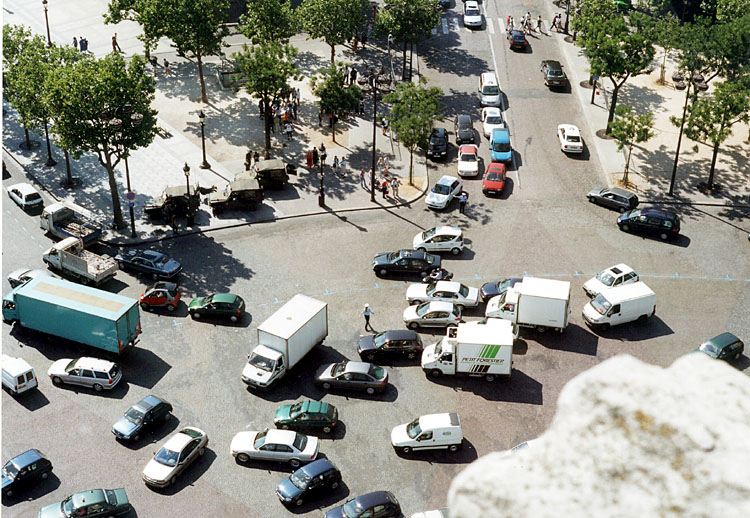
The dreaded roundabout can trace its roots, as well as its generally bad reputation, back to the mid-nineteenth century when French Emperor Napoleon III decided to give the streets of Paris a makeover. Baron Georges-Eugène Haussmann was chosen for the job, and the city underwent a major overhaul to its public works, including the Place de l’Étoile (today known as the Place Charles de Gaulle) which circles around the Arc de Triomphe.

The circle, which has no lane markings, serves as the convergence point of twelve roads that all empty straight into it. Traffic traveling around the circle must yield to incoming traffic and those vehicles that have made their way into the innermost portion of the circle have to stay there probably forever.

Fortunately, I’ve never driven it, but when I attempted to find a graphic demonstrating what the traffic pattern should ideally look like, the best I could do were some videos of rush hours nightmares and a delightfully helpful list of tips that include “be a little bit pushy” and “know what your insurance covers.” Of course there have long been terrible traffic circles in other places as well, including the US and, as Clark Griswold demonstrated in the 1984 film National Lampoon’s European Vacation, in the UK.

But in 1966, the traffic circle got an overhaul itself thanks to British city designer Frank Blackmore who developed a newer, friendlier roundabout in which traffic entering from soft curves, yields to the traffic already moving around the circle. When implemented, his design reduced accidents, and maybe after a while didn’t seem like the worst thing ever.

In 2016, Carmel, Indiana received the International Roundabout of the Year Award from the UK based Roundabout Appreciation Society. This isn’t a picture of the winning intersection, but I did think it was worth noting that there is such a society that gives out such awards. Image by Roberto Ramon Diaz Blanco from Pixabay

Then in 1984, when the English had been happily driving around in circles for nearly two decades, American engineer Leif Ourston reached across the pond with a possibly slightly over-the-top appeal, suggesting to Blackmore that as Sir Winston Churchill once asked America to join Britain in a struggle to protect democracy, it would be lovely if Britain might join us to bring the love for the roundabout to America.

Since no one could say no to an appeal like that, Blackmore agreed. The two toured the nation’s cities, proposing their safer alternative to stoplight-controlled intersections. Perhaps predictably, complaining people shouted them down everywhere they went. Some even held protest signs that included excessive exclamation points and ALL CAPS!!!!

It wasn’t until the city of Las Vegas agreed to give it a go and placed two roundabouts in a residential area of the city that they made any progress at all. The number of accidents went down and the incidences of roundabouts crept up throughout the US, leading the town of Carmel, Indiana to become the roundabout capitol of the nation with upward of 138 of them serving a population of just under 100,000 spread over an area of forty-nine square miles.

See? Easy-peasy. Loginname, CC BY-SA 4.0 https://creativecommons.org/licenses/by-sa/4.0, via Wikimedia Commons

I bet the citizens of Carmel did their fair share of grumbling at first, though I imagine they’ve gotten used to it by now. It’s hard to spend too much time arguing against an 89% reduction in traffic delays, a 56% reduction in stops, a 29% reduction in carbon emissions, a 28% reduction in fuel consumption, a 38% reduction in accidents at intersections (which account for 50% of traffic accidents nationwide), and a 90% reduction in fatalities at intersections.

I think folks in my town will eventually accept their tragic fate as well. This is, after all, not our first brush with these horrid circles. Just a quick count in my head comes up with at least six other roundabouts in town that I drive through regularly. I suspect there are more than that, each one initially met with righteous anger by local skeptics who grudgingly admitted after a while that it maybe didn’t seem like the worst thing ever.

People do come around, if in a somewhat roundabout way.

Investing in Crypto-Engines

In Philadelphia in 1874, inventor John Worrell Keely demonstrated before a stunned audience his amazing new engine that promised to change the world’s approach to energy production forever. As the crowd watched, Keely blew into a nozzle for a full thirty seconds, poured five gallons of water from a tap into that same nozzle, and pointed to a pressure gauge reading 10,000 PSI to indicate that the water had been disintegrated and had released a newly discovered vapor with enough power to send a steam ship from New York to Liverpool and back five times over.

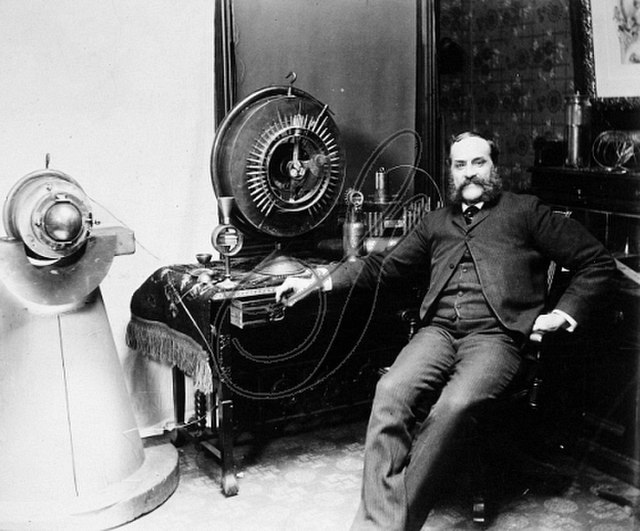
John Ernst Worrell Keely (ca. 1895), expert on sympathetic vibratory physics, posing with his impressively named motor that never worked. Not even a little. Public Domain, via Wikimedia Commons.

I imagine the audience may have had some questions, and Keely probably answered them. He certainly did so on a number of occasions. His invention, he said, was a “vibratory engine,” or if he were feeling particularly fancy, a “hydro-pneumatic pulsating vacuo-engine.”

Based on observations of a tuning fork in all its vibratory glory, Keely’s motor made use of etheric energy. And if you don’t know what that is, then I’m afraid I can’t help you. The best I can figure is that it’s kind of like an aura? Maybe? This is why I’m a writer and not an expert on sympathetic vibratory physics.

But Keely was an expert and he spent a lot of time explaining the alleged science behind his miraculous engine to potential investors, and some actual investors to the tune of $6 million of capital used for establishing his Keely Motor Company.

The biggest and most determined investor in Keely’s crypto-engine was a wealthy widow named Clara S. J. Bloomfield-Moore, who funded the company’s research for $100,000 plus a salary for Keely himself of $2,500 per month. I’m not a financial expert either, but I bet I don’t have to work hard to convince you that in the 1870s this was a whole lot of money.

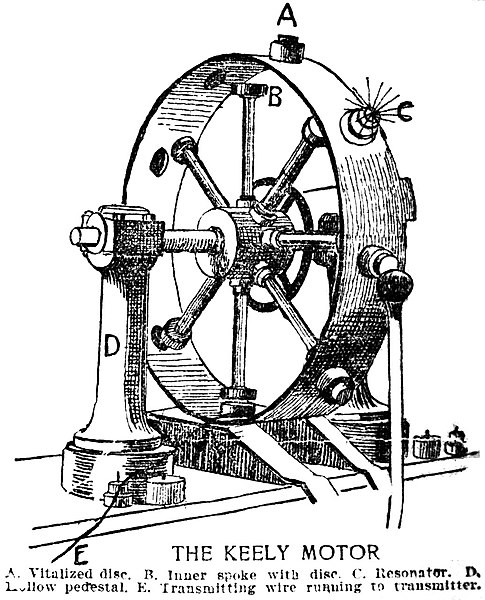
Oh, ok. Forget the engineers and physicists. I see how it works now. Unknown author, CC BY-SA 4.0 https://creativecommons.org/licenses/by-sa/4.0, via Wikimedia Commons

And it probably would have been a worthwhile investment had there been anything to the hydro-pneumatic pulsating vacuo-engine. I certainly wish there had been. I keep reading reports of gas prices on the rise and the potential for shortages this summer as people begin to scratch the itch to get out of the house and into a post-pandemic world of summer fun. It would be nice to be able to travel the country fueled by nothing more than a bucket of water.

The anticipated shortages come primarily from a rise in demand that follows on the heels of a steep reduction in demand amid lockdowns and travel restrictions. During that same time period, training programs for new tanker truck drivers shut down or limited operations and many more experienced drivers, finding less work, decided to go ahead and retire. Apparently, tanker truck drivers are the new toilet paper.

So, when my 13-year-old son finishes this final week of what has been the “longest, most awful eighth grade year of [his] life” (his words, because he’s funny), and says he wants to “take all the vacations,” I find myself wishing Keely had been on the up-and-up.

He definitely wasn’t. For all the fancy explanations and big words Keely had to offer when asked, he was consistently reluctant to allow engineers and physicists to study his equipment. The opportunity for a thorough examination didn’t arrive until after his death in November of 1898. That’s when investigators uncovered a laboratory full of a great deal of piping, mechanical belts, pneumatic switches, and a large water-powered motor hidden in the basement.

He never did get his tuning fork engine to work. He did, however, manage to become a pretty successful humbug, skillfully attracting and putting off investors for more than twenty years with shady business practices akin to including the phrase “investing in crypto” in the title of a blog post about vibration and imaginary vapor. My hero.

He also coined the term “hydro-pneumatic pulsating vacuo-engine,” which has the potential to make you sound really smart at your next cocktail party, and maybe even raise some ill-gotten funds, as long as you are prepared to answer a few follow-up questions.

Like a Bat Out of Hell

Clara Ford was at home one day in 1919, I assume doing whatever it is that Clara Ford typically did at home, when she was informed by police that her husband Henry had gotten into trouble with his car. Evidently, he’d been driving “like a bat out of hell,” as one does, I suppose, when one essentially invents the modern auto industry and is probably showing off for one’s grandson who is also in the car.

And worse, he’d been doing so without a driver’s license.

The charming story about Henry Ford and his run-in with the police is shared by the Henry Ford Museum, where you can also see Ford’s first driver’s license, which obviously the above image does not show. Image by mohamed Hassan from Pixabay

That in itself is not as terribly shocking as it first sounds because Michigan only started issuing licenses that year. And after his run-in with the police Henry Ford, at the age of 56, went ahead and got one.

At the age of 56 I think it’s fair to expect that a person is wise enough and cautious enough to be trusted with such power. In fact, that probably happens well before the age of 56. I for one am pretty responsible behind the wheel at a mere 43 years of age. I can’t say I’ve never been pulled over, but it’s been a rare occurrence in my life as a driver. And though I’ve had my license since the tender age of 16, I don’t believe I’ve ever driven like a bat out of hell.

Still, in the last few weeks, 16 has been striking me as incredibly young for the responsibility of driving. Because my oldest son recently hit that milestone.   

A lot of young’uns aren’t pushing so hard these days to get their driver’s license the moment they can. In 2018 there were approximately 227 million licensed drivers on the road in the United States, but only about 25% of sixteen-year-olds were among them. That was down from nearly half in the mid-1980s. I have no idea why so many of the kids aren’t as anxious to get behind the wheel these days, but that was not the case for my son.

To be clear, I’m not suggesting that 227 million people were actually on the road at the same time. Can you imagine the traffic jam?
photo credit: Shawn | Shiyang Huang Traffic jam @ Beijing via photopin (license)

He wanted to drive. Actually, I think he’s been wanting to drive since he was four years old, strapped into a car seat in the back, and asking me remarkably intelligent questions about the rules of the road. True story.  

It wasn’t exactly a shock that when he turned fifteen and was old enough to take the written driving test and receive a learner’s permit in our state, he was pretty excited to do it. And he’d been studying since the age of four, so it also wasn’t shocking that he pretty easily passed.

In that year of learning, first in an empty parking lot, then back roads, busier streets with traffic circles and stoplights, lonely highways, and eventually busy interstates where he merged like a pro and stayed nicely centered in his lane, he became a fairly competent driver.

Then he turned sixteen and he wanted to take his driving test so he could get his license. He passed with no trouble. And then on the very day I celebrated the sixteenth anniversary of the first time I ever held my squirming, squishy-faced baby boy, I watched that same kid back out of the driveway and disappear down the street in a car that he was driving all by himself to his martial arts class.

Still what I see.
photo credit: Frank Hemme Hacer camino. via photopin (license)

It was the most anxious moment of my life.

My husband, also anxious, quickly decided he needed to run an errand and followed him. I was grateful, because until that moment, I was pretty sure I might also have an errand to run, and I was relieved when I received a text a little bit later letting me know the car was safely parked at the school.

My son really is a good driver and I become more comfortable each time he returns home safely. I can’t guarantee that he doesn’t drive like a bat out of hell, but I know he never did in his year of permit driving and so far, the police haven’t indicated that that has changed.

I don’t know if these bats are flying out of Hell, but they do seem to be in a reckless kind of hurry. photo credit: USFWS Headquarters Mexican free-tailed bats exiting Bracken Bat Cave via photopin (license)

At least he had to pass a test. Henry Ford didn’t. Michigan only began driver testing in 1931. That is better than the Great State of Missouri, which was actually one of the first to issue licenses for drivers, in 1903. It was another 49 years before the state began testing.

But despite what I sometimes suggest when I am not-so-silently judging the other drivers on the road from the privacy of my own car, they seem to do a pretty good job of it now.

So maybe, depending on the kid, 16 isn’t such a bad age to issue a driver’s license? I don’t know. But I suppose I’d probably worry about him at any age. Maybe even if he were 56.

Four Wheels and a Hint of Danger

In the wee hours of the morning on July 4, 1896, Henry Ford smashed the brick side of his shed with an axe. That might sound a little extreme, but after months of work the inventor and future business superstar was finally ready to test drive a new creation he called the Quadricycle. The trouble was it didn’t fit through the door.

Ford_quadricycle_crop
If I saw this coming down the road I’d probably get out of the way. Ford’s Quadricycle. Public Domain, via Wikimedia Commons

With the exception of a brief breakdown due to a faulty spring, the rest of the test drive was more or less a success. Ford’s friend and assistant James Bishop rode ahead on his bicycle to warn carriages and pedestrians to get out of the way. Ford fired up his four-horse-powered gasoline engine and tootled along behind in a 500-pound frame with four bicycle tires, no breaks, little steering ability, and a “horn” made from a doorbell.

Thankfully, he improved on the design a little through the years.

Can’t you just picture that first test run? I can imagine the look on Henry Ford’s face as he raced through the streets of Detroit at a whopping twenty miles per hour. It must have been a mix of elation at the beginning of a dream coming true and the terror of barely controlling something powerful enough to kill you and everyone in your way. It’s probably the same expression I wore many years ago the first time I got behind the wheel of a car and it actually started moving.

permit driver
Our version of a crier on a bicycle. Trouble is you don’t see it until he’s already driven past.

My oldest son recently got to have that experience. He turned fifteen at the end of last year and in the state of Missouri that means he became eligible to test for his driving learner’s permit. Because his birthday falls so late in the year, we decided it would be wise to get the permit as soon as possible so he had a better chance of gaining plenty of experience on icy winter roads before the state considers granting him a real license at age sixteen.

But because we didn’t have anyone on a bicycle to warn everyone to get out of the way, we decided to start in a large, empty parking lot on a dry, sunny day.

I’m not sure what expression I wore when I handed him the keys that first time and took my place in the passenger seat. I’d like to think I conveyed calm reassurance. We took a little time for him to get familiar with dashboard controls, mirrors, break, and accelerator. Then he turned the key for that first time, put the car in gear, and took his foot off the brake.

_MG_2365
How I see my teenager when he sits behind the wheel. photo credit: Alex E. Proimos Learning to Drive via photopin (license)

As Henry Ford probably was more than a century ago and as surely every new driver has been since, my son was nervous and a little unsure, but also really excited to discover the sensation of wielding so much power.

That afternoon he drove us around and around the parking lot, practicing turning, breaking, and parking. Then I made him work on backing up, another thing Henry Ford’s original Quadricycle couldn’t do.

When we were both a little more comfortable, we took the lesson to a few quiet back roads. He even drove us home and parked in the garage without incident and with very little cringing or pretend break stomping from me.

My son is still a little uncertain behind the wheel. He’s got more to learn and will need a lot more practice to gain the confidence required to be a really good driver, but he’s attentive and teachable and determined. I’ve no doubt he’ll get there. I just hope he never feels the need to take an axe to the side of the garage.

SmokeFrontCover
Coming soon!

And . . .These days, when I’m not teaching my son how to drive, I’m preparing to launch a new book, coming February 4th. Follow this link to get a peek!

Follow the Arrows

As the summer wears on, and my children increasingly have trouble entertaining themselves, I find myself struck at the genius of my mother. It was well-known in my house growing up in Smalltown, Illinois, that it was a very bad idea to utter the words, “I’m bored” in front of Mom. Her response would, without fail, be, “Great! The toilets need to be scrubbed.”

photo credit: Mykl Roventine via photopin cc</a
photo credit: Mykl Roventine via photopin cc

But every so often, if one of us had a friend or two over to play and we found ourselves in a lull, she would take pity on us and come up with these amazingly creative ideas, from fun little games to large scale projects of awesomeness. One of my favorites was a game she resurrected from her own childhood in Even Smallertown, Illinois called an arrow hunt.

The idea was that one person (or one team) would take a piece of chalk and go somewhere in our Smalltown neighborhood to hide. Along the route, the hiders marked a chalk arrow every time they changed directions. The arrow had to be clearly visible, though it could be in an unexpected place, and the final arrow pointed to the spot where the hider(s) would be found.

The game was a hit. It killed a lot of otherwise boring summertime hours, no toilets were scrubbed, and my friends and I discovered all the nooks and crannies of the nearby park and neighborhood landscaping. And I got really good at spotting a trail.

So did pilot Jack Knight on one dark night in 1921 when he completed a successful flight from Chicago to North Platte, Nebraska. This was important for two reasons. First, it was the first (and possibly only) time anyone ended up in North Platte on purpose. Second, Knight’s flight had been a test for the US Postal Service.

A relatively new technology, airplanes offered the promise of efficient coast to coast mail delivery. But navigation was still in its infancy with pilots relying on landmarks to guide them. This meant that night flying was pretty much out.

It's possible this man has no idea where he's going.
It’s possible this man has no idea where he’s going.

That is until someone had the brilliant idea to use postal workers and citizen volunteers to man a series of bonfires along Jack Knight’s dark route. His success led to the (slightly) more sophisticated plan to dot the Transcontinental Air Mail Route from New York to San Francisco with 50-foot steel, gas-lit beacons mounted into giant yellow concrete arrows on the ground.

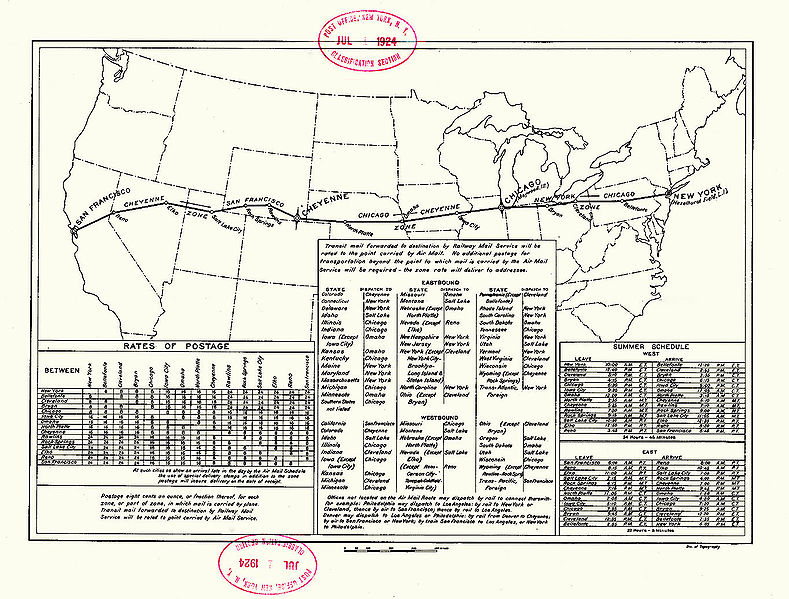
Each arrow pointed toward the next beacon, around ten miles or so away depending on topography. Congress thought it was a great idea and by 1924 there were giant arrows pointing the way from Cleveland, Ohio all the way to Rock Springs, Wyoming. And because the Postal Service realized there weren’t a lot of reasons to stop in Rock Springs, Wyoming, the route was extended over the next few years, eventually reaching from New York to San Francisco.

air mail route
Transcontinental Airmail Route

Of course it wasn’t long before fancier navigation systems developed and pilots began to feel that radio frequencies were somewhat more reliable than the old fly-real-low-and-follow-the-arrows system. During WWII, the steel beacon towers were dismantled and repurposed, putting a practical end to the dotted Transcontinental Air Mail Route.

But the arrows are still there. Their paint is faded and they may have a few cracks here and there, but many of them that haven’t become the victims of development are still there to be found by the odd eagle-eyed traveler.

So we’re almost to the countdown to the start of school. I am not as creative as my mother and my boys are spending their childhood in Not-So-Small-Suburb, Missouri so even in our very safe neighborhood, I’m not terribly comfortable with the idea of them chasing arrows through the streets. My solution for summer boredom is to plan the big family vacation for the end of the summer, as a reward of sorts, for making it this far. And now I know as we pack up for our trip west, we’ll be following the arrows after all.

Arrows go left. Arrows go right. Follow in the morning, or follow them at night.