One Wicked Omission

A few weeks ago in this space, I posted a piece about Taylor Swift and the history of public education in the United States. Except that apparently I didn’t. A few hours after the post went live, I received a text from one of my aunts saying, “Am I the first to point out a spelling error?…”

She was the first, and the error was unfortunate because instead of typing public education, I had accidentally left out a very important letter l. Fortunately, I was able to fix it quickly and if any of the rest of you noticed, you were gracious enough to cut me some slack.

Whales. Image by M W from Pixabay

I try to be a meticulous editor, but anyone who has followed this blog for very long has probably spotted the occasional error that gets through. Often either the hubs or my eagle-eyed mother will discover them and point out the mistakes spell check won’t catch. One time a reader I don’t know personally was kind enough to politely point out that the country of Wales is spelled differently than the marine mammal with a similar name.

You’ve all been very kind over the years, and as far as I know none of my silly typos have led to any controversy. Royal printers Robert Barker and Martin Lucas were not so fortunate. In 1632, they stood trial in the court of King Charles I for a mistake that made its way into their 1631 re-printing of the King James Bible. The mistake occurred in Exodus 20:14, which should read: “Thou shalt not commit adultery.” The problem was that this printing omitted the word not.

Barker and Lucas had to answer for the slip-up to the tune of £300. That’s roughly £56,000 today, or about 75,000 US Dollars, which is a pretty steep price to pay for three little letters. To make matters worse, the gentlemen lost their publishing license.

But think about how many words they got right! Image by Pexels from Pixabay

While nearly all of the one thousand misprinted Bibles were confiscated and destroyed before they had a chance to tear apart too many families, at least fifteen copies still exist today—seven in England, seven in the United States, and one in New Zealand.

A British rare book dealer named Henry Stevens obtained one of the copies in 1855 and called it the Wicked Bible, a name that has pretty much stuck since then. In the last decade, copies have changed hands for somewhere around $50,000, which means that if the descendants of Robert Barker and Martin Lucas still had a copy, they’d need to wait a few years yet to come out ahead.

I doubt any of my typos would fetch that kind of bling, and so my promise to you, dear reader is that I will continue to do my best to catch all the irritating little typos on this blog. I can assure you that if I ever suggest adultery as a good life choice, then you can assume it’s a terrible mistake.

I do feel for Barker and Lucas, though. It may be true that none of the errors that have occasionally popped up in my little corner of the blogosphere have been so grievous or costly. Still, I’m certainly aware that no matter how cautious an editor one may be, it can be a big risk to put your words out there in a pubic space.
Malapropos of Nothing

I admit to being a little bit of a language snob. Of course I recognize that language evolves and a misspoken word today may be perfectly acceptable tomorrow, at least for some, but know that if you use a malapropism, I’ll probably judge you.

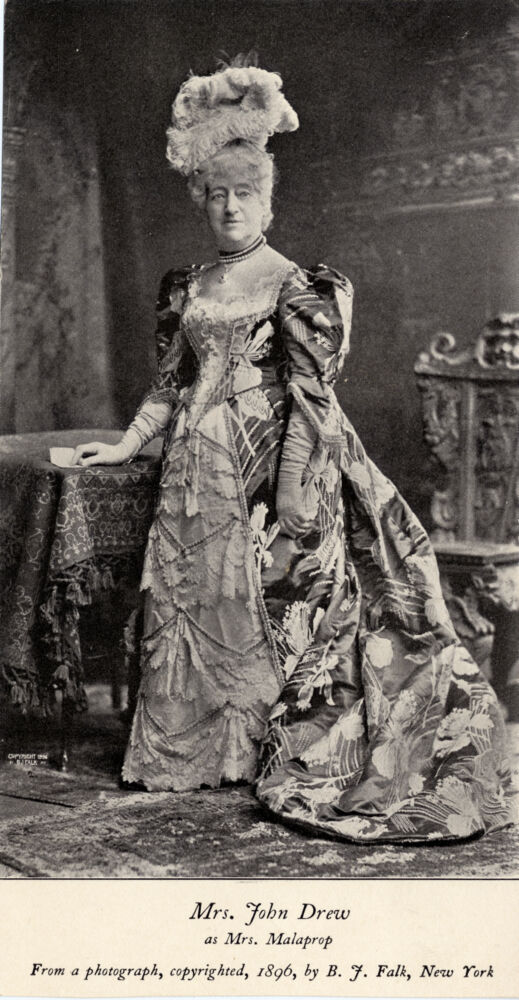
In case you are unfamiliar with the word malapropism, in lame man’s terms, it’s the mistaken replacement of a word with another that sounds similar. The term, derived from the French mal à propos, meaning inappropriate, got picked up in the English language because of playwright Richard Brinsely Sheridan. In his 1775 play The Rivals, a character named Mrs. Malaprop is notorious for muddling up her words. 

One version of Mrs. Malaprop looking “as headstrong as an allegory on the banks of the Nile,” which is one of her delightful lines. University of Illinois Urbana-Champaign University Library, Public domain, via Wikimedia Commons

That’s not to say that Sheridan was the only, or even the first, writer to make use of such a character trait, but I suppose that’s a moo point. For all intensive purposes, that’s when the concept entered the English language where it’s been driving language snobs like me bonkers ever since.

I’ve been thinking about malapropisms a lot lately because the publication date of Paradise on the Pike, my new historical novel set in the 1904 World’s Fair in St. Louis, is drawing near and I have discovered that not everyone is familiar with the word “pike.” 

If you happen to live in one of the handful of US states that contain a turnpike, you might be able to puzzle out that “turnpike” is another word for toll road and that “pike” is another word for a road. You might even be familiar with the phrase “coming down the pike,” meaning something is going to happen in the future. For example, I have a new novel coming down the pike. 

If you don’t happen to live near a turnpike, then you might mistakenly believe the phrase is “coming down the pipe,” in which case, I’m probably judging you. 

But this particular malapropism does make some logical sense because there is another phrase “in the pipeline” that also refers to something that is going to happen soon. I could, for example, tell you that I have a new novel in the pipeline. Conflating the two seems like a fairly innocuous mistake.

And of course you can go ahead and say whatever you like. It’s a doggy dog world and I don’t always get my way even if I do think malapropisms ought to be nipped in the butt whenever possible. Really, I could care less. Except that the expression, “coming down the pike,” may actually have its roots in the 1904 World’s Fair in St. Louis in which a mile long stretch of road along the north side of the fairgrounds that formed the main entertainment section of the fair was referred to as “the Pike.”

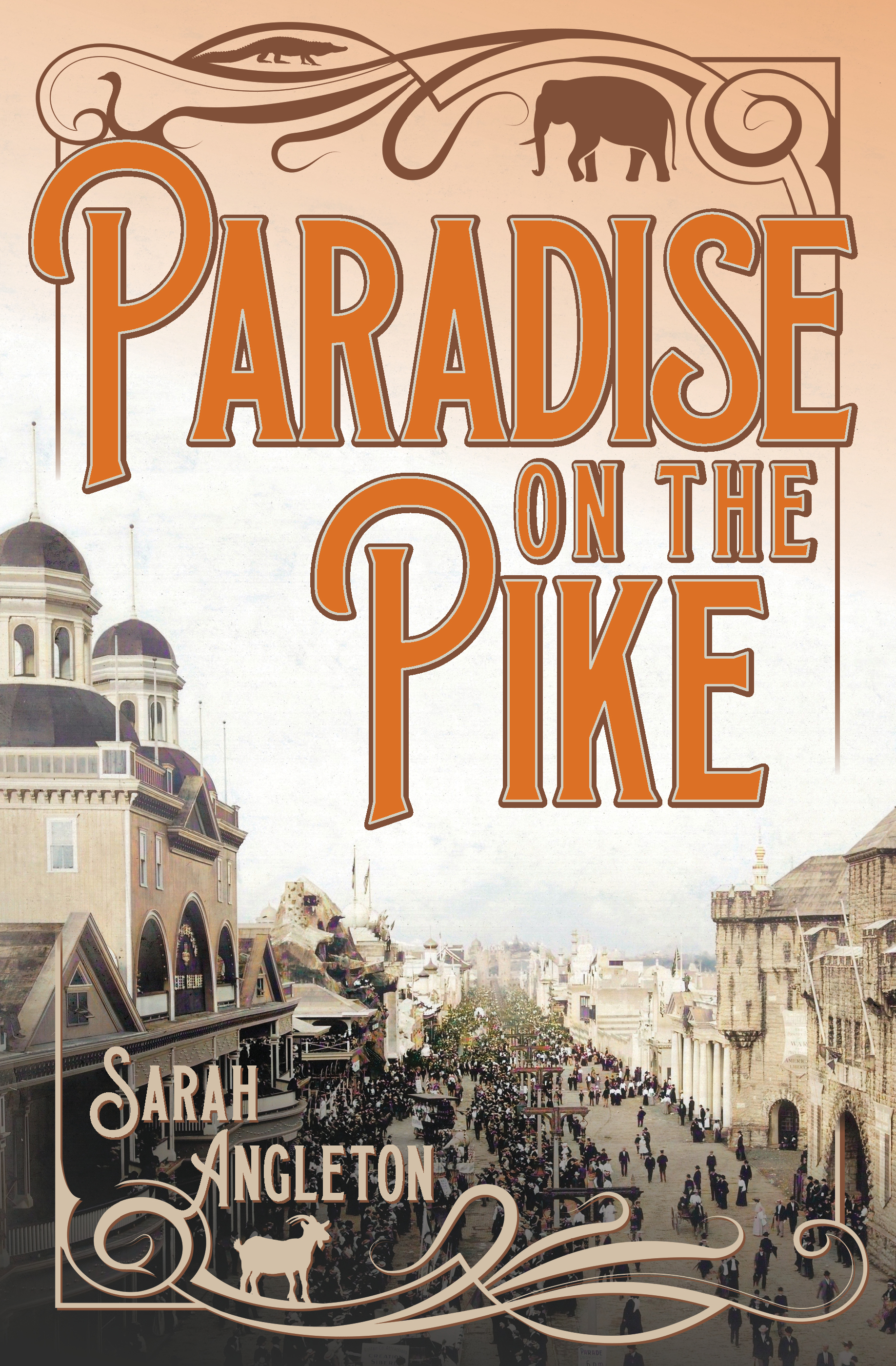
A new historical mystery coming down the pike on April 18, 2024.

The Pike contained all manner of concessions including battle reenactments, rides, a wax museum, fashion demonstrations, mock-ups of exotic locales, dancers, musicians, and animal shows. It was also the site of daily parades, leading to much excitement as people crowded around to catch a glimpse of what wondrous things might be coming down the Pike.

And so, the cover of my newest novel in the pipeline that will be coming down the pike on the 18th of April, just in time to celebrate the 120th anniversary of the 1904 World’s Fair, features a picture looking down the historical Pike. I hope you’ll forgive me for stringing out the cover reveal and keeping you on tender hooks for a few weeks. I also hope you’ll really enjoy the book when it’s finally here. And in the meantime, language snobbery aside, I hope you’ll love the book by its cover.