Meet Me at the Fair

On November 22, 1944 after schedule delays, numerous script rewrites, budget woes, and a leading lady still unhappy with her role, a new Christmas musical debuted on the big screen in St. Louis, the city at the film’s heart. 

The song “Meet Me in St. Louis,” well known today because of the musical, is actually from 1904 and was written specifically for the World’s Fair. Public Domain, via Wikimedia Commons

Despite the mess of getting to that moment, Meet Me in St. Louis enjoyed immediate success, becoming Metro-Goldwyn-Mayer’s second highest grossing film up to that point, coming in only behind Gone With the Wind. After the premiere, Judy Garland even decided she liked it after all and commented to the producer, “Remind me not to tell you what kinds of pictures to make.”

The screenplay is based on a series of semi-autobiographical short stories by St. Louis native Sally Benson who wrote of an upper middle-class family that lived at 5135 Kensington Avenue during the construction of the 1904 World’s Fair on the grounds of Forest Park in St. Louis.

I confess, I saw the movie for the first time later in life than I should have, having grown up within easy reach of St. Louis. My childhood summers included trips to downtown to watch the Cardinals play at Busch Stadium where the musical’s title song is still played by the organist at every game and the crowd sings along as the words scroll across the jumbotron. 

I’ve been many times to the wonderful outdoor Muny theater in Forest Park where the stage adaptation of Meet Me in St. Louis, originally produced in 1989, is performed every few years. I even got engaged in that park on the very grounds of the actual 1904 World’s Fair.
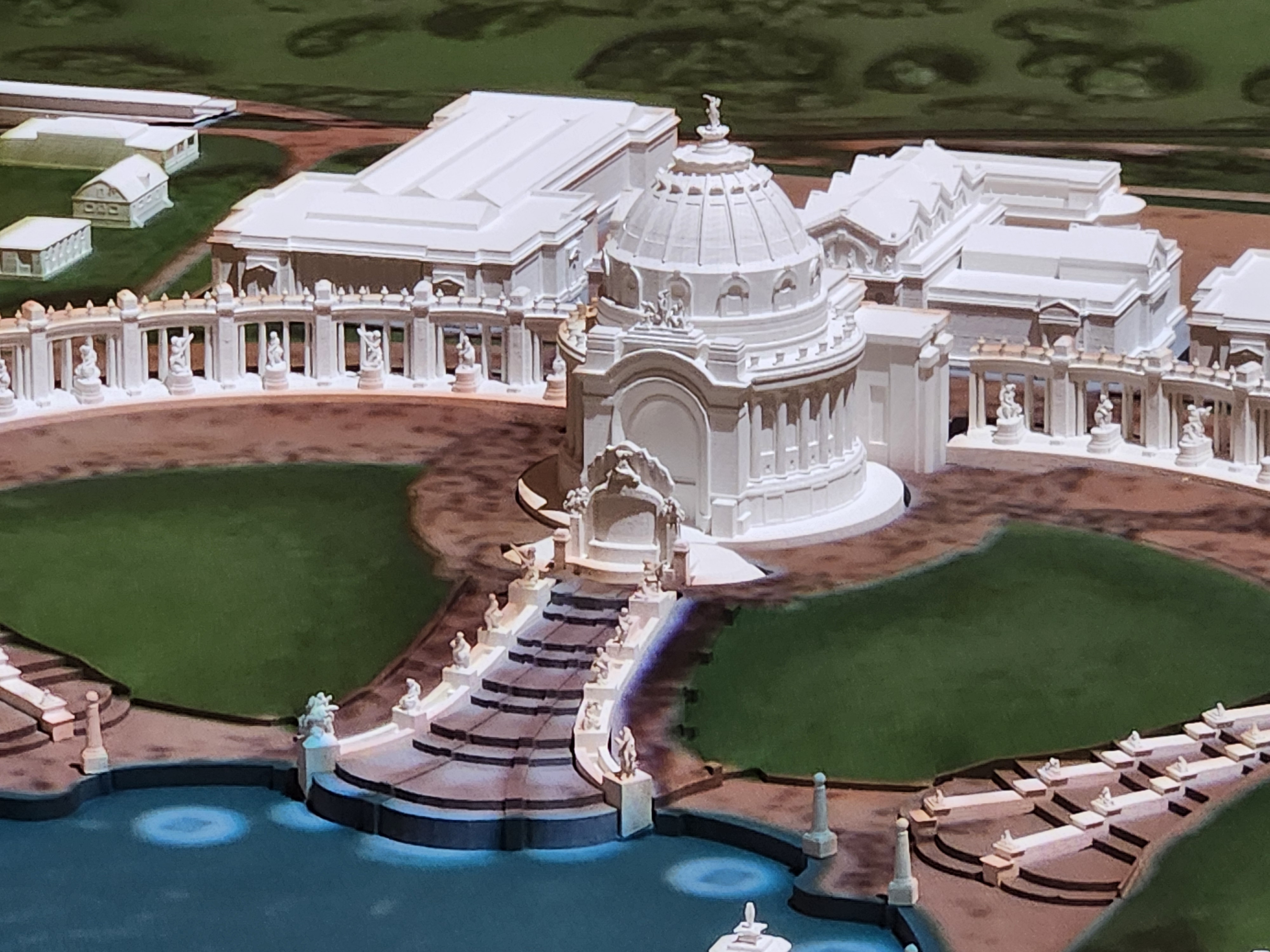
I was lucky enough to get a sneak peek at the new exhibit, open to the public on April 27th. It contains a scale model of the entire fairgrounds. And it’s spectacular.

Officially known as the Louisiana Purchase Exposition, the Fair is a big deal in St. Louis history. It transformed the city, launching it for about seven months into the center of the world’s attention. 

And it’s still a big deal, today. One-hundred and twenty years later the World’s Fair looms large in the community memory carried now by not a single living person who was there to see it, sparking excitement whenever it comes up in conversation, which is kind of weirdly a lot.

It’s especially on everyone’s minds right now because at the end of this month, just in time to celebrate the 120th anniversary of the opening of the Fair, the Missouri History Museum will reveal a newly re-imagined permanent World’s Fair exhibit. 

Equally exciting for everyone who either lives in my house or happens to be my mother, is the release of my new historical mystery set on the grounds of the 1904 World’s Fair in St. Louis. 

Paradise on the Pike is available for the first time today. The story takes place in the enchanting world of Hagenbeck’s Zoological Paradise and Trained Animal Circus on the Pike, which is the entertainment strip within the Fair. It’s not a light, sentimental sort of story like Sally Benson’s, but it does contain elephants and lions and a pair of cantankerous goats. It also allowed me, and will hopefully allow you, to spend some time strolling through the Fair, which was almost entirely constructed of temporary buildings meant to disappear.
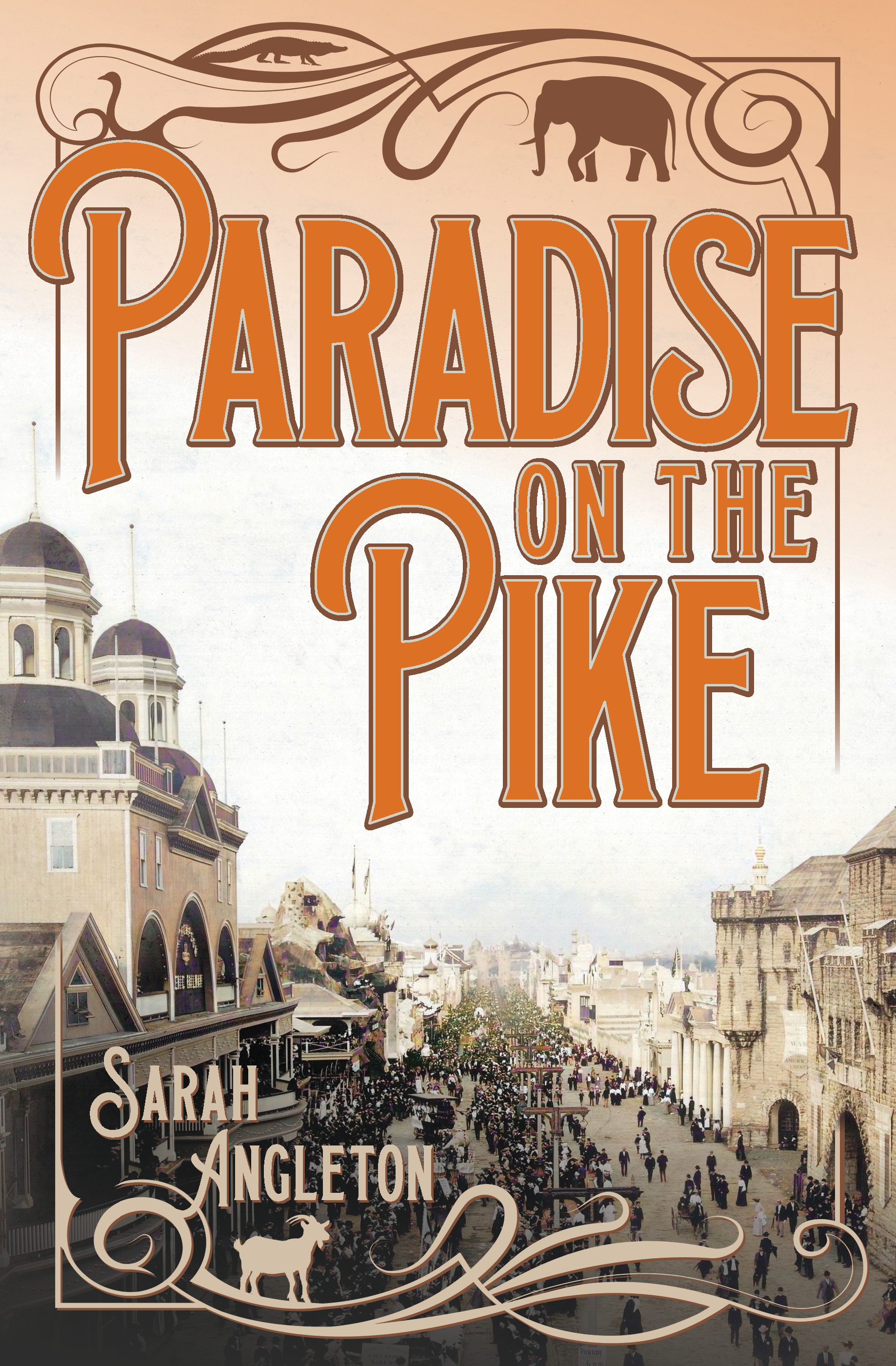
Available today! Order from your favorite independent bookstore or slightly bigger bookstore or Amazon.

And maybe that’s why, one hundred and twenty years later, it still takes up space in our imaginations, because we’re a little like six-year-old Tootie at the end of Benson’s stories when the family marvels over the lights and fountains on the fairgrounds and her sister Agnes asks if it’ll ever be torn down.

Tootie emphatically replies, “They’ll never tear it down. It will be like this forever.”

Agnes, relieved, exclaims, “I can’t believe it. Right here where we live. Right here in St. Louis.”

Forest Park retains very few physical reminders of the enormous event that once filled its every corner and held the attention of the world, but in the hearts of the St. Louisans who stroll through the grounds and wish they could have seen those lights shining, it will never be torn down. It’ll be like this forever.

You can find more information about Paradise on the Pike at this link.
Get a Bicycle. You will certainly not regret it, if you live.

In 1963, a leader for the Ozark Area Council of American Youth Hostels, Dick Leary, decided it would be a fun idea to take a nighttime bike ride through the city of St. Louis. He organized the event for a night in October and set it up to begin at midnight at Union Station. Unfortunately (because most people probably thought he was joking) Leary was the only rider to turn up.

Determined that it was still a good idea (and because I’m guessing he battled insomnia), Leary completed it himself and the next year managed to recruit a few more riders. Word started to get out and by the early 1970s thousands of participants were showing up to complete the ride every year.

Eventually, the event became known as the Moonlight Ramble, the longest-running nighttime cycling event in the world. Organized now through the University of Missouri-St. Louis, the route has changed a few times over the years, but the full course is always around 18 to 20 miles through the heart of downtown St. Louis on the early Sunday morning in August that occurs closest to the full moon.

And despite the addition of a premier riding group (personally I’m not sure how anyone can take themselves all that seriously while sporting glow necklaces snaked through their bicycle spokes), the Ramble is NOT a race (shoe clips are not allowed, nor are they advisable). It’s a ride. All ages, all ability levels, and even all manner of wheeled, human-powered vehicles are welcome. I (typically sound asleep by no later than 10:30) rode in the Ramble for the first time this year, along with my sister and a handful of her cycling buddies, most of whom had participated in the event before.

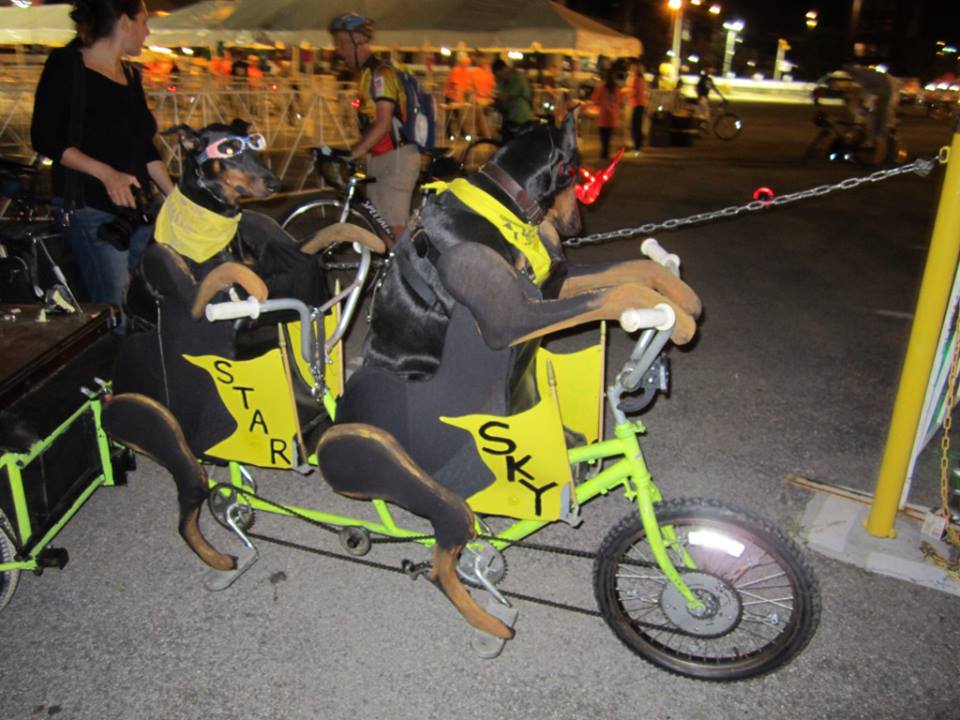
Okay, so maybe "human-powered" isn't a strict requirement.
Okay, so maybe “human-powered” isn’t a strict requirement.

It was a gorgeous night, under the nearly full moon. The first riders took off from Busch Stadium at 12:10 (after a slight delay for traffic from the preseason Rams game). As there were probably four thousand riders, it took a while to get us all going and even with the best efforts of the St. Louis police department and an army of volunteer ride marshals, it took a bit for the remaining downtown traffic to adjust to the onslaught of bicycles (most drivers smiled to see us; a few were cranky). Once we were really going, though, I have to say it was one of the coolest experiences I’ve ever had in the city.

Now, I realize that this is generally a (sort of) history blog and that this particular post has thus far come up a little short in that area (unless you’re really easily satisfied and a brief reference to 1963 is enough for you), but I think I can make a case for why it still fits. And to do so, I am going to direct your attention to the expertise of Professor Kenneth Jackson who teaches the History of the City of New York at Columbia University (and who is a much more reliable source of all things history than is yours truly).

Since he began teaching the class in the late 1970s, Professor Jackson has led his students on a nighttime, five-hour bicycle tour from Columbia University to the Brooklyn Promenade. Along the way, Jackson stops at various points of interest to deliver lectures through a bullhorn to the now hundreds of students that come along for the ride.

The professor admits, however, that it is not so much the knowledge shared in his lectures that sticks with the students, but simply the experience of seeing the city in this strangely intimate way, when the moon is bright and the streets are quieter (a little bit anyway, but of course this is New York we’re talking about). One student had this to say about standing in front of Federal Hall at 4:30 AM: “In this sleepy blur I catch myself imagining that I’m there, imagining that [Professor] Jackson is Washington and we’re getting ready to start this new republic.” Another student commented: “This is the first time I feel like I’m really living in the city.”

That's a lot of people "really living" in the city of St. Louis.
That’s a lot of people “really living” in the city of St. Louis.

I get that. I grew up not so far from St. Louis and I have been delighted to be back again, nearer still to what I consider “my city.” Since moving here this past February I have taken my children up in the Arch, explored the Zoo, wandered through the Botanical Garden, enjoyed the theater at both the Fabulous Fox and the outdoor Muni, and been to Busch Stadium to watch the Cardinals play more often than I should admit (I lived two entire baseball seasons in Oregon and apparently distance really does make the heart grow fonder).

After riding the Ramble, all of these different places found a home in that mental map that I always wish I was better at carrying around with me (you may recall that in a previous post I mentioned that my sense of direction is, well, okay so I don’t actually have one). I may not have learned a great deal about the history of my city on this ride, but I did get to know St Louis itself better and be a part of it in a way I never had before.

Bill Emerson said it well in 1967 when he wrote in the Saturday Evening Post: “A bicycle does get you there and more…. And there is always the thin edge of danger to keep you alert and comfortably apprehensive. Dogs become dogs again and snap at your raincoat; potholes become personal. And getting there is all the fun.”

Nighttime cycling is not perfect. The Ramble attracts all kinds of folks, the serious cyclists and the families out to make lasting memories together, but also the rowdies whose frequent beer stops make it best to avoid them.  I also certainly wouldn’t recommend a nighttime ride outside of an organized event. But late night ride events and tours are popping up all over the world (Paris, London, and Moscow are just a few of the cities that I discovered offer similar experiences).

I don't know what this thing is, but it was probably the coolest vehicle in the ride.
I don’t know what this thing is, but it was probably the coolest vehicle in the ride.

But even if you don’t own a bike (often they can be rented), haven’t ridden since you were a kid (you never forget how), or for some reason would prefer sleeping to rambling in the moonlight, consider taking some advice from Mark Twain who once learned to ride one of the old-timey high-wheeled bicycles of his day and had this to say of the experience: “Get a bicycle. You will certainly not regret it, if you live.”

So maybe I do care if I ever get back.

On April 18, 1981, the night before Easter that year, young David Craig attended a baseball game in Pawtucket, Rhode Island, at the invitation of his uncle, Dennis Craig, the home plate umpire. Little did he know that the Triple-A game between the Pawtucket Red Sox and the Rochester Red Wings would make baseball history as the longest professional baseball game ever played.

With a start time of 8:25 p.m., the game began as a regular pitching duel, scoreless for six innings. The Red Wings finally scored a run in the 7th; the Red Sox answered in the 9th. Next came another 11 scoreless innings (yes, you read that right). So then in the 21st inning, when the Red Wings scored, only to have Pawtucket’s Wade Boggs drive in the tying run in the bottom of the inning, no one was particularly happy about it (least of all Boggs). The players endured another 11 scoreless innings until league president Harold Cooper heard about it and demanded the suspension of play at the conclusion of the 32nd inning (at 4:07 a.m.!).

At this point, the crowd had dwindled from 1,740 to a mere 19 (excessively loyal) fans, each of whom received, for their devotion, season passes to the stadium. Not included in the count is David Craig, who by this time, was fast asleep. To the best of his uncle’s knowledge, David Craig has never since been to another baseball game.

And, as much as I love baseball, I can’t say I blame him.

I recently attended a game that had me questioning my own devotion to the sport. On Sunday, June 17th (Father’s Day), my family went to a game at Busch Stadium in St. Louis (a rare treat now that we live on the West Coast) between the Cardinals and the Kansas City Royals.

First, I should explain a little about my own relationship to Cardinal baseball. I am a fan by birth. More specifically, my maternal grandparents were fans. My father (originally just another frustrated Cubs follower) became a dedicated fan by marriage. My siblings are fans. My husband and most of his family are fans. And now the next generation (with the exception of one nephew, who hasn’t been alive long enough yet to fully grasp that the Cubs are never going to win) is made up of Cards fans. Cardinal baseball is entwined with some of my most precious memories of childhood and family.

I am not the person who is going to recite for you the names and stats of every player who has ever worn a Cardinals jersey, but I catch the games when I can and generally follow the team’s ups and downs. I celebrated their World’s Series victories in 1982, 2006, and 2011 and my heart broke those years when they were close enough to taste it, but were ultimately unsuccessful. I follow them closely enough to proudly proclaim that they have the most championship wins of any team in baseball (because the Yankees don’t count).

Still, I have to admit, I wasn’t really that upset to see them lose the Father’s Day game to Kansas City. With the exception of a couple of back-to-back homeruns by Cardinals Matt Holliday and Alan Craig in the 6th, it was a relatively boring game. The Cards were up by 1 in the top of the 9th; their closer Jason Motte was on fire, throwing fast balls the Royals couldn’t see, let alone hit. There were two outs, two strikes, and I was already packing up my kiddos (a little bored, though they had hung in pretty well for little guys) when disaster struck in the form of a solo shot homerun by Kansas City’s Billy Butler.

Inwardly I groaned, but I was fairly confident that the Cardinals would score to end the game. They didn’t. Instead it went on for 6 more innings. Each team had chances to win. Neither did. And the thing about extra inning baseball is that it’s rarely good, because nine innings of baseball is enough to tire most players out. After about 11 or so, the fatigue begins to show. And by 14(when there really should be another stretch because a sing-along might help lift everyone’s spirits), has caught a big case of the Please just let it ends.

The crowd thinned more and more after each half inning until it was pretty much just us and the Kansas City fans. The organist got stuck in a rut of weary charge riffs. And we debated. Even nearly left a couple of times, but you just don’t travel 2000 miles to go to a baseball game and not see it through to the end. By the time it was finally over, the game had lasted around 5 hours. When Kansas City’s Yunieski Bettencourt hit a 2-run homer the 15th, I am ashamed to admit, I was sort of hoping a little bit that the Cards wouldn’t recover (though I would have happily cheered for a three-run homer if one happened to come their way).

I am also a little ashamed to admit how truly upset I was that St. Louis swept the Royals in Kansas City the very next weekend, not, of course, because they won, but because they didn’t win when I was there to see it.

And I have to wonder just how long we would have stayed at the ballpark. Certainly (okay, probably) not 32 innings. The Pawtucket-Rochester game was continued, by the way. The next time the two teams were scheduled to play in Pawtucket, on June 23, in front of a sellout crowd of 5,746, play resumed. In one inning (just under 18 minutes of play), the Red Sox won it in the bottom of the 33rd inning. David Craig wasn’t there to see it.