For the Bragging Rights

On October 4, 1986 the Missouri River flooded its banks and damaged the stretch the Missouri-Kansas-Texas Railroad track that stretched between Sedalia and Machens, Missouri. This in itself wasn’t particularly unusual. The area is prone to flooding and had proven a problem for the railroad company since the earliest days of the route. What was unusual about the 1986 flood was that the company decided to abandon rather than repair the route.
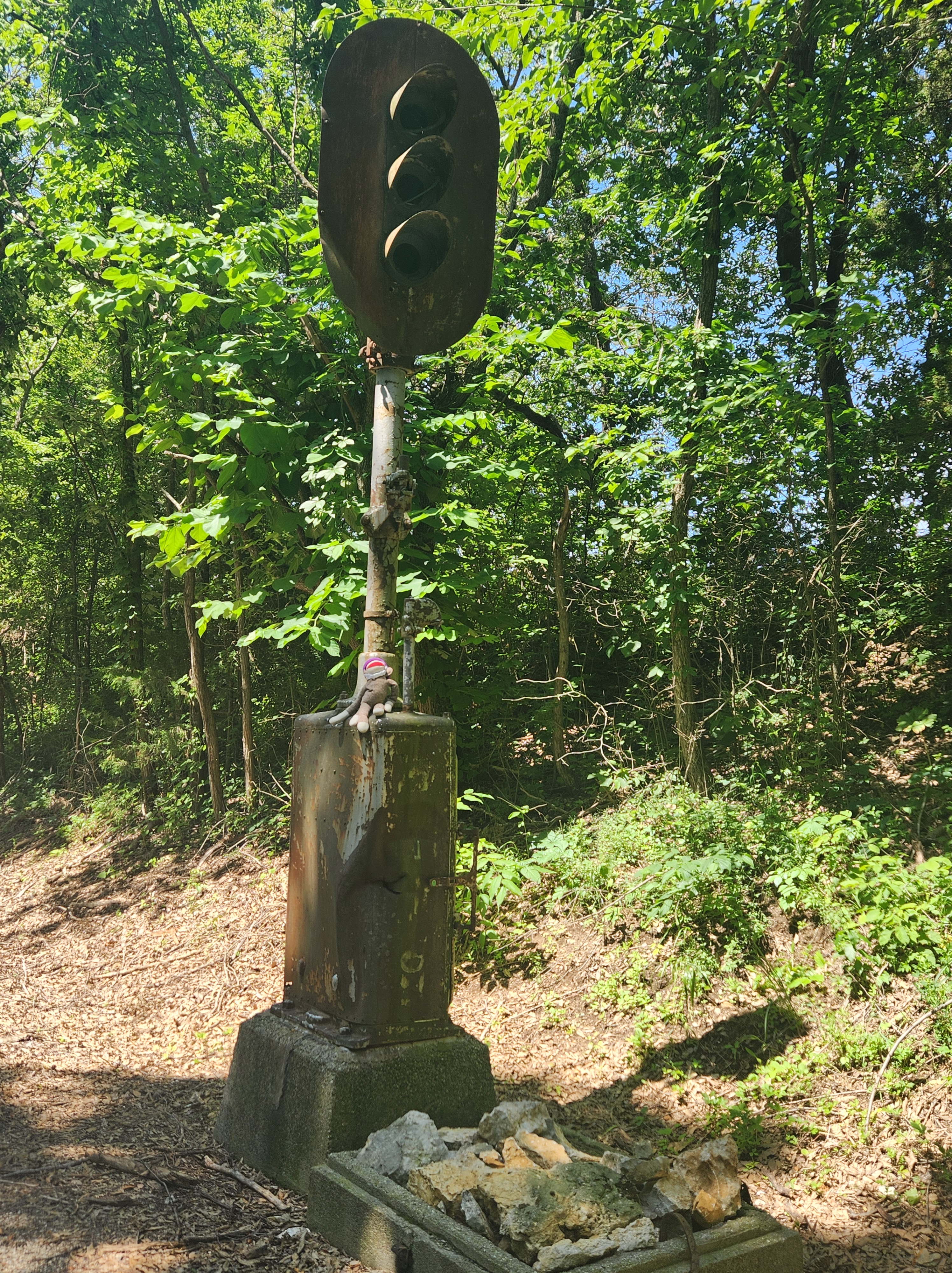
This is the last remaining signal from the MKT Railway.

This turned out to be good news for the biking and hiking enthusiasts of the Great State of Missouri. With help from a generous donation from Ted and Pat Jones (of the Edward Jones Financial Investment Company based in St. Louis), the Missouri Department of Natural Resources purchased the abandoned right-of-way to use as a trail. 

The first section of the crushed limestone MKT trail, shortened to KT, which became simply “the Katy” opened in 1990 around Rocheport, Missouri. Today it officially extends from Clinton in the western part of the state to Machens in the east, comes in at about 239 miles, and is the longest recreational rail trail in the United States. Several spurs offer additional distance, including a 47-mile Rock Island Spur that runs to Kansas City.
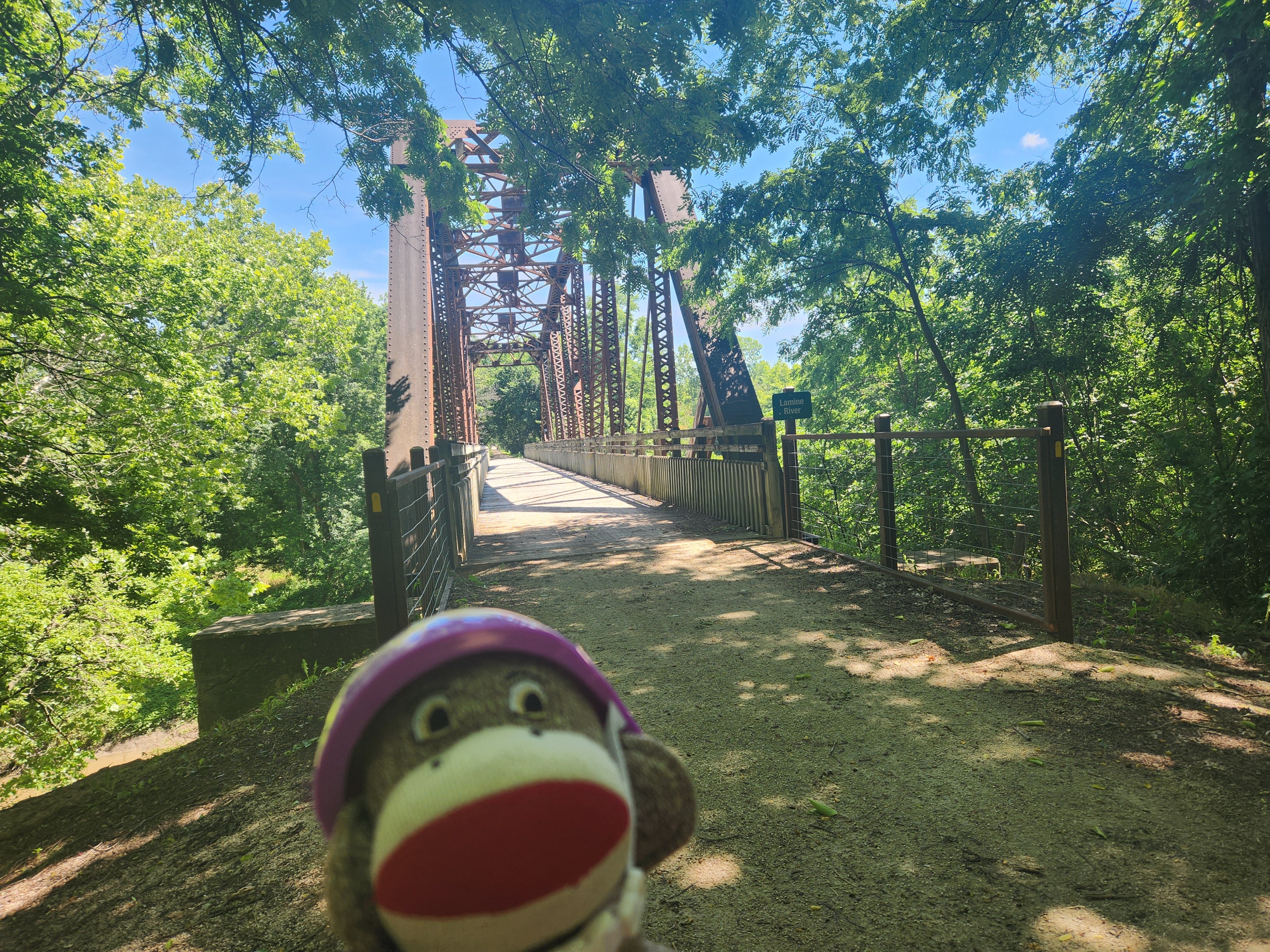
Sock Monkey Steve came along as well, but his skinny little monkey legs weren’t much help.

My sister and I were happy enough last week to hop on our bicycles and crush the route between Clinton and St. Charles. That’s officially 12.7 miles from the end in Machens, but St. Charles is a better place to stop and get picked up and taken out for celebration barbecue and cookies. Also, if we add in all of the spurs into towns that we took along the way, we more than made up the difference.

It turns out a lot of cyclists (and some hikers) tackle the whole Katy. We met quite a few cyclists, some of them traveling the same direction as us, some day riders who had done the whole thing on previous occasions, some with light loads and dedicated sag wagons, and others carting their own camping gear. Some riders do the full length in as little as three days. Five to six days seems to be the most common. 
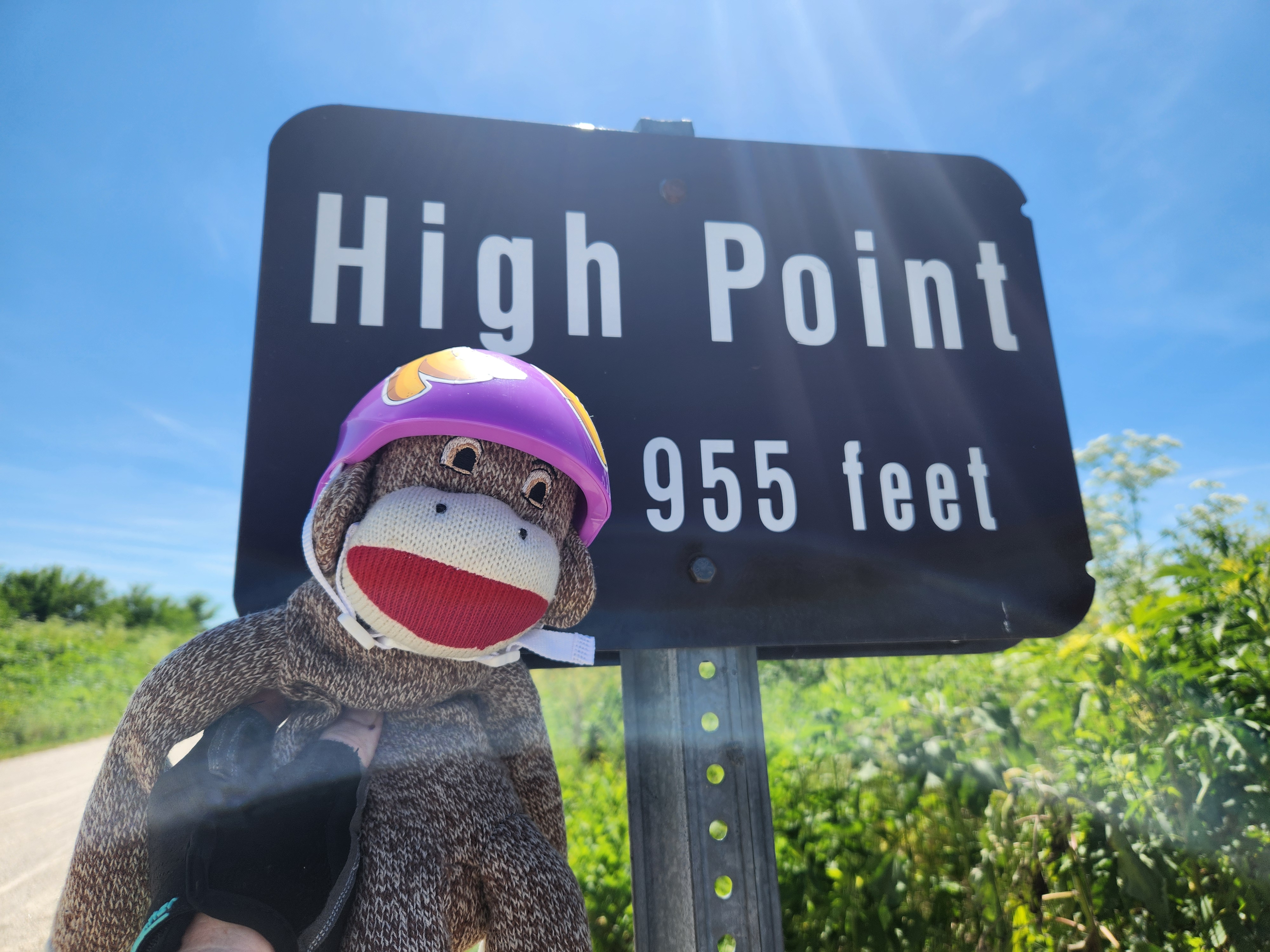
We reached the high point of the trail on the first day, but it definitely was not all downhill from there.

We did six, which was good enough for us. And we stayed in hotels and B&Bs along the way, because we couldn’t imagine that sleeping on the ground was going to be restful enough for us after forty-plus miles of biking on crushed gravel to then be able to get back up and do it again the next day. We did carry our gear with us, though, which was enough of a burden. 

The trail, though straight and flat-ish, requires a lot of work. Some patches are very well groomed. Some not so much. After one stormy night, we had to dodge quite a few downed branches. There are some stretches where large gravel and washouts make the riding all the more challenging, and the western portion of the trail all the way to about a mile outside Boonville is often slightly uphill, just enough to be a slog.

A train tunnel near Rocheport.

But the trail is beautiful, with much of it running between the Missouri River and gorgeous bluffs. It crosses over numerous creeks on pretty truss bridges, through tunnels, forest, wetlands, prairie land, rolling farmlands, and past historic remnants of the railroad.

As challenging as some days were, as sore as our bodies ended up being, and as tired as we were by the time we lugged our bikes from the trail to our stops each night, I’m awfully glad we did it. I don’t know that I learned anything profound from the experience, though someday when my backside is less sore, I will probably think of some way to turn the experience into a terribly moving and deeply reflective personal essay. For now, it’s enough to have crushed the Katy for the bragging rights.
Get a Bicycle. You will certainly not regret it, if you live.

In 1963, a leader for the Ozark Area Council of American Youth Hostels, Dick Leary, decided it would be a fun idea to take a nighttime bike ride through the city of St. Louis. He organized the event for a night in October and set it up to begin at midnight at Union Station. Unfortunately (because most people probably thought he was joking) Leary was the only rider to turn up.

Determined that it was still a good idea (and because I’m guessing he battled insomnia), Leary completed it himself and the next year managed to recruit a few more riders. Word started to get out and by the early 1970s thousands of participants were showing up to complete the ride every year.

Eventually, the event became known as the Moonlight Ramble, the longest-running nighttime cycling event in the world. Organized now through the University of Missouri-St. Louis, the route has changed a few times over the years, but the full course is always around 18 to 20 miles through the heart of downtown St. Louis on the early Sunday morning in August that occurs closest to the full moon.

And despite the addition of a premier riding group (personally I’m not sure how anyone can take themselves all that seriously while sporting glow necklaces snaked through their bicycle spokes), the Ramble is NOT a race (shoe clips are not allowed, nor are they advisable). It’s a ride. All ages, all ability levels, and even all manner of wheeled, human-powered vehicles are welcome. I (typically sound asleep by no later than 10:30) rode in the Ramble for the first time this year, along with my sister and a handful of her cycling buddies, most of whom had participated in the event before.

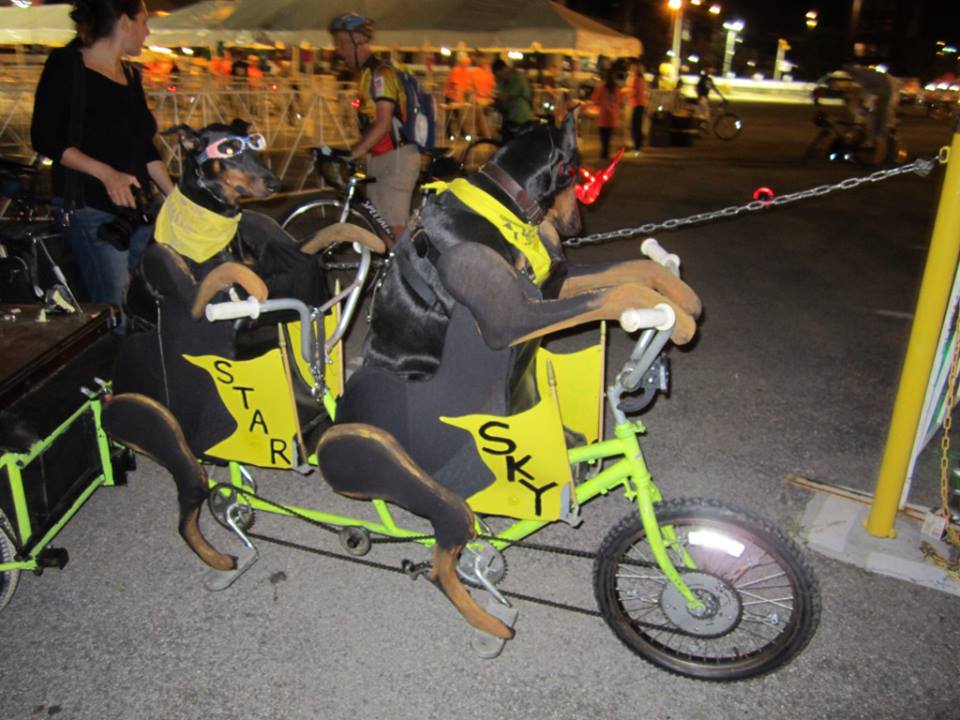
Okay, so maybe "human-powered" isn't a strict requirement.
Okay, so maybe “human-powered” isn’t a strict requirement.

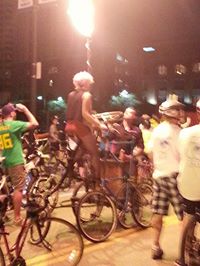
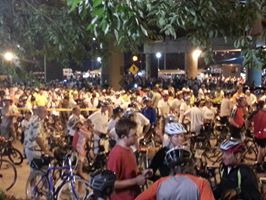
It was a gorgeous night, under the nearly full moon. The first riders took off from Busch Stadium at 12:10 (after a slight delay for traffic from the preseason Rams game). As there were probably four thousand riders, it took a while to get us all going and even with the best efforts of the St. Louis police department and an army of volunteer ride marshals, it took a bit for the remaining downtown traffic to adjust to the onslaught of bicycles (most drivers smiled to see us; a few were cranky). Once we were really going, though, I have to say it was one of the coolest experiences I’ve ever had in the city.

Now, I realize that this is generally a (sort of) history blog and that this particular post has thus far come up a little short in that area (unless you’re really easily satisfied and a brief reference to 1963 is enough for you), but I think I can make a case for why it still fits. And to do so, I am going to direct your attention to the expertise of Professor Kenneth Jackson who teaches the History of the City of New York at Columbia University (and who is a much more reliable source of all things history than is yours truly).

Since he began teaching the class in the late 1970s, Professor Jackson has led his students on a nighttime, five-hour bicycle tour from Columbia University to the Brooklyn Promenade. Along the way, Jackson stops at various points of interest to deliver lectures through a bullhorn to the now hundreds of students that come along for the ride.

The professor admits, however, that it is not so much the knowledge shared in his lectures that sticks with the students, but simply the experience of seeing the city in this strangely intimate way, when the moon is bright and the streets are quieter (a little bit anyway, but of course this is New York we’re talking about). One student had this to say about standing in front of Federal Hall at 4:30 AM: “In this sleepy blur I catch myself imagining that I’m there, imagining that [Professor] Jackson is Washington and we’re getting ready to start this new republic.” Another student commented: “This is the first time I feel like I’m really living in the city.”

That's a lot of people "really living" in the city of St. Louis.
That’s a lot of people “really living” in the city of St. Louis.

I get that. I grew up not so far from St. Louis and I have been delighted to be back again, nearer still to what I consider “my city.” Since moving here this past February I have taken my children up in the Arch, explored the Zoo, wandered through the Botanical Garden, enjoyed the theater at both the Fabulous Fox and the outdoor Muni, and been to Busch Stadium to watch the Cardinals play more often than I should admit (I lived two entire baseball seasons in Oregon and apparently distance really does make the heart grow fonder).

After riding the Ramble, all of these different places found a home in that mental map that I always wish I was better at carrying around with me (you may recall that in a previous post I mentioned that my sense of direction is, well, okay so I don’t actually have one). I may not have learned a great deal about the history of my city on this ride, but I did get to know St Louis itself better and be a part of it in a way I never had before.

Bill Emerson said it well in 1967 when he wrote in the Saturday Evening Post: “A bicycle does get you there and more…. And there is always the thin edge of danger to keep you alert and comfortably apprehensive. Dogs become dogs again and snap at your raincoat; potholes become personal. And getting there is all the fun.”

Nighttime cycling is not perfect. The Ramble attracts all kinds of folks, the serious cyclists and the families out to make lasting memories together, but also the rowdies whose frequent beer stops make it best to avoid them.  I also certainly wouldn’t recommend a nighttime ride outside of an organized event. But late night ride events and tours are popping up all over the world (Paris, London, and Moscow are just a few of the cities that I discovered offer similar experiences).

I don't know what this thing is, but it was probably the coolest vehicle in the ride.
I don’t know what this thing is, but it was probably the coolest vehicle in the ride.

But even if you don’t own a bike (often they can be rented), haven’t ridden since you were a kid (you never forget how), or for some reason would prefer sleeping to rambling in the moonlight, consider taking some advice from Mark Twain who once learned to ride one of the old-timey high-wheeled bicycles of his day and had this to say of the experience: “Get a bicycle. You will certainly not regret it, if you live.”