Chapters Eight

In 1955, responding to a Life magazine article that explored the problem of underachievement in American children’s literacy rates and a book published soon after titled Why Johnny Can’t Read, then Houghton Mifflin education director William Spaulding reached out to an old friend with a challenge.

Theodore Geisel thought it would take him at most a month or two to use a provided list of 348 words every six-year-old should know, whittle it down to about 225 words, and shape them into a story that, at Spaulding’s insistence, “first graders can’t put down.”
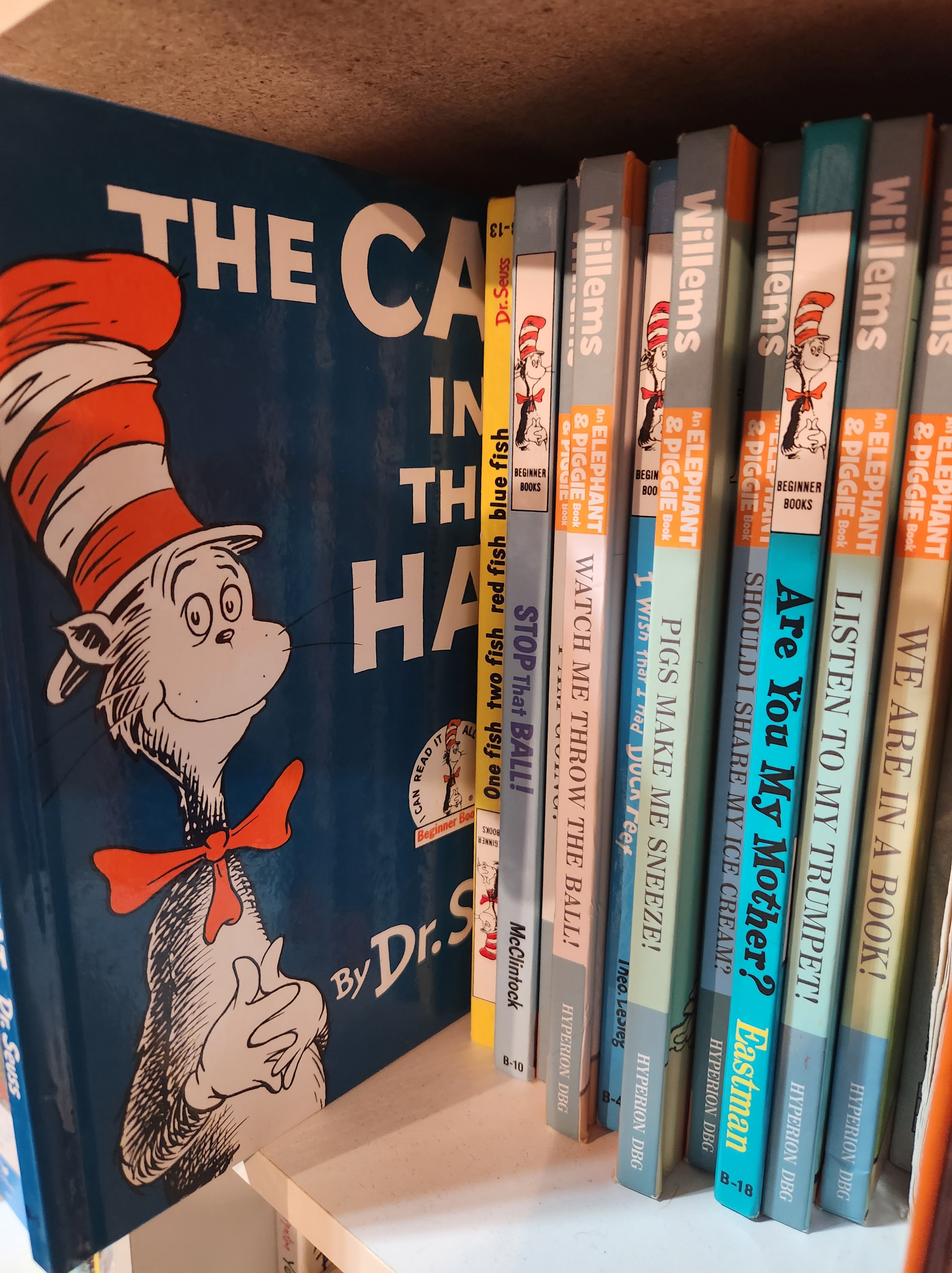
It’s been a few years since our household has contained a first grader, but this is still in the collection because you never know when one might pop by for a visit.

It turned out to be a much taller order than the beloved Dr. Seuss, who was accustomed to making up silly words when he couldn’t find a rhyme, first assumed. At one point, he claimed he looked at the list and determined that the first two rhyming nouns he found would be the subject of his book. When he put a striped hat on a naughty cat, children’s literature was changed forever. He ended up using 236 unique words to write his The Cat in the Hat. It took him a year-and-a-half to do it.

I can sort of relate. I’m in the middle of a second draft of what I hope will someday be my fourth historical novel. That is, by the way, the best of my many excuses for not being super consistent on my blog lately. Also travel and the chaos of summer and life in general, but mostly it’s the novel thing. I’m fairly certain the novel won’t delight many first graders, but I would like to think it may someday be a book readers won’t be able to put down.

It’s a long way from that right now. A good portion of the book is still in that terrible rough draft stage in which the plot contains holes, the research has thin patches, the word choices are sloppy, the pacing is erratic, and the irresponsible characters are largely calling the shots. At this stage, I’m still hoping someone who loves me would have the good sense to destroy it if anything should happen to me before I’ve had a chance to clean it up.

Slowly but surely, I am working my way through the second draft. This is when I consider the rhythm of the story. I might move things around a little, adjust the pacing, fill in some background information, answer a few more targeted research questions, rein in those rambunctious characters, and start to play more intentionally with language. And like Dr. Seuss writing The Cat in the Hat, I’m finding that the whole thing is taking a lot longer than I thought it would.

Fortunately, I have not been tasked with changing the face of children’s literature and the landscape of early literacy education, but I do have approximately one million words in the English language I can choose from. I will not be trying to figure out how many unique ones I end up using, but my goal is somewhere in the neighborhood of 90,000 words or so, which does require some whittling.

For right now, most of that whittling needs to happen in chapter eight, which is where the pacing of this story really went off the rails. I must have been on a roll when I got to that part of the rough draft because I threw everything in there, including something like a quarter of the book’s major plot points.

It’s a monstrous hot mess that will eventually become at least five chapters, if not more, in the second draft. The problem is that it’s hard to convince myself I’m making much progress when, after days and days, I’m still trying to shape chapter 8d.

I’ll get there. Eventually. In the meantime, it does help to recognize that while I’m struggling with a process that is taking longer than I expected, the Greats have struggled with this, too. It also helps that even though my ninety-ish thousand words probably shouldn’t be made up, very few of them have to rhyme.

Literacy and the Racist Kangaroo

Though I wasn’t born until more than twenty years later, one of the most important moments of my childhood occurred on this day in history. You see, on the fifteenth of May, in the Jungle of Nool, in the heat of the day, in the cool of the pool, he was splashing…enjoying the jungle’s great joys…when Horton the elephant heard a small noise.

hortonbook
photo credit: CCAC North Library via photopin cc


Dr. Seuss’s Horton Hears a Who! was published in 1954 and it was by far my favorite in our family’s collection of children’s books. The reason is simple. It was my dad’s favorite, too. In fact I can’t remember a single time when I climbed up on his lap to read a book that he didn’t begin with those oft-recited lines, regardless of what book I had brought him. The joke never got old.

But it wasn’t just that my dad loved the book so much. I think, in retrospect, the famous line, “A person’s a person, no matter how small,”resonated with me, the youngest child in a family of high achievers. And, the part of me that has always been a little bit writerly appreciated that Dr. Seuss so gracefully pulled off an obvious plot hole when Horton searches the clover field for the Whos that then beg him to take care of them when, really, if they’d just been allowed to rebuild in the clover field they’d have been perfectly safe.

That doesn't look like such a bad place to land.   photo credit: ajari via photopin cc
That doesn’t look like such a bad place to land. photo credit: ajari via photopin cc

Looking back, I get now why he couldn’t do that. If he had, the allegory would have broken down. Maybe. Of Theodore Seuss Geisel’s many books most have been scrutinized for subversive meanings. Some of them Dr. Seuss explained during his lifetime. Horton Hears a Who!, he didn’t. Still, neither he nor his widow ever refuted the widely held assumption that the book was an allegory for the post WWII relationship between the United States and Japan.

Politically, Dr. Seuss was an active Democrat, a believer in large governments taking care of small, and with one glaring exception, was outspoken against racism. Turns out, he wasn’t much of a good friend to the Japanese. He strongly supported internment camps for Japanese Americans, refusing to differentiate them from citizens of Japan.

He made his opinion very clear with a series of terribly stereotypical political cartoons that sought to dehumanize the Japanese and foster fear and animosity toward them. Had he tweeted them he might have been banned for life from the NBA or at least fined by the NFL and forced to apologize.

Um...Dr. Seuss?
Um…Dr. Seuss?

But by 1954, Dr. Seuss’s perspective changed. Hitler’s Axis had been defeated, Japan’s population had suffered terribly at the hands of the United States and its atomic bombs, and for the most part, the US postwar occupation of Japan had drawn to a close with a flourishing democracy and the promise of a bright future (with robots).

After the war, Dr. Seuss had the opportunity to visit the country. While there he was impressed with the culture and people he had previously belittled in his cartoons. In Kyoto he befriended a professor named Mitsugi Nakamura to whom he dedicated Horton Hears a Who!

So just as the people of Japan faced the threat of annihilation by atomic weapons, the citizens of Whoville face a deadly bath in boiling beezlenut oil. In a parallel to the US effort to protect and guide a postwar Japan, it is through a combination of a strong protector and the tremendous effort of a proud people that the Whos are saved.

photo credit: daveparker via photopin cc

In the end, a racist kangaroo that has worked tirelessly to spread anti-Who propaganda, villainized anyone who would stand up for the little guys, and has even attempted to ignore the Whos’ very existence is redeemed in a dramatic turnaround. And the little kangaroo in her pouch learns a big lesson, too.

I doubt very much that Dr. Seuss intended for many of his readers to get all of that from Horton’s adventure with the Whos of Whoville. He claimed he never wrote from a moral because “kids can see a moral coming a mile off,” but admitted “there’s an inherent moral in any story.” He was also a big believer in giving people in general and children in particular the tools to become great thinkers.

So I don’t think he would be bothered by the fact that when as a child I read, “A person’s a person no matter how small,” I assumed he was talking about me. I think he’d be glad to know that this book, more than any other, launched me toward literacy. And I hope it would bring a smile to his face to know that even now, the fifteenth of May makes me think of cuddling up with my dad and a good book and of Horton and the Whos and of the redemption of a racist kangaroo.

photo credit: Tatters ❀ via photopin cc


Please don’t look at me like that.

On Christmas morning 1902, young brothers Quentin and Archie Roosevelt revealed a holiday surprise to their parents. As the first family entered the White House room where they were to open their gifts, the boys threw open a set of closet doors to reveal a small decorated Christmas tree.

English: A Christmas Tree at Home
Surprise! There were too many trees in the yard anyway. (Photo credit: Wikipedia)

The tree had been cut from the White House grounds and with a little assistance from staff had been wired for electric lights. The trouble was that President Theodore Roosevelt had specifically banned White House Christmas trees the previous year.

A dedicated outdoorsman and environmentalist, Roosevelt had listened to the increasing public concern over unnecessary forest destruction and come to the decision that his family would not participate in the holiday tradition.

Now, please believe me when I say that I am not a Christmas tree hater. I recognize that for many of the folks out there who celebrate Christmas, the season just simply would not be the same without a freshly cut tree. But I don’t have a real tree in my home.

Primarily this is because I have a family member who is terribly allergic to evergreen, but I also appreciate that artificial trees don’t need to be watered, rarely burst into flame, and possess bendy branches that are quite convenient for whimsical ornament placement. Best of all, when Christmas is over, I don’t have to worry about how to dispose of my tree.

christmas tree recycling dropoff 4
Oh. Right there? OK. (Photo credit: sdminor81)

At least I thought that was an advantage, until I moved to Oregon, which produces more live Christmas trees than any other state in the United States. Sometime during the week following our first Oregonian Christmas, a young lady knocked on our door and explained that her glee club, chess team, cheerleading squad, or something was raising funds by recycling Christmas trees for people. When I told her that we had an artificial tree, the perky smile slid from her face.

She recovered quickly, the ends of her mouth turning up, a look of disbelief in her shining eyes as she shifted to try to see around me into my home. The “tree” was easy to spot in the front room.

“Oh, okay. Thanks anyway.” She turned to walk back down the driveway, her shoulders sagging, as if I had just explained how I’d accidentally run over her puppy.

Puppy-sam
Let me be perfectly clear about this. I did NOT run over anyone’s puppy. (Photo credit: Wikipedia)

But now we’re back in the Midwest where real trees cost nearly as much as the artificial ones and no one seems to take it as a personal affront that we prefer unpacking our tree from a box in the basement to strapping it to the roof of our car.

Still, my time in the Pacific Northwest has given me a new perspective on the advantages of real Christmas trees:

1.      Real evergreen trees make your house smell lovely and if anyone is allergic to them, his or her airway will soon clog enough to not smell them anyway so everyone wins.

2.      Real trees introduce a new crop of spiders into your home that soon take up residence and can become beloved pets for your children.

3.      Real trees spread their needles over the floor to be tracked all over the place, giving your entire home a fresh green Christmas-y feel.

4.      Real trees produce plenty of sap to coat your family’s treasured ornaments and protect them from potential breakage.

5.  When a young lady shows up on your doorstep offering to recycle your Christmas tree as a fundraiser for the annual honors orchestra trip to Boise, you don’t have to inform her that you have just run over her puppy.

And it turns out the Roosevelt family discovered a new perspective on their live Christmas tree, too. According to the story, the president was not particularly angry with his young sons, but decided that this was a teachable moment. He invited his friend and adviser Gifford Pinchot who would later serve as Chief of the United States Forest Service to explain to the boys the problems of deforestation and the use of trees for decorative purposes. Instead, Pinchot told them that sometimes the selective harvesting of older trees could be beneficial to a forest.

Christmas Tree Lot (#2548)
I’d like the one with the fewest bald spots and the most spiders, please.(Photo credit: regan76)

There’s no record of trees being reincorporated into the Roosevelt Christmas celebrations in the White House, but many reforestation laws and environmental acts came out of Theodore Roosevelt’s presidency. Today, most of the Christmas trees in the United States are farm raised with highly sustainable farming practices.

So go ahead all you holiday traditionalists out there. Gather with your family around your real Christmas tree and sing Dr. Seuss’s “Welcome Christmas” or whatever it is you do to celebrate. I will be with my family, passing out the gifts left under our perfectly shaped, green plastic Christmas “tree” complete with occasional clusters of small fake pine cones. In a few days, I will pull off the branches and stuff them back into the box in the basement. And I promise I will try not to run over your puppy.

Merry Christmas!