Chocolate, Vinegar, and Ashes

And another hint! As we slide down the backside of February we draw ever closer to a new historical mystery. Ten more weeks until publication! Public Domain, via the Missouri History Museum.

We’ve finally made it to the half-way point of February, which has the nerve to include an extra day this year. I realize if you live in the Southern Hemisphere, this milestone is not a huge cause of celebration for you, but if like me, you are located in the Northern Hemisphere, February is the last great stronghold of dreaded winter, and you know, it hasn’t really been that bad, at least not in my little corner of the world.

That’s probably because it’s been busy. The month started with that famous rodent prognosticator Punxsutawney Phil failing to see his shadow, allegedly a sign that spring is not a long six weeks away, but is in fact right around the corner in just a quick six weeks or so. 

Then last Sunday, the Kansas City Chiefs won the Superbowl, which was a big deal here in the Great State of Missouri, and I guess also for fans of Taylor Swift. In case you are not familiar with Midwestern geography, Kansas City is located in both Kansas and Missouri. The Chiefs represent the latter. And in case you have been fortunate enough to escape the hoopla, Taylor Swift is dating a Chief, so she’s been at a lot of the games, including this one, over which there was much ado made.

If you want to keep the good times rolling, apparently today (February 15) is World Hippo Day. Image by Don Orchard from Pixabay

Then came Pancake Day, followed by Ash Wednesday, which this year fell on Valentine’s Day, a holiday that celebrates chocolate and overpriced roses (both sharply discounted today, in case you forgot).

Of course Valentine’s Day isn’t so special for everyone. It can be a tough day if everyone else seems to have a special someone and you don’t. But it could also be worse, because it turns out people knew how to be mean to one another even before the invention of the internet.

Valentine’s Day has been celebrated in some capacity as a day of love since the early 15th century, but card makers didn’t get in on the action until about 1840. That’s when mass produced Valentines hit the market, and when they did, not all of them were nice. Sure, you could find a beautifully constructed card with a sweet romantic poem on the inside and address it to your sweetheart, but on the shelf next to it, you might just find what came to be known as a vinegar Valentine.

These were more cheaply made, tended to feature grotesque drawings and included rude suggestions and insults. If that wasn’t bad enough, they also went through the mail anonymously with postage to be paid by the recipient. At the height of their popularity millions of such sour Valentine’s greetings were sold in both the US and England, and in the mid-19th century, they made up about half of the Valentine’s Day card market. 
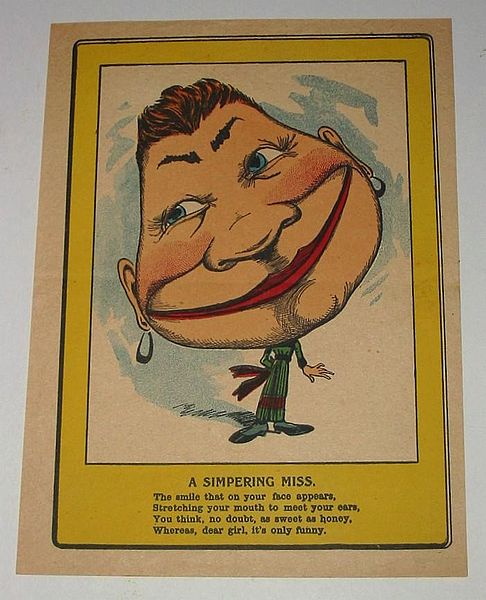
Public Domain, via Wikimedia Commons

What isn’t entirely known is whether a large percentage of these might have been viewed as friendly jokes, but what is true is that it’s harder to find well preserved examples of them than it is their sickeningly lovey-dovey counterparts. That could be because they tended to be cheaper and made of flimsy materials. Or it could be that people didn’t feel particularly compelled to hang onto the insults.

Thankfully, it’s not as common to find an insulting Valentine’s card today because as a species, humans have evolved past the point of sending anonymous hate through the mail. Instead we create false social media profiles and spew it on the internet. As God intended.

Anyway, I hope you had a good February 14th, free of vinegary insults, and that you got from it what you hoped—to eat chocolate and feel loved or to don ashes and reflect on the weight of sin and death. Or both. Either way, the end of February is in sight. And I don’t think it’s really going to be that bad.

An Extra Day and a Hot Mess

Sometime around the year 1235, Johannes de Sacrobosco, a monk and astronomer teaching at the University of Paris, published his Du Computo Ecclesiastico, an in-depth study of the hot mess that is the history of the calendar in all its various imaginings and recalculations through the years.

Though I haven’t read it, the history rumor mill suggests the book is pretty scholarly. Sacrobosco definitely had a lot of things to say about the way the passage of time should be measured, including a few suggestions for reckoning the Julian calendar to solar and lunar observations and calculations. By his day, the equinoxes and solstices had already experienced a pretty significant backwards slippage in time.

julius caesar death
Julius Caesar wishing February had been a little bit longer, because March wasn’t looking so good for him. Vincenzo Camuccini / Public domain

The book also includes a story about how the calendar ended up in such a terrible fix in the first place, like that time the month of February became comically short because Augustus Caesar decided to borrow a day for his own namesake month of August so that it would be every bit as long as the previous month named for his dad.

February is comically short, not only because it usually has twenty-eight days instead of the more traditional thirty or thirty-one, but because it follows January, which at least in my corner of the world is the longest darn month of the year. It’s bleak and cold and filled with the junk you put off during the holidays. Oh, and it follows the holiday season, which is as fun as January isn’t.

groundhog-4814471__340
Any month that starts off with a groundhog is pretty okay in my book. Picture by hatlerbratton, via Pixabay

Like it has most years I can remember, February has kind of flown by comparison. This shortest month comes with a furry mascot, a celebration of love, Girl Scout cookies, the start of baseball spring training, and slightly brighter days. Mine probably went especially fast, too, because it included a book launch and the corresponding flurry of activity. My calendar has actually been kind of a hot mess.

But as “not as awful as January” as February is, it does kind of get the shaft, even in leap years like this one. Had I been in Sacrobosco’s place writing a treatise on the convoluted history and problem of calendars (which I assure you no one would call a pretty scholarly work), I also would have included that story about Augustus Caesar lopping off February’s end, because it’s a pretty great one. Of course, it wouldn’t have been true if I’d written it, either.

It turns out there’s plenty of evidence that the calendar’s multitude of problematic and somewhat sporadically assigned month lengths predated both Augustus and Julius. The latter did do his level best to fix it, consulting with the astronomer Sosigenes from Egypt to come up with a 365-day year that corrected with a leap day every fourth year.

Gregory XII
Pope Gregory XII, a man whose calendar was not a hot mess. Justus van Gent / Public domain

Not bad. But it didn’t fix the problem indefinitely and it wasn’t until three hundred fifty years after Sacrobosco’s book that Pope Gregory XII made a really good change to the plan. That’s when it was decided that the calendar everyone would use (except for those who didn’t feel like it) would include 365 days, with a leap year every fourth year, except for a century year, unless it could be evenly divided by four hundred.

Simple, no?

But it has more or less worked since then with a large chunk of the world buying in to its use, or at least more or less understanding it so that business can be conducted with relative ease all 365 days, 5 hours, 48 minutes, and 46 seconds of the year.

It’s still not perfect and will need more corrective action over the course of millennia. Evidently the rotation of the earth isn’t even entirely consistent, making our measurement of time a little less precise than we’d probably like to think. But there are astronomers who regularly work on that problem and keep us all on track by occasionally adding an extra one-Mississippi to the clock. I imagine most of us aren’t much bothered.

In fact, other than the approximately 4.2 million “leaplings” world wide who will be celebrating their birthday this Saturday or the hopelessly romantic ladies who will be exploiting a silly tradition and proposing to their fellas, a lot of us probably barely even notice February 29th when it rolls around.

Unless you’re like me and your calendar is a little bit of a hot mess. Personally, I plan to make good use of this February’s extra day.