Making a Big Splash

In 1882, owner of the Rock Island and Milan Steam and Horse Railway Company, Bailey Davenport took on a new business venture to drive more business. What he created was Watchtower Park, a leisure destination at the end of the line on the bluffs overlooking the Rock River at Rock Island, Illinois.

This recreational park, admission to which was included with the price of a trolley ticket, opened with groomed hiking trails, a grand pavilion with picnic tables, and what Davenport advertised as a healing spring. Eventually, it would expand to include live theater, vaudeville, tennis courts, and billiards tables.
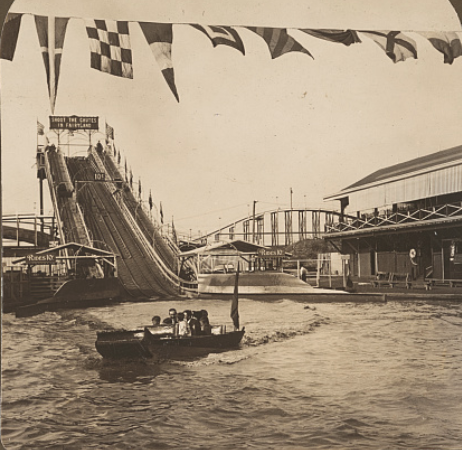
Shoot the Chute on the Pike at the 1904 World’s Fair.

But the biggest attraction, built in 1884 by J. P. Newburg, was a five hundred foot greased wooden track built into a hill down which a wide flat-bottomed boat zoom toward the river where it created a satisfying splash and glided across the surface of the water. An attendant then used a pulley system to drag the boat back up the hill for another go.

Watchtowers “Shoot the Chute” ride was the first of its kind, but the design quickly took off, becoming a frequent feature of amusement parks throughout the United States and the world. It’s probably no surprise then that a Shoot the Chute ride popped up in 1904 in the entertainment section, known as the Pike, on the grounds of the World’s Fair in St. Louis.

What might be more surprising is that there were actually two such rides on the Pike—one for the fairgoers, and one for the elephants at Hagenbeck’s Zoological Paradise and Trained Animal Circus. And just as a visitor standing nearby the Shoot the Chute could expect to enjoy a cool splash on a hot, sticky St. Louis summer day, a visitor to Hagenbeck’s could get showered by the kerplunk of an 8,000 pound pachyderm.

The elephant slide sure did make a splash, and appears frequently as a highlight in fairgoer written accounts. One biographer of Hagenbeck elephant trainer Reuben Castang even recounts a shared story in which Castang took an accidental plunge with the giant animals, and lived to play it off as if it had been a planned stunt.

Now that’s how you make a splash.

A fictionalized version of this scene appears in my new historical mystery, Paradise on the Pike, which came sliding onto the market this past week. With any luck, and with a lot of help from wonderful people spreading the word and building the buzz, it’s making a big enough splash that readers will notice and take a chance on it.

Hagenbeck’s Zoological Paradise and Trained Animal Circus is central to the novel, which is populated by elephants and many other animals that were fun characters to write. And of course sometimes when researching, you come across something that you just can’t leave out. Because everyone loves a good Shoot the Chute ride and some stories just make a big splash.

If you’d like to read more about the real Hagenbeck elephant antics that appear in the book, check out my guest post featured by writer and very gracious host Roberta Eaton Cheadle on her blog Roberta Writes.

Meet Me at the Fair

On November 22, 1944 after schedule delays, numerous script rewrites, budget woes, and a leading lady still unhappy with her role, a new Christmas musical debuted on the big screen in St. Louis, the city at the film’s heart. 

The song “Meet Me in St. Louis,” well known today because of the musical, is actually from 1904 and was written specifically for the World’s Fair. Public Domain, via Wikimedia Commons

Despite the mess of getting to that moment, Meet Me in St. Louis enjoyed immediate success, becoming Metro-Goldwyn-Mayer’s second highest grossing film up to that point, coming in only behind Gone With the Wind. After the premiere, Judy Garland even decided she liked it after all and commented to the producer, “Remind me not to tell you what kinds of pictures to make.”

The screenplay is based on a series of semi-autobiographical short stories by St. Louis native Sally Benson who wrote of an upper middle-class family that lived at 5135 Kensington Avenue during the construction of the 1904 World’s Fair on the grounds of Forest Park in St. Louis.

I confess, I saw the movie for the first time later in life than I should have, having grown up within easy reach of St. Louis. My childhood summers included trips to downtown to watch the Cardinals play at Busch Stadium where the musical’s title song is still played by the organist at every game and the crowd sings along as the words scroll across the jumbotron. 

I’ve been many times to the wonderful outdoor Muny theater in Forest Park where the stage adaptation of Meet Me in St. Louis, originally produced in 1989, is performed every few years. I even got engaged in that park on the very grounds of the actual 1904 World’s Fair.

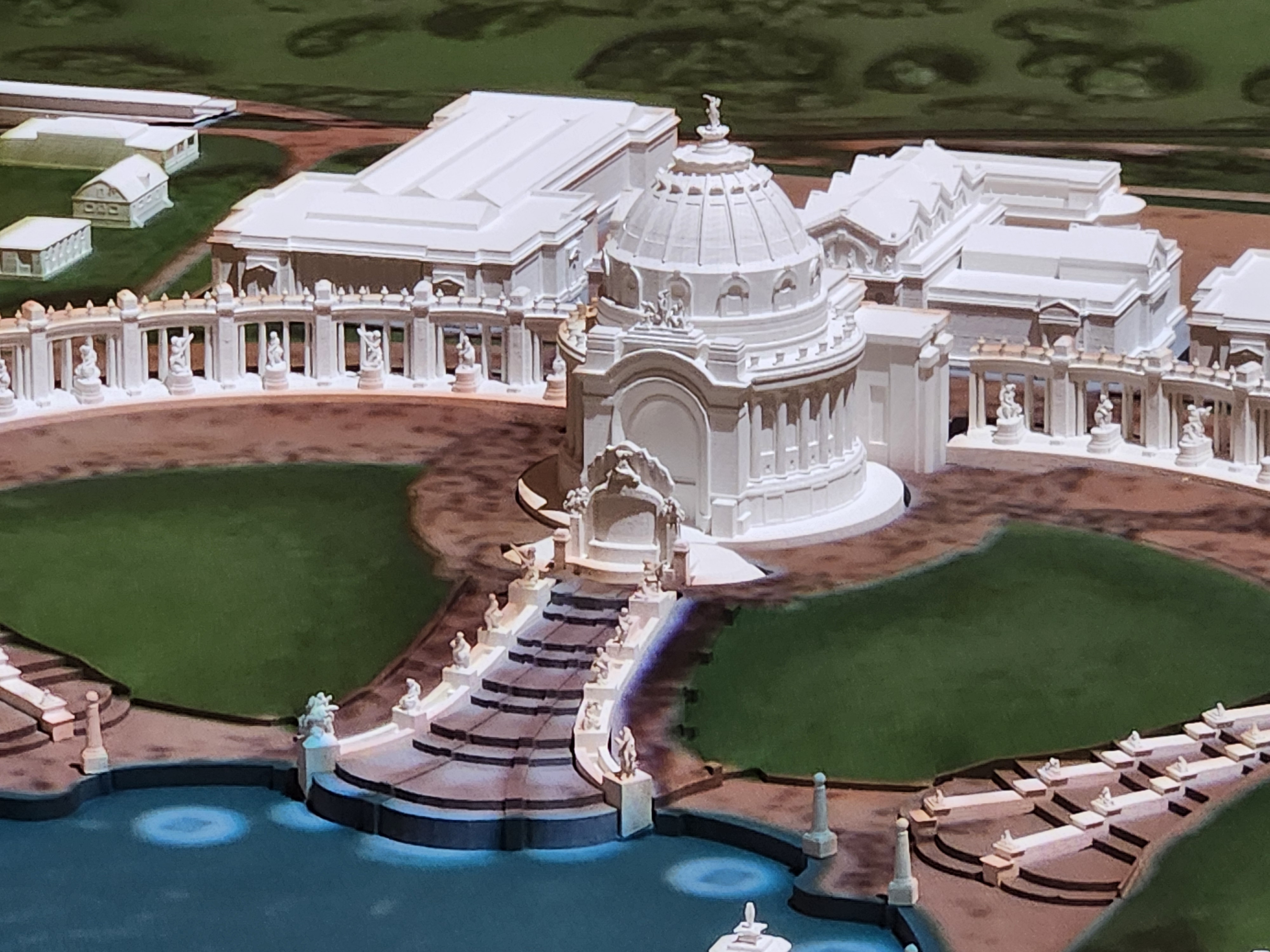
I was lucky enough to get a sneak peek at the new exhibit, open to the public on April 27th. It contains a scale model of the entire fairgrounds. And it’s spectacular.

Officially known as the Louisiana Purchase Exposition, the Fair is a big deal in St. Louis history. It transformed the city, launching it for about seven months into the center of the world’s attention. 

And it’s still a big deal, today. One-hundred and twenty years later the World’s Fair looms large in the community memory carried now by not a single living person who was there to see it, sparking excitement whenever it comes up in conversation, which is kind of weirdly a lot.

It’s especially on everyone’s minds right now because at the end of this month, just in time to celebrate the 120th anniversary of the opening of the Fair, the Missouri History Museum will reveal a newly re-imagined permanent World’s Fair exhibit. 

Equally exciting for everyone who either lives in my house or happens to be my mother, is the release of my new historical mystery set on the grounds of the 1904 World’s Fair in St. Louis. 

Paradise on the Pike is available for the first time today. The story takes place in the enchanting world of Hagenbeck’s Zoological Paradise and Trained Animal Circus on the Pike, which is the entertainment strip within the Fair. It’s not a light, sentimental sort of story like Sally Benson’s, but it does contain elephants and lions and a pair of cantankerous goats. It also allowed me, and will hopefully allow you, to spend some time strolling through the Fair, which was almost entirely constructed of temporary buildings meant to disappear.

Available today! Order from your favorite independent bookstore or slightly bigger bookstore or Amazon.

And maybe that’s why, one hundred and twenty years later, it still takes up space in our imaginations, because we’re a little like six-year-old Tootie at the end of Benson’s stories when the family marvels over the lights and fountains on the fairgrounds and her sister Agnes asks if it’ll ever be torn down.

Tootie emphatically replies, “They’ll never tear it down. It will be like this forever.”

Agnes, relieved, exclaims, “I can’t believe it. Right here where we live. Right here in St. Louis.”

Forest Park retains very few physical reminders of the enormous event that once filled its every corner and held the attention of the world, but in the hearts of the St. Louisans who stroll through the grounds and wish they could have seen those lights shining, it will never be torn down. It’ll be like this forever.

You can find more information about Paradise on the Pike at this link.