Don’t Call it a Comeback

Hello blogosphere! I know it’s been a hot minute since I appeared in this space. It turned out I needed the break. I also have had less time to write as I spent the last school year working full-time at a middle school where I learned to use phrases like “it’s been a hot minute.” I had a great year and would happily return for another, but life is shifting again, as it does. 

For well over a year now, my husband has been dealing with a long commute for a job that he loves. With our youngest son’s graduation from high school this spring, we’ve been looking to escape the bustling suburb that has been our home for more than a decade, searching for more land, a smaller house, and a shorter drive.

I’m pleased to report that we found all three, but as his route to work is shortening, mine is lengthening too much for my position to be practical. And that’s okay, because now, in between renovation projects on our new kind of weird house that sits on the pretty much perfect land, I can spend more time writing again.

Because when I see a majestic creature like this, the first thing I think is that it sure would look good in a hat. Minette Layne from Seattle, Washington, USA, CC BY 2.0 https://creativecommons.org/licenses/by/2.0, via Wikimedia Commons

I’m excited to be back. I’ve missed this sharing of vaguely historical and occasionally hysterical tidbits, kind of like one misses the hottest trends of their childhood. I’m seriously at least as excited as I would be if celebrities suddenly started wearing acid wash jeans again, we all decided to walk like an Egyptian, or whales donned dead salmon hats

Okay, so you may not have been entirely hip to Orca culture of the late 1980s like I have recently pretended to be, but yes, apparently, there was a brief window of time in 1987 when trendy killer whales, particularly those who frequented the Puget Sound, placed jaunty dead fish on their enormous heads.

Why they did this researchers aren’t sure, but then acid wash jeans didn’t make a lot of sense either. Some suggest it was a clever way to save some food for later during times of abundance. Orcas have been known to swim with large chunks of food tucked under a fin, a mode of transportation that isn’t terribly practical for a relatively small fish like a salmon. That fits much better as a hat. 

Or it could just be a playful fashion statement that this year has seen a little bit of a comeback. It’s definitely not as wide-spread as it was in 1987, but then I suppose the retro look isn’t for everyone. 

In case you want to dress like a fashionable Orca, Amazon has you covered.

Still, there have been a few instances over the past several months of Orcas once again sporting dead fish hats, enough to get some in the whale fashion industry to declare it a hot trend of the season, similar to the boat rudder disabling challenge that cropped up a couple years ago or the orca kelp massage fad surging right now, that is surely the result of a whale lifestyle influencer.

And why not bring back a little bit of fun, like a silly hat in a great big briny sea, or one more hopefully amusing, poorly researched, sort-of history blog written by a real human being drifting in a metaphorical sea of the artificially intelligent web.

I mean, I’m not walking like an Egyptian, but I am pretty excited to be back.

Orca-strated Attack

These past few weeks, or maybe months, I have fallen out of the blogosphere a little bit. Life has just been really busy. Fortunately, it has calmed down a little now, and I’m hoping to reestablish the routine of a weekly post, because apparently when I turn my back for just a couple of minutes, the killer whales go to war with humanity.

To be fair, this might not be entirely unexpected behavior. In his Natural History, Pliny the Elder refers to the orca as “an enormous mass of flesh armed with teeth” that is “peculiarly hostile” to whales, often ramming them until they manage to kill them, “dash[ing] them to pieces against the rocks.”

This man knew a storm was brewing. Pliny the Elder, Public Domain, Wikimedia Commons.

Humans have had a varied relationship with these animals throughout history. While Western culture has often feared orcas, most Indigenous American cultures have, through various mythologies, regarded them as powerful rulers of the sea, sometimes depicted living in houses and cities beneath the waves, and generally benevolent toward humans.

It turns out that both perspectives might reflect a little bit of the truth, because one thing that’s pretty clear is that orcas, which are more closely related to dolphins than to whales, are pretty smart. Reading about their natural behavior, one comes across words like clans, matriarchs, and friendships. Orcas have highly organized social structures. Throughout the world, though they may “speak” different dialects and enjoy different dietary habits, they still seem to communicate pretty well with one another.

An enormous mass of flesh armed with teeth. But it’s also pretty cute, as long as you don’t make it angry. Public Domain, via Wikimedia Commons

And a growing number of them are angry. It turns out that a global pandemic isn’t the only thing that 2020 brought us. It also saw a rapid uptick in orca attacks on boats, particularly off the coast of the Iberian Peninsula. Some researchers trace the attacks to a single female orca they’ve named White Gladys who after experiencing some unknown trauma at the hands of humans, started rallying the troops to get her revenge.

Now, I’ve grown up in the era of Free Willy, rather than the horror film Orca. I’ve enjoyed watching these beautiful creatures play in the wake of a ferry in the Pacific Northwest, and my adorable little niece (now grown) dubbed them “Er-Ers” because to her that is what they sounded like. I’ve always kind of liked orcas, and so it has been a little shocking for me to discover that they are vengeful, and organized, and seem to have a solid working knowledge of the mechanics of boats.

Because the behavior Pliny the Elder described in 70 AD is more or less exactly what the orcas are now doing to boats. They ram them in a particular and consistent fashion, targeting the rudders until the boats are disabled in the water. These are not boats that have provoked the creatures in any way, though they certainly seem to be getting the blame for something terrible.

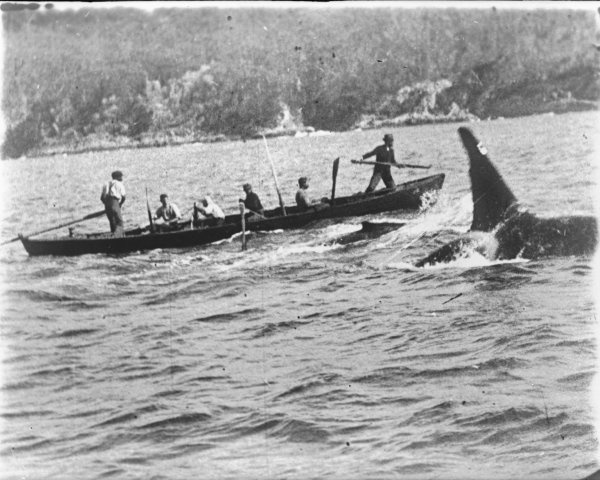
I mean, if the orcas have declared war on the humans and their boats, I don’t know that it’s entirely unjustified. Charles Eden Wellings (1881-1952), Public domain, via Wikimedia Commons

Often the animals have lost interest once the boats are rudderless, but there have been recent cases in which the orcas have followed, continually ramming the boat and pretty much terrifying the people on board as it’s towed back to safe harbor. In at least three instances now, boats have actually been sunk by orca attack.

Since July of 2020, there have been more than seven hundred reports of orca encounters in the same part of the world, five hundred of which resulted in engagement and damage to boats. Some observations suggest that adult orcas have been teaching younger ones how to efficiently take out rudders. The behavior is spreading.

One solution on offer is to tag and track several of the adult orcas we know to be instigators so that we can better predict where attacks might occur and boats can more easily avoid troubled waters. The problem is that the tagging process can be fairly traumatic for the animal, which is clearly already a little disgruntled with humans. It could make the problem worse.

Personally, I’m not terribly concerned as I live something like seven hundred miles from the nearest coastline. I’m unlikely to encounter an angry killer whale in my neighborhood. And not to be a traitor to my species, but I also would be lying if I said I wasn’t a little impressed with the orcas.

Obviously, people who do spend a fair amount of time on the ocean are going to have to figure out a good way to avoid conflicts, and marine biologists need to determine how best to stop the problem from spreading across the world. Then again, in a fast-paced world in which the biggest new problem facing humanity feels like artificial intelligence, it’s kind of nice to know that good old fashioned animal intelligence can still be threat.