Meet Me at the Fair

On November 22, 1944 after schedule delays, numerous script rewrites, budget woes, and a leading lady still unhappy with her role, a new Christmas musical debuted on the big screen in St. Louis, the city at the film’s heart. 

The song “Meet Me in St. Louis,” well known today because of the musical, is actually from 1904 and was written specifically for the World’s Fair. Public Domain, via Wikimedia Commons

Despite the mess of getting to that moment, Meet Me in St. Louis enjoyed immediate success, becoming Metro-Goldwyn-Mayer’s second highest grossing film up to that point, coming in only behind Gone With the Wind. After the premiere, Judy Garland even decided she liked it after all and commented to the producer, “Remind me not to tell you what kinds of pictures to make.”

The screenplay is based on a series of semi-autobiographical short stories by St. Louis native Sally Benson who wrote of an upper middle-class family that lived at 5135 Kensington Avenue during the construction of the 1904 World’s Fair on the grounds of Forest Park in St. Louis.

I confess, I saw the movie for the first time later in life than I should have, having grown up within easy reach of St. Louis. My childhood summers included trips to downtown to watch the Cardinals play at Busch Stadium where the musical’s title song is still played by the organist at every game and the crowd sings along as the words scroll across the jumbotron. 

I’ve been many times to the wonderful outdoor Muny theater in Forest Park where the stage adaptation of Meet Me in St. Louis, originally produced in 1989, is performed every few years. I even got engaged in that park on the very grounds of the actual 1904 World’s Fair.
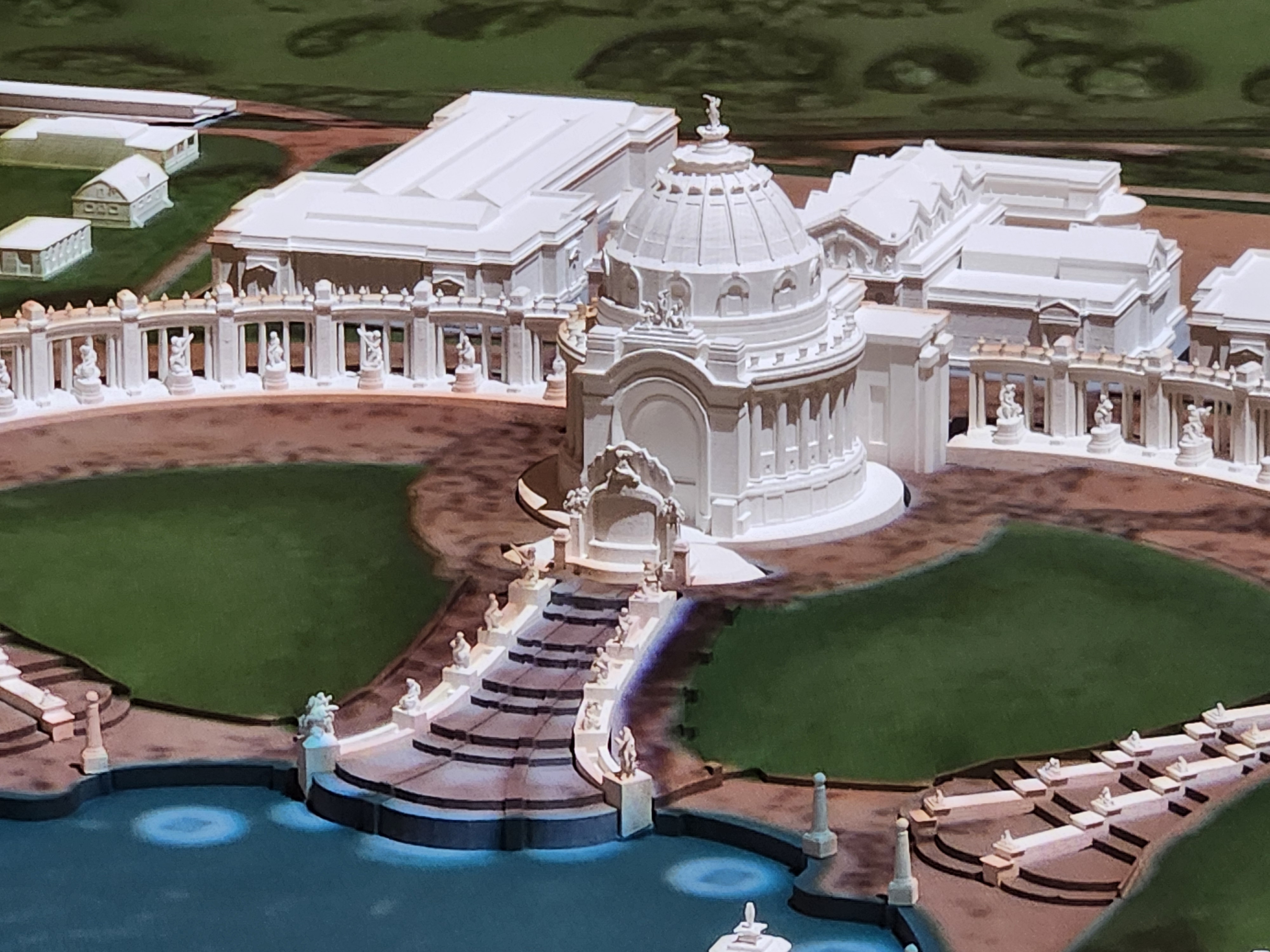
I was lucky enough to get a sneak peek at the new exhibit, open to the public on April 27th. It contains a scale model of the entire fairgrounds. And it’s spectacular.

Officially known as the Louisiana Purchase Exposition, the Fair is a big deal in St. Louis history. It transformed the city, launching it for about seven months into the center of the world’s attention. 

And it’s still a big deal, today. One-hundred and twenty years later the World’s Fair looms large in the community memory carried now by not a single living person who was there to see it, sparking excitement whenever it comes up in conversation, which is kind of weirdly a lot.

It’s especially on everyone’s minds right now because at the end of this month, just in time to celebrate the 120th anniversary of the opening of the Fair, the Missouri History Museum will reveal a newly re-imagined permanent World’s Fair exhibit. 

Equally exciting for everyone who either lives in my house or happens to be my mother, is the release of my new historical mystery set on the grounds of the 1904 World’s Fair in St. Louis. 

Paradise on the Pike is available for the first time today. The story takes place in the enchanting world of Hagenbeck’s Zoological Paradise and Trained Animal Circus on the Pike, which is the entertainment strip within the Fair. It’s not a light, sentimental sort of story like Sally Benson’s, but it does contain elephants and lions and a pair of cantankerous goats. It also allowed me, and will hopefully allow you, to spend some time strolling through the Fair, which was almost entirely constructed of temporary buildings meant to disappear.
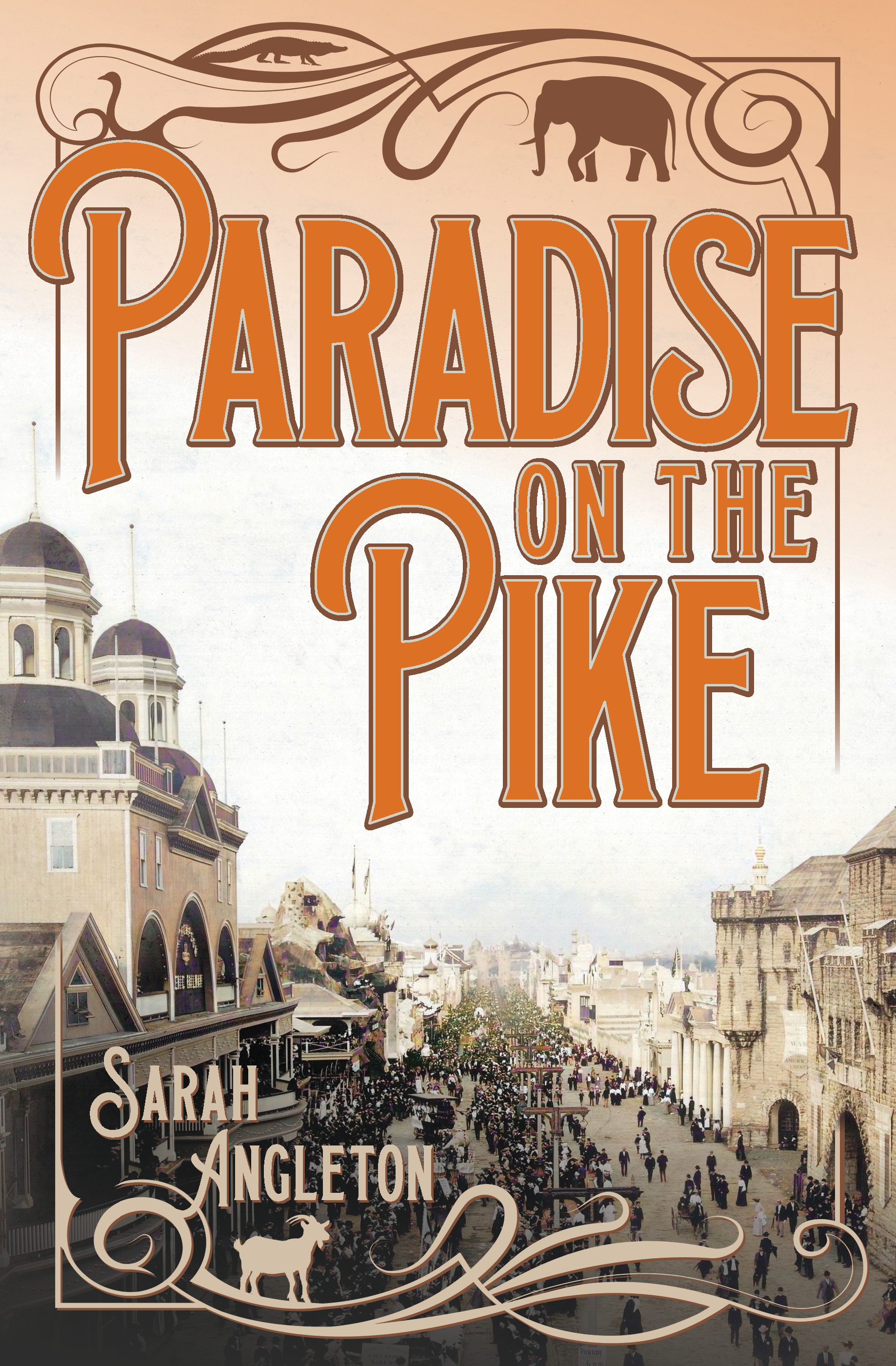
Available today! Order from your favorite independent bookstore or slightly bigger bookstore or Amazon.

And maybe that’s why, one hundred and twenty years later, it still takes up space in our imaginations, because we’re a little like six-year-old Tootie at the end of Benson’s stories when the family marvels over the lights and fountains on the fairgrounds and her sister Agnes asks if it’ll ever be torn down.

Tootie emphatically replies, “They’ll never tear it down. It will be like this forever.”

Agnes, relieved, exclaims, “I can’t believe it. Right here where we live. Right here in St. Louis.”

Forest Park retains very few physical reminders of the enormous event that once filled its every corner and held the attention of the world, but in the hearts of the St. Louisans who stroll through the grounds and wish they could have seen those lights shining, it will never be torn down. It’ll be like this forever.

You can find more information about Paradise on the Pike at this link.
St. Louis Goes Big, Warts and All

In 1874, Richard Compton, a sheet music publisher from the St. Louis area, hatched a large-scale plan to promote the city he called home. He was attempting to capitalize on an artistic trend in which cities across the United States were engaging. He recruited Camille Dry, an artist who specialized in pictorial maps.

By the late 19th century, every city that was a city had one, a map that highlighted (and exaggerated) its finer qualities. The details of these maps were stunning. Every street, every building, even many windows accounted for, they were designed to attract industry and promote trade.

20160203_111819
One book: St. Louis-Made Population Enlarger and Me: This Sort of Thing is my Bag, Baby

St Louis needed the boost. Its central location and close proximity to the Mississippi River had caused it to boom, but Chicago was booming at a faster clip. Just four years before Dry began his sketches, St. Louis had been embroiled in a scandal over the bribing of census takers to overinflate its population. (Inflate-gate?)

And so the plan was hatched. The artist responsible for producing pictorial maps of eight cities in five different states in 1871 and 1872, took to a hot air balloon (rumor has it anyway), tethered to the East side, and in about a year (probably working with a team), drew a map the likes of which the world had never seen.

Larger and more detailed than any pictorial map then or since, Dry’s work consists of 110 separate drawings, each about 11 x 14 inches in size, that when laid out, cover an area 24 feet long and 8 feet high. Because folding such a map would probably prove challenging, Compton published it, along with 112 pages of business listings, as a book titled Pictorial St. Louis: The Great Metropolis of the Mississippi Valley, a Topographical Survey Drawn in Perspective A.D. 1875.

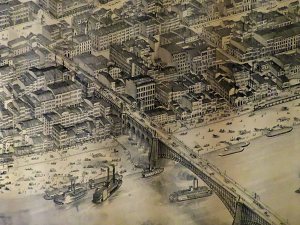
Eades Bridge
Dry’s map shows almost ten miles of riverfront and more than 40 square miles west of the Mississippi. This panel shows the Eads Bridge, which today is just north of the Arch. But not in 1875.

With a whopping price tag of $25 dollars (which in today’s money is quite a bit more than you’d shell out for your average convenience store road map), and a cumbersome title that didn’t yield great search results on Amazon, the project was a financial flop.

But this beautiful map remains as a point of pride for the city it depicts. Since last May, the Missouri History Museum, located in St. Louis’s Forest Park, has featured an exhibit entitled “A Walk in 1875 St. Louis.” The map has been blown up to 10 feet x 30 feet panels, showing exquisite details like the tents of a visiting circus, a man driving a herd of cows through the city streets, and a mob making a run on a local bank.

Interspersed with the map are the stories of the lives of St. Louisans in 1875, including the foods they ate, the clothes they wore, and the parasites they ingested in their drinking water. The special exhibit will be open through February 14, and I’m ashamed to admit I didn’t get there until time had almost run out. But I’m glad I saw it.

What impressed me the most was that while other cities used their beautiful maps to gloss over their warts, exaggerating and sometimes out-and-out lying to prospective businessmen and settlers in order to lure them in, Compton and Dry took a different approach. The warts are shining brightly on this map. St. Louis wasn’t a perfect Utopia in 1875 and I would never suggest that it is now.

history museum
Missouri History Museum, just one of many places that makes St. Louis great. And wouldn’t it be fun to color?

But like Richard Compton, I love my city. I know we’ve had some problems. Race relations are tense, crime has crept up, and I hear some football team chose to leave us for LA (a city that in 1875, barely took up one page of map). The press has been unforgiving. Still, St. Louis is an amazing place with a lot to offer and I’m proud to call it home.

So here’s my idea. What the city of St. Louis needs to do is promote itself in a medium people can respect. We need to jump on the biggest trend to sweep across this great nation since the pictorial map craze of the 19th century and show off not just our warts, but also everything that is amazing about our city.

That’s right. What we need is a St. Louis-themed adult coloring book. A really, really big one.