Shooting for the Moon with A Lot of Help

Even astronauts need a little help from 400,000 friends. NASA, Public domain, via Wikimedia Commons

On July 16 of 1969, at 9:32 AM approximately one million people gathered on Florida beaches to witness the launch of Apollo 11. Many of them had camped out for multiple days to claim a spot. I imagine their enthusiasm was palpable.

Millions more people watched on television. Excitement mounted in the first few days of the mission and by the time Neil Armstrong took that first small step, 650 million people tuned in to see it happen, making the event the most widely watched television broadcast in history.

And it couldn’t have happened if NASA’s first female launch controller JoAnn Morgan hadn’t been in the control room, or electrical engineer Tom Sanzone hadn’t designed and monitored the backpack life support systems worn by the moon-walkers, or if astronaut Frank Borman hadn’t used a personal connection to assure that the Luna 15 Soviet spacecraft wouldn’t interfere with the Apollo mission, or if diver Clancy Hatleb hadn’t been on scene to welcome the returning astronauts to earth by whisking them into quarantine in case of space germs.

A new historical mystery set against the backdrop of the 1904 World’s Fair in St. Louis, for fans of Water for Elephants and Devil in the White City.

In all, NASA estimates that approximately 400,000 people contributed to the success of the Apollo 11 moon landing, from thousands of engineers working throughout the world to the janitors and caterers that kept the facilities running smoothly. Every successful launch requires coordinated effort from a lot of people.

That statement is true when applied to Apollo 11, and it’s true when applied to a new book. My fourth historical novel, Paradise on the Pike, a mystery set against the backdrop of the 1904 World’s Fair in St. Louis, will officially launch on April 18 and it’s taken a lot of people to get it this far, from critique partners, beta readers, and cheerleaders to cover artist, formatter, and editor. It maybe hasn’t taken 400,000 people, but it’s been a lot.

And I still need help to get the book off the ground because no matter how enthusiastic I am about this book launch, I can’t make it successful by myself. I could really use an enthusiastic crowd to camp out on the beach and cheer loudly in hopes that even more people will become curious enough to tune in.

If you are interested in being part of that first, important crowd, I would love for you to join my launch team on Facebook. Participation is simple. You’ll receive an advance digital copy of the book to review (along with some helpful guidance if you’re not too sure how to do that) and some graphics to share on social media, There will also be some fun and chances to win prizes along the way. Sign up to be part of the group at this link:  https://forms.gle/psi7ctZ6fNK88dbB9

Or if Facebook isn’t your thing, but you happen to be a NetGalley reviewer, you can request a review copy of the book at this link: https://www.netgalley.com/catalog/book/354539

I probably won’t be able to pull together a million, or even 400,000, people to help me with this, though feel free to share the opportunity with anyone you think might be interested. Of course I also wouldn’t be terribly surprised if somewhat fewer than 650 million people eventually read my book. Still, it takes a lot of help to shoot for the moon.
Smarter than the Average Dinosaur

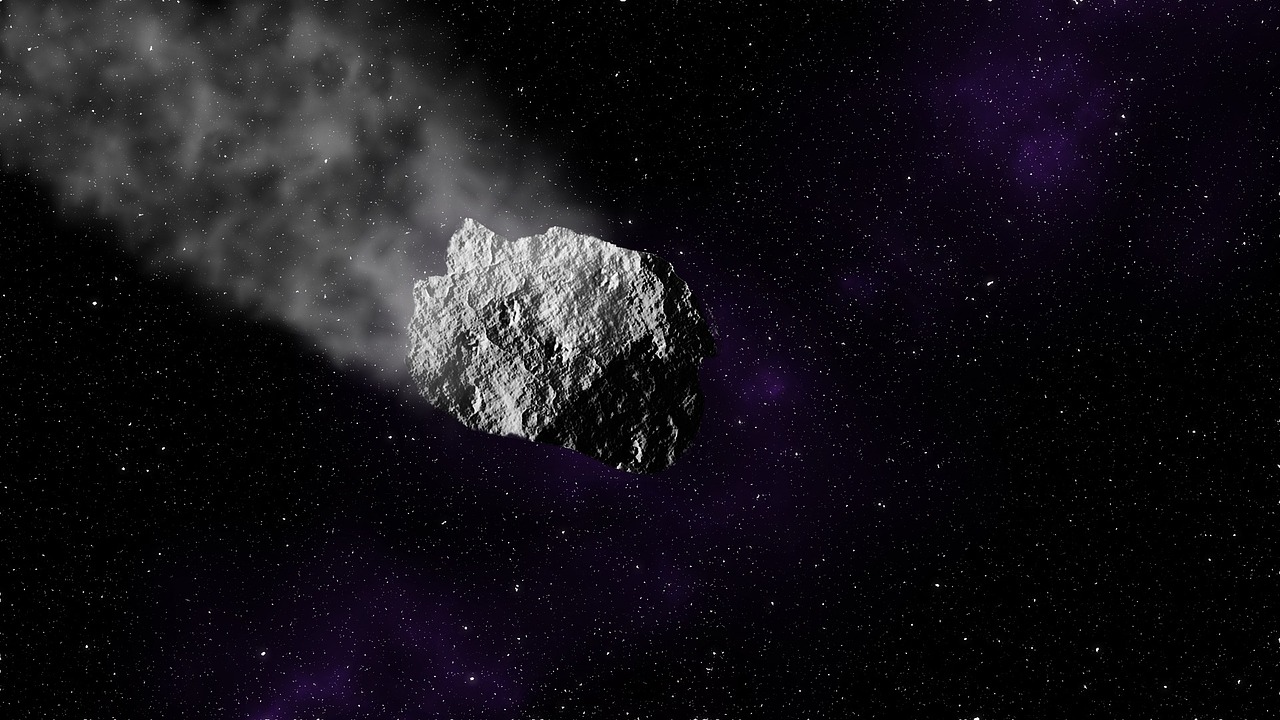
It’s been 70.3 million years, give or take a day or two, since the approximately six-mile-wide Chicxulub meteor landed in Yucatan, Mexico and caused a mass extinction event. Earth’s dinosaur inhabitants didn’t so much as lift a finger to try to stop it, a decision they weren’t around to regret.

Image by A Owen from Pixabay

More than 1.9 billion years before that, the Vredefort meteor, now believed to have been more than twice as large as the Chicxulub, impacted the earth at what today is Free State, South Africa. Nothing was done about it by the unicellular lifeforms that might have eventually become dinosaurs if they could have been bothered.

And so, this week I was happy to hear that the planet’s current dominant inhabitants have decided to take the threat more seriously. Since the very first discovery of an asteroid by Italian astronomer, mathematician, and priest Giuseppe Piazzi in 1901, humanity has held onto a little niggling feeling that a human-ending catastrophe might just be hurtling its way through space on a collision course with our big blue ball.

Piazzi’s asteroid, Ceres, isn’t a threat. It seems content enough in the asteroid belt between Mars and Jupiter and has even received an upgrade to dwarf planet. But there are plenty of rocks flying around up there. The researchers who look at such things suggest that asteroids that are at least three miles in diameter have struck the planet about sixty times in the 4.5 billion years or so it’s been around. Of those, three of them were likely large enough to have caused mass extinction.

Image by Michael Watts from Pixabay

Frankly, while three instances in 4.5 billion years is enough to keep writers of science fiction busy for a long time, I’m not really all that concerned. The odds of being alive to see it happen are pretty small.

Of course, it’s just this kind of nonchalant attitude that took out the dinosaurs. Lucky for humanity, I’m not in charge of Earth’s defenses against incoming space rocks.

Don’t worry, because NASA is on the job. This past Monday, the Double Asteroid Redirection Test successfully collided with and nudged a completely innocent asteroid that was too busy minding its own business to wipe out life on Earth.

Over the next months and years, astronomers all over the world will be observing and calculating just how much impact the DART had on the asteroid’s path and we will all breathe a little easier knowing that we might just be smarter than the average dinosaur.

Earthquakes and Alien Probe Technology

At around 9:00 on the morning of January 19, 1916, Baxter, Missouri resident Mrs. Frank Jackson heard a terrible noise and received a frightful shock. The sound would later be described as something like discharged dynamite followed by a series of heavy strikes against a large drum and fading off to the north, disappearing completely after a few minutes. Initial reports in the local paper didn’t identify the source of the noise, but rather requested the opinions of readers as to what may have caused the disturbance.

One of the most useful observations came from some of the Jacksons’ neighbors who were working in a field nearby and claimed to have been peppered by gravel falling from the sky. And of course there was the 611 gram stone that crashed through the Jacksons’ roof, hit a log beam, and lodged itself in their attic.

meteorite
If I’m honest, I’m sure I have a lot of junk in my attic, too. Probably not from space, but still. photo credit: kakov Chelyabinsk meteorite via photopin (license)

What had fallen from the sky was a meteorite, made of, well, spacey meteorite stuff, as verified twenty years later by American Meteorite Laboratory founder H. H. Nininger. It measured somewhere around 13 cm across. While the impact of such a stone isn’t going to dramatically alter the earth’s climate or cause mass extinction, it’s certainly large enough to weigh down the corner of a tarp on a breezy day or scare the stuffing out of someone when it crashes through the roof of their house.

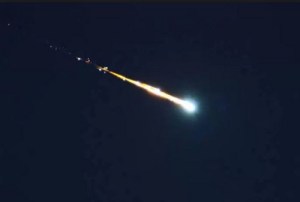
There’s not much word on what poor Mrs. Jackson thought as the meteorite came crashing into her house, but perhaps we can make some assumptions based on the reactions of those who witnessed a fiery meteoroid falling through the sky above southeast Michigan on Tuesday of this week.

If Twitter is any indication, the good folks in Michigan, though not quite as terrified as Oregonians facing the trauma of pumping their own gas, were pretty freaked out by the incident. Captured on dashcam video, the meteoroid, which scientists estimate was about two yards across when it entered Earth’s atmosphere, exploded in the sky, causing a small Earthquake and an awfully loud boom.

meteoroid
I’m a big fan of shooting stars, but I admit if I actually saw a huge one that exploded with a loud boom and an earthquake, I might get a little jumpy. photo credit: tonynetone meteorite hits Thunder Bay, Ontario via photopin (license)

Witnesses expressed confusion and then a great deal of concern as they processed whether Armageddon had come at last. Within minutes, conspiracy theorists took to the Internet to caution against initiating any contact with the many small meteorites scientists believe are now spread across the state. The main concern, obviously, is that surviving meteorites are actually alien technology, likely parts of otherworldly probes, of the variety that have been sent frequently to Earth by malevolent alien forces since at least since the 15th century. Seems legit to me.

NASA, on the other hand, has seemed relatively flippant about the whole event, more or less stating that though massive balls of fire flying into the Earth’s atmosphere are relatively rare, slightly less massive balls of fire do it all the time. So maybe everyone should just calm down.

alien
I just have to assume that if aliens have really been sending probes to Earth for at least hundreds of years, they aren’t really in that much of a hurry to invade.

Despite both the dire warnings and the nonchalance, the hunt is on for meteorite pieces. NASA has made a few suggestions for where people might have luck looking, but is clear that any chunks found will probably be pretty small and might not really be worth all that much.

But when H. H. Nininger verified the Baxter meteorite as the real thing, he was quick to make an offer. I haven’t been able to find how much he paid for this delightful addition to his extensive meteor collection, but hopefully it was at least enough to cover the repairs to the Jacksons’ roof.

Since Tuesday’s heavenly event, experts have explained to the media that the value of a meteorite will depend largely on its makeup. Whereas the more common iron will net you somewhere between 50 cents and $5 per gram, a stone meteorite might fetch up to $20 per gram. Now if it’s made of alien probe technology, well, I suppose there’s no telling how high the price might go.