
There’s a rumor running around out there on the Internet where, as everyone knows, all things are true, that William Shakespeare invented more than 1,700 words of the English language. If one considers that the Modern English of Shakespeare’s day was a fairly young language, then it makes sense that new words might have been developing pretty fast. And if you’ve ever met a writer, and particularly a poet, then you’ve probably noticed that they do occasionally invent new words or more likely, new uses of old ones. There’s no question Shakespeare did his fair share of that.
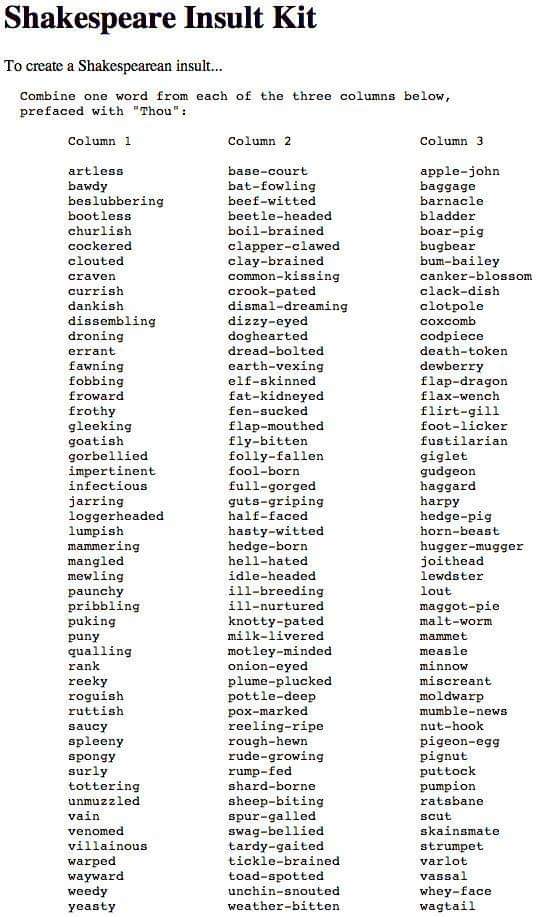
Also roaming around on the Internet lately is a fun challenge in which three columns of insulting Shakespearean words can be combined to come up with a single devastating slight to use in your next piece of writing. Most recently posted by The Writer’s Circle, this was issued as a challenge to me by a friend who knows I’m a writer who likes a good challenge as much as a like a good old timey insult.
Of course I’m only assuming these columns of words show up somewhere among the nearly 29,000 unique words spread across Shakespeare’s forty three surviving works. There are no citations, and I’m not going to take the time to search for them, because regardless of their origin, they make up some pretty fantastic insults.
Still, it’s worth noting I think that if Shakespeare invented 1,700 new words, that means his works contained roughly 6% unique words that would have been entirely unfamiliar to his audience.
Now, because I enjoy a challenge, I certainly don’t mind reading a work that is going to make me pick up a dictionary once in a while, but if I have to look up 6% of the unique words I encounter, I’m going to find myself pretty quickly frustrated by the beslubbering hasty-witted joithead who wrote them.
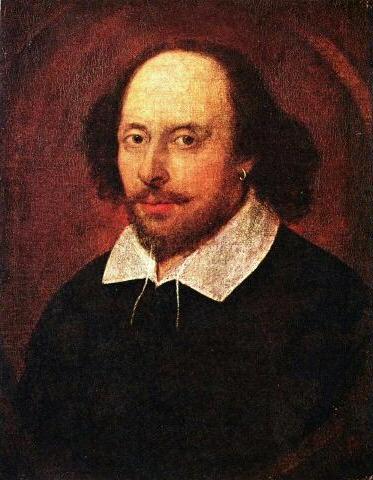
It’s worse than that, too, because the first English-language dictionary wasn’t put together until more than a century after the saucy doghearted coxcomb of a poet William Shakespeare produced his venerated works.
The Oxford English Dictionary, which provides the written origin of English words, wasn’t even attempted until the second half of the nineteenth century and wasn’t completed until 1928. This thanks to somewhere around three thousand contributors who meticulously hunted through centuries of English language works to determine that 1,700 words or so probably came from the mind of that one old English playwright/poet that everyone had actually heard of.
In other words, the editors and contributors of the OED, while dedicated and deserving of our respect and thanks, may have occasionally been loggerheaded tickle-brained foot-lickers when it came to Shakespeare. Arizona State University English professor Jonathan Hope has been particularly effective in pointing out that OED contributors had more access to and read more carefully from Shakespeare’s works than from those of other writers who now in the digital age, we can more easily discover used quite a few of The Bard’s newfangled words before he did.

Photo by Winfred C. Porter, Public domain, via Wikimedia Commons
I don’t think that discovery necessarily takes anything away from Shakespeare’s works or his influence on English literature and language. In reality, I think it makes him better, because he wasn’t asking his dictionary-deficient audience to puzzle out what he was trying to say. That joy he reserved for the mewling folly-fallen gudgeons in future high school classrooms.
To the audience of his day, and to those who care to notice today, what he did was use words well. And while he probably didn’t use most of the words in this handy kit in quite the same combinations I’ve attempted to use them in this post, there’s no question the man knew his way around an insult.
And now I challenge you to use one in the comments.


 Author Sarah Angleton