The Real Renaissance: Elves, Fairies, and the Golden Age of Piracy

058

I have long maintained that this is not a serious history blog. Though I do attempt to provide good-ish information, and have generally completed at least some “research” on the topic, I’m a storyteller first and so I often fill in a few blanks along the way. And, on occasion, I may throw in a few anachronisms that you, intelligent reader, I assume will pick up on.

Still, I think it bears repeating, if you are starting your big school history research project and the first thing you’ve done is stop by to see what the practical historian has to say about it, you’re probably not going to get a very good grade.

That’s why I decided recently that I should beef up my credentials a little so that I can provide more reliable, useful information. With that in mind, this past weekend, I attended, for the first time ever, a Renaissance festival. Just for you.

It turns out, I don’t live too far from the site of the annual St. Louis Renaissance Faire, a festival that isn’t the biggest (that’s in Texas where everything is bigger) or best of its kind (or even the top 13 according to the Travel channel), but seemed to me like a good place to start my quest for historical accuracy.

The real Renaissance is that period of time that spans the gap between the Middle Ages and life that is somewhat more recognizable by us modern folk. Generally considered to stretch from the 14th century to the 17th, it started as a cultural explosion in Florence and much like the black plague, spread through all of Europe.

The period is characterized by major shifts in art, science, religion, and education. The people of the Renaissance began to think of the world and of themselves differently. Exactly when and exactly why this shifting began is open to a surprising amount of (kind of hostile, actually) debate among scholars. The whole thing is frankly a little nebulous, so in the interest of making it a little more concrete, here’s what I learned when I visited the fair, set in the 16th Century French Village of Petit Lyon:

  1. There was an enormous amount of cleavage during the Renaissance. Seriously, it was everywhere, breast tissue spilling over the tops of

    Queen Elizabeth I didn't get the memo about the cleavage. Evidently she had no sense of style at all.
    Queen Elizabeth I didn’t get the memo about the cleavage. Evidently she had no sense of style at all.

    incredibly tight corsets. I even saw a too-tight corset paired with a pair of sweatpants. So, evidently, there were also no decent tailors.

  2. The Renaissance can be marked by the presence of elves, although admittedly this could have been only in France. A lot of elves. Many of them had bows. Some wore jester hats and jingling shoes. Still others had too-tight corsets. But though they varied, they could all be easily identified by their very pointy ears.
  3. Bands of singing and dancing Caribbean pirates roamed village streets. They were not the clandestine thieves you might expect, but rather were garishly dressed, self-identified as pirates, and occasionally performed for royalty.

    Someone should probably tell theses "gentlemen" that they belong in the Caribbean in the early 18th century, not in 16th century France. To illustrate the point, Captain Jack Sparrow was there, too, but he was too surrounded by an adoring crowd to get a good picture, as I was unwilling to wait in line.
    Someone should probably tell theses “gentlemen” that they belong in the Caribbean in the early 18th century, not in 16th century France. To illustrate the point, Captain Jack Sparrow was there, too, but he was too surrounded by an adoring crowd to get a good picture, as I was unwilling to wait in line.
  4. The waffle cone, suggested by many to have been invented at the 1904 St. Louis World’s Fair, was a favorite treat of European royalty during the Renaissance.
  5. If one could manage to avoid the elves, there was still the large number of fairies to contend with. So many fairies, complete with delicate wings, blue-tinted skin, high-pitched sugary voices, and sparkly magical fairy dust. It was best to avoid these whenever possible.
  6. Jousting knights mostly told jokes, especially puns. They loved puns. They also enjoyed insulting the attending royalty, who were pretty much cool with it.
  7. The most popular food of 16th century France was by far the turkey leg. As most sources claim that the turkey, which is native to the Americas, arrived in Europe in the 17th Century, I think we can safely assume that those sources are wrong.
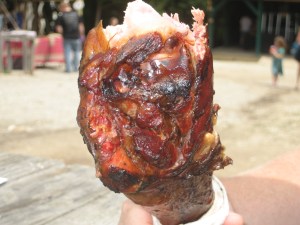
    Anachronism tastes delicious!
    Anachronism tastes delicious!
  8. King Francois II of France did not speak French. I know this because my nine-year-old who only knows a few French phrases had the opportunity to be knighted. When the king addressed him in French, my boy responded politely in the king’s own tongue, to which King Francois blushed and quickly changed the subject, in English.

So there you have it, the real Renaissance as best as I can tell. I should caution you, though. If you happen to be starting your big school history project on 16th century France or the Renaissance in general and you start by checking out the St. Louis Renaissance Faire, you’re probably not going to get a very good grade. Unless of course you happen to be writing about elves and fairies. In that case, you should be good.

Avast Ye Wedding Lubbers

Multnomah Falls

On a recent family excursion to Multnomah Falls, a place I’ve been too few times, I noticed a sign along the trail that I hadn’t read before, probably because I assumed it had something to do with rock formations and/or water volume as most of the signs do.

But this one was different. It described an event from September of 1995 when a boulder weighing 400 tons (according to the sign that is approximately the same weight as a school bus filled with concrete, and go ahead and disprove that) fell from the rock face next to upper Multnomah Falls, plunging 225 feet into the pool at the bottom. Upon entering the water the school bus boulder produced a 70-foot splash that washed over the observation bridge, completely dousing a wedding party that had been posing for pictures. Now, I may not care much about geology, but I am a big fan of wedding photos.

In case you haven’t been to the falls, though, let me just provide a little background. Located on Interstate 84, just outside of Portland, Multnomah Falls drops a total of 620 feet, making it the highest waterfall in the Columbia River Gorge and the second highest year-round waterfall in the United States. Between the upper and lower portion of the falls spans Benson Bridge, constructed in 1914.

And if geology is your thing, Multnomah Falls is allegedly a fascinating place to visit because rumor has it you can see something like six different lava flows, evidence of flooding that occurred thousands of years ago, and probably even some really interesting differences in rates of erosion that have led to the tiered formation of the falls and the occasional plunging school-bus-sized rock. Personally, I just care that it’s pretty.

In fact, all those impressive geological goings-on coupled with the well-placed bridge in the middle make the easily accessible Multnomah Falls an ideal spot for all your magical wedding photo needs. Then there’s the tragic and super romantic mythological accompaniment that I didn’t even mention yet.

According to one Native American legend, the chief of the Multnomah people had a beautiful and beloved daughter. He arranged for her to marry a strong young chief from the neighboring Clatsop people and planned many days of feasting and celebration during which tragedy struck. A terrible sickness descended on the wedding festivities. The only solution, as determined by an honored medicine man, was for an innocent maiden to sacrifice herself. The idea was that her sacrificial love would impress the Great Spirit and the sick would recover. When her betrothed fell ill, the young maiden took it upon herself to save her people. She climbed up to the high cliff and leapt to her death. As a token of her loving sacrifice, a spring welled up on the cliff top, the water descending as a lasting bridal gown testimony to the young maiden.

I don’t know about you, but had I gotten married in Oregon, I think we would have made the effort to get that picture. But even though the myth lends a certain wild sentimentality to the photo op, I have to wonder if it ultimately makes a lot of sense to get fancied up in tuxedoes and ball gowns and go for a hike. Assuming here that your daily wear is somewhat less formal, don’t the memories painted by such pictures just ring a little false?

Yet as anyone who has ever tried to make small talk with relative strangers for hours at a wedding reception while waiting for the bridal party to arrive knows, couples do this kind of thing all the time. In fact, my husband was a groomsman at the beginning of this summer and while I’ve not yet seen the photographic evidence, it sounds like things may have gotten a little out of hand. Let’s just say there are some modern art sculptures on an undisclosed Midwestern college campus that are probably feeling a little violated. What that has to do with the celebration of marriage, well, you’d have to ask the couple. No one else seems willing to talk about it.

So the sign at the falls got me thinking about wedding photos and it happens that a few days ago some good friends of mine celebrated their wedding anniversary. It’s one of those that I always remember not only because I was a bridesmaid (and I actually liked the dress, and yes, I have even worn it since), but also because they had the foresight to get married on International Talk like a Pirate Day.

They’re a great couple and I am honored to be featured in their wedding photos, in which I never once posed with any modern art sculptures. But as I was looking back through the pictures, I realized that along with the lined up bridal party, the first kiss as husband and wife, and the gathered family, were some of the other kinds of photos as well: the ones in which excessively well-dressed people are deliberately posed in unnaturally casual ways.

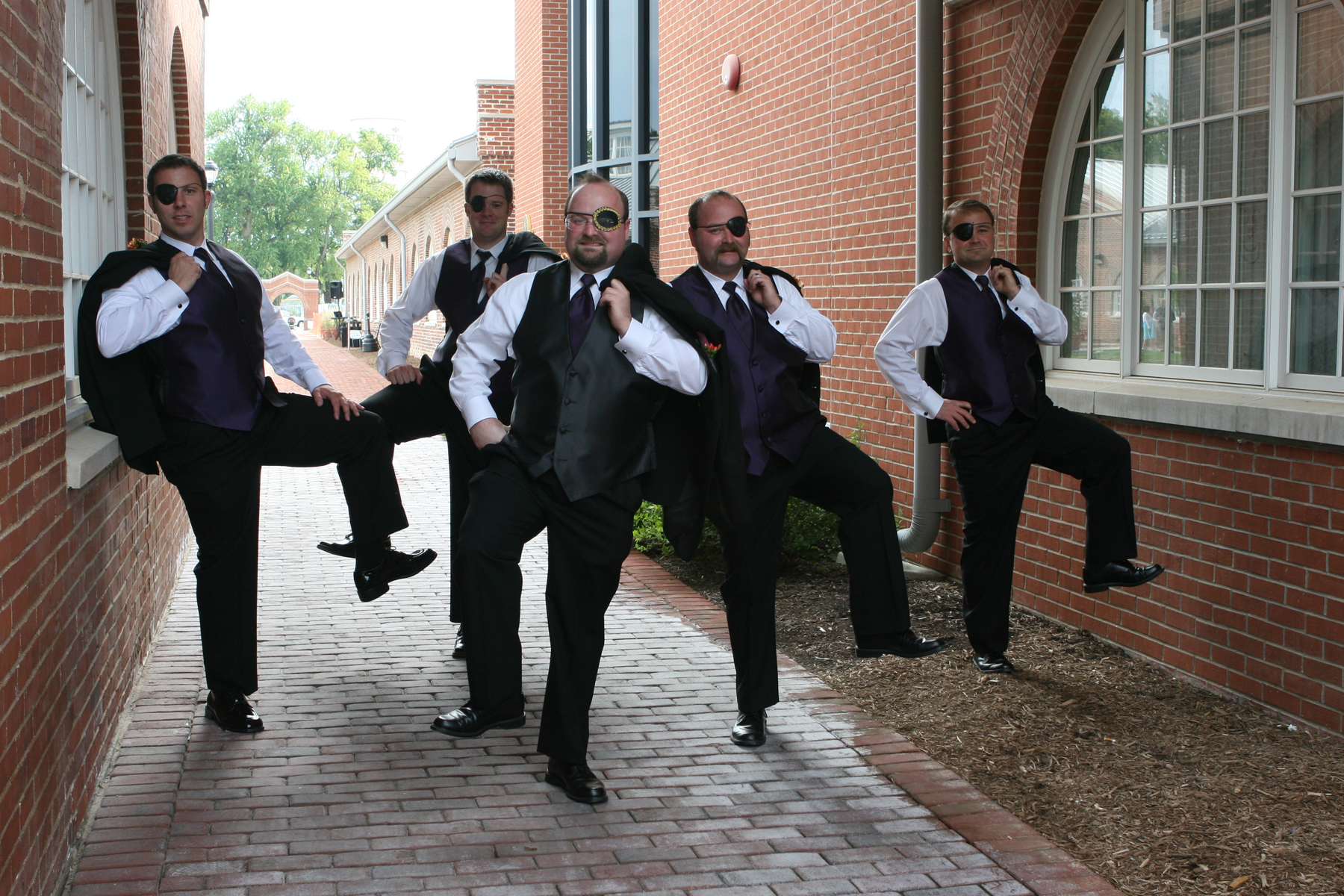
Clearly these men are pirates. You can tell by the way they are standing.

Ultimately, though, I think these are the ones I like best because it says a lot about a photographer (and how well they know the couple whose wedding they are trying to capture) and even more about the couple themselves, because if the photo didn’t somehow resonate with who they are, then it never would have made the wedding album. For my friends, their memories will forever include a nod to the internationally celebrated holiday with which they share their special day. And because of their willingness to embrace it, their friends will never forget to leave a heartfelt message on their Facebook pages: “Arr. Ye be havin a jolly anniversary ye old scurvy dogs.”

I am happy to report, too, that the Multnomah Falls wedding deluge resulted in no major injuries. In an interview after the wedding, the bride said of the event, “We got the tragedy out of the way and now we’re home free.” That’s a great attitude that I assume has led to many years of happily ever after. I just hope someone managed to snap a picture of the splash.

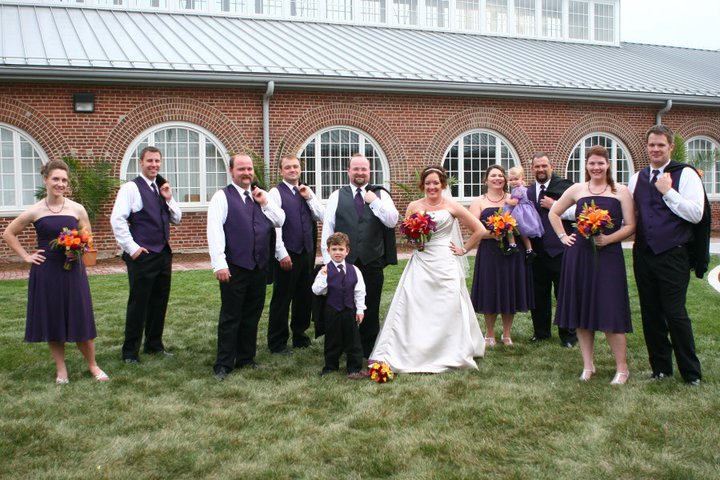
Just a bunch of well-dressed people casually hanging out in a courtyard, cuz that’s how we roll.

Wedding photos by Layne Aumann Photography. www.aumannphotography.com/

These wedding pictures are used by permission and may not appear elswhere without consent, lest ye be wantin to walk the plank.