Down the Creek Without a Paddle

It’s been a big couple of weeks in the house of practical history. If you’ve followed this blog for long you’re probably aware that I have two sons. When I started this thing way back once upon a time they were pretty small, just starting school, giving me, their mommy, bits of time to devote to something like blogging about history and nonsense.

As children do, they’ve gone and grown up now. My youngest graduated from high school last spring, turned eighteen this summer, and left this week on a great adventure. I won’t go into the specifics because he is an adult with sole possession of his own stories. I will say that I’m really proud of him and I miss him already.

It was a beautiful trip.

My oldest son spent the summer away on an adventure of his own, returning about a week and half before his brother’s planned departure, and so as a family we decided to spend a little fun time together. We chose to take a quick getaway in the middle of the week to canoe down part of the North Fork of the White River in Southern Missouri. It’s a beautiful little river and the state has experienced plenty of rain this spring and summer. The occasional low spots one might sometimes experience were nicely covered over and the current was swift.

My husband and I used to be pretty experienced canoeists; my sons, not so much, but after spending the summer apart, they wanted to catch up and canoe together. No mother could say no to that. Of course, we as the the more experienced, took the cooler and strapped the dry bag to our boat.

They worked together really well, communicating through the tougher spots where rocks and debris made the steering (and staying dry) a little more challenging. Despite more experience and twenty-five years of marriage, we didn’t do quite as well. The problem wasn’t our lack of communication exactly. It was more our admittedly slower reflexes and slightly poorer eyesight that got us. And also a fallen tree that we didn’t manage to skirt on an outside bend the way we needed to.

The current was fast where it happened. When the canoe dumped, my husband managed to hold onto it and ride with it several bends downstream, while I grabbed onto the first thing that came to hand, which was the cooler. I clutched it tightly and rode the current, feet first, until I got to a place I could safely stop myself, very near where my husband had finally managed to bring the canoe to shore.

A couple of kind strangers helped him empty the water while our sons chased down all of the wayward objects that had once been in our boat. They found everything except for one paddle. The dry bag was still fairly dry, the cooler that had so beautifully kept me afloat, was no worse for wear, and they even managed to grab my favorite baseball cap that had been swept off my head.

I’m pretty sure this happened yesterday.

Other than a couple scrapes and bruises, we were unhurt, although the strap of one of my husband’s sandals broke during the ordeal leaving him with only one functioning shoe, and of course, there was the beating we took to our egos. That only got worse when shortly after the incident, our just grown sons decided that for our safety, they should each take one of us. And we agreed. Ouch.

Though I don’t think we were at any serious risk of injury in this shallow river, the reality was that for a few minutes there, we were up a creek without a paddle, a phrase that though surely older in conversation, began showing up commonly in American print in the mid to late nineteenth century.

So there we were, divided up between our children, my husband with only one shoe and me without a paddle, each being steered down the river by one of the boys whose lives used to more or less take the direction we chose for them. I suppose now we get to watch them navigate the currents of their own lives.

They were good boys. They are good men. I guess that’s just how life flows.
For the Bragging Rights

On October 4, 1986 the Missouri River flooded its banks and damaged the stretch the Missouri-Kansas-Texas Railroad track that stretched between Sedalia and Machens, Missouri. This in itself wasn’t particularly unusual. The area is prone to flooding and had proven a problem for the railroad company since the earliest days of the route. What was unusual about the 1986 flood was that the company decided to abandon rather than repair the route.

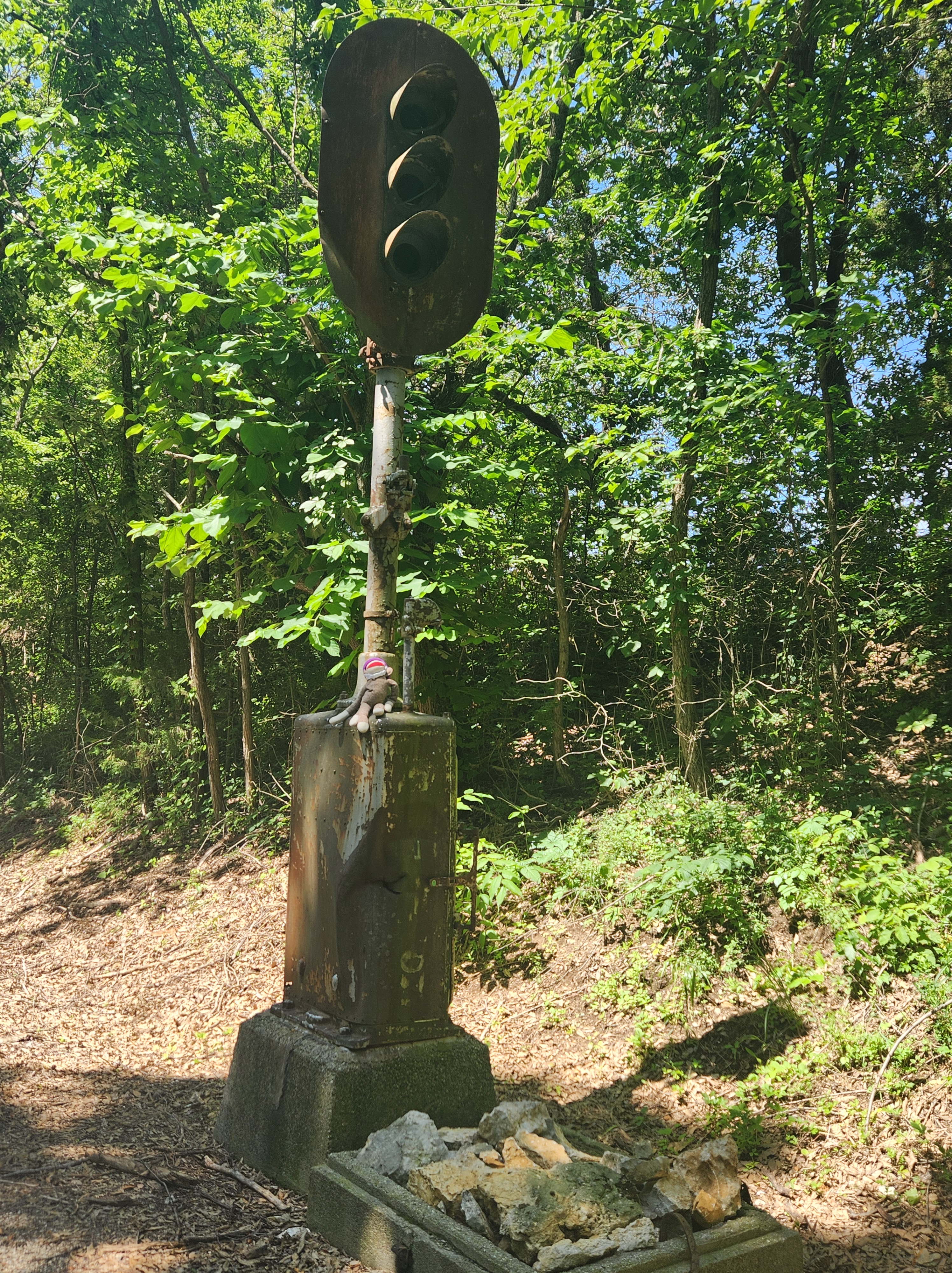
This is the last remaining signal from the MKT Railway.

This turned out to be good news for the biking and hiking enthusiasts of the Great State of Missouri. With help from a generous donation from Ted and Pat Jones (of the Edward Jones Financial Investment Company based in St. Louis), the Missouri Department of Natural Resources purchased the abandoned right-of-way to use as a trail. 

The first section of the crushed limestone MKT trail, shortened to KT, which became simply “the Katy” opened in 1990 around Rocheport, Missouri. Today it officially extends from Clinton in the western part of the state to Machens in the east, comes in at about 239 miles, and is the longest recreational rail trail in the United States. Several spurs offer additional distance, including a 47-mile Rock Island Spur that runs to Kansas City.

Sock Monkey Steve came along as well, but his skinny little monkey legs weren’t much help.

My sister and I were happy enough last week to hop on our bicycles and crush the route between Clinton and St. Charles. That’s officially 12.7 miles from the end in Machens, but St. Charles is a better place to stop and get picked up and taken out for celebration barbecue and cookies. Also, if we add in all of the spurs into towns that we took along the way, we more than made up the difference.

It turns out a lot of cyclists (and some hikers) tackle the whole Katy. We met quite a few cyclists, some of them traveling the same direction as us, some day riders who had done the whole thing on previous occasions, some with light loads and dedicated sag wagons, and others carting their own camping gear. Some riders do the full length in as little as three days. Five to six days seems to be the most common. 

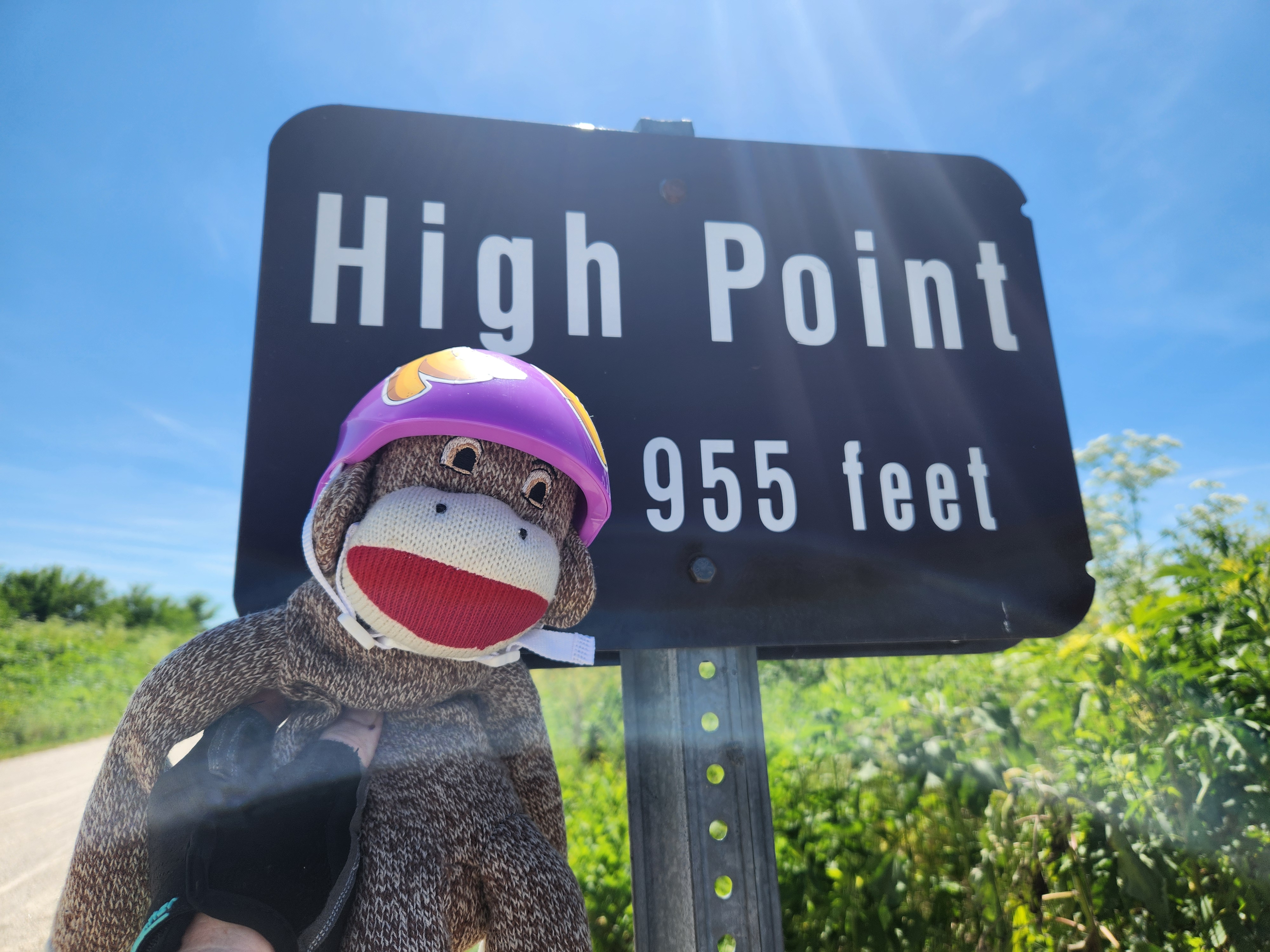
We reached the high point of the trail on the first day, but it definitely was not all downhill from there.

We did six, which was good enough for us. And we stayed in hotels and B&Bs along the way, because we couldn’t imagine that sleeping on the ground was going to be restful enough for us after forty-plus miles of biking on crushed gravel to then be able to get back up and do it again the next day. We did carry our gear with us, though, which was enough of a burden. 

The trail, though straight and flat-ish, requires a lot of work. Some patches are very well groomed. Some not so much. After one stormy night, we had to dodge quite a few downed branches. There are some stretches where large gravel and washouts make the riding all the more challenging, and the western portion of the trail all the way to about a mile outside Boonville is often slightly uphill, just enough to be a slog.

A train tunnel near Rocheport.

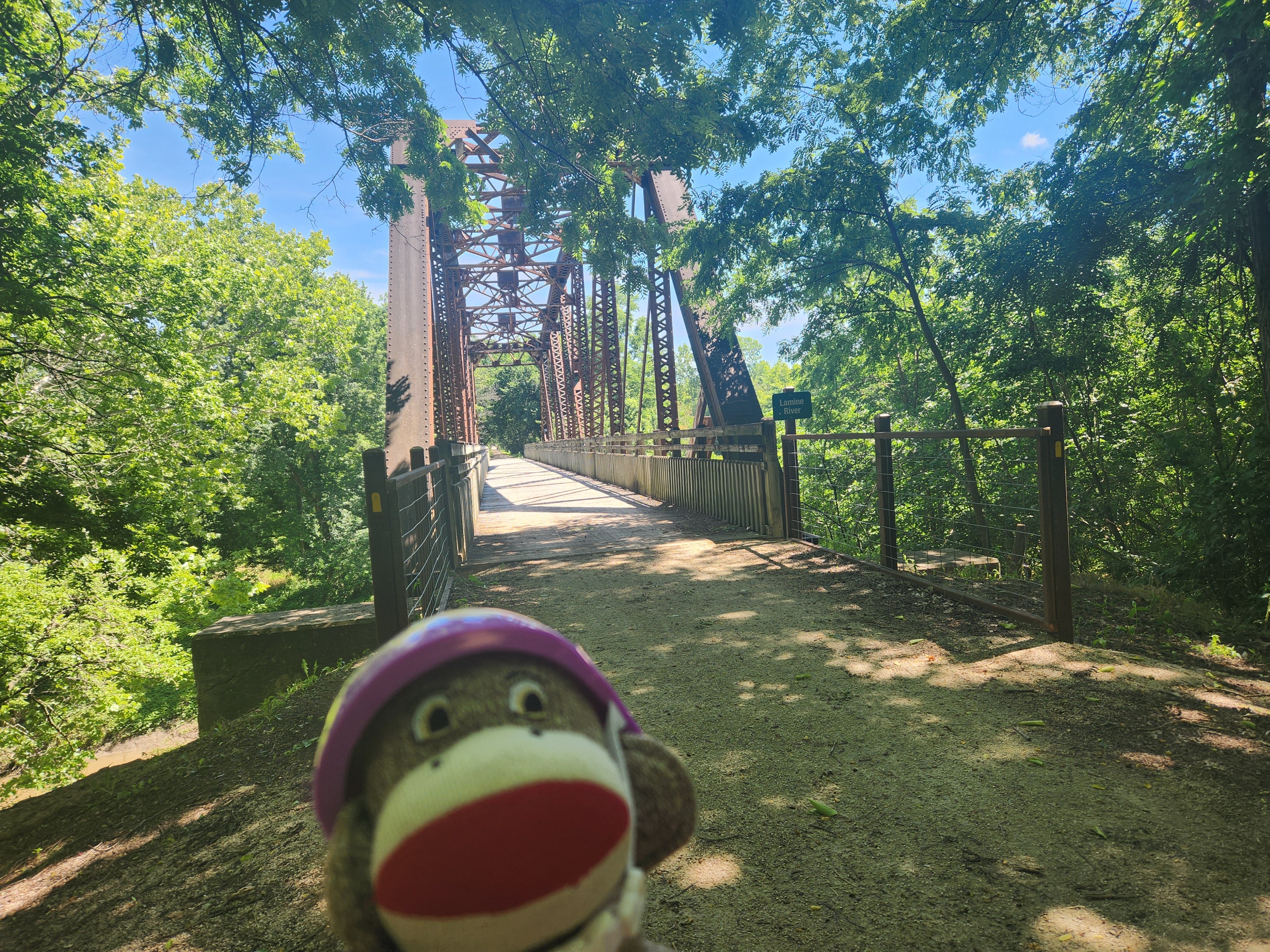
But the trail is beautiful, with much of it running between the Missouri River and gorgeous bluffs. It crosses over numerous creeks on pretty truss bridges, through tunnels, forest, wetlands, prairie land, rolling farmlands, and past historic remnants of the railroad.

As challenging as some days were, as sore as our bodies ended up being, and as tired as we were by the time we lugged our bikes from the trail to our stops each night, I’m awfully glad we did it. I don’t know that I learned anything profound from the experience, though someday when my backside is less sore, I will probably think of some way to turn the experience into a terribly moving and deeply reflective personal essay. For now, it’s enough to have crushed the Katy for the bragging rights.

Meet Me at the Fair

On November 22, 1944 after schedule delays, numerous script rewrites, budget woes, and a leading lady still unhappy with her role, a new Christmas musical debuted on the big screen in St. Louis, the city at the film’s heart. 

The song “Meet Me in St. Louis,” well known today because of the musical, is actually from 1904 and was written specifically for the World’s Fair. Public Domain, via Wikimedia Commons

Despite the mess of getting to that moment, Meet Me in St. Louis enjoyed immediate success, becoming Metro-Goldwyn-Mayer’s second highest grossing film up to that point, coming in only behind Gone With the Wind. After the premiere, Judy Garland even decided she liked it after all and commented to the producer, “Remind me not to tell you what kinds of pictures to make.”

The screenplay is based on a series of semi-autobiographical short stories by St. Louis native Sally Benson who wrote of an upper middle-class family that lived at 5135 Kensington Avenue during the construction of the 1904 World’s Fair on the grounds of Forest Park in St. Louis.

I confess, I saw the movie for the first time later in life than I should have, having grown up within easy reach of St. Louis. My childhood summers included trips to downtown to watch the Cardinals play at Busch Stadium where the musical’s title song is still played by the organist at every game and the crowd sings along as the words scroll across the jumbotron. 

I’ve been many times to the wonderful outdoor Muny theater in Forest Park where the stage adaptation of Meet Me in St. Louis, originally produced in 1989, is performed every few years. I even got engaged in that park on the very grounds of the actual 1904 World’s Fair.

I was lucky enough to get a sneak peek at the new exhibit, open to the public on April 27th. It contains a scale model of the entire fairgrounds. And it’s spectacular.

Officially known as the Louisiana Purchase Exposition, the Fair is a big deal in St. Louis history. It transformed the city, launching it for about seven months into the center of the world’s attention. 

And it’s still a big deal, today. One-hundred and twenty years later the World’s Fair looms large in the community memory carried now by not a single living person who was there to see it, sparking excitement whenever it comes up in conversation, which is kind of weirdly a lot.

It’s especially on everyone’s minds right now because at the end of this month, just in time to celebrate the 120th anniversary of the opening of the Fair, the Missouri History Museum will reveal a newly re-imagined permanent World’s Fair exhibit. 

Equally exciting for everyone who either lives in my house or happens to be my mother, is the release of my new historical mystery set on the grounds of the 1904 World’s Fair in St. Louis. 

Paradise on the Pike is available for the first time today. The story takes place in the enchanting world of Hagenbeck’s Zoological Paradise and Trained Animal Circus on the Pike, which is the entertainment strip within the Fair. It’s not a light, sentimental sort of story like Sally Benson’s, but it does contain elephants and lions and a pair of cantankerous goats. It also allowed me, and will hopefully allow you, to spend some time strolling through the Fair, which was almost entirely constructed of temporary buildings meant to disappear.

Available today! Order from your favorite independent bookstore or slightly bigger bookstore or Amazon.

And maybe that’s why, one hundred and twenty years later, it still takes up space in our imaginations, because we’re a little like six-year-old Tootie at the end of Benson’s stories when the family marvels over the lights and fountains on the fairgrounds and her sister Agnes asks if it’ll ever be torn down.

Tootie emphatically replies, “They’ll never tear it down. It will be like this forever.”

Agnes, relieved, exclaims, “I can’t believe it. Right here where we live. Right here in St. Louis.”

Forest Park retains very few physical reminders of the enormous event that once filled its every corner and held the attention of the world, but in the hearts of the St. Louisans who stroll through the grounds and wish they could have seen those lights shining, it will never be torn down. It’ll be like this forever.

You can find more information about Paradise on the Pike at this link.