
About a week ago, the worst thing that can ever happen to a community happened in my town, and it has been absolute pandemonium ever since. Everywhere I go I hear the cries of the people, from the grocery store checkout lines to the ladies’ locker room at the community center. And don’t get me started on the city’s Facebook page, where many comments contain exasperated emoji faces, excessive exclamation points, terrible grammar, and sometimes even ALL CAPS.
People are pretty upset, and it’s little wonder why, because last week, after months of public notices, published plans, and inconvenient construction, an old interstate ramp connected to the town’s main commercial thoroughfare was suddenly closed and replaced with a new one that includes, of all things (and I’m sorry if this is too upsetting for your sensibilities), a roundabout.
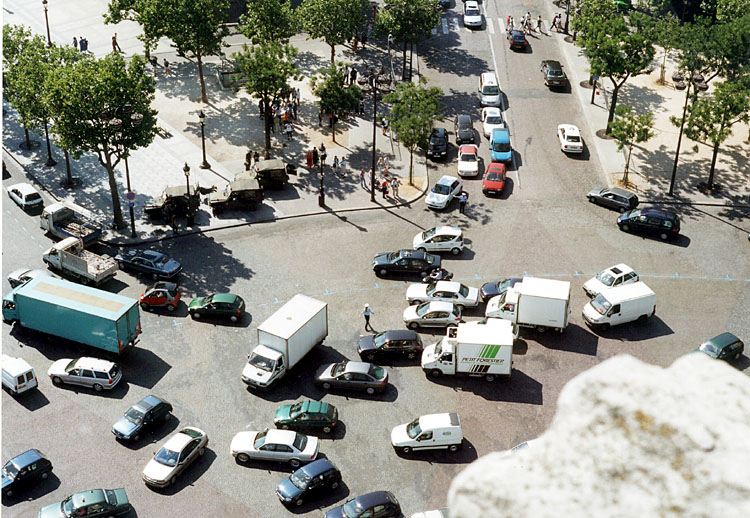
I know. It’s difficult to process. I’ll give you a minute.
The dreaded roundabout can trace its roots, as well as its generally bad reputation, back to the mid-nineteenth century when French Emperor Napoleon III decided to give the streets of Paris a makeover. Baron Georges-Eugène Haussmann was chosen for the job, and the city underwent a major overhaul to its public works, including the Place de l’Étoile (today known as the Place Charles de Gaulle) which circles around the Arc de Triomphe.
The circle, which has no lane markings, serves as the convergence point of twelve roads that all empty straight into it. Traffic traveling around the circle must yield to incoming traffic and those vehicles that have made their way into the innermost portion of the circle have to stay there probably forever.

Fortunately, I’ve never driven it, but when I attempted to find a graphic demonstrating what the traffic pattern should ideally look like, the best I could do were some videos of rush hours nightmares and a delightfully helpful list of tips that include “be a little bit pushy” and “know what your insurance covers.” Of course there have long been terrible traffic circles in other places as well, including the US and, as Clark Griswold demonstrated in the 1984 film National Lampoon’s European Vacation, in the UK.
But in 1966, the traffic circle got an overhaul itself thanks to British city designer Frank Blackmore who developed a newer, friendlier roundabout in which traffic entering from soft curves, yields to the traffic already moving around the circle. When implemented, his design reduced accidents, and maybe after a while didn’t seem like the worst thing ever.

Then in 1984, when the English had been happily driving around in circles for nearly two decades, American engineer Leif Ourston reached across the pond with a possibly slightly over-the-top appeal, suggesting to Blackmore that as Sir Winston Churchill once asked America to join Britain in a struggle to protect democracy, it would be lovely if Britain might join us to bring the love for the roundabout to America.
Since no one could say no to an appeal like that, Blackmore agreed. The two toured the nation’s cities, proposing their safer alternative to stoplight-controlled intersections. Perhaps predictably, complaining people shouted them down everywhere they went. Some even held protest signs that included excessive exclamation points and ALL CAPS!!!!
It wasn’t until the city of Las Vegas agreed to give it a go and placed two roundabouts in a residential area of the city that they made any progress at all. The number of accidents went down and the incidences of roundabouts crept up throughout the US, leading the town of Carmel, Indiana to become the roundabout capitol of the nation with upward of 138 of them serving a population of just under 100,000 spread over an area of forty-nine square miles.

I bet the citizens of Carmel did their fair share of grumbling at first, though I imagine they’ve gotten used to it by now. It’s hard to spend too much time arguing against an 89% reduction in traffic delays, a 56% reduction in stops, a 29% reduction in carbon emissions, a 28% reduction in fuel consumption, a 38% reduction in accidents at intersections (which account for 50% of traffic accidents nationwide), and a 90% reduction in fatalities at intersections.
I think folks in my town will eventually accept their tragic fate as well. This is, after all, not our first brush with these horrid circles. Just a quick count in my head comes up with at least six other roundabouts in town that I drive through regularly. I suspect there are more than that, each one initially met with righteous anger by local skeptics who grudgingly admitted after a while that it maybe didn’t seem like the worst thing ever.
People do come around, if in a somewhat roundabout way.
 Author Sarah Angleton
Tragic fate indeed. I hate roundabouts.
Everyone hates roundabouts. Until they don’t.
I love this blog and hate roundabouts. I live 7 minutes from Walmart and have to go through two roundabouts to get there. Here’s my rule—slow dow when approaching
. Look to your left and if no one is going to hit you—then GO.
We live at Lake of the woods, so it seems everywhere we go is on Allen Rd ( or as I call it- the roundabout road).
Great blog, Sarah..
Sounds like you’re doing it right!
If it weren’t so sad, this would be very funny. Having grown up with roundabouts in Germany, I don’t understand why people have such trouble adjusting to them. I would rather stop at a roundabout than a red light any time of the day.
The statistics certainly demonstrate that your preference is the more logical one. I admit, I started out as a skeptic, but I’ve found they’re generally pretty smooth and easy. I do sometimes struggle with the multilane ones if I’m driving in an unfamiliar place, but I can usually adapt ok.
I agree that the multilane versions can be frustrating, especially if driver’s don’t pay attention or get into the wrong lane. I think it’s helpful to remember that one could always stay in the roundabout for an extra round (or more) until there is an opening (provided one doesn’t get caught at the Arc de Triomphe.
Place de L’Etoile is in a category all its own. For one thing, the rules of right of way are backwards. I saw somewhere that there’s a push in Paris to thin down the number of lanes and attempt to improve the flow ahead of the 2024 Olympics, but of course there’s public resistance. 🙄
We tend to be resistant to change, at least initially.
When driving in Paris, it’s best to drive like a Parisian. 😊
There are many, many roundabouts in NZ. In our ones the normal road rules, safe driving techniques, even basic human courtesies, are legally lifted in favour of a free-for-all game of chicken. Apparently this is meant to improve traffic flow. Every so often government tries to help by reversing the give-way rules, which is about as effective as you’d imagine.
Oh dear. Our new one is a little bit of a free-for-all right now, but I think that’s just because it’s new and people are unsure.
You cleverly took a roundabout way getting to the topic! When my wife and I moved to Washington D.C. area in 1969, we had no experience with traffic circles. What a shock. My wife could not drive home from work in the rush hour and I was terrified at the speed and what seemed like reckless abandon of the cab drivers. Slow down and I knew I would get rear ended. Good that we survived because they are everywhere now.
I very recently learned that traffic circles and roundabouts are different things, though the difference is a subtle one. Roundabouts are safer intersections that slow down traffic with gentle curves and logical right-of-way rules, preventing slow-downs and accidents. Traffic circles, on the other hand, are Satan’s roadways.
I am a bad enough driver, I do not need extra handicaps!
This is a brilliant posting!! My town has two roundabouts. I often take a “round about way” to use the roundabouts because they’re easier than trying to cross a road at crossroads without lights! Besides the two roundabouts are useful: “To get to my house turn right at the second roundabout!” And of course our two roundabouts are greatly aided by the fact that the town has very little traffic!
But is it the first right or the second right or the third right? I could see how that might be a useful way to avoid receiving visitors.
Sorry, I hate roundabouts. It gives me the screaming heebie-jeebies just thinking about them.
You’re not alone. I read this at a local open mic last night and got some lively feedback. 🙂
The last sentence of this post is gold. Around here, we can’t handle four-way stop intersections. A roundabout would simply be pure evil.
Four way stops are always a bit of a gamble around here, too. I’m coming to appreciate the traffic circle. Almost.