Sarah Angleton is a wife, mom, blogger, book nerd, history enthusiast, author, and lover of puns. Her books include Paradise on the Pike, Launching Sheep & Other Stories, Gentleman of Misfortune, Smoke Rose to Heaven, and White Man's Graveyard.
Good Thursday morning to you all! This post isn’t really a post. It’s really just an explanation of why I am not posting this week…Because I’m editing!
This is not my novel. This is a picture from Pixabay. No sneak peeks! Unless perhaps you are the kind of person who likes to review books. If that’s the case, we should talk.
Or rather, I’m carefully following 98.9% of the advice offered by a much more talented editor than me, one who doesn’t fling commas around willy-nilly, use inappropriate ellipses, and who knows her way around an em dash. I cringe to think what she would do with that last sentence.
So, what am I editing? Thank you for asking. I’m editing a book. To be precise, I’m editing my book, a (an? you can see why I need help) historical novel that will be published in early September, when it will immediately climb to the bestseller lists because of its prodigious use of em dashes. Also mummies. Did I mention it has mummies? And murder. Maybe a little bit of mayhem, too. And even a hint of romance.
We’re in full on summer mode here. My kids have been out of school for almost two weeks and in that time we’ve gone swimming several times, spent a day at Six Flags, hosted visiting relatives, gotten too much sun, caught fireflies, climbed boulders, picnicked alongside a babbling creek, played with friends, and stayed up too late. It’s been a busy, fun couple of weeks, but it hasn’t left a lot of time for blogging.
I’m going to be honest here. In between loading the cooler, packing and unpacking the car, and keeping up with the mounds of laundry produced by so much summer fun, I have given very few moments of thought to this week’s blog topic. Frankly, I haven’t come up with much because I’ve been preoccupied. And why do today what can be put off until tomorrow, right?
Why yes, I did find my blog topic in a random meme on Facebook. What? I looked into it.
I figure if Mozart could manage to write the overture to Don Giovanni the night before its scheduled premiere in Prague, surely I can rattle off a post at the last minute.
According to somewhat well documented legend, Mozart went out for a drink the evening of October 28, 1787, where he encountered someone who reminded him that his opera collaboration with Italian poet Lorenzo da Ponte still lacked an overture. Mozart, who surely knew this already, allegedly pointed to his head and responded, “It’s all in here.”
Apparently it was, because the composer returned to his boarding house where he enlisted the help of his wife to regale him with stories and keep him awake while he worked. By 7 o’clock the next morning, the copyist set to work and the evening of October 29, 1787, the orchestra sight read the overture in front of the audience. The talented musicians knocked it out of the park and the audience went wild, because Mozart. He tweaked the piece a little for later performances, but there’s no question Mozart demonstrated that procrastination and greatness can coexist.
Of course I’m pretty sure this post won’t go down in history as a great example of the best that history/humor blogs have to offer. If I had allowed myself more time, I could have written something much better, more humorous, more thoughtful, or more profound. It might even be already composed more or less entirely in my head, but I’m no Mozart. And I’d rather get back to the pool.
On May 1, 1633, thirty-two-year-old beauty Venetia Stanley Digby was found dead in bed in her London home. A popular lady at court, her surprising demise set the city abuzz with rumors, many of them focused on her husband, the grief-stricken Sir Kenelm Digby.
Sir Kenelm Digby, father of wine snobbery. And Pinterest wine bottle centerpieces. [Public domain], via Wikimedia CommonsA popular man himself, Digby was a scholar, an off-and-on Catholic, and a former privateer. He was also a noted chef, alchemist, and enthusiastic supporter of sympathetic medicine (in which treatment was applied to the injury-causing instrument, rather than to the injured).
He was kind of like your favorite crazy uncle who dabbles in a little bit of everything. And who might accidentally kill his wife in the process. Of course this is a hypothetical uncle. I certainly have no such uncle. My uncles are wonderful men who occasionally read this blog.
Though he wasn’t a particularly faithful husband, Digby took Venetia’s death pretty hard. He retreated from his life at court, renewed his devotion to Catholicism, and found solace by throwing himself into his studies. He found greatness at the bottom of a wine bottle. Also in its sides and neck.
Don’t get me wrong. I’m a big fan of drinking wine pretentiously. photo credit: NwongPR The Somm Team via photopin (license)
Because it was around this time that England faced a wood shortage that led to an increase in hotter coal-burning furnaces rather than the wood-fed ones typically used for glassmaking. Digby fired up his furnace and went to work producing a dark, thick bottle suited for elegantly storing wine.
Up until this point in history glass hadn’t been up to the task, and if it held wine at all, it was for presentation purposes only. Since the early days of its development in about 3000 BC, glass was generally too thin and delicate for wine.
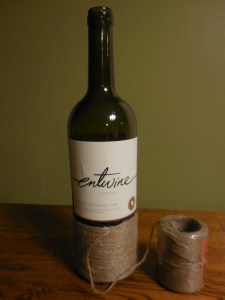
This bottle was mocking me.
That is until Sir Kenelm Digby became the father of the modern wine bottle. It’s a good thing he did, too, because before his thick-glassed bottle, wine didn’t get stored and savored and swirled and pretentiously sipped. And even more important than that, there weren’t thousands of empty, standard-sized bottles awaiting magical Pinterest transformation into dreamy wedding centerpieces.
It’s Sir Digby, then, I can thank for the hours and hours I have spent these past few weeks collecting, rinsing, and wrapping wine bottles in yards of twine. One of my nieces is a soon-to-be bride. She needs centerpieces for her reception, and I’m kind of like that favorite crazy aunt who will volunteer to do just about any tedious wedding-related task you require without complaint, though not without a blog post.
Best. Aunt. Ever. Not that it’s a competition. That I’m totally winning.
Of course my niece has many wonderful aunts who occasionally read this blog, and she has never publicly declared that I am her favorite. But I think we all know.
I also think the bottles turned out pretty well. I know the centerpieces will be beautiful, the ceremony will be perfect, and my niece and her groom will remember their special day for all of their long, happy lifetime together. I also think Sir Kenelm Digby would have been pleased to know to what great use his bottles had been repurposed, as part of a celebration of marriage and love.
The end of the school year is nearly upon us. The teachers and students are counting the days and hours remaining, looking forward to the final bell. I’m counting, too, but I’m a little more panicked than my children are. I am looking forward to lazy summer mornings and family adventures to far-flung places, but there’s no question my schedule and the way I approach getting things done is about to change dramatically. It takes some planning. And it takes not getting a stupid cold two weeks before the crazy summer begins.
Ah…spring. photo credit: califmom ‘Snot Funny via photopin (license)
I’ve been incredibly lucky so far this year. I avoided the dreaded flu that took many of my friends and neighbors completely out of commission for a week or more. While others coughed and sniffled their ways through the winter, I breathed easy. Then a few days ago, I woke up with an excruciatingly sore throat at the start of what has been a goopy-headed, achy, tired week with a lengthy to-do list.
As you probably know, there are quite a few suggested remedies out there for colds, none of which work most of the time, and no actual cure. I get that. Nobody is going to win the Nobel Prize for curing the common cold. The world has bigger problems.
But I was curious to see what solutions people came up with in the past. Frankly, I didn’t come across much that I wanted anything to do with. I did, however, find some relief of sorts in a book by William Buchan, a Scottish physician who in 1769 became the Dr. Spock of his day. For those of you who are younger than me, Dr. Spock is the physician who wrote the household medicine book your mother would have kept on a shelf in the kitchen before she had access to Dr. Google.
Not that Spock. photo credit: Tom Simpson Dr. McCoy and Mr. Spock animation cel from Star Trek: The Animated Series (1973) via photopin (license)
Long before Spock’s Baby and Childcare, there was Buchan’s Domestic Medicine: or, a Treatise on the Prevention and Cure of Diseases by Regimen and Simple Medicines. The book sold more than 80,000 copies in nineteen editions before his death in 1805, and was the most popular medical book sitting on the kitchen shelves of mothers across Europe.
Dr. Buchan had a lot to say about the dreaded common cold, most of it having to do with sweat. The man was obsessed with perspiration, insisting that you must never neglect the crucial process of sweating and must also at all times remain completely dry. That may sound like contradicting information, but think of it like reading a study that concludes drinking coffee will prolong your life, and then the next day reading another study that insists coffee will give you cancer. So yeah, it’s definitely contradictory.
Forget hand sanitizer. If you want to stay healthy, grab a towel! Picture by Pexels, via Pixabay.
But Buchan’s main concern in focusing so much attention on sweat has mostly to do with temperature. Common diseases, including the ever-aggravating head cold, he claims, are caused most often by exposure to drastic changes in temperature. And that would totally explain why an otherwise perfectly healthy person might suddenly develop a cold in the middle of spring, when the temperature is at its most wishy-washy. That is, if you happen to be an eighteenth century doctor with no concept of viruses and disease transmission.
To keep from catching a cold, then, the good doctor says one should change his or her clothes immediately after sweating, to avoid rapid cooling. Also if one finds oneself overheated, he or she should, under no circumstances, drink something cold or, to be extra safe, anything at all. That’s also true when a carelessly wet person inevitably develops a cold. Never drink. Not spirits. Not water. Not anything. Also avoid particularly cool, juicy fruit. Vegetables are okay, as tolerated.
By far Dr. Buchan’s most dire warning is about sleeping in a damp bed, which you definitely don’t want to do. By damp, of course he means one that has not been in proper use for some time, and so has absorbed moisture from the air. Always, he says, put guests in rooms with beds that have been thoroughly slept in and not carefully cleaned. In fact, he recommends completely avoiding spending much time at all in rooms that have been recently cleaned.
Because nothing says “Welcome to my home” like a guest bed that looks like this. photo credit: Edna Winti Sunrise via photopin (license)
And this I think is the one piece of advice in this little book that may be beneficial to me, because on my long list of to-dos is to prepare my house for hosting folks who will be staying with us for a large family event coming up right after school lets out. Normally this would involve a lot of washing and scrubbing and sanitizing. Since I’m still fighting this cold, I don’t really have the energy for all of that.
Thanks to Dr. Buchan’s medical wisdom, I know I can just relax and rest up instead. I’ll be a thoughtful and responsible hostess, by welcoming my guests into a healthful and dry, filthy home, with a cup of coffee that may or may not give them cancer.
On May 7, 1947 real estate lawyer Abraham Levitt, along with his two sons William and Alfred, announced a plan to build a community of middle class homes on Long Island. Responding to a growing urgency in the US for family housing after World War II and the corresponding baby boom, the Levitts built nearly identical slab homes just as fast as they could. By 1951, they had produced more than 17,000 houses in Levittown and surrounding areas.
The houses and nice lawns weren’t the only things that looked the same in Levittown. The building project also carried a legacy of racial discrimination for many years. By Gottscho-Schleisner Collection [Public domain or Public domain], via Wikimedia CommonsEach Levitt house came complete with a television, a well-manicured lawn, and plenty of rules to maintain the right sort of neighborhood vibe. People snapped up the houses as soon as they could be built. The project was so successful that in many ways it became a model for suburban housing developments all across the US.
And with them spread the idea of the Homeowners Association with all its various limitations on backyard chicken farms and exactly how long the stupid grass is allowed to be in order to maintain the look of turf lawn perfectionism. I’m sure I don’t have to tell you at this point, but man, I hate to mow.
We had a long, cold early spring here in the Midwestern US. If you know anyone from this corner of the world, I’m sure you heard about it. The weather was all anyone could talk about for a while. For weeks, I couldn’t go to the grocery store without a stranger stopping me to discuss the cold. I even blogged about how March was throwing a toddler-worthy tantrum.
Actually the worst part may have been the steady stream of weather memes. So. Many. Memes.
I hate to be one of those people who is never happy, no matter what the weather does, but frankly now that our nice warm spring is finally here, with stunning blossoms, and the constant drone of suburban lawn care, I kind of wonder what we were all complaining about.
The Levitts certainly weren’t the first people to ever have grass lawns. Researchers point to the need for our ancestors on the savannah and later tucked inside medieval European castles to be able to see oncoming threats. Like lions. And invading armies. And door-to-door missionaries.
Medieval lawn care service. Or the black plague. It was hard to tell. Image via Pixabay
But for a long time, personal lawn space was a luxury unavailable to other than the wealthiest individuals, who could afford to hire an army of scythe-wielding caretakers, didn’t need to dedicate every available patch of land to growing food, and had time to play lawn darts.
But now we have lawn mowers, grocery stores with shelves full of Doritos, plenty of time for lawn darts, and persnickety homeowners associations that make those of us in suburbia promise not to hang our laundry out to dry in the sun, raise chickens in our back yards, or let our grass grow three feet high.
How people used to mow their lawns. Also against the rules of my HOA. Sigh.photo credit: Tambako the Jaguar Grazing Highland cows via photopin (license)
Most of the time, I don’t mind. Even though I’d like to know I have freedom to do so, I don’t really want to raise live chickens. And if I’m being perfectly honest, my husband does most of the mowing because for some reason he finds it kind of enjoyable. When he’s too busy or when this crazy beautiful weather we’re finally having leaves us with jungle grass every other day, I grumble and step up to keep the HOA off my back. These are tradeoffs I’m willing to make at this point in my life for good schools and quick access to city amenities.
Someday perhaps I’ll move further away from the city where I can dry my laundry on a clothesline in the sun and raise as many chickens as I want (still probably zero, but the freedom is the thing). Then I suppose I won’t have anything to complain about. Except for the tract-wielding missionaries that snuck up on me through the waving prairie grass. And of course the weather. I’ll always be able to complain about that.
It’s been about six years since researchers Michael Streck and Nathan Wasserman published in the reputable journal Iraq that they had made a stunning and important breakthrough. The two men had been working to translate an Ancient Babylonian tablet discovered by J. J. van Dijk in 1976. Much to the delight of the world, the tablet turned out to contain a series of riddles and punch lines, poorly written, most likely by a wisecracking youth.
Among the 3,500-year-old jokes is what Streck and Wasserman refer to as the oldest known Yo’ Mama joke. That may require a little stretch of the imagination. Part of the riddle is indecipherable, and what is there goes something like this: “…of your mother is by the one who has intercourse with her. What/who is it?”
Sadly, the answer to the incomplete question has also faded forever from history. But from context, it seems safe to assume that the riddle was not intended to flatter poor mama.
This really may have been the first time someone bothered to chisel an insulting joke about someone’s mother, though I doubt it was the first time such a joke was ever uttered. Writers and comedians and people looking to pick fights have been slinging mud at mothers for millennia, I suppose because they elicit a pretty universal response.
Moms are pretty awesome.
No matter what our relationship with our mother, whether she is close to us, not so close, no longer with us, or was never a part of our life at all, mothers matter profoundly in the human experience. That truth transcends eras and cultural identities and it makes Yo’ Mama jokes, from the partial ancient ones to the cleverer ones of today, a little uncomfortable. Because most of us love our mamas, or at least know what it feels like to really want to be close to and adore our mamas.
As Mother’s Day comes up here in the US (on May 13, in case you’ve forgotten) I hope you’re thinking about ways to let yo’ mama know how much you love and appreciate how much she loves and appreciates you.
If you’re in need of a last minute gift idea, I’ve got one for you. Until May 13 (again, that’s Mother’s Day), you can follow the “Mother’s Day Book Sale” tab at the top of this post and get a personalized and signed copy of Launching Sheep & Other Stories. It’s even discounted 33% just because Yo’ Mama likes books so much that you should get her one for Mother’s Day.
Early last year I wrote about a fitness challenge I had joined, pledging to walk 2,017 miles in the year 2017. In case you’re curious and don’t like to do math, that comes out to around five and a half miles per day. It’s doable for a fairly active person, which I generally am.
Still, I didn’t make my goal last year. I was close enough that if I assumed I’d walked about twenty miles on a couple of days I missed recording and averaged twelve miles each day for the last two weeks, I would have made it. It didn’t seem worth it. Honestly, I’d done really well until November when I became more focused on writing a novel and eating turkey.
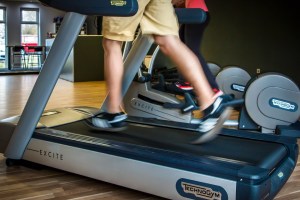
I don’t know…that looks like a lot of work. Picture by profivideos, via Pixabay
It definitely takes consistent effort and I think it’s safe to say we all have those days when we’re sick, or lazy, or sitting in a chair writing a novel, or driving across the country. It’s stringing too many of those days together that’s the problem.
But as I discovered on a recent road trip to visit my parents in Illinois that last obstacle isn’t so bad. It takes me about two hours to get to their house pretty much regardless of the route I take. Each option comes with drawbacks. The most direct route takes me across the Mighty Mississippi on a scary, crumbly bridge so narrow I’ve seen truck drivers back up rather than meet a vehicle coming across in the other direction.
This time I wisely chose to go another way with thicker traffic, but a much nicer bridge, and then a two lane highway in Illinois that could use a little love and attention and provides plenty of broken, bumpy adventure. But this road has a hidden benefit for those drivers wearing their fitness bands. In the hour I was dodging potholes on that lonely Illinois road, my fitness band credited me with six hundred steps.
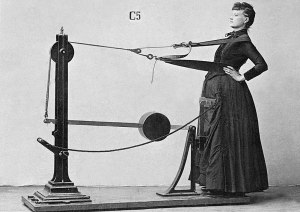
And why shouldn’t it? I may not have done the walking myself, but my body surely benefited from the jiggling. At least it might have according to Swedish physician and inventor Gustav Zander, who in the latter half of the 19th century invented some of the earliest forms of gym equipment. Included among Dr. Zander’s creations was the first belt vibrator machine (if you Google that, use caution).
This contraption had a belt you’d place around your waist or arm or leg, or I guess wherever your problem areas may be and then it magically vibrated the fat away. Dr. Zander’s wonderful machine provided healthful massage, relieved mental fatigue, rid the body of harmful toxins, and toned muscles. Or it didn’t.
The use of passive exercise machines like the belt vibrator peaked in the early part of the 20th century and surged again through the 1950s and 60s. There’s just something really appealing about getting into shape without wearing legwarmers or doing any actual work at all.
Who needs workout equipment? Picture by Antranias, via Pixabay
Even today there are numerous products on the market designed to move your muscles for you while you read a book or give yourself a pedicure. Today’s devices generally stimulate muscle contraction using targeted electrical pulses. And though such gadgets may offer some therapeutic benefits, providing you with that beach ready body isn’t one of them. For that, they’re about as effective as Dr. Zander’s original passive jiggle apparatus or my car on a bumpy road.
So maybe jostling car steps shouldn’t count, but since my fitness tracker is just as likely to ignore a quick jaunt across the room or a climb up sixteen flights of stairs, I’m going to assume it more or less evens out. This year’s goal is 2,018 miles and by the time November rolls around, I may decide to sit in a chair and write a novel while eating my body weight in turkey. I’ll need every extra jiggly step I can get.
And speaking of novels, there’s exciting news coming down the bumpy pike on that score. I can’t promise you any free steps, but if you want to be among the first in the know, you can sign up to receive email news from me here: http://eepurl.com/b3olY1
Last week, I had the opportunity to participate in a grand tradition that has thankfully faded since its heyday prior to World War I. For one day only, I conducted a school band. There are a few things you might need to know about me before you realize the absurdity of that statement. First, I haven’t played in a band, school or otherwise, for more than twenty years. Second, to the best of my recollection, I have never conducted one. Until last week.
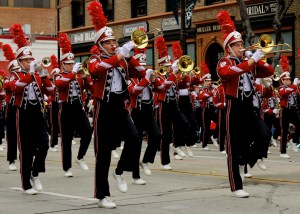
By far the coolest hats in school. photo credit: Prayitno / Thank you for (12 millions +) view Red Raider Marching Band Pulaski H.S. ~ Wisconsin via photopin (license)
After World War I, the American school band movement, with roots in the mid-19th century, found its footing as a large number of military trained musicians returned to civilian life and brought with them a set of skills they could put to good use in public schools. Before that, school band was kind of an afterthought. If it existed at all, it was generally led by whatever teacher maybe had a little musical knowledge and wanted the extra cash.
But with an influx of actual talent and a hefty push from the instrument manufacturing industry, 1923 saw the first Schools Band Contest of America in Chicago. Small and poorly organized at first, the contest continued to improve and grow, encouraging the spread of school band programs and spawning the mostly state level contests of today.
What I thought I looked like.
More than 90% of American schools now have some form of band education, and it’s a great thing that they do because students who participate in music have improved logic and reasoning skills, increased coordination, higher levels of engagement in their education, better stress management ability, greater self-confidence, and better standardized test scores on average than their nonmusical peers.
I’m grateful that the schools my kiddos attend have strong band programs with talented teachers. Of course that does mean that sometimes those teachers travel with parts of the program for performances and competitions, and have to leave the rest of their students in the hands of whatever substitute teacher may have a little musical knowledge and wants the extra cash.
This brings me to my conducting gig last week. I’ve been trying to do some occasional substitute teaching in our district lately, which has turned out to be a great way to get to know the teachers and administrators in the schools my kids attend. It does also occasionally stretch me a little outside of my comfort zone.
Last week, two of our directors accompanied the high school band to a competition, and I stepped in to help back at home. I started my day in study hall with about twenty high schoolers that didn’t go on the trip. No problem there. I also got to enjoy listening to the rehearsal of some impressive middle schoolers who stayed on task while one of their own teacher-designated peers guest conducted.
What I actually looked like.
But then there was the grade school, where I found myself in charge of a class of sixth graders just getting their musical bearings. Fortunately, the lesson plan was specific and thorough. I had access to the students’ musical exercises through an app so I could have them play along. That helped smooth over my shortcomings somewhat. Then we got to an exercise that could be played as a round and the students, who had been remarkably cooperative, really wanted to do it.
The app couldn’t help me with that. With trepidation, I assigned parts, counted off the time, and waved my hand in a 4/4 cross pattern like I almost knew what I was doing. I kind of even sort of gave cues when it was time for each new section to start. Then I provided them with a nice big cutoff at the end, which they played right through because they’re sixth graders and they weren’t watching me anyway. But much like my early American school band movement predecessors, I somehow muddled through.
Fortunately this week, the real band directors are back.
It’s prom season here in the great state of Missouri. Every Saturday night from now until early May, dinner out at any local chain restaurant in the area (McDonald’s included) will come with a red carpet-worthy display of colorful chiffon and smart waistcoats.
I kind of love it. Even though I’d rather muck out horse stalls with a pair of chopsticks than watch the Oscars, I do enjoy seeing people dressed up in their finest frills. Since my own children aren’t old enough to participate in that grand old tradition yet, I soak up the images of the overly fancy diners and photos of my friends’ teenage kids posted on social media, with the advantage that I don’t have to be the one up all night worried that they’re not making good choices.
To be clear, I don’t know any of these people, but don’t they look nice? photo by Ilhabela, via Pixabay
I do hope they all have a wonderful time, that they make it home safe with their hearts and their dignities intact, and that they dance their socks off. Because they have a fair amount of pressure and angst in their lives and most of them could use a night of cutting loose on the dance floor to work some of that out of their systems.
Just maybe, on a larger and more tragic scale, that’s what it was all about on a steamy July day in 1518, when Frau Troffea of Strasbourg in Alsace began to dance. She did so in the middle of the street, to a tune that played only in her head, without explanation or regard for anyone who might be watching. She simply danced.
And she didn’t stop.
After a few days, people began to join her. Within a week, thirty-four dancers had danced into the danger zone on the streets of Strasbourg. A month later the crowd had swelled to four hundred, still without any logical explanation.
Absent any better ideas, the authorities directed the building of a stage and enlisted the services of local musicians to provide an environment suitable for those getting’ jiggy with it to work the jiggy out of their systems.
If people around you start dancing for no apparent reason, I think you just have to go with it.
Eventually, and after a large number of the afflicted dropped dead from sheer exhaustion, the massive, spontaneous flash mob stopped.
We know of Frau Troffeau from the writings of Swiss physician and alchemist Theophrastus von Hohenheim (whose historical stage name is Paracelsus). He arrived in Strasbourg a few years after the event with an eye to establishing a medical practice there. Paracelsus believed that the epidemic most likely stemmed from the vengefulness of unhappy wives, citing Herr Troffea, who allegedly hated nothing more than his wife’s dancing.
And while Paracelsus’s explanation probably seems as strange as the dance epidemic itself, historians and physicians today don’t have much to offer as a better explanation. One prevalent theory is that the symptoms were caused by Claviceps purpurea, a fungus that infects rye and other grains, served as the basis for the development of LSD, and has been known to cause people to go a little loopy.
But another maybe plausible suggestion is that this was a social psychological disorder stemming from the trauma of living in a time of frequent plague, natural disaster, and generally poor living conditions. I guess I sort of get that. Like Meghan Trainor, I feel better when I’m dancin.’
The citizens of Strasbourg weren’t the only victims of this most unusual epidemic, either. From the eleventh century to the middle of the seventeenth, numerous accounts of similar incidents pop up throughout Europe. Most of these are well documented. This actually happened. A lot of people really did dance themselves to death. And then it just stopped.
But all things considered, maybe in the Middle Ages that wasn’t such a bad way to go. Dancing can definitely be therapeutic, as can getting dressed up in your fanciest duds and going out to dinner with your friends. So have fun, kids.
In 1948, former Royal Navy WWII pilot, accountant, and avid nudist Edward Craven Walker sat in a pub in Dorset County, England and noticed an inventive homemade device bubbling away on a stovetop in the pub’s kitchen. What he saw was an egg timer created by a regular customer using a cocktail shaker and two immiscible liquids, one of which danced before his eyes like some kind of alien blob.
Tech security company Cloudflare has a wall of Lava Lamps in its San Francisco office that it uses to generate random seeds for its encryption algorithms. It also adds a pretty chill vibe to the place. photo credit: niwasan Lava lamp Gallery – colección invierno 2009-2010 via photopin (license)
Walker was entranced by the bubbly display and mulled it over for a long time after, deciding to experiment with the concept himself in hopes of finding a way to make a lamp device that worked in a similar fashion. He retreated to his mancave shed where, presumably naked, he tried different containers and liquid combinations until he found something that worked.
In 1963, he introduced the world to his Astro Lamp. Just one year later, a US Patent was filed and in 1965 the Lava Manufacturing Corporation in Chicago bought the American rights to what they would call the Lava Lite Lamp, because groovy alliteration sells. Or at least it did in the late 60s and 70s.
I mention lava lamps today, because according to several websites devoted to listing “this day in history” events, like brainyhistory.com, on-this-day.com, and some random guy on Facebook (who, admittedly comes off a little sleazy and maybe not entirely legit) insist that April 5, 1965 was the celebration of “Lava Lamp Day.”
Groovy. And maybe that’s reason enough to celebrate.
Try as I might, I cannot determine why this particular date is important in the history of the Lava Lamp. It’s not the day the US Patent was filed. I suppose it could be the day the American rights were purchased, or even the day the lamps hit the US market, but I’m not able to verify either of those guesses. I also can’t find any reference to an actual celebration either in 1965 or beyond, that revolved around the Lava Lite Lamp. What I’m left with, then, is the assumption that it might be entirely made up and lifted and shared, as so many things on the Internet tend to be.
Still, when you come across a Lava Lamp (if you ever have then you know what I’m talking about), it’s hard to look away. And though the popularity of Walker’s psychedelic invention waned through the eighties as people became mesmerized instead by big hair and shoulder pads, it enjoyed a resurgence in the late nineties and well into today.
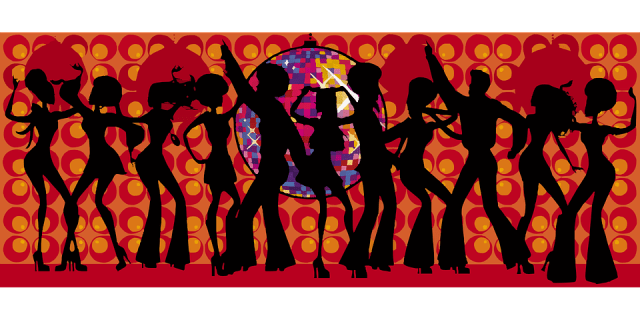
The Internet is pretty quiet about how the original Lava Lamp Day was celebrated, but I imagine it looked something like this.
My son, who was not alive in sixties or seventies, even has one in his bedroom. If you felt so inclined, you could probably find your own right now at your local discount store. Or your basement. And if you’re the crafty type, you can try to make your own. There are plenty of instructions available on the Internet, most of which don’t even require nudity, but then Walker’s exact formula for perfect lava-tude is a proprietary secret. Also, as previously demonstrated, the Internet may occasionally be less than reliable.




















 Author Sarah Angleton