A Plague of Gesundheits

Sometime over the past few weeks, influenza descended in full force on our fair city, stretching across the region, flooding our doctors’ offices, our schools, and our homes. One area school even recently reported nearly 200 student absences in a single day. I probably don’t need to tell you there’s been a lot of sneezing, and a fair number of “God bless yous.”

For quite a while now my social media feed has been filled with friends lamenting that their households have fallen victim, warning those whose children have had social contact with theirs might just be next, and offering a sort of wish for good health in spite of the odds.

sickbed
Does it make me a bad person that I think this is actually kind of a relief from the political squabbling? photo credit: BC Gov Photos Take a shot at protecting yourself and others from the flu via photopin (license)

And, really, that’s what that wonderful phrase “God bless you,” is really probably all about. Though no one can say for certain exactly where it came from (even Snopes.com, which I have to assume at least tried), the most often related story attributes the custom to Pope Gregory I who took over for Pelagius II, when the latter fell victim to the plague in 590.

This was the tail end of what history remembers as the Plague of Justinian, possibly the first recorded instance of bubonic plague (like you might even today encounter in a National Park), or at least something related to it. The exact bug behind the pandemic probably doesn’t matter all that much. What we do know is that it killed quickly, and it started with a sneeze.

Gregory didn’t exactly want to be named Pope, but he received the title by acclimation, and soon set to work ministering to the stricken people of Rome. He prayed for deliverance from sickness and encouraged repentance, even organizing a large procession to the Vatican, in which the faithful gathered in a large coughing, sneezing crowd in order to share in worship and germs.

Allegedly Gregory also began the practice of offering a blessing for good health upon a person who sneezed, thereby praying away the plague. The Justinian Plague didn’t really extend beyond Gregory’s stint as Pope, so maybe there was something to his approach. Or maybe the bug had simply run its course through the population.

Portrait of Pope Gregory I
If he were around today, I’ve no doubt Pope Gregory would encourage holy flu vaccination. By Unknown – Public Domain, via Wikimedia Commons

Either way, the tradition of saying, “God bless you,” or wishing someone good health (with a Gesundheit or similar expression) is so deeply ingrained in our behavior pattern now, it’s hard to remain silent when we hear a sneeze.

The question is, I suppose, does it help? Sadly, I don’t know that anyone has ever researched that. But what does help is vaccination. Now, fortunately for our family, we are well vaccinated folks, so when it was our turn last week our symptoms were relatively mild. We dealt with a few aches, some low-grade fevers, a good helping of fatigue, and plenty of coughing and sneezing and gunk. But all in all, it wasn’t too bad, with only my oldest developing a secondary ear infection, easily taken care of with an antibiotic.

washhands
All I can say is there is not nearly enough of this going around at that middle school. photo credit: BC Gov Photos Take a shot at protecting yourself and others from the flu via photopin (license)

For us, then, this week has been a return to our regularly scheduled program. Everyone has gone to school or work, and my oldest is off and running, heading into the next big thing. For him, that means making a movie with several of his friends to enter into the school district’s upcoming film festival.

For weeks now they’ve been working on a script and costumes, rehearsing lines, and practicing stunts. I admit I’m not entirely sure what the film is about. The plot keeps changing, though I’m fairly certain it involves a wizard or two. Their biggest hurdle in getting it finished has been that members of the crew keep getting sick.

But I’m looking forward to seeing the completed project and I imagine it will work out just fine. After all, the first surviving film copyrighted in the US, now considered by the Library of Congress as “culturally, historically, or aesthetically significant,” consists of nothing more than 5 seconds of a man sneezing.

Gesundheit!


And speaking of ongoing creative projects, I currently have two books projects underway that will be published this year. If you’re interested, you can check them out on this recently re-installed book page.


 

Empress for Life and a Free Glass Vase

On November 30, 1809, Napoleon Bonaparte needed to deliver some bad news to his wife Josephine. Nearly fourteen years after he married this widowed mother of two who was six years his elder, and almost five years after he declared her Empress of France, the time had come for him to ask her for a divorce.

Presumably he wasn’t thrilled with the idea. It wasn’t a perfect marriage. The two had weathered family disapproval, a fair bit of infidelity, and the kind of long absences conquering often requires.  But the love letters he wrote to her reveal that Napoleon was a man very much in love with his wife.

The problem was that an emperor needs an heir, and Josephine had yet to give him one, so Napoleon had to make a change. Josephine screamed when he broke the news to her, but after she had a little time to think about it she agreed to the divorce. And he insisted that she retain the title Empress, even after his remarriage.

NM2432
Josephine, Empress of France and Patroness of Roses. By Jean-Baptiste Regnault – Per-Åke Persson / Nationalmuseum, Public Domain, https://commons.wikimedia.org/w/index.php?curid=52123172

Now either Josephine was an extremely understanding woman, or Napoleon was an incredibly convincing guy. Or maybe a little bit of both. But I’m guessing it also didn’t hurt that over the years he’d given her a lot of roses.

Because as everyone who ever turns on the radio, or watches television, or opens an Internet browser around this time of year can tell you, roses are the only certain way to a woman’s heart. And a lot of people are getting the message, because florists sell somewhere around 220 million of these most magically romantic flowers for Valentine’s Day each year. Half of those are sold in the US, where 75% of the sales are to men who are, obviously, the best husbands, boyfriends, or sons a gal could ask for.

And the best of the best of those men upgrade to two dozen of the all red variety along with chocolate dipped strawberries and a free glass vase for only $59.99 as long as they order before midnight on February 12 and use promo code: Napoleon.

strawberries
You can keep the vase, but these do look delicious. photo credit: k is for kristina via photopin (license)

Because who wouldn’t want that?

Maybe most women really would. Personally, I don’t get too excited about roses or free glass vases. Don’t get me wrong, I think roses are gorgeous, and they smell good, and it’s nice to get flowers every once in a while because it’s a reminder that my man was thinking about me and wanted to make a romantic gesture.

But the primary reason the rose (which in addition to representing love has often been adopted as a political symbol) has become our Valentine flower of choice, may have more to do with the fact that we celebrate love in the middle of winter. To do so, we have to import a huge number of flowers, and as flowers go, roses are pretty hardy.

And for Napoleon, it’s a good thing they are, because his Josephine loved roses. In 1799, without consulting her husband, she purchased the run-down Château de Malmaison on 650 acres a few miles outside of Paris, and began work to establish a large rose garden.

Soon, gathering roses for Josephine’s garden became something of a national priority. Napoleon ordered the French Navy to confiscate any seeds (and, I assume, glass vases) found aboard seized vessels. And even during the height of conflict during the Napoleonic Wars, many English gardeners were given safe passage through blockades so they might deliver rose varieties to Josephine.

napoleon_bonaparte
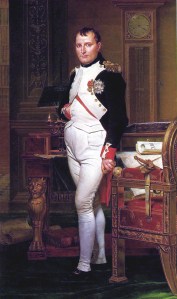
Napoleon Bonaparte, much to the dismay of high end comedians everywhere, was not as short as we’ve been led to believe. In today’s standard measurements he was around 5’6 or 5’7, respectably average for a man of his time. By Unknown – Public Domain, https://commons.wikimedia.org/w/index.php?curid=21290

When in 1809, Napoleon informed his beloved that he would divorce her to marry a woman who might conceive an heir, the jilted woman sought solace at her chateau among her hardy roses. By the time of her death in 1814, Château de Malmaison boasted almost 200 varieties of roses, and her enthusiasm had begun a trend, leading to the establishment of more than 2500 varieties by 1830 in nurseries across France.

By establishing a large garden devoted to only one type of flower, Josephine elevated the rose, long valued as a sweet smelling, medicinal flower, to the status of a flower grown primarily for its beauty, especially when gathered by the dozens and presented on February 14 along with chocolate covered strawberries and a free glass vase. 

And now I don’t want to sell Napoleon short (see what I did there?). I’m sure it took more than roses to convince Josephine that a divorce was the right thing to do for the good of France. Because I gotta tell you, if my man were to present me with my favorite flowers (a bouquet of seasonally available, local-ish varieties at a time when flowers are more seasonally available), and then tell me that even though I’d always be his favorite empress, we had to break up for the good of our country, I wouldn’t scream. I’d just clock him in the head with the free glass vase.

Trending in History: Giants and Jerkfaces

On October 16, 1869, on William Newell’s farm near Cardiff, New York, two men digging a well, hit something surprising with their shovels. What they eventually uncovered was a ten foot tall, 3,000 pound petrified man.

cardiff_giant_2
Someone clearly had an unfortunate run-in with geode water. Excavation of the Cardiff Giant, Public Domain, via Wikimedia.

For years, newspapers had been featuring reports of petrified men, believed to have come into contact with water from the inside of geodes. So no one had any doubt such a thing could happen. The good people of Cardiff flocked to see the giant, took selfies to post on Instagram and tweeted out the Syracuse Daily Standard article that dubbed the giant “a new wonder.”

Of course there were a few skeptics. Among them was Dr. Boynton, a local science lecturer who assumed the find was actually a large statue of historical significance. Noteworthy geologist and paleontologist James Hall liked this theory, calling the find, “the most remarkable object yet brought to light in our country,” a quote that once added to a picture of the respected scientist became a meme netting more than 120,000 likes and 15,000 shares on Facebook.

giantmeme
Looks legit to me.

Many theologians got excited, too, pointing to the very large man as evidence supporting the literal interpretation of Genesis 6:4, which claims there were once giants on the earth. The news commentators and bloggers had a lot to work with.

But notably absent from most “media” coverage was the assessment of Yale paleontologist Othniel Marsh who stated upon seeing the Cardiff giant, “It is of very recent origin, and a most decided humbug…” Marsh wasn’t the only one to voice such outrageous ideas, but he might as well have not said anything, for all the good it did.

Most visitors adamantly claimed there was no way they would ever believe the giant had not once been a living, breathing creature. Because once a person’s decided to believe something, it’s hard to convince them not to.

Eventually, the man behind the humbuggery did confess. Cigar manufacturer, dedicated atheist, and cousin to Mr. Newell, George Hull admitted to having the statue commissioned and buried after engaging in a debate with a Methodist preacher over the literal interpretation of Genesis 6:4. He really just wanted to say, “Gotcha!”

As a bonus, he also made a pretty penny off his share in the scheme eventually selling his interest for nearly a half million adjusted 2017 dollars. He definitely fooled a lot of people and certainly supported the point that those who set out to make a point by fooling a lot of people, are kind of big jerkfaces.

Seriously, it was ALL OVER social media. #HumbugHull  #CardiffCon #GiantJerkface.

barnum
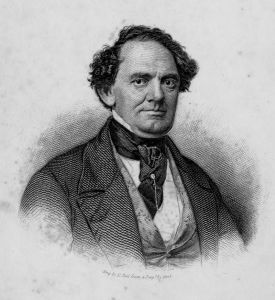
P.T. Barnum, America’s favorite son of humbuggery, offered to buy the Cardiff Giant. When his offer was refused, he commissioned his own gypsum giant and claimed the first was a forgery. Like a boss. Public Domain, via Wikimedia

But I do think, unwittingly, Hull made another point, too. Because his giant was the fakest fake news of the day. That’s right, folks. We’ve ALWAYS had fake news. Just like we’ve ALWAYS had biased news. Because none of us, members of the media included, lives in a vacuum. Our experiences, our intentions, and our personalities, whether individual or institutional, all serve to inform our biases.

The media attention given to the Cardiff Giant rarely included expert voices that contradicted the sensational because sensational sells and improves SEO as its shared widely across platforms evidently designed to make otherwise reasonable and more or less kind-hearted people seem completely insane. So media outlets use (among other tactics) carefully worded headlines, precisely cut-off quotes, and selective expert interviews to make that happen.

So how do we combat this? First, I think we would all benefit from a deep breath. Then, the next time you think about clicking “share,” take a minute to analyze three things:

  1. The bias of the source (and, yes, there is one, see the previous paragraph)
  2. Your goal in sharing the piece (if it’s either to taunt or to yell, “Gotcha!” it’s possible you should reconsider)
  3. Whether or not the piece will further civil discourse (or whether you’re just behaving like kind of a jerkface).

I don’t mean to sound like I’m coming off heavy-handed here, though I admit that’s exactly what I’m doing. I don’t deny that I have an agenda. I want my social media feeds to be kinder, more civil places today than they were yesterday. I want to have informed conversations with informed adults who don’t always agree with me, but whose opinions are interesting and worth giving some serious consideration. And I want the media to stop reporting about how biased the media is, because, frankly, that’s super old news.

So I hope you’ll remember George Hull and the Cardiff Giant and give some thought to my terribly biased interpretation of the way we should view his story. I hope, too, that at some point you will begin to question the authority of a history blogger who insists that #GiantJerkface was trending on Twitter in 1869. And, last but not least, I hope you are careful to avoid contact with geode water (which I think sells for $7 a bottle at Whole Foods), because I’d hate to see you get petrified, and I read somewhere that can happen.

The Rich Bird-Like Timbre of the Fourth Grade

This has been a big week in the life of my fourth grade son. Something he’s been looking forward to for a long time finally happened. Because in our school district, about half way through the school year, our fourth graders embark on a brand new adventure in musical education. They receive recorders.

henry-viii
This man could have rocked Harry Champion’s “I’m Henery the Eight, I am” on the recorder. Hans Holbein the Younger (1497/1498–1543) [Public domain or Public domain], via Wikimedia Commons
I’ve been blessed with children who love music. My oldest began piano lessons in Kindergarten and the last few years has shifted to playing the guitar in hopes of one day becoming his own one-man band. Meanwhile my youngest has a brilliant sense of pitch and rhythm, and when he’s in the mood, the voice of an angel. But a little more on the shy side than his brother, Son #2 hasn’t really taken a shine to musical performance. Other than a few months of piano lessons and a blessedly short-lived obsession with the bagpipe, he has more or less avoided playing an instrument.

So I was a little surprised he was super excited to receive his recorder. And even more surprised (and admittedly a little less delighted) that he was also super excited to practice playing it. In the living room. Pretty much all the time.

worstinstrument
Still the most unpleasant instrument in the world. photo credit: PeterThoeny Care for a scotch whiskey? via photopin (license)

I suppose it’s not the most unpleasant instrument in the world. It does have a long and glorious history, dating to at least as early as fourteenth century. Characterized as a flute with a whistle mouthpiece and seven holes in the front with one thumb hole in the back, the recorder emerged as a major musical force throughout the Renaissance. 

Valued for its narrow range and rich, bird-like timbre, it made an ideal instrument for ensembles, according to a lot of Renaissance composers who have never been in my living room when Son #1 decides to relive the glories of his fourth grade year and join in.

Even England’s King Henry VIII was a big fan, having in his possession at the time of his death a total of 78 recorders. Many of these were likely played by rotating musicians charged with providing a soundtrack for the monarch as he Supremely Headed the Church of England, warred with France, and divorced or beheaded his various wives. Rumor has it, Henry played a mean recorder, too, and just as Handel, Vivaldi, Bach, and others would later do, the king also composed for the funny little instrument.

recorderbagpipe
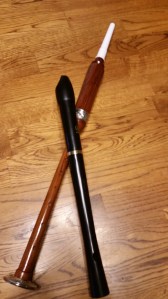
I think my biggest fear is that this new obsession with the recorder may rekindle his interest in the bagpipe.

Of course I have to assume that being so constantly surrounded by a chorus of recorders may have (along with the constant aches and pains of a long series of accidents and illnesses) contributed to Henry’s famous crankiness.

I know I haven’t particularly enjoyed the soundtrack at my house this past week. But at least on Saturday, when we had an almost 70 degree spring-like day (today it’s snowing, because it’s the Midwestern US), my brilliant husband suggested that my son take his practicing outside. I’m sure my neighbors enjoyed the rich, bird-like timbre.

Anything You Can Do, Has Probably Already Been Done by a Fictional Character

On November 14, 1889, journalist Elizabeth Bisland began an epic journey. Departing from New York with little luggage and only six hours notice from the owner of the monthly family magazine Cosmopolitan (yes, the same one that now embarrasses you in front of your family at the checkout), Bismuth headed west across the US. Her goal was to race around the world in less than eighty days, faster than the fictional Phileas Fogg.

bisland
Elizabeth Bisland, wearing her game face.  (New York Public Library Archive) [Public domain], via Wikimedia Commons
But beating the eccentric Jules Verne character wasn’t all she had in mind, because the real purpose of Bisland’s trip was to outstrip fellow journalist Nellie Bly, dispatched by New York World the same day, heading east on a steamer across the Atlantic on her own Fogg-esque  journey.

The difference between the two was that Bly had no idea she was competing against anyone. She didn’t learn of Bisland’s trip until December 24 when someone in Hong Kong told her they thought she’d likely lose.

A few weeks ago, I set out on an epic journey of my own. A friend proposed starting a group on Facebook to motivate people who wanted to resolve to be better versions of themselves in the coming year. She suggested we all attempt to walk 2,017 miles in 2017.

That breaks down to about 5 ½ miles per day, which is doable for a fairly active person who puts forth some effort to get there. This is just the kind of challenge I love. I told her to count me in. Soon, because my friend is married to the kind of handy guy you’d like to have around to fix your computer, we had an app in which to log our daily miles, complete with a leaderboard so we could cheer each other on.

There are twenty-three of us in total. Some I know. Some I don’t. And we are, so far, a friendly, encouraging collection of people just trying to inspire each other and reach our individual goals, which for some, is not actually 2,017 miles this year. And that’s perfectly okay.

bly
Nellie Bly, ready to win, even when she doesn’t know she’s playing. By Library of Congress (umsystem.edu) [Public domain], via Wikimedia Commons
I love that we can encourage one another on our journeys. But if I’m being perfectly honest, I want to be on top of that leader board. Today, I am. Tomorrow is less certain, because there are two other participants jostling for that top position, and at least one other person has mentioned being a runner, which means that if we get a couple of nice days, that person could easily record a huge spike in mileage.

So every day I read all the motivational comments from my fellow travelers and I feel a little like Elizabeth Bisland, racing against someone who is (or was until they read this post) totally unaware of the competition. After Bly discovered Bisland, the tide shifted in the race. On her way to England, Bisland was informed that her fast steamship to New York had already left without her. This turned out to be false, but unaware of that, Bisland boarded a slower moving vessel.

In the meantime, Bly faced massive snows in the Western US, eventually overcoming them only at the tremendous expense of a chartered train on a southern route with purchased right of way across the country. Bly did manage to pull out the win, arriving in New York on January 25, 1890, 72 days, 6 hours, and 11 minutes after her departure. Bisland completed the trip on January 30, defeated, but still ahead of Phileas Fogg.

There are, I think, a few of takeaways from this story. First, writers make stuff up*. All the time. Sometimes it’s plausible. Sometimes it’s really not, but often the writer has convinced readers to trust him so they feel like it probably could be sort of plausible in the right circumstances. And then readers go out and try it.

This is how we ended up with submarines (inspired by a journey 20,000 Leagues Under the Sea, made up by Jules Verne), rockets (inspired by War of the Worlds, famously made up by H.G. Wells), and those headphones you use with your iPod (predicted in Ray Bradbury’s made-up Fahrenheit451).

This leads us to the next lesson we should learn from the story. Writers need to stop writing dystopian novels about a terrifying zombie apocalypse or the inevitable rise of sentient, power-hungry robots. Right now. Seriously, just stop. We’re begging you.

terminator
The world does not need this. photo credit: dalecruse Seattle via photopin (license)

And the third thing we need to learn is that no matter how friendly, encouraging, or supportive the motivational group, if there’s a leaderboard involved, at least one person (and I’m guessing at least three or four in the case of my Facebook walkers), is gunning for that top spot. It isn’t that we don’t want you to meet your goal. We just want to do it better.


*There is an outside chance that Verne’s Phileas Fogg was loosely based on eccentric shipping magnate and one-time presidential candidate George Francis Train, who circumnavigated the globe in 80 days in 1870. But, really, by “eccentric,” I mean that his life reads much like a fictional story anyway. I suppose writers do sometimes borrow from life as well.

How Otto the Visionary Became a Well-Rounded Person

Several years ago when we were the mommies of much littler littles, a friend of mine asked me for some mommy advice. My friend grew up in Upstate New York, where winters are bitter cold and ponds form thick ice. Now that she found herself raising her own children in Central Illinois where winter can be bitterly cold for days at a time, and frozen ponds can sometimes be a touch unpredictable, she was looking for a place to teach her children the crucial life skill of ice skating. Exasperated at having to sign them up for lessons at a nearby ice arena, she shook her head and said, “Well I guess that’s just what you have to do so your kid can learn to skate. I mean, how did you learn?”

My friend was truly shocked when I answered, “I didn’t.”

january-scene-skating-early-1820s
I’m no human locomotion expert, but I think the guy in the yellow pants is just about to bite it on the ice. January Scene, 1820, Public Domain, via Wikimedia Commons

My family had a box of ice skates in various sizes shoved away in the basement, in case we ever happened upon a good thick patch of ice. As far as I can remember we never did. And though my town didn’t have an indoor (or outdoor) ice rink, we lived about thirty miles from a town that did have one. I remember attending an ice skating party one time. Or it might have been twice.

That was it. That’s the only experience I’d ever had with ice skating. Sure there were hockey leagues in the next town and I had friends whose families made the effort to get plenty of ice time. But we weren’t that family. I didn’t mind a bit. When I did make it out onto the ice, I mostly just fell. A lot.

No. I mean, A LOT. I think I made it around the entire rink one full time, death grip on the wall the entire way, before I gave up with very cold tears streaming down my cheeks.

I can honestly say that I never felt myself disadvantaged by my lack of this particular skill. Clearly there is a cultural difference between my friend and me. Ice skating is a skill she views as essential to becoming a well-rounded individual. It’s important to her.

It was also important to the people of Southern Finland as much as 4000 years ago. Historians believe that’s when someone (let’s just call him Otto the Visionary) first decided sliding across the slippery ice on a thin set of blades was probably a good idea. And it might have been, because according to human locomotion expert, Federico Formenti, the savings in energy and time while traveling on foot among the many lakes in the southern portion of Finland, might have been well worth the effort it took Otto to strap a couple of animal bones to his shoes.

skate-guy
Just saving some time, taking a shortcut across the ice. photo credit: R.A. Killmer How is this possible? via photopin (license)

The ice skate has, of course, been improved since those early years. Skating spread through much of Europe and by the 17th century had become a beloved cold weather activity spawning skating clubs, competitions, and innovations that soon distinguished the sports of speed and figure skating. Then in the 19th century, Canadians started playing ice hockey. It’s anyone’s guess what they did before that. Curling, perhaps?

Despite the wide range of ways to enjoy the sport, and even though I do become an expert on figure skating every four years as I comment “knowledgably” about the slight wobble on the landing of the otherwise flawless triple axel that will surely cost the favored skater the gold, I don’t feel the need to participate.

momskates
Evidence. Sorry it’s so blurry. That’s bound to happen when you just landed a sick triple axel. Or when you hand your 12-year-old your phone and say, “Take a picture of me looking awesome!”

Except this past weekend when I did. My twelve-year-old son, who has been skating a few times (and is obviously a more well-rounded individual than his mother), had the opportunity to go skating with a youth group he’s a part of. And because I’m super lucky, I got assigned as a chaperone for the outing.

When I chaperone, I generally like to participate. I get to know the youth better when I do, we share some laughs and make some memories. Fun is had. Trust is built. That’s all well and good. But remember the death grip on the wall and the cold tears streaming down my cheeks? I do. And I did.

I admit I was scared, but my son wanted me to give it a go so I decided I would. Sure I fell a few times, bruising both my hip and my dignity a little, and if I’m being perfectly honest, there was probably a slight wobble on the landing of my triple axel. But for a kid from Illinois, who has never felt the need to conserve energy or time by strapping blades to my shoes and sliding across the ice, I think I did okay. And, I’m probably now a more well-rounded person. Maybe even a visionary.


Even People With Bodies Buried In Their Basements Aren’t Perfect

In 1726, when he was just twenty years old, young Benjamin Franklin decided to be perfect. His Puritan upbringing had provided a pretty good understanding of right and wrong, so he figured it wouldn’t be a problem to just do right all the time. To that end he developed a system. Consulting with several writings on morality, he opened up a fresh new journal and made a list of what he considered the thirteen most important virtues of man.

On the list were temperance, silence, order, resolution, frugality, industry, sincerity, justice, moderation, cleanliness, tranquility, chastity, and humility. Next to each, he wrote brief descriptions. Then he discovered what most of us do at some point or other: Perfection isn’t as easy as it sounds.

A lot of us can probably relate. Nearly a week into our New Year’s resolutions, our enthusiasm for regular gym attendance, careful diet, or meticulous organization, might be starting to wane. By this time next month, the people who research such things suggest, fewer than 70% of resolution-makers will still be plugging away at whatever it is they resolved.  By six months out, the number drops below 50%.

new-year
It all sounds so easy on December 31. photo credit: Beegee49 Happy New Year via photopin (license)

But if you are the type of person who makes resolutions at the New Year (along with 50 to 60% of Americans, and me), then I suggest we learn some lessons from Benjamin Franklin.

He didn’t tackle his full list at once. Instead, he started with one and didn’t move on until he felt he could reasonably add another. In his little journal, he kept track each day whether or not he had successfully carried out his goal. Sometimes he did, and sometimes he didn’t, but over time, he began to succeed a little more and fail a little less.

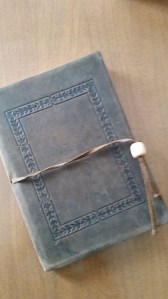
Now, I don’t know that I’m as motivated toward perfection as Franklin was, but last Christmas (not the one we just celebrated, but the one before that), one of my nephews gave me a very thoughtful gift. He picked out for me a very nice, high-quality, leather-bound journal. A great gift for a writer, no? The trouble is, it’s so nice, that now, more than a year later, I haven’t written a single word in it.

I scribble notes and thoughts almost constantly on pieces of scrap paper or notebooks bound by wonky bent spirals and repurposed from last year’s school supplies. But those aren’t high-quality, leather-bound journals selected just for me. And what if I fill it with something silly only to discover a perfect noble purpose for it later on? It’s been a lot of pressure.

So this year, in 2017, I decided to pull the empty journal from the drawer in my nightstand and turn that first page. I’m going to follow in the footsteps of Benjamin Franklin, to pursue my version of perfection, and list the virtues I’d like to work on this year, loosely based on his original thirteen:

noose
If a man is hanged, it’s not very pleasant. If a man is hung, well, polite people don’t mention such things. photo credit: WatchTheFlash_Photography via photopin (license)
  1. Temperance. More carrot sticks. Fewer French fries.
  2. Silence. Less insufferable correcting of other people’s grammar. Unless they use “hung” when what they really mean is “hanged.” Because there’s only so much a person can do.
  3. Order. Empty the dishwasher after it runs so that dirty dishes don’t pile up indefinitely in the sink.
  4. Resolution. Work through the toppling stack of to-read books on my nightstand. And on the bookshelf in my office. And in the box in my closet. This one may take a while.
  5. Frugality. Remember words are precious. Tweet more regularly. If 140 characters is enough for the soon-to-be leader of the free world to discuss important policy (which, admittedly, it might not be), then surely it’s enough for me to sound occasionally clever.
  6. Industry. Spend less time staying up late to watch Netflix, after I’m done binge-watching iZombie, of course. Perfection takes time.
  7. Sincerity. Do a better job of feigning interest in Minecraft when my children are talking to me. Alas, truly sincere interest is not attainable.
  8. Justice. Spend less time criticizing my children, and more time feigning interest in Minecraft.
  9. Moderation. Stop yelling at talk radio while sitting at stoplights, and recognize the idiots truly cannot hear me, but the guy in the next lane might be able to and he’ll probably have a better day if he can’t.
  10. Cleanliness. Clear out the more than 900 e-mails in my inbox that pertain to flash sales, old publication rejections, and sign-ups for events that happened nine months ago.
  11. Tranquility. Take the dog for more walks.
  12. Chastity. Actually I’m going to practice more silence on this one.
  13. Humility. Here Franklin wrote, “Imitate Jesus and Socrates.” I don’t think I can improve on that one.
journal
Doesn’t it look nice? Maybe I’ll just start with writing my name in it. I won’t regret that. Right?

If this list, or your version of it, seems too daunting for you to tackle in 2017, or if are already thinking of giving up the resolutions you made a few days ago, don’t fret. You still opened that fancy new journal year and took a chance. The people who study such things tell us that if you make New Year’s resolutions, you are already ten times more likely to reach your goals than is someone who didn’t bother.

Even Franklin, who once electrocuted a turkey to amuse his friends and who died with fifteen bodies buried in his basement, admitted he never actually reached perfection. Still he kept track of his progress and was convinced he’d become a better man for the effort.

That Gift in the Top of Your Closet

In February of 1862, President Abraham Lincoln followed up on a letter that had been sent to his predecessor by Somdetch Phra Paramendr Maha Mongut, the king of Siam. The king had made a generous offer to the people of the United States, suggesting that he would be happy to send a gift of a sufficient number of elephants to breed in the wilds of the nation. And it certainly wasn’t the bizarre offer it might seem like today. Highly intelligent and useful in transporting goods and raising circus tents, Asian elephants enjoyed a long history as generous gifts.

President Lincoln crafted a highly diplomatic response, explaining that America did not offer environmental conditions conducive to wild elephant success and that when it came to transporting goods, we were scraping by okay with our newfangled steam engines. But he was also careful to thank the king for his very gracious offer.

consular_flag_of_thailand-svg
Consular Flag of Thailand, featuring an auspicious elephant. Public Domain, via Wikimedia Commons

Because some elephants, particularly the rare albino ones, have long been considered sacred in Siam and throughout Southeast Asia, given their relationship to Siddhartha Gautama (the Buddha). The story goes that Gautama’s mother dreamt of a white elephant descending from heaven on the very night she conceived her son.

So white elephants (and some not-so-white ones that are found to possess other traits earning them the title of “auspicious elephants”) have long been considered the sacred property of the reigning king in Siam. On occasion, the king also may have chosen to honor deserving courtiers by giving them the gift of trusting a white elephant to their care.

elephant-house
Royal Elephant Stable where the King of Siam used to keep his White Elephants (today: The Royal Elephant National Museum, Bangkok) By Hdamm (Own work) [CC BY-SA 3.0 (http://creativecommons.org/licenses/by-sa/3.0) or GFDL (http://www.gnu.org/copyleft/fdl.html)%5D, via Wikimedia Commons
It was a generous gift, but there were drawbacks. The amazing and rare creatures were too sacred to be put to work raising circus tents, had to be specially housed, and had to eat. A lot. A white elephant gift from the king, then, was not exactly something to be desired. It could easily burden a man into poverty. And it was a gift that couldn’t be refused.

Allegedly this is where the term “white elephant gift” came from, to refer to something you might give or receive that no one really wants. I don’t know about you, but over the years, I have been to my share of white elephant gift exchanges (also referred to as a Yankee Swap, or a Naughty Santa, which is NOT what it sounds like). These events usually come complete with rules that allow participants to trade the terrible gift they receive for someone else’s terrible gift. The idea, of course, is that one man’s trash may actually be another man’s treasure.

tea-cozy
Another man’s treasure. photo credit: sukigirl74 teacosy top view via photopin (license)

And who knows? Perhaps you have been searching for years for a tea cozy that’s the perfect shade of cerulean, and maybe your friend Ted has been just dying to get his hands on the Duran Duran cassette gathering dust in the top of your closet since the early 90’s.

But if your exchange doesn’t result in you taking home a gift you actually kind of want, don’t fear. You had a good time with friends, enjoying some laughs as everyone attempted to steal the same ceramic Yoda m&m dispenser. Besides you can always shove your unfortunate gift in the top of your closet and dust it off for next time.

Because over the last few years, the notion of re-gifting has gained some traction as a way to both rein in Holiday spending and create less waste. There are helpful re-gifting etiquette guidelines online and in October of 2008, then governor of Colorado, Bill Ritter declared December 18 as “National Re-gifting Day.” Frankly, I’m not sure the governor of Colorado has that kind of national authority. 

At least some people agree with me because a quick Internet search reveals that National Re-gifting Day can also be observed on either December 15, or on the last Thursday before Christmas, which to be fair to Governor Ritter will sometimes fall on the 18th. But I suppose it doesn’t matter when you mark it on the calendar because as other important festive occasions approach, National Re-gifting Day is a holiday that you can always pull off the dusty top shelf of your closet, stick in recycled gift bag, and celebrate again and again.

Santa Might Be On To Something

I don’t know about you, but I’ve been busy this holiday season. Already several times I’ve party planned and cleaned and hosted and cleaned. I’ve shopped for gifts, a task that no matter how early I start, always seems to take until Christmas Eve. I’ve made Christmas candies and cookies, decorated and crafted and spread Christmas cheer in a lot of little ways. But in order to accomplish these tasks, I’ve had to let others slide.

The biggest of those other tasks is sending Christmas cards. I wasn’t feeling too bad about that, though, because I am fortunate not to have many overachieving friends. I’m happy to report that I didn’t receive a single card the day after Thanksgiving (seriously, such a betrayal might signal the end our friendship). Nor did I receive any cards for the first nearly two weeks of December, which goes a long way in making a busy gal feel truly special.

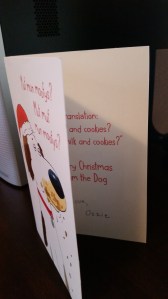
dog-card
I even received a Christmas card from my dog this week, though judging by a curious postmark (and his notable lack of thumbs), I suspect he had help.

But then this third week of Advent arrived, and with it came the postcards featuring the smiling faces of friends and family and busy children who are growing faster than I can quite grasp, handmade die-cut works of art filled with sweet holiday greetings, and letters recounting a year’s worth of adventures.

So that’s when the guilt started to set in. Because for all I have done so far this busy season, I haven’t designed a postcard or die-cut any artsy Christmas trees or written a year-end letter. I haven’t even purchased a big box of factory-made holiday greetings.

And I feel especially bad about it when I take a moment to realize that even Santa, easily the season’s busiest fictional character with tens of thousands of letters to send, already has this holiday task well in hand.

In my defense, Santa does have a lot of practice. He’s been sending Christmas letters to excited littles at least since the late 19th century, decades before postal policy technically allowed him to do so. Because letters addressed to Santa Claus used to wind up in the Dead Letter office.

Or at least officially they did. There were always  those kindhearted postmasters who couldn’t stand the thought of a letter to Santa going unanswered, or an innocent expression of real need going unmet.

One such kindhearted person was Connecticut postmaster Harris Eames, who in 1894 opened a letter addressed to “Sandy Clous” from a little girl in a family he knew. From the letter, Eames learned that the family had fallen on harder times than anyone had realized. The postmaster contacted local businesses and orchestrated a Sandy Clous miracle.

santa-suit
Actually, I don’t think this guy really does much of anything himself. He doesn’t even deserve those cookies! Public Domain image, via http://www.costumers.com/

For years, similar heartwarming stories rolled in from post offices all over the country, until finally, in 1913, the Postal Department relented, accepting its position as the gatekeeper for Santa Claus.

The procedure for handling and answering letters from children to their Christmas hero has changed through the years amid growing privacy concerns, but many postal offices still partner with local charities to deliver Sandy Clous miracles through what is collectively known as “Operation Santa.” And the jolly old elf himself will take the time to write back to any child who wants to send him a letter.

Sort of.

Much like Santa’s brilliant gift-giving policy, his letters do require a little help from parents. The current USPS Santa letter instructions state that you must include the response letter in a self-addressed, stamped envelope included in a specially addressed outer envelope.

presents
If only I could get my family to buy and wrap their own presents.

Oh, and because Santa is super organized and on top of such important tasks, it has to be received in Anchorage, Alaska by December 1oth. That way the postal elves have time to process it and get it back to you by Christmas, postmarked from the North Pole, of course.

I do think the USPS and Santa are on to something. So, I’ll tell you what. If you are hoping to receive a Christmas card from me this year, all you need to do is design one, place it in a self-addressed stamped envelope and a larger envelope addressed to me. Then drop it in your mailbox and I will send it right back to you, postmarked from St. Louis to give it that truly authentic feel.

Now, if you wanted it by Christmas, you’d have had to get it to me by December 10th, since I’ll surely drive around with it in my purse for a few days before remembering to drop it in the mailbox. But since we both know you can’t reasonably expect a Christmas card from me until January, I think there’s still time.


Nothing Says Christmas like an Excess of Pickles

In April of 1864, during the American Civil War, Private John C. Lower of the 103rd Pennsylvania Infantry, was captured and taken to a Confederate prison camp. There, after many months of captivity, he found himself on Christmas Eve, hungry, weak, and knocking on death’s door. He begged for help, appealing to the mercy of a guard who took pity on him and gave him a pickle.

christmas-pickle
If I owed my life to a pickle, I would definitely hang one on my Christmas tree.

It was this pickle that Private Lower later credited with the saving of his life, and when he finally returned home, he began a curious holiday tradition with his family. Whether Lower survived because the kindness of the prison camp guard infused him with hope for humanity, or because the slug of seven whole much needed calories provided him the energy to live on, no one can say for sure.

Pickles have long been considered to provide good health and vitality, and have been relied upon by military leaders dating back as far as Julius Caesar, to give their soldiers a much needed kick. Still, it seems likely that Lower’s story is entirely made up to explain the long-standing tradition of the Christmas pickle.

Never heard of it?

Neither had I, but apparently it’s been an American tradition since at least 1890 (or 1865, in the Lower household). Before that it was a “time honored German tradition.” The trouble with that theory, of course, is that most Germans haven’t heard of it either.

The idea is that parents hide a pickle ornament somewhere on the tree on Christmas Eve, and in the morning, the first child to spot it wins a small prize or receives a special blessing for the year to come, or earns the right to open the first present.

Okay, so it’s a little bit charming. And for the purposes of this blog post, I went on a pickle-finding adventure of my own. I searched several stores, asking employees if they had traditional Christmas pickle ornaments. Most of them looked at me with mystified expressions full of barely masked pity. Only one knew what I was talking about, though her store did not carry them. A surprised employee in the store where I finally had success, said, “Well, I think we had some cucumbers. Or maybe they were pickles?”

larry-and-bob
I didn’t have the heart to tell her I already had a cucumber on my tree.

They were. And I bought one. Because even if it isn’t an age-old German Christmas tradition, we Americans sure do love our pickles. More than half of the cucumbers we grow eventually become pickles. That’s twenty-six billion of them per year. And each of us allegedly eats an average of nine pounds of them per year, which means someone out there is eating an awful lot of pickles to balance out my somewhat less than nine pound contribution.

chicken-sandwich
I wonder how many Chick-fil-A sandwiches I’d have to eat to meet my pickle quota.

But there’s still the question of how they ended up on our Christmas trees. There are a couple theories other than the one involving Private Lower, including one that suggests the source is a miracle of St. Nicholas in which he resurrected two murdered boys who’d been sealed into a pickle barrel by an innkeeper (securing his place on the naughty list). There are lots of variations of that story, though, and most don’t involve pickles at all. Also, it’s pretty awful and not very Christmas-y.

The theory that I find most believable, is that in 1890, F.W. Woolworth began importing Christmas ornaments from a German glass factory, many of them in the shapes of fruits. Some of them were pickles (and, yes, cucumbers, and therefore pickles, are fruits…ask a botanist). While the pomegranates and pears sold fairly well, for some reason, the pickles didn’t strike most people as particularly Christmas-y. And so a German custom was born, right there in an American five-and-dime.

It turns out this long standing Christmas tradition that few of us have actually heard of, may really stem from a marketing campaign and an excess of glass pickles, the most non-Christmas-y fruit imaginable. But, it’s kind of fun and weird. So, why not?