From Ox-Drawn Wagon to Airplane: Sharing Dysentery for Thanksgiving

In April of 1852, a twenty-one year old husband and new father named Ezra Meeker, set out with his wife and infant son on a trip to the West. The journey began in Eddyville, Iowa and ended more than 2000 miles away in what would become Washington State.

The Meekers certainly weren’t the only ones to make the journey over what had come to be known as the Oregon Trail. In fact, an estimated 400,000 folks loaded up their ox-drawn wagons and made the trip over at least part of the same well-worn trail west during about a thirty year span in the middle of the 19th century.

By all accounts it was a difficult journey, leaving an estimated 80,000 emigrants dead from starvation, exposure, disease, or accident. But the Meekers made it alive and well, establishing a brewing business that made them a fortune they eventually lost.

meeker_in_omaha
76-year-old Ezra Meeker in Omaha, on a mission to preserve history. Public Domain, via Wikimedia Commons.

And like I imagine most of the survivors of the Oregon Trail would claim, Ezra Meeker remembered the dangerous move westward as a transformative experience, perhaps even THE transformative experience of his life. So when it came to his attention that much of the old Oregon Trail had been plowed over and forgotten, he set out on another journey to preserve it.

In 1906, at the age of 76, Meeker put together a team of oxen and an authentic wagon to make the journey once again, in reverse, this time for the purpose of establishing monuments along the original trail. Again the trip wasn’t easy, but he made it all the way to Washington DC to meet with President Theodore Roosevelt. Then he wisely took a train back home.

Before the age of 93, Meeker managed to make the journey several more times, once by Pathfinder automobile and once by airplane, making him the only person known to have traveled the Oregon Trail by wagon, train, car, and plane.

Ezra Meeker spent more than twenty-five years of his life advocating for the preservation of the Oregon Trail, afraid that this epic journey undertaken by so many brave pioneers would fall away from the collective memory of the American people.

But what Meeker didn’t realize was that, thanks to the genius of Minnesota educator Don Rawitsch, such a thing could never happen. A student teacher in an 8th grade history class in 1971, Rawitsch was looking for a way to help his students grasp the dangers inherent in the 19th century American westward migration. What he came up with was a simple computer game in which the player leads a wagon party from Independence, Missouri to Oregon’s Willamette (which rhymes with d@#n it!) Valley.

calamity
The trail is fraught with peril.

And most likely dies along the way.

If you were an American elementary school kid in the eighties, nineties, or early 2000s, you most likely played a version of the educational game Oregon Trail. And you most likely got dysentery and died. Or maybe you drowned while attempting to cross a river, or your wagon broke down and you died from exposure, or you caught cholera or typhoid or you ran out of ammunition and you starved to death. Or maybe, like Ezra Meeker, you actually made it to the end of the trail.

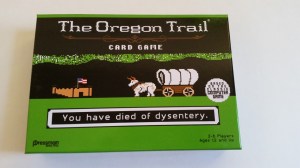
If you never played the game, you now have another chance. There are some recent electronic versions available, but none, I’m sure, that are as fun as a card game based on Rawlitsch’s original idea. My sister-in-law brought a copy of it to family Thanksgiving, and let me just tell you, it provided hours of hilarious entertainment, as well as a lot of death.

The card game is filled with nods to its electronic predecessor, complete with bad computer graphics, instructions to “press the space bar,” and frequently doled out calamities, including immediate death by snakebite. Players work together as a team of as many as six pioneers, and if even one person reaches the Willamette Valley alive, everyone wins.
oregontrail
I braved the Black Friday crowds to buy my own copy of the game, because my sister-in-law won’t be here for family Christmas, and dysentery is something to be shared.

But that probably won’t happen.

Even Ezra Meeker finally met his match. In 1928, on the verge of yet another Trail journey, this time in a Model A Ford, specially designed with a top that resembled a covered wagon, the 97-year-old fell ill with dysentery (or possibly pneumonia) and died.

Something to be Thankful For

In May of 1897, American author and humorist Samuel Clemens (or Mark Twain) arrived in London as part of a lengthy world tour. There he was greeted by the news that his cousin, a Mr. James Ross Clemens, also in London, had been gravely ill.

The cousin recovered, but news spread across the ocean that Clemens had grown ill and was, in fact, on the verge of death. The news sparked tremendous worry and speculation that the beloved author would soon die.

twain
Samuel Clemens, who did not die in London in 1897, or in the great Facebook death glitch of 2016. By Photographer: A.F. Public Domain, via Wikimedia Commons

It was Frank Marshall White with the New York Journal that finally set the record straight when he sent a cable to Twain inquiring after his health. The author replied, explaining the confusion between his identity and that of his cousin’s, reassuring White that he was perfectly healthy, and remarking that, “The report of my death was an exaggeration.”

Twain would go on to live almost thirteen more years after the incident, which he found kind of funny. I mean it could happen to anyone, right?

And apparently it can. Because in the wee hours of the morning, on November 11, 2016, a Facebook glitch resulted in the reported deaths of a large number of its users, including CEO Mark Zuckerberg. The notice, appearing with a flower icon above the cover photo of an individual’s wall, read: “Remembering [your name]. We hope people who love [your name] will find comfort in the things others share to remember [your] life.”

The glitch was fixed quickly and the company issued a statement and apology about the sad notices. Mark Zuckerberg, to the best of my knowledge, is still alive and well, and, if you were unfortunate enough to come across your own death notice, then you can rest assured that the report of your death was an exaggeration.

I don’t know whether I was counted among the dead. I wasn’t awake at the time of the glitch, but no one offered any condolences to my family so I suspect I had a lucky escape this time.  And that’s something to be thankful for heading into American Thanksgiving tomorrow.

The Rio Grande wild turkey
I’m also thankful for Thanksgiving turkey. photo credit: US Department of State The Rio Grande wild turkey via photopin (license)


Have a happy and safe holiday!


Dear Coffee Shop Dudes: The Blogger Recognition Award

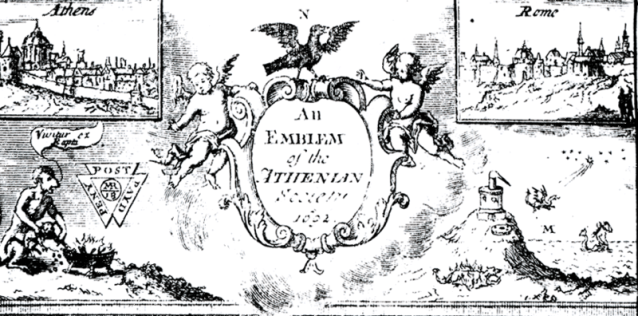
First published in London by editor John Dunton on March 17, 1691, The Athenian Mercury, ended with the following announcement:

All Persons whatever may be resolved gratis in any Question that their own satisfaction or curiosity shall prompt ’em to, if they send their Questions by a Penny Post letter to Mr. Smith at his Coffee-house in Stocks Market in the Poultry, where orders are given for the reception of such Letters, and care shall be taken for their Resolution by the next Weekly Paper after their sending

The publication was something wholly new to the English-reading public, whose own questions made up the content of the biweekly paper.

The public response was overwhelming, prompting Dunton to seek help from his mathematician friend Richard Sault, and eventually the allegedly well-read Dr. Norris as well as Reverend Samuel Wesley. Together this group formed the Athenian Society, know-it-alls who gathered over coffee to wrestle with the deepest concerns of their anonymous readers.

athenian-oracle-front
Everyone knows a good emblem makes you seem far more authoritative. Frontispiece to the Athenian Oracle, a collection of issues of The Athenian Mercury. Public Domain, via Wikimedia.

Questions were often of a scientific nature, like What becomes of smoke? (it dissipates), What do you think of the Milky Way in the Heavens? (it’s made up of a bunch of stars and it’s pretty neato), or Whether when a horse neighs, it is rejoicing or because he is angry? (He’s just sayin’ “hey!”, or possibly “hay!”).

Some were more philosophical, such as, What is death? (no longer alive, more or less), Why do men dream of things they never thought of? (minus Divine influence, they don’t), or Whether truth is always to be spoken (yes, of course, unless it shouldn’t, but definitely mostly yes).

Still others had to do with issues of the heart, including such gems as, A lady who is extremely troubled by corns desires to know the reason? (probably Divine punishment for breaking some poor fella’s heart) and Where is the likeliest place to get a husband in? (an advertisement in this paper would be a good place to start, but besides that, anywhere there are likely to be more men than women).

Often given credit for being the first advice column, the forerunner of Dear Abby and Ask Ann Landers, The Athenian Mercury ran for seven years, dispensing wisdom and advice, and even spawning a brief spin-off called The Ladies’ Mercury devoted only to questions pertaining to the concerns of the fairer sex.


coffee-shop-dude
Dude in a coffee shop getting sage advice from the Internet. photo credit: Jerome Olivier thinkers via photopin (license)

Of course today print media has an uncertain future and its parts, including the traditional advice column, are falling by the wayside, but if you are in need of advice, there is certainly no shortage of it on the Internet. Upstart fake media outlets, weirdly specific discussion forums, and smarty-pants bloggers abound, ready to solve your biggest, most intimate problems.

And why not? They are probably just as qualified four dudes hanging out in a coffee shop, debating life’s greatest questions, like, Whether birds have any government? The answer, obviously, is yup.

Recently, I was asked to share some advice for newcomers to the blogosphere as part of the Blogger Recognition Award. The rules of accepting the award are as follows:

  1. Write a post to display your award.
  2. Give a brief story of how your blog started.
  3. Give two pieces of advice for new bloggers.
  4. Thank the person that nominated you and link to his or her blog.
  5. Pass the award on to 15 more smarty-pants bloggers.

So, here it goes. I started blogging because, appropriately enough, I took the advice of a friend who said I should. If I’m qualified to give advice (and again, using the measuring stick of four dudes in a coffee shop, I might be), then it would be:

  1. Blog consistently (as much as possible) according to a realistic schedule that you can maintain in the context of your life.
  2. Find a consistent niche that offers you lots of material that you’re good at writing about.
  3. Okay, this one is just a bonus, because I like you all so much. Don’t blog overtly about politics. Unless of course that’s just your thing, but if that’s the case, I don’t envy you.

And now for the best part. In answer to the question, What is worse than ingratitude? the Athenian Society was uncharacteristically quiet (literally answering “__ __ __ __ __”).  I agree with them on this one and I am very grateful  to Jasmine of How Useful It Is for passing this award on to me, along with the advice (and I’m paraphrasing here): If you get a blog award, pass it on already! Sorry it took me so long.

And now for the other best part. I’d like to pass the Blogger Recognition Award on to the following folks:

thekitchensgarden

witlessdatingafterfifty

The Book of Secrets

Cooking With a Wallflower

Zombie Flamingos

Cleopatra Loves Books

Serendipity

Reading Recommendations

Recipe in A Bottle

A Generous Helping

Maverick on the Move

What Should I Read Next?

James Harrington’s Blog of Geek and Writing

The Monster In Your Closet

History Present

Pat Wahler, Author

Okay, so that’s sixteen, but they are all well worth checking out. You can trust me. I’m a smarty-pants blogger.


Yes! Wonderful Things! Fashionable Man-Cardigans and the Mannequin Challenge

In 1907, the 5th Earl of Carnarvon hired Egyptologist Howard Carter to aid him in his excavations in the Valley of the Kings. Carter worked for years, with a brief break caused by World War I, but it wasn’t until November 4, 1922, with Lord Carnarvon growing impatient and about to pull the plug on the whole operation, Carter got his big break.

That’s when he found stairs that led to a tomb he thought likely to be undisturbed. On November 26th, with the excited Lord Carnarvon by his side, Carter chiseled a small hole leading to the antechamber of the young, and fairly insignificant King Tutankhamun. When asked if he saw anything, the Egyptologist answered, “Yes! Wonderful things!”

It took months to catalogue everything in the antechamber and it wasn’t until 1932 that Carter was finished removing the thousands of wonderful things buried with the pharaoh. Among those were musical instruments, chariots, weapons, and a mannequin.

449px-mannequin_of_tutankhamun
Life-size bust of Tutankhamun, found in his tomb. And possibly, the world’s oldest fashion mannequin. By Jon Bodsworth [Copyrighted free use], via Wikimedia Commons
At least that’s the purpose Carter suggested for the life-size, armless bust of King Tut, that it was used to model his jewelry, and robes, and fashionable man-cardigans. And dating from around 1350 BC, it may have been among the first of its kind.

Since then mannequins have gone through a number of changes. They’ve been life-size dolls shipped between European Aristocracy to exchange fashion trends, whicker dress-forms, and awkward 300-hundred pound sculptures with false teeth, glass eyes, and real hair.

At times they’ve been made from easily melted wax, have become the celebrated date on the arms of the occasional disturbed artist, and have come to life as the love interest in a bad eighties movie. Mannequins have been both curvy and slender, to reflect the fashion ideal of the era. They’ve been mangled by Salvador Dali, and they’ve often appeared in shop windows with no arms, no legs, and no heads. But longer than we’ve had big shop windows to put them in, and maybe even longer than we’ve had fashionable man-cardigans to display, mannequins have been around to creep us out.

mannequin
A headless mannequin could never pull off this look. photo credit: vtpoly best mannequin eyes, Seattle via photopin (license)

Recently, a new kind of mannequin has taken over the Internet. Scores of people are now rising to the mannequin challenge. And by scores, of course, I mean high school students, athletes, and probably very soon, people old enough they probably ought to have better things to do.

The way it goes is that a group of people stand, completely still in mid-activity, as if they are mannequins, while another person with a camera moves among them filming close-ups of their stunningly (or not so) executed poses. And usually there’s music, because let’s face it, people standing still is not, on its own, necessarily an exciting thing to watch.

I say, why not rise to it? Because Internet challenges have been with us for years (not like actual mannequins, or man-cardigans, or King Tut, but still, a while) and this one might have come at just the right time. I think after the week the US (and to some extent the world) has had, and is having, we might all be feeling a little frozen anyway.

So go ahead, give it a try. I would, but I’m old enough I probably ought to have better things to do.

https://youtu.be/NbJZP0xCIq4

Crime Doesn’t Pay. Neither Does Poetry.

July 26, 1875 wasn’t a great day for John Shine. The man who would later become a US Marshal and a California state senator, at the time, worked as a stagecoach driver for Wells Fargo. That day, only a few miles outside of Calaveras County, he encountered a man standing in his path. He wore a flour sack over his head and he held a shotgun leveled at Shine’s chest.

In a commanding voice, the flour sack asked politely for Shine to throw down the locked strong box, and happily reminded his accomplices hiding behind the boulders with nothing but their deadly shotgun barrels showing, to shoot the driver should he refuse to comply. Shine didn’t need to be asked twice. He threw down the box.

black-bart
The fictional Black Bart was an “unruly and wild villain” with a thick black beard and messy black curls. The real Black Bart was your kindly old gentleman neighbor.[Public domain], via Wikimedia Commons
The gentlemanly outlaw allowed the stagecoach to move on down the trail. Only later, when Shine returned to the scene, did he realize that the flour sack’s accomplices were nothing more than well positioned sticks.

This was most likely the first stagecoach robbery committed by the outlaw who would come to be known as Black Bart. Named (by himself) after a dime novel villain, Black Bart would go on to pull close to twenty-five robberies of Wells Fargo stagecoaches, netting himself a total of around $18,000. The sum was a small drop in the big bucket of about $415,000 Wells Fargo lost to stagecoach robberies over a fifteen year period.

But Black Bart set himself apart. He always worked by himself, never rode a horse, and refused to behave in an ungentlemanly manner. Not once did he fire a shot or steal so much as a dime from a passenger.

And on at least two occasions, he even wrote poetry:

To wait the coming morrow,

Perhaps success, perhaps defeat

And everlasting sorrow

Yet come what will, I’ll try it once,

My conditions can’t be worse

But if there’s money in that box,

It’s munny in my purse.

And there was this one:

I’ve labored long and hard for bread,

For honor and for riches

But on my corns too long you’ve tread,

You fine-haired sons-of…

Well, you get the idea.

The robber signed both poems as “Black Bart, the P o 8.” Get it? Because he’s a po-eight! I assume that’s the idea anyway. He was also pretty great with a license plate. And that, it turns out is a good thing because in November of 1883, Black Bart’s reign of crime came to an end.

During what became his final robbery, Black Bart took fire and a bullet grazed his hand. He managed to escape, stemming the bleeding with a handkerchief that bore a laundry mark. Then, somewhere along the way, he dropped the handkerchief.

diligence_wells_fargo
The 19th century version of the armored car. By PRA (Own work) [CC BY-SA 3.0 (http://creativecommons.org/licenses/by-sa/3.0) or GFDL (http://www.gnu.org/copyleft/fdl.html)%5D, via Wikimedia Commons
Because Wells Fargo detectives are evidently well versed in every crime drama ever, they conducted an extensive search and traced the handkerchief to a laundry in San Francisco where they learned that it belonged to Charles Bowles, a mild-mannered, gray-haired gentleman who lived a quiet, but elegant life in a boarding house nearby. Mr. Bowles was sentenced to six years in prison for his string of robberies.

The moral of the story, obviously, is that the only way to make money writing poetry is to also rob a stagecoach, and even then, only if you don’t get caught. And that, my friends, is why you should stick to writing novels. It just so happens it’s National Novel Writing Month. So you better get started. These days, a good stagecoach robbery is a hard thing to pull off.

Scary Stuff: The Attack of the One-Eyed, One-Horned Alligator in Short Shorts

I’ve mentioned before that Halloween is not my favorite time of year. Not that I don’t like a fun costume or a good sugar high. I just really don’t enjoy scary things. Horror movies, haunted houses, and Ouija boards are not for me. If something frightening startles me, I’m likely to scream and punch (scary clowns be warned).

And as far as monsters go, unless they live on Sesame Street or spend much more of their time in philosophical reflection upon their own nature and creation than they do engaging in actual scaring, then I’m not a big fan. But I do have a soft spot for one particularly friendly rock ‘n’ roll loving, purple people eating, flying monster in short shorts from my childhood.

purple-people
The Purple People Eater isn’t scary because he only eats purple people. At least I hope that’s right.

Because I have fond memories of setting the needle of my Fisher Price record player on a Wacky Winners record and dancing around the living room to Sheb Wooley’s “Purple People Eater.” (Once in a while, my actual age startles me, and I’m likely to scream and punch.)

The story goes that the son of one of Wooley’s friends came home from school with a joke one day: “What has one eye, one horn, flies and eats people?” The answer, so obvious to us now, was, “A flying purple people eater!” The joke struck the funny bone of the kid’s dad, who shared it with his friend Sheb. He liked it so much, the actor/songwriter sat down immediately to scribble some lyrics.

Then in 1958 (and just to clarify, that was long before me and my Fisher Price record player came along), Sheb Wooley had a hit on his hands, with “Purple People Eater” becoming the only novelty song to ever to sit in the top spot of the Billboard pop chart.

Wooley went on to record a number of novelty songs, and had a run of successes as an actor, particularly in western films. But while he is certainly best known as the voice behind everyone’s favorite pigeon-toed, under-growed flying monster who plays a mean head horn, his voice has been heard most in something else.

Because most likely the songwriter/actor is also the man responsible for the most famous scream in the world. Performed in a sound studio for use in the 1951 film Distant Drums, the scream was a response to the need to fill in the sound a guy would make if he were suddenly attacked and dragged under water by an alligator.

Personally, I think Wooley nailed it.

And apparently so did a lot of filmmakers, because after the unique scream became a part of the Warner Brothers sound library, it got plopped into a whole lot of movies. So many movies, in fact, that a group of film students at the University of Southern California took notice and set out on a quest to uncover the first movie that ever featured Wooley’s well-used scream.

The earliest they found was a 1963 western movie called The Charge at Feather River, in which a character named Private Wilhelm takes an arrow to the leg and lets out a scream that, to my mind, sounds a lot like the noise a guy would make if he were being attacked and pulled under water by an alligator.

sheb_wooley_1971
Sheb Wooly. If this man is attacked by an alligator, he will scream like a falling storm trooper. By OMAC Artist Corporation, Bakersfield, CA. [Public domain], via Wikimedia Commons
Of course the film students were off by a few years, and who knows how many movies, but the sound clip took on the nickname “the Wilhelm scream” anyway. And that might have been the end of a fun little story, except that among the USC classmates that discovered the unique little piece of movie sound was Ben Burtt, the sound designer who worked on a unique little movie called Star Wars.

As a nod to his friends, Burtt decided to include the Wilhelm scream in the movie, because it turns out the sound a storm trooper makes when falling down a chasm is pretty much the same sound a man makes when getting attacked by an alligator.

In fact, the sound makes it into every Star Wars movie, as well as each Indiana Jones. And basically all the filmmakers you’ve heard of have picked up on the joke, too. Wooley’s iconic scream has been included in The Lord of the Rings, Toy Story, Titanic, and Pirates of the Caribbean. Some estimates put the number of films that have used the clip close to 300. I would attempt to verify that, but there’s a good chance at least a few of those are horror movies.

Nearly 300 Hollywood folks have been attacked and dragged under the water by an alligator because of the otherwise harmless purple people eater. And that’s pretty scary stuff. Man, I hate Halloween.

Confectionary Kernels and America’s Least Most Awful Choice

On September 9, 1950 the town of Midland Park, New Jersey experienced a holiday tragedy the likes of which had been previously unknown. The effects would be felt by retailers across the nation and by perhaps as many as tens of disappointed little Halloween goblins and ghouls.

Because right in the middle of the process of making a batch of candy corn, a beeswax-lined kettle caught fire and burned the Goelitz Confectionary Company New Jersey factory to the ground. The good news is that all of the employees managed to escape the blaze unharmed. And the other good news is that 2000 pounds of candy corn was consumed by the blaze, which meant no one else had to eat it.

candy-corn
I would rather set this on fire than eat it. photo credit: Great Beyond Day 293/365 – Candy Corn via photopin (license)

Candy corn has been around since at least the late 19th century when it was allegedly invented by George Renninger of the Wunderle Candy Company. The weird pretend vegetable candy had its wider debut in 1880, when Goelitz Confectionary first mass produced packages of it and sent it out into the world marketed as “Chicken Feed.”

Obviously there can be no accounting for the questionable culinary tastes of 19th century America. But the really strange part is there still seems to be a small, enthusiastic remnant of the population that loves the stuff. These are the folks who at parties, gobble handfuls of candy corn mixed with peanuts and insist it’s just like eating a PayDay candy bar (which in this blogger’s humble opinion, is also gross) or who design specialty candy corn cocktails, because nothing says, “Mix me with vodka!” like corn syrup and fondant.

These are the same people who are responsible for candy companies feeling the need to produce up to 15 billion kernels of candy corn every year, including buckets of them in red, white and green for Christmas (a traditional corn holiday) or red, white, and pink for Valentine’s Day (so you can tell the one you love, “Here, I got you this corn.”).

grosscandycorn
I don’t even know what to think of this.

I know I typically try to avoid a whole lot of controversy on this blog, but I do realize at this point, I will have to concede that a few of you reading may find yourself in the candy corn camp. Even my dad, who is one of the wisest people I know, is generally right about most things, and is a loyal reader of this blog, also occasionally enjoys candy corn.

But highly scientific market research into American candy preferences suggests that candy corn is by far the most divisive candy on the market. People who don’t like it, really don’t like it and probably have their fists raised as they nod along with this post. And I suppose the tens of people who love it, really do love it. They can’t wait for retail Halloween to roll around every July so they can stock up, make themselves a candy corn martini, and munch some PayDay mix.

They’re the people who in 1950, were dismayed at the September Goelitz fire because even though the handful of other companies that produced the confectionary kernels tried their best, there was a candy corn shortfall that year.

Goelitz decided not to rebuild its New Jersey factory, though they still produce a good share of the candy corn on the market. Today, the company is known as Jelly Belly, the same ones responsible for the vomit flavored Bertie Botts Every Flavor Bean, easily the third worst candy in the world.

pumpkinpeeps
Oh no! This is an option I hadn’t considered. This may change things. photo credit: giveawayboy It’s that time again… via photopin (license)

So, you may ask, what’s the second most awful candy in the world? Well, actually I admit there may some room for debate on that front. As much as I dislike candy corn, Halloween offers us another terrible alternative in the form of that weird brown taffy that comes in the orange and back wrappers. Honestly, it’s kind of a toss-up and if you try to give out either one to Trick-or-Treaters, you might deserve the egging your house is sure to receive.

But, since the American* public is facing another looming similar situation in which it will have to attempt to choose the least terrible of the worst alternatives imaginable, I figured we all could use a little practice. To that end, I’d like to conduct a brief and highly scientific poll. So, what do you think? Is candy corn the worst candy on the market? And if not, why, do you think, are you so clearly wrong?


*I realize that candy corn is more or less an American problem, but Non-Americans are more than welcome (and even encouraged) to participate in this important debate, too. I suspect, no matter the outcome, our houses are all getting egged.

And That’s Why You Shouldn’t Mess with a Babylonian Pig

This year my oldest son began middle school. It’s going well, for the most part. He’s thriving in the world of increased social opportunities, having found a group of buddies that all seem to get one another pretty well. And despite the increase in workload, he’s enjoying the academic challenges middle school is bringing. He’s even almost a little more organized and responsible than he used to be. Well, he’s working on it anyway.

We’ve had a few hurdles to jump, but it’s more or less off to a good start. Or at least I thought it was until he came home the other day and as he ran down his list of homework and other tiny scraps of information he occasionally lets slip out, he casually mentioned that his classmates had sentenced him to death.

big-pig
Actually I’m pretty impressed with his skills if he managed to run off with one of these things. photo credit: jpellgen Largest Boar via photopin (license)

As you can imagine, a number of follow-up questions flashed though my mind. The answers to some of them were that he stole a pig, his accuser was a landowner, much wealthier and more important than he was, and that she tried to shoot him as he fled the scene, but the law didn’t seem to care about the attempted murder. Just the pig thief, even though he requested leniency and so did a number of character witnesses who swore he would never do such a thing unless he were starving. And, you know, he’s a middle school boy, so he might feel like he’s starving most of the time.

Finally, after enjoying my mystified expression for a moment, he went on to explain that his social studies class had been studying Hammurabi’s Code. Just in case it’s been as long since your middle school social studies days as it has since mine, I’ll explain.

stele_du_code_dhammurabi
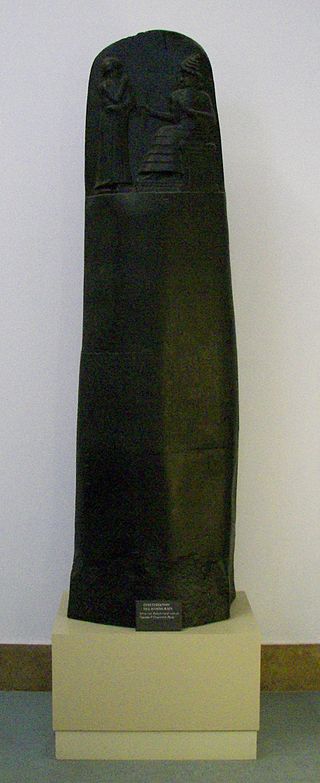
What a constitution looked like in 1754 BC. CC BY-SA 2.5, https://commons.wikimedia.org/w/index.php?curid=818801

In 1901, while working on a site in the ancient city of Susa (in modern day Iran), Egyptologist Gustave Jéquier discovered a stone stele, over seven feet tall, covered in cuneiform script. When translated, the 44 columns and 28 paragraphs were shown to contain a total of 282 laws, which, dating to somewhere around 1754 BC, form one of the oldest written codes of law known.

Established under the Babylonian king Hammurabi, the laws cover a wide range of issues, including contract terms, liability, fraud, divorce, and the theft of a pig by a starving sixth grader in social studies class.

The code is also the first good example history has thus far offered up of a system of presumed innocence, with court proceedings that allow for both prosecutor and defendant to present evidence. Of course it’s not all rosy, because the code also spells out a hierarchical application of the laws. For instance, a doctor successfully treating the injuries of a high-ranking man will make more money than if he successfully treats a slave, but he will also face a much stiffer penalty for unsuccessful treatment of a wealthy man, and if it’s say, your run of the mill freed man, well, it officially just doesn’t matter.

And if a landowner steals livestock from another landowner, he is required to pay ten times the value of the stolen property to rightful owner. If, on the other hand, a starving middle school boy steals a pig from the rich girl who owns the desk next door, the punishment is unquestionably death.

As his mother, I might complain about this sad injustice, perhaps start a tablet writing campaign to the Babylonian elders, or petition the king for a pardon. But, I suppose the law is the law, and I’m completely thrilled that my kid has such a great social studies teacher. At least for the few days he has left.

Being Discovered for Discovering a Viking Discovering Boston in a Metal Bra

In 1837, Carl Christian Rafn published his book Antiquitates Americanae. In it the Danish historian most known for his work translating Old Norse literature, suggested a location for Vinland. What many scholars assumed to be only a land of legend, Rafn placed in North America. And at least one North American was listening.

800px-eben_norton_horsford
Eben Norton Horsford. Brilliant chemist. Not as brilliant archaeologist. Responsible for Boston’s “Dude in Metal Bra” statue. By Unknown – [1], Public Domain, via Wikimedia Commons
In fact, Harvard professor and wealthy inventor of double-acting baking soda, Eben Norton Horsford, became obsessed with the notion. This brilliant chemist turned less brilliant amateur archaeologist confidently declared his discovery of the onetime foundation of a home belonging to Leif Erikson. Conveniently, the foundation stones were discovered along the banks of the Charles River, not far from Horsford’s Cambridge, Massachusetts home.

Other, more established archaeologists, determined that the alleged Viking foundation stone was more likely a pile of relatively insignificant rocks. But that didn’t stop Horsford from producing a great many books  about the huge amounts of evidence he found made up of a Viking settlement in the Boston area that predated Christopher Columbus by about five hundred years.

At least a few North Americans listened to him, too.  That’s why, since 1887, there has been a statue of a young, thrusting Leif Erikson on Boston’s Commonwealth Avenue Mall, even though there is no evidence whatsoever that Vikings ever visited Beantown.

pile-of-rocks
This might be a pile of construction rubble at my neighbor’s house. OR it could what’s left of the foundation of an Old Norse Starbucks. You be the judge.

Legitimate archaeological evidence did finally surface in Newfoundland in 1960, which places Vikings in North America a good 500 years before Christopher Columbus made the trip. And since 1964, the sitting US President has issued an annual proclamation, calling for the October 10th observation of Leif Erikson Day.

But despite all that, I have to admit, I never knew there was an alleged Viking connection to Boston. That little tidbit of fabricated historical fun I picked up from middle grade author Rick Riordan, of Percy Jackson fame. As the mother of two voracious middle grade readers who both gravitate toward the fantasy genre, I have become a big fan of Mr. Riordan’s work, which playfully borrows from the world’s great mythological stories and introduces a new generation of thoroughly modern young heroes.

One of his newest series, Magnus Chase and the Gods of Asgard, is set in Boston, where the hero, who dies at the beginning of the book only to find himself in Valhalla, discovers that Boston is a stronghold of Norse Mythology, which he probably should have always known because of that statue of the man with the leather bra.

This summer, as part of a crazy road trip adventure, my family and I spent about half a day in downtown Boston. The first thing my oldest son wanted to do was to set out to see if we could find the “dude in the metal bra.” And since the request was inspired by literature, what could we do? Of course, we found him!

Then in a moment of pure inspiration, I got famous. I decided to tweet a picture of the statue to Rick Riordan. My buddy Rick (who I happen to know reads my blog whenever he’s not busy writing a gazillion books, which, just to be clear, is never), liked and retweeted my tweet. And soon some of his followers (he has just a few more than me), also liked and retweeted my tweet. Even now, several months later, I get a new notification every week or so that someone else has found and liked my tweet of discovering Leif Erikson discovering Boston in a metal bra. It’s gotten more action than anything else I’ve ever sent out into the Twittersphere, and the activity stats tell me that it’s been seen by around 45,000 tweeps.

So the naysayers may tell you that the Vikings never settled in Boston, but I know better, because I’ve seen the proof. Thanks to the wonders of instant Internet fame, so have nearly 45,000 of my closest friends.

And that’s the almost sort of true story of how Leif Erikson and I became famous discoverers in Boston.

A Celebration Worthy of a Slice of Non-Satan-Spit-Poisoned Pie

Centuries ago, though no one is quite sure when, Michael the Archangel engaged in war with the forces of evil. It was a great battle that ended with the expulsion of Lucifer and his minions from Heaven.  And to add injury to insult, the story goes, Lucifer fell directly into a large, thorny blackberry bush and got so mad he spit on the otherwise delicious fruit.

michael-and-dragon
Michael defeating the Dragon. I suppose a day like this would be enough to make anyone a little cranky. But why is that the blackberries’ fault? Jerk. By Sultan Edijingo (Own work) [CC BY-SA 4.0 (http://creativecommons.org/licenses/by-sa/4.0)%5D, via Wikimedia Commons
Originally, the story of this epic battle was extrapolated from a few verses in the twelfth chapter of Revelation and explored by a number of writers including John Milton. Today, the interpretation of those verses is widely debated by Biblical scholars with most assuming that they don’t really refer to a Heavenly battle in the distant past, but instead represent an end-of-days battle to come.

But sometime in the fifth century, a basilica near Rome began to celebrate the feast of Saint Michael and All Angels, also called Michaelmas, on September 30, the traditional day the battle was won. It’s been celebrated to varying degrees ever since.

How exactly the blackberry bush became a part of the legend isn’t entirely clear, but the tale emerged from England where Michaelmas was widely considered the marker of the change of seasons from summer to fall. Since Revelation contains oh-so-delightful imagery of Satan spewing a river of dragon drool, and since blackberries, which usually peak in August, are pretty iffy by the end of September, I suppose it stands to reason that the two are somehow related. I guess.

Or maybe it’s just that with the shifting of the seasons, from long days and ripe berries, into long nights and barren fields feels a little unfair. And Lucifer is just the kind of jerk that might add injury to insult and spit poison all over the last vestiges of summer goodness.

Or it could just be an excuse to eat blackberry pie and celebrate a holiday with a ridiculous name, because by tomorrow, blackberries the world over will be covered in poisonous Satan spit, and I don’t know about you, but I’m not going to take any chances.

The wisest course of action, then, is to bake your last summer pie of the season today, in honor of Poisoned Blackberries Day. Because Satan is a jerk.

blackberry-pie
Actually you should probably eat the whole thing because it’s a pretty important day. Also, just to be safe. photo credit: David Gallagher Apple Blackberry via photopin (license)

But if that’s not reason enough for you to celebrate, then perhaps you could bake a pie in recognition of another equally ridiculous and even less well-known event that also occurs today. Because this is my 200th post on this silly little blog that pretends to be about history. I think a milestone like that deserves a slice of non-Satan-spit-poisoned pie.