“Throw Away Your Razor” November

In 1895, a young man named King Camp Gillette stood in front of his shaving mirror contemplating some recent advice he’d received from work at the Crown Cork and Seal Company, manufacturers of bottle caps. The advice was this: “Invent something people use and throw away.”

King Camp Gillette sporting an impressive mustache for the month of Movember.

That seemed like a sound idea to Gillette who thought about it so long and so hard, he nicked himself with his razor. He grabbed a towel and cursed as he attempted to stem the bleeding and clean himself up. Then he grabbed the strop he used to sharpen the blade so he could get good clean nicks the next time he shaved too. That’s when it hit him. What he’d really like to do instead is just throw the darn thing away.

And maybe, he thought, just maybe, other men, men who were tired of tearing up their skin for the sake of a fashionably close shave, might feel the same way. He wasn’t wrong, because about a hundred years later, men stood up in great droves to throw their razors away for an entire month in an effort to tell the world that men’s health and well-being matters.

Evidently babies don't participate in No Shave November. photo attribution: http://www.flickr.com/people/21309047@N00
Evidently babies don’t participate in No Shave November. photo attribution: http://www.flickr.com/people/21309047@N00

It was in the late 1990’s that “No Shave” November (or “Movember” if you prefer a mustache to a beard) began to emerge. The idea is that for a whole month, men (and sometimes women) agree not to shave in order to raise awareness and, in some cases, research funds for health issues specific to men.

I should say, I certainly have nothing against the beardless, even in
November, but I do like the event. I think it’s a fun way to talk about some serious stuff, because, though I really don’t care whether the men in my life sport whiskers or don’t, I do care very much whether or not they look after their health needs. And I realize that too often, men don’t. So, please, Gentlemen, visit your doctor occasionally (or get a doctor, if that’s where you’re at) and take care of business.

razor patent
A great November 1904 leap forward for men’s health.

Now, to be fair, Gillette didn’t think the answer to his problem would be to throw away his razor forever and just stop shaving at all. Instead, he got down to business, found himself a knowledgeable partner (William Nickerson), and applied for a patent for his disposable safety razor in 1904 on the 15th of “Throw away your razor” November.

Though not the first encased blade razor on the market, it was the first with a replaceable head and within a few years, men were sold. Gillette had successfully invented something that people use and throw away and had become a well-shaved millionaire in the process. The company that bears his name, though now owned by Proctor & Gamble, continues to move forward behind the mantra, “There is a better way to shave and we will find it.”

This November, millions of men have come together to declare that at least for a couple more weeks, that better way is not to shave at all. But my hope is that long after November has run its course and a lot of menfolk have returned to their regular shaving routines, they will remember how their manly plight was made better by King Camp Gillette. And I’m hoping that every time they throw away their razor blade, the men in my life, and the men in yours, will remember that it’s important to the people they love that they look after themselves and take care of business.

Writing My Hyde Off: A NaNoWriMo Adventure

One fall night in 1885, Mrs. Fanny Stevenson was awakened by the terrified screams of her dreaming husband. Concerned, she quickly roused him, to which he responded, “Why did you wake me? I was dreaming a fine bogey tale.”

What Scottish-born writer Robert Louis Stevenson had been conjuring in his dream was the transformation of the upstanding Dr. Jekyll into the monstrous Mr. Hyde. When he put pen to paper to tell the story, his wife claimed it took him just six days to complete it.

Stevenson
Robert Louis Stevenson looking a little haggard. Like maybe he has TB. Or a cocaine problem. Or nightmares. Or maybe he just wrote a beloved classic novella in SIX DAYS.

Probably suffering from undiagnosed tuberculosis for most of his life, Stevenson was quite ill when The Strange Case of Dr. Jekyll and Mr. Hyde came tumbling out of him. Some have suggested the feverish pace with which he wrote the novella came from a cocaine binge, but his family insisted that it was simply the frustrated workings of bedridden genius.

Whatever spurred him, Stevenson seems to have mirrored his characters, stepping outside of himself for those six days to indulge the part of him that had a story to tell, maybe a brilliant allegory of addiction, and certainly a classic story of the capacity for both good and evil inside each of us.

I’m sure you’re at least somewhat familiar with the story, but even so, it’s a quick read and well worth it if you’ve never opened it up. Maybe knowing that the initial draft was written in only six Hyde-like days makes it all the more chilling. And maybe inspiring.

Because it’s November, which means that it’s that time of year when writers of all walks of life, some experienced and some not, step outside of themselves and write a novel.

I swear I'll get started on those 50,000 words as soon as I make this really important sign for my office door.
I swear I’ll get started on those 50,000 words as soon as I make this really important sign for my office door.

National Novel Writing Month (NaNoWriMo) began in 1999 with the decision of 21 friends in the San Francisco Bay Area to set themselves a ridiculous goal to each write a novel within a month. It sounds crazy at first, because, well, we’re talking about a novel here. It’s a long project full of research and imagination. Some of the greatest novels ever written took years or even decades to complete. And some of the worst novels did, too. Snoopy wrote for fifty years and never made it past his opening line.

But it turned out there was purpose in the madness of the plan, even if the original participants didn’t realize it at first. The group had such a good time with the challenge, they opened it up to a wider community the next year and 140 people participated. The year after that it was around 5,000. In November of last year, 310,000 adult writers and 89,000 young writers, from all over the world, participated in NaNoWriMo.

Not all of them completed the 50,000-word goal, but 400,000 people stepped outside of themselves to indulge that part of them that had a story to tell. What started as a silly little writing challenge has blossomed now into a huge network of encouragement, with resources for writers at every stage of the game before, during, and long after that initial, probably terrible, first 50,000-word draft.

stevewriting
The Strange Case of Dr. Jekyll and Mr. Hyde is around 26,000 words, initially written in just six days, which gives me 24 days to write my additional 24,000 words. No problem.

I heard about NaNoWriMo for the first time a few years ago through my local library that was sponsoring a series of “write-in” events in conjunction with it. I’ve since had lots of friends participate in the event. So, this year, I’m finally doing it. I’ve researched, planned, and outlined what I hope will be become 50,000 revision-worthy words. In December, I’ll have to drink my potion and let Dr. Jekyll take back over to do the real work of revision, revision, and still more revision. But for now, I am stepping outside of myself and indulging my Mr. Hyde (minus the cocaine) because he’s got a story to tell.

Good luck to all my fellow NaNoWriMos out there! Obviously I’m glad you stopped by, but seriously, stop reading blog posts and get to work. You have a novel to write!


Praying for KitKats

I don’t know how it is in your neighborhood, but mine is starting to get pretty spooky. Mummies, skeletons, and witches peek out from behind trees jumping, unwelcome, into my periphery. I love my neighbors, and they love Halloween, so I won’t really complain, but I admit, I’m not a big fan of this holiday coming up tomorrow.

As far as I can tell, fear isn’t a particularly enjoyable sensation. I have never understood the point of haunted houses or scary movies. I don’t like being startled. And I really don’t like nightmares.

Aren't you a little old to be Trick-or-Treating?   photo credit: abbynormy via photopin cc
Aren’t you a little old to be Trick-or-Treating? photo credit: abbynormy via photopin cc

But even though all of that is true, my family still observes Halloween, because I really do enjoy handing out candy to all of the creatively costumed kids and to the crowds of tiny Disney Princesses. As long as they don’t ring the doorbell past bedtime, I can even appreciate the clearly-too-old-to-participate teenagers that cut eye holes in their moms’ best sheets and show up on my doorstep.

My kiddos are all set, too. Their costumes have been pieced together and we’ve developed a plan for warm layers underneath because, of course, the meteorologists tell us that Halloween night may be bringing our first freeze of the season and I have worked too hard on these costumes to simply have them wear their coats.

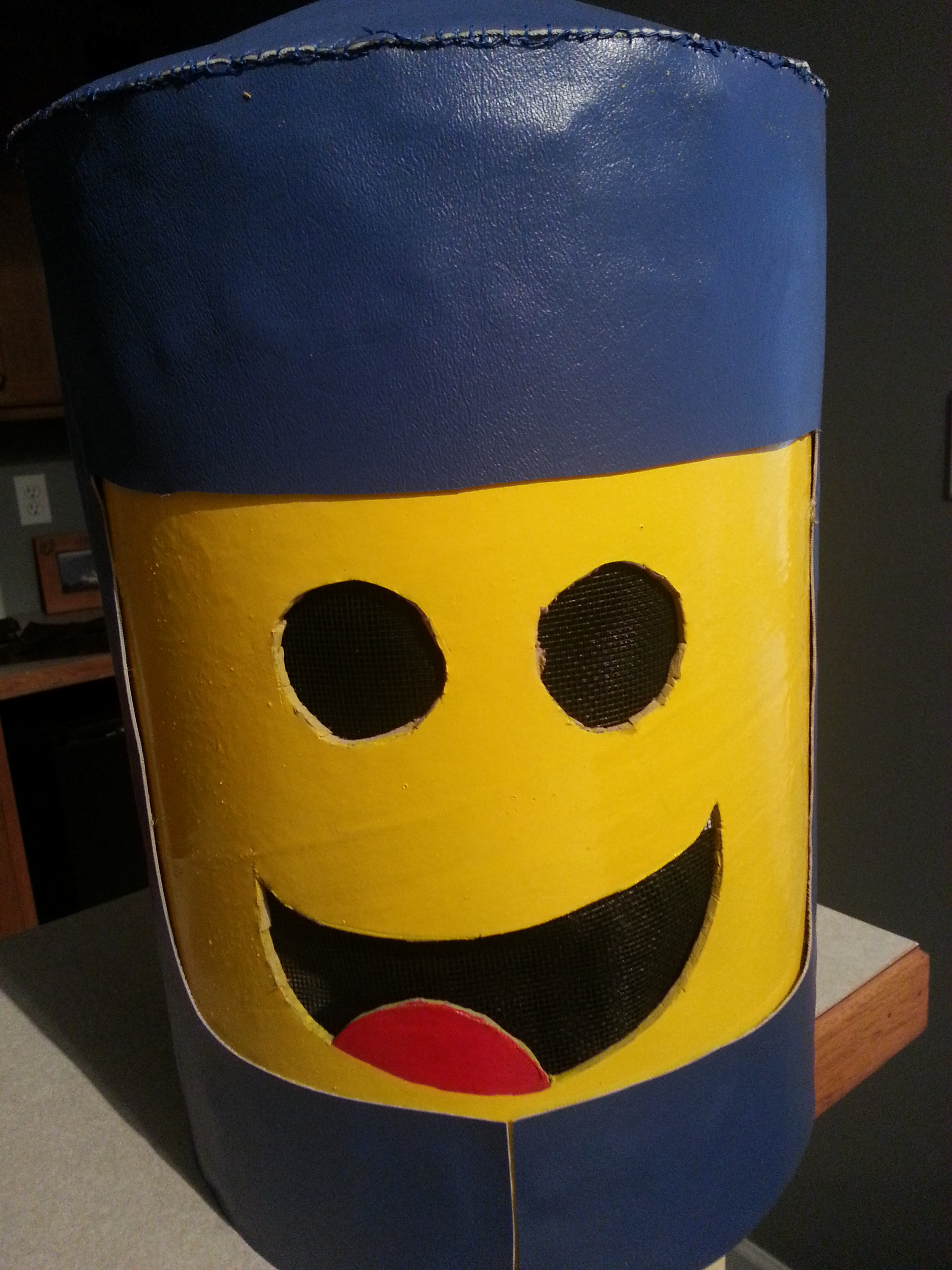
I mean, I don't want to brag that I'm the best mom in the world or anything, but an awful lot of love went into that mask.
I mean, I don’t want to brag that I’m the best mom in the world or anything, but an awful lot of love went into that mask.

All that’s left is for me to figure out what the heck we are going to do with all that candy. Because, as I mentioned, my neighbors seem to love Halloween and I love my neighbors, so I will not refuse their generosity.

But trick-or-treating is kind of a strange tradition, isn’t it? It’s generally assumed that the practice is derived from the Celtic festival of Samhain. Observed as far back as at least 2000 years, Samhain marked an important seasonal transition and a time when the spirits of the deceased were believed to walk the earth again.

Since it’s probably not smart to presume all wandering spirits are friendly, gifts of food (mostly KitKats, I assume) were often left for them by the living who also cut eye holes in their moms’ best sheets or donned Disney princess dresses so any unfriendlies might not notice them.

800 years later, when the Church decided to Christianize the Celts, Samhain became a problem. It’s really difficult to overcome superstition and the desire to give KitKats to tiny Disney princesses. What the Church decided to do was commandeer the holiday and transform it into Hallowtide, a festival encompassing All Hallow’s Eve, All Saint’s Day, and All Soul’s Day, from October 31 to November 2.

Because what wandering spirit wouldn't appreciate this?  photo credit: Andrew _ B via photopin cc
Because what wandering spirit wouldn’t appreciate this? photo credit: Andrew _ B via photopin cc

Instead of fearing evil wandering spirits, the holiday became about honoring and praying for the departed. By the 11th Century, the Church had come to be pretty cool with the idea of dressing up as angels, demons, and Disney princesses as a part of the celebration and soon the tradition of “guising” emerged. Children (and probably a few neighborhood teens who were clearly too old to participate) knocked on doors, often with a song, to beg for food or money in exchange for prayers offered up for the dead. The beggars became known as “soulers” and the treat most often given was called a “soul cake.”

Soul cakes were small and round, often with crosses marked on the top. I can’t find a recipe, but rumor has it they were sweet cakes with things like ginger, raisins, and not nearly enough KitKats in them. I’m betting that’s why the tradition has evolved from “if you give me a treat, I’ll pray for you” to “if you don’t give me a KitKat I’ll egg your house.”

Where's my KitKat?  photo credit: katerha via photopin cc
Where’s my KitKat? photo credit: katerha via photopin cc

But the soul cake does give me an idea of how I can deal with the massive amount of candy that will be entering my house tomorrow night. I’m going to take a lesson form the early Christian Church and commandeer my children’s candy bags (after letting them eat A LOT of candy on Halloween night, I promise) and re-purpose as many of the sweet treats as I can into baked goods that I will serve to friends and neighbors during the coming, more cheerful holiday season.

I have been scouring the Internet for recipes that will help me do just that. My favorite so far is this one for KitKat Cookie Bars. If you know others, please feel free to share. And keep in mind that if you don’t, I just might egg your house.

Drinks with the Devil Lead to Puking Pumpkins

This morning I’ve been living the stay-at-home mom’s dream. I took my children to school, covered my kitchen table in newspaper, and carved jack-o-lanterns. Okay, maybe it’s not every stay-at-home mom’s dream, or even mine, though I’m pretty sure my kids think I make them go to school just so I can play with their toys all day long.

Remember when we were kids and we had to do this with just a spoon and a steak knife. And bandaids.

I really did borrow their carving tools because I haven’t carved a pumpkin on my own since my oldest could manage to rub pumpkin guts in his hair, but tomorrow are the fall parties in my sons’ classrooms and while I did manage to dodge being put entirely in charge this time, I volunteered to help.

And no fall party would be complete without a few Jack-o-lanterns, that bizarre Halloween craft that traces its roots back to a not-so-nice wandering spirit named “Stingy Jack.” According to an Irish tale, Jack was a ne’er-do-well who had a run-in with the devil, a much more famous ne’er-do-well.

Because he was such a good guy, Jack invited the devil to join him for a drink. The devil agreed and even said he’d pay the bill when Jack suggested that the devil turn himself into a coin from which he could later transform back, thereby cheating the bar owner out of the price of the drinks. As soon as the devil transformed, Jack grabbed the coin and placed it in his own pouch next to a small cross he had presumably stolen from someone much nicer than himself. The devil was trapped and Jack only agreed to release him for a promise that he’d leave Jack his soul.

pumpkindrill
Don’t worry, my boys will get to carve they’re own pumpkins, too. They might even get to use Dad’s tools.

Some versions of the tale claim that Jack trapped the devil in a tree with similar results, but regardless of how it happened, the years went by and Stingy Jack died, as nearly all ne’er-do-wells eventually do. Of course, because of his ne’er-do-well ways, Jack didn’t make the cut for Heaven. The devil wouldn’t take him in either and so Jack found himself stuck. Not knowing where to go, he asked his old drinking buddy for directions. In answer, the devil flashed him what I have to assume was truly a devilish grin and tossed Jack a burning ember from the eternal fires of Hell.

Jack wasn’t too bothered. He simply placed the ember in the trusty old turnip he happened to be carrying with him into the afterlife, because that seemed like a pretty good folklore-y kind of thing to do. And ever since then, we’ve been carving vegetables because, well…because…um…

So it turns out this story might not really address the history of today’s jack-o-lanterns at all. There’s not even much evidence that the tradition is particular Irish in origin. Jack’s story is similar to tales from around the globe, used to explain the ghostly phenomenon of ignis fatuus, or the eerie lights that sometimes appear at night over marshy areas and, like a newborn’s smile, are often attributed to gas.

The Māori people of New Zealand were carving gourds to use as lanterns as early as 700 years ago, and it worked pretty well. On a night when little ghouls and goblins are running through the streets, it seems like a good idea to light their way. The practicality of the carved gourd as a way to see where one was going and ward off the evil of the night eventually merged with the spooky tale of Stingy Jack and the Jack-o-lantern we know and love was born, maybe as recently as the early 19th century.

So today the jack-o-lantern is a staple of Halloween décor and of fourth grade classroom fall parties, where it’s featured in the “puking pumpkin” experiment. How could I not volunteer to help with that!?

Uh oh. These pumpkins don't look like they're feeling so well.
Uh oh. These pumpkins don’t look like they’re feeling so well.

After the party tomorrow afternoon you can check out a video of the puking pumpkins on my Facebook page.

The Cheese is Old and Moldy

In the summer of 1987, Paddy Coughlan and Dan O’Conner got to work digging peat on a farm near Glenahilty in Ireland’s Tipperary County and found a little more than they expected. The two men worked together to extract their mysterious find, which turned out to be a 100-pound block of 1,400-year-old cheese.

So just picture this, older and boggier. photo credit: abbyladybug via photopin cc

An exciting find to be sure, especially if you happen to have a box of crackers handy, but Coughlan and O’Connor didn’t. They contacted archaeologist Tony Candon, who, though pretty psyched about the find, was also fresh out of crackers. He did, however, identify the find as cheese (or possibly butter) and declared it quite likely edible, preserved as it was by the cool, acidic, and anaerobic conditions of the bog.

For nearly 27 years, it was a really impressive discovery. Then in February of 2014, archaeologists published the findings from the excavation of a 17th-century B.C. cemetery in the Taklamakan Desert in China’s Xinjiang region. What they found was about 200 well-preserved mummies, each with a little chunk of 3,600-year-old yellow cheese hanging around its neck. Though there’s secondary evidence that cheese has been around some parts of the world for more than 7000 years, this is the oldest actual cheese that’s ever turned up.

I mention this, not because I am particularly knowledgeable about cheese (I’m certainly not), but because today happens to be National Moldy Cheese Day. As far as I know Hallmark hasn’t produced a card for this one yet and you might be hard pressed to find it printed on a wall calendar, but nevertheless today is, without question, the day when we’re all supposed to take a moment to appreciate moldy cheese.

Because this is sort of a history blog, I scoured Wikipedia for at least a couple of minutes to see if I could discover the origin of the strange holiday. I failed. But I think given the importance our ancestors placed on cheese (a convenient snack for the deceased or a 100-pound treasure to be buried in in the back yard for safe keeping), we can assume that Moldy Cheese Day has been around for a while, just like the forgotten slice of American sizzling on the middle school blacktop or that block of Swiss growing fuzzy in the back of your refrigerator.

Vieux-Boulogne, the world's stinkiest cheese, according to two Camdon University studies in 2004 and 2007. Grant money well spent I'd say. photo credit: noodlepie via photopin cc
Vieux-Boulogne, the world’s stinkiest cheese, according to two Cranfield University studies in 2004 and 2007. Grant money well spent I’d say. photo credit: noodlepie via photopin cc

And there’s no question that there are folks among us today who are crazy about cheese. Foodies rave about various stinky cheeses with rinds washed in this or that briny solution. They speak of aging processes and of textures and flavors described as earthy or meaty. There are die-hard cheese eaters out there who can’t wait to devour the smelliest cheeses they can find, not even shying away when the odor is described as similar to that of sweaty feet.

This defies explanation. Just...no. photo credit: cdw9 via photopin cc
This defies explanation. Just…no. photo credit: cdw9 via photopin cc

My guess is that Helen Lucy Burke is one of these die-hard cheese fanatics (not to be confused with the Green Bay Packers cheese-head fanatics, who are even more peculiar). Ms. Burke threw caution to the wind and sampled the 1,400-year-old bog cheese where it’s now kept at the Roscrea Heritage Centre in Tipperary. She described the flavor as unpleasant, though not quite revolting, similar to a dried Wensleydale cheese, which I’m pretty sure I’m never going to eat.

But perhaps you are braver than I am. If you are, you can celebrate Moldy Cheese Day by branching out and trying something new, or, if you want, rumor has it you can cut the fuzzy parts off that lump of Swiss and eat it without worry.

Personally, I think I might celebrate by cleaning out my fridge.

The Single Greatest Advancement in the Field of Cookie Science Ever

In 1937, in a busy restaurant kitchen in Whitman, Massachusetts, a harried chef by the name of Ruth Wakefield rushed to make a batch of her butterscotch nut cookies to serve with ice cream. But there was a problem. The vibrations from the industrial mixer Wakefield used, caused enough of a ruckus to knock loose a bar of semi-sweet chocolate stored on the shelf above, which, becoming splintered by the mixer, contaminated the dough with chips of the chocolate variety.

Beware of  falling chocolate.   photo credit: AngryJulieMonday via photopin cc
Beware of falling chocolate. photo credit: AngryJulieMonday via photopin cc

Wakefield nearly threw the dough out, disgusted at the wasteful accident, and determined that the reputation of the Toll House restaurant was important enough to just start the batch over. Fortunately for Grandmas and glasses of milk everywhere, another cook convinced her to go ahead and bake the batch. And the results just seemed right.

Of course that’s probably not a true story. Another version suggests that Wakefield was making chocolate cookies, but had run out of baker’s chocolate. She substituted chunks of semi-sweet chocolate (allegedly a sample bar provided by Nestlé) thinking it would melt through the dough. And the world rejoiced that it didn’t.

If I’m perfectly honest (and I never lie about cookies), I doubt the validity of this tale, too. Because Wakefield was an educated lady and not a hack in the kitchen. I’ve seen enough Food Network shows to know that even highly trained chefs under extreme conditions (like using only a pocket knife and a candle to make a five course gourmet meal made entirely of beef jerky, in fifteen minutes) occasionally make silly mistakes. Still, I’m inclined to give Wakefield the benefit of the doubt on this one.

I suspect that she understood the properties of chocolate and very intentionally invented the single ever greatest leap forward in the field of cookie science (and trust me, it is a science). For her contribution to the field, she received a lifetime supply of free chocolate (and consulting fees) from Nestlé for the rights to print her recipe on the backs of their bright yellow chocolate chip packages, where it’s been ever since.

Even today, for a lot of us this recipe (perhaps tweaked a little over the years, but still largely the same) on the Nestlé’s package is our go-to for chocolate chip cookies. But it’s not without its rivals. Actually, there are some who claim it wasn’t even the first, that in fact the 1934 Hershey’s cookbook contained a similar cookie recipe.

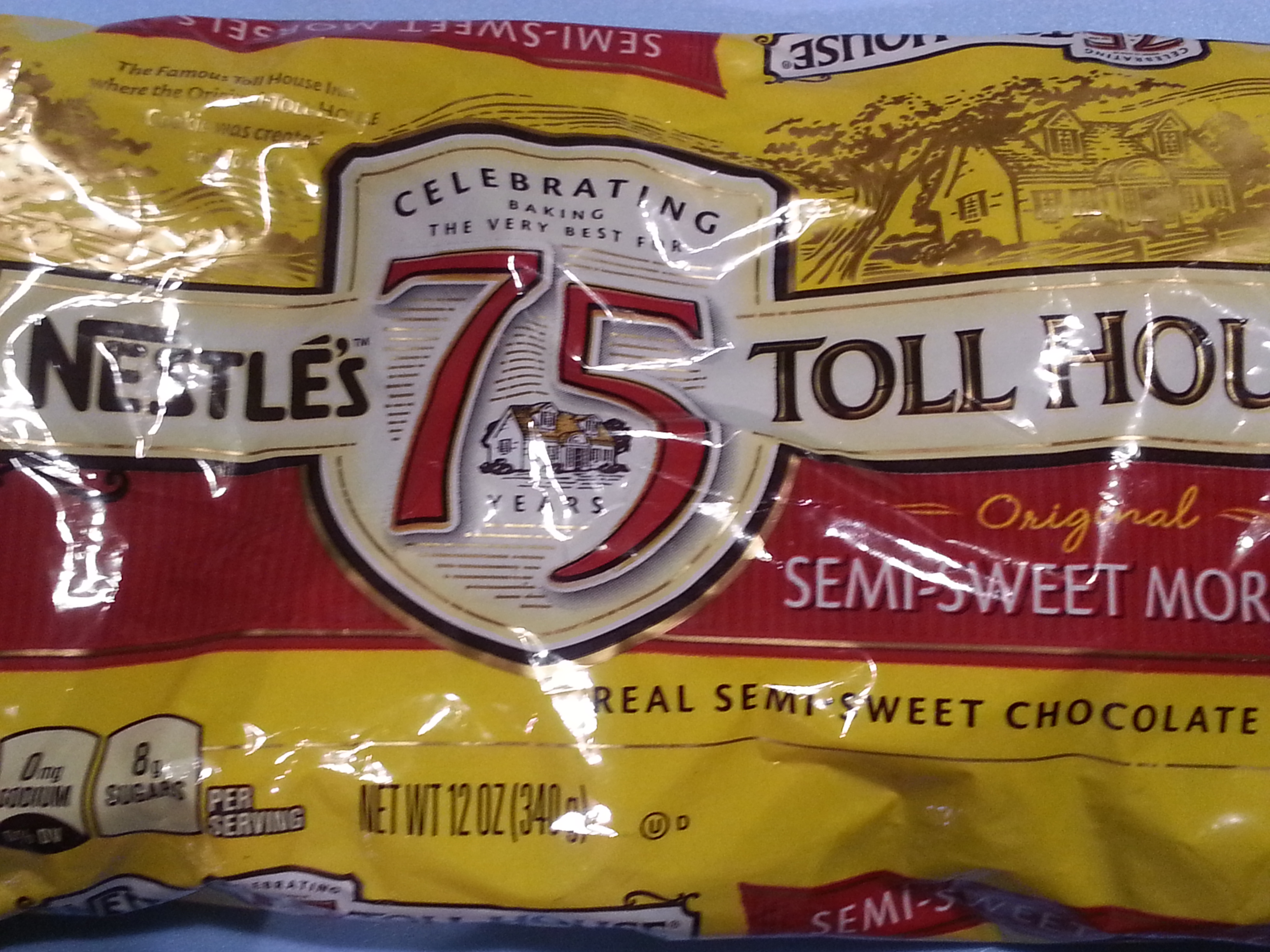
This little yellow package always makes me hungry for cookies.

And there are many who would argue that the Nestlé Toll House recipe is kind of meh when compared to some of the manufactured cookies on the market today, the most exciting of which, according to my quick sampling of those who have enough time on their hands to write about great chocolate chip cookies on the Internet, is the Dutch company Merba’s 37% chocolate chip cookie.

There’s even one blogger who set out to test whether or not Merba cookies really contained 37% chocolate simply because (and I’m guessing here) he has too much time on his hands. He concluded that given a little wiggle room for error in his experimental technique, it did. Why 37% you may ask? It does seem pretty random.

Another mathematics blog attempted to answer that. In a complicated explanation of the behavior of randomly scattered dots within a circle and the intricacies of cookie manufacturing, he proved without question that he has even more time on his hands than the first guy.

Don’t get me wrong. I am super impressed by the dedication of both men to the field of cookie science. Personally, I think the Merba cookie has 37% chocolate because it seems like a good number and it looks good on a package. I base this on the conclusions of some other people with too much time on their hands, who tell us that if asked to pick a random number between 1 and 100, most of us will choose either 37 or 73.

Since a cookie with 73% chocolate would pretty much be, well, a chocolate cookie, Merba wisely chose 37% for their delicious marketing gimmick. Because it just seemed right. And that’s also why I chose to celebrate my 37th birthday this week with a giant chocolate chip cookie, baked from my altered version of Ruth Wakefield’s famous recipe with, if I’m honest, quite likely more than 37% chocolate.

Because it just seemed right.

Way more than 37% delicious.

Not a Bear. Not a worm. Not a meteorologist.

This week saw the official beginning of autumn on September 23, and the accompanying loss of productivity that results from

I sure hope you like pumpkin! photo credit: JeepersMedia via photopin cc

an adorable Google doodle to mark it. I love this season, as the weather begins to cool, the leaves take on the rich hues of the season, and everything starts to smell (and taste) like pumpkin spice.

It’s been especially beautiful in my corner of the world this week with crisp clear mornings that shake off the chill and settle into pleasant sunny afternoons. And there’s a sense of urgency to soak up every bit of the beauty because before too long the jack-o-lanterns will rot on the front porch and we’ll all have had our fill of apples, raking, and, yes, maybe even those pumpkin-spiced lattes.

Then the long, dark, cold months of winter will settle in. According to some weather “experts” we Midwesterners should indeed be bracing for a long, dark, cold, winter. And by “experts,” of course, I mean the woolly worms.

If you’re in another part of the US you may call these critters “wooly bear” or “fuzzy bear” caterpillars even though they are maybe two inches long and not generally (ever) classified as bears. As they are also not technically worms, I won’t argue with you, but this is my blog post so I’ll be referring to them as “wooly worms.” Because that’s what they’re called.photo credit: mattnis via photopin cc
If you’re in another part of the US you may call these critters “woolly bear” or “fuzzy bear” caterpillars even though they are maybe two inches long and not generally (ever) classified as bears. As they are also not technically worms, I won’t argue with you, but this is my blog post so I’ll be referring to them as “woolly worms.” Because that’s what they’re called.photo credit: mattnis via photopin cc

That these fuzzy little critters can predict the degree of severity of the coming winter has been known since at least as early as the 1600’s, but it wasn’t until the fall of 1948 that the phenomenon was (kind of) formally studied. This was the year Dr. Howard Curran, then curator of entomology at the American Museum of Natural History took some friends, including a New York Herald Tribune reporter, their wives, and presumably a picnic with a few bottles of pumpkin spice ale and headed to Bear Mountain State Park to examine the woolly worms.

What he hoped to test was the folklore assertion that the wider the orange/brown band in the middle of the woolly worm’s stripe pattern, the milder the winter, and that collecting and examining woolly worms would be a fun way to spend a day with Mrs. Curran and their friends. Evidence suggests that the latter assertion is absolutely true because the group continued their “research” tradition for the next eight years.

As to whether or not the woolly worm can accurately predict the severity of the coming winter, well, Curran’s evidence did seem to jive with the old wives tale and his results were published in the New York Herald Tribune, sparking renewed interest in the tale that has led to woolly worm festivals and celebrations in Ohio, North Carolina, Kentucky, Pennsylvania, and even recently in Lion’s Head, Ontario, which just goes to show you that searching out woolly worms really is a fun way to spend a Saturday.

Still, Dr. Curran was careful to note that his sample sizes were small, his technique imprecise, and his results, though delightful, were somewhat suspicious. More recent studies have shown that there really isn’t a correlation between the coloration of woolly worms and the weather pattern of the coming winter.

Definitely not a bear. Rod Allday [CC-BY-SA-2.0 (http://creativecommons.org/licenses/by-sa/2.0)], via Wikimedia Commons
One of 260 species of Tiger Moth. Definitely not a bear. Rod Allday [CC-BY-SA-2.0 (http://creativecommons.org/licenses/by-sa/2.0)%5D, via Wikimedia Commons
The stripes instead tell us something of the woolly worm’s age, how long it’s been eating, and which of 260 species of tiger moth (the grown up version of the woolly worm) it might belong to. Entomologists do admit that given all that, the coloration may tell us something about the weather patterns of the previous winter, but then even meteorologists can tell us that information with at least some degree of accuracy, so it really isn’t that impressive.

I wonder which side the woolly worms are nestled on. photo credit: Sister72 via photopin cc

Still, I admit that on a recent family bike ride, we noted the coloration of the droves of woolly worms that crossed the bike path. To our untrained eyes, they seemed to indicate a harsh winter ahead. And a lot of meteorologists agree, citing such prediction tools as statistical analysis and computer generated weather models. Seems to me like it would be easier just to grab a few friends and head out on the bike trail or take a picnic up to Bear Mountain and enjoy a nice slice of pumpkin pie, if for no other reason than to soak up the beauty of these autumn days.

Young Love, Teenage Angst, and One Very Angry Goat

On October 6, 1945, a Chicago tavern owner named William Sianis went to Wrigley Field to watch his beloved Cubs play in game 4 of the World Series against the Detroit Tigers. Sianis opened his tavern in 1934, naming it The Billy Goat Tavern after a goat that had presumably fallen off the back of a passing truck and wandered into the place. “Murphy” the goat became the tavern’s mascot and “Billy Goat” Sianis’s good luck charm.

This is also where fans of Saturday Night Live can order a "Cheezeborger, Cheezeborger, Cheezeborger, NO PEPSI, and a Coke." photo credit: jpellgen via photopin cc
This is also where fans of Saturday Night Live can order a “Cheezeborger, Cheezeborger, Cheezeborger, NO PEPSI, and a Coke.” photo credit: jpellgen via photopin cc

So like all good baseball fans (who are known for their quirky superstitions), Sianis wanted to share some of his good luck with the team. He bought two tickets, one for himself, and one for Murphy the Goat. Trouble was, Wrigley Field had a strict “no goats” policy. Sianis went so far as to appeal to Cubs owner P.K. Wrigley who also denied Murphy’s entrance, saying simply, “The goat stinks.”

Murphy was offended. Right then and there Sianis raised his hands and declared: “The Cubs ain’t gonna win no more.” The Cubs lost Game 4 to Detroit and went on to lose the series, after which Sianis sent a telegram to P.K. Wrigley that read, “Who stinks now?”

As a St. Louisan and devoted Cardinals fan, I find this kind of hilarious, but I don’t know that I buy into the whole idea of curses. Still, there’s no denying that the Chicago Cubs started out as a solid ball club that more often than not was a force to be reckoned with. And that since that 1945 loss, have had the most rotten luck in baseball, having gone to the postseason only a few times since and with their mathematical elimination from contention this past weekend, have now experienced a 107 year stretch without a world series title.

Isn't this a great cover?
Isn’t this a great cover?

But even though this season panned out, well, kind of like most of them, I recently found some hope for the Cubbies in the form of a charming little book called Caught Between Two Curses by Margo L. Dill.

In this YA romance with a touch of magic, Chicago girl Julie is a typical teenager facing the beginning of senior year, torn between a sex-obsessed jerk of a boyfriend and a hot best guy friend who it turns out is a lot less of a jerk. But Julie’s situation is even more complicated than that. She’s been raised by her aunt and uncle since the tragic death of her parents. And now her uncle has become mysteriously ill as well, leading her aunt to reveal the secret of the curse upon the men involved in Julie’s family, a curse that is intricately intertwined with the famous curse of the billy goat inflicted on the Cubs by William Sianis and Murphy.

Much like the people (who I think can honestly lay claim to the title “most dedicated fans in baseball”) who have made several attempts to break the curse, from bringing Murphy’s descendants into Wrigley Field, to organizing an international “Reverse the Curse” aid program that provides goats to impoverished families in underdeveloped nations, and even to hanging a severed goat’s head from a statue in front of the ballpark, Julie sets out on a mission to break the curse.

Rumor has it the curse will only lift when Cubs fans come to truly appreciate goats and welcome them in their midst. photo credit: Tc Morgan via photopin cc

The stakes are high, with her uncle’s life hanging in the balance and the future health of either her jerky boyfriend or the not-so-jerky love of her life endangered, but Julie is determined. She sets aside her own teenage angst (which rings embarrassingly true to life) and her indifference to baseball to cheer the Cubs to victory, the likes of which they haven’t seen in 107 years.

So, fear not, Cubs fans. 2014 wasn’t your year, but if Dill  can convince us that a teenage girl has within her the power to reverse the curse, then I believe there’s still hope. Even if you’re not a baseball fan, you should read the book. I think you’ll enjoy it. If you happen to be a Cubs fan then maybe you should read it to a goat. In Wrigley Field. Because there’s always next year.

Why Sometimes Football is Worth Watching

Today marks the beginning of a special season in my household. It’s the day that the Seattle Seahawks and the Green Bay Packers battle it out in the opener of the NFL season. As such, it’s the start of the five months of the year when my husband and I suddenly seem to have less in common.

Century Link Field, where the very long football season will get its start. By Visitor7 (Own work) [CC-BY-SA-3.0 (http://creativecommons.org/licenses/by-sa/3.0)], via Wikimedia Commons
Century Link Field, where the very long football season will get its start.
By Visitor7 (Own work) [CC-BY-SA-3.0 (http://creativecommons.org/licenses/by-sa/3.0)%5D, via Wikimedia Commons
Actually, it really started this past Saturday with the beginning of college football. I don’t begrudge him this interest of his. With the exception of feeling some understandable loyalty toward our various alma maters, he’s not a big fan of any particular team on either the college or pro level. But he loves the sport. He loves the strategy of the game and he enjoys learning the strengths of individual players and coaches, watching their successes and failures throughout the long season.

And I wish I could catch his enthusiasm, because I genuinely would like to be able to share in it with him. But as much as I try to watch the games and pay attention to his tutelage, I usually just wind up getting lost in the details.

Still, I decided to give it another shot, and so I sat down last Saturday to watch the Croke Park Classic broadcast from Dublin, Ireland, partly because I was intrigued. As far as I know, American football isn’t really one of the things Ireland is most known for. And it wasn’t even the first time Dublin had hosted American college football. In 1996, The Midshipman of the US Naval Academy were defeated in Croke Park by, of course, the Fighting Irish of Notre Dame.

Now eighteen years later, indicating that the threshold of the Irish people for the sport is similar to my own, Croke Park once again hosted an American football game. This time it was a match-up between Penn State and the University of Central Florida. Because neither team has an Irish mascot, it was a close game, with Penn State winding up on top of a 26-24 score.

Croke Park in Dublin, Ireland, host to Gaelic football, hurling, rugby, and occasionally American football.

I enjoyed watching it, too, because in addition to the football, which I found as bewildering as ever, ESPN-2, which aired the game, also featured informative clips about fascinating Irish sports that are lesser known in the United States.

My favorite of those featured is called Irish Road Bowling. It dates back to at least 1728 when it gets a mention in the poetry of Jonathan Swift, but likely to many years before that. The sport is played most often in the Irish Counties of Cork and Armagh. Similar sports are played in the Netherlands and parts of Germany. Even some areas of the United States are starting to get into the action, just sadly, not here in Missouri. Yet.

canon ballWhat intrigues me about this sport is its simplicity. Basically, you get a bunch of players together, find yourself a 28 ounce cannon ball (because I’m sure you have one in your garage somewhere) and see who can launch it down the road to an agreed upon finish line in the fewest throws.

Of course, like American football, road bowling is a sport of some rules, records, and heroes. And since 1954, the Bol-Chummann na hEirman (roughly translated as the Irish Association in Charge of Throwing Stuff Down the Road), has been in the business of making the sport complicated enough to support championship play, both locally and internationally, successfully taking the sport of Road Bowling all the way from terrible road nuisance despised by local authorities to ESPN-2 featured international sport of awesomeness.

Frankly, if the broadcasters of American football made more of an effort to introduce me to fun sports I’d never heard of from around the world, I’d probably watch more football. As it is, I can promise to watch at least once every eighteen years.


The Guy You’re Gonna Call

In 1933, renowned spiritual medium Eileen Garrett entered the parapsychology laboratory at Duke University where she met with botanist turned clinical parapsychologist J.B. Rhine to participate in his quantitative study of extrasensory perception (ESP).

Rhine brought out a deck of cards, specifically designed with his partner Karl Zener for the experiments. Each of the Zener cards contained one of five simple shapes. Ms. Garrett simply had to identify, without seeing the shape on the card, which one Rhine presented her with. The assumption was that an accuracy rate more than 20% would indicate ESP.

Zener Cards [Public domain], via Wikimedia Commons
Zener Cards, used to test for ESP [Public domain], via Wikimedia Commons
A few years prior, Rhine had gleefully exposed medium Mina Crandon as a fraud, so no one was more surprised than he when Garratt did identify the correct shapes more than 20% of the time. The medium herself, however, was not pleased with the results, claiming that she would have performed better had the cards not lacked a certain psychic energy.

She would have been better off graciously accepting her results because later testing by other researchers failed to find any ability to correctly identify the cards above that of normal chance. Actually Rhine’s methods attracted a lot of criticism, particularly claims that he inadvertently cued his subjects to the proper shapes on the cards. His results were never verifiable in subsequent tests.

But still, Rhine is credited with coining the term “parapsychology” and with being the first to honestly attempt to study it quantitatively. He continued his research at Duke until the university discontinued its support in the early 1960s and he founded the Journal of Parapsychology, the Institute of Parapsychology, and the Parapsychological Association. There’s no question he made himself into the foremost expert in his field, the guy you would call with all of your parapsychological concerns.

And in 1984, his dedication to his field of study brought him a great honor. In one of the opening scenes of Ghostbusters, Dr. Peter Venkman, played by Bill Murray, uses Rhine’s Zener card methodology to test two students for ESP, torturing a young male student who fares at least as well as Garratt did, and hitting on a pretty young lady who always seems to guess correctly even though she doesn’t.

Hook and Ladder Company No. 8. NO FIRES! and NO GHOSTS! "Ghostbusters Firehouse 2 (2007)" by Daniel SCHNERF - Own work. Licensed under Creative Commons Attribution-Share Alike 3.0-2.5-2.0-1.0 via Wikimedia Commons - http://commons.wikimedia.org/wiki/File:Ghostbusters_Firehouse_2_(2007).jpg#mediaviewer/File:Ghostbusters_Firehouse_2_(2007).jpg
Hook and Ladder Company No. 8. NO FIRES! and NO GHOSTS! “Ghostbusters Firehouse 2 (2007)” by Daniel SCHNERF – Own work. Licensed under Creative Commons Attribution-Share Alike 3.0-2.5-2.0-1.0 via Wikimedia Commons – http://commons.wikimedia.org/wiki/File:Ghostbusters_Firehouse_2_(2007).jpg#mediaviewer/File:Ghostbusters_Firehouse_2_(2007).jpg

Like Rhine, Venkman faces the end of his university funding with grace and increased dedication to his chosen field of study. Rather than wallow in his misfortune, he and his associates move into an old firehouse and establish themselves as the guys you’re gonna call with all of your parapsychological concerns.

Perhaps you think it is a stretch to call this small nod to Rhine a great honor, and, well, of course you’re right. Because it would admittedly be a stretch to call Ghostbusters one of the great cinematic achievements of all time. Or of the 1980s. Or of 1984.

But even if it doesn’t hold up all that well, I was a child in the 1980s and Ghostbusters was surely the closest thing to a scary movie my parents ever let me watch. Because of that, it has formed an important part of my childhood. And maybe of yours, too. If so, you’re in luck.

This week marks the 30th anniversary of the original theatrical release of Ghostbusters with (and if you have ESP then you can probably know this already) a theatrical release.

Stay Puft: The monster in your closet since 1984 photo credit: Great Beyond via photopin cc
Stay Puft: The monster in your closet since 1984
photo credit: Great Beyond via photopin cc

That’s right. Starting today and going through this next week, you can celebrate this momentous anniversary by donning your eighties garb and heading to a theater near you to experience the Stay Puft marshmallow attack on New York City in its full big-screen glory.

I think you’re going to do it. I see parachute pants, teased bangs, and a whole mess of ectoplasm in your future. And there’s a fifty percent chance I’m right.