I Just Thought You Should Know

On January 13, in the year AD 532 Byzantine Emperor Justinian attended a tense chariot race in Constantinople’s Hippodrome. The competing chariot teams were known simply as the Blues and the Greens, the colors they wore. But these were more than sports teams. They had become important political factions with which the people of Constantinople and the Eastern Roman Empire identified. They had become the face which the people wore to interact with their leaders.

And on this particular January day, the people were angry. Three days earlier, some of the leaders of both the Blues and the Greens organizations were arrested and sentenced to death by Justinian for hooliganism gone too far. When two of the hangings were botched and a surviving representative from each of the Blues and the Greens was carried off to a church to seek asylum, the supporters of both groups united to petition for a pardon for the two men.

Mosaic of Emperor Justinian with a model of the Hagia Sophia which he had rebuilt after it burned in the Nika Riots. By Byzantine mosaicist, ca. 1000 [Public domain], via Wikimedia Commons
The pardon was denied, but Justinian did graciously plan a new chariot race for everyone to enjoy three days later. That may have been a mistake. From the start of the first race to the end of the twenty-second (of twenty-four), the crowd chanted quests for mercy for their leaders. And then, according to contemporary accounts, the chant shifted to “Long live the merciful Blues and Greens.”

Anyone who has ever been swept up in a sports rivalry will understand that when rival fans find common ground in a sports stadium, it’s time to get nervous. Evidently Justinian knew that. He took off, barricading himself in his palace.

That very night, to the cry of “Nika!” (victory or conquer), the rioting began. Large parts of the city burned and five days later the exhausted Justinian called on his loyal military leaders who successfully herded the rioting mob into the Hippodrome and slaughtered them. The Nika riots were over. Nothing positive had been accomplished. And 30,000 people were dead.

This is not a lighthearted story from history. And I apologize that this is not my typical lighthearted post, but I’ve had riots and the devastation they can cause on my mind lately. You see, I live in the greater St. Louis area. I don’t live in the suburb of Ferguson, but like its citizens, St. Louis is the city I call home and the residents of Ferguson are my neighbors. And I think I can safely speak for a lot of us who live in the area when I say that these past almost two weeks now, have been a terrible emotional strain.

My heart breaks for the family and friends of Michael Brown, who in their eyes was a gentle giant whose possible actions on the day of his death were very out of character. My heart also breaks for the family, friends, and coworkers of Officer Darren Wilson who are struggling to cope with the repercussions of what they see as an atypical action of a good cop. And my prayers are with the investigators charged with figuring out how this all went down to begin with.

But above all, my heart cries out for the people of Ferguson, the Greater St. Louis community, and this multi-colored nation of equals where there is still enough pain and mistrust bubbling beneath the surface that one tragic event can cause us to lash out at each other.

Because the Nika riots weren’t about chariot racing. They weren’t really even about seeking pardon for political leaders. They were about a people who felt they were being unfairly burdened by a government that wouldn’t hear them. They were scared for their futures and spurred on by an opportunistic movement to depose the sitting emperor.

I don’t think the Ferguson riots are entirely about the shooting of Michael Brown. If they were, then the media could move on while the very careful investigation stretches out and the crowds could return home (for many, many of them that’s not Ferguson, or St. Louis, or even Missouri) and await the findings. They could stop tearing apart the streets and keeping the children who should have started school last week, at home and scared.

The riots in Ferguson continue not because a white police officer shot a young black man, but because no matter what the investigation shows were the causes of that incident, and no matter where the blame lands, we live in a nation in which it still isn’t so hard to believe that our racial differences divide us to the point of senseless violence.

I’m choosing to write about this not just because it’s difficult to focus on much else in my corner of the world right now and certainly not because I have answers. But I write because I have been disturbed by the way the media has portrayed the Ferguson situation. In most instances the news has been negative and misleading.

Members of the media have been guilty of rushing to draw erroneous conclusions that have served to inflame passions. Coverage has focused on the unforgivable actions of a militarized police force that in reality has gone out of its way to minimize injuries to protestors even while sustaining injuries itself, often backing down when it seemed safe to do so, clearing streets and business areas where violence appears likely to spread, and, yes, occasionally asking members of the media to (gasp) comply with its instructions.

St. Louis Gateway Arch on a calm summer evening. By Blueberoo1987 (Own work) [CC-BY-SA-3.0 (http://creativecommons.org/licenses/by-sa/3.0)], via Wikimedia Commons
St. Louis Gateway Arch on a calm summer evening. By Blueberoo1987 (Own work) [CC-BY-SA-3.0 (http://creativecommons.org/licenses/by-sa/3.0)%5D, via Wikimedia Commons
What we haven’t seen much of, and I think, because I live in the area, I hear more of it than the national and international media lets out to the world, is the number of area clergy walking through the crowds to be a calming presence encouraging peaceful protest and discouraging violence.  The media hasn’t focused much on the African American business professionals who mingle with the crowd to spread calm and sense in the midst of anger and fear.

What you may not have seen is the groups of peaceful protestors coming together with police to identify violent and criminal opportunists among the crowd, nor have you been shown the members of MIZZOU’s Phi Alpha Phi black fraternity cleaning up the streets and going door to door in Ferguson to register voters so that its citizens can bring about the change in leadership that will give them a louder voice in their community.

I write because I want you to know that I am proud of this community and of the people in it who understand that further violent or criminal actions only cause more harm. I have hope for Ferguson. It’s going to be a long road, but I believe that when the dust settles and the outside protestors, media, and opportunists go home, it will pull itself up again and stand together as a stronger community with citizens who understand each other a little better. Because I think the people of Ferguson see the damage this continuous rioting is doing and I think bit by bit, they are beginning take their town back from the riots. And bit by bit, they will find more effective ways to heal their wounds.

And I just thought you should know.

Absolute Leisure and Peace

In May of 1906 the Atlantic Monthly published a piece by American nature essayist John Burroughs who wrote of his experience camping in Yellowstone National Park with President Theodore Roosevelt. The trip itself occurred three years earlier in the spring of 1903, but Burroughs begins his essay by explaining that in the time since, he’s not had a moment to sit down and write about it what with all the “stress and strain of [his] life at [home]—administering to the affairs of so many of the wild creatures about [him].”

I can relate to that. I try to post to this blog every Thursday with some new snippet of history and nonsense, but sometimes I don’t make it. And now it has been three weeks since my last post. Summer is especially tough because my sons (7 and 9) are out of school and, well, what with the stress and strain of administering to the affairs of the wild creatures about me, I just hadn’t gotten around to it until now.

But my family just recently returned from a trip through the Western United States, including Yellowstone and since school started this week, I thought I’d finally take a moment to write about it.

We entered the Yellowstone through the North Gate, called the Roosevelt Arch and dedicated by President Theodore Roosevelt on his 1903 visit. By Acroterion (Own work) [CC-BY-SA-3.0 (http://creativecommons.org/licenses/by-sa/3.0)], via Wikimedia Commons
We entered the Yellowstone through the North Gate, called the Roosevelt Arch and dedicated by President Theodore Roosevelt on his 1903 visit. By Acroterion (Own work) [CC-BY-SA-3.0 (http://creativecommons.org/licenses/by-sa/3.0)%5D, via Wikimedia Commons
First of all, though my husband has been to the oldest national park in the world several times, the boys and I had never been. Just judging by the variety of license plates we saw and the number of languages we heard, I’m guessing most of you have been. If you haven’t, and you ever have the opportunity, you should go.

Because it’s weird.

Even our travel companion Steve was a little apprehensive.

At least that’s all most people told me about it before I went. And they weren’t wrong. It is weird. It bubbles and boils beneath you and vents its acrid steam and then belches great plumes of water before a crowd that can’t help but gasp and cheer even while realizing that the earth here could actually explode and kill us all.

And then there’s the wildlife. Our first night in the park we camped because we wanted our boys to have that experience. We got our tent all set up and attended an evening ranger program where we proceeded to learn all the ways bears, elk, and bison can and will kill you. Then we slept in our tent pitched alongside trees that had been marked by bears, elk, and bison. We spent our remaining nights in a lodge.

We didn't point out the bear markings to the boys until we were packing up the tent the next morning.
We didn’t point out the bear markings to the boys until we were packing up the tent the next morning.

But Roosevelt and his companions largely didn’t. On a brief respite from a westward speaking tour, the president mostly camped in the backcountry. Of course there were no terribly endangered bison to speak of in the park at that time, and as this was early spring, most of the bears were still hibernating, but there were lots of elk and still a fair number of mountain lions and other predators.

It was the animal life that chiefly interested Roosevelt. According to Burroughs, the president, much to the chagrin of those companions charged with his safety, set off by himself as often as he could to enjoy a quiet picnic lunch alongside a wandering herd. Once while coatless and half lathered in the middle of a shave, Roosevelt rushed to the canyon’s edge to watch the treacherous descent of a group of goats headed for a drink from the river below.

Despite the grueling travel over still deep snow in many parts of the park, the sixteen day detour through Yellowstone apparently left Roosevelt refreshed and more determined than ever to advocate for the nation’s natural spaces.

When we were about to leave the park, I admitted to my husband, who had largely planned this trip on his own, that I’d had my doubts about this vacation. It’s not that I don’t like to animal watch and hike. I do, but I wondered if it would hold the attention of our boys or if we would all be tired and cranky and wishing we’d spent a week at the beach instead.

I was pleasantly surprised. They loved it, almost every minute of it. They delighted in the walking past the smelly, gurgling acid pools of a giant super volcano and they loved craning their necks to spot distant elk herds and bird species they’d never seen or bothered to identify.

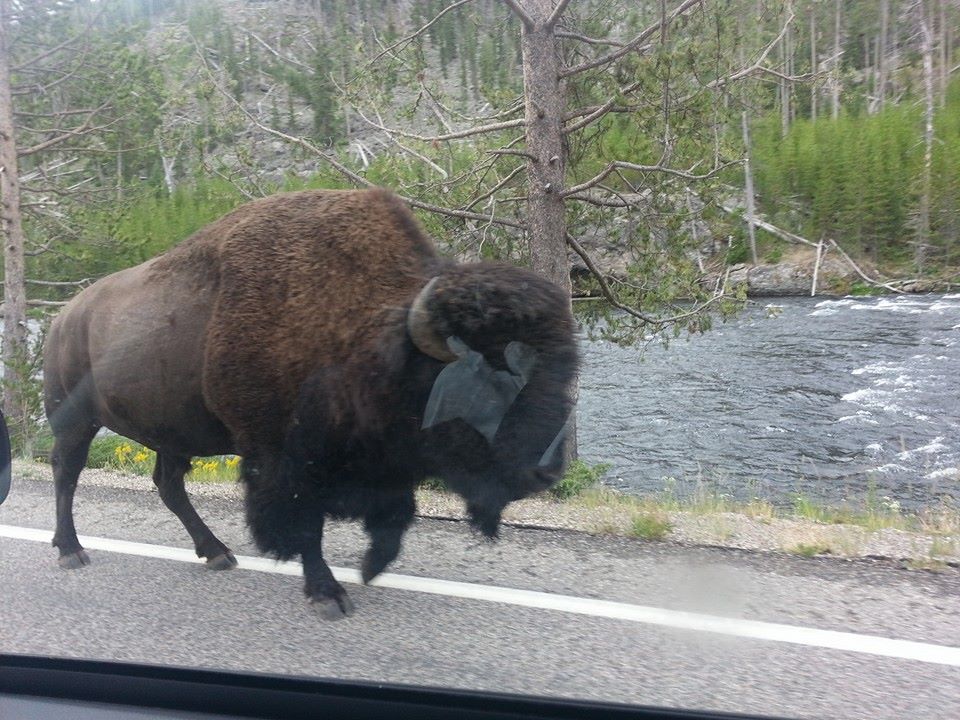
At times the wildlife was a little closer than we would have liked.

We came home refreshed. And I’m delighted to finally take a moment to reflect on the journey. I’m also glad that it didn’t take me the three years it took Burroughs, who defended his slow pace by reminding his readers that he didn’t have the “absolute leisure and peace of the white house” that allowed Roosevelt to write his own reflections shortly after the trip.

Yep. I bet that’s it. If only I were president, I’d have all the time in the world to post. And maybe even to improve my golf swing.

By White House (Pete Souza) / Maison Blanche (Pete Souza) (The Official White House Photostream [1]) [Public domain], via Wikimedia Commons

Follow the Arrows

As the summer wears on, and my children increasingly have trouble entertaining themselves, I find myself struck at the genius of my mother. It was well-known in my house growing up in Smalltown, Illinois, that it was a very bad idea to utter the words, “I’m bored” in front of Mom. Her response would, without fail, be, “Great! The toilets need to be scrubbed.”

photo credit: Mykl Roventine via photopin cc</a
photo credit: Mykl Roventine via photopin cc

But every so often, if one of us had a friend or two over to play and we found ourselves in a lull, she would take pity on us and come up with these amazingly creative ideas, from fun little games to large scale projects of awesomeness. One of my favorites was a game she resurrected from her own childhood in Even Smallertown, Illinois called an arrow hunt.

The idea was that one person (or one team) would take a piece of chalk and go somewhere in our Smalltown neighborhood to hide. Along the route, the hiders marked a chalk arrow every time they changed directions. The arrow had to be clearly visible, though it could be in an unexpected place, and the final arrow pointed to the spot where the hider(s) would be found.

The game was a hit. It killed a lot of otherwise boring summertime hours, no toilets were scrubbed, and my friends and I discovered all the nooks and crannies of the nearby park and neighborhood landscaping. And I got really good at spotting a trail.

So did pilot Jack Knight on one dark night in 1921 when he completed a successful flight from Chicago to North Platte, Nebraska. This was important for two reasons. First, it was the first (and possibly only) time anyone ended up in North Platte on purpose. Second, Knight’s flight had been a test for the US Postal Service.

A relatively new technology, airplanes offered the promise of efficient coast to coast mail delivery. But navigation was still in its infancy with pilots relying on landmarks to guide them. This meant that night flying was pretty much out.

It's possible this man has no idea where he's going.
It’s possible this man has no idea where he’s going.

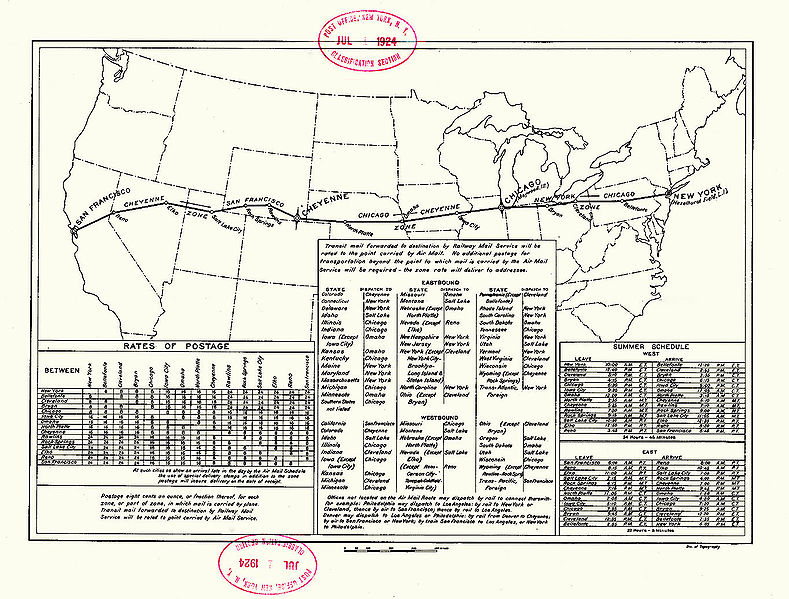
That is until someone had the brilliant idea to use postal workers and citizen volunteers to man a series of bonfires along Jack Knight’s dark route. His success led to the (slightly) more sophisticated plan to dot the Transcontinental Air Mail Route from New York to San Francisco with 50-foot steel, gas-lit beacons mounted into giant yellow concrete arrows on the ground.

Each arrow pointed toward the next beacon, around ten miles or so away depending on topography. Congress thought it was a great idea and by 1924 there were giant arrows pointing the way from Cleveland, Ohio all the way to Rock Springs, Wyoming. And because the Postal Service realized there weren’t a lot of reasons to stop in Rock Springs, Wyoming, the route was extended over the next few years, eventually reaching from New York to San Francisco.

air mail route
Transcontinental Airmail Route

Of course it wasn’t long before fancier navigation systems developed and pilots began to feel that radio frequencies were somewhat more reliable than the old fly-real-low-and-follow-the-arrows system. During WWII, the steel beacon towers were dismantled and repurposed, putting a practical end to the dotted Transcontinental Air Mail Route.

But the arrows are still there. Their paint is faded and they may have a few cracks here and there, but many of them that haven’t become the victims of development are still there to be found by the odd eagle-eyed traveler.

So we’re almost to the countdown to the start of school. I am not as creative as my mother and my boys are spending their childhood in Not-So-Small-Suburb, Missouri so even in our very safe neighborhood, I’m not terribly comfortable with the idea of them chasing arrows through the streets. My solution for summer boredom is to plan the big family vacation for the end of the summer, as a reward of sorts, for making it this far. And now I know as we pack up for our trip west, we’ll be following the arrows after all.

Arrows go left. Arrows go right. Follow in the morning, or follow them at night.


Ending with a Bang: The Long Weary Road to the Last Out

One hundred years ago, on July 17, 1914, a weary baseball crowd at Pittsburg’s Forbes Field awaited the end of a very long game. For 21 innings the Pirates and the New York Giants battled it out. At last, Larry Doyle of the Giants sent a two-run shot over the wall bringing the game to a score of 3-1, devastating the remaining Pittsburg faithful. It had been a dreadfully long game. Pittsburg’s manager had long since been ejected for arguing a call. The mood was surely solemn. And to top it off, a storm was brewing above the city.

There would be no celebratory fireworks for the Pirates, but there would be an impressive light show when in what has to be the most spectacular baseball play of all time in the bottom of the 21st inning, New York outfielder John Joseph “Red” Murray caught a long fly ball for the third out and was simultaneously knocked unconscious by a lightning strike.

Evidently even God grows weary of baseball after a while.  photo credit: Michael Fienen via photopin cc
Evidently even God grows weary of baseball after a while. photo credit: Michael Fienen via photopin cc

I love baseball, though I’m not a great sports fanatic in general. I only know who won the world cup because my Facebook feed briefly became the hooligan section (Germany, right?). As much as I have tried for my husband’s sake, American football is just beyond me. And all I know about hockey and professional basketball is that they have ridiculously drawn-out playoff schedules that seem to stretch into the next regular season of play.

But baseball captures my attention. So I was thrilled when both of my sons, ages 6 and 9 decided they wanted to play this summer. My 9-year-old had some previous experience. Last summer he played in a non-competitive coach-pitch league where he made some friends, developed some skills, and had a pretty good time. And as a little kiddo he played on a tee ball team where the two biggest highlights of his season were losing a tooth in the infield and handing it to the nearest parent volunteer (who took it quite graciously I thought), and dumping a glove-full of grass on the head of a little girl who had just run to third.

Consider carefully before volunteering to help out with tee ball.  photo credit: courosa via photopin cc
Consider carefully before volunteering to help out with tee ball. photo credit: courosa via photopin cc

Unfortunately this summer hasn’t gone as well. This season we tried a different, competitive league. I’m certainly not opposed to competition. It’s important to learn how to both win and lose well. And the kids have done well will that. But what has broken my heart has been seeing the way that my son and his teammates have been crushed by frustrated and inconsistent coaching and by bad sportsmanship from both parents and coaches (on all the teams).

With only one game to go, we’re nearing the end of the season, and my son doesn’t want to go to practice and doesn’t want to go to the game. I’m going to make him, because it’s a good lesson in honoring commitments, even when it’s tough, but I get it. I don’t really want to go to the game either.

It hasn’t been all bad, of course. He has made some friends, gotten much better at spitting sunflower seeds, and has learned that even in the midst of endless innings stuck in the outfield and pointless arguments between hothead coaches and umpires who aren’t bold enough to toss said coaches from the field, there are bright moments.

His team isn’t going to win first place, but they are well over .500 and my son’s still thrilled when he manages to field the ball well or when he has a good at bat. But I’m also afraid that this kid, who loves to watch this sport as much as I do, may never want to try to play baseball again. Frankly, he’s weary. It’s been a dreadfully long season and going into the last game, against the best team in the league, the mood is solemn and a storm is brewing.

I sincerely hope the game doesn't get called for bad weather because then we'd have to play a make-up.
I also sincerely hope the game doesn’t get called for bad weather because then we’d have to play a make-up.

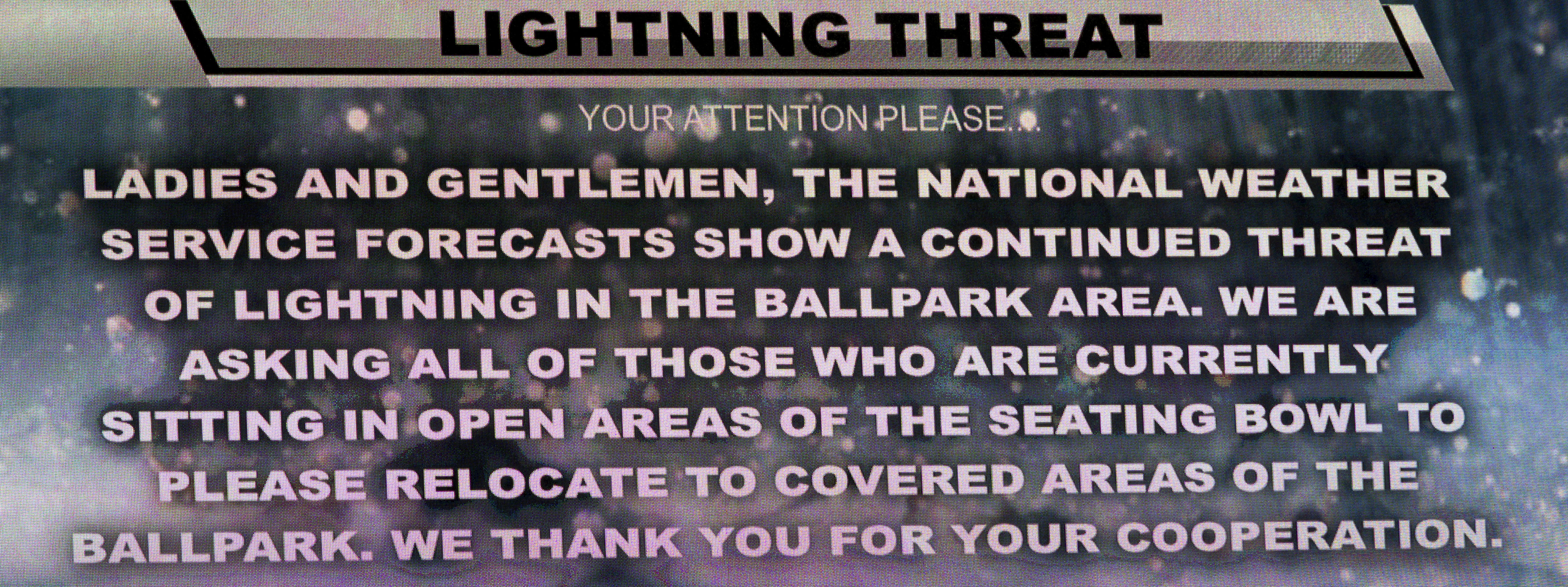
So although I sincerely hope that none of the players get struck by lightning (and I suppose no coaches or parents either because I am trying to model good sportsmanship), I do hope that there’s something in this last game that sparks his excitement for the sport again and provides him with a good memory to carry into next time.

Nothing will stop this man from catching a fly ball. By Bain News Service, publisher. [Public domain], via Wikimedia Commons
NOTHING will stop Red Murray from ending a 21 inning game. By Bain News Service, publisher. [Public domain], via Wikimedia Commons
I’m not sure that Red Murray remembered the game winning catch he made that day in Pittsburg, but his legend certainly lived on. And so did he. Rumor has it he even played in the very next Giants game. In my book that either makes him the most dedicated baseball player ever, or perhaps this the biggest tall tale in the sport. Either way it’s a good story with a great ending.

Oh the Places I’ve Never Gone: A Story of SPAM

I love a good road trip and, I confess, I have a little bit of an obsession. I collect brochures. I don’t mean that I have a basement full of full color brochures from every place I’ve ever visited. That might actually make sense.

I mean that at every hotel, roadside diner, and rest stop, the first thing I do is check out the tourism brochure rack, and I usually pick up at least three or four. Of course I do this in the places where I’m staying for a while, but also in the places I’m just driving through.

In case you can't read it, that phone number is 800-LUV-SPAM, so you can get all of your SPAM and SPAM Museum-related questioned answered. I'm sure you have many.
It’s Free! And it has bathrooms. And probably tee shirts.

And here’s the strange part, I almost never go to the places in the brochures. But I love to learn about bizarre little tourist sites that get highlighted on those racks. I guess it’s my way of soaking in some of quirkiness of the communities I am privileged to pass through.

There are the standard places like zoos, waterparks, and outlet malls and in this part of the country there’s usually a cave tour or two. Sometimes those are accompanied by interesting stories. But the ones I like best advertise those truly unique places, the ones that are just weird enough that it’s unlikely anyone would ever travel specifically to a particular area just to see them.

My latest find, maybe the best brochure I have ever picked up on a road trip, came from a hotel in Rochester, Minnesota where we stopped this weekend on our way to watch a community theater musical production that featured one of our very talented nieces.

Obviously she stole the show and we were delighted to be there to watch her performance, but I admit, second to that, my favorite part of the trip was the place we didn’t go: The SPAM Museum in Austin, Minnesota.

Austin is only about a 45 minute drive from Rochester and not particularly out of the way for a traveler headed back to St. Louis, but it was the last day of our whirlwind weekend road trip. We were anxious to head home. And I was the only one who seemed at all interested in going.

Even Big Foot loves SPAM.

How could I not be? First of all the museum is free, so even if it’s not everything it’s advertised to be, all you’ve lost is an hour or so of your time, which you can’t ever get back. Still, how can you say no to a tourist destination that boldly proclaims: “Theater! Game Show! Restrooms! IT’S ALL HERE!”

So since my family wouldn’t be convinced to tour the museum (okay so it’s possible I didn’t try that hard), I had to research SPAM the old fashioned way and just Google it.

SPAM hit the market in 1937 and soon dominated the canned meat industry. A spiced ham product initially made entirely from pork shoulder which had been an underutilized cut of meat up to that point in the company Hormel’s canned meat products, SPAM received its iconic name from a somewhat suspicious contest.

The winning entry was submitted by an actor named Ken Daigneau who also happened to be the brother of a Hormel Foods Vice President. There’s no word on whether or not said vice president was in fact the judge of the contest, but Hormel awarded Daigneau $100 for his efforts and it’s a good thing they did because “ham jello” just doesn’t sing as well.

Though SPAM (which Hormel claims stands for “spiced ham” and not the “something posing as meat” that some have suggested) took off largely as a wartime food, its real boost into the popular psyche came from Monty Python’s famous 1970 SPAM comedy sketch, which period actors with brilliant British accents (I’m sure) reenact daily for a fascinated audience at the SPAM Museum.

Alas, I’ve never been. Still, I do have the brilliant brochure that both splits into detachable postcards with fun SPAM facts so you can conveniently invite your friends from all over the world to a SPAM pilgrimage they won’t soon forget and also features a helpful map placing the museum into geographical context with the World’s Largest Stack of Empty Oil Cans. I haven’t managed to collect a brochure advertising that American travel gem yet, but it’s definitely on my list of sites to not visit.

spammap
10,000 Lakes? Big Deal. Come to Minnesota for the SPAM!

Super Foods of Future Past

In the fall of 1902, twelve healthy young men sat down together in a dining room set up in the basement of the former Bureau of Chemistry in Washington D.C. for the first of many meals they would share. The food they ate was whole and healthy, prepared with the finest ingredients, and calculated to meet the specific caloric needs of each individual. Oh, and it was laced with borax.

Dr. Harvey Washington Wiley. Chief Chemist in the United States Department of Agriculture. Food and drug safety enthusiast. Poisoner of young men.

The twelve young men at the table were the first volunteer subjects of a study designed by the Bureau of Chemistry’s Chief Chemist Dr. Harvey Wiley to determine the human health effects of various common additive food preservatives.

Each young hero agreed that for the duration of his participation he would ingest nothing but the food provided him through the study, the only exception being water, which was carefully measured. He also agreed to regular medical examinations, and, of course, he agreed to clean his plate.

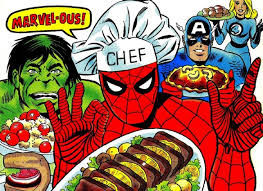
Wait, there isn't any radiated spider venom in this, right? I have the weirdest reaction to that stuff.
Wait, there isn’t any radiated spider venom in this, right? I have the weirdest reaction to that stuff.

At the dawn of the 20th century, Americans were as concerned about the chemicals in their foods as we are in 2014. And with no real regulation, it was nearly as difficult to make good family food decisions as it is today amidst confusing regulation and an overwhelming amount of ever evolving and sometimes conflicting health information.

Then along came Dr. Wiley and his “Poison Squad” as they were soon called by the press. They operated under the motto, “Only the Brave dare eat the fare,” rotating through and testing at various times throughout the five year duration of the study: borax, benzoic acid, sulfur dioxide, formaldehyde, copper sulfate, salicylic acid, and saltpeter.

As soon as a man developed symptoms that inhibited the performance of his daily routine, he was given a minimum of forty days rest during which he ate nutritious food that contained none of the test chemical. But as Dr. Wiley later explained during a hearing before the Committee on Interstate and Foreign Commerce, the study was necessarily limited because unlike with animal testing, he couldn’t cut open his test subjects and examine their organs. Apparently, they wouldn’t agree to that.

So, I don't know what's in that turkey leg, but I don't think it agrees with him.
So, I don’t know what’s in that turkey leg, but I don’t think it agrees with him.

Still, the study and the publicity that accompanied it, helped pave the way for the 1906 Pure Food and Drug Act and for the agency that would emerge officially in 1930 as the Food and Drug Administration. The act addressed fairness in labeling more than the elimination of food dangerous food preservatives, but four of Wiley’s test additives are long since gone from American foods, including borax, salicylic acid, formaldehyde, and copper sulfate.

Thanks to the heroic sacrifices of the poison squad, the food we eat is a little bit safer, which doesn’t seem to do much to ease our minds as we are still at war with all things perceived as unnatural in our foods. Regardless of what diet you subscribe to, be it the Mediterranean, Paleo, Flexitarian, or whatever, the one thing they all pretty much agree on is that you should eat as much real, single-ingredient, “whole” food as you can.

And even the most practical of nutritionists, who caution against adopting a diet so rigid that it’s not workable, agree that this is probably a pretty good idea. But as a mom who does the vast majority of the grocery shopping and as much of the cooking as I can’t get out of, I wanted to know, just what are those whole superfoods my family should be eating?

Turns out Prevention magazine has some suggestions. Actually, there are quite a few lists of the super-est foods of 2014, but I liked this particular list because most of the foods on it were included elsewhere, too, and there were several I’d never heard of before. You just can’t get any more super than that.

Holy Whole Foods, Batman!

A few of my favorite are:

1. Avocado oil – just the oil, not the avocado because it was super a couple of years ago
2. Coffee – some years it’s good; some years it’s bad; this year the price is going up so it’s super
3. Shichimi togarashi – a Japanese spice that is apparently really hot and rich in antioxidants, but way more Hipster-friendly than say, blueberries
4. Salsify – a root vegetable that is low calorie and high in fiber because, you know, it’s a vegetable
5. Za’Atar – a Middle Eastern spice that decreases the instances of foodborne illnesses, kind of like cooking does
6. Teff – a gluten free grain whose biggest claim to healthfulness seems to be that you can’t digest it
7. Canary seed – yep, that’s right, bird seed is a gluten free grain option for people, too, so that in 2014, you have permission to finally eat the way you’ve always wanted to, like a bird. Super.

Um, just no.
Um, just no.

I don’t know what was on the list of super foods in 1906, but I guess I know what wasn’t. Don’t worry, though. No formal follow-up study was ever done on the participants of the poison squad, but anecdotally their health didn’t suffer in the long term. One participant, William O. Robinson of Falls Church, Virginia, passed away in 1979 at the age of 94. I think we have to conclude that his longevity stemmed from the fact that he was so well preserved.

The Real Renaissance: Elves, Fairies, and the Golden Age of Piracy

058

I have long maintained that this is not a serious history blog. Though I do attempt to provide good-ish information, and have generally completed at least some “research” on the topic, I’m a storyteller first and so I often fill in a few blanks along the way. And, on occasion, I may throw in a few anachronisms that you, intelligent reader, I assume will pick up on.

Still, I think it bears repeating, if you are starting your big school history research project and the first thing you’ve done is stop by to see what the practical historian has to say about it, you’re probably not going to get a very good grade.

That’s why I decided recently that I should beef up my credentials a little so that I can provide more reliable, useful information. With that in mind, this past weekend, I attended, for the first time ever, a Renaissance festival. Just for you.

It turns out, I don’t live too far from the site of the annual St. Louis Renaissance Faire, a festival that isn’t the biggest (that’s in Texas where everything is bigger) or best of its kind (or even the top 13 according to the Travel channel), but seemed to me like a good place to start my quest for historical accuracy.

The real Renaissance is that period of time that spans the gap between the Middle Ages and life that is somewhat more recognizable by us modern folk. Generally considered to stretch from the 14th century to the 17th, it started as a cultural explosion in Florence and much like the black plague, spread through all of Europe.

The period is characterized by major shifts in art, science, religion, and education. The people of the Renaissance began to think of the world and of themselves differently. Exactly when and exactly why this shifting began is open to a surprising amount of (kind of hostile, actually) debate among scholars. The whole thing is frankly a little nebulous, so in the interest of making it a little more concrete, here’s what I learned when I visited the fair, set in the 16th Century French Village of Petit Lyon:

  1. There was an enormous amount of cleavage during the Renaissance. Seriously, it was everywhere, breast tissue spilling over the tops of
    Queen Elizabeth I didn't get the memo about the cleavage. Evidently she had no sense of style at all.
    Queen Elizabeth I didn’t get the memo about the cleavage. Evidently she had no sense of style at all.

    incredibly tight corsets. I even saw a too-tight corset paired with a pair of sweatpants. So, evidently, there were also no decent tailors.

  2. The Renaissance can be marked by the presence of elves, although admittedly this could have been only in France. A lot of elves. Many of them had bows. Some wore jester hats and jingling shoes. Still others had too-tight corsets. But though they varied, they could all be easily identified by their very pointy ears.
  3. Bands of singing and dancing Caribbean pirates roamed village streets. They were not the clandestine thieves you might expect, but rather were garishly dressed, self-identified as pirates, and occasionally performed for royalty.

    Someone should probably tell theses "gentlemen" that they belong in the Caribbean in the early 18th century, not in 16th century France. To illustrate the point, Captain Jack Sparrow was there, too, but he was too surrounded by an adoring crowd to get a good picture, as I was unwilling to wait in line.
    Someone should probably tell theses “gentlemen” that they belong in the Caribbean in the early 18th century, not in 16th century France. To illustrate the point, Captain Jack Sparrow was there, too, but he was too surrounded by an adoring crowd to get a good picture, as I was unwilling to wait in line.
  4. The waffle cone, suggested by many to have been invented at the 1904 St. Louis World’s Fair, was a favorite treat of European royalty during the Renaissance.
  5. If one could manage to avoid the elves, there was still the large number of fairies to contend with. So many fairies, complete with delicate wings, blue-tinted skin, high-pitched sugary voices, and sparkly magical fairy dust. It was best to avoid these whenever possible.
  6. Jousting knights mostly told jokes, especially puns. They loved puns. They also enjoyed insulting the attending royalty, who were pretty much cool with it.
  7. The most popular food of 16th century France was by far the turkey leg. As most sources claim that the turkey, which is native to the Americas, arrived in Europe in the 17th Century, I think we can safely assume that those sources are wrong.

    Anachronism tastes delicious!
    Anachronism tastes delicious!
  8. King Francois II of France did not speak French. I know this because my nine-year-old who only knows a few French phrases had the opportunity to be knighted. When the king addressed him in French, my boy responded politely in the king’s own tongue, to which King Francois blushed and quickly changed the subject, in English.

So there you have it, the real Renaissance as best as I can tell. I should caution you, though. If you happen to be starting your big school history project on 16th century France or the Renaissance in general and you start by checking out the St. Louis Renaissance Faire, you’re probably not going to get a very good grade. Unless of course you happen to be writing about elves and fairies. In that case, you should be good.

Go, Go Bananas!

Last week I received some exciting news from WordPress. I’ve been at this blogging thing for a little over two years now, posting once a week about history (sort of) and sharing bits of my experiences. And apparently last Thursday I published my 100th post.

Okay, so the number is a little inflated because I have reposted a couple of times. And, yes, if you know how many weeks there are in a year, then I’m sure you’ve realized I’ve missed a few weeks here or there. I am aware that many bloggers out there are way more productive than I am, posting two or three times a week. Some even post every single day!

That’s more than I can commit to because I’m a wife and mother and fiction writer, too. All of that comes first for me. But also because as shallow as my “research” often really is, it takes a fair bit of thought to put one of my posts together.

So when I saw that I’d posted 100 times to this blog, I was pretty excited. I wanted to celebrate. The question then, was how does one celebrate such an accomplishment?

Well, I thought about that, fielded a few suggestions from Facebook (mostly ice cream) and decided there’s really only one way to celebrate something this big: with BANANAS.

It even looks like a smile.

In 1876, the United States celebrated the 100th anniversary of the signing of the Declaration of Independence by throwing a big party on a world stage. The Centennial Exposition of 1876 was the first World’s Fair to be hosted on American soil. It started May 10 in the host city of Philadelphia and ran for six months, including around 30,000 exhibits and welcoming a whopping 10 million visitors.

The Exposition was more than a celebration of America’s past. It was a declaration to the world that the nation was emerging as an industrial leader and world power. And it was an opportunity for visitors to experience first-hand the cutting edge of cool.

Among the exhibits was a 50-foot-tall Corliss steam engine, a travel bathtub, a 2000-pound mechanical calculator, the first commercial root beer, the arm and torch that would eventually grace the Statue of Liberty, some device called a “telephone” invented by a fella named Bell, and the first bananas available to the public in the United States.

I think it's pretty safe to assume that the 1876 Centennial Exposition also introduced the world to the banana phone.   photo credit: bhardy via photopin cc
I think it’s pretty safe to assume that the 1876 Centennial Exposition also introduced the world to the banana phone. photo credit: bhardy via photopin cc

Originating in Southeast Asia, bananas were cultivated possibly as early as 1000 BC. They came to the New World in 1516 where they were planted by a Spanish priest Tomás de Berlanga who later took them into Panama. The fruit spread rapidly through Central and South America, but it didn’t make the journey to the US until the 1870’s.

So when banana trees (actually according to most persnickety Internet “experts” the plants are technically herbs) went on display at the Exposition on June 5th and the fruits (or, again, for the persnickety, the berries) could be purchased for 10 cents each, wrapped in aluminum foil and eaten with a fork, Americans were smitten.

Clearly NOT a tree.
Clearly NOT a tree.

In the 138 years since, bananas have grown to be the most often consumed fruit in the United States. That’s despite the insistence of some fitness “experts” (whom I’m assuming are also persnickety) that these nutrient rich, portable, fiber-rich, low-fat super fruits are somehow bad for us.

So, I know I haven’t been posting for 100 years and I think it unlikely that this silly little blog will ever emerge as a dominant world power, but I’ve decided that I’m going to celebrate 100 practical history posts Centennial Exposition style anyway.

And because I also value the opinions of my friends, I think I’ll have ice cream, too.

Now we're talking!
Now we’re talking!

Without a Driver in Mind: The Google Doodlebug

On February 7, 1661, at the tender age of seven, the Kangxi Emeror who would become the longest reigning emperor in history, ascended to China’s throne. It would be another six years before he managed to seize full control from his regents, but when he did, he proved to be a successful ruler.

Part of the reason for this, I have to think, is that he had at least one really smart friend. You know that friend, right? He’s the (kind of nerdy) one who seems to know at least a little bit about everything and can come up with solutions to any problem.

For the young emperor, that friend was a Jesuit priest named Ferdinand Verbiest who was serving as a missionary in China. Verbiest became a favorite teacher, tutoring the emperor in geometry, philosophy, and music.

Ferdinand Verbiest, Jesuit (1623-1666)

He spoke more than six languages, wrote more than thirty books, designed and oversaw construction of an aqueduct, was a capable cartographer, used fancy European astronomical gadgetry to correct the Chinese calendar, and rebuilt and headed the Beijing Ancient Observatory. In a day before everyone had the ability to google the answer to any question, a guy like Verbiest was pretty handy to have around.

And then to top it all off, he constructed a totally cool toy to impress the Kangxi Emeror, because what’s a know-it-all nerdy friend without a few impressive gadgety toys?

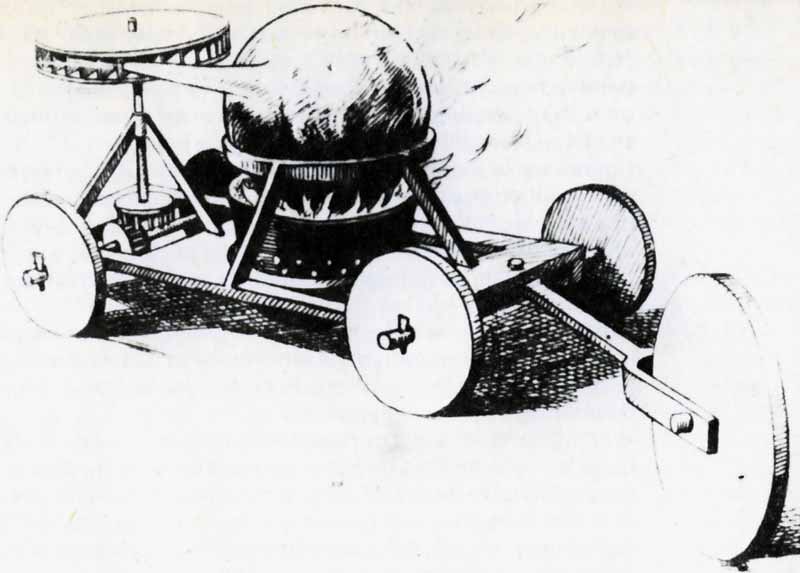
What Verbiest designed was a steam-powered vehicle. It was designed without a driver in mind as it was only a little over 25 inches long and though he describes it in his book Astronomia Europea, it’s not clear whether or not he ever built it. Still (not to take any credit away from Karl Benz) this may have been, at least in concept, the world’s first ever self-propelled “car.”

SteamMachineOfVerbiestIn1678

So let’s skip ahead a few centuries. I don’t know whether or not you yourself have one of those nerdy know-it-all friends like Verbiest, but fortunately, we all have access to one. In our house, we call him “Google.” Thanks to our smart phones this “friend” now goes with us everywhere and he knows (or at least he thinks he does) pretty much everything about anything.

photo credit: Mez Love via photopin cc

Of course you do have to be a little careful because he can’t always be counted on to give you an entirely correct answer. For example, you might ask him who invented the first car and he’ll direct you to some silly blog post about Ferdinand Verbiest, which you should probably just ignore.

But he has held up his end of the nerdy know-it-all friend bargain in the gadgety toy department. After all he did make you a pair of glasses that allow you to pretend to be the Terminator. And now he’s made you a self-propelled car that is designed without a driver in mind.

Just yesterday, Google announced that this summer, it will have about a hundred prototype vehicles ready for testing, without a gas pedal, steering wheel, or brake pedal among them. But don’t worry, your friend Google isn’t a complete idiot. He will include two seatbelts just in case some irresponsible driver of a regular old human-controlled car slams into you.

The new self-driving car seats two, won’t go over 25 miles per hour, and, frankly, looks kind of like a toy. Google hasn’t released a name yet for its newest gadget. I’m thinking it should be the Google Doodlebug. I’m also thinking, I probably won’t be lining up to drive ride in one any time soon.

Literacy and the Racist Kangaroo

Though I wasn’t born until more than twenty years later, one of the most important moments of my childhood occurred on this day in history. You see, on the fifteenth of May, in the Jungle of Nool, in the heat of the day, in the cool of the pool, he was splashing…enjoying the jungle’s great joys…when Horton the elephant heard a small noise.

hortonbook
photo credit: CCAC North Library via photopin cc


Dr. Seuss’s Horton Hears a Who! was published in 1954 and it was by far my favorite in our family’s collection of children’s books. The reason is simple. It was my dad’s favorite, too. In fact I can’t remember a single time when I climbed up on his lap to read a book that he didn’t begin with those oft-recited lines, regardless of what book I had brought him. The joke never got old.

But it wasn’t just that my dad loved the book so much. I think, in retrospect, the famous line, “A person’s a person, no matter how small,”resonated with me, the youngest child in a family of high achievers. And, the part of me that has always been a little bit writerly appreciated that Dr. Seuss so gracefully pulled off an obvious plot hole when Horton searches the clover field for the Whos that then beg him to take care of them when, really, if they’d just been allowed to rebuild in the clover field they’d have been perfectly safe.

That doesn't look like such a bad place to land.   photo credit: ajari via photopin cc
That doesn’t look like such a bad place to land. photo credit: ajari via photopin cc

Looking back, I get now why he couldn’t do that. If he had, the allegory would have broken down. Maybe. Of Theodore Seuss Geisel’s many books most have been scrutinized for subversive meanings. Some of them Dr. Seuss explained during his lifetime. Horton Hears a Who!, he didn’t. Still, neither he nor his widow ever refuted the widely held assumption that the book was an allegory for the post WWII relationship between the United States and Japan.

Politically, Dr. Seuss was an active Democrat, a believer in large governments taking care of small, and with one glaring exception, was outspoken against racism. Turns out, he wasn’t much of a good friend to the Japanese. He strongly supported internment camps for Japanese Americans, refusing to differentiate them from citizens of Japan.

He made his opinion very clear with a series of terribly stereotypical political cartoons that sought to dehumanize the Japanese and foster fear and animosity toward them. Had he tweeted them he might have been banned for life from the NBA or at least fined by the NFL and forced to apologize.

Um...Dr. Seuss?
Um…Dr. Seuss?

But by 1954, Dr. Seuss’s perspective changed. Hitler’s Axis had been defeated, Japan’s population had suffered terribly at the hands of the United States and its atomic bombs, and for the most part, the US postwar occupation of Japan had drawn to a close with a flourishing democracy and the promise of a bright future (with robots).

After the war, Dr. Seuss had the opportunity to visit the country. While there he was impressed with the culture and people he had previously belittled in his cartoons. In Kyoto he befriended a professor named Mitsugi Nakamura to whom he dedicated Horton Hears a Who!

So just as the people of Japan faced the threat of annihilation by atomic weapons, the citizens of Whoville face a deadly bath in boiling beezlenut oil. In a parallel to the US effort to protect and guide a postwar Japan, it is through a combination of a strong protector and the tremendous effort of a proud people that the Whos are saved.

photo credit: daveparker via photopin cc

In the end, a racist kangaroo that has worked tirelessly to spread anti-Who propaganda, villainized anyone who would stand up for the little guys, and has even attempted to ignore the Whos’ very existence is redeemed in a dramatic turnaround. And the little kangaroo in her pouch learns a big lesson, too.

I doubt very much that Dr. Seuss intended for many of his readers to get all of that from Horton’s adventure with the Whos of Whoville. He claimed he never wrote from a moral because “kids can see a moral coming a mile off,” but admitted “there’s an inherent moral in any story.” He was also a big believer in giving people in general and children in particular the tools to become great thinkers.

So I don’t think he would be bothered by the fact that when as a child I read, “A person’s a person no matter how small,” I assumed he was talking about me. I think he’d be glad to know that this book, more than any other, launched me toward literacy. And I hope it would bring a smile to his face to know that even now, the fifteenth of May makes me think of cuddling up with my dad and a good book and of Horton and the Whos and of the redemption of a racist kangaroo.

photo credit: Tatters ❀ via photopin cc