You’re It!

A late 19th century stroll through the open spaces in German towns may have brought you face to face with a group of laughing children engaged in the fast-paced game of Iron Tag. This is according to the writings of philosopher, teacher, and folklorist William Wells Newell. Newell, who is best known for founding the American Folklore Society in 1888, had a particular interest in the habits of belief he found among children.

His book Games and Songs of American Children published in 1883 explores the persistence of folk beliefs that have leaked into the imaginations of children and manifested as imaginative play. Among the discussion is a description of the classic game of tag pretty much as we all know it still today in which a selected “it” must chase and tag the other children, whose job it is to stand on base and relentlessly tease their hot and sweaty pursuer.

Nederlands: of uploader heeft geen info achter...
Children’s Games (1560) by Pieter Brueghel. I think I can see an intense round of toilet tag in there. (Photo credit: Wikipedia)

Newell traces the origin of the game to the “original form” of iron tag, which according to him was still common through Germany and Italy in his day (apparently American children had already moved on to the highly advanced “Toilet Tag” version).

Iron tag, as the name suggests, declares that the pursued children are safe as long as they are touching something made of Iron. This is of particular interest to a folklorist because of an ancient superstition that iron is a great source of protection from evil. The belief is prevalent across many cultures probably because the highly useful element occurs naturally in large quantities in the earth, because blood (the life force) contains and smells of iron, and because the wearing of an iron suit powered by a fictional inexhaustible energy source makes one a virtually invincible superhero.

The Mark III armor as featured in the 2008 fil...
I don’t know about you, but I feel safer with Iron Man around. (Photo credit: Wikipedia)

According to Newell, the “it” in a children’s game of tag represents an evil spirit from which the pursued children must escape, mostly because he is quite the risk taker given that he recently caught a tiger by the toe leading his mother to sock your mother right in the nose.

Newell’s point is a good one, I think. Folklore, he argues, is not merely the realm of adults, but also influences the lives and creativity of children, which we can see in the history of the way even silly games (except of course for “toilet tag” which is serious business) have developed over time.

Where I think he’s wrong is in his assertion that “iron tag” was the original form of the game. It turns out it’s not actually so easy to trace the history of tag. I suspect this is because the game is more or less innate (kind of like Monopoly). We can see lots of young animals engage in tag-like play as they are learning life skills like pouncing, escaping, and irritating the adults in their lives. Human children, too, seem to play versions of tag as soon as they are old enough to chase.

Lion cubs Serengeti
You’re it! (Photo credit: Wikipedia)

And I have it on good authority that the assassination of Julius Caesar and the eventual fall of Rome was really just a byproduct of a game of tag gone wrong. If you want details, you can check out the insightful and thorough treatise on the subject by The History Bluff (who’s blog is nearly as authoritative as this one) here.

But however the game began, it has persisted through the ages and emerged as just plain old fashioned fun. There’s even a group of ten friends from Spokane, Washington who have been engaged in a single game of tag for twenty-three years even though they are now in their forties and living all across the country from one another. The men say the reason they still do it is because it keeps them in touch with one another and fosters lasting friendships among them.

While the rest of us scrape by making the occasional comments on photos of our growing families on Facebook, these men actually fly across the country in order to tag the next “it,” thereby turning this childhood game into the great force for networking and relationship building it was probably always intended to be.

I say this because I recently had the honor of being tagged in a similar game. No one caught a plane and hid in my trunk awaiting my arrival so that they could hand off the terrible burden of being the slow kid. Instead I was “tagged” by a fellow blogger and writer with some questions to answer and pass on to three lucky new “its,” specifically writers who have blogs.

First I’d like to say a big thank you to Donna Volkenannt who is the winner of 2012 Erma Bombeck Global Humor Writing Award and the genius behind the blog Donna’s Book Pub, which is a great resource for writers. Donna claims that she just brushed my arm with her finger tips, so, you know, whatever. I guess I’m it.

English: Children playing a variant of tag. In...
Okay, okay. You got me. (Photo credit: Wikipedia)

The Questions:

WHAT ARE YOU WORKING ON RIGHT NOW?

I am in the process of seeking representation and publication for my first historical novel, the story of a fortune-teller from 19th century New York State with a troubled past, a unique talent, and a secret with the potential to unravel one of the most successful deceptions in US history.

In the mean time, I have returned my attentions to short fiction and essay as I research my next novel which will center on a movement among some American abolitionists to establish the nation of Liberia.

HOW DOES IT DIFFER FROM OTHER WORKS IN THE GENRE?

I’ve found there is a lot of variance in historical fiction, but that it basically boils down to two ends of a wide spectrum. On one end are the novels that closely follow the life and story of a known historical figure. The other end of that spectrum would be novels that take place in a particular time and place, but that include only wholly fictional characters that are drawn from the details typical of people from the era in which the author has placed them. My first novel fits between the two. My main character is entirely fictional, though throughout much of the novel she interacts directly with a known historical figure and her experiences include actual historical events and people.

I chose this approach for this particular project because my character has discovered the “smoking gun” in a historically significant conspiracy theory for which there is no known resolution in scholarly writing. Since I was faced with offering an explanation that history itself has never revealed, I thought the best vehicle for doing so would be a character who is a representative of her era rather than a real-life participant in it.

WHY DO YOU WRITE WHAT YOU WRITE?

I write the kinds of things I like to read. I most appreciate fiction that re-introduces me to a world I thought I knew and makes me look at new details that draw connections I never suspected before. I think that’s why I’m so drawn to historical fiction because it immerses me in this world that is familiar, but that I’ve typically considered only through the lens of my own contemporary perspective. When I experience it through a cast of fictional characters, suddenly I find myself immersed in the era and attempting to bridge the gap between my experiences and knowledge to that of a person (whether based on a real person or simply drawn from the era) who approached the same story with an entirely different set of circumstances than I did. My favorite fiction makes me want to do my own research. I write what I write because I would love to inspire that desire in others.

WHAT IS THE HARDEST PART ABOUT WRITING?

I think the hardest part for me is generating that first, terrible rough draft. Most writers, I think, will agree with me that the real work on a story begins when the rough draft is over and the revision starts, but you never get to that part if you don’t first get the thing written. It can be really uncomfortable to return to an unfinished draft to forge ahead with the story when I know darn well that what I’ve already written is full of obvious holes, lazy word choices, and even the kind of bad grammar that would embarrass me right out of the industry. Still, forge on I must, because until I’ve written that overly sentimental ending that I will most certainly change later, I don’t stand a chance of completely restructuring the first chapter.

Corona Typewriter
If I had to use one of these, I’d be in trouble. (Photo credit: alonso_inostrosa)

And now it’s time to tag three more writers so we can all benefit from what I am sure will be their insightful answers to these questions. So…

Chelsea Brown (The Jenny Mac Book Blog)

Samuel Hall

Michelle Ule

I totally got you! Oh, and, of course, no tag backs.

True Tales from the First Grade

This week I have had the pleasure of learning a great deal about one of the most beloved figures in the history of American pioneering days. I refer to Johnny Appleseed, who, frankly, I didn’t know for sure even existed. I thought I would pass some of this wealth of knowledge to you, dear reader, because I’m guessing that like me, you may have a somewhat muddled image of this legend.

First of all, he did exist. His real name was John Chapman and (not surprisingly) he had a thing for apple seeds. In the first part of the 18th century, just as settlers were headed out to tame the wilderness of Ohio, Indiana, and Illinois, John Chapman set out ahead of them. He travelled most often on bare foot, scattering apple seeds willy-nilly as he went, pausing only to participate in the occasional flash mob.

Polski: Salsa flash mob w Złotych Tarasach, 29...
If you look closely you can just see the top of Appleseed’s head in the very back. (Photo credit: Wikipedia)

Johnny Appleseed was a loving man, whose compassion for the poor was as famous as was his dancing. He delighted in defending the helpless from bears with his trusty rifle. And he travelled extensively through Europe and into the volcanoes of Hawaii to scatter apple seeds.

Okay, so it turns out, my source may not be all that reliable (imagine!). It is, in fact, my six-year-old son who came home from his first grade class full of lore and a new found love for everything apple.

So it seemed like a good idea to take the boys to a nearby U-pick orchard, and to check a few facts. It turns out it is true that the legend of Johnny Appleseed developed from a real man named John Chapman and he was famous for his compassion. He really did travel almost exclusively on foot (and rarely wore shoes) from Pennsylvania, most likely as far as Illinois for the purpose of planting apple seeds.

Where the legend gets a little fuzzy is with his motivation for all this extreme farming. Some historians have suggested that he was one of the most successful businessmen and landowners in the early days of the settled Midwestern US. I can see their point. Apples were an extremely important crop in the early pioneering days, and not only because apple crisp is super delicious.

With water sources so often contaminated, apple cider was a safe way to get water (and, if allowed to ferment, a buzz). Apples themselves are a long-lasting, easily stored food source. And perhaps most importantly, vinegar can be made from apples, which allowed pioneers to preserve food. That is, if they didn’t use all of their harvest to make apple crisp.

This was AWESOME
Who needs clean drinking water when you could have this? Yum!(Photo credit: Wikipedia)

Whether or not he was a strong tenor or a graceful dancer, Chapman was certainly a sound businessman. He didn’t scatter his seeds willy-nilly. Instead, he planted them very deliberately near water ways where settlers were likely to end up and where the trees were likely to thrive. He fenced them in, enlisted help at times to care for them, and visited his far-flung orchards whenever he could to make sure they were doing well and to distribute trees to new settlers.

Like any good capitalist, Chapman found a market demand and supplied it. But even though he was highly successful, that’s not what made him a legend.

Business boomed, and Chapman could have been a very wealthy man. Possibly he even was at times. He didn’t exactly hesitate to sell his trees for a profit, but he also didn’t deny trees to any of the pioneers who couldn’t afford to pay for them. For payment, he often accepted the scraps of cast-off clothing that were all he ever wore, or sometimes even just an IOU that he never bothered to collect on.

You see, Johnny Appleseed was never in the business of making money, but rather the business of evangelism. He was a devout follower of the Swedish mystic Emanuel Swedenborg whose accounts of his prophetic visions revised and to some extent replaced Christian teachings in the minds of his followers. Chapman shared his apples, and Swedenborg’s writings until his dying day.

“Prophets” were more common than apples in the back woods of the United States in those early days, and Swedenborg’s teaching never gained much momentum there. But Chapman’s apples certainly took root and his compassionate nature and simplistic lifestyle became the stuff of legend.

As for my son’s other claims, Chapman was a strict vegetarian who once extinguished his campfire in order to spare the mosquitoes that might accidentally fly too close to the flames. According to most accounts, he travelled with little more than a book, a cooking pot hat, and his apple seeds, so I think it unlikely that he shot very many bears. And though there are stories that probably originated in the few years following Chapman’s death that he planted apple trees as far away as California, there’s absolutely no evidence he ever travelled to Europe or Hawaii. There are also rumors that he and Elvis have been running a successful used car dealership in Boise. I hear they sell excellent apple crisp on the side.

And, sure, I somehow doubt that I’m getting a perfect account of first grade curriculum. My son (and I have no idea where he gets this trait) has the tendency to fill in the occasional imaginative detail. But I think that might be in keeping with the Johnny Appleseed legend anyway. From the painfully simple life of this one devout, apple-obsessed little man has emerged a great spirit of ecology, adventure, and love.

Of the real man behind the legend, we may only know two things for certain: flash mobs are awesome and apple crisp is delicious.

English: Drawing of Jonathan Chapman, aka John...
I’d probably buy a car from this man. (Photo credit: Wikipedia)

In Recognition of the Little Guy

In the fall of 1780, John Paulding of New York State went to pay a visit to his sweetheart Sarah Teed. Paulding stood at over six feet tall and while today this would hardly guarantee him a spot in the NBA, for the era, he was impressively large. Perhaps it was for this reason that Sarah’s brother decided to surround his sister’s beau (I’m guessing he didn’t approve of the relationship) with the help of several armed friends. Of course it could also have been because Paulding was a known Patriot and American militiaman while Sarah’s brother was an active Loyalist.

Not surprisingly, Paulding didn’t take kindly to the threatening nature of the encounter and opened fire on the Loyalists, injuring several before he was captured. Most of the attackers wanted to kill him on the spot, but Ensign Teed convinced them to spare the young man’s life, proving, I think, that a sister’s wrath is far more dangerous than a few gunshot wounds.

So instead, Paulding’s captors took him to the makeshift “Sugar House” prison set up by the British in New York City where he spent one night before escaping by jumping from a window in broad daylight, because (and again I’m just guessing here) he was also a ninja.

Mikya ninja
Tall and stealthy. Not a man to trifle with. (Photo credit: Wikipedia)

His next stop was the nearby livery stable where he scrounged up a green coat, of the type commonly worn by the German soldiers hired by the British to fight in much of the Revolutionary War. Once disguised, he made his way fairly easily back toward home, where a few days later it was business as usual (though I suspect he avoided the Teed household for a while) as he headed out on patrol with a couple of militia buddies, now wearing his new green coat.

The next part of Paulding’s story may be more familiar to those of you who are American Revolutionary history buffs because while on patrol, Paulding and his buddies (Isaac Van Wart and David Williams) came upon the British spy Major John André who was famously hanged for his collaboration with the American traitor Benedict Arnold.

John Andre http://www.loc.gov/loc/lcib/0304/pa...
John Andre: “Nice Coat, man. So hey what do you think about the British. Pretty crazy, right?” (Photo credit: Wikipedia)

Relieved to see that one of the armed men he met was wearing a familiar, and usually friendly, coat, André began to feel out the men’s loyalties. Unfortunately for him, Paulding was as clever as he was tall and under his leadership, the three militiamen soon took the spy into custody, reportedly refusing an extravagant bribe. For their efforts, the three men were eventually awarded the first ever Fidelity Medallions upon the personal recommendation of George Washington.

The Fidelity Medallion. At least as prestigious the Liebster Award. Maybe even more. (Photo Credit: Wikipedia)

I tell you this story because some suggest that it is the oldest example of a military award being bestowed upon men of common birth. In other words, it was the first time anyone had bothered to recognize the little guy. Now, I can’t prove that’s true, and I kind of hope it isn’t. I’d like to think that people long before 1780 were willing to give a nod to their fellows, but then there is some truth, even well beyond the scope of the military, to the idea that often accolades go to recipients who don’t really benefit much from them while the little guy who could use a pat on the back, often goes unnoticed.

liebster_award
Nowhere near as prestigious as the Fidelity Medallion, but pretty great anyway.

So with that in mind, I am extremely honored to have the opportunity to pass on a wonderful blog award that was recently given to me. The Liebster Award recognizes blogs that don’t yet have a whole lot of followers (fewer than 200). In fact, I am truly amazed to say that I no longer fit the requirements for the award. Just about a week ago the editors at  Wordpress chose my recent post about the taxation of beards by Russia’s Peter the Great to be featured on Freshly Pressed. The response has been overwhelming. In one week, more than 150 new readers decided to follow my silly little history blog. Wow! And there are more new people who have dropped in to “like” or comment upon posts I have written.

I would like to say a big thank you to all of you who are new to my little corner of the blogosphere. Before you arrived, I had been writing for a pretty small audience about moments in history, my life, and the point at which the two occasionally connect, no matter how far I have to stretch it. Since my posts do require a fair bit of research to put together, there have been  times when I’ve been discouraged that there aren’t more people reading. And I know there are other bloggers out there just getting going and sometimes feeling a little frustrated that there aren’t many people reading. That’s why I am accepting the Liebster award, so that I can give a nod to other little guys out there.

The Rules:

1. Thank the person who nominated you and link to their blog.

2. You must answer the 10 questions given to you by the nominee before you.

3. You must nominate 10 of your favorite blogs with fewer than 200 followers and notify them of their nomination.

4. You must come up with 10 questions for your nominees to answer.

Thank you very much to Rachel Malburg whose blog Simple.Fun.Raw could soon become my new favorite food blog. She had me at brownie bites.

The Questions:

WHAT WAS YOUR FIRST JOB?

I was a camp counselor, a job that taught me important things like how to build a perfect fire that can be started with only one match (after 10 or 12 tries), every last stinkin’ verse to the song Boom-Chicka-Boom, and how to make the perfect s’more (while hiding the leftover chocolate from the campers so that staff can eat it on the weekends)

WHY DID YOU START BLOGGING?

I guess the most honest answer is that like so many of us blogging types, I am a writer, who wishes to someday be a bestselling author, or, at least to have someone maybe read my books and kind of like them. I guess, then, you could say I am in pursuit of the almighty platform. But beyond that, I always thought newspaper columnists like Dave Barry had the very best job in the world and with the death of print media, came the rise of the blog. So here I am.

WHAT KIND OF FAMILY DID YOU GROW UP IN?

Think Leave it to Beaver. More or less.

IS THIS WHERE YOU THOUGHT YOU’D BE AT THIS AGE?

I’ve made a lot of plans in my life. Some have worked out. Some haven’t. But I can definitely say I am very happy with where I am right now.

WHAT IS YOUR FAVORITE PLACE YOU’VE EVER VISITED?

The California Redwoods. It’s like hiking through a fairy tale.

IF YOU COULD TRAVEL ANYWHERE IN THE WORLD, WHERE WOULD YOU GO?

There are simply too many places I’d like to go to answer that question. For right now, I’m working to complete the goal of reaching all 50 US states by age 50.

WHAT’S THE MOST EXPENSIVE THING YOU’VE EVER PURCHASED?

A home in Oregon just before the bottom fell out of the housing market. Sometimes adventure is expensive.

CAT OR DOG PERSON?

I’m kind of a crazy fish lady.

WHAT’S YOUR FAVORITE MOVIE?

The Princess Bride. 26 years later, nothing has yet been able to top it.

And last but not least…

SO WHAT EVER HAPPENED TO JOHN PAULDING?

Okay, it’s possible that this was not the question actually put forward by Rachel, but it really isn’t fair to ask a writer to name her favorite book. And since you asked, he lived the life of a hero, died of natural causes, and now has many streets, parks, and elementary schools named after him. He also married Sarah Teed. I doubt her brother was invited to the wedding.

The Nominations: These are a few blogs that have piqued my interest, but that don’t have a huge following yet. Some are pretty new and are probably still working to find their voice, but worth watching, I think. A few have been around for a while and are just looking for their audience. Perhaps they will pique your interest, too.

1. Book Smart Literary Reviews

2. LoriCamper.com

3. Barrywax

4. Biggest Ball of String

5. History Undusted

6. 25 True Stories

7. Ingilblogger

8. Not So Distant Past

9. Professor Mondo

10. Economics Courageous

As for questions to the nominees, um, same questions, I guess? Except maybe that last one. For that, you get a freebie.

A Hairy Tax Scheme: Ridding Society of Superfluous Burdens

As Englishman John Perry walked through the streets of Veronezh, Russia at the tail end of the 17th -century, he encountered a man he had known for some time, but whom he hardly recognized. The man was a carpenter with whom Perry, an engineer who served in the court of Peter the Great, had worked before. For as long as Perry had known him, the carpenter, like most Russian men of the day, had worn a long beard and untrimmed mustache. Fresh from the barber, the carpenter now had a smooth face.

Perry exchanged a few pleasantries with the man and then asked what he had done with his beard. In response, the clean-cut carpenter pulled the beard from his breast pocket and explained that he would keep it someplace safe and that one day it would be placed back upon his face in his coffin. That way, when he reached the pearly gates, St. Nicholas (who as we all know has a beard that’s long and white) would know him.

The carpenter had become the latest victim of the tsar’s beard tax. Peter the Great had recently returned from what Wikipedia calls an “incognito” tour (meaning, I can only assume, that he wore a big bushy fake beard) through Europe in an attempt to drum up international support for his military campaign against the Ottoman Empire. His efforts failed (because obviously 17th-century Europeans hated beards), but Peter had learned his lesson and on September 5, 1698, he issued a beard tax on the men of Russia (thus, essentially outlawing “No shave November.”)

Peter I, Emperor and Autocrat of All the Russi...
Peter the Great sporting a highly fashionable (and completely legal) mustache (portrait by Paul Delaroche, 1838). (Photo credit: Wikipedia)

And it was hefty, too. Wealthier citizens were required to pay 100 rubles per year (that’s something like, well, a lot of rubles, I bet). The rest of the citizens had to pay a Copek (which is also probably a lot of Copeks) for the privilege of sporting a beard. In addition to the right to keep their whiskers (and incur the wrath of the tsar), payment of the tax also bought the unshaven a medallion they had to wear as proof of their legal right to bear registered whiskers. Evidently, concealing a beard inside your breast pocket did not require additional licensure.

English: A beard token, received for paying th...
The beard token contained the roughly translated words: “The beard is a superfluous burden.” (Photo credit: Wikipedia)

The only men exempted from the law were the clergy who were allowed to maintain long beards and traditional dress, as the rest of the country embraced modern fashion trends. Even so, the clergymen were pretty hacked off about the whole thing and launched a pamphlet campaign, claiming that Peter (the Great Heretic) had gone much too far.

Like often happens with poorly handled calls to conservative ideals, the young men of Russia thumbed their noses at the outraged clergymen and happily got up early for work so they’d have time to shave every day. The real reason, of course, for the radical support of the misguided policies of the tsar was that the young ladies of Russia responded positively to the change.

I doubt such a tax would ever fly today, though, at least not here in the US where the beard has now taken on social icon status and the men who wear them are far more likely to carry a duck call and a shotgun than to wear a medallion.

And I can’t speak for all ladies, but for me personally, I don’t mind so much. Now, I’m not a big fan of long bushy facial hair, but a nicely trimmed beard tells me that while a man cares at least something for personal hygiene, he is also practical and confident enough to forego the daily ritual of shaving. I wouldn’t want to begrudge him that option.

So I asked my husband (a handsome and neatly trimmed bearded fellow) what he thought about a beard tax. His anger at such a concept was as swift and unyielding as was that of the pamphlet-wielding Russian clergymen of old. I have to admit, the tax does seem remarkably unfair because men who wear beards already have to make great sacrifices in order to do so.

For example, this past weekend, when our family cooked out at the grandparents’ house, we made s’mores, which we all enjoyed immensely. All, that is, except for my husband, who when questioned by our boys as to why he wasn’t eating one of the gooey treats, replied by explaining that a bearded man must avoid melted marshmallow when he is far from his own shower.

S'more
S’more: well worth a close shave, I’d think. (Photo credit: Christopher S. Penn)

Historians have suggested that the Russian beard tax was a part of Peter the Great’s attempt to modernize (meaning Europeanize) his country, but there may have been a few practical advantages to the law as well.  Regardless of his motive, Peter’s tax was more or less successful. And it wasn’t finally repealed until 1772, by which point John Perry’s carpenter friend had probably long since carried his beard into Heaven.

Stepping in Toxic Waste: A Guide to Fashion after Labor Day

This past Sunday morning I selected from my closet a pretty white dress I recently bought on sale (because it looks awesome on me). My husband looked at me and instead of saying, “You look really nice,” opted for the comment: “Good thing you’re wearing that while you can because next weekend is Labor Day.” Oh, and then he offered the obligatory compliment (because I really did look nice and he’s the kind of man who isn’t going to let that go unsaid).

But wait a minute. Although no one who knows me would accuse me of being a fashionista (which I don’t believe is a real word), I am the member of my family whose fashion sense is most often consulted. My husband rarely wears a new shirt/slacks combination without asking me if it works okay, and I often send my eight-year-old back to his room to change into clothing that at least matches a little. For my stubborn six-year-old (who on this 100° day chose to wear a long-sleeve red and gray Mario Brothers shirt with green and brown plaid shorts) there is no hope.

So, even though I probably wouldn’t have chosen to wear my pretty white dress after Labor Day, (because I was raised with a vague awareness that that is a fashion faux pas), I was stunned to hear my husband make reference to this hard and fast law of fashion.

Of course many suggest that it’s no longer a hard and fast rule, but it’s still out there and is generally followed by a lot of us. The origin of the guideline that suggests you should put away your white wardrobe between Labor Day and Memorial Day is a little unclear, but there are several theories about the social factors that may have contributed to its development.

Gabrielle "Coco" Chanel
Actually Coco Chanel wore white after Labor Day long before it was cool. (Photo credit: Wikipedia)

First, summer is hot and industry is dirty. In the late 1800s, the wealthy who could escape the sweltering city summer, retreated to the country where there was significantly less industrial goop in the air and on the streets. There they were free to wear the white they could not wear in the filth of the city, where the working class wore much more practical, dirt and soot-colored clothing. Of course all good things (like summer vacation) must eventually end and so with the return of fall, came the return of drab colors.

Logically it follows that the distinction of wearing white in the summer months became closely associated with the wealthy who wished to differentiate themselves from the working class. But Industrialization brought with it lots of new money and an emerging strong middle class. Much of the population found itself needing to navigate a new social landscape and so rules developed to help. One that’s easy to remember (and enforce) is that of wearing white only between Memorial Day and Labor Day (holidays that were established in the second half of the 19th century and had come to mark the beginning and end of summer in the US).

English: Labor Day Parade, Union Square, New Y...
English: Labor Day Parade, Union Square, New York, 1882 (Lithographie) (Photo credit: Wikipedia)

But my favorite theory as to why this simple fashion rule stuck for so long is the most cynical. Since New York has long been the hub of American fashion trends, the experts that drive it opted for practicality (who’d have thought?). Since the region’s rainy fall begins sometime around Labor Day most years, the experts declared that at that date it was no longer acceptable to wear white, a declaration that failed to consider weather patterns elsewhere in the nation.

Whether or not there is any truth to that last theory, most fashion experts now generally agree that you can wear white year-round (and since they carry a fashion police badge, you’d better listen). Of course in the same breath they will advise you to wear “winter whites” after Labor Day, whatever that means (as far as I am concerned, if it isn’t in the Crayola box, it isn’t a color). I guess you have to be a fashionista (which is definitely not a real word, whatever Miriam-Webster has to say on the subject) to understand the subtle nuances of all the rules.

If it's a color, you will find it in there somewhere.
If it’s a color, you will find it in there somewhere.

But since I am (or at least was until this past Sunday) the closest thing my family has to a fashionista (a word apparently coined when I was in high school; I wasn’t one then, either), it falls on me to take the kiddos shopping. Because they hate it, this is a task I perform only when it absolutely must be done. And as they can no longer wiggle their toes inside their cramped gym shoes, it had to be done this week.

Now I don’t know if you have shopped for tennis shoes in the last month or so, but as we have approached Labor Day, for some reason the tennis shoes have gone from traditional white (or occasionally gray or black, if you’re feeling a little wild) to the color of toxic waste (also known as “winter white”?). So I have to assume that the fashion experts have been lying to us and it is, in fact, a terrible fashion misstep to don white shoes at this time of year.

English: tennis Español: tenis
Call me old fashioned, but I just think this is what tennis shoes should look like, before they turn dingy gray anyway. (Photo credit: Wikipedia)

I don’t have a problem with bright colors (Crayola lists a few “neons” among its collection) and actually I can’t say that I hate my eight-year-old’s choice of shoes sporting neon carrot or even my 6-year-old’s laser lemon selection (which should pair nicely with his green and brown plaid shorts). The shoes look good on them in that adorable-little-kid-who-likes-to-express-himself sort of way.

My only real complaint is that it so happens I needed new tennis shoes, too. And apparently the experts think I might also look good in toxic waste shoes (in that crazy-lady-who-talks-to-herself-on-the-subway sort of way).

I looked long and hard (on a return trip during school hours because the kiddos have no patience for this sort of thing) and I finally found a pair with an adequate toe box and arch with only a minimal amount of sea serpent blue and wild watermelon. Not really my best colors, I think, but who am I to argue with fashion? Perhaps I’ll wear my new shoes with my pretty white dress. After Memorial Day, of course.

Get a Bicycle. You will certainly not regret it, if you live.

In 1963, a leader for the Ozark Area Council of American Youth Hostels, Dick Leary, decided it would be a fun idea to take a nighttime bike ride through the city of St. Louis. He organized the event for a night in October and set it up to begin at midnight at Union Station. Unfortunately (because most people probably thought he was joking) Leary was the only rider to turn up.

Determined that it was still a good idea (and because I’m guessing he battled insomnia), Leary completed it himself and the next year managed to recruit a few more riders. Word started to get out and by the early 1970s thousands of participants were showing up to complete the ride every year.

Eventually, the event became known as the Moonlight Ramble, the longest-running nighttime cycling event in the world. Organized now through the University of Missouri-St. Louis, the route has changed a few times over the years, but the full course is always around 18 to 20 miles through the heart of downtown St. Louis on the early Sunday morning in August that occurs closest to the full moon.

And despite the addition of a premier riding group (personally I’m not sure how anyone can take themselves all that seriously while sporting glow necklaces snaked through their bicycle spokes), the Ramble is NOT a race (shoe clips are not allowed, nor are they advisable). It’s a ride. All ages, all ability levels, and even all manner of wheeled, human-powered vehicles are welcome. I (typically sound asleep by no later than 10:30) rode in the Ramble for the first time this year, along with my sister and a handful of her cycling buddies, most of whom had participated in the event before.

Okay, so maybe "human-powered" isn't a strict requirement.
Okay, so maybe “human-powered” isn’t a strict requirement.

It was a gorgeous night, under the nearly full moon. The first riders took off from Busch Stadium at 12:10 (after a slight delay for traffic from the preseason Rams game). As there were probably four thousand riders, it took a while to get us all going and even with the best efforts of the St. Louis police department and an army of volunteer ride marshals, it took a bit for the remaining downtown traffic to adjust to the onslaught of bicycles (most drivers smiled to see us; a few were cranky). Once we were really going, though, I have to say it was one of the coolest experiences I’ve ever had in the city.

Now, I realize that this is generally a (sort of) history blog and that this particular post has thus far come up a little short in that area (unless you’re really easily satisfied and a brief reference to 1963 is enough for you), but I think I can make a case for why it still fits. And to do so, I am going to direct your attention to the expertise of Professor Kenneth Jackson who teaches the History of the City of New York at Columbia University (and who is a much more reliable source of all things history than is yours truly).

Since he began teaching the class in the late 1970s, Professor Jackson has led his students on a nighttime, five-hour bicycle tour from Columbia University to the Brooklyn Promenade. Along the way, Jackson stops at various points of interest to deliver lectures through a bullhorn to the now hundreds of students that come along for the ride.

The professor admits, however, that it is not so much the knowledge shared in his lectures that sticks with the students, but simply the experience of seeing the city in this strangely intimate way, when the moon is bright and the streets are quieter (a little bit anyway, but of course this is New York we’re talking about). One student had this to say about standing in front of Federal Hall at 4:30 AM: “In this sleepy blur I catch myself imagining that I’m there, imagining that [Professor] Jackson is Washington and we’re getting ready to start this new republic.” Another student commented: “This is the first time I feel like I’m really living in the city.”

That's a lot of people "really living" in the city of St. Louis.
That’s a lot of people “really living” in the city of St. Louis.

I get that. I grew up not so far from St. Louis and I have been delighted to be back again, nearer still to what I consider “my city.” Since moving here this past February I have taken my children up in the Arch, explored the Zoo, wandered through the Botanical Garden, enjoyed the theater at both the Fabulous Fox and the outdoor Muni, and been to Busch Stadium to watch the Cardinals play more often than I should admit (I lived two entire baseball seasons in Oregon and apparently distance really does make the heart grow fonder).

After riding the Ramble, all of these different places found a home in that mental map that I always wish I was better at carrying around with me (you may recall that in a previous post I mentioned that my sense of direction is, well, okay so I don’t actually have one). I may not have learned a great deal about the history of my city on this ride, but I did get to know St Louis itself better and be a part of it in a way I never had before.

Bill Emerson said it well in 1967 when he wrote in the Saturday Evening Post: “A bicycle does get you there and more…. And there is always the thin edge of danger to keep you alert and comfortably apprehensive. Dogs become dogs again and snap at your raincoat; potholes become personal. And getting there is all the fun.”

Nighttime cycling is not perfect. The Ramble attracts all kinds of folks, the serious cyclists and the families out to make lasting memories together, but also the rowdies whose frequent beer stops make it best to avoid them.  I also certainly wouldn’t recommend a nighttime ride outside of an organized event. But late night ride events and tours are popping up all over the world (Paris, London, and Moscow are just a few of the cities that I discovered offer similar experiences).

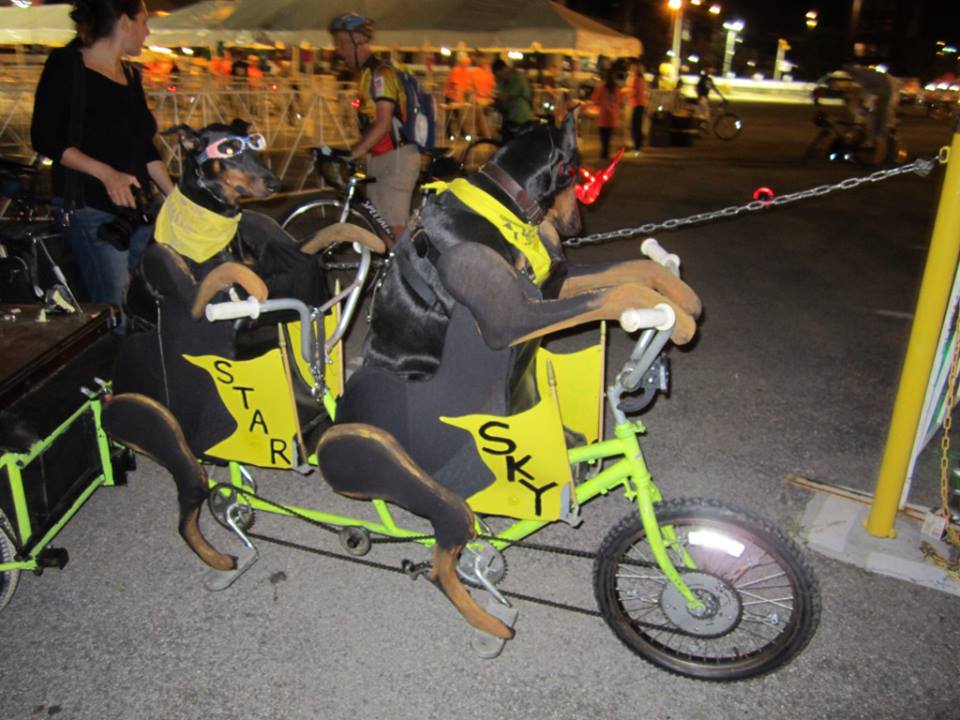
I don't know what this thing is, but it was probably the coolest vehicle in the ride.
I don’t know what this thing is, but it was probably the coolest vehicle in the ride.

But even if you don’t own a bike (often they can be rented), haven’t ridden since you were a kid (you never forget how), or for some reason would prefer sleeping to rambling in the moonlight, consider taking some advice from Mark Twain who once learned to ride one of the old-timey high-wheeled bicycles of his day and had this to say of the experience: “Get a bicycle. You will certainly not regret it, if you live.”

Here We Go!

This morning I sent my youngest son to his first day of first grade. He’s a smart boy, usually pretty well-behaved (or so I hear from other people), friendly, and very funny. I know that he will do well with school this year. But for some reason he is incredibly nervous about this venture into first grade.

The poor kid ate very little breakfast and wouldn’t say much. When I asked him what he wanted to wear for his big day, he thought for a while and then chose a camouflage tee-shirt because he wanted to be able to hide if he got scared. I gave him a hug and told him he would be a great first-grader. Then I told myself he would be fine. And I told my husband (apparently several times) that our little guy would be just fine.

I have to hand it to the brave little man. When it came time to go, he looked slightly panicked, but he shouldered his big blue backpack and went willingly into the building. I found myself whispering, “Here we go” and, once again, “he’ll be fine.” I started thinking back over this summer’s many adventures and smiled to realize that these were almost the same words I had whispered to him as I sat next to him on his first roller coaster ride.

In 1850, at the tender age of twelve, LaMarcus Adna Thompson successfully built his own butter churn and ox cart. But believe it or not, this was not the height of his mechanical prowess. After a time, young Thompson grew up (as all young men must), apprenticed as a carpenter, and designed a machine used for the production of ladies’ stockings.

English: LaMarcus Adna Thompson, the inventor ...

He soon founded the Eagle Knitting Company in Elkhart, Indiana. Alas, as the well informed (which no doubt means you) will likely already realize, the ladies’ stocking industry is incredibly stressful and really is no place for a young man destined for greatness. For the sake of his health, Thompson took some time away from his growing company for a doctor-prescribed trip west.

He then apparently disregarded his doctor’s advice (or he was not a particularly competent map-reader) and found himself in Pennsylvania where he observed the Mauch Chunk, Summit Hill and Switchback Railroad. The railroad was a clever way to cart coal from Summit Hill to the Lehigh River at Mauch Chunk (today that’s Jim Thorpe, Pennsylvania).

What Thompson saw was a cart full of coal and a couple of bewildered mules, rushing on a track through a series of switchbacks down the mountainside as fast as gravity would carry it. At the bottom, the cart was unloaded so that mules could haul it the long way back uphill.

Switchback R.R. (railroad), Mauch Chunk, from ...
Switchback R.R. (railroad), Mauch Chunk, from Robert N. Dennis collection of stereoscopic views (Photo credit: Wikipedia)

And an idea began to form in the inventor’s mind. Perhaps he thought about the mules (likely more stubborn than stupid) that willingly took the carts back up the mountainside to repeat the process. Or maybe he observed them carefully as they flew downhill and noticed that though they screamed they also threw their hooves in the air and smiled as though someone might snap their picture on the hairpin switchback turns.

Whatever the reason, Thompson thought the railway looked like fun and he hatched a plan to design and build something similar for people. His “Switchback Railway” opened at Coney Island in 1884 and was an immediate success, giving LaMarcus Thompson a claim to the title “Inventor of the Modern Roller Coaster.”

Mind you Thompson doesn’t have a great claim to the title. Russians started slipping down huge ice slides as early as the seventeenth century and the French built the first wheeled coaster by 1817. Still, Thompson can take credit for the first successful introduction of the roller coaster to the United States, where it’s been soaring to higher, faster, and “upside-down-er” heights ever since.

Thompson's Switchback Railway, 1884.

And I, for one, am grateful for his contribution. I experienced my first roller coaster as soon as I was tall enough to pass the safety precautions and once I started, I never looked back. On more than one occasion I have arrived at the entrance of an amusement park in time to be among the first through the gate for the sole purpose of running to the back of the park and riding the best coaster two or three times before the rest of the crowd caught up and the line got long. I have also been the kid who chose to ride the coaster back-to-back-to-back many times over as the park neared the close of the day and no one else was left in line to take my place.

So I was thrilled to take my two sons to Six Flags this summer and introduce them to the rides that defined many of the summer days of my youth. My eight-year-old is tall for his age and would qualify to ride any coasters he cared to try. My six-year-old, though too short for some, seemed determined to conquer any rides that frightened him.

It turned out that they weren’t as brave as I had hoped. I did get my older son on a few rides, with mixed reviews (for some reason the feeling of his heart thumping in his ears and his stomach turning somersaults doesn’t especially appeal to him). My six-year-old took a long time to get up his nerve, but he surprised me in the end, choosing to ride one of the smaller wooden rollercoasters, one with a large hill and a dark tunnel.  I admit I was concerned that he didn’t know what he was getting himself into. Still, once he had decided to give it a try, I doubt he could have been dissuaded (smart as he is, he is easily more stubborn than a mule).

As the lap bar lowered, I held him close and whispered, “We’ll be fine.” And as the train began to roll, “Here we go!” He did conquer his fear and though I don’t think he would say that he loved the ride, he is pretty sure he will try it again someday. I just hope he feels the same way about first grade.

Backpack fashion
Backpack fashion (Photo credit: aka Jens Rost)

Off the Scale and Into the Box, to Grandmother’s House We Go

Okay, okay, so I haven’t posted on this blog in something like a month. And yes, I am aware that there are dire consequences to such neglect. I know very well that if I am not posting, then no one can be reading and if no one is reading, then no one is talking about what I am posting, and if no one is talking about what I am posting then I will never reach the gazillion readers that might provide me with a large enough platform for a traditional publisher to consider taking a risk on publishing my novel that approximately .000001% of my blog followers will someday check out from the library.

I’m not complaining. The industry is what it is and I suppose it might be fair to say either I want to play or I don’t. Except that I do, most of the time. And other times, like over the course of the last month, I don’t. You could say I am taking an extended break. And, yes, I do mean “taking” because I probably won’t post again for something like a month. The reason for this is simple.

 My sons are 8 and 5 and they never will be ever again. In fact, my five-year-old is planning to turn six in the next couple weeks, and I’m going to have to let him. So while they are eight and five (almost six), I would really like their summer vacation experiences to include a mother who is available to read a book with them, or play a board game with them, or throw a ball with them. What I don’t particularly want their summer to include is a mother who is shoeing them away so she can read just one more blog, or research just one more post.

In fact, I am only sharing this one because I have shipped my children off for a couple days at Grandma’s house. Obviously I don’t mean that I literally shipped them since the US Postal Service declared back in1920 that it would no longer accept children as parcel post. And, yes, like all regulations (and safety warnings) that appear a little unnecessarily ridiculous, someone actually did it.

U.S. Mail Storage Box
But it looks so child friendly.

All 5-year-old Charlotte May Pierstorff of Grangeville, Idaho wanted to do was visit her grandmother who lived just 75 miles away in Lewiston, Idaho. Of course this was 1914 and so simply hopping in the family minivan and heading an hour or so down highway 95 wasn’t an option yet. The only good route across the fairly treacherous landscape was to take a train, an expensive proposition for the Pierstorff family.

Little May’s parents were poor, but they were also clever (or desperate for a date night).  They did what any caring parents would do. They pasted a postage stamp on their young daughter and dropped her in the mail. And at the time, they were completely within the law to do it.

The US Postal Service had begun offering domestic parcel post service in January of 1913 and while there were restrictions on poisons and certain types of live animals (smelly ones), there weren’t any regulations specifically prohibiting the mailing of people. Little May weighed in at 48 ½ pounds, just under the maximum allowable weight for a live chicken, which, it seems, was good enough for the Grangeville Postmaster.

Chicken Suit
And what grandma wouldn’t be delighted to receive this in the mail?

Mail clerk Leonard Mochel (a cousin of May’s mother, which makes the story a little less disturbing) took charge of the world’s largest chicken and saw her safely to her grandmother’s house in Lewiston. As a package, May’s train fare was only 53 cents, about a third of what she would have paid as a passenger.

May Pierstorff was likely the first child to travel by mail, but despite an outcry from postal employees, she was certainly not the last. Finally on June 13, 1920, the USPS announced that it could no longer accept children as parcel post, as children were clearly not “harmless live animals which do not require food or water while in transit.”

USPS service delivery truck in a residential a...
Just think of the mess my children could make of this back seat.

Having just driven my children the two hours to Grandma’s house in a car packed with snacks,  I have to agree with the USPS on this one. Children are most definitely not harmless (and they can be a little smelly). And believe me, despite my very noble sounding rationale for my lengthy absence from the blogosphere, I don’t think it will win me a Mother-Of-The-Year award any time soon. My kiddos still irritate me and there are days when I find myself wishing they would just hurry and grow up a little already. I still snap at them occasionally, or let myself get too distracted to listen to them tell me about their latest imaginary adventure. I may even wish from time to time that I could drop them in the mail and ship them off to family members who are less tired and can recognize how wonderfully adorable my children really are.

I have missed and will continue to miss blogging regularly because I have had the pleasure to virtually meet some really interesting people out there in the blogosphere. And I am fairly certain that there are at least a gazillion more really interesting people waiting to be virtually met. But that will have to wait a little while longer because next summer, I will be the mother of sons who are nine and six (nearly seven), and though I’m sure they will still be occasionally irritating (and smelly), they won’t ever again be the same as they are right now.

Why I Don’t Trust Underwear Salesmen

Last week I got a call from a friend I hadn’t seen in a while asking me to substitute in her Bunco group that Friday. Because I haven’t been in my new community very long I don’t know a lot of people yet. So even though my friend lives on the other side of St. Louis (about an hour drive from me) I was flattered she’d thought of me and I readily agreed to join in.

Of course if I had been thinking of my history, I might not have been so eager. In May of 1885, Joseph Ramsden arrived in New York on vacation from Manchester, England. A successful businessman, Ramsden set out to explore the city and was delighted when just a day into his vacation he was recognized on the street. A gentleman claiming to be the nephew of the captain of the ship Ramsden had recently arrived on, told the flattered businessman that the captain had spoken well of him.

The new acquaintance, himself a successful manufacturer of women’s undergarments, offered Ramsden a guided tour of Broadway. The two found they had a lot to talk about (I’m guessing mainly women’s undergarments) and Ramsden (unwisely) agreed to accompany the captain’s nephew into a small second-floor office where he claimed he needed to buy a train ticket.

Ladies' underwear advertisement, 1913

As the man dug around in his bag for the money he used to pay the ticket salesmen, he also pulled out items necessary to his business (perhaps samples of women’s undergarments?) to show a fascinated Ramsden. Then at the bottom of the bag, the man happened to discover that he also had a deck of cards. Logically, he showed his latest and greatest card trick to a suitably impressed Ramsden and ticket-salesman.

So the next step was for the ticket salesmen to ask the two new friends if they knew how to play three-card monte, a popular gambling game of the time, sometimes played with a combination of cards and dice. Ramsden (wisely for once) declined the ticket salesman’s invitation to play the game, which prompted the salesman to suggest that perhaps Ramsden didn’t have enough money to play (he may have also called him a chicken). Still Ramsden was (again, wisely) reluctant to play, but as his pride was at stake he (alas, unwisely) took ₤50 from his pocket to prove his worth. That’s when Ramsden’s new acquaintance (who it turned out was neither the captain’s nephew nor a manufacturer of women’s undergarments) snatched the money and ran.

A photo of American confidence and bunco man J...
Do not agree to buy underwear from this man. (Photo credit: Wikipedia)

Ramsden pursued the man to no avail and when he returned to the ticket office, he found only an abandoned room. Joseph Ramsden had been swindled by one of the most famous bunko men of the age, variously known as William Howard, John Astorhouse, Henry Post, Louis Alcaser, Charles Clayton, and most often as “Hungry Joe” Lewis. And Ramsden was in good company with military and political leader John A. Logan and poet and writer Oscar Wilde, both also bunkoed by Hungry Joe.

The game of bunko as it’s played today descended from a game called 8-dice cloth that was a popular social pastime in 18th century England. When the simple dice game arrived in the United States in the 1850’s, it had become a swindler’s game. At first referred to as Banko, the simple dice game merged with the Spanish card game “Banca” (called Monte in Mexico) and became a vehicle for elaborate set-ups designed to swindle money from gullible marks.

It wasn’t long until “bunko” came to refer to any con designed by a “bunko man” and perpetrated on the gullible who found themselves “bunkoed.”Seedy Bunko parlors sprang up all over the nation in the late 19th century and were resurrected in the speakeasies of Prohibition. Bunko men were common and city police departments maintained regular bunko squads to counter the problem.

But even though the bunko of today is essentially a game of chance, it really is more of a social outlet for (primarily) busy ladies (“bunko babes”) who for one night a month can pay $5 to leave their husbands in charge of the kiddos and enjoy a margarita with other busy ladies. If they are the big winner they may even get to take home a kitschy prize.

I am happy to report that my friend has never claimed to be a manufacturer of women’s undergarments (apparently an untrustworthy group of folks) and the invitation I received to play bunko wasn’t an elaborate set-up. I was not, however, the lucky winner when I played. After stringing together more than a dozen low scores in a row, I guess you could say I lost my shirt.

But Bunko has become a much friendlier game over the years. My spectacular loss meant that I went home with a prize, too. Actually as a substitute, I didn’t even have to pay $5 for dues. I think my friend’s group may have been bunkoed.

English: Four coloured 6 sided dice arranged i...

The Practical Historian Learns a New Word

Because even though "blogiversary" remains a made-up word, it's still a thing.
Because even though “blogiversary” remains a made-up word, it’s still a thing.

Exactly one year ago today I posted for the first time on this blog. Unless you’re closely related to me, there’s a pretty good chance you missed it. But I am delighted that there are a few more of you out there now, some even so kind as to offer polite comments and feedback and many with fantastic blogs of your own. And so I wanted to acknowledge and celebrate my first blogiversary (mostly because I love made-up words).

The question is how does a blogger who claims to write about history write with any authority about a form of communication that can only really be traced back to 1994? The word blog itself didn’t crop up until 1999 as a portmanteau (another great word, not made-up) of  “web” and “log” because a webllogging jokester decided to use the phrase “we blog” and it stuck.

Now you could say it’s just gotten plain out of hand with words like vlog (a video blog), travelog (a travel blog), and splog (a spamming blog) seeping into our language. Of course we can all thank Merriam-Webster for this trend.

Now THAT'S a dictionary. Webster's Third New I...
Now THAT’S a dictionary. Webster’s Third New International thankyouverymuch. (Photo credit: Martin Criminale)

Back in 1961, Webster’s Third New International Dictionary hit the bookshelves and boy did it make folks mad. In this edition, editor Philip Gove had the nerve not only to eliminate English words that hadn’t been in use since before 1755, but in doing so he freed up space to include words that were commonly spoken leading up to and into 1961. He even went so far as to include alternate spellings and once wrote in the St. Louis Post-Dispatch that “the basic responsibility of a dictionary is to record language, not set its style.”

He wasn’t wrong, of course. Despite the controversy, Webster’s Third went on to become a respected and widely relied upon resource even if it did contain the word “ain’t.” But I can see the concern. Without a steadfast standard what is to prevent just anybody from making up words willy-nilly (a word that has been more or less in common use since 1610 and that can still be found in Webster’s, tucked between willy-mufty and willy-wagtail).

The truth is that language evolves constantly and so do the ways in which we communicate with one another. What started out as a few escribitionists (a word that has not yet made it into most dictionaries) with online journals, blossomed into thriving online communities of people sharing their thoughts on absolutely anything until even politicians, respected journalists, and hack writers like me decided to get in on the action.

Actually this is not my first blogging experience. Twice during my graduate studies, I was required to establish and maintain edublogs in order to support class reflection and discussion. The first focused on teaching rhetoric in a university setting. I assure you it was not even as exciting as it sounds.

The second was entirely devoted to the life and works of Jane Austen. It included only the most serious of posts like when I offered a reading of Persuasion from the perspective of Avril Lavigne and wrote “Seize upon the scissors” a lot. In case you’ve never read Jane Austen’s personal letters (but who hasn’t?) you’ll have to trust me when I say that is well worth a chuckle or two.

So when I returned to blogging seven years later because a fellow writer insisted that I couldn’t get published without a blog (though like most future bestsellers I’ve yet to get published with one), I really wanted to be sure that I found the right niche that would allow me to write comfortably and consistently.

I decided on history because as a writer of historical fiction I research nitpicky and highly blog-worthy historical details all the time anyway (and that’s the reason I can use the phrase “boat-licker” properly). It seemed like a good fit. Then as I found my blog voice I discovered what I really write is part history (sometimes true, occasionally made-up) and part personal essay (usually true, often exaggerated). I have also been known to throw in a little math and science or food from time to time. And, I’d like to think, a little splash of wit.

So since I’ve been at this a year now, I’m thinking I should come up with a word that accurately describes the type of writing I attempt here in my little corner of the blogosphere. I’m also thinking that it should contain the word blog. Maybe more than once. I’m open to suggestions.