Open Up! It’s Your Pizza!

In 1889, King Umberto and Queen Margherita of Italy, visited the waterfront city of Naples. Known for its large population of working poor, Naples also had in abundance a distinctive dish, one that was cheap to produce and could be eaten quickly. Though ancient Egyptians sometimes ate topped flatbread, it was the pizza of Naples that would become the most beloved food of slumber parties, late night study sessions, and diet cheat days.

I doubt Queen Margherita anticipated the dish’s eventual culinary domination, but she was intrigued by the colorfully topped flatbread the Neapolitans seemed to scarf down with such relish. Tired of posh dinners full of the kind of fancy French cuisine fit for royalty, she decided to see how the little folks live and give it a try.

 [Public domain], via Wikimedia Commons
Queen Margherita of Italy. I bet she’d look happier if someone brought her a pizza. [Public domain], via Wikimedia Commons
She had her people do some asking around and soon summoned Raffaele Esposito, the proclaimed best pizza chef in Naples, to Capodimonte Palace so he could make her some pizza. Thirty minutes (or less) later, Esposito became the first pizza deliveryman as he set up shop in the palace kitchen and prepared three varieties of his best pizza for the queen to try.

Margherita didn’t care much for the one covered in garlic. Nor was she fond of the one sporting anchovies (because she evidently had taste buds), but she quite liked the one topped with tomato sauce, mozzarella, and basil. She liked it so much, Esposito renamed it margherita pizza and assured her majesty that anytime she was in Naples, she need only call and he would deliver one hot and ready to her door.

And of course she loved it, because sometimes after a long day of feigning delight in the company of wealthy Neapolitans, waving in the direction of the poor workers, and looking generally queenly, I bet it can seem pretty daunting to sit up straight, use the correct fork, and choke down an endless parade of haute cuisine dishes (roughly translated as small portions of fancy rich food you won’t find on pizza).

Sometimes, you just want to relax, grab a paper plate and a can of Coke, and answer the door to a nice hot cheesy pizza. We’ve all been there. And that’s presumably where one Oswego, Illinois resident was a little over a week ago on the evening of January 25. It had probably been a long day and it was pizza night.

Unfortunately, the delivery driver took a shortcut through a corner parking lot to avoid a red light and got pulled over by the police. When they discovered drug paraphernalia in the car, the police arrested the deliveryman and pizza night was headed for ruin.

Except that police officers are people, too, and they also have those nights when they just need dinner to come to their doors.
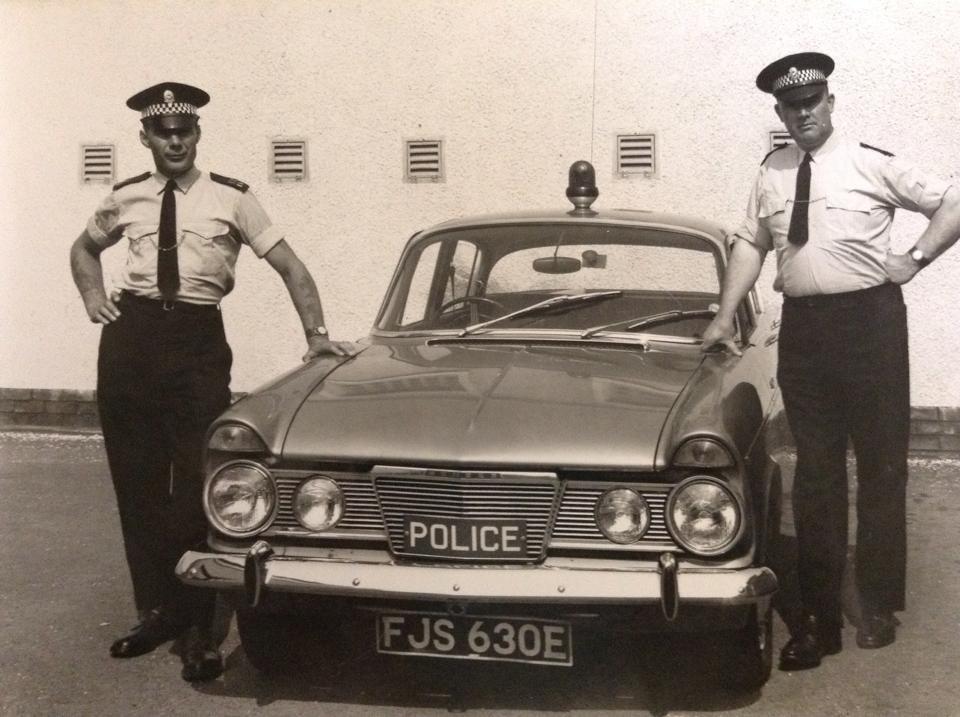
These men look like they've had a long day. I bet they could use a pizza.   photo credit: Ross & sutherland Constabulary patrol car 1968 via photopin (license)
These men look like they’ve had a long day. I bet they could use a pizza. photo credit: Ross & sutherland Constabulary patrol car 1968 via photopin (license)

When they realized the pizza had been paid for and that it had been bound for a home just a few blocks away, the officers went ahead and delivered the pie to a surprised, but grateful customer.

I love that story. And I love the story of Queen Margherita and the first ever pizza delivery. Of course the latter, like so many good tales from history, is unsubstantiated and according to Zachary Nowak, the assistant director of Food Studies at the Umbra Institute in Perugia, Italy, is quite probably false.

He has good reasons for his claims, though his evidence is by no means conclusive. I’m not going to worry about any of that. The start of the school day was delayed here because of icy roads and I’m terribly behind. It’s shaping up to be a long day. I’m thinking this evening I may grab a paper plate and a can of Coke, and open the door to a hot, cheesy pizza. I just wonder who’s going to deliver it.

The Cheese is Old and Moldy

In the summer of 1987, Paddy Coughlan and Dan O’Conner got to work digging peat on a farm near Glenahilty in Ireland’s Tipperary County and found a little more than they expected. The two men worked together to extract their mysterious find, which turned out to be a 100-pound block of 1,400-year-old cheese.

So just picture this, older and boggier. photo credit: abbyladybug via photopin cc

An exciting find to be sure, especially if you happen to have a box of crackers handy, but Coughlan and O’Connor didn’t. They contacted archaeologist Tony Candon, who, though pretty psyched about the find, was also fresh out of crackers. He did, however, identify the find as cheese (or possibly butter) and declared it quite likely edible, preserved as it was by the cool, acidic, and anaerobic conditions of the bog.

For nearly 27 years, it was a really impressive discovery. Then in February of 2014, archaeologists published the findings from the excavation of a 17th-century B.C. cemetery in the Taklamakan Desert in China’s Xinjiang region. What they found was about 200 well-preserved mummies, each with a little chunk of 3,600-year-old yellow cheese hanging around its neck. Though there’s secondary evidence that cheese has been around some parts of the world for more than 7000 years, this is the oldest actual cheese that’s ever turned up.

I mention this, not because I am particularly knowledgeable about cheese (I’m certainly not), but because today happens to be National Moldy Cheese Day. As far as I know Hallmark hasn’t produced a card for this one yet and you might be hard pressed to find it printed on a wall calendar, but nevertheless today is, without question, the day when we’re all supposed to take a moment to appreciate moldy cheese.

Because this is sort of a history blog, I scoured Wikipedia for at least a couple of minutes to see if I could discover the origin of the strange holiday. I failed. But I think given the importance our ancestors placed on cheese (a convenient snack for the deceased or a 100-pound treasure to be buried in in the back yard for safe keeping), we can assume that Moldy Cheese Day has been around for a while, just like the forgotten slice of American sizzling on the middle school blacktop or that block of Swiss growing fuzzy in the back of your refrigerator.

Vieux-Boulogne, the world's stinkiest cheese, according to two Camdon University studies in 2004 and 2007. Grant money well spent I'd say. photo credit: noodlepie via photopin cc
Vieux-Boulogne, the world’s stinkiest cheese, according to two Cranfield University studies in 2004 and 2007. Grant money well spent I’d say. photo credit: noodlepie via photopin cc

And there’s no question that there are folks among us today who are crazy about cheese. Foodies rave about various stinky cheeses with rinds washed in this or that briny solution. They speak of aging processes and of textures and flavors described as earthy or meaty. There are die-hard cheese eaters out there who can’t wait to devour the smelliest cheeses they can find, not even shying away when the odor is described as similar to that of sweaty feet.

This defies explanation. Just...no. photo credit: cdw9 via photopin cc
This defies explanation. Just…no. photo credit: cdw9 via photopin cc

My guess is that Helen Lucy Burke is one of these die-hard cheese fanatics (not to be confused with the Green Bay Packers cheese-head fanatics, who are even more peculiar). Ms. Burke threw caution to the wind and sampled the 1,400-year-old bog cheese where it’s now kept at the Roscrea Heritage Centre in Tipperary. She described the flavor as unpleasant, though not quite revolting, similar to a dried Wensleydale cheese, which I’m pretty sure I’m never going to eat.

But perhaps you are braver than I am. If you are, you can celebrate Moldy Cheese Day by branching out and trying something new, or, if you want, rumor has it you can cut the fuzzy parts off that lump of Swiss and eat it without worry.

Personally, I think I might celebrate by cleaning out my fridge.

The Single Greatest Advancement in the Field of Cookie Science Ever

In 1937, in a busy restaurant kitchen in Whitman, Massachusetts, a harried chef by the name of Ruth Wakefield rushed to make a batch of her butterscotch nut cookies to serve with ice cream. But there was a problem. The vibrations from the industrial mixer Wakefield used, caused enough of a ruckus to knock loose a bar of semi-sweet chocolate stored on the shelf above, which, becoming splintered by the mixer, contaminated the dough with chips of the chocolate variety.

Beware of  falling chocolate.   photo credit: AngryJulieMonday via photopin cc
Beware of falling chocolate. photo credit: AngryJulieMonday via photopin cc

Wakefield nearly threw the dough out, disgusted at the wasteful accident, and determined that the reputation of the Toll House restaurant was important enough to just start the batch over. Fortunately for Grandmas and glasses of milk everywhere, another cook convinced her to go ahead and bake the batch. And the results just seemed right.

Of course that’s probably not a true story. Another version suggests that Wakefield was making chocolate cookies, but had run out of baker’s chocolate. She substituted chunks of semi-sweet chocolate (allegedly a sample bar provided by Nestlé) thinking it would melt through the dough. And the world rejoiced that it didn’t.

If I’m perfectly honest (and I never lie about cookies), I doubt the validity of this tale, too. Because Wakefield was an educated lady and not a hack in the kitchen. I’ve seen enough Food Network shows to know that even highly trained chefs under extreme conditions (like using only a pocket knife and a candle to make a five course gourmet meal made entirely of beef jerky, in fifteen minutes) occasionally make silly mistakes. Still, I’m inclined to give Wakefield the benefit of the doubt on this one.

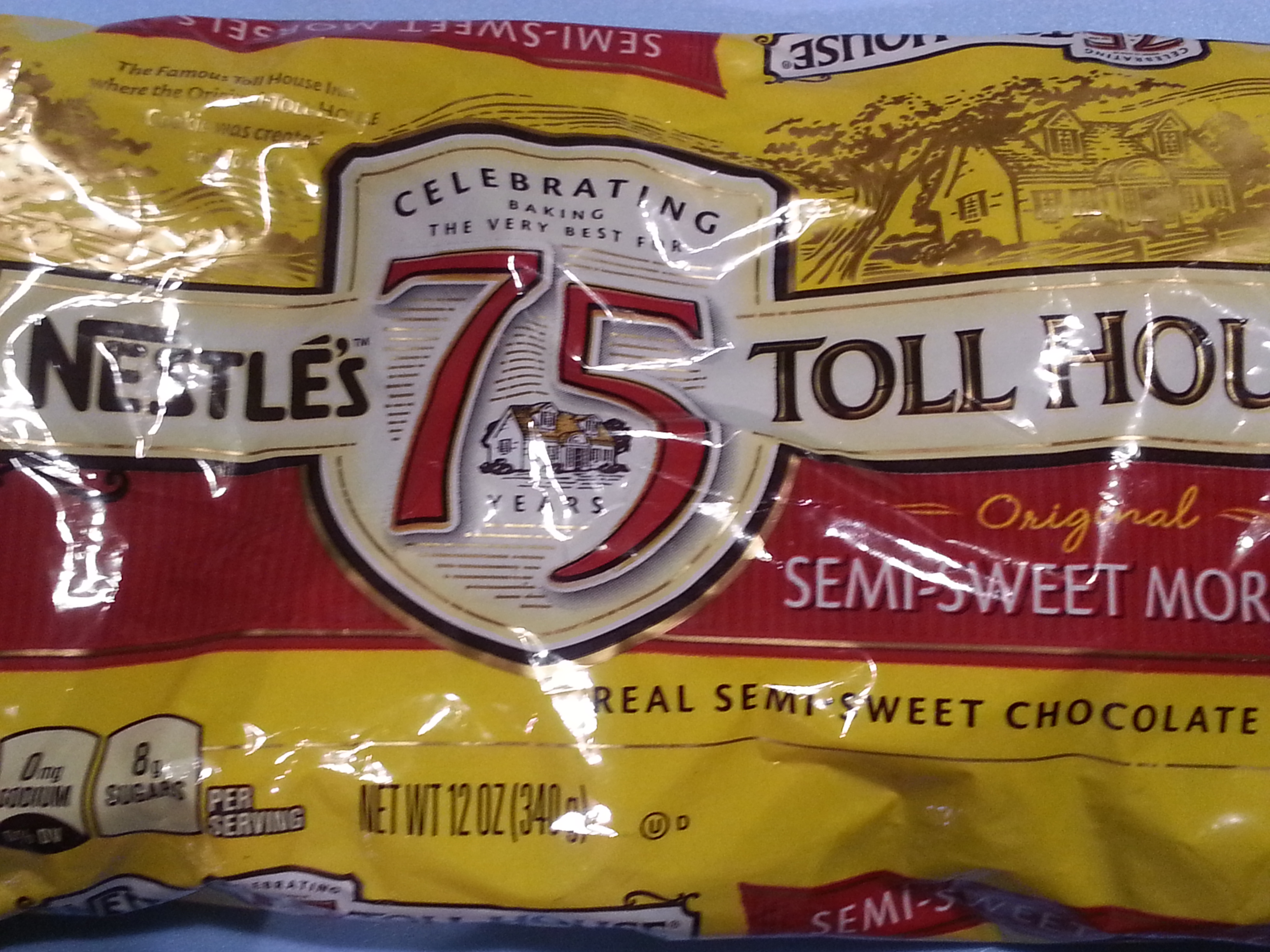
I suspect that she understood the properties of chocolate and very intentionally invented the single ever greatest leap forward in the field of cookie science (and trust me, it is a science). For her contribution to the field, she received a lifetime supply of free chocolate (and consulting fees) from Nestlé for the rights to print her recipe on the backs of their bright yellow chocolate chip packages, where it’s been ever since.

Even today, for a lot of us this recipe (perhaps tweaked a little over the years, but still largely the same) on the Nestlé’s package is our go-to for chocolate chip cookies. But it’s not without its rivals. Actually, there are some who claim it wasn’t even the first, that in fact the 1934 Hershey’s cookbook contained a similar cookie recipe.

This little yellow package always makes me hungry for cookies.

And there are many who would argue that the Nestlé Toll House recipe is kind of meh when compared to some of the manufactured cookies on the market today, the most exciting of which, according to my quick sampling of those who have enough time on their hands to write about great chocolate chip cookies on the Internet, is the Dutch company Merba’s 37% chocolate chip cookie.

There’s even one blogger who set out to test whether or not Merba cookies really contained 37% chocolate simply because (and I’m guessing here) he has too much time on his hands. He concluded that given a little wiggle room for error in his experimental technique, it did. Why 37% you may ask? It does seem pretty random.

Another mathematics blog attempted to answer that. In a complicated explanation of the behavior of randomly scattered dots within a circle and the intricacies of cookie manufacturing, he proved without question that he has even more time on his hands than the first guy.

Don’t get me wrong. I am super impressed by the dedication of both men to the field of cookie science. Personally, I think the Merba cookie has 37% chocolate because it seems like a good number and it looks good on a package. I base this on the conclusions of some other people with too much time on their hands, who tell us that if asked to pick a random number between 1 and 100, most of us will choose either 37 or 73.

Since a cookie with 73% chocolate would pretty much be, well, a chocolate cookie, Merba wisely chose 37% for their delicious marketing gimmick. Because it just seemed right. And that’s also why I chose to celebrate my 37th birthday this week with a giant chocolate chip cookie, baked from my altered version of Ruth Wakefield’s famous recipe with, if I’m honest, quite likely more than 37% chocolate.

Because it just seemed right.

Way more than 37% delicious.

Oh the Places I’ve Never Gone: A Story of SPAM

I love a good road trip and, I confess, I have a little bit of an obsession. I collect brochures. I don’t mean that I have a basement full of full color brochures from every place I’ve ever visited. That might actually make sense.

I mean that at every hotel, roadside diner, and rest stop, the first thing I do is check out the tourism brochure rack, and I usually pick up at least three or four. Of course I do this in the places where I’m staying for a while, but also in the places I’m just driving through.

In case you can't read it, that phone number is 800-LUV-SPAM, so you can get all of your SPAM and SPAM Museum-related questioned answered. I'm sure you have many.
It’s Free! And it has bathrooms. And probably tee shirts.

And here’s the strange part, I almost never go to the places in the brochures. But I love to learn about bizarre little tourist sites that get highlighted on those racks. I guess it’s my way of soaking in some of quirkiness of the communities I am privileged to pass through.

There are the standard places like zoos, waterparks, and outlet malls and in this part of the country there’s usually a cave tour or two. Sometimes those are accompanied by interesting stories. But the ones I like best advertise those truly unique places, the ones that are just weird enough that it’s unlikely anyone would ever travel specifically to a particular area just to see them.

My latest find, maybe the best brochure I have ever picked up on a road trip, came from a hotel in Rochester, Minnesota where we stopped this weekend on our way to watch a community theater musical production that featured one of our very talented nieces.

Obviously she stole the show and we were delighted to be there to watch her performance, but I admit, second to that, my favorite part of the trip was the place we didn’t go: The SPAM Museum in Austin, Minnesota.

Austin is only about a 45 minute drive from Rochester and not particularly out of the way for a traveler headed back to St. Louis, but it was the last day of our whirlwind weekend road trip. We were anxious to head home. And I was the only one who seemed at all interested in going.

Even Big Foot loves SPAM.

How could I not be? First of all the museum is free, so even if it’s not everything it’s advertised to be, all you’ve lost is an hour or so of your time, which you can’t ever get back. Still, how can you say no to a tourist destination that boldly proclaims: “Theater! Game Show! Restrooms! IT’S ALL HERE!”

So since my family wouldn’t be convinced to tour the museum (okay so it’s possible I didn’t try that hard), I had to research SPAM the old fashioned way and just Google it.

SPAM hit the market in 1937 and soon dominated the canned meat industry. A spiced ham product initially made entirely from pork shoulder which had been an underutilized cut of meat up to that point in the company Hormel’s canned meat products, SPAM received its iconic name from a somewhat suspicious contest.

The winning entry was submitted by an actor named Ken Daigneau who also happened to be the brother of a Hormel Foods Vice President. There’s no word on whether or not said vice president was in fact the judge of the contest, but Hormel awarded Daigneau $100 for his efforts and it’s a good thing they did because “ham jello” just doesn’t sing as well.

Though SPAM (which Hormel claims stands for “spiced ham” and not the “something posing as meat” that some have suggested) took off largely as a wartime food, its real boost into the popular psyche came from Monty Python’s famous 1970 SPAM comedy sketch, which period actors with brilliant British accents (I’m sure) reenact daily for a fascinated audience at the SPAM Museum.

Alas, I’ve never been. Still, I do have the brilliant brochure that both splits into detachable postcards with fun SPAM facts so you can conveniently invite your friends from all over the world to a SPAM pilgrimage they won’t soon forget and also features a helpful map placing the museum into geographical context with the World’s Largest Stack of Empty Oil Cans. I haven’t managed to collect a brochure advertising that American travel gem yet, but it’s definitely on my list of sites to not visit.

spammap
10,000 Lakes? Big Deal. Come to Minnesota for the SPAM!

Super Foods of Future Past

In the fall of 1902, twelve healthy young men sat down together in a dining room set up in the basement of the former Bureau of Chemistry in Washington D.C. for the first of many meals they would share. The food they ate was whole and healthy, prepared with the finest ingredients, and calculated to meet the specific caloric needs of each individual. Oh, and it was laced with borax.

Dr. Harvey Washington Wiley. Chief Chemist in the United States Department of Agriculture. Food and drug safety enthusiast. Poisoner of young men.

The twelve young men at the table were the first volunteer subjects of a study designed by the Bureau of Chemistry’s Chief Chemist Dr. Harvey Wiley to determine the human health effects of various common additive food preservatives.

Each young hero agreed that for the duration of his participation he would ingest nothing but the food provided him through the study, the only exception being water, which was carefully measured. He also agreed to regular medical examinations, and, of course, he agreed to clean his plate.

Wait, there isn't any radiated spider venom in this, right? I have the weirdest reaction to that stuff.
Wait, there isn’t any radiated spider venom in this, right? I have the weirdest reaction to that stuff.

At the dawn of the 20th century, Americans were as concerned about the chemicals in their foods as we are in 2014. And with no real regulation, it was nearly as difficult to make good family food decisions as it is today amidst confusing regulation and an overwhelming amount of ever evolving and sometimes conflicting health information.

Then along came Dr. Wiley and his “Poison Squad” as they were soon called by the press. They operated under the motto, “Only the Brave dare eat the fare,” rotating through and testing at various times throughout the five year duration of the study: borax, benzoic acid, sulfur dioxide, formaldehyde, copper sulfate, salicylic acid, and saltpeter.

As soon as a man developed symptoms that inhibited the performance of his daily routine, he was given a minimum of forty days rest during which he ate nutritious food that contained none of the test chemical. But as Dr. Wiley later explained during a hearing before the Committee on Interstate and Foreign Commerce, the study was necessarily limited because unlike with animal testing, he couldn’t cut open his test subjects and examine their organs. Apparently, they wouldn’t agree to that.

So, I don't know what's in that turkey leg, but I don't think it agrees with him.
So, I don’t know what’s in that turkey leg, but I don’t think it agrees with him.

Still, the study and the publicity that accompanied it, helped pave the way for the 1906 Pure Food and Drug Act and for the agency that would emerge officially in 1930 as the Food and Drug Administration. The act addressed fairness in labeling more than the elimination of food dangerous food preservatives, but four of Wiley’s test additives are long since gone from American foods, including borax, salicylic acid, formaldehyde, and copper sulfate.

Thanks to the heroic sacrifices of the poison squad, the food we eat is a little bit safer, which doesn’t seem to do much to ease our minds as we are still at war with all things perceived as unnatural in our foods. Regardless of what diet you subscribe to, be it the Mediterranean, Paleo, Flexitarian, or whatever, the one thing they all pretty much agree on is that you should eat as much real, single-ingredient, “whole” food as you can.

And even the most practical of nutritionists, who caution against adopting a diet so rigid that it’s not workable, agree that this is probably a pretty good idea. But as a mom who does the vast majority of the grocery shopping and as much of the cooking as I can’t get out of, I wanted to know, just what are those whole superfoods my family should be eating?

Turns out Prevention magazine has some suggestions. Actually, there are quite a few lists of the super-est foods of 2014, but I liked this particular list because most of the foods on it were included elsewhere, too, and there were several I’d never heard of before. You just can’t get any more super than that.

Holy Whole Foods, Batman!

A few of my favorite are:

1. Avocado oil – just the oil, not the avocado because it was super a couple of years ago
2. Coffee – some years it’s good; some years it’s bad; this year the price is going up so it’s super
3. Shichimi togarashi – a Japanese spice that is apparently really hot and rich in antioxidants, but way more Hipster-friendly than say, blueberries
4. Salsify – a root vegetable that is low calorie and high in fiber because, you know, it’s a vegetable
5. Za’Atar – a Middle Eastern spice that decreases the instances of foodborne illnesses, kind of like cooking does
6. Teff – a gluten free grain whose biggest claim to healthfulness seems to be that you can’t digest it
7. Canary seed – yep, that’s right, bird seed is a gluten free grain option for people, too, so that in 2014, you have permission to finally eat the way you’ve always wanted to, like a bird. Super.

Um, just no.
Um, just no.

I don’t know what was on the list of super foods in 1906, but I guess I know what wasn’t. Don’t worry, though. No formal follow-up study was ever done on the participants of the poison squad, but anecdotally their health didn’t suffer in the long term. One participant, William O. Robinson of Falls Church, Virginia, passed away in 1979 at the age of 94. I think we have to conclude that his longevity stemmed from the fact that he was so well preserved.

Go, Go Bananas!

Last week I received some exciting news from WordPress. I’ve been at this blogging thing for a little over two years now, posting once a week about history (sort of) and sharing bits of my experiences. And apparently last Thursday I published my 100th post.

Okay, so the number is a little inflated because I have reposted a couple of times. And, yes, if you know how many weeks there are in a year, then I’m sure you’ve realized I’ve missed a few weeks here or there. I am aware that many bloggers out there are way more productive than I am, posting two or three times a week. Some even post every single day!

That’s more than I can commit to because I’m a wife and mother and fiction writer, too. All of that comes first for me. But also because as shallow as my “research” often really is, it takes a fair bit of thought to put one of my posts together.

So when I saw that I’d posted 100 times to this blog, I was pretty excited. I wanted to celebrate. The question then, was how does one celebrate such an accomplishment?

Well, I thought about that, fielded a few suggestions from Facebook (mostly ice cream) and decided there’s really only one way to celebrate something this big: with BANANAS.

It even looks like a smile.

In 1876, the United States celebrated the 100th anniversary of the signing of the Declaration of Independence by throwing a big party on a world stage. The Centennial Exposition of 1876 was the first World’s Fair to be hosted on American soil. It started May 10 in the host city of Philadelphia and ran for six months, including around 30,000 exhibits and welcoming a whopping 10 million visitors.

The Exposition was more than a celebration of America’s past. It was a declaration to the world that the nation was emerging as an industrial leader and world power. And it was an opportunity for visitors to experience first-hand the cutting edge of cool.

Among the exhibits was a 50-foot-tall Corliss steam engine, a travel bathtub, a 2000-pound mechanical calculator, the first commercial root beer, the arm and torch that would eventually grace the Statue of Liberty, some device called a “telephone” invented by a fella named Bell, and the first bananas available to the public in the United States.

I think it's pretty safe to assume that the 1876 Centennial Exposition also introduced the world to the banana phone.   photo credit: bhardy via photopin cc
I think it’s pretty safe to assume that the 1876 Centennial Exposition also introduced the world to the banana phone. photo credit: bhardy via photopin cc

Originating in Southeast Asia, bananas were cultivated possibly as early as 1000 BC. They came to the New World in 1516 where they were planted by a Spanish priest Tomás de Berlanga who later took them into Panama. The fruit spread rapidly through Central and South America, but it didn’t make the journey to the US until the 1870’s.

So when banana trees (actually according to most persnickety Internet “experts” the plants are technically herbs) went on display at the Exposition on June 5th and the fruits (or, again, for the persnickety, the berries) could be purchased for 10 cents each, wrapped in aluminum foil and eaten with a fork, Americans were smitten.

Clearly NOT a tree.
Clearly NOT a tree.

In the 138 years since, bananas have grown to be the most often consumed fruit in the United States. That’s despite the insistence of some fitness “experts” (whom I’m assuming are also persnickety) that these nutrient rich, portable, fiber-rich, low-fat super fruits are somehow bad for us.

So, I know I haven’t been posting for 100 years and I think it unlikely that this silly little blog will ever emerge as a dominant world power, but I’ve decided that I’m going to celebrate 100 practical history posts Centennial Exposition style anyway.

And because I also value the opinions of my friends, I think I’ll have ice cream, too.

Now we're talking!
Now we’re talking!

It’s Only Wafer Thin

Right now in my freezer, I am proud to report, there is still one full sleeve of Girl Scout Thin Mint Cookies. One afternoon right at the end of January, an adorable little neighbor girl showed up on our doorstep peddling the irresistible treats. And I wasn’t home. I say this because I don’t want to accept the blame for the ridiculous number of boxes we purchased.

You see, my husband is a sucker very generous man, one of the many reasons I love him so much. He also has a competitive streak so when that shrewd little neighbor girl told him her dad had ordered seven boxes of Thin Mints, my man ordered EIGHT BOXES. The trouble with this is that he doesn’t eat them. He doesn’t even like them; he just knows I do. He did  also order a box of his favorite Samoas, which is currently unopened in the pantry, but mainly he ordered cookies for me.

Oh, no, no. I just meant one of the little green boxes. Oh, okay, I'll just take them all. photo credit: Brother O'Mara via photopin cc
Oh, no, no. I just meant one of the little green boxes. Oh, okay, I’ll just take them all.
photo credit: Brother O’Mara via photopin cc

Sweet, right? But as any little scout savvy enough to set up a sales table outside a marijuana clinic or to pit one competitive neighbor against another can tell you, these things are addictive. It’s true that according to the FAQ page linked to the Girl Scouts of America website: “Girl Scout Cookies…are considered a snack or special treat. As with all treats, they should be enjoyed in moderation.”

Of course. That makes sense. It’s good advice. I won’t sit down and eat the entire box, then. I’ll just eat one of the two little sleeves of wafer thin cookies. For now. Then I’ll have a glass of milk. And maybe the other sleeve of cookies, since the box is already open.

And that’s why I don’t order eight boxes.

It’s also the reason that since its humble beginnings as a 1917 fundraising bake sale for the Mistletoe Scout Troop in Muskogee, Oklahoma, the sale of Girl Scout cookies has grown to staggering annual sales of over $700 million. Ten years after Juliette Gordon Low founded the Girl Scouts and just five years after that local cookie fundraiser in Oklahoma, Chicago Girl Scout leader Florence E. Neil put together an inexpensive cookie recipe for the organization’s magazine, The American Girl, encouraging local troops to sell the cookies to raise activity funds.

And even though the original 1922 Girls Scout cookie recipe wasn’t the Thin Mint, the program flourished. In 1936 Girl Scouts started working with a number of commercial bakeries across the country to supply the growing demand for their cookies, which by 1951 came in three delicious varieties: Do-Si-Dos (peanut butter sandwich cookies), Trefoils (shortbread), and at long last, Thin Mints.

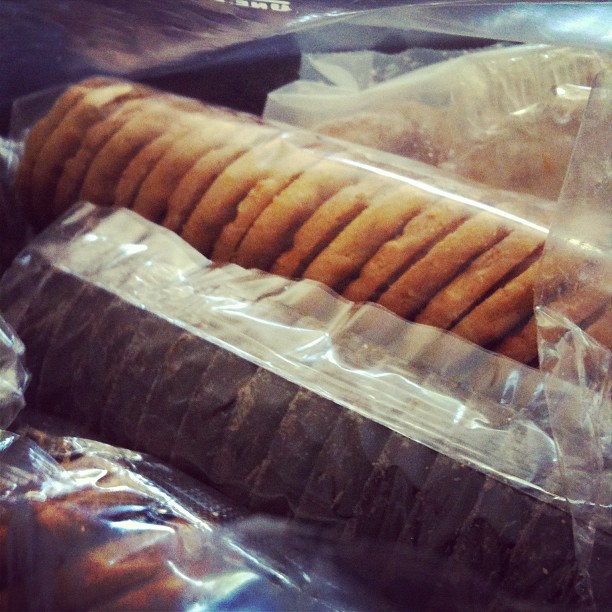
There is absolutley no reason to sit down and eat a whole box of Girl Scout Cookies at once. Not when they come so nicely packages in 1/2 box serving sizes. photo credit: elaine a via photopin cc
There is absolutley no reason to sit down and eat a whole box of Girl Scout Cookies at once. Not when they come so nicely packaged in 1/2 box serving sizes. photo credit: elaine a via photopin cc

Gradually, Girl Scouts consolidated their cookie sources and today the ones you buy because cute little girls are standing in the cold right outside your favorite grocery store and you suspect they might not be allowed to go home until their cookie table is empty, come from one of two commercial bakers. Each bakery is required by the Girl Scouts to produce the three varieties standardized in 1951, but then select five more varieties to offer every year. The recipes are similar between the bakeries, but not identical, and the names may be different as well. So, if like my husband, you for some reason just love Samoas (actually the second best seller in the catalog), don’t be too upset if you find you have to settle for a box of Caramel deLites instead.

Thankfully, Thin Mints are always Thin Mints so there’s no confusion there, and I’m not the only one who likes them. As the top-selling Girl Scout Cookie, Thin Mints make up 25% of sales every year, most of them going to residents of my neighborhood. I am fortunate that even though my husband isn’t a big fan, my two sons enjoy them as much as I do, so I’ve managed to go through several packages by doling them out in lunch bags. I’ve mailed a couple more boxes in college care packages and I put the rest in the freezer.

Sadly, that last solution doesn’t work out all that well, because the only thing tastier than a Thin Mint is a frozen Thin Mint. And the only thing tastier than that is a sleeve of frozen Thin Mints. I’m not thinking the last cookies are going to make it into lunches tomorrow. I wonder how the boys would feel about getting Samoas instead.

I bet he'd rather have a Thin Mint. photo credit: Mike Licht, NotionsCapital.com via photopin cc
I bet he’d rather have a Thin Mint. photo credit: Mike Licht, NotionsCapital.com via photopin cc

True Tales from the First Grade

This week I have had the pleasure of learning a great deal about one of the most beloved figures in the history of American pioneering days. I refer to Johnny Appleseed, who, frankly, I didn’t know for sure even existed. I thought I would pass some of this wealth of knowledge to you, dear reader, because I’m guessing that like me, you may have a somewhat muddled image of this legend.

First of all, he did exist. His real name was John Chapman and (not surprisingly) he had a thing for apple seeds. In the first part of the 18th century, just as settlers were headed out to tame the wilderness of Ohio, Indiana, and Illinois, John Chapman set out ahead of them. He travelled most often on bare foot, scattering apple seeds willy-nilly as he went, pausing only to participate in the occasional flash mob.

Polski: Salsa flash mob w Złotych Tarasach, 29...
If you look closely you can just see the top of Appleseed’s head in the very back. (Photo credit: Wikipedia)

Johnny Appleseed was a loving man, whose compassion for the poor was as famous as was his dancing. He delighted in defending the helpless from bears with his trusty rifle. And he travelled extensively through Europe and into the volcanoes of Hawaii to scatter apple seeds.

Okay, so it turns out, my source may not be all that reliable (imagine!). It is, in fact, my six-year-old son who came home from his first grade class full of lore and a new found love for everything apple.

So it seemed like a good idea to take the boys to a nearby U-pick orchard, and to check a few facts. It turns out it is true that the legend of Johnny Appleseed developed from a real man named John Chapman and he was famous for his compassion. He really did travel almost exclusively on foot (and rarely wore shoes) from Pennsylvania, most likely as far as Illinois for the purpose of planting apple seeds.

Where the legend gets a little fuzzy is with his motivation for all this extreme farming. Some historians have suggested that he was one of the most successful businessmen and landowners in the early days of the settled Midwestern US. I can see their point. Apples were an extremely important crop in the early pioneering days, and not only because apple crisp is super delicious.

With water sources so often contaminated, apple cider was a safe way to get water (and, if allowed to ferment, a buzz). Apples themselves are a long-lasting, easily stored food source. And perhaps most importantly, vinegar can be made from apples, which allowed pioneers to preserve food. That is, if they didn’t use all of their harvest to make apple crisp.

This was AWESOME
Who needs clean drinking water when you could have this? Yum!(Photo credit: Wikipedia)

Whether or not he was a strong tenor or a graceful dancer, Chapman was certainly a sound businessman. He didn’t scatter his seeds willy-nilly. Instead, he planted them very deliberately near water ways where settlers were likely to end up and where the trees were likely to thrive. He fenced them in, enlisted help at times to care for them, and visited his far-flung orchards whenever he could to make sure they were doing well and to distribute trees to new settlers.

Like any good capitalist, Chapman found a market demand and supplied it. But even though he was highly successful, that’s not what made him a legend.

Business boomed, and Chapman could have been a very wealthy man. Possibly he even was at times. He didn’t exactly hesitate to sell his trees for a profit, but he also didn’t deny trees to any of the pioneers who couldn’t afford to pay for them. For payment, he often accepted the scraps of cast-off clothing that were all he ever wore, or sometimes even just an IOU that he never bothered to collect on.

You see, Johnny Appleseed was never in the business of making money, but rather the business of evangelism. He was a devout follower of the Swedish mystic Emanuel Swedenborg whose accounts of his prophetic visions revised and to some extent replaced Christian teachings in the minds of his followers. Chapman shared his apples, and Swedenborg’s writings until his dying day.

“Prophets” were more common than apples in the back woods of the United States in those early days, and Swedenborg’s teaching never gained much momentum there. But Chapman’s apples certainly took root and his compassionate nature and simplistic lifestyle became the stuff of legend.

As for my son’s other claims, Chapman was a strict vegetarian who once extinguished his campfire in order to spare the mosquitoes that might accidentally fly too close to the flames. According to most accounts, he travelled with little more than a book, a cooking pot hat, and his apple seeds, so I think it unlikely that he shot very many bears. And though there are stories that probably originated in the few years following Chapman’s death that he planted apple trees as far away as California, there’s absolutely no evidence he ever travelled to Europe or Hawaii. There are also rumors that he and Elvis have been running a successful used car dealership in Boise. I hear they sell excellent apple crisp on the side.

And, sure, I somehow doubt that I’m getting a perfect account of first grade curriculum. My son (and I have no idea where he gets this trait) has the tendency to fill in the occasional imaginative detail. But I think that might be in keeping with the Johnny Appleseed legend anyway. From the painfully simple life of this one devout, apple-obsessed little man has emerged a great spirit of ecology, adventure, and love.

Of the real man behind the legend, we may only know two things for certain: flash mobs are awesome and apple crisp is delicious.

English: Drawing of Jonathan Chapman, aka John...
I’d probably buy a car from this man. (Photo credit: Wikipedia)

The Magic of Nothing

Ship's Steering Wheel

This past week, Hurricane Sandy met up with her blustery friends from the north and the west to pound the east coast of the US. And as cleanup efforts continue an equally terrifying political storm looms on the horizon as we finally get to elections next week. In the midst of all the turmoil, it’s difficult to know exactly where to turn for a blog topic. So what I have decided to do this week is to offer a moment of stress relief during this relative calm between the storms by writing about nothing.

Specifically, I want to talk about the invention of the “nothing” that occupies the center of a traditional American doughnut. Though versions of doughnuts have been around for centuries and can be found throughout the world, the round doughnut with a hole in the middle has become largely an American tradition since it was introduced, most likely by the Dutch. This is one piece of history on which no one can really be sure, but one story does stand out as the clear fan favorite.

At the age of sixteen, a young Dutchman named Hanson Gregory set out for a life at sea. Like most successful young men, Gregory had a mother who loved him and worried about him, probably would have even struck out into the world with him if she could have, but because a young man needs the space to make his own way she did the next best thing. She cooked up a bunch of his favorite pastries (olykoek or “oily cakes”) and sent them with him. And like great moms everywhere, she also sent along the recipe.

Young Gregory gave his mother’s recipe to his cook and set about his ship duties. Life was good. He was doing his own thing, but could still enjoy a taste of home. Then on June 22, 1847, a terrible storm rose up and Gregory, olykoek in hand, had to make a decision. Either he could grab the ship’s wheel with both hands and fight to keep the boat on a safe course, but sacrifice his tasty snack in the process or he could eat his olykoek and possibly sacrifice the ship and the lives of its crew.

The clever young man did the only thing there was to do. He took his olykoek and plunked it down one of the wheel spokes to secure it. His pastry now safe, he grabbed the wheel with all his might and saved the ship.

Doughnut
Doughnut (Photo credit: Images of Sri Lanka – Sequential Shots)

The early olykoek was pretty much just a ball of dough fried in pork fat which often cooked unevenly, leaving a gooey center. What Hanson Gregory discovered during that fateful storm was that an olykoek with a hole in the middle, tasted better than the original and so he asked his cook to prepare them that way from then on. The doughnut as we know it today was born.

The doughnut really took off in America, though, when, in 1920, New York businessman Adolph Levitt invented the first doughnut-producing machine. His mass produced, holey, pastries received the label “Hit Food of the Century of Progress” at the 1934 World’s Fair in Chicago. We Americans have loved our doughnuts ever since and the proof is the success of chains such as Dunkin Donuts, launched in 1948 and Krispy Kreme Doughnuts, which got its start in 1936, as well as the rise of smaller doughnut boutiques throughout the nation, where one can often sample the best and strangest the doughnut industry has to offer.

On a recent trip to Portland, my sons and I visited one such doughnut shop. Voodoo Doughnuts has been a downtown oddity in Portland, OR (a city known for downtown oddities) since 2003.

Though it is possible to order a traditional glazed doughnut, the more than 90 doughnut varieties on the menu also include some truly bizarre options such as the Tangfastic. Sadly I was not brave enough to try that one, but the varieties we tasted were delicious. The boys chose chocolate-frosted cake doughnuts while I went for the signature voodoo doll doughnut, complete with a pretzel rod pin through the chest and red jelly filling that, like the hole, effectively addresses the concern of the underdone middle.

The doughnuts are good and the atmosphere is charmingly weird (you can get legally married there if, for some reason, you want to), but what I like most about Voodoo Doughnuts is their motto: “The magic is in the Hole!”

And they’re not wrong because if we learn anything from the heroic tale of Hanson Gregory, it is that this “nothing” in the middle of the doughnut, is really quite something. So as we take a deep breath in this semi-calm we have between storms here in the US, let’s just try to remember that after the ship has been righted and the undercooked dough has been scraped off the steering wheel, great things can come from some of life’s biggest storms, even if those great things might seem at first like nothing at all.