Skinny Pants and Cupcakes: Everything a Young Republic Needs

By 1796 the United States of America had a Constitution, fifteen states, a snappy flag, and a growing political divide. It certainly wasn’t everything a young republic would need, but it was a start and the gaps would be recognized and filled in over the next many years by an industrious, inventive, and fiercely determined population. Perhaps more than anything else, what a new nation needs is an identity, the building blocks of a shared, unique culture.

And also cupcakes.
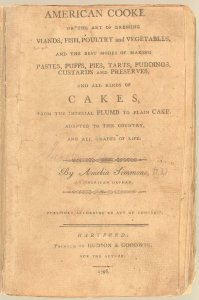
American cookery
What every young republic needs to have on its shelf. By Amelia Simmons, Hudson & Goodwin [Public domain], via Wikimedia Commons
It would be another thirty-two years before Noah Webster’s thoroughly American dictionary made its way into the world to assert ‘Merican standards over an inherited language, but before that, in 1796, another American stepped up to fill in an important cultural gap.

That’s when Amelia Simmons, about whom little is known beyond her self-identification as “an American orphan,” compiled and published what’s believed to be the first American cookbook. Up until that point, cooks in the US with access to unique local ingredients like maize, turkey, and “pompkin,” had to settle for English cookbooks full of English recipes for pies and puddings that sadly aren’t at all what their names imply to the modern American palate.

In her book, American Cookery (plus a subtitle that’s almost longer than the book) Simmons includes many traditional English dishes and cooking methods.  She also includes several with an American twist, like squash and pumpkin puddings, Indian slapjacks, corn cakes, roasted turkey with cranberries, and “A nice Indian Pudding.”

And also cupcakes.

chocolate cupcake
A picture of chocolate cupcakes that was not taken by me, in honor of National Chocolate Cupcake Day, which is totally a thing. photo credit: jamieanne Chocolate Cupcakes With Fudge Frosting via photopin (license)

Though she didn’t coin the term (that didn’t happen until 1828 in a cookbook compiled by Eliza Leslie), Simmons did include recipes for both “soft cakes in little pans,” and “a light cake to bake in a little pan,” possibly the earliest written references to the cupcake.

I bring up the cupcakes because yesterday was National Chocolate Cupcake Day here in the US. If you forgot to celebrate, don’t worry.  National (plain ol’) Cupcake Day is still coming up on December 15. I actually didn’t celebrate, or at least not in the traditional way, which I assume is to eat a chocolate cupcake.

It’s not that I don’t like chocolate cupcakes. I think if you’ve read this blog for very long, you’ve probably seen plenty of evidence that I do. Still, when I saw the “holiday” was coming up, I began to wonder if a cupcake is itself really a thing to celebrate. I suppose I always thought of this compact little treat as celebratory rather than celebration-worthy.

Cupcakes are for birthdays and baby showers and blogiversaries. They express congratulations when someone wins the lottery, or snags first place in the national juggling championship, or finally lands that book deal. At this point in our history there are entire cookbooks containing nothing but cupcake recipes and bakeries dedicated to making nothing but these most celebratory little cakes. And if you have a few staple ingredients in your pantry, a coffee cup, and a microwave, the Internet will be happy to tell you how to solve that late night cupcake craving without changing out of your pajamas.

coffee mugs
Finally this non-coffee drinker has a use for all of these, but not until the next time I need to celebrate in my pajamas.

Cupcakes are for just about anything, really, which makes a day for celebrating them seem a little over-the-top to me, and a day dedicated to just one flavor of them downright silly.

So what I decided to do instead is to make National Chocolate Cupcake Day a holiday in which I don’t eat a cupcake. I spent the day remembering the time when this dessert was an occasional treat that meant something truly special, and even served to fill a cultural gap in a burgeoning nation. I reflected back on a time when a great cupcake was a little harder to come by and I could fit into my skinny pants.

It was a good day. In fact, I’m thinking I may abstain from eating cupcakes for a while, at least until I can fit into those skinny pants again. Or I get a book deal. Then I’d really have something to celebrate.


It’s Kind of a Big Deal

First of all, I have mixed feelings about writing this post. Secondly, today, October 12th, is the 525th anniversary of the landing of Christopher Columbus in the Bahamas, representing the most influential event in the “Age of Discovery” and the irreversible beginning of arguably the largest population and cultural shift to ever alter the dynamics of human history.

It’s kind of a big deal.

In 1792 on the 300th anniversary of that day, the city of Baltimore erected what it claims is the oldest American monument to the famous Italian explorer. A couple of months ago the monument was defaced as part of an anti-racism demonstration you can view on YouTube if you want.

Columbus Day has been celebrated in various forms since around the time that monument went up, but Colorado became the first state to adopt the official holiday in 1905. In 1934, President Franklin Delano Roosevelt declared October 12th a federal holiday in honor of Columbus, a day that eventually came to be observed on the second Monday in October to better accommodate long weekend big deal furniture sales.

Today, that Monday is recognized not only by low, low prices and zero percent financing on five-piece living room sets, but also with large parades, closed banks, and empty mailboxes, because frankly we can all use a break from the furniture store advertisements.

slip covers
No more slip covers required. Thanks to Columbus Day. photo credit: Mário Tomé 2013 living room via photopin (license)

But in the last few years, the day has also been marked by protest. In cities across the nation, the debate rages about the value of historical monuments that commemorate any kind of messy history and Baltimore’s is not the only Columbus monument to meet up with vandals.

And this brings me to my mixed feelings about writing this post. I have made no secret about the fact that I don’t want this to be another space of controversy on the Internet. I really don’t. There’s enough negativity out there and it would be nice if there are a few places where we can take a break from all that.

Still, this is a history blog (kind of), and more than that, it’s a blog that claims history as mostly story, directed by a few verifiable facts and a little made up nonsense. So I’ve decided it’s time to explore this highly contentious issue.

Because there can be no argument (well, I’m sure there could be, but to the best of my knowledge no one has made it yet) that upon meeting the natives of the Americas for the first time, Christopher Columbus wrote of them in his journal  that they seemed to be pretty nice folks who would make wonderful slaves.

I sincerely hope that makes all of us feel morally icky.

Christopher Columbus Statue
Christopher Columbus, shifting history and pointing out all the people he hoped to enslave. By Kenneth C. Zirkel (Own work) [CC BY-SA 3.0 (https://creativecommons.org/licenses/by-sa/3.0) or Public domain], via Wikimedia Commons
I also have no problem with states like Alaska, Hawaii, Vermont, North Dakota, and Oregon choosing not to recognize the holiday or to use the day instead to honor Native Americans or whatever feels appropriate to them. In fact, I applaud efforts to re-evaluate the way we view and interpret historical events. I think we learn a lot about ourselves and ultimately become better people when we do that.

But I’m also in favor of furniture sales and of the large celebrations of Italian heritage and patriotism for which many American cities use Columbus Day. Even though our school district does not take the day off, it doesn’t bother me that many still do. Again, Columbus’s voyages ushered in a gigantic shift in the course of world history. It was kind of a big deal.

I think that’s what these monuments that people get so upset about really honor. I think they remind us of the shifts, of those moments in history when the world changed, in some ways for the better and in some ways not.  That’s the thing about stories. They can be told and viewed from different angles and even the ugly ones often contain nuggets of beauty.

Actually I would argue that all of our history contains some ugliness, but much like an individual may look back at past mistakes and be grateful for the way he or she has been changed by them, those big deal moments have also led to a great deal of beauty as the world has moved through and looked back at them.

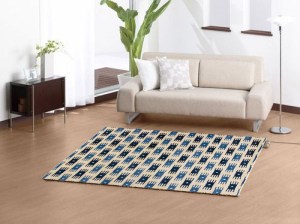
living room set
That’s better. Beauty and a big deal. photo credit: mattwalker69 Contemporary Rugs Rowsyn Multicolor via photopin (license)

I hope as a society we continue to have conversations about how we view and discuss the stories from our past. It’s probably healthy to re-evaluate the ways we honor or remember or criticize the figures that represent moments of great shifts. And I hope we don’t spend so much time angrily tearing apart our history that we lose our ability to view it from different perspectives.

Instead, I hope we remember to look at all of it, and to take the time to sit down together on our new bargain living room sofas to discuss and consider both the beautiful and the ugly, even if we have mixed feelings about it.

Copper Clues, Rubber Stamps, and Fancy Pants Treasure

In 1947 in the West Bank, not far from the site of the ancient city of Jericho, some teenage shepherds made an exciting discovery while tending their flocks and maybe also behaving a little like teenagers. One of these young men tossed a rock into an opening on the side of a cliff and heard a suspicious crashing sound. When the young man and his companions investigated, they discovered a collection of large clay jars, at least one of which contained the teenager’s rock, and seven of which contained the first texts discovered in the collection that came to be known as the Dead Sea Scrolls.

Dead_Sea_Scrolls_Before_Unraveled
Even without gold and silver, that’s a pretty fancy find. By Abraham Meir Habermann, 1901–1980 – Public Domain, via Wikimedia Commons

The discovery sparked a race of both Bedouins and archaeologists to scour the area for more, and eventually eleven nearby caves yielded hundreds of ancient texts that include portions of nearly every book in the Old Testament (and a complete copy of Isaiah), additional prophecies, descriptions of sectarian rules, military strategy, and poems of thanksgiving, among numerous other writings that have kept archaeologists geeking out for the last 65 years.

That’s all pretty great stuff, but I think the most intriguing discovery is what’s known as the Copper Scroll, found in March of 1952. It’s appropriately named because while all the other manuscripts found in the caves are written on parchment, this one is etched into copper sheeting. Its contents are pretty different from the other scrolls, too, because this one describes the world’s greatest treasure hunt, claiming to lead to what some estimate is over a billion dollars in silver and gold.

If you happen to be a first century Middle Easterner, familiar with the area, the clues are pretty simple. Each includes a general whereabouts (on the island that can only found by those who already know where it is), a specific spot (in the cupboard under the stairs), a depth for digging (as specified on a medallion last seen in a tavern in Nepal), and the treasure to be found (your body weight in gold, assuming you weigh the same as a duck). If you are a fluent reader of ancient Hebrew sprinkled with a little bit of Greek and a few typos, you might find they resemble a list of modern day letterbox clues.

In case you’re unfamiliar with letterboxing, it’s a treasure hunting hobby, in which people hide small, waterproof containers planted in clever outdoor (mostly) hiding spots and post clues online to help others find them. The containers each include a unique hand-crafted rubber stamp and a log book. When the seeker finds it, they stamp a personal book with the find and mark the box’s log book with their trail name signature stamp. Then they record the find online where they also warn the next letterboxer of the nearby nest of rattle snakes.

us letterboxing
Letterboxing has become a world wide hobby, but I imagine it will take me some time just to hunt down all of these. Protonk at en.wikipedia [CC BY-SA 3.0 (http://creativecommons.org/licenses/by-sa/3.0) or GFDL (http://www.gnu.org/copyleft/fdl.html)%5D, via Wikimedia Commons
A friend of mine introduced me and my boys to the hobby last spring. We’ve had a lot of fun with it, but if you happen to speak letterbox, you’ll probably have an easier time. I’ve found about ten boxes, and failed to find several more. Most of my successes have come when my friend is with me because having planted many herself, she knows the lingo and has hiked most of the trails already, not to mention she possesses a significantly sharper sense of direction than I do.

Some of the clues are straight forward (once you learn some of the basics, like that SPOR is an acronym for Suspicious Pile of Rocks); others consist of word puzzles or are written in Elvish. Some clues are visible only to those who’ve logged a certain number of finds or who are personally acquainted with the planter and have been given a code word. It wouldn’t surprise me in the least if some clues were even etched into copper and hidden in a cave somewhere in the West Bank.

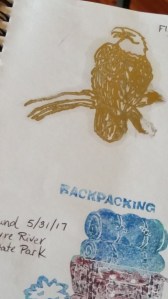
golden eagle
A pretty fancy pants find.

I’m sure I hike past five or six for every one I discover. But I have a good time, and though I’ve never found a duck’s weight in gold, I did once find a particularly fancy pants eagle stamp with a gold ink pad.

And I’ve had way more success than those who have attempted to find the Copper Scroll treasures. Despite plenty of expeditions and a few unverified claims, no one has found any of the treasure yet. There’s debate among scholars about whether or not the treasure truly exists, and if it does, who planted it, and maybe even whether it can be found at all by someone who doesn’t already know where it is. But if anyone ever does find this fanciest of treasures, I bet the finder will be a letterboxer.

Saving the World’s Clay Pigeon Population in Middle of Nowhere, Missouri

My family and I took advantage of the recent long holiday weekend to spend some quality time together making fun of each other. At least they made fun of me. Or as my husband likes to say, I made the fun. They just pointed it out.

We took a warm sunny day to pile into the old family truckster and drive out to a shooting range in Middle of Nowhere, Missouri to go trap shooting, a first for me and my sons. It was a fun afternoon, and I can see how people could get really into the sport.

William Carver certainly did when he moved out West in 1872 to practice dentistry in Nebraska, a profession he didn’t stick with for long but that lent him the nickname “Doc.” Instead, he took up trap shooting, and soon discovered he could make a pretty good living at it if he were good enough.

And he was good. Like really good. He toured the country and by 1879 even set sail for Europe where, according to biographer Raymond Thorp, he showed off his exceptional skills to the Prince of Wales and many wealthy patrons during an extended engagement at the Crystal Palace.

doc carver
Doc Carver: a man who did his best to decimate the clay pigeon population and a pretty darn good shot. By A.H. Arnold, Omaha (Heritage Auctions) [Public domain], via Wikimedia Commons
Referred to in the New York Times as “the man who can put a bullet through a silver quarter while the coin is flying through the air,” Doc Carver could have plausibly claimed the title of greatest shooter in the world, but one challenge remained. Because there was one shooter who might have been said to be better. And allegedly, the up-and-comer Carver had a hard time convincing champion Captain Adam Henry Bogardus (who was both a pretty darn good shooter and the perfector of the glass ball and trap that had been serving to save the world’s passenger pigeon population from the sport) to accept a match.

In 1883, Bogardus finally did accept and the two faced off with a shoot in Louisville, Kentucky. Doc Carver won by one bird in front of a crowd of 1000. But as disappointing as the loss may have been to Bogardus, the match-up had its advantages.  Soon both shooters received a hefty endorsement deal from George Ligowsky, inventor of the clay pigeon and trap that would serve to save the world’s glass ball population from the sport, and a lot of innocent fields from being littered with shards of broken glass.

What Ligowsky proposed, and paid handsomely for, was a series of 25 matches throughout the United States between the two champions, using the new clay pigeons. Doc Carver won nineteen of the matches, sealing his claim that he was good at the sport. Like pretty darn good. I guess it makes sense, this desire to prove oneself against someone else of great skill. It’s what drives a lot of athletes toward success and continues to push sport accomplishments to greater and greater levels.

What I can’t figure out is why it would be important to prove oneself against a person who has no particular interest or who has never demonstrated skill in a sport. Before this past weekend I had never been trap shooting in my life. Neither had my sons, but they were kind of excited about the idea when my husband (who has been trapshooting before) suggested we give it a try.

At first I was thinking this would be a great guys’ day out and I would have the house to myself so I could read a good book. Like a really good one. But then my youngest started to get a little nervous, suggesting he didn’t think he’d be very good at it, and maybe he shouldn’t go.

So, I sighed and did what moms do. I set aside my really good book, piled in the car with the family to head out to a gun range in Middle of Nowhere, Missouri, and I literally gave it my best shot. In fact I gave it a lot of my best shots. I even tried really hard to follow my sons’ very helpful advice and aim. I didn’t hit a single clay pigeon.

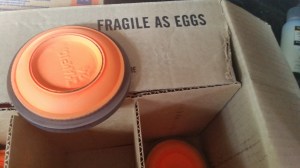
clay pigeons
You might think that would mean they’d be easy to break, but it turns out you still have to manage to hit them.

Not even one.

But I was an encourager. As my boys struggled (a lot less than I did) and then started to hit their targets more often than not, I cheered them on and became the butt of the jokes. Because I’m good at that.

As far as trap shooting goes, my sons are pretty good. My husband is really good (though maybe not yet to the level of pretty darn good). And, well, I’m not bad at releasing the clay pigeons.

All That and a Bag of Chips

Today marks the anniversary of a legend. It was on August 24, 1853 at an upscale resort in Saratoga Springs when the resort’s chef had had enough. One especially picky customer kept sending his French-fried potatoes back, insisting that they had been cut too thick. After several attempts to please the customer, George Crum decided to get a little passive aggressive. He sliced the potatoes razor thin, fried them, and then seasoned them with extra salt and probably a little bit of attitude.

As so often happens when we take the passive aggressive approach, it turned out the customer didn’t really receive the message. He loved Crum’s crispy potato chips and raved about them so that soon other customers requested them as well.

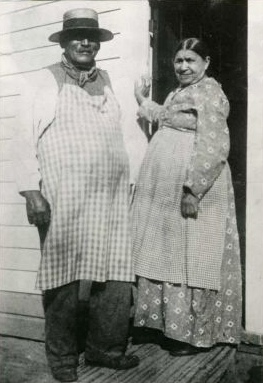
George_Crum_and_'Aunt_Kate'_Weeks
Maybe not the first person to ever make a potato chip, but probably the first to make passive aggressive potato chips, which is even better in my book. George Crum (aka George Speck) with his sister-in-law. Public Domain, via Wikimedia Commons

There are similar recipes from cookbooks in the early 1800’s so Crum’s probably wasn’t the first potato chip in history, but he has become a part of an invention legend that may even be a little bit true, if perhaps embellished somewhat over the years.  The dish was a hit and a few years later, Crum had opened his own restaurant, which featured a basket of salty chips on every table.

I love stories like this, the ones that tell of the accidental discovery of something great. Potato chips of course swept the nation, becoming one of America’s favorite snack foods. And by the 1980s, people were using the phrase “all that and a bag of chips” to describe something that was great, plus even a little bit better.

Potato chips have been on my mind lately because my kids have been back in school for about a week now. With that comes the early morning scramble to get everyone out the door breakfasted, clothed (in vaguely weather-appropriate clothing, not necessarily matching because if they aren’t going to take the time to care then I’m certainly not), tooth brushed, and with a packed backpack, signed homework planner, water bottle, snack, and lunch that yes, often includes a bag of chips. Don’t judge.

One week in, the morning school routine has gone really well so far, which is especially great because we’ve added a new complication into the mix. For the first time in a long time, I have started teaching an English class at a local college and so I also have to get out the door breakfasted, clothed (so far my choices have pretty much matched), tooth brushed, and with a pack full of books, lesson plans, a water bottle, and maybe the occasional bag of chips. Don’t judge.

chips
I do understand that these aren’t good for me, but when the mood strikes for a super thin and crispy, salty and delicious snack, nothing else will do. And they come in super handy bags. Don’t judge. strikesphoto credit: Leonard J Matthews potato chips via photopin (license)

I realize there are a lot of families that live this reality every day of the week, but since I have spent the last few years only staying home to write, it’s new for us. And at least so far, I kind of love it. I am enjoying being back in a classroom and among interesting colleagues talking about thinky kinds of things. I don’t know my students well yet, but so far most of them have managed to get out the door, dressed (hopefully also breakfasted and tooth brushed) and to class on time ready to learn, which is all I ask at this early point in the semester. I have high hopes that at least a few of them might learn a thing or two.

Since this is my first semester back in the classroom after a long absence, I am taking my time and only teaching one section. That also gives me a chance to reestablish my writing routine that has slipped into near nonexistence over the course of the summer. So far that’s working pretty well. It’s the best of both worlds, really. It might even be all that and a bag of chips.

Because No One Wants to Be William the Goat Face

My youngest son has had a kind of juvenile sounding nickname since he was itty bitty. That’s partly because he was itty bitty, but also because he shares a first name with one of my cousins and it didn’t seem fair to call him “Li’l___” all the time. Not that I hesitate to call my cousin “Big ___,” because he loves it. Probably.

I always assumed that my son would eventually opt to be called by a more grown-up sounding version of his name, but even though a fair number of people just go ahead and use it anyway, he’s always been adamant that he prefers the juvenile nickname.

Until now. In the last couple of weeks, my highly imaginative, incredibly funny, ukulele-playing, ten-year-old son has told me multiple times that if I want to call him by his grown-up name, I can.

The Ukulele Kid
I suggested we could call him “The Ukulele Kid.” He didn’t go for it.

The problem with that of course is that I don’t really want to. And even more importantly, I can’t really tell if he actually wants me to. He’s kind of inconsistent about the whole thing, like the change isn’t so much his idea, but just a bending to the expectations of the people around him.

I suppose that’s often how we get the names people use for us anyway. The fresh faced outlaw, possibly named William Henry McCarty (though even that is under some dispute among historians), who decided to call himself William H. Bonney when he first entered his life of crime, had little to say about it when he soon became known as Billy the Kid.

My favorite tall tale of the way it happened involves a blacksmith by the name of Frank Cahill who’d had too much to drink and didn’t like the look of William when he moseyed into the saloon. The older man allegedly began to mock the younger, saying something like, “You look like a scared li’l ol’ Billy goat. That’s what I’m gonna call you. Billy the Kid Goat.” Obviously Billy shot the drunken bully, but because horrible nicknames have a way of sticking, the rest is made up history.

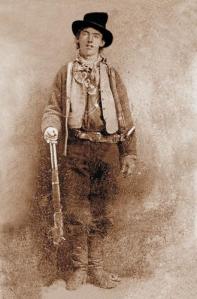
Billykid
It turns out that in real life Billy the Kid may have resembled a goat more than he resembled Emilio Estevez. By Ben Wittick (1845–1903) [Public domain], via Wikimedia Commons
It’s a good story, the kind that makes for great Western lore, but it’s far more likely Billy the Kid was assigned his nickname by J. H. Koogler, publisher of the Las Vegas Gazette, who printed the name for the first time on December 3, 1880, probably just because Bonney was so young.

There’s no real indication whether or not the youthful criminal appreciated his nickname. But he probably did not give it to himself. And despite what you may have learned from those most excellent time travelers Bill and Ted, it’s not likely he expected anyone to call him Mr. The Kid.

Billy’s career as a hardened criminal, though depicted in at least 50 Hollywood films (in which it should be noted he more closely resembles Emilio Estevez than he does a goat), lasted only about four years. His birthdate is a little disputed, but most accounts place him at about 21 when he was shot and killed by Sherriff Pat Garrett. Of course, much like Elvis, he may also have lived to be an old man under an assumed name.

And maybe he did. Because I suppose nobody can carry around a name like “The Kid” forever and if he hadn’t taken control of the situation, he might have eventually become known as William the Goat Face. So if my son means it and really wants to transition his name into something that can grow with him a little better, I’ll be glad to help him do so.

A Talking Dog that Cares About Grandmama

This week brought with it at least two stunning pieces of news. The first is that highly decorated Olympic swimmer Michael Phelps does not swim as fast as a great white shark, even if he wears a simulated shark skin wetsuit and a ridiculous fin. The second, equally shocking revelation, is that within ten years, our dogs could be speaking to us.

According to consumer futurologist William Higham (whose job is not nearly as made up as it sounds), the market demands a product that will allow the translation of dog barking. And it turns out Northern Arizona University biology professor emeritus and author of a book called Chasing Dr. Doolittle: Learning the Language of Animals, Con Slobodchikoff thinks it may be possible. And frankly, his job sounds way less made up.

Alexander_Graham_Bell
Alexander Graham Bell, inventor of the talking dog. And the telephone. By Moffett Studio, Public Domain, via Wikimedia Commons

A few days ago, Amazon got super excited about this and said that when there is such a product, they will be happy to ship it to you via drone and then hound you for a review. And as anyone who has ever tried to sell a book can tell you, the market lives and dies on the word of Amazon. But it got me thinking whether I really do want to know what my dog has to say.

Alexander Graham Bell, of telephone inventing fame, decided when he was a young man of twenty that he did want to know what his dog Trouve had to say. With both an elocutionist for a father and a mother who was nearly deaf, Bell became fascinated at an early age with how sound could be transformed by the shape of one’s mouth.

So he did what I’m sure any of us would have done. He taught his skye terrier to produce a sustained growl on command and then manipulated the dog’s mouth to approximate the words “How are you, Grandmama?” I imagine the interpretation took a little bit of imagination, but the discovery that it could be done led Bell in some interesting directions in his studies of speech and sound transmission.

skyeterrior
Skye terrier, a dog that cares about Grandmama. By Pleple2000 – Own work, CC BY-SA 3.0, https://commons.wikimedia.org/w/index.php?curid=1851190

Sometimes I do wish my dog could speak English, or at least that we could understand one another a little better. Almost two weeks ago, my family and I went out of town for the weekend and Ozzie got to spend a couple days in the kennel.

We have a great kennel and Ozzie is a very social dog, so he gets really excited when we take him there, but this time, the poor thing caught a cold. Several days after we got back, we noticed he had begun to sneeze more often than normal, and even cough a little. He was especially sleepy and didn’t seem to feel very well. We took him to the vet.

Ozzie came home with antibiotics he was not convinced he wanted to take. I wished I could explain to him the importance of the pills and that they will help him feel better, or at least prevent him from feeling even worse. Instead, I have to break them open and mix the medicine with peanut butter. And all I can do is let him lay his head on my lap so he can breathe a little easier while I scratch behind his ears.

So, I suppose we communicate just fine. Whether he understands that I’m trying to help or that the yuck he’s feeling is temporary, I don’t know. But he likes peanut butter (even when it’s laced with amoxicillin) and I think he at least knows I care.

Hopefully Trouve understood that, too. According to Bell, the dog enjoyed the attention and the treats that came along with his elocution lessons. Despite rumors to the contrary, Bell’s terrier never became a great orator. The inventor admitted he was never able to train the dog to make the sounds on his own. Of course it’s always possible that Trouve was just kind of a jerk who didn’t really care how Grandmama was doing.

sickozzie
In a week or so, when he’s feeling better, I bet Ozzie will be saying, “Hey, lady, where’s my peanut butter?”

And that’s the real concern I think. Because what if, after the Amazon drone delivers my dog interpretation device, I discover that I don’t care much for what my furry companion has to say. Ozzie is pretty expressive already. He tells me quite clearly when he needs to spend some private time outside and when it’s time for me to give him a treat. He can’t resist happily howling along when the boys play the piano, but seems to care not at all for the guitar and ukulele. He rests at my feet as I write, and stares at me with kind brown eyes when I read to him from my work, or pretend that I’m talking to him and not just to myself.

I suppose I’m just afraid to know what he’s really thinking at those times. What if he calls me names when I’m slower than he’d like to let him out or get him a treat? What if the lyrics he’s put to the piano tunes have no sense of poetry? What if he’s critical of my words? All things considered, I think I like our relationship the way it is. I like telling him how much I love him with a scratch behind the ears. And I like assuming that he does care very much how Grandmama is doing.

Liars, Outlaws, and Mandatory Fun

We’re in our second week of a heat wave here in the St. Louis area, the kind that pushes the heat index well over 1oo degree Fahrenheit and keeps us all stuck inside and miserable. We’re fortunate to have air conditioning and lots of fun places to escape the heat, but one day last week, it wasn’t enough.

It was one of those rare days when neither of my children had plans with friends and both were bored and cranky. We needed to get out of the house, to someplace else cool, obviously, but the struggle of agreeing on a destination proved too much. Finally I’d had enough. I decreed that we would have a “Mom’s Choice Mandatory Fun Adventure Day,” marched them to the car, and refused to tell them where we were going.

barn sign
For some reason once we hit I-44 it didn’t take the kids long to figure out where we were going. photo credit: el-toro Meramec Caverns Barn Ad via photopin (license)

Then I drove them an hour through winding back roads over to Interstate 44, to Meramec Caverns, the most widely toured cave in Missouri and where it’s always a crisp 60 degrees. If you’ve ever driven along I-44, you’ve seen the billboards. A lot of them. And a few painted barn roofs, too. Many of them identify Meramec Caverns as the one-time hideout for Missouri’s most infamous train and bank robber Jesse James and his gang. Sounds to me like a great place to get away and hide out from the heat for a while.

The story, as shared in complete earnest by our highly knowledgeable and enthusiastic tour guide goes something like this: Because the cave was a good source of saltpeter (or potassium nitrate), which was necessary for producing gunpowder, The Union Army used the cave as a munitions factory during the American Civil War until a group of Confederate guerrillas blew it up and put it out of business. Among those guerillas were the James brothers, Jesse and Frank.

Then in the mid to late 1860s, when the brothers began their crime spree, they remembered the cave and returned to use it as their hideout. It was a good one, too, because on at least one occasion a pursuing sheriff figured out their hiding spot, stood guard at the entrance, and waited to starve the criminals out. The man waited for three days before creeping further into the cave to discover a second exit through chilly 40 degree water that feeds into the Meramec River.

jamesbrothers
Jesse and Frank James welcoming visitors to their alleged super secret cave hideout. photo credit: Jinx! Meramec Caverns via photopin (license)

It’s just the right kind of story to capture the attention a couple of squirrely boys who have been forced into an afternoon of cave adventure fun. The story continues to capture the imaginations of around 150,000 cave visitors per year, and countless others who drive along I-44, wondering whether they should stop.

So I suppose it’s probably not a huge surprise that it isn’t likely true. I mean, yes, the cave, which explorers originally named Saltpeter Cave, did serve as a mine and munitions factory for the Union Army, and it was attacked by Confederate Guerillas. There’s even a chance Jesse and Frank James were among the soldiers responsible. But there’s really no reliable evidence that the brothers ever returned to the cave. In fact, it seems unlikely that they did.

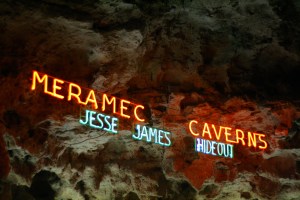
caverns sign
You’d think it might be obvious that’s where Jesse was hiding out, what with the neon sign and all. photo credit: Jinx! Jesse James Hideout in Neon! via photopin (license)

The “proof” of the story comes from Lester Benton Dill, the man responsible for developing the renamed Meramec Caverns into a tourist destination. Soon after purchasing the cave, Dill began to expand its accessible parts, which led in 1941 to the discovery of a room beyond a crevice normally underwater, but slightly exposed during times of extreme drought. Dill claimed that the room beyond the crevice contained a strong box connected to a well known train robbery committed by Jesse James and his gang. He opened up the cave to create more access and the room now contains mannequins of Frank and Jesse and is a part of the tour.

But no one is totally clear on when Dill, a master marketer who was known to occasionally push the limits of truthfulness, made this fascinating discovery and the only witness who could testify to the truth of the cave hideout theory was a man by the name J. Frank Dalton, who at the age of 102 claimed to be Jesse James. An imposter, he said, had been shot and killed 67 years earlier. He also said that yes, of course the James brothers had used Meramec Caverns as a hideout and handy escape route.

Of course the James family and DNA evidence both denied the new Jesse’s identity claims, but he’d already breathed life into the tale Dill had been trying to spin on billboards all across Missouri.

me and my book
If you happen to like history that has been commandeered and cleverly woven into other stories and is occasionally a little made up, you should check out my book Launching Sheep & Other Stories from the Intersection of History and Nonsense.

So basically, this guy just commandeered the tale of an interesting historical figure, and wove it together with his own story, sort of making up history a little in order to promote himself. Frankly I don’t know what kind of person might do such a thing. But personally I don’t really mind so much, because Meramec Caverns does make a great hideout on a hot day with bored kids, and a little tall tale doesn’t change that.

The cave features all kinds of wonders, including an amazing formation that looks like a genuine stage curtain on which the tour guides project lights and patriotic images while a recorded Celine Dion belts out a rendition of “America the Beautiful.” It’s easily the weirdest thing I’ve ever experienced on a cave tour, and that’s including the James mannequins.

But it’s a literally cool tour in a figuratively cool place, well worth the stop if you find yourself driving down I-44, or in the middle of a heat wave with bored, cranky brothers who need to have some mandatory fun.

Let’s Just Call Those the X-Days

What I really need is a do-over. At the start of the summer, all those sunny weeks and lazy days ago, I had visions of happy kids and chore charts and nutritious picnics, followed by well-sunscreened adventures to swimmin’ holes, bike trails, or the ballpark. During the long, relaxed evenings, we were going to harvest the latest offerings from our garden and work together to prepare a nice meal followed up by a pie we made with the abundant fruit we picked at the local orchards.  Of course, even in my fantasy my children wouldn’t eat said pie because fruit is NOT dessert. Sigh.

But you get the idea. This was supposed to be a highly organized, smooth running summer to remember. And it was all to start with that Day 1, when the biggest thing on our agenda, before all the fun could officially begin, was the organizing of all the random junk they brought home from school at the end of the year.

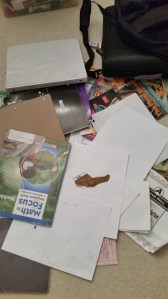
office floor
An actual picture of my actual office floor. Well, or what you can almost see of it.

Scheduled to take place in what is, throughout the school year when I have more time, my writing office, Day 1 never quite happened the way I hoped it would. The boys did follow my instructions and dump their well-worn backpacks, scribbled-on notebooks, and eraserless pencil nubs in the middle of the floor so we could sort the reusable supplies from the detritus. Somehow that’s as far as we got.

Each had his own idea of how he wanted to spend his first day of summer, and this was definitely not it. And so the pile of school year castoffs remained.

From there it was all downhill. We had a packed June with a fabulous family vacation and then camps and VBS and a mission trip for my oldest, and somehow that summer chore chart never got posted or enforced. I still can’t see the floor of my office. We haven’t been to the orchard or baked a pie my children won’t eat. And the math workbooks I bought so my children’s brains wouldn’t turn to mush over the summer break? Filled with nothing but unsolved problems and the best of intentions.

I feel like I just let the whole thing run away from me to become a disorganized mess, like the pile of crap in my office, or even like the US Patents office prior to 1836. That’s when Maine Senator John Ruggles formed a bill designed to revolutionize the US patent system, which until then had been kind of a hot mess and was in definite need of a do-over.

Prior to the 1836 act, patents required signatures from the Secretary of State, the Attorney General, and the POTUS, in the age long before a simple fax between these extremely busy people might have done the trick. Patents weren’t issued for months after they were filed, weren’t tracked effectively enough to protect an inventor from having his idea stolen, patented by someone else, and marketed falsely, and were limited to US citizens.  These patents weren’t widely available to the public, held in duplicate, or even issued an identification number.

Patent_Office_1877_fire
The 1877 fire in the new and improved fireproof US Patent Building. By Timothy H. O’Sullivan original photographer – Library Of Congress Public Domain, via Wikimedia Commons

The new act set up a Patent Office, run by a designated Commissioner of Patents. It required newly filed patents to be a matter of public record throughout libraries in the nation, allowed anyone to apply for a patent in the US, and demanded that applications be submitted in duplicate. The new patents were to be assigned identification numbers, with Patent Number 1 awarded to Senator Ruggles for his unique take on train wheel design. The previous patents were then retroactively numbered with “X” placed at the beginning, earning them the name “X-Patents,” and a new fireproof building was commissioned to house the records, which turned out to be timely since a few months after the act passed, the temporary patent office burned to the ground.  

There was a lot of great history lost in that 1836 fire that swallowed nearly 10,000 records, including the original patent for the fire hydrant. The majority of the X-Patent records weren’t recovered. The new building, not entirely completed until 1867, didn’t catch fire until 1877. Models and records (including that of an improved fire hydrant system) went up in that blaze as well. But by then the Patent Office had gotten its act together and no records were entirely lost to history.

school supplies
As many of my friends are lamenting the presence of school supplies in stores, I’m considering just torching all the X-supplies and starting fresh.

Now when I say I want a do-over, I certainly don’t mean to suggest that our summer has been a complete bust so far. We had a great family vacation and we’ve done a lot of fun things. We have ridden our bikes and done lots of swimming and made some delicious meals with the harvest from our garden. We’ve caught lightning bugs and completed summer library reading logs and been to the ballpark and gotten together with friends. I don’t want to burn the memory of those things.

But with about a month until school starts up again, I am feeling the need to start fresh. So today, on the 181st anniversary of the issuance of US Patent Number 1, I’m going to declare this Summer Day Number 1, the beginning of a refocused, more organized summer break. Everything that came before, I’m just going to call those the X-Days.

Ancient Toilets and A Little Inconvenience

In 1827, Englishman Charles Masson was a soldier for the East India Company, though not a particularly dedicated one. In that year, he deserted and began what became a several year journey of exploration through parts of India, and what is today Afghanistan and Pakistan, where he collected coins and artifacts, and became the first European to stumble onto the ruins of the city of Harappa.

Officially excavated for the first time in 1920, Harappa is one city within a very large prehistoric civilization known as the Indus Valley Civilization that stretched across the northern portion of South Asia and may have at one time supported a population of 5 million people.

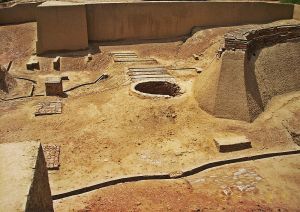
Harappa_Ruins_-_I
Ancient well at Harappa. By Hassan Nasir (Own work) [CC BY-SA 3.0 (http://creativecommons.org/licenses/by-sa/3.0)%5D, via Wikimedia Commons
This civilization had well-planned cities, a system of measurement, established trade, a thriving art scene, and a possible form of writing. It also had a system of wells, public and private baths, and the earliest known household flush toilets. All somewhere in the neighborhood of 3000 to 4000 BC.

Here is perhaps where it should be noted that the men who excavated the site at Harappa came from a civilization that had at this point been enjoying the widespread (though still not mandatory) use of in-home flush toilets for about seventy years.

I realize that sanitation and water supply isn’t a matter to be taken lightly. There’s no greater advancement in all of human history that has more profoundly influenced health and safety, and there are still many parts of the world in which safe drinking water and the safe disposal of waste is still sadly lacking.

It’s a huge privilege to live someplace where I can pretty much take the clean water flowing from my faucet for granted. And this week, my town has been experiencing a reminder of just how amazing that privilege is.

outhouse
Anytime I start to think it might have been fun to live in the 19th century, I picture this. photo credit: Midnight Believer Outhouse via photopin (license)

Early this week we received a call from our water district explaining that the city had issued a mandatory water conservation order. It seems a large 36-inch water main supplying our town took some damage. While repairs were underway, our little town was expected to receive about a third to a half of our normal water supply. In order to avoid depleting reserves and losing pressure in the system,  the city asked its citizens to aim for a reduction of water usage by 50%.

What that meant was no grass watering, car washing, or clothes laundering. I couldn’t hose down my thirsty garden and my neighbors couldn’t top off their swimming pool. The kids couldn’t run through the sprinkler on a hot day or whoosh down the slip ’n’ slide. With later updates the city attempted to lighten the harsh tone of the conservation order by expressing that if citizens really, really needed to do a load of laundry, they should forego taking a shower and washing their dishes.

shower
So you’re saying I CAN’T do the dishes? Darn. photo credit: Curtis Gregory Perry Hot and Cold via photopin (license)

I don’t know if you’re very familiar with my neck of the woods, but here along the Missouri and Mississippi Rivers, where occasional and sometimes catastrophic flooding is a legitimate worry, we don’t often have to deal with having too little water. So this was a bit of a shock to the system.

But I’m happy to report that late last night we got the okay to resume our normal water usage. We might have been a little smellier and our lawns are maybe a little less green and lush than they were a few days ago, but for the most part, we came through the ordeal unscathed. And despite a few snarky comments on the city’s Facebook page that were all in good fun, the people of our city didn’t really complain.

We know we’re the lucky ones. It’s thought that one of the major contributing factors to the eventual failure of the once thriving Indus Valley Civilization was drought and shifts in river flow.  

We continue to thrive here in our well-planned city where we have tape measures, a Walmart, a thriving art scene, and bloggers who practice a possible form of writing. And we have clean running water and flush toilets in our homes. Yes, life is pretty good here, even when it’s a little inconvenient.