One Brick at a Time: The Greatest Book on Earth

I don’t usually post on Tuesdays. But today is a special day, because five years ago, on May 9, 2012, I posted for the first time in this space as the Practical Historian. I didn’t really know what the blog would be about back then. I mean, I had a vague notion that since I write historical fiction, I should probably blog about history, but that was all I knew.

bloggiversary cupcake
Five years of blogging means I deserve a cupcake, right?

I was also a little scared, because I never liked history all that much. That is, until I started to research it as a storyteller. When I did that, I began to discover all of these weird and wonderful moments that make up the story of this world full of weird and wonderful people.

But right away I had a problem. You see, I’m not a historian. And I certainly never wanted to claim to be one, so I decided to take a very lighthearted approach to the subject, and to do my best along the way not to claim any authority I had no right to claim. I started to slowly build up the blog one brick at a time until it took on a distinctive, if somewhat unusual, shape.

What I ended up with was a blog that was a little bit history and a little bit me, one that was kind of funny, and sort of smart, and occasionally silly. And then all you readers started to show up, and you turned out to be funny and smart and occasionally silly, too.

Week after week, I found myself laying down bricks, and more and more of you followed along to see what I was up to, winding through history with me, with really no rhyme or reason at all to the path, and usually ending up somewhere surprising.

It’s like what the fine citizens of New York found themselves doing one sunny afternoon when a few of them noticed a poorly dressed gentleman laying bricks. When I say he was laying bricks, I don’t mean he was a mason busy with a construction project. Instead, this man was laying a brick here and then moving down the walkway to lay another one there, lined up just so. Whatever he was doing, he did it with precision, and in complete silence. The crowd that soon gathered found him fascinating, and as the man walked on, placing his bricks, they followed.

They followed him around the block and straight into Barnum’s American Museum where many of them purchased a ticket and continued their pursuit through the unusual displays they found there. As the crowd became distracted by the wonders and oddities in P.T. Barnum’s museum, the curious man and his bricks slipped out the back to continue on the path, where he picked up and replaced each precisely set brick as he came to it.

PT_Barnum_1851-crop
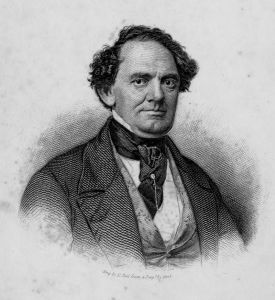
P. T. Barnum, the publicist I would hire, if only I could. By unattributed – Harvard Library, Public Domain, via Wikimedia Commons

Earlier in the day, the man had asked Barnum for a handout and what the great showman and even greater salesman offered instead was a job. Directed by Barnum, the man’s nonsensical bricklaying drew a crowd so large that after a few days, the police forced him to stop because traffic couldn’t get through. And many of the people who flocked to observe the brick man, paid to follow him into the museum. That’s some clever marketing by a man who called his own circus, “The Greatest Show on Earth,” and got us all to go along with it.

Now, if you’ve been reading this blog for the last month or so, you may have seen that as I approached this big blogiversary, the way I decided to celebrate was to publish a collection of some of my favorite posts from the past five years. If you’ve enjoyed the blog, I think you’ll enjoy the book (which features much better editing and a lovely cover). And if not, then maybe you know someone who would.

LaunchingSheep-CoverImage
Available today from Amazon and anyone else who sells books. I think there are still a few others.

So, I want to ask you for a favor. If you have appreciated the blog at any point over the last five years, would you be willing to share this post, or tell someone about the book, or mention it on Facebook, or give it a shout out on your blog, or send out a Tweet, or pin it, or Snapchat it to your grandma, or whatever the cool kids are doing these days?

Because as much as I love to write and as proud as I am of the blog and the book, I’m no P.T. Barnum and promotion scares me silly. I’ll do my best, but I’m pretty sure I will never be bold enough to call this the Greatest Book on Earth (if you feel so compelled, please feel free). And I sure would be grateful if you could lay down a few bricks along your path.

Thank you so much for five years. You are, without doubt, the Greatest Blog Readers on Earth.


If you’re into Twitter, here are a couple of ready-to-place bricks you can use:

Tweet: A quirky collection about history and family life and all the funny bits. #LaunchingSheep https://ctt.ec/7WXaq+A quirky collection about history and family life and all the funny bits. #LaunchingSheep https://ctt.ec/7WXaq+

Tweet: History meets modern day family life in this funny and heartwarming collection. #LaunchingSheep https://ctt.ec/UjzVD+History meets modern day family life in this funny and heartwarming collection. #LaunchingSheep https://ctt.ec/UjzVD+

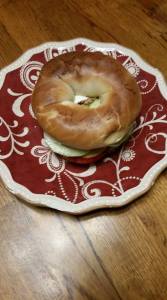
The Ultimate Grilled Bagel Sandwich. Trust Me.

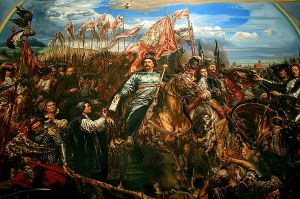
On September 12, 1683, after two long months of siege by the Ottoman Empire, the city of Vienna, Austria was rescued by the largest cavalry charge in history. Led by King Jan Sobieski III of Poland, the large combined force freed the city, a victory that became a turning point in the Ottoman-Habsburg Wars, a conflict already spanning nearly 300 years.

To say the people of Vienna were grateful would perhaps be an understatement. And legend has it that at least one Viennese baker took it upon himself to thank the king with a unique gift. The baker rolled a special bread into the shape of a horseshoe, boiled it, then baked it, so it would form a nice crust, and offered it King Jan, calling it a beugel, the German word for stirrup. King Jan took the gift, smeared it with cream cheese and lox and declared it gishmak.

KingJan
King Jan Sobieski of Poland placing his bagel order after the Battle of Vienna. Public Domain, via Wikimedia Commons

Well, that’s the persistent legend anyway. Actually the bagel, which does seem to have come from that general region of the world, predates the Battle of Vienna. Bagels are first mentioned in a list of “Community Regulations” in Krakow, Poland, dated 1610, where they are a suggested gift for mothers in childbirth, which, as far as I’m concerned, would have been way better than ice chips.

Some bagel historians (a highly competitive field, obviously) suggest the bagel may be a direct descendent of the soft, doughy pretzel produced in German monasteries from the twelfth century or so.

But however the wonderful chewy, crusty, traditionally Jewish, round bread came to be, it became a staple of the Polish diet and eventually found its way into New York (where they take their bagels very seriously), Chicago, and in 1983 to Carbondale, Illinois.

It’s true that Carbondale, home of Southern Illinois University, probably had bagels before 1983, but that was the year the Winston Bagel cart opened for business and introduced the world, one college student at a time, to the ultimate grilled bagel sandwich.

saluki
Salukis go crazy for bagels. photo credit: gott.maurer Kehailan Laura Baggins via photopin (license)

As an alumna of this esteemed institute of higher learning and a former frequenter of Winston Mezo’s weekend bagel stand, I was a little saddened to hear of Winston’s retirement this past weekend. It’s the end of an era at the old alma mater.

After a stint in the military, Winston arrived in Carbondale, in his words, “to sober up.” A recovering alcoholic, sober for 35 years, Winston served bagels, wisdom, and really bad jokes to the student population throughout all of that time.

His bagels became legend in the little college town and far beyond as students he encountered spread across the world. Before I left for school as a fresh-eyed 18-year-old, I was given this sage advice by another student: “Order a Winston bagel with everything, except the ingredients you absolutely cannot tolerate. Trust me.”

And it does take some trust, because fully loaded, Winston’s bagels (grilled over charcoal while you listen to some bad jokes), include: butter, cream cheese, cucumber, apple slices, garlic powder, cinnamon, raisins, chopped onions, sunflower seeds, and bacon bits.  I always ordered mine without onions and raisins. And it’s one of the most delicious combinations on the planet. Trust me.

winstonbagel
Trust me.

I had a full schedule this past weekend or I might have made the trip to Carbondale to have one last bagel grilled by the man himself. Instead, I joined SIU alumni around the world and fired up the grill to make my own.

Though it lacked the charm of the bad jokes, the bagel was every bit as delicious as I remember. It tasted like college and memories. And it tasted like the kind of food you might make for a king who just delivered your city from a long siege, and for whom you are especially grateful.

There’s a nice article about Winston and his bagels in a recent edition of the university paper, the Daily Egyptian. I wish the bagel man well in his retirement. SIU will miss him.

A Paper Book Smack Dab in the Middle of Nowhere

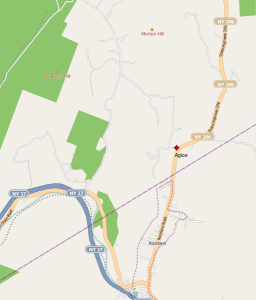
The intersection of State Route 206 and Morton Hill Road in Sullivan County, New York, could legitimately be considered the middle of nowhere. It’s a few miles north of Roscoe, New York, which sports a population of around 550 people, excellent fly fishing opportunities, and an allegedly haunted castle. But it’s Roscoe’s northerly neighbor, at that intersection in the middle of nowhere that might be the most interesting thing about the area.

Because that’s where, sometime in the late 1920s or early 1930s, the town of Agloe, New York was imagined into existence by Otto G. Lindberg and Ernest Alpers of the General Drafting Company. On their map of New York State, Lindberg and Alpers chose to set a trap for potential copyright infringers; and so right there in the middle of nowhere, where no one would ever have a reason to go, the mapmakers placed a dot they decided to label Agloe.

Agloe
Agloe is an anagram of the initials of Lindberg and Alpers, a good name, I think, for a dot in the middle of nowhere. By OpenStreetMap contributors (OpenStreetMap) [CC BY-SA 3.0 (http://creativecommons.org/licenses/by-sa/3.0)%5D, via Wikimedia Commons
Copyright infringement was a big problem in the mapmaking industry at the time (before GPS and the worldwide fleet of mapmaking Google cameras mounted on cars, boats, snowmobiles, and camels), and “paper towns” (because they exist only on paper) weren’t uncommon. And you can bet Lindberg and Alpers were glad they’d included Agloe when Rand McNally produced a New York State map a few years later that included the name of their made up town.

The problem was that Rand McNally’s lawyers had a pretty tight defense, because at some point along the way, a New York State couple saw the name Agloe on a map and decided to honor the little vanished town by naming their business in that approximate location the Agloe General Store.  Rand McNally claimed that their cartographers had visited the site, discovered the business, and concluded that this was one tiny New York hamlet that most certainly existed.

Still, the “town” and the business were in the middle of nowhere at the intersection of lightly traveled roads and, not surprisingly, the Agloe General Store didn’t last too long. Today, you can still visit Agloe, though you’ll have to plan your route to the intersection rather than the town since Google Maps removed the name in 2014. Once there you’ll find a nice sign welcoming visitors to the former site of the Agloe General Store and the made-up town it legitimized. You won’t find much else.

Paper towns
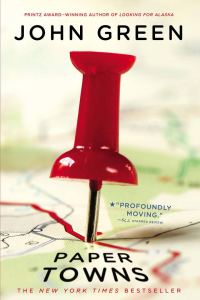
Author John Green thought the concept of paper towns was pretty cool, too, and Agloe features prominently in his novel.

I find the concept of paper towns fascinating, and as a writer, I particularly love the story of Agloe, which is an example of something invented on paper and imagined into actual existence.

That’s what writers do, or at least that’s what we try to do. We think and imagine and plan (and copyright), and eventually we produce a book, our imagination on paper, and we hope that someone will read it and will find that it has meaning in the real world.

In some ways, I’ve found blogging to be that way, too. Every week (and much more often than that for some), we write our posts and float our dots out there into the blogosphere, a place that can sometimes feel like the middle of nowhere. But then, if we keep at it, along come readers, many of whom are floating their own dots out into the virtual world and we begin to find meaning in one another’s work.

But writing in the middle of nowhere in the blogosphere doesn’t always feel tangible. I’ve been at this for a while now, and have been fortunate to have interacted with many gifted writers and amazing people in this space. On May 9 I will have been blogging as the Practical Historian for five years, and I continue to love doing it. To celebrate this milestone, I am releasing a tangible collection, (on paper, but also in e-formats) of some of my favorite posts and essays on history, life, and nonsense.

bookbox
A whole box full of highly meaningful paper books that really do exist.

If you’re interested, the book is available to preorder pretty much wherever you like to order books (and yes, on Amazon, too) and I promise that even though you can’t actually hold this paper (or electronic) book in your hands quite yet, I just received a shipment of honest to goodness copies. I’m not convinced you’ll find any great meaning in it, but it’s a fun book that really does exist. And it’s waiting for you just up ahead at that intersection in the middle of nowhere, not far from the haunted castle.

Popcorn for One

This past Saturday night, I did something new and wonderful. My husband spent the day with an old buddy of his and my children both attended an event Saturday night, so I found myself with some time on my hands at the end of a long, stressful week.

I thought about using the time to get some more long, stressful work done, but then I remembered that Beauty and the Beast was showing at the movie theater nearby and that I kind of wanted to see it, and no one else in my family did.

So, I bought a ticket and went to the movies by myself for the first time ever. Maybe it’s strange that a nearly forty-year-old American 21st century woman had never had that experience, and maybe you go to the movies by yourself all the time, but this was a first for me.

I bought some popcorn that I didn’t share with anyone. And when the person sitting beside me had to go to the bathroom in the middle of the movie, it wasn’t my problem.  In fact, once the lights went down and the movie started, I didn’t even notice the people next to me, because not one of them whispered to me, spilled his drink on me, or buried his eyes in my shoulder at the scary bits.

IMG_4974
Just one, please. With the perfect amount of butter.

I never entertained the fleeting thought that I should have chosen a different film because my movie-going neighbor clearly wasn’t enjoying this one. I just watched as the story of Belle and her Beast overwhelmed my senses and the stress of the week melted away in the dark auditorium.

And maybe that’s how it should be. After all, movie watching hasn’t always been the group activity it is today when movie-goers tend to grab their families, their sweethearts, or their rowdy group of friends, split a giant tub of popcorn, and sit back to enjoy the show.

When, on May 20, 1891, Thomas Edison first unveiled a working prototype of his laboratory’s Kinetocope, about 150 women gathered round to enjoy the experience, one at a time. The women were attending a convention of the National Federation of Women’s Clubs, and among them was Mina Edison, wife to the famous inventor.

Kinetoscope
Edison Laboratory’s Kinetoscope, what a movie theater looked like in 1891. Public Domain, via Wikimedia Commons

The device these ladies got to see was a large box with a small peephole in the top so that one person could peer inside and see a picture that moved. Edison (and more so his assistants, William Dickson and team) wasn’t the only one making progress toward moving pictures at the time, but when the ladies got a chance to look into the box and see William Dickson waving his hat at them, it was certainly a wholly new experience for them.

And it happened to the right group. Because the National Federation of Women’s Clubs had been developed to support women’s organizations engaged in improving lives through volunteerism. These were some hard working ladies, tackling some of the biggest civic issues of the day including women’s suffrage and child welfare. They had likely come to the conference exhausted, in need of encouragement and empowerment, and also rest and refreshment.

Though the moving picture they saw lasted only a few seconds, I have to assume they enjoyed their moment of solitude and focused entertainment, when in the midst of all these many people, each lady got a turn to see Dickson’s picture greet only her.

The experience caught on. Edison’s team also patented the Kinetographic Camera and by autumn of 1892, the movie viewing system had been fitted with a nickel slot and was headed into production. The first public Kinetoscope viewing parlor opened in New York in April of 1894, and soon the machines were in several major cities and in traveling exhibits throughout the United States. Folks lined up with their nickels, often paying a whole quarter to spend a few minutes jumping down a line of movie boxes to view a series of very short films.

Personally I’d find that a little frustrating and I’m glad that film soon moved into a bigger venue that could accommodate a larger audience. If not for that, we’d never have come to enjoy the hilarity of Mystery Science Theater 3000, or gotten to listen to rustle of hundreds of newspapers unfolding at the boring part of Rocky Horror Picture Show, or squirm in discomfort when an infected someone sneezes in the crowded movie theater during Outbreak. And we’d never miss a pivotal scene in order to accompany a kid to the bathroom.

Don’t get me wrong here. I still enjoy going to the movies with my family and friends. I think I even prefer it most of the time, but this is definitely an experience I will repeat when I get the chance. The movie was good. It’s a familiar story (my friend Pat recently wrote this fascinating post showing the Beast through the years), but it was well done with talented actors, strong voices, and plenty of Disney magic performed just for me. Most importantly, I did not leave in the middle to go walk with anyone to the bathroom. And my popcorn was just the way I like it.

A Highfalutin Riot: Fighting for the Right to Party at the Ballet

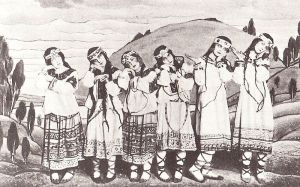
On the evening of May 29, 1913, many upstanding ladies and gentlemen of Paris, those with an appreciation for high culture and fine art, headed to the recently opened Théatre des Champs-Elysées for a night on the town. What they’d come to witness was  Rite of Spring, a highly anticipated performance by Les Ballet Russes, choreographed by the often controversial Vaslav Nijinsky with music composed by the unconventional Igor Stravinsky.

It’s unlikely any of those in attendance could have anticipated engaging in a shouting match with fellow ballet goers, being beaten with their neighbors’ canes, or having the peculiar rhythm of the music tapped out on top of their heads by the normally well mannered folks sitting behind them. But those are just the types of things that happened during what became perhaps the most notorious performance in ballet history.

RiteofSpringDancers
Riot-worthy ballet costumes. I guess. Rite of Spring Dancers. See page for author [Public domain], via Wikimedia Commons
From almost the moment the first note sounded, the audience appeared uncomfortable and soon discussions broke out about the discordant music and the aggressive movements of the dancers in wild costumes, portraying disturbing pagan scenes. It seems some in the audience appreciated such a fresh performance while others found it to be an assault on the tasteful traditions of ballet and music composition.

Soon the disagreements turned to shouting and cane whacking, allegedly requiring police interference by Intermission and settling into a full on riot before the end of the performance.

At a ballet.

As I’m sure you know if you’ve visited this blog before,  I’m super  kind of occasionally thorough in my research, so I did listen to Stravinsky’s Rite of Spring as I composed this post, and I have to say, I’m not sure I really get it. Bear with me here, because I am not qualified at all to be a music critic, but I do know what I like and don’t like. The Rite of Spring, while discordant and strange in places, strikes me as really beautiful at other times. And probably not riot-worthy.

But much more qualified music critics, some of whom consider this Stravinsky’s greatest work as well as one of the most influential compositions of the 20th century, often point out that it was a huge departure from the musical expectations of its time.

Igor_Stravinsky_Essays
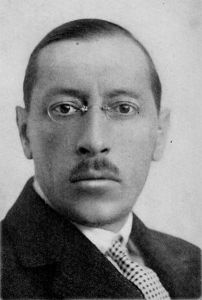
Does this look like a man who would inadvertently cause a riot? Igor Stravinsky. Photographer: Robert Regassi. Publisher: J. & W. Chester, publisher, no author listed (Miniature essays: Igor Stravinsky) [Public domain], via Wikimedia Commons
So maybe I do get it, at least a little bit. Music does after all have the potential to elicit strong emotional response. That’s the reason I tend to skip around on my iPod a lot looking for the song I’m in the right mood for, even if I don’t know what that is until I hear it. And it’s also the reason that in the family iTunes account, we have set up a bunch of different lists for cleaning, family dance-offs (not an infrequent occurrence at our house), and settling down before bed.

Each of us has our own individual list, too, and sometimes we do get into arguments about which one we should listen to while prepping dinner. There’s a lot of overlap in our musical tastes, so it isn’t always a big problem, but each of us (except for me, obviously) has our little quirks. My oldest son favors classical movie scores and great guitar riffs (tolerable), but also has an unfortunate taste for electronica. My youngest is often happy with Metallica, but still enjoys a “good” bagpipe tune. And my husband, a man I admire for so many reasons, has a regrettable and inexcusable love for the Beastie Boys.

But despite any disagreements, we still turn on the tunes. And I imagine the highfalutin folks at that first performance of Rite of Spring eventually returned for more of the ballet. And actually, there’s a little mystery surrounding this high society riot anyway.

For such an unusual event, there’re not a lot of good reliable details. What we do know rests on the eyewitness accounts of some of the performers and a few of those in attendance; and given that eyewitnesses are generally not all that reliable, it’s possible that some exaggeration may have occurred over the years.

800px-Beastie_Boys_Sonar_2007_Barcelona_Catalonia
This man, however, might tempt me to embrace my crazy. Beastie Boys’ Adam Horovitz By bakameh (Flickr) [CC BY 2.0 (http://creativecommons.org/licenses/by/2.0)%5D, via Wikimedia Commons
And while both Stravinsky and Nijinsky were upset by the event, Sergei Diaghilev, wealthy entrepreneur and founder of Les Ballet Russes, reportedly said of the scandal that it was “just what [he] wanted.” Because controversy sells, and a ballet rumored to have started a riot, will likely sell out. There were no reports of further violence erupting at any of the remaining performances.

So it’s possible Rite of Spring didn’t really make people embrace their crazy as much as we’ve been led to believe. Still, I gotta say, when my husband occasionally decides to fight for his right to party and cranks up the Beasties, I think I could probably find myself willing to whack someone over the head with a cane.

And speaking of things totally worth getting overly worked up about, tomorrow I will be sharing some exciting news with the folks who are signed up on my e-mail list. If that isn’t you, and you’d like it to be, you can sign up here: http://eepurl.com/b3olY1

Recipe for Spring: Start with 1.4 %Egg Yolk. Add Brain Freeze.

When he took on the office of the President of the United States in 1801, Thomas Jefferson brought with him his love for ice cream. Having most likely gotten his favorite ice cream recipe from his time serving as Minister to France, Jefferson often had the dessert served in what would, after a few years and a fire, come to be called the White House.

Thomas_Jefferson_rev
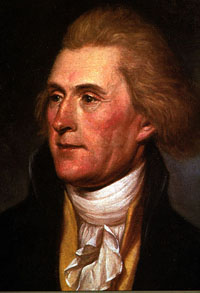
Just a hint of a smile in this portrait…I bet he’s thinking about ice cream. Thomas Jefferson, Public Domain, via Wikimedia Commons.

Jefferson accomplished a lot in his political career, but contrary to rumors that suggest otherwise, he did not introduce ice cream to the United States. He did, however, probably contribute to the spread of its popularity, and his handwritten recipe is the oldest of its kind known in the US.

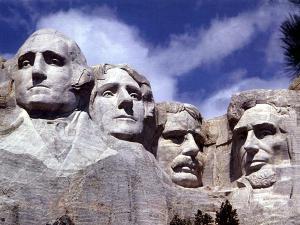
It calls for cream, of course, and sugar, vanilla, and plenty of egg yolks. I’m sure it was good, and if you want to try Jefferson’s recipe, you can allegedly do so while visiting Mount Rushmore where the National Park Service will be happy to sell you a cone.

Mountrushmore
When we visited Mount Rushmore a few year ago, we had no idea we could have eaten Thomas Jefferson’s way back ice cream. Guess we’ll have to visit again. Mount Rushmore, National Park Service, Public Domain, via Wikimedia Commons.

But according to the FDA, what you’ll be eating won’t technically be ice cream, which is defined as a frozen dessert containing at least 10% milkfat, a maximum of 100% overrun (the amount of mixed in air), and less than 1.4% egg product. You’ll have to call it French ice cream, or frozen custard instead.

It’s the eggs that make the difference, as most American ice cream recipes now forgo eggs all together in order to make production cheaper and handing easier. Custard is generally served fresh, and is stored at a slightly warmer temperature than ice cream. And custard has a much lower overrun, making it denser (upside down frozen custard has been holding onto spoons since long before Dairy Queen’s Blizzards) and creamier and, often, much more delicious.

You can trust me on this because we St. Louisans know a thing or two about frozen custard, which outside of the return of baseball(and yes, I’m going to go out on a limb here and speak for all of us) is our favorite sign of spring.

Finally this week, spring has sprung here in Missouri. It happened officially this past Monday, but all the unofficial signs have begun arriving, too. The temperature reached into the 80s (it didn’t stay there, because Missouri), tornadoes have touched down, the dog is shedding EVERYWHERE, and the seasonal frozen custard stands are finally open.

This last one matters most to our family, and especially to my nine-year-old son. We pass one of his favorites every day on the way home from his school, and every day I have to decided whether I will stop to get an after school treat or whether I will explain to him why it’s not a custard day.

Obviously we stop much less often than we don’t, but he never fails to ask. Fortunately this stand, like many in the area, closes in late November and doesn’t open again until early to mid-March, so I get a few months off from this tedious conversation.

But now it’s open, and my son is relentless. What can I do? He’s a St. Louis kid. And he loves his frozen custard.

Ted Drewes
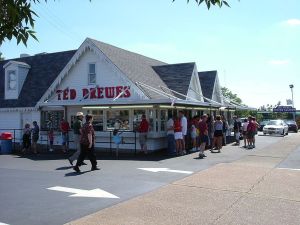
Ted Drewes Frozen Custard. “It really is good, guys..and gals.” By The original uploader was Indrian at English Wikipedia [GFDL (http://www.gnu.org/copyleft/fdl.html) or CC-BY-SA-3.0 (http://creativecommons.org/licenses/by-sa/3.0/)%5D, via Wikimedia Commons
The Midwest fell in love with this creamiest of frozen dairy desserts in the 1930s. The first machine designed for producing frozen custard was about ten or twelve years old at that point and had already taken the Jersey shore by storm, but no one loves the stuff as much as Midwesterners (the true cultural center of the nation).

The city that grabbed hold the most enthusiastically is Milwaukee. Since Wisconsin is made of dairy cows and ice, it was a natural fit. Today that city calls itself (unofficially) the frozen custard capital of the world and boasts that it contains more frozen custard stands per capita than any other city. Good for them.

fritz's
Our favorite local treat is Fritz’s Frozen Custard, a St. Louis tradition since 1983.

I mean no disrespect to my Milwaukee friends when I say this, but we have an arch, and a better baseball team, and Ted Drewes Frozen Custard, named by celebrity chef Bobby Flay as the best dessert he’s ever eaten. Ted Drewes has been a part of St. Louis since 1931, and as they say in their extremely clever catchphrase, “It really is good guys…and gals.”

My son and I don’t drive past a Ted Drewes every day on our way home from school, but just because our stand is less famous, doesn’t mean it’s any less beloved. And most importantly, it’s now open for the season.

We’ve already made our first stop for rich, creamy, frozen dairy deliciousness complete with more than 1.4% egg yolk, consumed so enthusiastically that my son gave himself his first brain freeze of the spring. I think Thomas Jefferson (coincidentally my favorite historical president, only partially because of his love for frozen custard) would be proud.


The Ear-splitting Crack of My Broken Backyard Dreams

On October 12, 1492, Christopher Columbus first set foot in the Bahamas. He hoped he would find gold, spices and silks, and a faster trade route to China. What he found instead was fertile land, an easygoing and hospitable people, and hammocks.

When he returned to Spain from that first voyage in March of 1493, Columbus brought with him a few of the people, a little gold, some tobacco plants, and, most importantly, some hammocks. Because, as everyone knows, hammocks are one of the greatest things in the world.

beach-hammock
Surely the highlight of any Caribbean voyage. Or possibly a view of my backyard. photo credit: shizham Tenggol Island via photopin (license)

By then, Natives of Central America had been using hammocks constructed of bark and plant fibers for around 500 years already, and though Columbus never did discover his direct water passage to the east, hammocks were certainly not a bad find. Europeans took to them right away, particularly finding them useful aboard ships.

And today, they are widely used for swinging in the light breeze suspended from two trees beside a white sand beach while sipping a piña colada. Or, possibly, in that great imaginary beach that exists in my suburban backyard.

When my husband and I bought our first little house, a few years into our marriage, it came with two posts in the backyard, perfectly spaced for a hammock. Obviously, we had to install one. We each spent many happy naps swaying in the backyard, often while cradling our oldest son who was a baby at the time. Because as perhaps the not-so-surprising research of skilled hammock scientists now tells us, human brains go to sleep faster while rocking. Apparently that’s even true of grownup human brains.

baby-hammock
Now that’s livin’ photo credit: crowdive Audrey and the hammock via photopin (license)

Unfortunately the next house didn’t have a convenient place to install the hammock, and when we thought about hanging it in the house after that, we discovered that while we’d been neglecting to use it, a colony of ants had discovered that they, too, enjoyed spending time in a hammock, though I don’t know that any skilled hammock scientists have studied that.

It took us an embarrassingly long time to get around to replacing it, but when we moved to Missouri a few years ago, we decided it was time. Last fall, my husband dug holes, poured concrete, and secured the strong posts. Then we hung the hammock and made a discovery that may have escaped the notice of the highly skilled hammock scientists: children in the middle grade to pre-teen range don’t seem to be soothed by the rocking motion in quite the same way. In fact, they may have the exact opposite response.

Because to my children, the hammock quickly became something to jump on and try to shove one another off. I get it. As much as I enjoy a nice nap, their way sounds fun, too. But, it turns out that may not be the best approach to maintaining strong, stable posts.

The first post snapped within two weeks. My husband was pretty cool about it. He shrugged and said he’d thought there was a troublesome knot in the post and wasn’t particularly surprised. He replaced it and all was well. Then winter came.

It’s been a mild one, with lots of spring-like breaks, so we haven’t put the hammock away, though it’s obviously not seen a lot of use. But this week the boys decided to give it a swing.

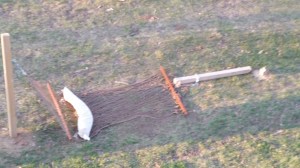
broken-hammock
An actual view of my backyard and the sad state of my hammock.

I wasn’t outside when it happened, but I heard the spectacular ear-splitting crack as the second post broke, followed by the cries of a very upset (though thankfully unharmed) boy. My sons tell me they weren’t jumping or wrestling on the hammock at the time. And I believe them, though I’m sure there was jumping and wrestling involved prior to the moment one of them laid back only to find himself landing on the ground.

This time my husband wasn’t quite as cool about the whole thing. He didn’t yell, but there was a sad look in his eye when he sighed and said he didn’t think it was worth replacing. Actually, what he said was, “They’re why we can’t have nice things.”

So I suppose, at least for now, you won’t find a hammock in our backyard. Or an imaginary white sand beach. You also won’t find gold, silk, or spices, or a direct water passage to Asia. But you can still find easygoing and hospitable people. And maybe even the occasional piña colada.


Empress for Life and a Free Glass Vase

On November 30, 1809, Napoleon Bonaparte needed to deliver some bad news to his wife Josephine. Nearly fourteen years after he married this widowed mother of two who was six years his elder, and almost five years after he declared her Empress of France, the time had come for him to ask her for a divorce.

Presumably he wasn’t thrilled with the idea. It wasn’t a perfect marriage. The two had weathered family disapproval, a fair bit of infidelity, and the kind of long absences conquering often requires.  But the love letters he wrote to her reveal that Napoleon was a man very much in love with his wife.

The problem was that an emperor needs an heir, and Josephine had yet to give him one, so Napoleon had to make a change. Josephine screamed when he broke the news to her, but after she had a little time to think about it she agreed to the divorce. And he insisted that she retain the title Empress, even after his remarriage.

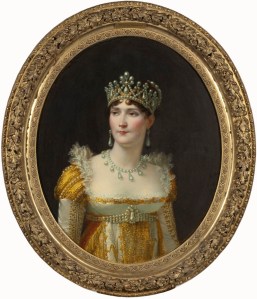
NM2432
Josephine, Empress of France and Patroness of Roses. By Jean-Baptiste Regnault – Per-Åke Persson / Nationalmuseum, Public Domain, https://commons.wikimedia.org/w/index.php?curid=52123172

Now either Josephine was an extremely understanding woman, or Napoleon was an incredibly convincing guy. Or maybe a little bit of both. But I’m guessing it also didn’t hurt that over the years he’d given her a lot of roses.

Because as everyone who ever turns on the radio, or watches television, or opens an Internet browser around this time of year can tell you, roses are the only certain way to a woman’s heart. And a lot of people are getting the message, because florists sell somewhere around 220 million of these most magically romantic flowers for Valentine’s Day each year. Half of those are sold in the US, where 75% of the sales are to men who are, obviously, the best husbands, boyfriends, or sons a gal could ask for.

And the best of the best of those men upgrade to two dozen of the all red variety along with chocolate dipped strawberries and a free glass vase for only $59.99 as long as they order before midnight on February 12 and use promo code: Napoleon.

strawberries
You can keep the vase, but these do look delicious. photo credit: k is for kristina via photopin (license)

Because who wouldn’t want that?

Maybe most women really would. Personally, I don’t get too excited about roses or free glass vases. Don’t get me wrong, I think roses are gorgeous, and they smell good, and it’s nice to get flowers every once in a while because it’s a reminder that my man was thinking about me and wanted to make a romantic gesture.

But the primary reason the rose (which in addition to representing love has often been adopted as a political symbol) has become our Valentine flower of choice, may have more to do with the fact that we celebrate love in the middle of winter. To do so, we have to import a huge number of flowers, and as flowers go, roses are pretty hardy.

And for Napoleon, it’s a good thing they are, because his Josephine loved roses. In 1799, without consulting her husband, she purchased the run-down Château de Malmaison on 650 acres a few miles outside of Paris, and began work to establish a large rose garden.

Soon, gathering roses for Josephine’s garden became something of a national priority. Napoleon ordered the French Navy to confiscate any seeds (and, I assume, glass vases) found aboard seized vessels. And even during the height of conflict during the Napoleonic Wars, many English gardeners were given safe passage through blockades so they might deliver rose varieties to Josephine.

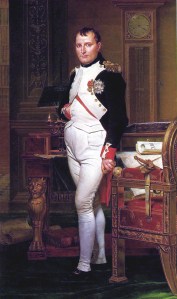
napoleon_bonaparte
Napoleon Bonaparte, much to the dismay of high end comedians everywhere, was not as short as we’ve been led to believe. In today’s standard measurements he was around 5’6 or 5’7, respectably average for a man of his time. By Unknown – Public Domain, https://commons.wikimedia.org/w/index.php?curid=21290

When in 1809, Napoleon informed his beloved that he would divorce her to marry a woman who might conceive an heir, the jilted woman sought solace at her chateau among her hardy roses. By the time of her death in 1814, Château de Malmaison boasted almost 200 varieties of roses, and her enthusiasm had begun a trend, leading to the establishment of more than 2500 varieties by 1830 in nurseries across France.

By establishing a large garden devoted to only one type of flower, Josephine elevated the rose, long valued as a sweet smelling, medicinal flower, to the status of a flower grown primarily for its beauty, especially when gathered by the dozens and presented on February 14 along with chocolate covered strawberries and a free glass vase. 

And now I don’t want to sell Napoleon short (see what I did there?). I’m sure it took more than roses to convince Josephine that a divorce was the right thing to do for the good of France. Because I gotta tell you, if my man were to present me with my favorite flowers (a bouquet of seasonally available, local-ish varieties at a time when flowers are more seasonally available), and then tell me that even though I’d always be his favorite empress, we had to break up for the good of our country, I wouldn’t scream. I’d just clock him in the head with the free glass vase.

Trending in History: Giants and Jerkfaces

On October 16, 1869, on William Newell’s farm near Cardiff, New York, two men digging a well, hit something surprising with their shovels. What they eventually uncovered was a ten foot tall, 3,000 pound petrified man.

cardiff_giant_2
Someone clearly had an unfortunate run-in with geode water. Excavation of the Cardiff Giant, Public Domain, via Wikimedia.

For years, newspapers had been featuring reports of petrified men, believed to have come into contact with water from the inside of geodes. So no one had any doubt such a thing could happen. The good people of Cardiff flocked to see the giant, took selfies to post on Instagram and tweeted out the Syracuse Daily Standard article that dubbed the giant “a new wonder.”

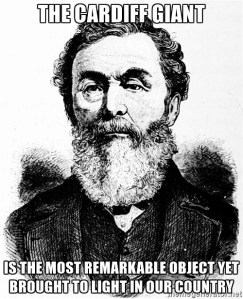
Of course there were a few skeptics. Among them was Dr. Boynton, a local science lecturer who assumed the find was actually a large statue of historical significance. Noteworthy geologist and paleontologist James Hall liked this theory, calling the find, “the most remarkable object yet brought to light in our country,” a quote that once added to a picture of the respected scientist became a meme netting more than 120,000 likes and 15,000 shares on Facebook.

giantmeme
Looks legit to me.

Many theologians got excited, too, pointing to the very large man as evidence supporting the literal interpretation of Genesis 6:4, which claims there were once giants on the earth. The news commentators and bloggers had a lot to work with.

But notably absent from most “media” coverage was the assessment of Yale paleontologist Othniel Marsh who stated upon seeing the Cardiff giant, “It is of very recent origin, and a most decided humbug…” Marsh wasn’t the only one to voice such outrageous ideas, but he might as well have not said anything, for all the good it did.

Most visitors adamantly claimed there was no way they would ever believe the giant had not once been a living, breathing creature. Because once a person’s decided to believe something, it’s hard to convince them not to.

Eventually, the man behind the humbuggery did confess. Cigar manufacturer, dedicated atheist, and cousin to Mr. Newell, George Hull admitted to having the statue commissioned and buried after engaging in a debate with a Methodist preacher over the literal interpretation of Genesis 6:4. He really just wanted to say, “Gotcha!”

As a bonus, he also made a pretty penny off his share in the scheme eventually selling his interest for nearly a half million adjusted 2017 dollars. He definitely fooled a lot of people and certainly supported the point that those who set out to make a point by fooling a lot of people, are kind of big jerkfaces.

Seriously, it was ALL OVER social media. #HumbugHull  #CardiffCon #GiantJerkface.

barnum
P.T. Barnum, America’s favorite son of humbuggery, offered to buy the Cardiff Giant. When his offer was refused, he commissioned his own gypsum giant and claimed the first was a forgery. Like a boss. Public Domain, via Wikimedia

But I do think, unwittingly, Hull made another point, too. Because his giant was the fakest fake news of the day. That’s right, folks. We’ve ALWAYS had fake news. Just like we’ve ALWAYS had biased news. Because none of us, members of the media included, lives in a vacuum. Our experiences, our intentions, and our personalities, whether individual or institutional, all serve to inform our biases.

The media attention given to the Cardiff Giant rarely included expert voices that contradicted the sensational because sensational sells and improves SEO as its shared widely across platforms evidently designed to make otherwise reasonable and more or less kind-hearted people seem completely insane. So media outlets use (among other tactics) carefully worded headlines, precisely cut-off quotes, and selective expert interviews to make that happen.

So how do we combat this? First, I think we would all benefit from a deep breath. Then, the next time you think about clicking “share,” take a minute to analyze three things:

  1. The bias of the source (and, yes, there is one, see the previous paragraph)
  2. Your goal in sharing the piece (if it’s either to taunt or to yell, “Gotcha!” it’s possible you should reconsider)
  3. Whether or not the piece will further civil discourse (or whether you’re just behaving like kind of a jerkface).

I don’t mean to sound like I’m coming off heavy-handed here, though I admit that’s exactly what I’m doing. I don’t deny that I have an agenda. I want my social media feeds to be kinder, more civil places today than they were yesterday. I want to have informed conversations with informed adults who don’t always agree with me, but whose opinions are interesting and worth giving some serious consideration. And I want the media to stop reporting about how biased the media is, because, frankly, that’s super old news.

So I hope you’ll remember George Hull and the Cardiff Giant and give some thought to my terribly biased interpretation of the way we should view his story. I hope, too, that at some point you will begin to question the authority of a history blogger who insists that #GiantJerkface was trending on Twitter in 1869. And, last but not least, I hope you are careful to avoid contact with geode water (which I think sells for $7 a bottle at Whole Foods), because I’d hate to see you get petrified, and I read somewhere that can happen.

The Rich Bird-Like Timbre of the Fourth Grade

This has been a big week in the life of my fourth grade son. Something he’s been looking forward to for a long time finally happened. Because in our school district, about half way through the school year, our fourth graders embark on a brand new adventure in musical education. They receive recorders.

henry-viii
This man could have rocked Harry Champion’s “I’m Henery the Eight, I am” on the recorder. Hans Holbein the Younger (1497/1498–1543) [Public domain or Public domain], via Wikimedia Commons
I’ve been blessed with children who love music. My oldest began piano lessons in Kindergarten and the last few years has shifted to playing the guitar in hopes of one day becoming his own one-man band. Meanwhile my youngest has a brilliant sense of pitch and rhythm, and when he’s in the mood, the voice of an angel. But a little more on the shy side than his brother, Son #2 hasn’t really taken a shine to musical performance. Other than a few months of piano lessons and a blessedly short-lived obsession with the bagpipe, he has more or less avoided playing an instrument.

So I was a little surprised he was super excited to receive his recorder. And even more surprised (and admittedly a little less delighted) that he was also super excited to practice playing it. In the living room. Pretty much all the time.

worstinstrument
Still the most unpleasant instrument in the world. photo credit: PeterThoeny Care for a scotch whiskey? via photopin (license)

I suppose it’s not the most unpleasant instrument in the world. It does have a long and glorious history, dating to at least as early as fourteenth century. Characterized as a flute with a whistle mouthpiece and seven holes in the front with one thumb hole in the back, the recorder emerged as a major musical force throughout the Renaissance. 

Valued for its narrow range and rich, bird-like timbre, it made an ideal instrument for ensembles, according to a lot of Renaissance composers who have never been in my living room when Son #1 decides to relive the glories of his fourth grade year and join in.

Even England’s King Henry VIII was a big fan, having in his possession at the time of his death a total of 78 recorders. Many of these were likely played by rotating musicians charged with providing a soundtrack for the monarch as he Supremely Headed the Church of England, warred with France, and divorced or beheaded his various wives. Rumor has it, Henry played a mean recorder, too, and just as Handel, Vivaldi, Bach, and others would later do, the king also composed for the funny little instrument.

recorderbagpipe
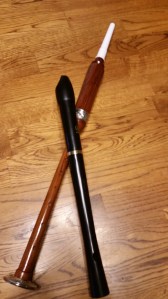
I think my biggest fear is that this new obsession with the recorder may rekindle his interest in the bagpipe.

Of course I have to assume that being so constantly surrounded by a chorus of recorders may have (along with the constant aches and pains of a long series of accidents and illnesses) contributed to Henry’s famous crankiness.

I know I haven’t particularly enjoyed the soundtrack at my house this past week. But at least on Saturday, when we had an almost 70 degree spring-like day (today it’s snowing, because it’s the Midwestern US), my brilliant husband suggested that my son take his practicing outside. I’m sure my neighbors enjoyed the rich, bird-like timbre.