Today marks the 47th anniversary of American astronaut Neil Armstrong’s giant leap for mankind, that moment when human beings first stepped onto the surface of the moon. Except that according to an article in the October 2, 1909, issue of Scientific American, written by John Elfreth Watkins, Armstrong may not have actually been the first.
Something about the crosshairs in the upper right hand corner seems off. I’m sensing something fishy about this story. [public domain], via Wikimedia CommonsWatkins relays an old Chinese legend that claims an official by the name of Wan Hu (or sometimes Wang Tu or Wan Hoo, depending on the source) launched a lunar mission around 2000 BC. According to this legend, Wan Hu strapped forty-seven small rockets to a large wicker chair, sat down, and told his assistants to light him up. Neither the man nor his rocket chair were ever seen again, perhaps an indication of success. And so after Soviet probe Zond 3 did a flyby of the moon in 1965, a crater on the dark side of the moon was deservedly named for famed Chinese astronaut.
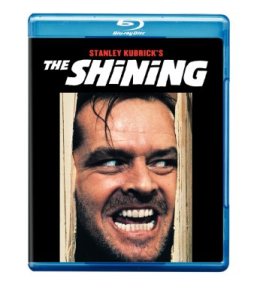
Of course some people believe that Wan Hu faked the entire stunt with the assistance of some fancy camera work under the direction of Stanley Kubrick, a scheme long covered over by a joint effort from the Chinese government and the cryogenically frozen head of Walt Disney. The evidence is far too involved to go into detail here, but it stems from the numerous drawings of the events that, to the well trained eye, reveal peculiar shadow angles, an oddly marked rock, and an unfurling flag, among other truly alarming details. Don’t even get me started on the secret clues buried within The Shining.
If you look really closely at Jack Nicholson’s space helmet, you can totally see a shadowy reflection of an object that might be a boom mic.
Now, I’m not generally a big believer in conspiracy theories, but this one, to me, seems entirely plausible. Because it turns out that prior to the 9th century, the Chinese didn’t yet have gunpowder, and they most certainly weren’t launching rockets in 2000 BC, strapped to a chair or not.
About thirty-five years after the publication of the Scientific American article, American author Herbert S. Zim offered a thoughtful update to the tale in his book Rockets and Jets. He logically placed the story of Wan Hu in the early 16th century. And it was some time after that when the Chinese began to adopt the tale, eventually erecting a statue of this hero of space travel at the Xichang Satellite Launch Center.
But if that’s not enough to convince you that the whole thing might just be made up, MythBusters Jamie Hyneman and Adam Savage attempted to recreate Wan Hu’s famous flight using technology that would have been available in 16th century China. They weren’t successful. And when they cheated and used more modern technology in an attempt to duplicate the results, their trusty dummy Buster wound up blown to bits and, most notably, not on the moon.
So, I think it’s safe to assume the conspiracy theorists have it right this time. Wan Hu could not have been the first man to step on the moon. The honor still belongs to Neil Armstrong, and thankfully, there’s no reasonable debate about that.
In February of 1512, a Spanish Conquistador named Juan Ponce de León received a royal commission to pillage, plunder, and claim the rumored islands northwest of Hispaniola. King Ferdinand specifically wanted this honor to go to Ponce de León, a Spanish son of a good Spanish family, because he did not want to cede any more power to Diego Columbus, the uppity son of that silly Italian fellow who’d done all the exploring for them in the first place.
Ponce de León had travelled to the New World initially on the second voyage of Christopher Columbus in 1493. Though it’s not clear what he did in the meantime, by 1504 he became the right hand man of the appointed governor of Hispaniola, Nicolás de Ovando, by effectively squashing a rebellion by the native Taínos.
Juan Ponce de Léon, pillager, plunderer, and Pokémon Trainer extraordinaire. Public Domain, via Wikimedia Commons
Thus began Ponce de León’s widely successful career of murder and exploration. He soon set off for the island eventually known as Puerto Rico in search of riches rumored by the Taínos, in exchange for which he enslaved many of them and gave the rest smallpox because he never washed his hands. He did find a great deal of gold, but by the time he returned to Hispaniola, Ovando had been usurped by the pesky Diego Columbus and a power struggle soon raged.
So when King Ferdinand suggested Ponce de León go exploring, he was probably pretty happy to oblige. He was the kind of guy who would jump at the chance to gather slaves, glory, and eternal youth, even if it meant wandering into a dark alley at 2 o’clock in the morning.
Because, yes, I think it’s safe to assume that if Ponce de León were alive today, he would be pretty obsessed with the game Pokémon Go. Now I don’t know where else in the world this game may be at this point, but here in the US, it made its debut earlier this month, and I’m telling you, wash your hands, because the pandemic is coming. If you are in the US and you don’t know the game yet, it’s what those people wandering aimless through your neighborhood while staring intently at their phones are doing.
There’s one! Oh wait, no, that’s just a toy. photo credit: 对阵/Versus via photopin (license)
I was just a few years too old to get caught up in the Pokémon craze the first time around and I’m going to sit it out this time around, too, so if you one of those obsessed (and I’m betting you’re not because you wouldn’t be wasting time/cell phone battery on reading this post), then I apologize for the following explanation.
As far as I can figure, Pokémon is a game in which you capture little powerful creatures and make them fight each other for your entertainment. In the late nineties, you did this by buying or trading Pokémon cards that you would play against your friends who would try to counter your attack with whatever cards they bought or traded for.
Now it’s gone mobile and realistic-ish, because through the magic of Internet mapping, Pokémon (the critters) can show up anywhere at any time and in order to capture them, all you have to do is throw Pokéballs (whatever those are) at them or hatch them from an egg by walking around like a crazy person.
Ah the good old days, when Pokémon was just a game that everyone was obsessed with. Oh, wait…
And if that’s not exciting enough for you, yes, you can make them fight, and you can take over “gyms” from other Poképlayers (a word I think I just made up, but probably not). The “gyms” are located in real-life public spaces, businesses, and even private properties that were once designated as something else, without any permission whatsoever given by the property-owners, or any recourse for those who don’t want their property to be a part of the game.
Did I get this about right?
And people have become absolutely obsessed with this game. I know because when I first heard about it maybe three or four days ago, it took over my Facebook feed, where so many of my otherwise pretty rational friends began posting screenshots of all the funny little places they’d found Pokémon, like in the bathroom stall at work. I would say an equal number of otherwise rational friends began railing against the posts and the crazy people stumbling about staring at their phones in places they ought not to have been, like the bathroom stalls of someone else’s workplace. Then I turned on the radio and the dj was droning on and on about Pokémon Go and I realized that even though I didn’t understand a single word, she assumed all her listeners knew exactly what she was talking about. And they probably did.
Virtual Pokémon in the non-virtual world. I admit, it looks pretty fun. Thanks to my multiple FB friends who, when I put out a call for a pic, obliged quickly and enthusiastically.
So why are people so obsessed with the game? All I can think is that they are reliving their childhoods, searching for a little bit of that wonder they felt in their youth, and hoping that by scouring a dark alleyway at 2 o’clock in the morning, and taking over new lands (or “gyms”), perhaps they can find it.
The great rumor mill of history suggests that that’s what Ponce de León was after as well when he stumbled into Florida. In addition to gold and slaves and glory, he was searching for the famed fountain of youth. Of course there are no contemporary sources that suggest this was the case, and even if he was seeking it, he never found it. In 1521, the conquistador was shot by poison tipped arrows fired by native inhabitants of his new land. Sapped of the strength even to throw a Pokéball, he died shortly after. And it couldn’t have happened to a nicer guy.
But despite the possible private property issues and potentials for abuse, which will need to be worked out, the game seems innocent enough. I wish all the Pokéballers (another word I think I just made up, but probably not) good luck on their quests for youth. But seriously, go wash your hands.
I am not a brilliant cook. I’m not exactly terrible either, unless you ask my youngest son, but then he refuses to eat anything that doesn’t come in a pizza box so I’m not sure you can trust his judgment on the matter. I have gotten braver with ingredients than I once was and may even occasionally go off recipe, which even more occasionally works out fairly well. And I have a few dishes that are actually quite good.
Over IX billion served. photo credit: The Golden Arches via photopin (license)
But meal planning for a picky household and trying to get everyone fed something that’s not terrible for them before they rush off to the next thing is tough. This is especially true in the summertime when I spend long days playing with my kids and then have to throw dinner together at the last minute.
So like so many busy families, we eat out, or at least eat take-out, far more than we should. It’s a problem that’s been around for millennia.
We know because the Roman city of Pompeii, so perfectly caught in the act of everyday life by the volcanic ash spewing from Mt. Vesuvius in 79 AD, had take-out restaurants. Or at least archaeologists can make a reasonable guess that that’s what they were. These cookshops or thermopolium (which roughly translates as “McDonald’s”) are equipped with stone counters with large recessed bowls. Some of the more well-preserved ones include depictions of the menu items offered.
They offered simple, easy to prepare fare, such as lentils, cheese, and porridges. Customers slathered their food with garum, a fermented fish sauce as ubiquitous as ketchup is today (though significantly more disgusting on French fries).
The food must have been fairly cheap, as the cookshops almost exclusively served the less well-to-do, an assumption made by archaeologists both because of the disdain with which Ancient writers refer to the thermopolium, and from the inclusion of kitchen facilities in the homes of the wealthy, a luxury lacking in most of the more modest dwellings.
I suppose if you don’t have a kitchen, it makes sense to eat out all the time. In retrospect, maybe this is the feature (or lack of feature) I should have looked for in a house. Instead I have a lovely kitchen. It’s roomy enough to work in and visit with family, friends, and neighbors while we prepare food to share. I love that.
But going out to eat with friends is also pretty nice.
It’s the daily grind, when it’s just me, and whining, hungry kids that aren’t going to eat whatever I’m cooking anyway, and a mountain of dishes, that I’m not too fond of. That’s when I start to think that the citizens of Ancient Rome may have had the right idea. Well, except about the fermented fish sauce.
In 1958, seventeen-year-old American high school student Robert G. Heft needed to find a good project for his history class. Realizing that his nation might be on the cusp of something important, Heft decided what he would do was address the obvious problem presented by admitting two more states to the then 48-state United States.
Young Heft spent twelve hours (probably the night before the project was due), using a yard stick and his mother’s sewing machine to carefully produce a new American flag design featuring 100 hand-cut stars, fifty on each side of the blue section.
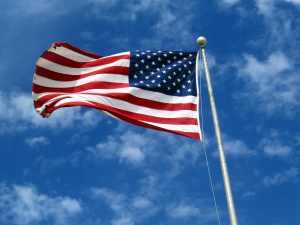
The new flag was raised on July 4, 1960 above Fort McHenry where Francis Scott Key famously penned the words that would one day be set to the most difficult tune on the planet for anyone to carry, though that doesn’t stop scores of drunken baseball fans from trying. photo credit: My favorite flag in the world. via photopin (license)
Bleary-eyed, he presented his project to his teacher Mr. Pratt, who promptly awarded him a B-. But young Heft had worked really hard and he wasn’t satisfied with the grade so he complained to his teacher, who sighed and finally agreed that he would give the project an A as soon as Congress accepted Heft’s design as the new American flag.
What was most likely meant as a dismissal, Heft took as a challenge. So in January of 1959, when Alaska became the first new state admitted to the Union since Arizona in 1912, he started to get excited. When later that same year, on August 21, Hawaii became number fifty, Heft held his breath in anticipation. Because he, along with somewhere around 1500 of his fellow citizens (all desperate to improve their history grades), had submitted unsolicited new designs for the flag. President Eisenhower himself called Heft to inform him that his design had been chosen.
It’s a great story, because it’s that of a relatively powerless young person, working hard, taking a chance, and achieving success against the odds. In a way it feels a little like the story of the United States itself.
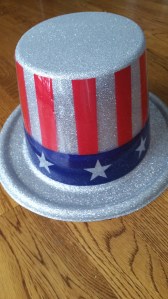
And super stylish hats. Let’s not forget those.
We Americans love our flag. Mostly, of course, we love what it represents, freedom and sacrifice and that fierce American pride instilled in us at birth. Many of us fly flags at home and we put the stars and stripes on ties and tee shirts and coffee mugs. We hoist our flag on Memorial Day at the end of May in honor of the men and women who have sacrificed to protect all that it represents. We display it again on July 4th, in honor of the original declaration of American attitude.
And thanks to a movement derived from the lesson plans of a creative Wisconsin teacher in 1885, whose school celebrated the flag’s birthday on June 14 (the 108th anniversary of the adoption of the stars and stripes), we now also fly it for Flag Day.
What this means is that in addition to showing our patriotism, we also get to be incredibly lazy. Because from the end of May to the beginning of July, it is perfectly appropriate to feature your stars-and-stripes front door decoration, candy dishes, and knick-knacks. And really, who’s going to say anything if you start at the beginning of May when you finally put the Easter bunnies away, and stretch it until the scarecrows come out in, say, September.
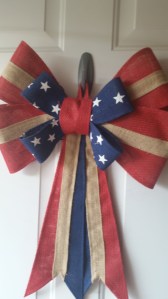
Heck, I’m so patriotic, I might just leave this up all year.
No one. Because you are patriotic. And if they do say anything, then clearly, they are not. If you want to be really lazy patriotic you might even stretch your flag-themed paraphernalia through Veteran’s Day in November, by which time, it is nearly acceptable to swap it for Christmas decorations. I recommend snowmen because they’ll last you well into Lent.
That, my friends, is how you become the envy of all your neighbors, because you always have such beautiful seasonal decorations in your home, while they can’t seem to find the time for such nonsense. Maybe they just aren’t as thoroughly patriotic as you.
Rest assured, even the addition of more states won’t render this centerpiece any less delightfully patriotic.
And the best part about all this wonderfully American stuff is that the number of stars doesn’t particularly matter. So if in a few years, there’s a 51st state, your oh-so-starred-and-striped paper-weight should weather the storm just fine.
Of course the flag itself will have to change in that case, but it’s okay because Robert Heft has us covered. He did retrospectively get his A on his project and went on to become a teacher and even served as mayor of his little Ohio town. When he passed away in 2009, Heft also held copyrights to flag designs with fifty-one through sixty stars. Just in case.
Don’t forget! You can join my e-mail list to receive updates on my forthcoming novel here: http://eepurl.com/b3olY1
If you happened to be a legionary during the early Roman Empire, you were accustomed to walking. In fact, according to Roman military writer Publius Flavius Vegetius Renatus (known by his friends and most practical historians as simply Vegetius), these guys were expected every day to march a little over 18 miles in about five hours or so.
And the sad part is, they aren’t even getting full credit for their hard work. They’ll have to go to the app later and add “lugging heavy equipment, 5 hours.” photo credit: Marcia via photopin (license)
Given that the Roman hour became longer and shorter depending on the season (don’t think about that too hard or you’ll get a headache), it’s difficult to know exactly how much time the soldiers were given to compete their strenuous hike. But to put the task into a little bit of modern day perspective, they didn’t reach their daily Fitbit goal until somewhere around 45,000 steps. Even if they had the full day to work on it, that’s a lot of walking.
As the number of personal fitness trackers I’m seeing worn has exploded over the last few years, I’m guessing by now that most of you are aware that if you’re not getting your prescribed minimum 10,000 steps each day, you’re probably going to die or something. Well, someday, anyway.
But it turns out, the recommendation to take at least 10,000 steps per day, in order to be an active, healthy person, isn’t an especially scientific one. It most likely comes from a brand of Japanese pedometer marketed in the 1960’s under the name manpo-kei , which, if you can believe everything you read on the Internet, roughly translates to “10,000 steps meter.”
So, like with a lot of un-scientific ideas that sound pretty logical and scientific-ish, 10,000 was adopted as the number to walk toward.
While that may not be a lot in the daily life of the average long-distance runner or floor nurse at a large hospital, most of us don’t take more than about 4 to 7 thousand in a day, unless we really work at it. And as a writer, I have to make an intentional effort to get there, because like most writers, I get my best work done on the days I spend a lot of time sitting.
Of course when I say most, I have to exclude historical novelist Ben Kane. Kane writes novels set in Ancient Rome, and while doing so, he spends a lot of time at his desk. He explains that after six novels, he started to realize that while writing is great for sharpening the mind, it’s not so great for trimming the waistline. So Kane grabbed some friends, some typical legionary garb, and about 42 pounds of equipment (still only about half what an actual legionary may have carried). Then he started marching.
Now that’s dedication to the craft. I currently write in the era of 19th century America, and it’s pretty rare (and by that I mean it never happens) for me to don my petticoat and corset to order to take a stroll. But I do have a Fitbit and I try to reach a somewhat arbitrary step goal every day.
And, really, arbitrary may describe the 45,000 daily steps credited to Roman soldiers by Vegetius, because some scholars have argued that as a writer who never actually donned eighty pounds of legionary garb and equipment, and who wrote in the fourth-century about the bygone era of early Roman Empire military might, Vegetius may not be a strictly reliable source. In other words, Vegetius may have been more practical historian than actual military historian, and he may have had the tendency to exaggerate.
But it really would have been important for a well-oiled military machine to be able to march long distances with great stamina, so if not exactly reliable history, the writer’s claims at least sound historical-ish.
And sometimes I think that’s good enough. Because what most medical experts are saying about fitness bands is that they are helping people become more aware of their sedentary tendencies and in many cases, are encouraging people to get up and move more than they were. We may not all get to 10,000 steps every day, but if we are making an effort to get there, then we are probably improving our health.
You can take my word for it. Because I’m a writer. And my claim sounds pretty scientific-ish.
Sometime right around the dawn of the nineteenth century, teacher extraordinaire James Pillans, headmaster of Old High School in Edinburgh, Scotland, had a problem. He had a bang-up geography lesson to share with his students, but he didn’t have the most effective equipment with which to do it. Like teachers have to do far too often, he cobbled together what he needed from what supplies he could come up with, and in this case, it worked pretty well.
James Pillans, educator extraordinaire. Believed to be responsible for creating the coolest classroom job in elementary school. By Stephencdickson (Own work) [CC BY-SA 4.0 (http://creativecommons.org/ licenses/by-sa/4.0)], via Wikimedia CommonsLike students as far back as the ancient Babylonians and Sumerians, these eager young people had personal slates on which to write and re-write their work. But what Pillans decided he really needed was one much larger slate at the front of the room, on which he could present his lesson to the entire class at one time.
That’s just what he constructed. He connected the slates and hung them in the classroom. The chalkboard was born. It was such a simple, brilliant idea, that the concept grew quickly. In America the first classroom blackboard was used at West Point by instructor George Baron. By the middle of the 19th century, nearly every classroom in America had one.
And because of a surprise discovery last summer, we now have an amazing glimpse of just what kinds of things they might have been used for in the early part of the twentieth century. Because during a summertime classroom renovation project at Emerson High School in Oklahoma City, workers uncovered blackboards from 1917 behind classroom walls.
The really cool thing was that they actually had stuff written on them. The boards, found in several classrooms, were covered with lessons and drawings, and even the names of some students. One featured a multiplication wheel, unfamiliar to any of the teachers. There were beautiful drawings of Thanksgiving turkeys, lists of spelling words, and lessons on cleanliness, all beautifully preserved.
Of course as chalk is intended to be a temporary medium, the boards obviously present a preservation problem. Fear of breakage prevents them from being relocated. So the school has covered some of the boards with plexiglass for display, hoping to preserve the lessons for another hundred years. Others have been re-covered behind walls, as Emerson is still a school building in use, and not all of the space can be sacrificed.
This past January a few more old chalk boards were found and the staff and students are pretty geeked out about the whole thing. Math teacher Sherry Read, whose classroom contains one of the old chalkboards, is particularly delighted because she points out that the drawings were left intentionally.
In an era before so many schools transitioned to using dry erase boards and markers instead of blackboards and dusty chalk, it was pretty much standard procedure to clean off the board and bang out the erasers at the end of the day. I remember in my elementary days (which were not a hundred years ago), that was the classroom job we fought over most.
But when these chalkboards were to be covered up, teachers from back in the day decided to leave behind evidence of what was happening in their classrooms, because if by chance someday, the boards were discovered behind the wall, they would be a record of the kinds of things going on in the classroom years ago. What a cool lesson for future generations to learn.
The chalkboard wall in my office, where I teach myself bang-up geography lessons. Hopefully James Pillans was a more gifted artist than I am. And didn’t have to contend with a closet door between Pennsylvania and Ohio.
And that, to me, is the very coolest part of this story. Teachers teach. It’s what they do. Their methods may change over time as they discover new ways to motivate and inspire their students, but teachers have always been an innovative, creative, inspiring, and self-sacrificing bunch.
I am sharing this story today not only because it’s awesome, but also because this is Teacher Appreciation Week in the United States. I hope all the teachers out there are having a great week as we rapidly approach the end of what I’m sure at times has been a very long school year. Because even though you are probably underpaid, overworked, and may generally feel underappreciated, your lessons last lifetimes; and your influence, centuries.
When gold was discovered there in 1848, hundreds of thousands of people flocked to the area that would a couple years later become state of California. Some struck it rich right away. For some it took a little longer. Still others became wait staff and went to endless auditions only to get a few bit parts in a commercial here or there.
There can be little doubt that this is when the California dream began to become a reality. And man, what a dream. Except that there was one glaring problem: brownies.
Because if you happened to be the super hip aunt of a couple of bright young gold miners on the adventures of their lives, pursuing bright futures, it was hard to send said youngsters care packages full of homemade brownies all the way from Missouri to California.
Most mail to the state traveled by boat, taking about two months to make the trek. The only other option for sending care packages was by a southern stagecoach route, which took somewhere in the neighborhood of twenty-four days. I don’t know if you’ve ever eaten brownies that were made from scratch twenty-four days ago, but I’m pretty sure if you have, it was a mistake.
Not brownies, but still probably important to the receiver. By Pony Express [Public domain], via Wikimedia CommonsEnter 1860, with a relatively new state, more or less disconnected from a country on the brink of civil war. Communication was an issue and luckily three men in the freighter business had a solution. William H. Russell, Alexander Majors, and William B. Waddell introduced the Pony Express, a relay system in which swift and brave young horsemen carried mail between Missouri and California, making the trek in a previously unheard of ten days.
The first delivery arrived in Sacramento on April 14, 1860, having started out in St. Joseph, Missouri on the 3rd. Changing horses every 10 to 15 miles, and riders every 75 to 100, this first trip transported 49 letters, 5 telegrams, and a handful of papers bound for intermediate destinations.
But still no brownies. Because even ten days is a long time to ask fresh brownies to say, well, fresh. And because the nature of the Express was such that weight was a huge consideration, a bulky box of brownies still had no good way to travel from here to there. Not to mention, the brave young horsemen probably got hungry.
Which brings me to my dilemma. You see, I am a super hip aunt of a couple of bright young people on the adventures of their lives, pursuing bright futures away from home at college. And for the past several years, I have been pretty good about sending care packages to each of them at least once a semester.
Just need some brownies now.
As my own children keep reminding me, this semester is nearly over. Soon the last projects and papers will be turned in, finals will be taken, grades will be calculated, and if I don’t get on it pretty quickly, no homemade brownies from super hip Aunt Sarah will have arrived.
And the trouble is I don’t have a good excuse. Because even if I were sending a care package to a niece or nephew mining for gold thousands of miles away in California, through the magic of the modern US Postal Service, I could get them their brownies in a couple of days. They’d probably even be relatively fresh.
It’s not that I haven’t thought about getting it done. I figured out when their respective spring breaks were so they wouldn’t receive goodies when they weren’t around to eat them. I’ve set aside appropriate sized boxes. I’ve made several batches of brownies (that were delicious). And now it would seem I’ve even taken the time to blog about the fact that I haven’t yet put together packages and actually taken them to the post office.
And now a few swift and brave young horsemen and I can be a super hip aunt.
So today I’m going to get it done.
Though the Pony Express was never financially successful and was halted after only about 18 months at the of the completion of the transcontinental telegraph (which was even less useful for shipping brownies), it did manage to transport more than 35,000 letters across the nation. And if a bunch of guys on horseback can accomplish that, I can probably box up some brownies and drive across town to the post office. Because I’m a super hip aunt.
This week I was reminded that even in the era of Donald Trump, people are still capable of taking voting seriously. Because a few days ago my attention was drawn to an exciting ongoing voting process on the Internet.
In case you’re not familiar with this incredible developing story, the Natural Environment Research Council (NERC) in the UK is in the process of designing a new boat. The 287 million dollar polar research vessel is a serious piece of nautical equipment expected to launch in 2019 in order to engage in serious nautical work.
But as everyone knows, a good boat needs a good name. And when I say everyone, I mean even the Ancient Babylonians. As early as the 3rd millennium BC, people heading out onto the water were taking the task pretty seriously, launching their vessels with elaborate ceremony and a carefully chosen name.
The Egyptians did it, too, as did the Greeks and Romans. Ships were most often named in honor of the gods and goddesses sailors felt the need to appease and appeal to for safety on the water. These were important names.
This boat obviously does not belong to a boat naming historian. photo credit: NS-00388 – Who Cares via photopin (license)
As the tradition continued to develop, ships most often took on feminine personas, either as a natural shift from the use of goddess names or as an outcropping of the feminine assignment in most European languages to la boat.
Some boat naming historians (yep, that’s a real thing) suggest that by giving a woman’s name to a ship, sailors and captains are more likely to take loving care of the vessels in their charge. And as a bonus, should the ship run into danger on the open sea, a feminine entity speaks more to the comfort and care of those who are at the mercy of her strength.
I don’t know about any of that, but what I do know is that finding the right name for a boat is serious business. And I know that putting the Internet in charge of naming your boat is risky. That’s the painful lesson the NERC is now learning. A few weeks ago the Council appealed to the public to recommend names for the new research vessel and then vote in support of favorites.
The NERC got the ball rolling with a few possibilities, including the RRS Shackleton, RRS Falcon, or RRS Endeavor. Fine names to be sure, but the one that has really caught the imagination of the voting public was proposed by James Hand, who added RRS Boaty McBoatface to the list.
I think Laryssa may have her work cut out for her protecting this precarious boatload. photo credit: Cages via photopin(license)
Mr. Hand’s idea caught on, and soon jumped to the top of the list, with over 100, 000 votes. And it turns out his suggestion was only one among a long list of very creative (and pretty funny) choices, including the RRS WhateverFloatsYa, the RRS I Like Big Boats and I Cannot Lie, and the RRS Immacrackdatice.
The NERC has actually been pretty cool about the whole thing. In public statements it has expressed thanks to an enthusiastic public for their humorous and overwhelming level of engagement. The Council will, of course, have final say over the name of the ship, and it will most likely not choose to go with BoatyMcBoatface in the end.
Still it seems the public has spoken, and as everyone knows, changing a ship’s name is about the dumbest thing you can do. Again, by everyone, I mean everyone who knows anything about boats, going back millennia.
Because tradition insists that Poseidon himself records and knows the name of every vessel on the sea. If he has to go scribbling them all out in the Ledger of the Deep, it leaves his records messy and confusing, and makes him all discombobulated and cranky. So if you must change the name of a ship, it’s wise to tread carefully.
Personally, I don’t put any stock into such warnings, but then I am not a boat owner, or sailor, or boat naming historian. I’m also thankfully not part of the Natural Environment Research Council, which after the polls close on April 16th, will be tasked with deciding whether it’s better to allow a serious vessel to carry a lighthearted name, or to risk irritating a discombobulated sea god or worse, incurring the wrath of the Internet trolls, and those who take the power of their vote super seriously.
Because one need look no further than the US presidential race to know that people love to vote for ridiculous things. And they get ridiculously upset when you try to reason with them. I’m pretty sure a cranky sea god is the least of the NERC’s concerns.
If you read this blog very often, or if you’ve read the “About This Blog” page, then you know, I don’t do politics in this space. I only rarely even skirt the edge of controversy, because there should be some places on the Internet where you can just have fun and not be offensive or offended, and we all have different opinions, different experiences, and different perspectives.
That being said, in life, I do politics. This has been a weird political season in the US, and a stressful week. No matter what end of the political spectrum you find yourself on most of the time, I think we can all agree that the future looks a little frightening.
Nothing but nincompoops and megalomaniacs from where I’m sitting. photo credit: hillary clinton ice-picking donald trump : ishootwindows, cliff’s variety, castro, san francisco (2015) via photopin (license)
Because we are very close to declaring that our two frontrunner candidates for President of the United States are:
1.A woman who is at best an blithering nincompoop who can’t figure out how to use her cell phone and thinks one wipes a server with the swipe of a cloth, or who is at worst a traitor guilty of granting political influence by foreign heads of state in exchange for lucrative speaking engagements.
2.A man who is at best an incompetent businessman whose ventures have only been highly successful in the area of declaring bankruptcy and screwing over investors and who has now managed to insult (probably literally) every person on earth, or who is at worst a narcissistic fascist megalomaniac.
I have a lot to say on this topic, but I will spare you. I could use a break, and I’d rather write about my dog. First, I should explain how I feel about dogs in general. I think they smell funny. And they slobber a lot. They bark when they shouldn’t. And they are incredibly needy.
Chubby dog basking in the sunlight, just hoping I’ll shut down the computer and take him for a much needed walk.
Despite the fact that I would not have considered myself a “dog person,” a couple years ago my family adopted a little black puppy we named Ozzie. That alone is a great story, for another time. What’s important to know now is that I love my dog.
I’m pretty sure that the Ancient Egyptian owner of Abuwtiyuw felt the same about his furry companion, who lived sometime during the Sixth Dynasty (2345-2181 BC) and was buried near the Great Pyramid of Giza.
Discovered in 1935 by Egyptologist George Reisner, a tablet that was part of the repurposed material used to build a different tomb, gives detailed instructions about the elaborate burial of a dog. There’s no picture of the dog, but he is described as a tesem, a breed similar to a greyhound or saluki, but with pointier ears. And what’s really cool about it, is that even though the tomb and mummy of the dog remain undiscovered, Abuwtiyuw is the earliest domesticated dog whose name we know.
Because his owner (a pharaoh whose name remains unknown) loved him enough to want to make sure he was taken care of. That’s what good pet owners do. Even if we don’t expect to love them, the little monsters worm their ways into our hearts and we take good care of them, because they take good care of us.
Ozzie, striking his most presidential pose.
So earlier this week, I took good care of Ozzie by taking him for his annual checkup and vaccinations. The good news is he’s a very healthy two-year-old dog. The bad news is he’s gotten a little chunky over the winter.
The vet’s exact words were, “He’s got some love handles.” So as the weather warms up this spring, we will be extra diligent in making sure Ozzie gets plenty of exercise so he can remain a happy, healthy dog.
That’s what I was thinking as my chubby pet and I waddled away from the vet’s office. And then I found myself reflecting on how amazing it is that I live in a nation where I am so absolutely blessed that not only can I provide my dog with regular medical care (a luxury many people throughout the world can’t even provide for their children), but he also eats so well that he’s overweight. Someday when he dies, I bet I could even provide a funeral for him in a swanky pet cemetery (though I probably won’t).
He even kisses babies. Or at least he takes food from them. And now I think I’m beginning to see the problem.
So come this November, I may have to decide whether I can vote for a person I might not trust to walk my overweight dog. But for now, I’m going to focus on the fact that I live in a nation so blessed, our dogs have love handles.
I’m still not a dog person. In fact, one thing I can say with a fair amount of certainty is that your dog smells funny, slobbers a lot, barks when he shouldn’t, and is incredibly needy. Ozzie, on the other hand, is all of that, but also happens to be a fuzzy, warm, loving (and maybe just a little chubby) bundle of awesome.
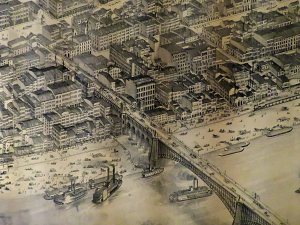
In 1874, Richard Compton, a sheet music publisher from the St. Louis area, hatched a large-scale plan to promote the city he called home. He was attempting to capitalize on an artistic trend in which cities across the United States were engaging. He recruited Camille Dry, an artist who specialized in pictorial maps.
By the late 19th century, every city that was a city had one, a map that highlighted (and exaggerated) its finer qualities. The details of these maps were stunning. Every street, every building, even many windows accounted for, they were designed to attract industry and promote trade.
One book: St. Louis-Made Population Enlarger and Me: This Sort of Thing is my Bag, Baby
St Louis needed the boost. Its central location and close proximity to the Mississippi River had caused it to boom, but Chicago was booming at a faster clip. Just four years before Dry began his sketches, St. Louis had been embroiled in a scandal over the bribing of census takers to overinflate its population. (Inflate-gate?)
And so the plan was hatched. The artist responsible for producing pictorial maps of eight cities in five different states in 1871 and 1872, took to a hot air balloon (rumor has it anyway), tethered to the East side, and in about a year (probably working with a team), drew a map the likes of which the world had never seen.
Dry’s map shows almost ten miles of riverfront and more than 40 square miles west of the Mississippi. This panel shows the Eads Bridge, which today is just north of the Arch. But not in 1875.
With a whopping price tag of $25 dollars (which in today’s money is quite a bit more than you’d shell out for your average convenience store road map), and a cumbersome title that didn’t yield great search results on Amazon, the project was a financial flop.
But this beautiful map remains as a point of pride for the city it depicts. Since last May, the Missouri History Museum, located in St. Louis’s Forest Park, has featured an exhibit entitled “A Walk in 1875 St. Louis.” The map has been blown up to 10 feet x 30 feet panels, showing exquisite details like the tents of a visiting circus, a man driving a herd of cows through the city streets, and a mob making a run on a local bank.
Interspersed with the map are the stories of the lives of St. Louisans in 1875, including the foods they ate, the clothes they wore, and the parasites they ingested in their drinking water. The special exhibit will be open through February 14, and I’m ashamed to admit I didn’t get there until time had almost run out. But I’m glad I saw it.
What impressed me the most was that while other cities used their beautiful maps to gloss over their warts, exaggerating and sometimes out-and-out lying to prospective businessmen and settlers in order to lure them in, Compton and Dry took a different approach. The warts are shining brightly on this map. St. Louis wasn’t a perfect Utopia in 1875 and I would never suggest that it is now.
Missouri History Museum, just one of many places that makes St. Louis great. And wouldn’t it be fun to color?
But like Richard Compton, I love my city. I know we’ve had some problems. Race relations are tense, crime has crept up, and I hear some football team chose to leave us for LA (a city that in 1875, barely took up one page of map). The press has been unforgiving. Still, St. Louis is an amazing place with a lot to offer and I’m proud to call it home.
So here’s my idea. What the city of St. Louis needs to do is promote itself in a medium people can respect. We need to jump on the biggest trend to sweep across this great nation since the pictorial map craze of the 19th century and show off not just our warts, but also everything that is amazing about our city.
That’s right. What we need is a St. Louis-themed adult coloring book. A really, really big one.





















 Author Sarah Angleton