Just Don’t Tell the Historians

Many things likely happened in the year 1404. Numerous babies took their first breaths and plenty of people surely took their last. Battles were waged and both won and lost. Some powerful people became more powerful, while the power of others began to decline. And in Korea, the second king of the Joseon Dynasty, King Taejong, fell off his horse.

Taejong was on a deer hunt when it happened. As he drew his bow, his horse stumbled and the king took a tumble. History knows of the incident because of the Veritable Records, an important feature of the Joseon Dynasty, the last royal house to rule Korea. The records, written in Classical Chinese, were maintained by hired historians tasked with extensive and entirely neutral preservation of events related to the monarchy and the state.

And I mean the truth is, if Taejong hadn’t asked the historians not to write about the fall, they still might have, but we probably wouldn’t be talking about it 620 years later. Image by Joachim_Marian_Winkler from Pixabay

Historians in this role were guaranteed legal protection from the king for what they wrote, and in fact, he wasn’t allowed to see them at all. Only other historians could take a look. They were sworn to secrecy and faced severe punishment if they failed to keep it under wraps. To avoid any potential royal interference, the documents remained sealed until after the king’s death and the new king’s coronation.

So when Taejong fell from his horse that fateful day, we not only know that it happened, but we also know that he tried to hide it from the historians. Because they wrote about that part, too.

It’s an astonishing story, not that a powerful man fell from his horse, as I’m sure that could happen to anyone. And not that a powerful man would want to hide an embarrassing incident from history. But that powerful people believed so firmly in the importance of free and accurate reporting that they took pains to ensure it could happen, even when it meant they might wind up being the butt of the joke.

The Veritable Records are now digitized. With the exception of the those of the last two Joseon monarchs, which are believed to have been unduly influenced by the Japanese and are considered less reliable, they are part of the National Treasures of South Korea, and are included in the Memory of the World register of the the United Nations Educational, Scientific, and Cultural Organization (UNESCO).

I’m cynical enough not to suggest that the Veritable Records are one hundred percent impartial. History is, after all, always written from the perspective of whatever imperfect human recorded it. It honestly wouldn’t surprise me if the story was thrown in just to lend credibility to the rest.

Um, yeah. Probably not. Image by Gerd Altmann from Pixabay

But I still find it astonishing from a modern perspective. Because today it’s not uncommon to find out that a story that could show a powerful person in a bad light has been ignored, suppressed, or tweaked by an allegedly free press to suggest a secret organization of assassin horse trainers clearly has it out for a powerful person. Probably because the powerful person is racist. Or something.

Or, just as bad, that this allegedly free press has amplified, distorted, or misrepresented a story in order to make it seem like a tumble from a horse might just be a character-revealing act of animal cruelty by a person undeserving of power. And who is also probably a racist. Or something.

It’s a confusing place to be as a society, not to know if there are any trustworthy media sources out there, free from influence of the powerful attempting to control the flow of information to those of us schlubs that make up the confused masses.

I’m just cynical enough to believe that there aren’t.

Overcoming the Hangries

It was sometime in about 1840 or so that Duchess of Bedford Anna Maria Russell found herself getting a little hangry. At the time, surging industrialization had begun to transform the daily schedule of the English, the wealthiest of whom tended to eat breakfast around 9:00 in the morning, luncheon around noon or so, and then dinner not until around 8:00 PM. There might also be a late morning coffee or tea break referred to as elevensies, which I recently learned is not just for Hobbits. That still left a long stretch of time between meals in the afternoon and into the evening.

Anna Maria wasn’t having it. As a lifelong friend of Queen Victoria, serving as a Lady of the Bedchamber (which because my knowledge of aristocratic life comes only from The Crown and Downton Abbey, I assume is just the officially recognized BBF to the queen), she didn’t have to just accept her fate. She was a pretty important lady, so she decided to so something about it.

The duchess began ordering herself a cup of tea and a light snack sometime in the mid-afternoon, and soon found that made her day a lot more pleasant. It became such a habit that she started inviting other important ladies to join her. They liked it, too.

When Anna Maria occasionally took leave of the queen and traveled back to her countryside home in Wobrun, Bedfordshire, she continued enjoying afternoon tea, invited her countryside pals to join her as well, and the tradition of afternoon tea was born.

Then one sunny August afternoon in 2024, a group of pretty important ladies in the United States decided it was high time they participated in the grand tradition of afternoon tea, too.

Okay, so these ladies might not be BFFs with royalty, but they are pretty important to me. I do also realize this may not have been the first time afternoon tea was ever served in the United States. In fact, I remember participating in a version of it in my eighth grade social studies class.

All I really recall from that experience was that we had to wear fancy clothes, had to eat kind of gross cucumber sandwiches right after lunch that I’m assuming consisted of rectangular cafeteria pizza, were warned not to add both milk and lemon to our tea, and had to take at least one no thank you sip. It was a highly educational experience.

When more than three decades later, one of my pretty important friends decided to invite a bunch of her equally important friends to afternoon tea, I didn’t entirely know what to expect. Thankfully, eighth grade social studies had prepared me for such a time as this.

I donned fancy clothes, including a big hat of the variety rarely worn these days by American ladies unless they are either going to the Kentucky Derby or to high church on Easter Sunday, and they happen to be six years old. I enjoyed my tea with milk, and no lemon, and I ate delicious goodies including some cucumber sandwiches that were excellent and very welcome after I failed to eat a lunch of rectangular cafeteria pizza. Truth be told, by the time afternoon tea rolled around, I was getting a little hangry.

Could Substitute for Ordinary Food

In 1748 in a stroke of genius, the French Parliament solved an important problem by banning a loathsome and gnarled vegetable that while perhaps suitable for hogs, was known to cause leprosy when consumed by humans. The French people probably didn’t mind so much, because no one in their right mind would willingly eat a disgusting, likely poisonous, potato from the ground anyway.

I now understand why people might have mistrusted these things. The ants sure did enjoy them, though.

Fortunately the Prussians weren’t quite as persnickety. They cultivated the starchy root vegetable and didn’t hesitate to feed it to humans. And as it was cheap and easy to grow, they certainly fed it to prisoners during the Seven Years’ War.

One such prisoner of war was French pharmacist Antoine-Augustin Parmentier who discovered, much to his delight, that he neither died nor developed leprosy on his potato diet and that in fact, with a little butter, sour cream, or cheese, the pig food he’d been given might not be half bad.

When he returned to France, Parmentier set about repairing the damaged reputation of the veggie by going to scientific institutions and soliciting statements touting the safety of potatoes as a food source. Then when the poor harvest season of 1770 threatened famine, as was not an uncommon occurrence in European history up to this point, Prementier’s “Inquiry into Nourishing Vegetables that in Times of Necessity Could Substitute for Ordinary Food,” won him a prize and some important attention.

They are kind of pretty. George Chernilevsky, Public domain, via Wikimedia Commons

Soon King Louis XVI and Marie-Antoinette jumped on board the potato wagon, adorning their royal clothes with the potato’s purple flower. They also set aside a plot of land on which Parmentier could plant his favorite spuds, which he placed under guard during the day to bestow upon the tubers the appearance of great value.

Under the cloak of darkness, when the guards were strangely scarce, hungry and bold Parisians managed to sneak a few of the highly valued vegetable that nicely bulked up a stew, filled up empty bellies, and didn’t cause any of them leprosy.

I think that’s my favorite part of the story of this transformation from starchy enemy to super veggie. The humble little potato that only pigs would eat became a highly desirable rock star of a vegetable that helped stave off the cycles of famine and became so ubiquitous that instead of substituting for ordinary food as a necessity, it eventually became kind of plain potatoes.

My garden was supposed to yield up a lot of plain potatoes this year, but alas, in our attempt to garden as organically as possible, we left them unguarded just enough that an army of ants managed to feast on them before we could.

The best part of writing this post was that I had to make my favorite potato casserole. Alas, I had to do it with store-bought potatoes.

What we ended up with was a whole bunch of wrinkled, disgusting, half-decayed vegetables that surely would have given us leprosy.

Okay, probably not, but I’m not a huge potato eater anyway. I only really like them prepared a few specific ways—generally either fried crispy or baked into a casserole with a lot of butter and cheese (turns out I’m a bigger fan of fat than vegetables).

But now that I don’t have my garden potatoes to eat, I can truly appreciate the genius of Antoine-Augustin Parmentier. After the ants got to my humble dirt vegetables, I was wishing I’d kept the garden under guard because all the other ordinary food I had to choose from just didn’t seem as appealing.

Guess I’ll get em next year.

T. Swift Vs. that Old Deluder Satan

It’s back to school time in my corner of the world, which means a couple of things: 1. It’s time to hit the Dixon Ticonderoga pencil sales and stock up 2. I’ve pretty much given up on watering my garden. And 3. I will (hopefully) be blogging more consistently every week.

It’s possible I have a tad obsession with these pencils.

Thank you to those of you who have still popped in to say hello through the summer as I followed a more casual posting schedule. I’m ashamed to admit that I’ve been pretty inconsistent about visiting the blogs of others, but I have high hopes of scooping up that dropped ball as well.

Even though my kids are no longer small and in need of constant supervision and entertainment through the summer months, there’s still something satisfying about beginning a new, regular schedule. My youngest son is a senior in high school this year, my oldest is beginning his second year of college, and I will be working at school in a full-time capacity for the first time since my college boy was a baby.

It feels good and right to all be participating in the wonderful tradition of public education that began in the United States in 1647 as a way to thwart the schemes of the Devil. That’s when the Massachusetts Bay Colony crafted a law firmly stating the guidelines necessary to ensure that its young people would be able to read the Bible and wouldn’t be susceptible to tricky demonic scheming.

All the desks have been scrubbed of bubblegum and graffiti, ready for the new year. Image by WOKANDAPIX from Pixabay

The law, known colloquially as the Old Deluder Satan Law because it begins with the words: “In being one chief project of that old deluder, Satan, to keep men from the knowledge of Scripture . . .” was a more specific version of a similar law put into place in 1642.

The earlier law claimed that the responsibility to educate the young fell to the community. It’s replacement expanded on that by instituting firm guidelines, stating that a community of at least fifty households must appoint a public educator. If there were a hundred households, then there needed to be a qualified master who could prepare the young folks for Harvard where they could take Satan-fighting classes like ENGLISH 183:”Taylor Swift and her World,” GERMAN 260: “Writing the Body in the Posthuman Age,” or GEN ED 1090: “What is a Book?”

These are actual course offerings from the current Harvard catalog. Take that, you old deluder!

Take that, you old deluder! Image by NoName_13 from Pixabay

Of course our public schools are more secular these days, but there’s still some truth to the assumption that an educated public is one that is more analytical and is therefore less susceptible to being misled by those with nefarious intentions.

I’d like to think that’s true, though the tone and quality of much of our public discourse leads me to believe we still have a lot of work to do. And so, I guess it’s time to get back to it. I’m armed with a stockpile of Dixon Ticonderogas, and I am ready.

Bring on the school year!

Wrong-Way Angleton

Recently, the hubs and I returned, via the back roads, from a quick getaway to commemorate our twenty-fourth wedding anniversary. It was a lovely, relaxing couple of days. We hiked and swam and ate well and just generally enjoyed the kind of meandering schedule that’s hard to follow when you’re toting around bored teenagers.

And so it felt right when the hubs asked me if on the way home I’d like to explore the back roads where not so much as a single bar of GPS-supporting data signal can be found. It was a suggestion he made almost apologetically because he assumed I’d be more comfortable sticking to roads I know better.

That was a considerate thought, because I have been known to lose my way from time to time and it has occasionally been a traumatic experience. The truth is, though, I have pretty much accepted that this disadvantage is just part of who I am, and if I have the time, I’ve even enjoyed getting a little turned around, because one never knows when you might end up somewhere better than you’d intended to go.

That could have been the case for one pilot who has gone down in history for going the wrong way. Eleven years after he helped ready Charles Lindbergh’s Spirit of St. Louis for its famous nonstop flight across the Atlantic, mechanic Douglas Corrigan made headlines himself as the last of the great aviation transatlantic daredevils. For his efforts, he was inducted into the Burlington, Wisconsin Liars Club and his pilot’s license was suspended.

On July 17, 1938, not long after landing in New York in a rickety modified aircraft salvaged from the junkyard and held together by little more than the audacity and ingenuity of its pilot, Corrigan took off again to make the return trip west across the country. Then to the surprise of onlookers, he turned and headed east instead.

When he landed twenty-eight hours later in Dublin, he asked the locals where he was and explained that he and his unreliable old compass had gotten turned around in the clouds.

Douglas “Wrong Way” Corrigan, looking pretty happy to be wherever he is. Unknown photographer, Public domain, via Wikimedia Commons

Of course not everyone believed the man who quickly became known as “Wrong-Way Corrigan,” possibly because his tale came with a wink and a grin. Also maybe because he’d already attempted to file a transatlantic flight plan in New York and had been denied since his plane was (I’m paraphrasing here) a hunk of junk.

The the public loved Corrigan, most likely because it’s kind of fun to root for an antihero who thwarted the rules and got away with. I have to assume, too, though, that there were a few sympathetic souls out there who thought there was a chance he was telling the truth.

I’m not suggesting that everyone who believed him was a gullible fool. I’m suggesting that they may have been the type who live with the condition I have come to know as directional insanity. As a fellow sufferer of this terrible malady, I could sympathize with a person who accidentally, delightfully, ended up in Ireland instead of California.

I’m not alone, either. In fact, there is a growing number of us. While I have been so afflicted since my earliest days of childhood, long before the era in which we all carry GPS devices in our pockets, the habitual use of such gadgets has been shown to negatively affect our spacial memories.

It’s also true that most of us have a harder time navigating as we age, so there really was never any hope for this gal who at one time went the wrong direction on an interstate she traveled regularly and didn’t realize it until she’d driven the amount of time that it should have taken her to get home and instead arrived at a town she’d never heard of.

This same gal, maybe a year ago, ended up about two hours north of where she was supposed to meet her sister for lunch because she got confused in a construction zone and took an exit she never takes from an interstate she travels regularly. The worst was the phone call to said sister who has never experienced a moment of directional insanity in her life, and rarely relies on GPS. Said sister wasn’t the least bit surprised.

So, card-carrying Wisconsin Liars Club member Douglas Corrigan would have had my sympathy had I been alive to see his possibly accidental triumph. He stuck to his story for the rest of his life and didn’t really get in very much trouble over it. His pilot’s license was revoked for about two weeks, the length of time it took him to make it back to the United States by ship, and he didn’t seem the least bit bothered by where he ended up.

Boredom Busting and Sportsball History

It was one of those long boring afternoons in 1965 when thirteen-year-old Frank  Pritchard and his siblings were in a pickle. They had nothing to do and were getting a little cranky. That’s about the time their dad, then a Washington State Representative, Joel Pritchard arrived home with his buddy Bill Bell after an afternoon of golf, and made sportsball history.

I suspect every great sport has a vaguely ridiculous origin story. Image by Nils from Pixabay

The two men jumped in to solve the problem by suggesting that the kids make up a game. Frank, apparently a typical 13 year old, turned it around and challenged them to make one up themselves. The two friends readily agreed and set out to see what they had handy.

The property had an old, little-used badminton court, but a quick search of the family’s sportsball equipment yielded no rackets or shuttlecocks. What they did find were some ping pong paddles and a wiffle ball. 

The ball bounced surprisingly well on the asphalt court and once they’d lowered the net a bit, the two men got the kids playing a made-up game that was a little bit like badminton, a little bit like tennis, a little bit like ping pong, and at least at first, a lot like Calvinball from the Calvin and Hobbes comic strip that two decades later would introduce the world to the greatest game to never have the same rules twice.

Also, this new made-up-on-the-spot sport was evidently pretty fun.

The family played the next weekend as well, and Pritchard and Bell introduced the game to another friend named Barney McClallum. Together, the three of them decided to write down some rules to their new hodgepodge sport that made Joel’s wife Joan think of pickle boat races in which the leftover or mismatched rowers team up and race just for fun. 

It was probably only a matter of time until someone decided a wiffle ball would be more fun to try to hit with a racket. Image by 기석 김 from Pixabay

So the game became pickleball. Whereas most sports that fall into the category of made-up-because-someone-was-bored fade into obscurity after a family reunion or two and someone has inevitably broken an ankle (which could maybe, possibly be an absolutely true story from the depths of Angleton family lore), pickleball became an official thing in 1972.

That’s when its inventors established a corporation to protect the integrity of their burgeoning, accidentally-kind-of-super-fun sport. By 1976, the game started getting some national press, and in 1978 it was included in a book titled Other Raquet Sports

By 1990 pickleball had made it to all fifty states, and in the mid-nineties, it was my favorite sport to play in my high school P.E. class, even though I was pretty sure my P.E. teacher Mrs. H. had made it up one afternoon when her kids were bored. 

Of course now, nearly thirty (thirty?!) years later, it seems like everyone plays pickleball. The United States Amateur Pickleball Association boasts more than 70,000 members, there are organized leagues and tournaments, and there’s even a restaurant in my part of the world called Chicken N Pickle where you can, get this, eat chicken and play pickleball. Brilliant.

Move over tennis. There’s a new game in town. Stephen James Hall, CC0, via Wikimedia Commons

The hubs had a birthday recently and he got a couple of rackets, so we decided to hop on the bandwagon and give it a try at a local park converted in the last few years from a baseball diamond (because who would ever want to play baseball?) to generally busy pickleball courts. Neither of us remembered precisely how to play, but after a YouTube video or two we were ready to go.

I vaguely recall being pretty good at the sport in high school. It turns out that thirty (thirty?!) years is plenty of time to get a little rusty. The hubs hadn’t played the sport in several decades either, but he does have a much more impressive background in tennis than I do, which gave him a definite advantage. Still, the game really is super fun. 

Like the kind of fun one might expect to have on a long boring day when the family goes searching for something to do among the sportsball castoffs in the garage. And a great game is born.

Pomp, Illuminations, and the Hard Work of Revision

So, today we celebrate a pretty big holiday here in the United States. We follow in the footsteps of John Adams who wrote to his wife Abigail that Independence Day should be recognized with “pomp and parade, with [shows], games, sports, guns, bells, bonfires, and illuminations from one end of this continent to the other.”

It’s a little rainy today in my corner of the world, but most of us will have all that pretty much covered. Of course, we aren’t really celebrating the anniversary of the day the Continental Congress first declared independence, nor the day one of history’s most famous breakup letters was drafted. The holiday doesn’t fall on the anniversary of the signing of the Declaration of Independence, and it doesn’t mark the moment when King George III read it and decided to sing a love song about sending an armed battalion.  

John Trumbull, Public domain, via Wikimedia Commons

Today’s July 4th celebration does commemorate all of that, but what it actually marks on the calendar is the day of the final pen stroke of the final draft of the document that spurred a war that birthed a nation.

As a writer who recognizes that first drafts rarely amount to much and that most of the best writing occurs in the rewriting, I find this pretty satisfying. It seems John Adams would not have agreed with me. When he wrote of his future nation’s Independence Day, he was referring to July 2, 1776.

I get it. He was excited. He’d had a hand in the original draft, working with Benjamin Franklin, Robert Livingston, Roger Sherman, and of course Thomas Jefferson to get it just so. Like a student who waited too long to start his final term paper and stayed up all night before the due date, assuming that in his push to get it finished, he’d written the most brilliant words ever penned by any student in the history of students, Adams was probably anxious to get it turned in to the Continental Congress, send it on to the king, and sit back to watch the fireworks.

Image by Johnny Maertens from Pixabay

Not surprisingly, however, Adams and his fellow committee members weren’t the only ones who had something to say about the wording of the Declaration. The debating began. In some ways, this important American document was improved by a few tweaks here or there, a little tightening of language or nuance of phrasing. And in other ways, it was made worse, like in the removal of all references to the immorality of slavery.

It’s still possible to make the wrong decision in revision, too, which is one of the things that makes the process so difficult. But the Continental Congress figured out where they had to compromise in order to make the declaration work enough for all the representatives in the room to move forward. The final draft would be signed nearly a month later on August 2. The date at the top of the document, however, remained July 4, which became an officially declared federal holiday in 1870.

The date is pretty ingrained at this point and I think, all things considered, it’s the right one to celebrate, though with the a full day of rain expected, and much to the frustration of my poor dog, I suspect many of my neighbors will celebrate with illuminations on the 5th and 6th this year.

Image by Jill Wellington from Pixabay

But in my mind, the 4th is the day the United States truly embarked on the notion that freedom and liberty sometimes require compromise and consideration of those who don’t agree with us, and that revision is painful, difficult, and necessary work.

The United States, such as it was imagined by the Second Continental Congress, wasn’t a perfect nation, nor was the vision of it perfected yet. That would take many, many years. So many, in fact, we’re still counting, and I suspect always will be.

But the best work comes in the difficult, painful revision process in which debate and compromise occurs. No matter how politically divided we may think we are, or how we as individuals may feel our nation is doing in this moment, I hope that’s something every American can be proud to celebrate.

If you are celebrating American Independence today or perhaps in the coming days, please be careful with all your pomp and illuminations, and have a wonderful holiday!

P.S. In the interest of full disclosure, I originally posted a version of this a few years ago, but it’s a holiday and the post still feels pretty relevant

Slathered in BBQ Sauce

In 1698, a Dominican missionary known as Pére Labat did what all good cooks throughout history have done—he wrote down the tips and tricks he learned from better cooks. Labat was in the French West Indies when he observed the use of a mixture of lime juice and chili peppers to season meat slowly cooking outdoors over indirect heat. When he wrote about it he possibly became the first person to record the use of an early kind of barbecue sauce, and I’m guessing, made a lot of people a little bit hungry just reading about it.

We had barely started at this point.

Barbecue had been around at least a couple centuries before that, originating with the barbacoa of the Taíno People of the Caribbean, and introduced to the Western world by Columbus’s voyages. Because whether you found the part of the world you were looking for or not, when you smell the roasty deliciousness of barbecuing meat, you want to share the experience.

Over the next several hundred years, the love of barbecue spread and was embraced most enthusiastically by the Southern United States where it became particularly a part of Black American culture. That’s when a broader variety of rubs and sauces really began taking it to the next level. Barbecuing became the quintessential American thing to do, making its way into political campaigns and into backyards across the country.

Ok, technically not barbecue, but I’m not going to turn my nose up at it.

Today, barbecue is pretty much synonymous with summer in the United States, and this year, at the Angleton household summer has arrived. Now, I will admit that like many careless Americans, I’m a little loosely goosey with the term barbecue. I am well aware that the term applies specifically to meat that is cooked with indirect heat and not on a grill, and that some of you are probably pretty persnickety about that definition. It might even make you a little mad that I’m about to use the term barbecue interchangeably with grilling out, which is apparently not the same at all.

But here’s the thing. This year we had a record crop of sweet cherries, largely because the birds we would normally fight for them were stuffed full already of a million cicadas. So we had to get a little creative. We jammed and pied and dried and salsa-ed.

Mmm. Tastes like summer.

Then we made sweet cherry barbecue sauce. And it is really, really good.

So now that the late spring days are starting to feel an awful lot like summer, we are cooking outside a lot more. At some point I’m sure we will legitimately barbecue in a smoker or in a pit. Most of the time we grill and call it good, because it doesn’t take as long to grill up a St. Louis pork steak as it does to smoke a Boston butt. 

And whether I’m using the word right or not, both taste amazing slathered in barbecue sauce.

Happy (almost) summer!

Song of the Cicadas

On April 15, 1791, the first of four stones marking the corners of the Federal District in Washington DC was laid by surveyor George Ellicott and his team, which included brilliant mathematician, astronomer, tobacco farmer, and free-born Black man Benjamin Banneker.

A representation of Benjamin Banneker, who for the next few weeks will be known primarily as the naturalist who documented the seventeen-year brood cycle.
PBS: http://www.pbs.org/
wgbh/aia/part2/2h68b.html, Public domain, via Wikimedia Commons

Banneker is known in the history books not only for his role in the laying out of Washington DC, but also as the man who compiled one of the earliest American almanacs. He provided a copy to then Secretary of State Thomas Jefferson as a counter to Jefferson’s assessment that Black men did not possess the mental capacity of white men. Throughout Banneker’s life he did what he could to fight this unjust assumption and advocate for freedom.

There’s a lot of big and important stuff Banneker should be remembered and celebrated for, but today I find myself only wanting to really talk about one of them—a topic that is at the forefront of the thoughts and conversations of millions of people in my corner of the world. Because according to Morgan State University researchers Asamoah Nkwanta and Janet Barber, Banneker is also one of the first people to have calculated and recorded the seventeen-year life cycle of the periodic cicada.

I admit that among insects that I give regular thought to, cicadas usually rank pretty low, somewhere way behind mosquitoes, ticks, and the carpenter bees that try to eat my deck every year. Recently, though, cicadas have claimed the top spot. I’m not alone, either, because the most frequent Google search topic over the last week in Missouri has been cicadas.

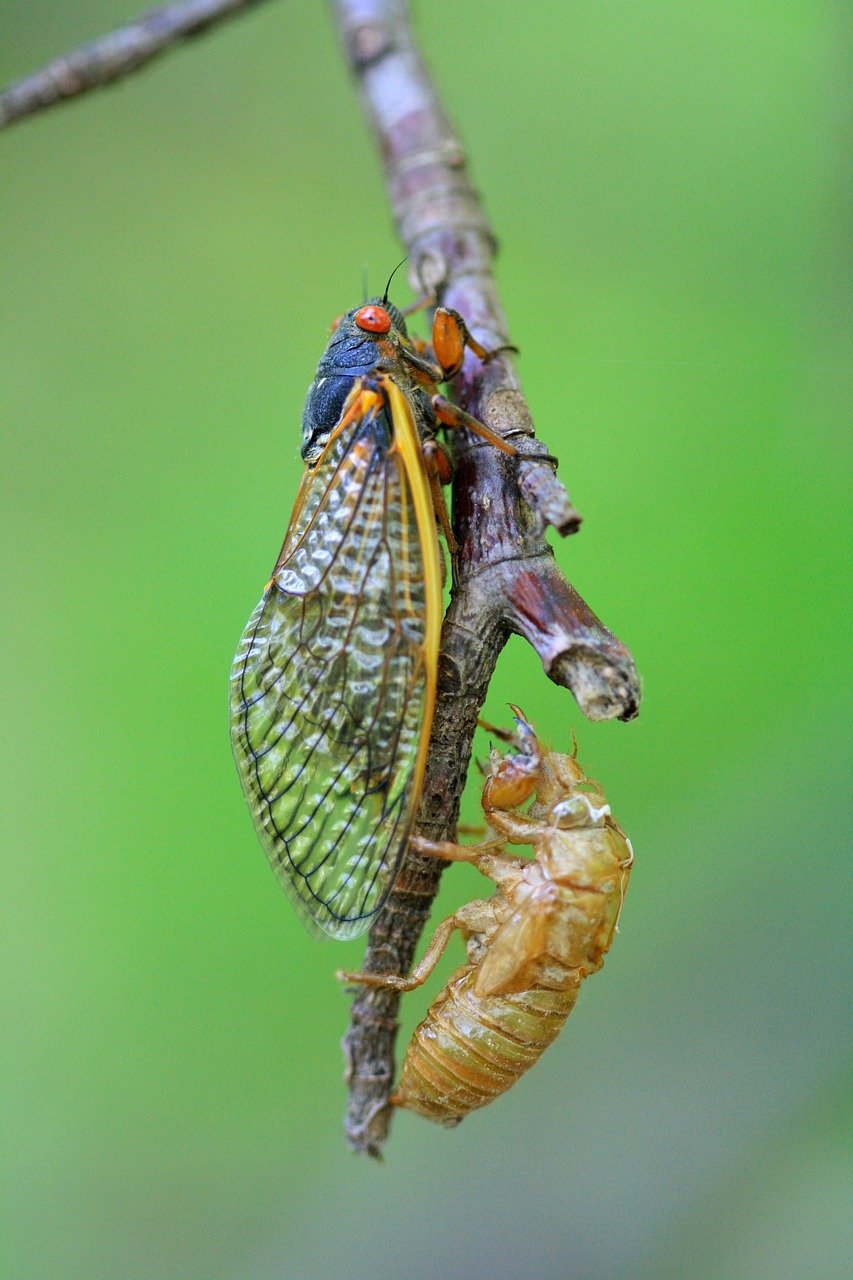
That’s because we make up part of the map covering two large broods of periodic cicadas. To give some context to that, there are some different varieties of this particular insect. One lives out its mating ritual for a few weeks every summer, molting and abandoning its creepy exoskeletons on tree trunks so that big brothers can stick them to the tee shirt backs of unsuspecting little sisters throughout the Midwest.

Top Google searches make great blog topics. Image by Ashlee Marie from Pixabay

Then there are the periodic variety that emerge from the ground to spend a few weeks molting and singing and mating every thirteen or seventeen years. This year, there are two large broods of periodic cicadas singing their way through Missouri’s trees. These particular broods have not been seen at the same time since 1803 and it will be another 221 years before it happens again. There are allegedly billions of them in the state right now. I believe it.

Their high pitched buzz, which peaks between 10 AM and 6 PM every day, was kind of pleasant at first, but has grown into an ever-present eerie drone still audible over the car radio and in every corner of my house. They drop onto sidewalks, hurl themselves into innocent passers by, cling to every rough surface they can find, and people on my social media feeds keep sharing cicada recipes as if I am going to start eating them. I assure you I am not.

Benjamin Banneker didn’t quite know what to make of the periodic cicadas the first time he encountered them either, and didn’t have the luxury of Googling for information. When he was seventeen, a large brood emerged in his corner of the world in rural Maryland. He initially thought they were locusts that would destroy the family’s tobacco harvest. He waged a fruitless war against them before coming to the conclusion that not only was he fighting a losing battle, but that the insects really weren’t doing much harm. And then, because he was a much better observer and record keeper than I am, he eventually mapped out their extremely extended life-cycle.

This is pretty much what the underside of every leaf in my yard looks like right now.

Our cicadas aren’t much of a problem this year, either. They may cause a little damage to trees while feeding on sap and laying their eggs in slits they make in the trunks, but unless the trees are young, it’s not a big deal. And the cicadas have been great for our cherry harvest because the birds have been so busy eating the big loud bugs they have more or less ignored our fruit.

Despite my best efforts, my dog eats the cicadas too, even without including them in a stir fry or dipping them in chocolate as so many of my disgusting friends have suggested. It’s given him a little bit of a belly ache, which kind of serves him right, I think.

I am looking forward to a few weeks from now when the billions of periodic cicadas will be gone, their eggs safely deposited for the next thirteen or seventeen years, and we can all go back to thinking about and discussing all of the many other much more important things going on in the world.

In the meantime, I’m trying to appreciate them the way Banneker came to. In his journal, he wrote “that if their lives are short they are merry, they begin to sing or make a noise from the first they come out of the Earth till they die.” Okay, I guess their singing isn’t THAT irritating. But I’m still not eating them.

Meet Me at the Fair

On November 22, 1944 after schedule delays, numerous script rewrites, budget woes, and a leading lady still unhappy with her role, a new Christmas musical debuted on the big screen in St. Louis, the city at the film’s heart. 

The song “Meet Me in St. Louis,” well known today because of the musical, is actually from 1904 and was written specifically for the World’s Fair. Public Domain, via Wikimedia Commons

Despite the mess of getting to that moment, Meet Me in St. Louis enjoyed immediate success, becoming Metro-Goldwyn-Mayer’s second highest grossing film up to that point, coming in only behind Gone With the Wind. After the premiere, Judy Garland even decided she liked it after all and commented to the producer, “Remind me not to tell you what kinds of pictures to make.”

The screenplay is based on a series of semi-autobiographical short stories by St. Louis native Sally Benson who wrote of an upper middle-class family that lived at 5135 Kensington Avenue during the construction of the 1904 World’s Fair on the grounds of Forest Park in St. Louis.

I confess, I saw the movie for the first time later in life than I should have, having grown up within easy reach of St. Louis. My childhood summers included trips to downtown to watch the Cardinals play at Busch Stadium where the musical’s title song is still played by the organist at every game and the crowd sings along as the words scroll across the jumbotron. 

I’ve been many times to the wonderful outdoor Muny theater in Forest Park where the stage adaptation of Meet Me in St. Louis, originally produced in 1989, is performed every few years. I even got engaged in that park on the very grounds of the actual 1904 World’s Fair.

I was lucky enough to get a sneak peek at the new exhibit, open to the public on April 27th. It contains a scale model of the entire fairgrounds. And it’s spectacular.

Officially known as the Louisiana Purchase Exposition, the Fair is a big deal in St. Louis history. It transformed the city, launching it for about seven months into the center of the world’s attention. 

And it’s still a big deal, today. One-hundred and twenty years later the World’s Fair looms large in the community memory carried now by not a single living person who was there to see it, sparking excitement whenever it comes up in conversation, which is kind of weirdly a lot.

It’s especially on everyone’s minds right now because at the end of this month, just in time to celebrate the 120th anniversary of the opening of the Fair, the Missouri History Museum will reveal a newly re-imagined permanent World’s Fair exhibit. 

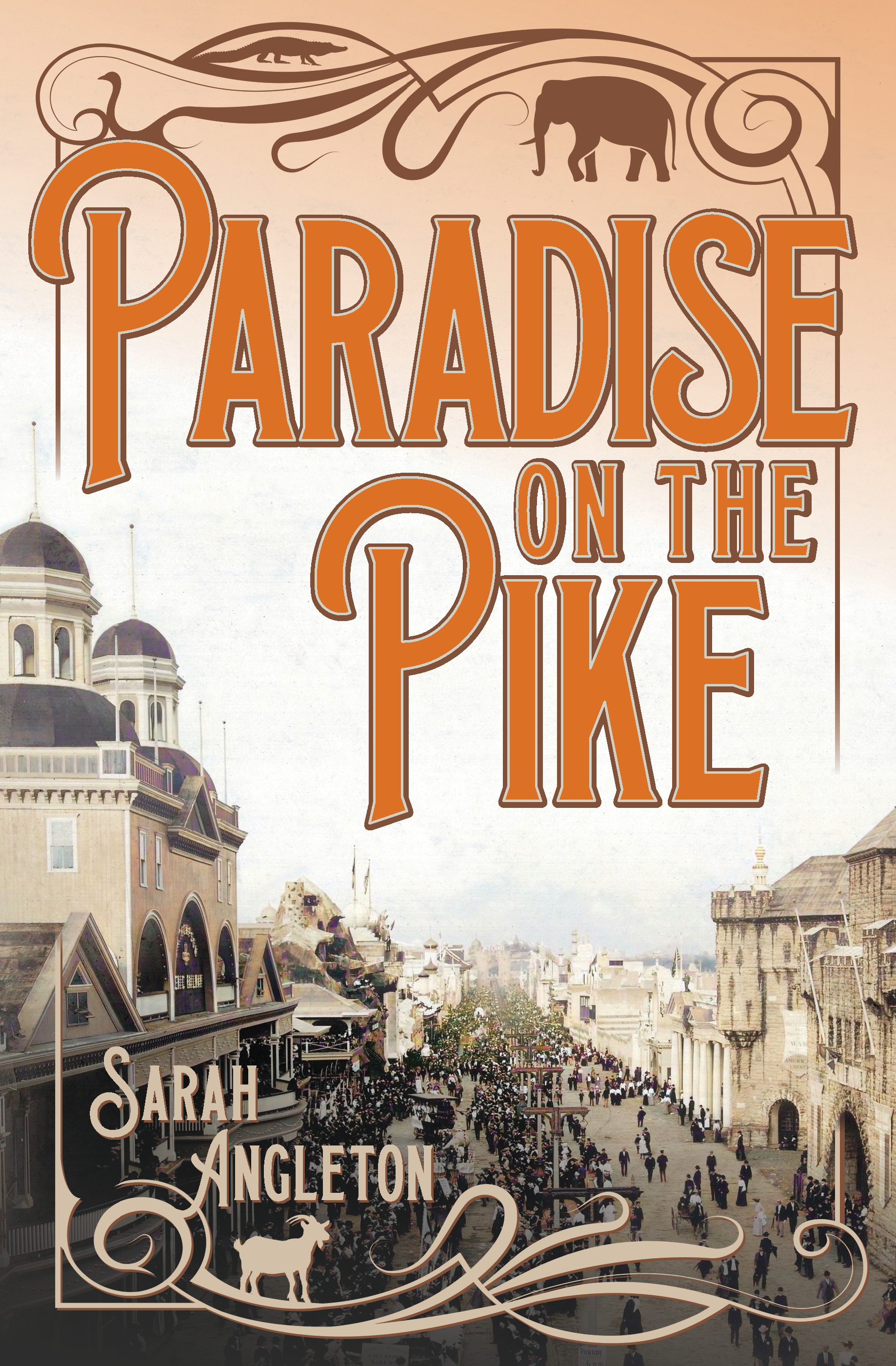
Equally exciting for everyone who either lives in my house or happens to be my mother, is the release of my new historical mystery set on the grounds of the 1904 World’s Fair in St. Louis. 

Paradise on the Pike is available for the first time today. The story takes place in the enchanting world of Hagenbeck’s Zoological Paradise and Trained Animal Circus on the Pike, which is the entertainment strip within the Fair. It’s not a light, sentimental sort of story like Sally Benson’s, but it does contain elephants and lions and a pair of cantankerous goats. It also allowed me, and will hopefully allow you, to spend some time strolling through the Fair, which was almost entirely constructed of temporary buildings meant to disappear.

Available today! Order from your favorite independent bookstore or slightly bigger bookstore or Amazon.

And maybe that’s why, one hundred and twenty years later, it still takes up space in our imaginations, because we’re a little like six-year-old Tootie at the end of Benson’s stories when the family marvels over the lights and fountains on the fairgrounds and her sister Agnes asks if it’ll ever be torn down.

Tootie emphatically replies, “They’ll never tear it down. It will be like this forever.”

Agnes, relieved, exclaims, “I can’t believe it. Right here where we live. Right here in St. Louis.”

Forest Park retains very few physical reminders of the enormous event that once filled its every corner and held the attention of the world, but in the hearts of the St. Louisans who stroll through the grounds and wish they could have seen those lights shining, it will never be torn down. It’ll be like this forever.

You can find more information about Paradise on the Pike at this link.