Pomp, Illuminations, and the Hard Work of Revision

So, today we celebrate a pretty big holiday here in the United States. We follow in the footsteps of John Adams who wrote to his wife Abigail that Independence Day should be recognized with “pomp and parade, with [shows], games, sports, guns, bells, bonfires, and illuminations from one end of this continent to the other.”

It’s a little rainy today in my corner of the world, but most of us will have all that pretty much covered. Of course, we aren’t really celebrating the anniversary of the day the Continental Congress first declared independence, nor the day one of history’s most famous breakup letters was drafted. The holiday doesn’t fall on the anniversary of the signing of the Declaration of Independence, and it doesn’t mark the moment when King George III read it and decided to sing a love song about sending an armed battalion.  

John Trumbull, Public domain, via Wikimedia Commons

Today’s July 4th celebration does commemorate all of that, but what it actually marks on the calendar is the day of the final pen stroke of the final draft of the document that spurred a war that birthed a nation.

As a writer who recognizes that first drafts rarely amount to much and that most of the best writing occurs in the rewriting, I find this pretty satisfying. It seems John Adams would not have agreed with me. When he wrote of his future nation’s Independence Day, he was referring to July 2, 1776.

I get it. He was excited. He’d had a hand in the original draft, working with Benjamin Franklin, Robert Livingston, Roger Sherman, and of course Thomas Jefferson to get it just so. Like a student who waited too long to start his final term paper and stayed up all night before the due date, assuming that in his push to get it finished, he’d written the most brilliant words ever penned by any student in the history of students, Adams was probably anxious to get it turned in to the Continental Congress, send it on to the king, and sit back to watch the fireworks.

Image by Johnny Maertens from Pixabay

Not surprisingly, however, Adams and his fellow committee members weren’t the only ones who had something to say about the wording of the Declaration. The debating began. In some ways, this important American document was improved by a few tweaks here or there, a little tightening of language or nuance of phrasing. And in other ways, it was made worse, like in the removal of all references to the immorality of slavery.

It’s still possible to make the wrong decision in revision, too, which is one of the things that makes the process so difficult. But the Continental Congress figured out where they had to compromise in order to make the declaration work enough for all the representatives in the room to move forward. The final draft would be signed nearly a month later on August 2. The date at the top of the document, however, remained July 4, which became an officially declared federal holiday in 1870.

The date is pretty ingrained at this point and I think, all things considered, it’s the right one to celebrate, though with the a full day of rain expected, and much to the frustration of my poor dog, I suspect many of my neighbors will celebrate with illuminations on the 5th and 6th this year.

Image by Jill Wellington from Pixabay

But in my mind, the 4th is the day the United States truly embarked on the notion that freedom and liberty sometimes require compromise and consideration of those who don’t agree with us, and that revision is painful, difficult, and necessary work.

The United States, such as it was imagined by the Second Continental Congress, wasn’t a perfect nation, nor was the vision of it perfected yet. That would take many, many years. So many, in fact, we’re still counting, and I suspect always will be.

But the best work comes in the difficult, painful revision process in which debate and compromise occurs. No matter how politically divided we may think we are, or how we as individuals may feel our nation is doing in this moment, I hope that’s something every American can be proud to celebrate.

If you are celebrating American Independence today or perhaps in the coming days, please be careful with all your pomp and illuminations, and have a wonderful holiday!

P.S. In the interest of full disclosure, I originally posted a version of this a few years ago, but it’s a holiday and the post still feels pretty relevant

Hollow Inside

On December 5, 1942 the Easter Bunny went to war. That’s when the United States War Production Board issued Conservation Order M-145, banning the production of novelty chocolate, including those delightful long-eared treats that had been gracing the Easter baskets of American kids for a few years by then.

The Board defended the decision by suggesting that the move would more intentionally include children in the war effort, providing them with the opportunity to be as sad as the adults in their lives. Instead of enjoying chocolate treats, children would wake up on Easter morning to plush bunnies, or to bunnies carved from soap or wood, which were somewhat less delicious.

Image by Ryan McGuire from Pixabay

Of course it’s worth noting that chocolate Easter bunnies had been introduced in Germany in 1890, had only come to the United States 1939, and had pretty quickly become hollowed out by vanishing supplies and profit margins. The children had already been sacrificing.

And the real reason for the decision had more to do with supply line interruptions and the diversion of limited resources to the front lines. That makes sense, because I think it’s safe to suggest that chocolate improves morale. It packs a pretty substantial caloric punch and is a mild stimulant, which makes it a great snack for soldiers on the go.

What makes it less great is chocolate’s tendency to melt and spoil. The War Production Board had a solution for that as well. Government contracts went to major chocolate manufacturers who could produce a D-ration chocolate bar with a higher melting point and a flavor described by soldiers as maybe a little bit better than a boiled potato. It was also not shaped like a bunny.

So, nobody was happy, though eventually American children did get their chocolate bunnies back. By about 1947, supply lines were humming along more or less at pre-war efficiency and chocolate was allowed to be both fun and delicious once again. The Easter Bunny returned home, but like so many who go to war, he’d been forever changed by the experience.

Image by Jill Wellington from Pixabay

Today, it’s hard to find a chocolate bunny that isn’t hollow inside. Manufacturers and chocolatiers will tell you that’s because when chocolate gets too thick, it’s less pleasant to bite into. Personally, I think I could manage, but hollow or not, I certainly won’t hesitate this Easter to bite into the long ears of a chocolate bunny.

According to many not entirely substantiated claims on the internet, more than ninety million such bunnies are sold in the US every year, and 89% of people surveyed claim that biting first into the ears is the right way to consume them. 5% are convinced that the tail should be first. I don’t know what to think of that other 6%. I guess maybe they’re hollow inside.

How about you? How will you be eating your chocolate bunny this Easter?

Chocolate, Vinegar, and Ashes

And another hint! As we slide down the backside of February we draw ever closer to a new historical mystery. Ten more weeks until publication! Public Domain, via the Missouri History Museum.

We’ve finally made it to the half-way point of February, which has the nerve to include an extra day this year. I realize if you live in the Southern Hemisphere, this milestone is not a huge cause of celebration for you, but if like me, you are located in the Northern Hemisphere, February is the last great stronghold of dreaded winter, and you know, it hasn’t really been that bad, at least not in my little corner of the world.

That’s probably because it’s been busy. The month started with that famous rodent prognosticator Punxsutawney Phil failing to see his shadow, allegedly a sign that spring is not a long six weeks away, but is in fact right around the corner in just a quick six weeks or so. 

Then last Sunday, the Kansas City Chiefs won the Superbowl, which was a big deal here in the Great State of Missouri, and I guess also for fans of Taylor Swift. In case you are not familiar with Midwestern geography, Kansas City is located in both Kansas and Missouri. The Chiefs represent the latter. And in case you have been fortunate enough to escape the hoopla, Taylor Swift is dating a Chief, so she’s been at a lot of the games, including this one, over which there was much ado made.

If you want to keep the good times rolling, apparently today (February 15) is World Hippo Day. Image by Don Orchard from Pixabay

Then came Pancake Day, followed by Ash Wednesday, which this year fell on Valentine’s Day, a holiday that celebrates chocolate and overpriced roses (both sharply discounted today, in case you forgot).

Of course Valentine’s Day isn’t so special for everyone. It can be a tough day if everyone else seems to have a special someone and you don’t. But it could also be worse, because it turns out people knew how to be mean to one another even before the invention of the internet.

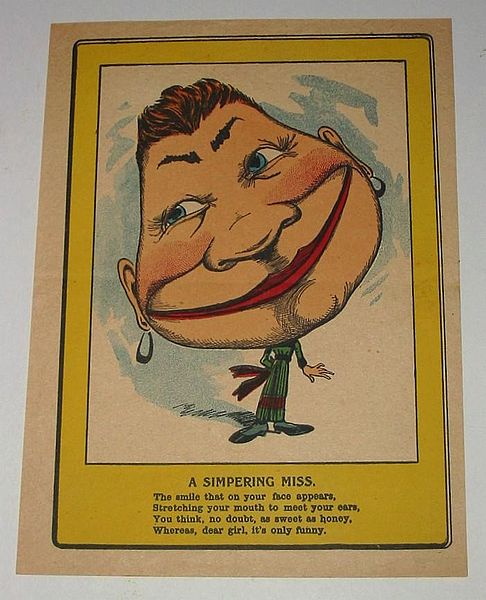
Valentine’s Day has been celebrated in some capacity as a day of love since the early 15th century, but card makers didn’t get in on the action until about 1840. That’s when mass produced Valentines hit the market, and when they did, not all of them were nice. Sure, you could find a beautifully constructed card with a sweet romantic poem on the inside and address it to your sweetheart, but on the shelf next to it, you might just find what came to be known as a vinegar Valentine.

These were more cheaply made, tended to feature grotesque drawings and included rude suggestions and insults. If that wasn’t bad enough, they also went through the mail anonymously with postage to be paid by the recipient. At the height of their popularity millions of such sour Valentine’s greetings were sold in both the US and England, and in the mid-19th century, they made up about half of the Valentine’s Day card market. 

Public Domain, via Wikimedia Commons

What isn’t entirely known is whether a large percentage of these might have been viewed as friendly jokes, but what is true is that it’s harder to find well preserved examples of them than it is their sickeningly lovey-dovey counterparts. That could be because they tended to be cheaper and made of flimsy materials. Or it could be that people didn’t feel particularly compelled to hang onto the insults.

Thankfully, it’s not as common to find an insulting Valentine’s card today because as a species, humans have evolved past the point of sending anonymous hate through the mail. Instead we create false social media profiles and spew it on the internet. As God intended.

Anyway, I hope you had a good February 14th, free of vinegary insults, and that you got from it what you hoped—to eat chocolate and feel loved or to don ashes and reflect on the weight of sin and death. Or both. Either way, the end of February is in sight. And I don’t think it’s really going to be that bad.

Irrelevant to Mental Development

On December 21, 1913, a journalist by the name of Arthur Wynne started a fad and angered a lot of librarians. Wynne worked for the New York World where he served as editor of the “Fun” section of the newspaper. Looking for something different to liven up the section, Wynne drew inspiration from a variety of word puzzles he’d encountered and came up with something he called a word cross puzzle, involving clues for placing words into blank squares that made up a diamond pattern.

Readers liked it, even when it was later renamed a crossword puzzle. In fact, they liked it so much that they flooded library reference desks to seek answers, which led to the general grumbling of librarians that serious researchers and scholars were being pushed out by frivolous puzzle doers engaged in what the New York Times (home since 1941 to arguably the most famous of gold standard crossword puzzles) called nothing more than “a primitive sort of mental exercise . . . irrelevant to mental development.”

Image by Marjon Besteman from Pixabay

Regardless of the naysayers, Americans were hooked, and as the world grew darker through the start of World War I, these silly little word puzzles became a moment of levity in the midst of the heaviness found throughout the rest of the newspaper pages. Within a very few years, most newspapers across the United States and many throughout the world were regularly printing crosswords.

In 1924 Simon & Schuster began publishing its big book of them, which led to the formation of the Amateur Crossword Puzzle League of America, a collection of dedicated crossword enthusiasts who set out to lay down some (much needed?) ground rules that standardized the puzzles.

I honestly didn’t know there was an Amateur Crossword Puzzle League of America before I began researching for this post. I also hadn’t known the word cruciverbalist, which in case you ever need to know while working on a crossword puzzle, is the proper term for a crossword enthusiast. I am not a cruciverbalist, but I know a few of them, and if I have more important things to put off, a crossword puzzle isn’t the worst way to waste a little time.

And so it is that on this one hundred and tenth anniversary of the modern-day crossword puzzle, just four days before Christmas when you’re probably starting to panic a little about all those holiday things you need to get done, I decided to gift you with a primitive sort of mental distraction that will be entirely irrelevant to your mental development. You’re welcome.

All of these clues are taken from frivolous information found in posts of Christmas past from this blog’s archives. Of course you can always rush out to your library reference desk, too. Just please don’t tell the librarians I sent you.

Lemons for Christmas

I’m a big fan of lemons. I don’t mean that I cut them open and suck on them like a crazy person. I acknowledge that they are sour and, on their own, pretty gross. But I do use lemons quite a bit when I cook, to cut that fishy flavor this corn-fed Midwestern gal doesn’t always appreciate, or to add a bit of acidic zing when the mood strikes and I want to feel a little fancy and channel my inner Food Network star.

Last year for Christmas my husband even got me a couple of small lemon trees in pots to grow in a sunny spot off to the side of my kitchen. Over the summer, the trees enjoyed the hot soupy atmosphere of our Missouri back deck (as did I), and now that it’s turned cold again they have settled back indoors, leafier and prettier, and probably no closer to actually producing fruit.

That’s okay. They’ll get there. Or they won’t. I’ll have fun trying anyway, and in the meantime, I can always buy a nice California lemon at the grocery store. I pick them out carefully. I like my lemons on the larger side, heavy for their size with a slight give when gently squeezed and with a nice fragrance.

I’m good at picking out lemons. Both at the grocery store and, unfortunately, at the car lot. I posted once before about our 2020 Subaru Outback, not long after it left us stranded on the side of the interstate while on family vacation with about twenty thousand miles on the odometer and a transmission that had catastrophically failed, leaving us down a vehicle for more than a month. I wish I could say that after the transmission issues the car hasn’t given us any more problems. Alas, it’s been something of a lemon. And not the kind that makes fish taste better.

It’s been a lemon more in that way that a mid-nineteenth century guy might have referred to a tart or undesirable woman. Or like the way a person in the early part of the twentieth century might refer to getting a rotten deal. Or an awful lot like when, according to Mental Floss, a used car dealer was said in the Oakland Tribune in 1923 to be pleased that he’d finally gotten rid of a lemon.

Not my dog. Or my car. Image by AI ART made in Germany to produce images for people from Pixabay

To be fair, the salesman who sold us our Outback probably did not knowingly sell us a lemon. It was brand new at the time, and Subarus have a reputation of being solid, reliable cars that hold onto their value. I mean their ads tend to feature good looking adventurous people driving into rugged landscapes with their good looking adventurous dogs, tails wagging and tongues and ears flapping happily out the rolled down windows. “Love,” they say, “Is what makes a Subaru a Subaru.”

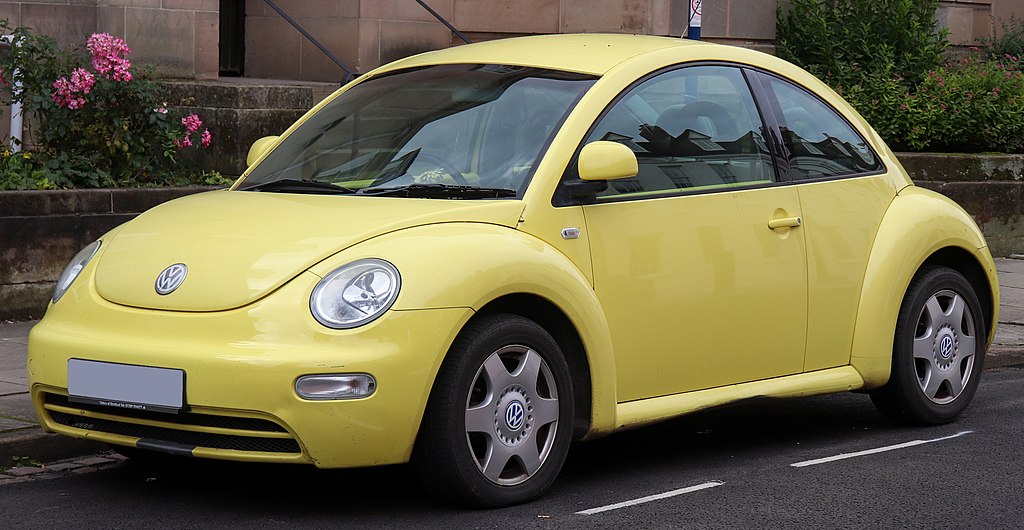
They certainly don’t label their vehicles as lemons, like Volkswagen decided to do in 1960. The printed ad displayed the image of a new, seemingly perfect (though vaguely ridiculous as the VW Beetle has always been), car labeled: “Lemon.” The ad copy went on to explain that an imperfection in the chrome strip on the glove compartment that wouldn’t likely have been noticed by the consumer, had caught the attention of one of the 3,389 quality inspectors, and that the car had been deemed unfit to sell until the problem could be corrected.

The yellow ones even kind of look like lemons. Vauxford, CC BY-SA 4.0 https://creativecommons.org/
licenses/by-sa/4.0, via Wikimedia Commons

The conclusion of course, is that a company with this level of attention to detail could be trusted to produce a car that will not only hold its value, but will also probably not result in a mandatory programming recall, a not-yet-covered-by-recall $1400 repair to its engine, a class action lawsuit regarding a parasitic battery problem the company has yet to find a solution to, an inexplicable break down at the intersection four blocks from home the day before Thanksgiving, and a family stranded on the side of the interstate when they should be on their way to the lake.

Despite being the project car of Adolf Hitler, Volkswagen and its Beetle enjoyed a good reputation among American consumers for a long time following the lemon ad campaign, though feelings toward the company have maybe soured a little since it got caught cheating on its emissions testing a few years back.

Subaru also has inspired a lot of consumer loyalty with its reputation for quality and service. I know that because every time I mention how frustrated I am with this car, I am flooded with comments from other Subaru drivers who absolutely love their cars. Even the tow truck driver on the day before Thanksgiving when mechanic shops are preparing to close down for the long weekend, told me how much he loves Subarus as he loaded my incapacitated car onto the back of his truck and a police officer directed traffic around us.

I realize it’s not Christmas yet, but this really couldn’t wait. When the day arrives, we’ll put a bow on it or something and pretend to be surprised.

And I get it. Sort of. We owned a previous Subaru Outback and it was a great car. We had lots of adventures in it with our good looking dog whose ears and tongue flapped happily out the rolled down window. Well, before he got carsick anyway. He’s not a great traveler.

But this year for Christmas (and for many Christmases and birthdays and anniversaries to come I suspect), instead of lemons, which I’m almost confident my trees will one day produce, we have traded in our 2020 Subaru Outback and purchased a Honda CR-V. The car has a great reputation, and I’m feeling hopeful that this Christmas, I’m not getting a lemon.

Happy Thanksgiving

Today I am thankful for many things, including:

  1. A loving family.
  2. A comfortable home.
  3. Turkey.
  4. International readers who don’t mind being wished a happy Thanksgiving today even though they are not specifically celebrating the act of giving thanks.
  5. Neighbors who refuse to plug in their Christmas lights until tomorrow.
  6. I guess the other neighbors, too.
  7. Readers near and far who are patient with me when I blow off blogging in favor of eating turkey with my loving family in my comfortable home where the Christmas lights will not be plugged in until tomorrow.

Keeping Eggstra Busy

Lately I have discovered that life as the mother of a burgeoning adult about to graduate from high school and head off to college is busy. It involves college visits and research into housing options and fraternity opportunities. It requires increased organization and skillful prodding as the end looms ever closer and senior-itis casts long shadows over deadlines that threaten derailment of plans if allowed to pass by unanswered. There’s also the financial planning and the dogged encouragement to apply for just one more scholarship and the editing of essays penned by a person with little interest in revising yet one more time.

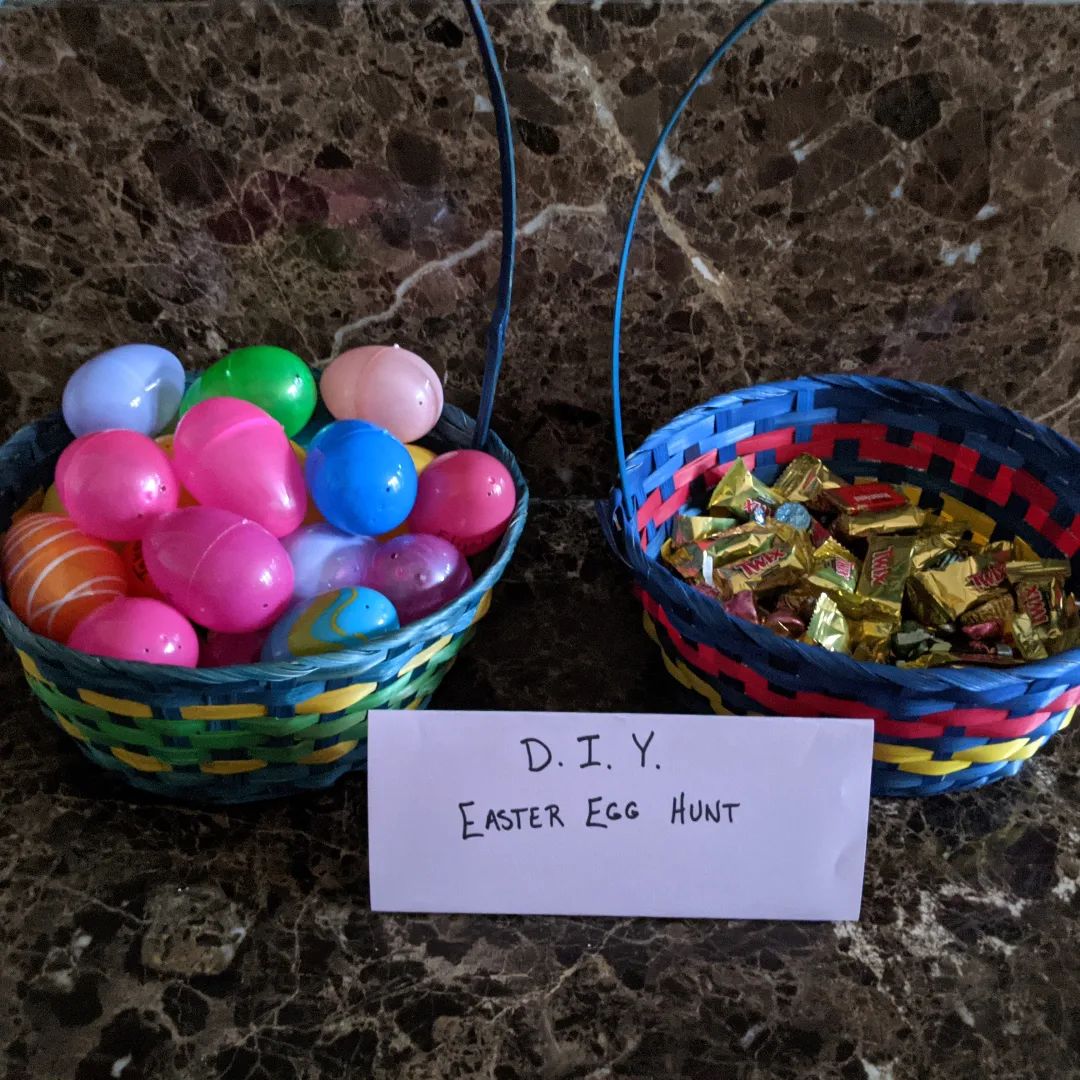
This was the egg hunt I provided for my children last year. Not long ago one of my sons asked if we were doing the same fun thing again this year. Mom for the win!

At our house it also includes long hours and dedication to a robotics team that will soon travel to compete for the second year in a row on the world stage, and the fundraising efforts that allow said team to take advantage of such an honor.

There are smaller senior trips as well and an upcoming last high school prom to prepare for. Graduation announcements need sending and a party needs planning and there’s family summer that needs scheduling around a new set of obstacles. And then there are all of the Easter eggs that need to be stuffed with treats.

This last one I thought was behind me as my children are both teenagers now and are not generally all that concerned about the Easter bunny. Alas, being the mother of a senior and also apparently somewhat of a sucker, I have found myself volunteering on the parent committee to throw a Grad Night celebration for the graduates.

In case you’re unfamiliar with Grad Night, it’s an over-the-top fun, all-night, drug and alcohol-free lock-in event designed to help burgeoning adults with not-yet-fully-developed brains celebrate and also avoid making stupid decisions that may get them hurt or worse on the night of graduation. Similar events are held all across the United States, including several very large ones at the Disney parks in both Florida and California.

Ours is not taking place at Disney World, but it will be fun. And it does take a lot of planning and an enormous fundraising effort to make it happen, which is why I find myself among a small group of moms, who are also suckers, busily stuffing thousands of candy-filled plastic Easter eggs.

Ozzie is not going to be helping deliver eggs, but he does make a super bunny ear model.

Because Easter eggs are a big deal.

People have been decorating eggs for millennia, predating Christ by a long shot, but the tradition of hunting for decorated eggs as part of an Easter celebration is generally traced to 16th century Germany, and possibly even to Martin Luther. Maybe. It does at least seem that eggs became a celebratory Easter treat largely because they were forbidden during Lent, and that Easter egg hunts, then, as now, were fun.

The tradition spread to England via the German-born mother of Queen Victoria who later continued egg hunts with her own children. In the United States, too, it was German immigrants who brought with them the egg hunt, which quickly spread across the young nation where eventually people figured out that eggs, while enjoyable to eat, are just eggs, but that hollow plastic eggs can contain candy, which is even more fun.

And then the idea for the Egg My Yard fundraiser was born. It’s turned out to be a really popular idea that finds me spending a lot of time mindlessly stuffing eggs so that my senior and I can don bunny ears and join with lots of other bunnies this Saturday to provide a fun Easter surprise for hundreds of families throughout our school district and surrounding area.

Image by Cindy Parks from Pixabay

It should be a great event. Grad night will be, too, and so will prom, and the robotics world championship, and the upcoming craft fair and two trivia night fundraisers that still stand between me and the end of the school year.

It’s a lot. But with the end of the year rapidly approaching, and the day looming when my burgeoning adult son will become a recent high school graduate moving into student housing and onto bigger and better things, I find I don’t really mind keeping busy.

Piece by Stupid Piece

You may not be aware of this, but this is a very big week in the life of United States puzzlers, because this coming Sunday, January 29th is National Puzzle Day, which has been going strong since 2002. I know that if you are not a puzzle enthusiast, this may not seem like such a big deal to you, but I mean, come on, it’s January, and I’m betting we all could use a little something to celebrate.

Image by congerdesign from Pixabay

That’s a pretty safe bet, because just a brief internet search has informed me that there are more than six hundred specially designated days of observation that help us work our way piece by piece through this the bleakest of (northern hemisphere) months. Included on this truly inspiring list is Yodel at Your Neighbors Day, Gorilla Suit Day, National Bubble Wrap Appreciation Day, and Kiss a Shark Week. Really, National Puzzle Day seems like a relatively worthy one to acknowledge.

I don’t think I could ever be considered a puzzle enthusiast, but I do enjoy the occasional jigsaw, and I find that’s particularly true this time of year when the outside is not as friendly as I’d like. And whether you celebrate them or not, jigsaw puzzles have been around since about 1767.

That’s when an English mapmaker and engraver named John Spilsbury is credited with creating the first one. He called his puzzle a dissected map, because that’s just what it was. His intention was to use a pieced apart map with a wooden backing to help teach geography. The idea was well-received and Spilsbury soon found himself in the puzzle business.

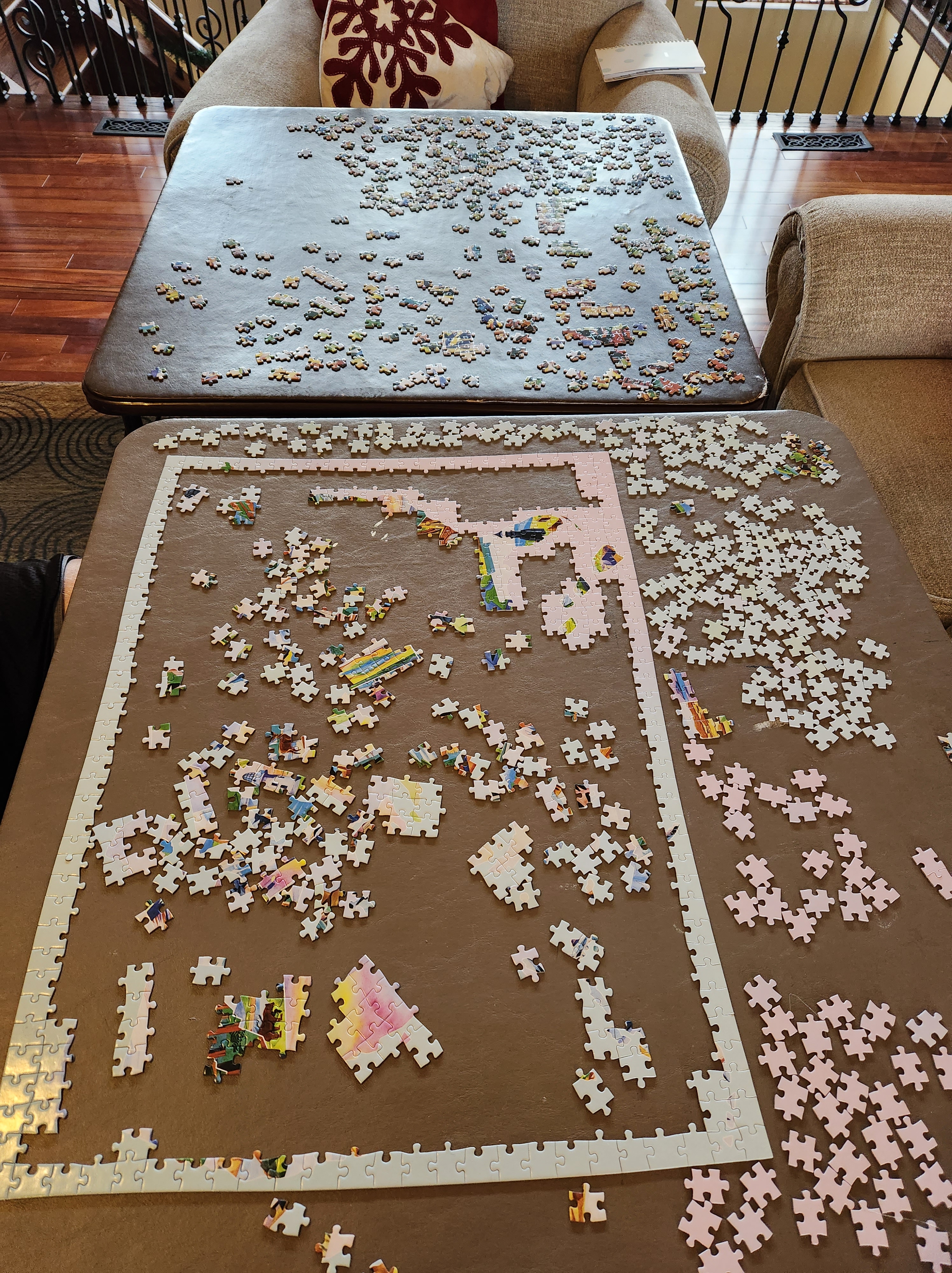
This was the situation approximately a week after I started my last puzzle.

Of course, today’s jigsaw puzzles come with all kinds of images, some of them maddeningly complex because there are evidently puzzlers who pretty much just hate themselves, I think. I recently saw an ad for one that consists of a thousand clear plastic pieces all roughly the same size and general shape. No thank you.

But I do appreciate a little bit of a challenge. My family has a tradition begun by my dad when he and my mom were first married. My mom likes a good puzzle and every year for Christmas, my dad gives her one without the box, which he only gives her after she’s completed the puzzle. He eventually started also doing that for those of his children whose eyes didn’t start to twitch at the thought. This year, with a little help picking it out, he gave me one that did turn out to be a map. Sort of.

I’m not sure that John Spilsbury would have approved of this particular puzzle. The image is in the shape of the United States, with faint lines that accurately divide the space into the appropriate fifty states. But within those basic shapes, it’s a pretty artistic interpretation of the states that doesn’t always make a lot of sense.

I did it! Finally.

For example, Virginia includes a grizzly bear, Wisconsin features mountains, and Kentucky seems to be made entirely of desert. In case you are unfamiliar with the geography of the United States, none of that is correct. The puzzle is also a thousand small pieces of roughly the same shape and consists of large patches filled with nothing but subtly shaded pastels. It turned out to be a much more difficult puzzle than the person who chose it thought it would be.

I did finish it, though, because I don’t mind a little bit of a challenge, at least not too much, and I really wanted that box. Also, by the time I’d pulled a muscle in my back hunching over the maddening little pieces, there was no way I was giving up, even though it took me nearly two weeks and a lot of complaining.

Logically, the best way to celebrate National Puzzle Day is to put together a puzzle. Since it will still be January, there’s a good chance this Sunday will be cold and dreary and so it will probably be a good day for it. If you do, please put in a piece or two for me. I think I’ll skip it this year. My back still hurts from putting together the Great Kentucky Desert.

Advice for Avoiding Goblins and Drummers

A few days ago, on January first, I took down my Christmas decorations. I did this for a few reasons. First, as much as I love the holiday season, after six weeks of it, I do get tired. And it really is six weeks at our house. We decorate the day after Thanksgiving, more or less without fail and remain decorated until at least the new year.

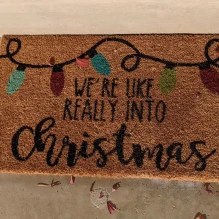
If you’ve been reading this blog for a long time, then you may recall that our version of decorating is no small task. It involves nine feet of Christmas tree, snowflake throw pillows, much garland wrapping, and lighted geese in the front yard. This is nowhere near an exhaustive list, but it gives you an idea. As it says on our seasonal welcome mat, we’re like really into Christmas.

Second, after a Christmas spent with the deep freezer working overtime, the Midwest offered up a miraculous sixty-degree, sunny day perfect for pulling up lantern stakes from the yard and removing light strings from the roof. If I could ignore the coming two-and-a-half months of cold that remain this winter, it felt a bit like a spring cleaning kind of day.

I’m talking about the kind of day in which one might take a minute organize the Christmas storage boxes in the basement instead of continuing to shove the reindeer salt and pepper shakers into the same box as that string of broken lights that may offer up some replacement bulbs for the ones we used to use that looked kind of similar, except they included purple bulbs in addition to red, green, blue, and yellow.* That’s right. Not only did I put away our cherished Christmas decorations. I threw away a bunch of old, broken ones we no longer use. I was basically on fire.

The 2022 calculated cost of the gifts in Twelve Days of Christmas is $45,523.27. In case you needed another inflation index, that’s up 10.5% from 2021. Image by wal_172619 from Pixabay

And obviously the third reason I took down the Christmas decorations promptly on January first is because I didn’t want to risk, depending on who you ask, a case of bad luck, a possible goblin invasion, or the shock of hosting twelve drummers drumming in my home.

Because evidently Christian tradition dating back to the sixth century suggests that holiday decorations are perfectly acceptable at least until Epiphany, the day the wise men arrive on scene and twelfth and final day of Christmas. To leave them up any longer is, for many, a holiday faux pas that might just bring you bad luck or goblins or at the very least a disgruntled homeowners association.

I’m not sure I fully understand. Outside of singing the song about giving someone an alarming number of birds, I have never observed the twelve days of Christmas. Most of the traditions I grew up with and have continued in my own home occur in the lead up to and on the day of Christmas itself, which is why by the twelfth day of Christmas, on January 5th or 6th (depending on particular brand of Christianity or perhaps counting habits), I’m plum tired out.

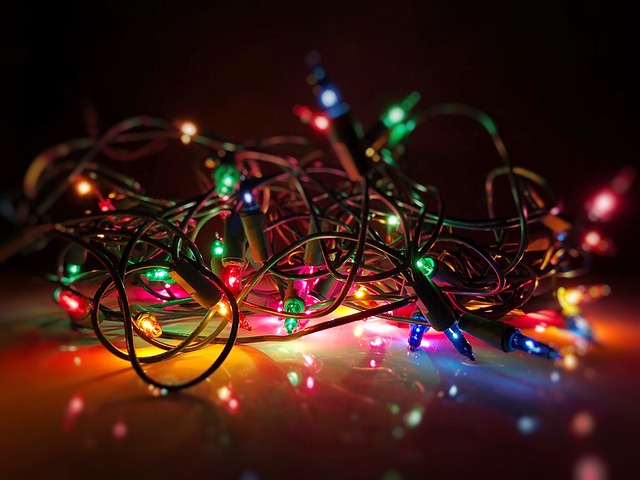
I didn’t even put them away in a wadded mess this year. Image by Wokandapix from Pixabay

Right now, I’m looking around my bland, non-Christmas-decorated house on a day that is neither sixty degrees nor sunny, and I’m grateful to have gotten all the work out of the way several days ago. I’m also happy to report that there doesn’t seem to be a penalty for taking the decorations down early.

But if yours are still up, then today might just be the day. I tell you this because I care and because I don’t want to see your home invaded by goblins. Or drummers.

*I wish I could honestly claim this isn’t a real example from my life, but it is.

Rockefeller Around the Christmas Tree

On December 24,1931 a construction crew was hard at work on a twenty-two-acre building site between 48th and 51st Streets in Midtown Manhattan. Two hundred twenty-eight buildings had been razed, forcing the relocation of several thousand tenants for what was originally meant to be the new site of the Metropolitan Opera.

James G. Howes, Attribution, via Wikimedia Commons

The stock market crash of 1929 and the economic depression that followed made the planned move impossible. John D. Rockefeller, Jr., who had leased the land from Columbia University for the Opera’s use quickly reformulated a plan to build up a mass media entertainment complex with Radio Corporation of America and its subsidiaries. Over the next several years it would develop into the Rockefeller Center with nineteen buildings and a sunken square annually featuring an iconic ice rink guarded by a humongous Christmas tree passed by half a million people per day.

But on Christmas Eve of 1931, the public wasn’t yet thrilled with the plans for the space and there was still a lot of zoning red tape in the way. The Italian-American crew, however, was hopeful. They had work, when so many did not, and the promise of much more on the horizon. And it was the night before Christmas. What they needed was a great big tree.

The workers and their families chipped in to purchase a twenty-foot-tall balsam fir that they erected in the middle of the muddy construction site and decorated with cranberries, paper, and tin cans. I’m sure the tree wouldn’t have looked all that impressive alongside the fifty-footer that two years later officially became what the Rockefeller Center’s website refers to as “a holiday beacon for New Yorkers and visitors alike.”

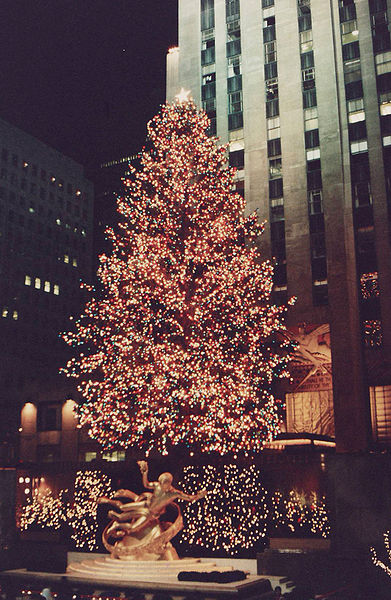
Daniel Dimitrov, CC BY-SA 4.0 https://creativecommons.org/licenses/by-sa/4.0, via Wikimedia Commons

Even fifty feet seems tiny when compared to the trees now used, which typically range between seventy-five and eighty-five feet tall, and once even as much as one hundred feet. The decorating of this beast of a tree takes dozens of workers more than a week to complete before the nationally broadcast lighting ceremony that takes place every year after Thanksgiving.  

Still, I think twenty feet is pretty impressive, if not even a little bit excessive. Many years ago, when my family and I lived in a different house in a different state, our living room had a high, vaulted ceiling. My husband, who pretty much loves all things Christmas, decided we needed a bigger Christmas tree to better fit our space than the measly seven-and-a-half-footer we’d been getting by with.

I couldn’t find a picture of our twelve-foot tree, but it pretty much looked like this, except three feet taller.

I took some convincing, but he found a good deal on an artificial (due to family allergies and general disdain of sap and spiders) tree that was twelve feet tall and since he was willing to move the ladder around to decorate the top five feet, I agreed to the purchase.

That first year the tree was a little sparsely decorated with our seven-and-a half-feet worth of ornaments and I can see why the construction workers at Rockefeller Center would have resorted to using tin cans to fill the space. The tree was gorgeous, and it made my husband very happy. I did, however, feel a little bit like I was living in a shopping mall. Or maybe at Rockefeller Center.

It didn’t completely break my heart when the next house came with lower ceilings and we had to trade down. Over the years we’ve managed to reach a compromise and now put up a nine-footer, which is still awfully pretty, but doesn’t require nearly as much ladder manipulation to decorate.

I do see him staring at it sometimes, though, probably thinking he could fit another several inches beneath the ceiling. Maybe someday we will. It is, after all, a holiday beacon for us and for visitors alike.