Forget the Bunny: A Case for the Easter Fox

With Easter Sunday nearly upon us, it’s probably time we talk about rabbits. I have a complicated relationship with these admittedly adorable creatures. My first favorite stuffed animal was a floppy-eared bunny I received at Easter. My youngest son, too, has a stuffed bunny that is near and dear to his heart, enough so that when he was younger, there were many nights of frantic searching for “Bunny,” who always managed to disappear at bedtime leaving behind one inconsolable little boy.

evilbunny
Just look at that twitchy nose. He’s up to something. photo credit: emraps my kid’s face via photopin (license)

And then there’s the Easter Bunny, one of a very few species of mammals to lay eggs, and the only one known to lay eggs filled with candy. This creature is also commonly classified as a rarely seen and likely nonexistent animal (like Big Foot), a creeper sent to spy on naughty children (like the elf on the shelf), or a guy in a scary costume that makes small children cry in the middle of the mall commons (like our favorite jolly fat man).

But where does this strange critter come from? The answer to that may be as hard to find as a favorite stuffed bunny at bedtime (make sure you check outside in the wet grass next to the play set). There are references to the Easter Bunny as early as the 16th century in Germany where it seems likely the tradition was born.  

BrownDog
The only bunny I’ve ever liked.

And speculation that rabbits and hares became linked to the holiday because they are the animals most closely associated with the pagan goddess Ostara, traces its roots back to the connection of the goddess with the Christian holiday. That connection was first postulated by the 8th century monk and (practical) historian known as the Venerable Bede, who a lot of scholars now think probably just kind of made it up.

That didn’t stop Jacob Grimm (of fairytale-telling fame) from spreading the rumor in 1835, nor does it slow the annual onslaught of internet claims that Easter is little more than the Christian commandeering of yet another pagan holiday (which, even according to quite a few pagan scholars, it’s not).

But that still doesn’t explain why a bunny brings a basket of eggs, a common symbol of fertility and new life, to hide for the kiddos on Easter. All we really know is that the tradition seems to come out of German Lutheranism in various forms, all involving the hiding of colored eggs by an animal. The species of the egg-bearer varied by region, showing up sometimes as a rabbit, but in other places as a rooster, a cuckoo, a stork, or a fox. Eventually the rabbit won the day. By the time German immigrants began arriving in large numbers in America in the 1700s, they brought the Easter Bunny with them.

Bunny
Well, I’m fond of this one, too. Now that my son is getting older, it doesn’t hippity hop through my yard much anymore, but I didn’t really mind. Except at bedtime.

But as I mentioned at the beginning of this post, I have a complicated relationship with bunnies. On the one hand, they are adorable.  And on the other hand, I hate them. Because while the Easter Bunny brings candy, plain ol’ bunnies hippity hop through my neighborhood with impunity.

These monstrous little nose-wigglers descend every spring to destroy my carrot, beet, and lettuce crops, decimate my blueberry bushes, and even nibble the life out of the new little tree shoots that have done nothing to deserve this harsh treatment. The demons dig ankle-spraining holes in my yard (never once having the decency to leave a candy-filled egg inside) and relentlessly taunt my dog who is well-intentioned, but too slow to catch them.

EasterOzzie
My poor dog would like to add another argument against the Easter Bunny.

So here’s my proposal. Let’s go back to the Easter Fox. Foxes are shy enough you rarely see them. They’re also kind of cute, but much easier to say no to when your son begs for one as a pet, and they will pretty much leave your beet crop untouched. Also, in the wild, though foxes do not lay eggs (and neither do bunnies, in case you weren’t clear on that), they do tend to steal and occasionally hide them. Also (and I think it’s safe to say this is the most important point) adopting the fox as the official mascot of Easter would effectively put an end to all this “Hoppy Easter” nonsense.

So it just makes sense. Or at least it makes as much sense as the Easter Bunny.

Corned Beef and Cabbage and Something about Snakes

Last week I got to do something fabulous. I took a quick girls’ trip to Florida with my sister, cousin, and aunt. And I did not take my kids or my husband. Not that I don’t like traveling with them. They’re really fun people. But this was a special trip to celebrate my sister’s birthday by hanging out on the beach and watching some baseball.

We went to Jupiter, Florida, spring training home of the St. Louis Cardinals (and the Florida Marlins, but nobody cares), where we attended three games, played on the beach, explored a lighthouse with the most amusing tour guide I’ve ever encountered (but that’s another post), witnessed a rehabilitated sea turtle get released into the wild, ate a lot of cheesecake, and had, generally, a really great time.

FredbirdandSteve
Okay, so it wasn’t strictly a girls’ trip. Of course we had to take Steve the traveling sock monkey. He’s a huge fan!

And even though I didn’t take him with me, I could not have enjoyed such a trip without the efforts of my wonderful husband who rearranged his busy work schedule to hold down the fort for a few days, getting the kids to and from school, managing homework, keeping up with all the activities, and cooking dinner.

It’s this last part I may appreciate the most, because while I was gone, he cooked corned beef and cabbage. It’s a dish a lot of Americans will be preparing tomorrow in honor of St. Patrick’s Day, even in spite of the fact that it falls this year on a Friday in Lent and at least the dedicated Catholics among us should probably stick to fish.

I confess that not being particularly Irish, nor even the tiniest bit Catholic, I’ve never really known a great deal about Saint Patrick. I just know that if you don’t wear something green on March 17th, someone somewhere will feel compelled to pinch you and that if you cook corned beef and cabbage in my house while I’m home (or possibly in the same state), your fate will be much worse than that.

It turns out history doesn’t yield up a whole lot of reliable information about St. Patrick, either. We know that he was born in Britain sometime in the last half of the 5th century, that he arrived in Ireland as a slave at age sixteen (possibly kidnapped by pirates), made it back home six years later, and had a vision calling him back to Ireland as a missionary, where he proceeded to do all kinds of legendary things like preaching with shamrocks and driving out snakes. That’s where his story gets a little muddy, and may (as some historians suggest) get combined with another missionary known as Palladius who was in Ireland in the early half of the 5th century.

saint patrick
Though we don’t know for sure, it seems likely enough St. Patrick may have used the shamrock to illustrate the concept of the Trinity, since Ireland actually has shamrocks. Unlike snakes, which Ireland never did have. Not even green ones.[Public Domain], via Wikimedia Commons
But the lack of concrete details sure doesn’t stop us all from gettin’ our green on, even though the color more historically associated with this saint is actually blue. Historical stuff does tend to yellow with age, and Chicago goes to all that trouble to turn their river disgusting green, so I guess I’ll allow it.

The tradition that I can’t tolerate, however, is corned beef and cabbage. And frankly, I shouldn’t have to. Because Saint Patrick is as likely to have eaten corned beef as he is to have driven all of the snakes from Ireland (which, according to fossil records, never existed there in the first place). In fact, historically, Irishmen in general never ate much beef, the meaty part of their diet tending to be primarily salted pork.

If we really want to celebrate St. Patrick and all things Irish, then it’s bacon we should be eating. Now that I could get behind.

It wasn’t until the great influx of Irish immigrants into America in the 19th century that corned beef became a St. Patrick’s thing at all, and that’s only because the meaty part of the American diet tended to be more beefy. Relatively cheap beef brisket was readily available to Irish Americans who settled in large numbers alongside the kosher delis of their Jewish neighbors, and so they convinced themselves, their descendants, and green beer-guzzling Americans from all walks of life that corned beef and cabbage is a good, Irish-y idea.

But it’s not.

stpathat
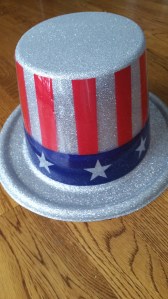
I’m not a total party pooper. I will wear this ridiculous hat while not eating corned beef and cabbage.

Still, Americans will fire up their crock pots, stink up their houses, and line up in droves to eat corned beef and cabbage tomorrow. And I’m sure those lines will include a lot of Irish and/or green beer-guzzling American Catholics throughout the country where many local dioceses (though far from all) have granted dispensations to their parishioners who wish to partake.  

I can honestly say there’s not enough green beer in the world to make me want to participate in the tradition, and because I married a very smart and thoughtful man, I don’t have to. He had his corned beef last week. By the time I got back from my trip, the house had thoroughly aired out. Had it not, I’d not have hesitated to head back to the beach.

Santa Might Be On To Something

I don’t know about you, but I’ve been busy this holiday season. Already several times I’ve party planned and cleaned and hosted and cleaned. I’ve shopped for gifts, a task that no matter how early I start, always seems to take until Christmas Eve. I’ve made Christmas candies and cookies, decorated and crafted and spread Christmas cheer in a lot of little ways. But in order to accomplish these tasks, I’ve had to let others slide.

The biggest of those other tasks is sending Christmas cards. I wasn’t feeling too bad about that, though, because I am fortunate not to have many overachieving friends. I’m happy to report that I didn’t receive a single card the day after Thanksgiving (seriously, such a betrayal might signal the end our friendship). Nor did I receive any cards for the first nearly two weeks of December, which goes a long way in making a busy gal feel truly special.

dog-card
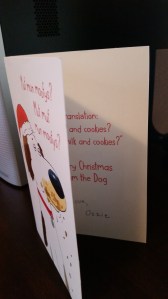
I even received a Christmas card from my dog this week, though judging by a curious postmark (and his notable lack of thumbs), I suspect he had help.

But then this third week of Advent arrived, and with it came the postcards featuring the smiling faces of friends and family and busy children who are growing faster than I can quite grasp, handmade die-cut works of art filled with sweet holiday greetings, and letters recounting a year’s worth of adventures.

So that’s when the guilt started to set in. Because for all I have done so far this busy season, I haven’t designed a postcard or die-cut any artsy Christmas trees or written a year-end letter. I haven’t even purchased a big box of factory-made holiday greetings.

And I feel especially bad about it when I take a moment to realize that even Santa, easily the season’s busiest fictional character with tens of thousands of letters to send, already has this holiday task well in hand.

In my defense, Santa does have a lot of practice. He’s been sending Christmas letters to excited littles at least since the late 19th century, decades before postal policy technically allowed him to do so. Because letters addressed to Santa Claus used to wind up in the Dead Letter office.

Or at least officially they did. There were always  those kindhearted postmasters who couldn’t stand the thought of a letter to Santa going unanswered, or an innocent expression of real need going unmet.

One such kindhearted person was Connecticut postmaster Harris Eames, who in 1894 opened a letter addressed to “Sandy Clous” from a little girl in a family he knew. From the letter, Eames learned that the family had fallen on harder times than anyone had realized. The postmaster contacted local businesses and orchestrated a Sandy Clous miracle.

santa-suit
Actually, I don’t think this guy really does much of anything himself. He doesn’t even deserve those cookies! Public Domain image, via http://www.costumers.com/

For years, similar heartwarming stories rolled in from post offices all over the country, until finally, in 1913, the Postal Department relented, accepting its position as the gatekeeper for Santa Claus.

The procedure for handling and answering letters from children to their Christmas hero has changed through the years amid growing privacy concerns, but many postal offices still partner with local charities to deliver Sandy Clous miracles through what is collectively known as “Operation Santa.” And the jolly old elf himself will take the time to write back to any child who wants to send him a letter.

Sort of.

Much like Santa’s brilliant gift-giving policy, his letters do require a little help from parents. The current USPS Santa letter instructions state that you must include the response letter in a self-addressed, stamped envelope included in a specially addressed outer envelope.

presents
If only I could get my family to buy and wrap their own presents.

Oh, and because Santa is super organized and on top of such important tasks, it has to be received in Anchorage, Alaska by December 1oth. That way the postal elves have time to process it and get it back to you by Christmas, postmarked from the North Pole, of course.

I do think the USPS and Santa are on to something. So, I’ll tell you what. If you are hoping to receive a Christmas card from me this year, all you need to do is design one, place it in a self-addressed stamped envelope and a larger envelope addressed to me. Then drop it in your mailbox and I will send it right back to you, postmarked from St. Louis to give it that truly authentic feel.

Now, if you wanted it by Christmas, you’d have had to get it to me by December 10th, since I’ll surely drive around with it in my purse for a few days before remembering to drop it in the mailbox. But since we both know you can’t reasonably expect a Christmas card from me until January, I think there’s still time.


Nothing Says Christmas like an Excess of Pickles

In April of 1864, during the American Civil War, Private John C. Lower of the 103rd Pennsylvania Infantry, was captured and taken to a Confederate prison camp. There, after many months of captivity, he found himself on Christmas Eve, hungry, weak, and knocking on death’s door. He begged for help, appealing to the mercy of a guard who took pity on him and gave him a pickle.

christmas-pickle
If I owed my life to a pickle, I would definitely hang one on my Christmas tree.

It was this pickle that Private Lower later credited with the saving of his life, and when he finally returned home, he began a curious holiday tradition with his family. Whether Lower survived because the kindness of the prison camp guard infused him with hope for humanity, or because the slug of seven whole much needed calories provided him the energy to live on, no one can say for sure.

Pickles have long been considered to provide good health and vitality, and have been relied upon by military leaders dating back as far as Julius Caesar, to give their soldiers a much needed kick. Still, it seems likely that Lower’s story is entirely made up to explain the long-standing tradition of the Christmas pickle.

Never heard of it?

Neither had I, but apparently it’s been an American tradition since at least 1890 (or 1865, in the Lower household). Before that it was a “time honored German tradition.” The trouble with that theory, of course, is that most Germans haven’t heard of it either.

The idea is that parents hide a pickle ornament somewhere on the tree on Christmas Eve, and in the morning, the first child to spot it wins a small prize or receives a special blessing for the year to come, or earns the right to open the first present.

Okay, so it’s a little bit charming. And for the purposes of this blog post, I went on a pickle-finding adventure of my own. I searched several stores, asking employees if they had traditional Christmas pickle ornaments. Most of them looked at me with mystified expressions full of barely masked pity. Only one knew what I was talking about, though her store did not carry them. A surprised employee in the store where I finally had success, said, “Well, I think we had some cucumbers. Or maybe they were pickles?”

larry-and-bob
I didn’t have the heart to tell her I already had a cucumber on my tree.

They were. And I bought one. Because even if it isn’t an age-old German Christmas tradition, we Americans sure do love our pickles. More than half of the cucumbers we grow eventually become pickles. That’s twenty-six billion of them per year. And each of us allegedly eats an average of nine pounds of them per year, which means someone out there is eating an awful lot of pickles to balance out my somewhat less than nine pound contribution.

chicken-sandwich
I wonder how many Chick-fil-A sandwiches I’d have to eat to meet my pickle quota.

But there’s still the question of how they ended up on our Christmas trees. There are a couple theories other than the one involving Private Lower, including one that suggests the source is a miracle of St. Nicholas in which he resurrected two murdered boys who’d been sealed into a pickle barrel by an innkeeper (securing his place on the naughty list). There are lots of variations of that story, though, and most don’t involve pickles at all. Also, it’s pretty awful and not very Christmas-y.

The theory that I find most believable, is that in 1890, F.W. Woolworth began importing Christmas ornaments from a German glass factory, many of them in the shapes of fruits. Some of them were pickles (and, yes, cucumbers, and therefore pickles, are fruits…ask a botanist). While the pomegranates and pears sold fairly well, for some reason, the pickles didn’t strike most people as particularly Christmas-y. And so a German custom was born, right there in an American five-and-dime.

It turns out this long standing Christmas tradition that few of us have actually heard of, may really stem from a marketing campaign and an excess of glass pickles, the most non-Christmas-y fruit imaginable. But, it’s kind of fun and weird. So, why not?

A Celebration Worthy of a Slice of Non-Satan-Spit-Poisoned Pie

Centuries ago, though no one is quite sure when, Michael the Archangel engaged in war with the forces of evil. It was a great battle that ended with the expulsion of Lucifer and his minions from Heaven.  And to add injury to insult, the story goes, Lucifer fell directly into a large, thorny blackberry bush and got so mad he spit on the otherwise delicious fruit.

michael-and-dragon
Michael defeating the Dragon. I suppose a day like this would be enough to make anyone a little cranky. But why is that the blackberries’ fault? Jerk. By Sultan Edijingo (Own work) [CC BY-SA 4.0 (http://creativecommons.org/licenses/by-sa/4.0)%5D, via Wikimedia Commons
Originally, the story of this epic battle was extrapolated from a few verses in the twelfth chapter of Revelation and explored by a number of writers including John Milton. Today, the interpretation of those verses is widely debated by Biblical scholars with most assuming that they don’t really refer to a Heavenly battle in the distant past, but instead represent an end-of-days battle to come.

But sometime in the fifth century, a basilica near Rome began to celebrate the feast of Saint Michael and All Angels, also called Michaelmas, on September 30, the traditional day the battle was won. It’s been celebrated to varying degrees ever since.

How exactly the blackberry bush became a part of the legend isn’t entirely clear, but the tale emerged from England where Michaelmas was widely considered the marker of the change of seasons from summer to fall. Since Revelation contains oh-so-delightful imagery of Satan spewing a river of dragon drool, and since blackberries, which usually peak in August, are pretty iffy by the end of September, I suppose it stands to reason that the two are somehow related. I guess.

Or maybe it’s just that with the shifting of the seasons, from long days and ripe berries, into long nights and barren fields feels a little unfair. And Lucifer is just the kind of jerk that might add injury to insult and spit poison all over the last vestiges of summer goodness.

Or it could just be an excuse to eat blackberry pie and celebrate a holiday with a ridiculous name, because by tomorrow, blackberries the world over will be covered in poisonous Satan spit, and I don’t know about you, but I’m not going to take any chances.

The wisest course of action, then, is to bake your last summer pie of the season today, in honor of Poisoned Blackberries Day. Because Satan is a jerk.

blackberry-pie
Actually you should probably eat the whole thing because it’s a pretty important day. Also, just to be safe. photo credit: David Gallagher Apple Blackberry via photopin (license)

But if that’s not reason enough for you to celebrate, then perhaps you could bake a pie in recognition of another equally ridiculous and even less well-known event that also occurs today. Because this is my 200th post on this silly little blog that pretends to be about history. I think a milestone like that deserves a slice of non-Satan-spit-poisoned pie.

Take a Walk, Ya Scurvy Dogs

A couple weeks ago, I had a run-in with a pirate. It was a sunny, post-tropical storm day in Charleston, South Carolina, a place that takes great pride in its pirates. We’d been in the area to celebrate the wedding of a niece and decided to take in a little bit of the colorful local history.

That’s when the pirate showed up. He was everything you’d expect with tall boots, a real sword, and a trusty parrot sidekick named Captain Bob. He knew everything there was to know (or at least everything I’d ever think to ask) about the swashbuckling personalities that graced the waters from North Carolina to Barbados during piracy’s Golden Age.

pirate-eric
Eric the pirate and Capt. Bob of Charleston Pirate Tours.

We walked with our pirate companion quite a few city blocks and along the oceanfront park where convicted buccaneers were once hanged for their crimes. This same site today still hosts scores of Charlestonians engaging in unsavory acts. Like yoga.

But the true treasure of the experience was the vast knowledge shared about real people from history including Stede Bonnet, the gentleman pirate who gave up a life of privilege in Barbados to play pirate with his hired friends. And Anne Bonny, a society girl gone wild, with a preference for scallywags. And that most famous of all pirates known sometimes as Edward Teach, or less commonly as Edward Beard, or more commonly as Black Beard. Boy, that guy didn’t turn out to be quite what we (or Wikipedia) thought.

You might begin to wonder how I, a respected practical historian, could simply trust the word of a pirate, not necessarily assumed to be the most honest of men. But I think I did mention he had a parrot, right? Also, never once did he utter the sound Arrrr.


079
My only previous encounter with live pirates, at the St. Louis Renaissance Fair. These were somewhat less concerned with historical accuracy.

Well, okay, that’s not entirely true. He did say it once, when he informed us that to the best of his knowledge (and that of everyone else that knows about these things) pirates didn’t actually say Arrrr.

That, along with that uniquely gruff Piratey accent and the stubborn reluctance to correctly use a possessive pronoun or conjugate the verb “to be,” is an entirely fictional construct, popularized mostly by British actor Robert Newton in his role as the one-legged Long John Silver in Disney’s 1950 version of Treasure Island.

It turns out that though they were probably a little more well-versed in nautical terms for boat riggings and sea monsters than was the average landlubber, pirates most likely talked like, well, guys of their era. Their language, like ours, was shaped by their various heritages and experiences, and would not have been particularly uniform.

And I’m sorry to be the one to tell you that no pirate ever said the words “Shiver me timbers!” without getting laughed off the plank.


800px-pyle_pirate_plank_edited
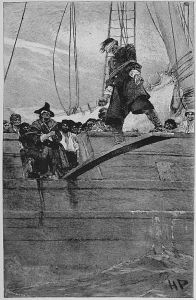
Actually plank walking has a somewhat dubious history, too. Illustration by Howard Pyle, Public Domain, via Wikimedia Commons


Now I know that like me, this revelation must concern you somewhat. After all, International Talk like a Pirate Day is rapidly approaching (on September 19, which you no doubt already knew) and you haven’t a thing to say.

The holiday, begun sort of unofficially in 1994 by two guys playing racket ball and talking like guys of their era, became slightly official when columnist Dave Barry gave it a rousing stamp of approval in 2002.

What started as friends having a little fun irritating the heck out of their coworkers, has blossomed now into a truly international event prompting (if you can believe the handy pirate map on the holiday’s official website) perhaps dozens of organized events designed to annoy the heck out of way more people’s coworkers.

But beneath all of the irritation, the day really is about having fun, together with your friends, talking like average guys of your era, the kind of guys who think that pirates said things like, “Arrr, treasure I ain’t got nor knows wheres, but ye be cutthroats and ye better serve up yer peace or I’ll feed ya piecemeal to the rats, ya scurvy dogs.”

So join in the fun and celebrate the day like Long John Silver would, says I. Plunder some booty, shiver some timbers, and irritate the heck out of your coworkers with your creative grammar and imaginative slang. But if you ever find yourself in South Carolina, look up Charleston Pirate Tours and take a walk with Pirate Eric and Captain Bob. I promise it’ll be worth ye the hour, me mateys.


A Post for Every Season

In 1958, seventeen-year-old American high school student Robert G. Heft needed to find a good project for his history class. Realizing that his nation might be on the cusp of something important, Heft decided what he would do was address the obvious problem presented by admitting two more states to the then 48-state United States.

Young Heft spent twelve hours (probably the night before the project was due), using a yard stick and his mother’s sewing machine to carefully produce a new American flag design featuring 100 hand-cut stars, fifty on each side of the blue section.

17571380795_bac6abbe67_o
The new flag was raised on July 4, 1960 above Fort McHenry where Francis Scott Key famously penned the words that would one day be set to the most difficult tune on the planet for anyone to carry, though that doesn’t stop scores of drunken baseball fans from trying. photo credit: My favorite flag in the world. via photopin (license)

Bleary-eyed, he presented his project to his teacher Mr. Pratt, who promptly awarded him a B-. But young Heft had worked really hard and he wasn’t satisfied with the grade so he complained to his teacher, who sighed and finally agreed that he would give the project an A as soon as Congress accepted Heft’s design as the new American flag.

What was most likely meant as a dismissal, Heft took as a challenge. So in January of 1959, when Alaska became the first new state admitted to the Union since Arizona in 1912, he started to get excited. When later that same year, on August 21, Hawaii became number fifty, Heft held his breath in anticipation. Because he, along with somewhere around 1500 of his fellow citizens (all desperate to improve their history grades), had submitted unsolicited new designs for the flag. President Eisenhower himself called Heft to inform him that his design had been chosen.

It’s a great story, because it’s that of a relatively powerless young person, working hard, taking a chance, and achieving success against the odds. In a way it feels a little like the story of the United States itself.

20160609_073234
And super stylish hats. Let’s not forget those.

We Americans love our flag. Mostly, of course, we love what it represents, freedom and sacrifice and that fierce American pride instilled in us at birth. Many of us fly flags at home and we put the stars and stripes on ties and tee shirts and coffee mugs. We hoist our flag on Memorial Day at the end of May in honor of the men and women who have sacrificed to protect all that it represents. We display it again on July 4th, in honor of the original declaration of American attitude.

And thanks to a movement derived from the lesson plans of a creative Wisconsin teacher in 1885, whose school celebrated the flag’s birthday on June 14 (the 108th anniversary of the adoption of the stars and stripes), we now also fly it for Flag Day.

What this means is that in addition to showing our patriotism, we also get to be incredibly lazy. Because from the end of May to the beginning of July, it is perfectly appropriate to feature your stars-and-stripes front door decoration, candy dishes, and knick-knacks. And really, who’s going to say anything if you start at the beginning of May when you finally put the Easter bunnies away, and stretch it until the scarecrows come out in, say, September.

20160609_065732
Heck, I’m so patriotic, I might just leave this up all year.

No one. Because you are patriotic. And if they do say anything, then clearly, they are not. If you want to be really lazy patriotic you might even stretch your flag-themed paraphernalia through Veteran’s Day in November, by which time, it is nearly acceptable to swap it for Christmas decorations. I recommend snowmen because they’ll last you well into Lent.  

That, my friends, is how you become the envy of all your neighbors, because you always have such beautiful seasonal decorations in your home, while they can’t seem to find the time for such nonsense. Maybe they just aren’t as thoroughly patriotic as you.

20160609_070524
Rest assured, even the addition of more states won’t render this centerpiece any  less delightfully patriotic.

And the best part about all this wonderfully American stuff is that the number of stars doesn’t particularly matter. So if in a few years, there’s a 51st state, your oh-so-starred-and-striped paper-weight should weather the storm just fine.

Of course the flag itself will have to change in that case, but it’s okay because Robert Heft has us covered. He did retrospectively get his A on his project and went on to become a teacher and even served as mayor of his little Ohio town. When he passed away in 2009, Heft also held copyrights to flag designs with fifty-one through sixty stars. Just in case.


Don’t forget! You can join my e-mail list to receive updates on my forthcoming novel here: http://eepurl.com/b3olY1

A Fine Specimen of a Novel Except for not Having a Head

On September 10, 1945, a farmer by the name of Lloyd Olsen was expecting his mother-in-law for a visit and so he set about doing the unsavory work of killing a chicken for dinner. He scooped up a young rooster scratching and pecking its way through the barnyard and dealt the fatal blow.

Mike_headless_chicken
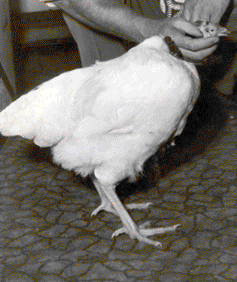
Mike the Miracle Chicken posing with his head. Photo via http://www.miketheheadlesschicken.org

Except that it wasn’t. The rooster staggered like any freshly killed chicken might, but unlike most, this one never stopped. Astonished, Lloyd decided not to serve the determined bird for dinner that night and the next morning found it sleeping soundly with its phantom head tucked under its wing.

The farmer knew at that point he had a genuine oddity on his hands. With an eyedropper he managed to feed his headless wonder chicken, whom he named Mike, a mix of grain and water. Soon, the Olsens and Mike were headed out on tour across the country, delighting sideshow crowds with what Lloyd referred to as “a fine specimen of a chicken except for not having a head.”

A group of skeptical headless chicken experts at the University of Utah agreed with him. It seems when Lloyd lopped off Mike’s head, the farmer somehow managed to miss the jugular vein and a very lucky clot kept Mike from bleeding out. With most of his brain stem still attached (though the larger part of his head would soon reside in a jar), Mike was still a remarkably healthy rooster. It probably doesn’t come as much of a surprise to the average chicken farmer,  but it turns out chickens (which have bird brains to begin with) don’t actually need great deal of brain power to get by.

Mike lived quite happily, raking in a tidy little sum for the Olsens (his would-be murderers), until he finally managed to choke to death eighteen months later in a motel in the middle of Arizona. But don’t be sad, because Mike’s determined spirit remains alive and well in his hometown of Fruita, California where every year on the first weekend in June, they celebrate the Mike the Headless Chicken Festival.

That’s right. This very weekend (since I’m sure you don’t have better things to do), you can hop over to Fruita and run a 5K or participate in a disc golf tournament. If you have a prize chicken of your own (headless or not), you can enter it into a poultry show, or you can try your hand at rooster calling, chicken dancing, or peep eating.

Because people will celebrate pretty much anything.

For example, just a few of the quirky celebrations you could attend in the United States this summer include: the Mosquito Festival in Clute, Texas, the Humongous Fungus Festival in Crystal Falls, Michigan, and the Road-Kill Cook off Festival in Marlinton, West Virginia.

I think that’s great. It’s all in good fun, and I do love a good quirky celebration (except for maybe that last one). And in fact, I’m doing a little celebrating of my own. If you visit this blog very often, you may have noticed, it looks a little different since the last post. More changes are coming in the near future, but for now, I am using a moderately fancier theme, and if you look to the top, there is a new page as well: “Coming Soon! A Book!”   

book galley
A book galley. Without a head.

I am delighted to announce that this fall (maybe as early as October), I will finally become a traditionally published novelist, a goal I’ve been working toward for a very long time.

I hope you’ll take a moment to click on the new page, celebrate with me, and maybe even sign up to receive an occasional e-mail about the progress of the project and some other fun stuff. I won’t be holding a mosquito calling contest (which just sounds like a bad idea) or crowning anyone “Miss Roadkill” (or “Miss Practical Historian” because that tiara is all mine). But I will be letting readers in on some exclusive content that I’m sure you’d hate missing out on even more than you’d hate missing the opportunity to don your mask and snorkel to attend the Underwater Music Festival in the Florida Keys National Marine Sanctuary.

The book, a historical novel, has no official title yet, because my publisher and I haven’t yet agreed on the perfect fit, and it has no cover yet because the brilliant graphic designer I’m working with is patiently awaiting a title so he can finish his lovely design. But I assure you that what I do have is a fine specimen of a novel except for not having a head.

While the truth of the existence of Mike the Headless Chicken has occasionally been called into question, despite the testimony of several of Utah’s finest headless chicken experts, I assure you, the book really is coming soon. And headless or not, I think  it’s worth celebrating.

Santa Claus: A Fat, Jolly Kleptomaniac with a Raging Coke Addiction

In 1931, Michigan-born illustrator Haddon Sundblom was approached by the Coca-Cola Company to reinvent the image of Santa Claus. The artist had a lot to work with. The legend which had begun with the generosity of a 4th-century bishop was Americanized by Washington Irving in 1809.

20151216_090918.jpg
Coke and Santa Claus, forever linked by the efforts of Haddon Sundblom. That’s effective advertising.

In 1823, thanks to the poetry of Clement Moore (maybe), he became a jolly elfish figure with magical flying reindeer.  During the American Civil War, artist Thomas Nash gave St. Nicholas his more familiar name. Santa Claus became an enthusiastic Union supporter dressed in fur from head to toe.

American artists Rockwell, Wyeth, and Leyendecker captured the essence of Santa Claus in the early 20th-century. The jolly fat man received a fur-trimmed stocking cap, wide black belt, black boots, and a large bag of toys. This is also when red and white became his undisputed favorite colors.

By the time Sundblom got hold of him, Santa already resembled a Coke can in the American imagination. But Santa was still elfish, stern, and a little bit too much like a random fat guy in a funny suit. Evidently, that didn’t make people want to run out and drink Coca-Cola.

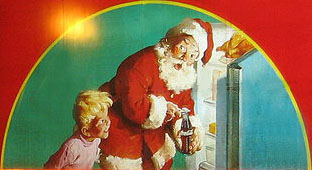
Sundblom solved the problem by recruiting his neighbor, a fat, jolly salesman, to model for him. The result was a magical looking image of a warm and friendly man people the world over began to identify with. For thirty years, Sundblom breathed life into his Santa. He played with toys, relaxed by the fire, and pilfered the Christmas feast from the refrigerator.

Coca-cola_truck_fragment
A jolly Sanata demonstrating for an innocent child that it’s perfectly okay to snag a drink from someone else’s fridge without asking permission. By User:Husky [CC BY-SA 3.0 (http://creativecommons.org/licenses/by-sa/3.0)%5D, via Wikimedia Commons
All this he did with a warm smile and a bottle of Coke. The images captured the imagination of the world, even in nations where “Santa” was more often portrayed as a wiry bishop. The rumor spread that Sundblom and Coca-Cola invented the iconic red and white suit of the American Santa Claus.

But it isn’t exactly true. What they did was standardize Santa as a fat kleptomaniac with a friendly face and a raging Coke addiction. And Christmas has been all the jollier ever since.  

6463743173_00a2eb0804_o
Creeptastic. Seriously. photo credit: Elf on a Shelf Playing with Knives via photopin (license)


My kiddos have outgrown their Santa years, and thankfully we never got into that creeptastic Elf on a Shelf thing. But they appreciate the magic of the legend, and they’ll have a hard time getting to sleep on Christmas Eve. Because our stockings are still hung by the chimney with care, and my boys know St. Nicholas soon will be there.

He’ll be jolly-ish as he assembles surprises late into the night (maybe we could use an elf on our shelf). He’ll drink the Coke left for him on the hearth because he’ll need the caffeine. And before he stumbles bleary-eyed into bed, he might even raid the fridge.

Sparkly, Gluten-free Love, and other Reasons we may not get Valentine’s Day Quite Right

I don’t care much for Valentine’s Day. And it’s not just because I spent two days crafting sparkly paper sharks with working clothespin jaws to hold packages of Goldfish crackers for my children to give to their classmates, only to receive a note home the day before the party reminding parents that treats must be peanut and gluten free and all treat labels must be submitted to the school two weeks in advance.

20150211_183811
Stupid shiny sharks.

I don’t actually have a problem with expressing love with a sweet note or a gift. I think remembering to do that from time to time can be really important in a relationship.

And I know Americans will do our fair share of celebrating. In fact, according to a recent National Retail Federation poll, we plan to spend an average of $133.91 on candy (peanut and gluten free, approved two weeks in advance), cards, and gifts, which translates to about $13.7 billion as a nation. A poll by the American Express Spending and Saving Tracker predicts the total will be closer to $37 billion and that half of American engagements for the entire year will occur on Valentine’s Day.

The whole thing stems from the legend of St. Valentine, a 3rd Century priest who was beheaded by command of Roman Emperor Claudius II. Known as Claudius the Cruel, the emperor had strong military aspirations, but was alarmed to find that his soldiers didn’t always share his enthusiasm. He decided the reason must be that their hearts, and their attentions, were at home with their families. The solution was simple. He banned marriage.

Claudius II, the first man to throw an "I hate Valentine's Day" party. By =*File:5305 - Brescia - S. Giulia - Ritratto di Claudio II il Gotico - Foto Giovanni Dall'Orto, 25 Giu 2011.jpg: Giovanni Dall'Orto.  derivative work: Cristiano64 [Attribution], via Wikimedia Commons
Claudius II, the first man to throw an “I hate Valentine’s Day” party. By Brescia – S. Giulia – Ritratto di Claudio II il Gotico – Foto Giovanni Dall’Orto, 25 Giu 2011.jpg: Giovanni Dall’Orto. derivative work: Cristiano64 [Attribution], via Wikimedia Commons
As you can imagine, this didn’t sit well with the young lovers of Rome, many of whom appealed to St. Valentine to marry them in secret. A sucker for romance, Valentine did marry them. Lots of them. Until Claudius found out and had the priest beheaded on February 14, 270-ish.

Okay, I admit, that’s kind of a cool story of standing up for love in the face of a blood-thirsty emperor. It’s the kind of heroic thing that ought to be commemorated. Of course, if the legend is true, and since there were at least three different saints named Valentine, and it’s not entirely clear which the story is attributed to, let’s just say it’s suspicious, then there’s still the reality that February 14th is the day in which the champion of love was beheaded.

I suppose that by celebrating love on a dark day, we honor the man who died for his belief in it. But when I think about what the legend really suggests, that love and the commitment of marriage and family is worthwhile, I’m not sure we’re celebrating it right.

 photo credit: Pink and orange roses via photopin (license)
I honestly don’t think I can listen to another commercial about how even if I say I don’t want roses for Valentine’s Day, I really do want roses for Valentine’s Day, without wanting to hit someone over the head with that free glass vase.
photo credit: Pink and orange roses via photopin (license)

If we are to believe commercials, sitcoms, and Lifetime movies (and why wouldn’t we?), then Valentine’s Day is an incredibly stressful holiday. If you have a special someone in your life, then we are led to believe that your actions, or inactions, on February 14th will make or break your relationship. If you happen not to have a special someone to send you overpriced roses, then you are required to spend the day horribly depressed. Even my seven-year-old is stressed about the day, concerned that if he gives his Valentine sharks to the little girls in his 2nd grade class, “it might give them false hope.”

I just don’t think all the crazy to-do is what the St. Valentine legend is all about. Instead, I think it’s about recognizing the kind of love that demands commitment and hard work, that requires two people to grow and change together, to consider one another always, and to demonstrate appreciation for one another without prodding from a greeting card commercial.

We are going to be eating these things for a very, very long time.

Now I’m not going to throw an “I Hate Valentine’s Day” party and I certainly don’t fault you if you’re among those who will be spending $133.91 (plus a little more to make up for my considerably smaller contribution). I did spend two days constructing sparkly shark Valentines and I will probably find some small way to acknowledge the day because I own a heart-shaped pan and Valentine’s Day really is the one time each year when I get to use it.

Perhaps I’ll bake a peanut- and gluten-free cake and then my family will know that I love them. Or maybe it will be a heart-shaped, gluten-filled extra gooey chewy brownie with peanut butter frosting.