Writers Have All the Ideas

In May of 1903, a man by the name of William West, recently convicted of some crime or other, arrived at the Federal Correctional Institute in Leavenworth, Kansas for processing. As the records clerk took the new inmate’s precise measurements, he asked him about the man’s prior murder conviction, at point which a genuinely surprised West insisted he had committed no such heinous crime. The records clerk remained unconvinced, presenting West with a file of a convicted murderer named William West that included his precise measurements and a picture identical to himself.

That a convict might lie about his past crimes didn’t surprise the clerk, but what did surprise him was that the William West in the file was still serving his sentence, and so couldn’t be the William West standing in front of him.

It turned out that the two men, later presumed to be identical twins separated at birth, possessed identical characteristics when processed with the Bertillon measurement of physical characteristics in common use in the US prison system. Fortunately, the clerk was delighted to discover that the two men did have one distinguishing characteristic: their fingerprints.

And that is the excellent story of how fingerprinting became an important tool of forensic science in the United States. Of course as with most excellent stories in history, this bears the telltale too perfectly symmetrical marks of being not precisely true. It makes for good fiction.

In reality, there are oily smudges looping, arching, and whorling all over the smooth surfaces of history, dating back at least 4,000 years when Hammurabi sealed contracts with a fingertip. Not much more recently, the Chinese used inked prints as unique signatures on contracts, and as early as 200 BC may have been using hand prints left at crime scenes to help crack burglary cases.

It was in the 17th century that European scholars started describing the unique combinations of patterns on the ends of our fingers. Then in 1892, Sir Francis Galton, cousin to Charles Darwin, and originator of the unsavory study of eugenics, published a helpful classification of the patterns of fingerprints. That led to Sir Edward Henry’s development of a practical system of identification that could be used in law enforcement, which he presented to Scotland Yard.

Of course as impressive as this sounds, Mark Twain solved a crime using fingerprinting in his somewhat embellished memoir Life on the Mississippi in 1883, indicating, I think, that it would behoove scientists to pay closer attention to writers because they have all the ideas.

Scotland Yard adopted Henry’s system in 1901, brought it to the 1904 World’s Fair in St. Louis, and presented it to St. Louis police detectives and the general public, including both the fictional amateur sleuth in my novel set at the World’s Fair, as well as the historical M.W. McClaughry, records clerk at the penitentiary at Leavenworth, Kansas. In September of 1904, fresh from his trip to the fair McClaughry requested that a fingerprinting system be implemented at the prison. It was another one hundred and twenty years before my sleuth put the science to work in my book, Paradise on the Pike.

But even though the story of the two William Wests is somewhat fictional, too, there’s a ring of some truth to it. There were two William Wests at Leavenworth at the same time and they were identical, distinguishable only by their unique fingerprints. They did become a good illustration of the usefulness of the relatively newfangled science of fingerprinting. Still, in reality, the timeline of the story doesn’t quite work out.

When a second William West showed up to be processed, it doesn’t seem that it caused much of a stir at all. It was, however, convenient to have them both there when clerk M.W. McClaughry got excited about this newfangled science that had already been in use in some way for thousands of years. And it sure did make for a good story.

Not Quite History Yet

I’ve been at this Thursday blogging thing for more than a decade now, which makes me feel terribly old. I’ve never figured out how to make money off it, though apparently some people do. I probably couldn’t anyway because I rarely share recipes or include bullet points that offer succinct strategies to improve your health or achieve your financial goals. This blog will rarely  promise you better sleep, space-saving hacks, or hot vacation tips. And I assure you, you will never ever read technology advice in this particular corner of the blogosphere.  

While I do harbor a vague hope that readers who stumble across my blog might be curious enough to buy one of my historical novels, I’m in this space primarily because I enjoy it. I enjoy playing with history and interacting with readers and being kind of silly and occasionally toying with an idea that might just turn out to be a little bit profound and spur some good thinking.

One such book. Excellent historical fiction for a middle schooler. Emotionally tough read for those who remember.

But once in a while, Thursday falls on a day when I’m not sure I have any words to offer. This is one of those Thursdays, because of course, twenty-four years ago today, a moment of national tragedy occurred here in the US and altered the way I think about the world. 

And I still don’t want to write about it. I don’t know if someday I will want to. In the past twenty-four years, several authors have ventured to do so, many in nonfiction formats, but also several now who have chosen to let the sad events of September 11, 2001 be the backdrop for fictional stories.

I’ve read a few such novels, and have appreciated them. Last year when I took some time off of writing and worked in a middle school library, I sometimes recommended them, discussed them, and shelved them—in the historical fiction section of the library.

Yes, we debated whether that was appropriate or not. After all, the Historical Novel Society, which seems as though it should be the authority on the genre, defines historical fiction as a story written at least fifty years after the events described or that has been written by someone who was not alive during the events, and so has approached them only via outside research. Their website does, however, also acknowledge that it’s complicated.

Most of the writers of the stories that bump up against the events of the September 11th terrorist attack in New York were alive when it occurred, and are certainly not fifty years removed from the event. Like me, they probably remember where they were when the news of the planes hitting the twin towers broke, and they shared in the shock of a nation that had been generally pretty lucky throughout its relatively short history not to have experienced too much terror on its own soil.

My adult children have no living memory of this event, but for me it’s still pretty raw. National Park Service, Public domain, via Wikimedia Commons

But the readers in the middle school library have no living memory of that awful day. Their older siblings likely have no living memory of it, either. And so they have no direct emotional connection with which to approach the subject matter. To them, it is just another historical event they learn about in school, like the Kennedy assassination, or the Apollo moon landing, or the attack on Pear Harbor were to me. 

I’m pretty sure I have written in this space, at least tangentially, about all three of those historical events, because even such huge moments in history are fairly easy to plumb for material that’s only vaguely worth writing about—my specialty in this space.

Today, however, is different. It’s a day when ridiculous historical tidbits that might be fun to write about are obscured by this other monstrous moment. And that one moment, at least for me, isn’t quite history yet.

Meet Me at the Fair

On November 22, 1944 after schedule delays, numerous script rewrites, budget woes, and a leading lady still unhappy with her role, a new Christmas musical debuted on the big screen in St. Louis, the city at the film’s heart. 

The song “Meet Me in St. Louis,” well known today because of the musical, is actually from 1904 and was written specifically for the World’s Fair. Public Domain, via Wikimedia Commons

Despite the mess of getting to that moment, Meet Me in St. Louis enjoyed immediate success, becoming Metro-Goldwyn-Mayer’s second highest grossing film up to that point, coming in only behind Gone With the Wind. After the premiere, Judy Garland even decided she liked it after all and commented to the producer, “Remind me not to tell you what kinds of pictures to make.”

The screenplay is based on a series of semi-autobiographical short stories by St. Louis native Sally Benson who wrote of an upper middle-class family that lived at 5135 Kensington Avenue during the construction of the 1904 World’s Fair on the grounds of Forest Park in St. Louis.

I confess, I saw the movie for the first time later in life than I should have, having grown up within easy reach of St. Louis. My childhood summers included trips to downtown to watch the Cardinals play at Busch Stadium where the musical’s title song is still played by the organist at every game and the crowd sings along as the words scroll across the jumbotron. 

I’ve been many times to the wonderful outdoor Muny theater in Forest Park where the stage adaptation of Meet Me in St. Louis, originally produced in 1989, is performed every few years. I even got engaged in that park on the very grounds of the actual 1904 World’s Fair.

I was lucky enough to get a sneak peek at the new exhibit, open to the public on April 27th. It contains a scale model of the entire fairgrounds. And it’s spectacular.

Officially known as the Louisiana Purchase Exposition, the Fair is a big deal in St. Louis history. It transformed the city, launching it for about seven months into the center of the world’s attention. 

And it’s still a big deal, today. One-hundred and twenty years later the World’s Fair looms large in the community memory carried now by not a single living person who was there to see it, sparking excitement whenever it comes up in conversation, which is kind of weirdly a lot.

It’s especially on everyone’s minds right now because at the end of this month, just in time to celebrate the 120th anniversary of the opening of the Fair, the Missouri History Museum will reveal a newly re-imagined permanent World’s Fair exhibit. 

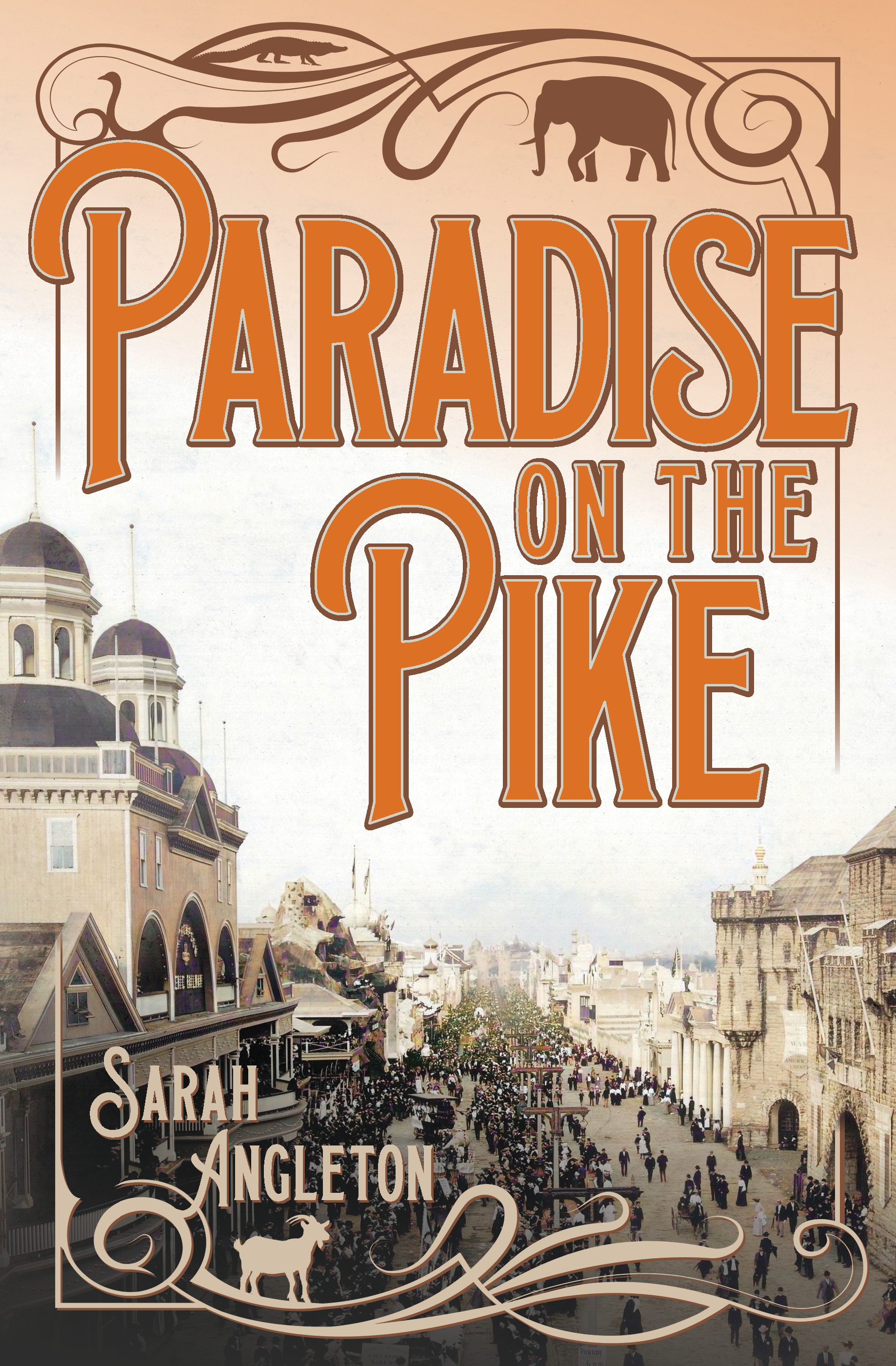
Equally exciting for everyone who either lives in my house or happens to be my mother, is the release of my new historical mystery set on the grounds of the 1904 World’s Fair in St. Louis. 

Paradise on the Pike is available for the first time today. The story takes place in the enchanting world of Hagenbeck’s Zoological Paradise and Trained Animal Circus on the Pike, which is the entertainment strip within the Fair. It’s not a light, sentimental sort of story like Sally Benson’s, but it does contain elephants and lions and a pair of cantankerous goats. It also allowed me, and will hopefully allow you, to spend some time strolling through the Fair, which was almost entirely constructed of temporary buildings meant to disappear.

Available today! Order from your favorite independent bookstore or slightly bigger bookstore or Amazon.

And maybe that’s why, one hundred and twenty years later, it still takes up space in our imaginations, because we’re a little like six-year-old Tootie at the end of Benson’s stories when the family marvels over the lights and fountains on the fairgrounds and her sister Agnes asks if it’ll ever be torn down.

Tootie emphatically replies, “They’ll never tear it down. It will be like this forever.”

Agnes, relieved, exclaims, “I can’t believe it. Right here where we live. Right here in St. Louis.”

Forest Park retains very few physical reminders of the enormous event that once filled its every corner and held the attention of the world, but in the hearts of the St. Louisans who stroll through the grounds and wish they could have seen those lights shining, it will never be torn down. It’ll be like this forever.

You can find more information about Paradise on the Pike at this link.

Seven More Years of Wrinkles and Gray Hair

Today marks exactly four weeks until my fifth book launches into the world. It’s been nearly seven years since I published my first, a collection developed from the first five years of this blog. That book, called Launching Sheep & Other Stories from the Intersection of History and Nonsense, is part history, part memoir, and a good part made-up silliness. The cover features a picture of me in period costume.

This picture has served me well, but it’s time to age up a little bit. Image by KarenAndersonDesigns

That was my first professional author photograph. My second was taken not long after in preparation for the release of my first novel, which happened about five months later. That one is a tad bit more professional and includes much less ridiculous clothing. I’m smiling, but not too much. I look like an approachable but also knowledgeable and literary lady in her thirties.

Most of those things, I hope I am. One of them, I definitely am not. And that’s why I recently had some new photos taken. Having portraits taken is uncomfortable for me. I don’t exactly run from the camera, but as a typical mom and keeper of memories, I am more often behind the lens than in front of it.

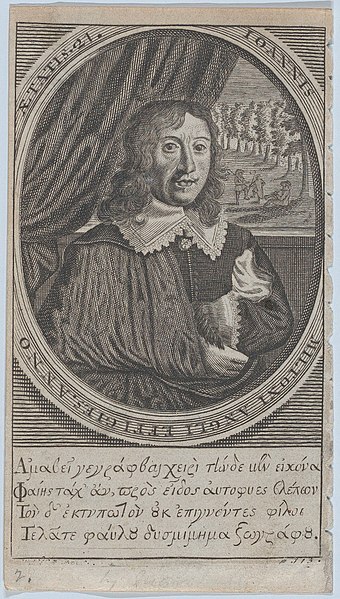
But I’ve earned nearly seven more years of wrinkles and gray hair since the last set of head shots, and readers have been expecting author portraits since the papyrus scrolls of Ancient Egypt. I couldn’t avoid them any more than John Milton could have when his printer Humphrey Moseley insisted the poet include one with his first collection of poems in 1645.

Maybe not the most flattering portrait ever. William Marshall, Public Domain, via Wikimedia Commons

Milton enlisted the help of renowned engraver William Marshall to create a frontispiece including an author portrait. At the time, Milton was thirty-seven years old, but the standard of the day was to include a picture of the poet at a younger age. Alas, that is no longer the standard.

According to the words engraved around the portrait, William aimed to depict Milton at the age of twenty-one. According to the overly large nose, greasy hair, puckered lips, and swollen right eye of the portrait, he missed.

The picture was so unflattering and Milton so upset about it, that the poet asked the engraver to include the following lines in Greek (a language that Marshall allegedly could not read) beneath the portrait:

“Looking at the form of the original, you could say, perhaps that his likeness has been drawn by a rank beginner; but, my friends, since you do not recognize what is pictured here, have a chuckle at a caricature by a good-for-nothing artist.”

An approachable, knowledgeable, literary lady with seven more years of wrinkles and gray hair, looking pretty darn okay. Image by Karen Anderson Designs.

When the collection was updated in 1673, the portrait was no longer included, but Milton, apparently still bitter about the worst head shot ever, moved his added poetic words to the interior of the book and slapped a title on them: “On the Engraver of his Portrait.”

Fortunately, my good friend and photographer is much more pleasant to work with than William Marshall apparently was. She doesn’t bat an eye when I ask her to photograph me in period costume holding a laptop, or to meet me in Forest Park in St. Louis so we can get a hint of the 1904 World’s Fair into the pictures.

She makes it as easy as possible for an awkward, squinty-eyed person such as myself to look pretty darn okay. I can trust that she’d never make my nose appear too large, my eye swollen, or my hair extra greasy. She’d probably even digitally remove my wrinkles and gray hair if I asked her to, but I didn’t. And she can trust that I’ll never include an insulting poem about her work in my book.

Challenge Accepted

There’s a rumor running around out there on the Internet where, as everyone knows, all things are true, that William Shakespeare invented more than 1,700 words of the English language. If one considers that the Modern English of Shakespeare’s day was a fairly young language, then it makes sense that new words might have been developing pretty fast. And if you’ve ever met a writer, and particularly a poet, then you’ve probably noticed that they do occasionally invent new words or more likely, new uses of old ones. There’s no question Shakespeare did his fair share of that.

Challenge accepted.

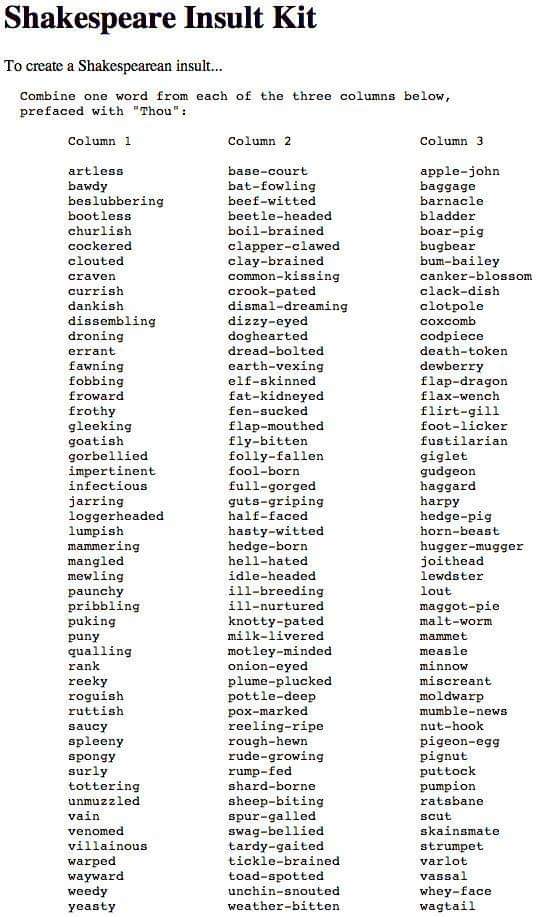
Also roaming around on the Internet lately is a fun challenge in which three columns of insulting Shakespearean words can be combined to come up with a single devastating slight to use in your next piece of writing. Most recently posted by The Writer’s Circle, this was issued as a challenge to me by a friend who knows I’m a writer who likes a good challenge as much as a like a good old timey insult.

Of course I’m only assuming these columns of words show up somewhere among the nearly 29,000 unique words spread across Shakespeare’s forty three surviving works. There are no citations, and I’m not going to take the time to search for them, because regardless of their origin, they make up some pretty fantastic insults.

Still, it’s worth noting I think that if Shakespeare invented 1,700 new words, that means his works contained roughly 6% unique words that would have been entirely unfamiliar to his audience.

Now, because I enjoy a challenge, I certainly don’t mind reading a work that is going to make me pick up a dictionary once in a while, but if I have to look up 6% of the unique words I encounter, I’m going to find myself pretty quickly frustrated by the beslubbering hasty-witted joithead who wrote them.

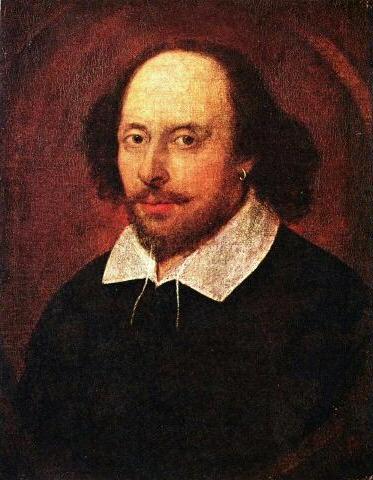
There’s no doubt in my mind that a brilliant insult is forming behind those eyes. Attributed to John Taylor, Public domain, via Wikimedia Commons

It’s worse than that, too, because the first English-language dictionary wasn’t put together until more than a century after the saucy doghearted coxcomb of a poet William Shakespeare produced his venerated works.

The Oxford English Dictionary, which provides the written origin of English words, wasn’t even attempted until the second half of the nineteenth century and wasn’t completed until 1928. This thanks to somewhere around three thousand contributors who meticulously hunted through centuries of English language works to determine that 1,700 words or so probably came from the mind of that one old English playwright/poet that everyone had actually heard of.

In other words, the editors and contributors of the OED, while dedicated and deserving of our respect and thanks, may have occasionally been loggerheaded tickle-brained foot-lickers when it came to Shakespeare. Arizona State University English professor Jonathan Hope has been particularly effective in pointing out that OED contributors had more access to and read more carefully from Shakespeare’s works than from those of other writers who now in the digital age, we can more easily discover used quite a few of The Bard’s newfangled words before he did.

Just eleven more weeks until the release of my new historical mystery! I can’t share the cover just yet, but this picture gives a hint about the book, which contains no Shakespearean insults and probably very few made up words.
Photo by Winfred C. Porter, Public domain, via Wikimedia Commons

I don’t think that discovery necessarily takes anything away from Shakespeare’s works or his influence on English literature and language. In reality, I think it makes him better, because he wasn’t asking his dictionary-deficient audience to puzzle out what he was trying to say. That joy he reserved for the mewling folly-fallen gudgeons in future high school classrooms.

To the audience of his day, and to those who care to notice today, what he did was use words well. And while he probably didn’t use most of the words in this handy kit in quite the same combinations I’ve attempted to use them in this post, there’s no question the man knew his way around an insult.

And now I challenge you to use one in the comments.

0p3N SE$@me!

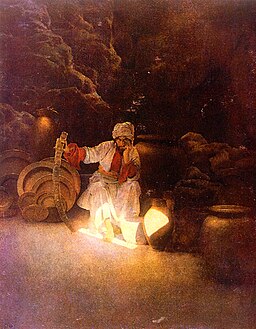
Once upon a time in a Persian town, there were two brothers. One was a much better hacker than the other. The first brother stumbled on a password, carelessly scribbled on a sticky note and stuck to the underside of a keyboard. Thus he was able to open a secret door, sneak into a cave filled with stolen treasure, and take a pouch of coins, small enough not to be noticed. 

If I’m honest, I relate to the second brother. Not that I would steal gold from someone’s cave, but if my life depended on my recall of a password, I’d be in trouble. Maxfield Parrish, Public domain, via Wikimedia Commons

The second brother, learning of this success, decided he’d go a little bigger, hacked his way into the cave, loaded himself and a bunch of mules down with enough treasure that it would most certainly be missed, and then promptly forgot the password to get back out of the cave. Then the thieves who’d stolen the treasure to begin with, returned to the cave and did a little hacking of their own.

It’s a familiar story of course, added to the collection of Middle Eastern tales One Thousand and One Nights in the eighteenth century by French translator Antoine Galland who heard the tale from Syrian storyteller Hanna Diyab. It also feels a little bit like the story of my life. 

I don’t mean the part about the hacking. Rest assured, I have no skills whatsoever in that area. Most of the time I can’t even remember my own passwords. I have zero brainspace left over for yours, even if I overhear you loudly proclaim them at the hidden door leading to your treasure trove.

In fact, were you to leave your password written down on a sticky note underneath your keyboard, your biggest concern should be that I would mistype it enough times that I’d accidentally lock you out of your cave. And if I ever ask you the name of your first pet, I assure you, I’m just curious. Also, I’ll probably forget that, too.

Can’t be too careful.
Image by S K from Pixabay

Like most of us I have a pretty contentious relationship with passwords. I recognize they are necessary. So much of our lives are stored digitally now and it is certainly important to safeguard our privacy and our treasure from unscrupulous people with enough skills and mules to try to steal it. 

But I also feel like it’s a little much. For example, why exactly do I need a password to protect my popcorn rewards at my local movie theater? Are there a lot of hackers who are anxious to steal my $2 off coupon? And do I care enough to dedicate already pretty crowded memory space to a unique password made up of a minimum of ten characters that must include both upper and lower case letters, a number, a symbol, a sign of the zodiac, a knock-knock joke, and a blood sacrifice? 

Also, it’s February 1, which means there are approximately 12 weeks to go before the launch of my new historical mystery. Cover reveal coming soon!

The experts, who I assume in some cases are the hackers themselves, say the era of passwords may be coming to an end anyway. In the coming decades the whole system may be replaced entirely by biometrics. As often as the fingerprint scanner on my phone fails and I have to either put in a password or wait thirty seconds and try again to see if my thirty-second-older fingerprint works any better, I’m not yet convinced that will be a huge improvement.

But in the meantime, we will just have to hustle to stay a step ahead of the hackers with our wily strings of ever-changing mixed-up characters. To aid in that effort, I am reminding you that today, February 1, is apparently Change Your Password Day. I suspect that, like me, you have too many passwords floating around in your head to remember such a thing. So, you know, take a little time today to change up your one thousand and one passwords and be proactive in protecting your vital information. And your popcorn coupons.

Chapters Eight

In 1955, responding to a Life magazine article that explored the problem of underachievement in American children’s literacy rates and a book published soon after titled Why Johnny Can’t Read, then Houghton Mifflin education director William Spaulding reached out to an old friend with a challenge.

Theodore Geisel thought it would take him at most a month or two to use a provided list of 348 words every six-year-old should know, whittle it down to about 225 words, and shape them into a story that, at Spaulding’s insistence, “first graders can’t put down.”

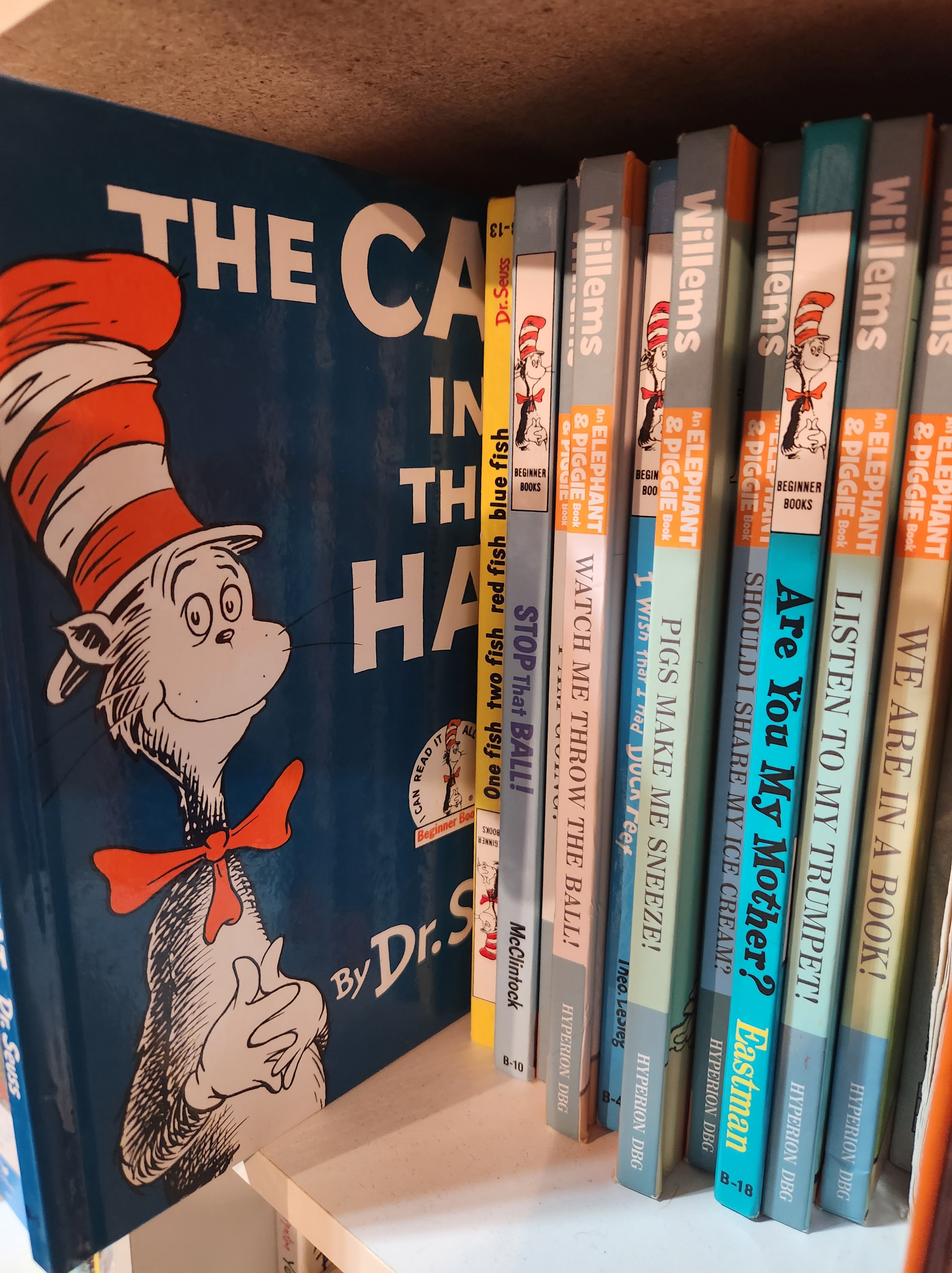
It’s been a few years since our household has contained a first grader, but this is still in the collection because you never know when one might pop by for a visit.

It turned out to be a much taller order than the beloved Dr. Seuss, who was accustomed to making up silly words when he couldn’t find a rhyme, first assumed. At one point, he claimed he looked at the list and determined that the first two rhyming nouns he found would be the subject of his book. When he put a striped hat on a naughty cat, children’s literature was changed forever. He ended up using 236 unique words to write his The Cat in the Hat. It took him a year-and-a-half to do it.

I can sort of relate. I’m in the middle of a second draft of what I hope will someday be my fourth historical novel. That is, by the way, the best of my many excuses for not being super consistent on my blog lately. Also travel and the chaos of summer and life in general, but mostly it’s the novel thing. I’m fairly certain the novel won’t delight many first graders, but I would like to think it may someday be a book readers won’t be able to put down.

It’s a long way from that right now. A good portion of the book is still in that terrible rough draft stage in which the plot contains holes, the research has thin patches, the word choices are sloppy, the pacing is erratic, and the irresponsible characters are largely calling the shots. At this stage, I’m still hoping someone who loves me would have the good sense to destroy it if anything should happen to me before I’ve had a chance to clean it up.

Slowly but surely, I am working my way through the second draft. This is when I consider the rhythm of the story. I might move things around a little, adjust the pacing, fill in some background information, answer a few more targeted research questions, rein in those rambunctious characters, and start to play more intentionally with language. And like Dr. Seuss writing The Cat in the Hat, I’m finding that the whole thing is taking a lot longer than I thought it would.

Fortunately, I have not been tasked with changing the face of children’s literature and the landscape of early literacy education, but I do have approximately one million words in the English language I can choose from. I will not be trying to figure out how many unique ones I end up using, but my goal is somewhere in the neighborhood of 90,000 words or so, which does require some whittling.

For right now, most of that whittling needs to happen in chapter eight, which is where the pacing of this story really went off the rails. I must have been on a roll when I got to that part of the rough draft because I threw everything in there, including something like a quarter of the book’s major plot points.

It’s a monstrous hot mess that will eventually become at least five chapters, if not more, in the second draft. The problem is that it’s hard to convince myself I’m making much progress when, after days and days, I’m still trying to shape chapter 8d.

I’ll get there. Eventually. In the meantime, it does help to recognize that while I’m struggling with a process that is taking longer than I expected, the Greats have struggled with this, too. It also helps that even though my ninety-ish thousand words probably shouldn’t be made up, very few of them have to rhyme.

Really Uncomfortable Shoes

A couple of weeks ago I got a text in the middle of the day from my oldest son, currently a senior in high school. This occurred during his lunch break and it isn’t particularly unusual for me to get a text from either of my children, typically regarding after school plans, or asking me to refill a lunch account, or wash a uniform, or whatever. On the days I stay home to write, I am happy to do these things. But this particular text was a little unusual because it said “Blog topic: Cinderella’s fur slippers.”

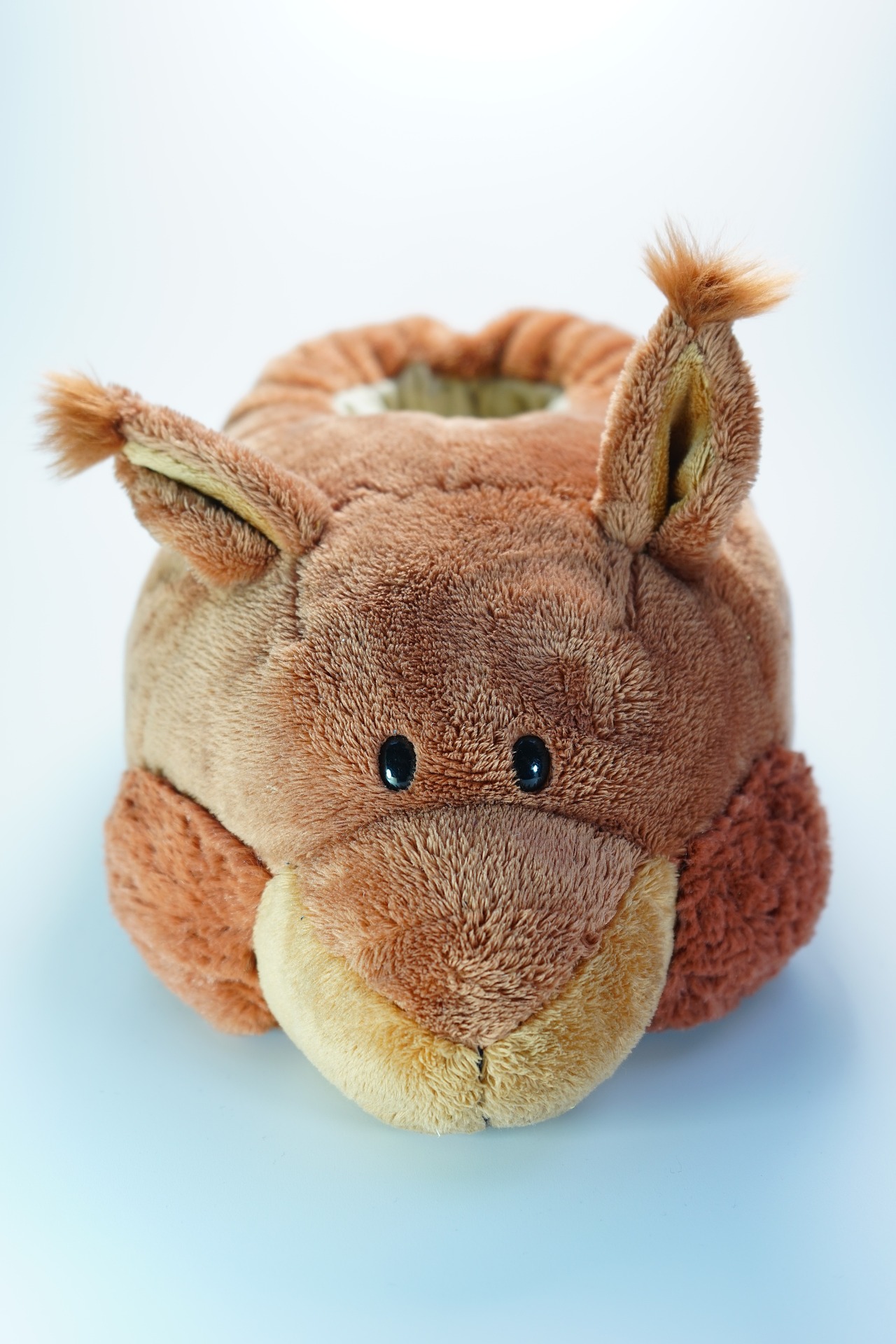
Admittedly this might look a little strange with a ballgown, but it would be more comfortable than glass. Image by Hans from Pixabay

It was a special moment for me for a couple of reasons. 1. My teenage son, who doesn’t particularly pay attention to my blog or anything about me really because he’s a teenager and I am his mom and I suppose that is developmentally appropriate, discovered something quirky and weird and thought of me. 2. He thought of me not only because I post about quirky and weird things (as a blogger buddy recently suggested), but also because he remembered how much I absolutely love the story of Cinderella.

Actually, it’s not so much that I love the story itself, which has been around in some form since Ancient Egypt. It’s also been expressed in almost more cultures than folklorists dare count. But I do love the cartoon Disney movie version.

I am by no means the kind of Disney-obsessed woman one would expect to have a favorite princess, but I do in fact have a favorite, and it’s Cinderella. The reason for this is simple. Originally released in 1950, quite a few years before I was born, the film was re-released to movie theaters in 1987, when I saw it on a special day out with my dad.

My parents were always good about that when I was young, setting aside times when each of their four children could occasionally be the center of attention. Times like that with my dad make for precious memories, and this one includes funny singing mice, a magical pumpkin carriage, and glass slippers.

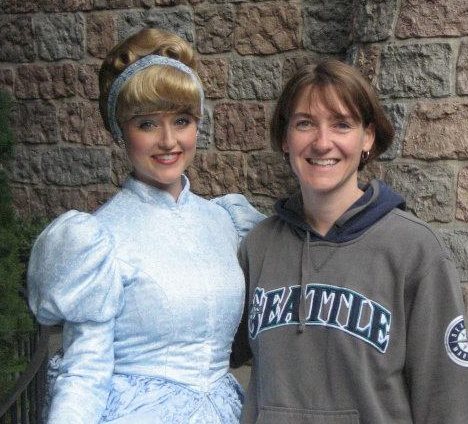
When my family and I went to Disneyland many years ago, I stood in exactly one character line. My husband and then very young sons were remarkably patient.

But not fur slippers. My curiosity was piqued. I asked my son some follow-up questions. His time was limited and I didn’t get much back from him, so I did a little digging on my own. What I discovered was that in 1841, French writer Honoré de Balzac, whose funny name scandalized the ladies of River City in The Music Man 116 years later, suggested there’d been a silly mistake made when the French version of the story was originally published in 1697.

Charles Perrault had taken the story from oral tradition and his version went on to become the primary influence of the Disney movie that is so well known. When he wrote it, however, according to Balzac, Perrault mistook an old French word vair which refers to squirrel fur and wrote it as the word verre, which means glass. Cinderella, then, might not have ended up with quite as many blisters from her dance shoes.

Balzac’s suggestion became a favorite tidbit of folklore gossip because most of us would rather dance in fuzzy slippers than in glass heels. It makes a lot more sense, and it is just the kind of quirky and weird historical mix-up I like to blog about.

Less comfortable than a fuzzy slipper, but much prettier. Image by Sarah Penney from Pixabay

But it turns out Balzac not only had a funny name, but he was also probably wrong about Cinderella and her famous footwear. Over the many centuries the story has existed, Cinderella, who has had lots of different names, has also had lots of different kinds of shoes. Some are silk and jeweled, some are intricately embroidered, or made of gold or silver, but none seem to ever be made of fur.

And while not every version of the story contains a great deal of magic, Perrault’s does. I tend to think that an author who chooses to include a fairy godmother, pumpkin coach, and mice that turn into horses probably wouldn’t hesitate to place his heroine in uncomfortable shoes just to make the story a little more magical.

Magic really is the reason I love it so much in the first place. I love the singing bubbles and the sewing mice and the fairy godmother. I love the memory of a magical day spent with my dad. And if I can believe that a teenage boy would take time out of his busy day to text his mom about the cool little historical Cinderella rumor he just heard, then I can believe my favorite princess wore really uncomfortable shoes.

Just the Worst: A Celebration of Banned Book Week

In 1637, English lawyer and colonist Thomas Morton, founder of the Merrymount colony that eventually became Quincy, Massachusetts, published a book that was not very complimentary of his Puritan neighbors.

According to Morton, who had been pretty successful in establishing trade and good relations with the Native Americans in the vicinity of his colony, the Puritans were generally unfair, dishonest, abusive, and hateful. He also had some unflattering nicknames for them.

Amsterdam: Jacob Frederick Stam, publisher, Public domain, via Wikimedia Commons

Prior to writing his book, Morton had attempted to expel the Puritans from Massachusetts with a lawsuit that rested on their alleged misrepresentation of their purpose for establishing a colony in the first place. They’d done so in a different location than originally planned as well, and in a location to which someone else technically held the rights. He won the suit.

The lawsuit had come on the tail of a particularly nasty encounter between Morton and his neighbors.  Despite his own traditional Anglican beliefs, Morton engaged in his fair share of passive aggressive paganistic behavior of the variety that would drive a Puritan mad. When he erected an eighty-foot-tall maypole and invited his Algonquin friends over for a raging kegger, the highly offended Puritans arrested him, cut down his maypole, burned down his colony, and left him to die stranded on a rocky, coastal island.

Fortunately, Morton had managed to make himself some friends by throwing the best parties and, you know, not slaughtering them, and so he survived the ordeal. If the legal decision that revoked the Massachusetts Bay Colony charter had been enforced, that might have been the end of it, but it wasn’t. And so, Morton wrote his offensive book.

New English Canaan, which today is considered a historically significant literary work of the American colonial period, consists of three parts. The first is a primarily positive view of Native American customs. The second is an account of the natural history of Massachusetts. And the third is a satirical look at why Puritans are just the worst.

Image by Pretty Sleepy Art from Pixabay

The book was originally published in the Netherlands, where anti-English books of the day tended to be published. Not all that surprisingly, most of the copies were initially seized and destroyed by the English government. The few copies that managed to circulate were quickly condemned and banned by the Puritans, making New English Canaan the first banned book in America.  

Today there are just sixteen original copies of Morton’s book in existence, though it has been republished with plenty of scholarly criticism and is freely available on the internet. I haven’t read it, but honestly, the mere fact that it was banned makes me kind of want to pick it up.

I might just do so, in honor of Banned Book Week. The annual event is celebrated this week by the American Library Association and by intelligent, thoughtful people everywhere who are not the busy-body mom crusaders across the nation that have for some reason decided they are responsible for monitoring the reading material of everyone else’s children.  

Carol M. Highsmith, Public domain, via Wikimedia Commons

I feel compelled, too, as long as I am standing up here on my soapbox, to state that such people shout on each side of the political aisle, as is evidenced by the practice of revenge banning being attempted at a truly alarming rate.

At this point I am so frustrated by the book banners I, probably unfairly, assume that if given the chance they would cut down a maypole, burn down a school, and banish all the librarians to die alone on a rocky, coastal island. All in the noble name of keeping children safe from just the kind of intellectual stimulation and freedom of thought that could help them to develop into critical thinkers. Just the worst.

Thank heavens for the majority of parents who recognize that censorship belongs in their private homes and families, along with their noses. Thank heavens, too, for the librarians who, too often without support from their district administrators, are standing up for the freedom to read. And shame on the politicians who are not.

Happy Banned Book Week to all!

A Conflict Among the Stars

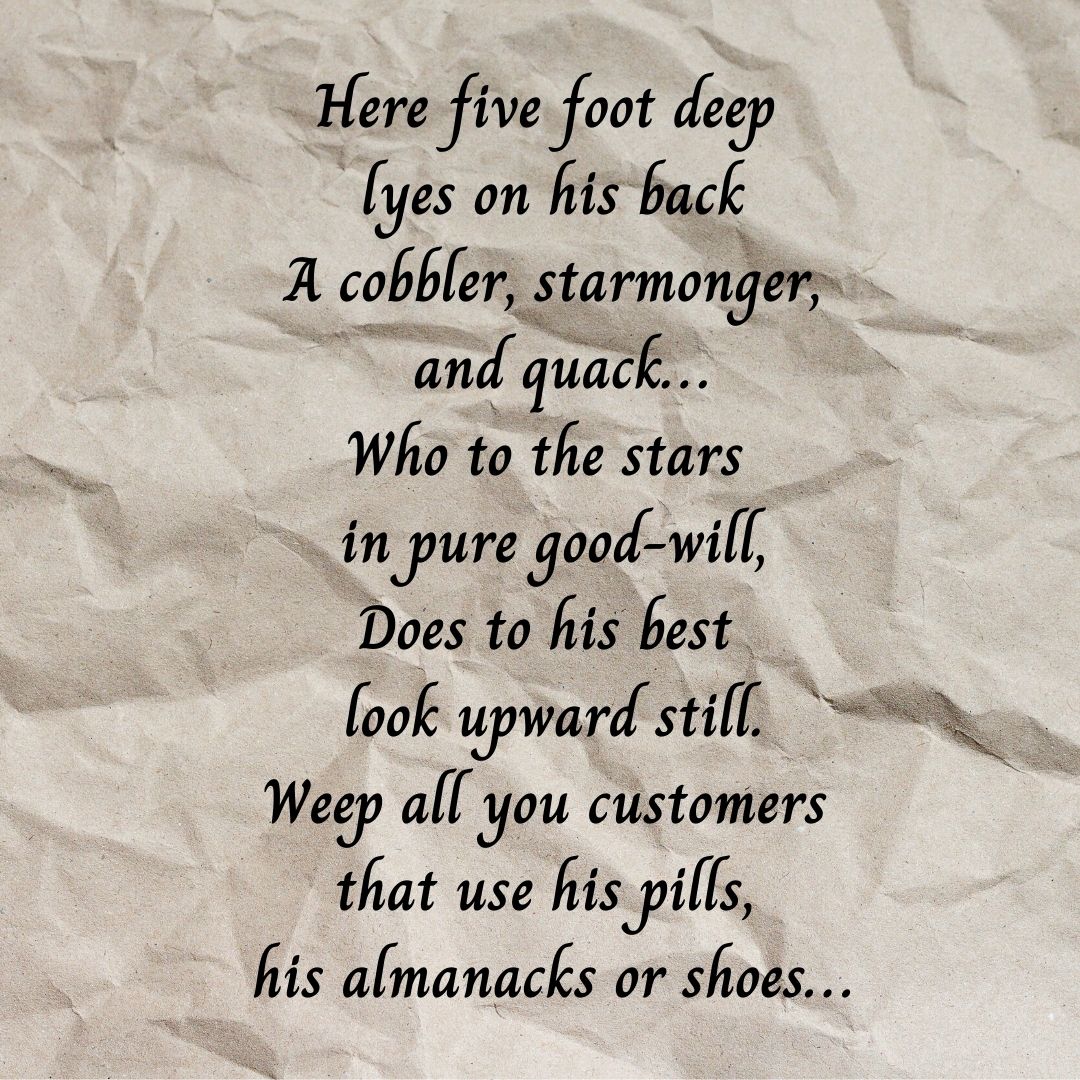
Three hundred fourteen years ago today on March 31, 1708, well-known astrologist, physician, and former shoemaker John Partridge died right on schedule. The prediction of his “infallible death” had been published earlier that year in a letter written by a man called Isaac Bickerstaff, who then at the prescribed date, also published a clever rhyming eulogy.

Turns out the pen really is mightier than the slap.

No one was more surprised by the timely demise of Partridge than the man himself who returned home from a trip shortly after the report to discover that even those he knew well had heard and were so convinced by the news that he had a hard time persuading them that he was, in fact, still alive. When he wrote an article explaining that he had not died, Bickerstaff quickly answered with an admonition for the rogue that would write so insensitively of the dead.

As mean-spirited as Bickerstaff’s pronouncement might have been, from one perspective, Partridge may have earned it. He was a self-proclaimed reformer of astrology who published an annual almanac in which he regularly and erroneously predicted the deaths of renowned individuals. He was also somewhat outspoken against the Church and in his 1708 almanac had referred satirically to it as the “infallible Church.”

Partridge, who lived another six or seven years after Swift’s pen killed him off, and whose precise date of death is unknown, which might also be Swift’s fault. He’d probably have preferred a public slap. See page for author, CC BY 4.0 https://creativecommons.org/
licenses/by/4.0, via Wikimedia Commons

The barb settled uncomfortably on Isaac Bickerstaff, which was a pseudonym of the highly offended writer, satirist, astrology skeptic, and Anglican cleric Jonathan Swift. In the moment, Swift decided against charging the stage and slapping the spit out of Partridge and instead chose to give the man a taste of his own medicine by predicting his death.

Swift’s revenge was definitely effective. After the news spread that the prediction had been spot on, Partridge coincidentally also found himself in a dispute with his publisher that led to the discontinuation of his almanac for a few years. When he finally did attempt to re-emerge, he found his reputation damaged beyond repair. Some astrology enthusiasts even suggest that it was this prank of Swift’s that led to a general discrediting of the entire field that lasted through the eighteenth and into the nineteenth centuries.

So, maybe the satirist who once modestly proposed that the most sensible solution to Irish poverty was to eat babies, pushed it a little too far this time. Comedy can, after all, be a hit or miss, depending on context and perspective and perhaps whether or not one’s spouse has a penchant for the dramatic and a mean right slap.