Christopher Columbus, famed explorer who kind of resembles Fozzie Bear. Licensed under Public Domain via Wikimedia Commons
On September 18, 1502, on his fourth and final voyage to the New World (which he still stubbornly insisted was Asia, because by then he was becoming a little floopy) Christopher Columbus arrived in what would come to be known as Costa Rica. I say “arrived” because “discovered” is certainly the wrong word, as he was warmly greeted by canoes full of Carib Indians, representing one of four indigenous tribes living in the area at the time.
In fact, archaeologists have uncovered evidence of human occupation in Costa Rica dating back at least 10,000 years. A large variety of tools, weapons, metal work, and even remnants of an ancient city complete with aqueducts indicate that many cultures may have come, gone, and coexisted through the area.
This tree frog from Costa Rica resembles Kermit the Frog when the pollen count is really high. By Tim Ross (Own work) [Public domain], via Wikimedia CommonsBut its rich history of human diversity isn’t all that makes the country so fascinating, because representing just one third of one percent of Earth’s landmass, Costa Rica contains approximately four percent of the species that exist on the entire planet. It boasts the highest density of biodiversity of any country in the world, with hundreds of species that, outside of captivity, can only be found there.
And Costa Rica is home to somewhere in the neighborhood of 175 species of amphibians. Eighty-five percent of those are frogs. It’s got the poison dart frogs, the famous red-eyed tree frog, the giant toad, and the rainforest rocket frog, which at a length of about half and inch is not the smallest frog in the world, but it does have the coolest name.
And now there’s one more frog in Costa Rica, because recently researcher Brian Kubicki found a previously undiscovered glass frog he named Hyalinobatrachium dianae. Like in so much of the world, Costa Rican species are being stressed by rapid environmental change and the country has already lost many frog species to extinction. So to discover a new one is pretty exciting.
Especially when the Internet decides that new species looks like Kermit the Frog. And it does, kind of, at least in the same way that if you put a domestic pig in a blonde wig and taught it karate, it would totally resemble Miss Piggy.
The new frog does have similar coloring to Kermit, except on its belly where its skin is nearly transparent so you can see all of its internal organs. It also has big white eyes that bug out of its head, and like its Muppet counterpart, H. dianae plays the banjo and harbors a not-so-secret wish to make it big in showbiz.
So the only real question remaining is what is Kermit the Frog doing in Costa Rica? Because as everyone who has seen the straight-to-video classic Kermit’s Swamp Years knows (and judging by the reviews that could be as many as a dozen people or more), Kermit is originally from the swamps of the Deep South, not Costa Rica.
The answer to the question may lie in the years he spent as a hard-hitting investigative journalist at Sesame Street News. As something of a hard-hitting investigative journalist myself, I have uncovered footage from Kermit’s past that may explain the link between the famous Muppet and this new little glass frog now taking the Internet by storm, a link drawn straight through the famous explorer Christopher Columbus who accidentally stumbled onto Costa Rica so many years ago. Enjoy!
John Calvin, the father of Presbyterianism, and maybe sometimes kind of a controlling jerk.
In the summer of 1536, a young philosopher and theologian named John Calvin, having recently gotten himself into trouble in his native Catholic France by writing about his unique brand of Protestantism, arrived at an inn in Geneva, Switzerland. While there he was approached by a local church leader who begged him to remain in Geneva to help him organize the new Protestant church there.
Suspecting that it may have been predetermined by God that he do so, Calvin agreed and spent much of the remainder of his life (after being thrown out of Geneva for a few years because he kind of acted like a controlling jerk) preaching and teaching, setting in place a theocratic system of pastors, doctors, elders, and deacons, each dedicated to over-seeing different aspects of running Calvin’s idea of a perfect society.
He was remarkably influential, his ideas in some respects giving rise to capitalism, individualism, and democracy. Still, today, we’d probably call him a controlling jerk, and so did many of his contemporaries. Loudly. Sometimes over the sound of his preaching, and for many years after.
The English philosopher Tomas Hobbes, writing in his controversial Leviathan nearly 100 years after Calvin’s death, was critical of the Presbyterian political design. Sometimes considered the father of modern political philosophy, Hobbes was pretty sure that not only had Calvin been a jerk, but that so were all the bishops ruling within the Church, and, well, basically everyone else, too.
Thomas Hobbes, father of modern political philosophy, and pretty sure you’re kind of a jerk.
Hobbes promoted the idea that humans were little more than machines, designed to act only in the interest of the self and this informed his political views. His words were influential, often as a starting point for debates by more reasonable philosophers, who mostly thought Hobbes was kind of a pessimistic jerk.
But about three hundred years after his death, and more than four hundred years after the death of John Calvin, both men were honored in the personalities of two of the most beloved philosophers of modern times, when the world was introduced on November 18, 1985, to a six-year-old boy with spiky yellow hair and a stuffed tiger, who was the best friend a kid could have.
Bill Watterson, the creator of Calvin & Hobbes, explained in his 1995 book celebrating the tenth anniversary of the comic strip, that he’d chosen the names from these two historical men. He doesn’t offer a great deal of explanation as to why, only that Hobbes the tiger seems to express a certain mistrust of human nature that shows up from time to time as his apparent pride in not being human himself. Calvin, Watterson claims, is based more or less on his adult self, as he grapples with big questions through the metaphor of tenacious, bratty childhood.
Though the strip ended in 1995 and Bill Watterson makes it a point to remain private and with very few exceptions, irritatingly aloof, the characters of Calvin and Hobbes have remained in the public consciousness, because between the laughs, the strips are really about friendship, imagination, and growing up. In the midst of funny childish games, Calvin and Hobbes speak to certain human truths.
My seven-year-old philosopher’s last birthday cake, on which Calvin & Hobbes look a little bit like jerks.
Right now, in my home, the largest truth they speak to is that a little boy with spiky yellow hair and a wild imagination really can provide profound wisdom disguised as disarming charm, sometimes without even knowing it.
My youngest son, a spiky-yellow-haired seven-year-old philosopher, is a huge fan of Calvin & Hobbes. He spends hours poring over the various collection books and I think he knows every strip by heart, turning over each one in his mind, sharpening his already impressive wit and gleaning some very useful advice. The day he marched into the kitchen and asked me for a chainsaw, and in lieu of that, a cookie, I knew I was in trouble.
He stood there with his clever grin, assured of his predetermined success. Tucked under his arm was his constant companion, a small stuffed rabbit named Bunny (because my son, though wickedly clever, can’t name many 17th-century philosophers). I suspected Bunny might be the real mastermind behind the great cookie plot; that she somehow played on my son’s greedy human nature and put him up to it. That would be just like her. As thoughtful and devoted as she is, sometimes she’s kind of a jerk.
I gave him the cookie.
My son’s “Hobbes,” a stuffed bunny he appropriately named “Bunny.” Sure, she looks all innocent sitting on the couch waiting for him to come home from school, but don’t be fooled. The second he comes through that door, she’ll pounce. Because sometimes, she can be a real jerk.
In 1933, renowned spiritual medium Eileen Garrett entered the parapsychology laboratory at Duke University where she met with botanist turned clinical parapsychologist J.B. Rhine to participate in his quantitative study of extrasensory perception (ESP).
Rhine brought out a deck of cards, specifically designed with his partner Karl Zener for the experiments. Each of the Zener cards contained one of five simple shapes. Ms. Garrett simply had to identify, without seeing the shape on the card, which one Rhine presented her with. The assumption was that an accuracy rate more than 20% would indicate ESP.
Zener Cards, used to test for ESP [Public domain], via Wikimedia CommonsA few years prior, Rhine had gleefully exposed medium Mina Crandon as a fraud, so no one was more surprised than he when Garratt did identify the correct shapes more than 20% of the time. The medium herself, however, was not pleased with the results, claiming that she would have performed better had the cards not lacked a certain psychic energy.
She would have been better off graciously accepting her results because later testing by other researchers failed to find any ability to correctly identify the cards above that of normal chance. Actually Rhine’s methods attracted a lot of criticism, particularly claims that he inadvertently cued his subjects to the proper shapes on the cards. His results were never verifiable in subsequent tests.
But still, Rhine is credited with coining the term “parapsychology” and with being the first to honestly attempt to study it quantitatively. He continued his research at Duke until the university discontinued its support in the early 1960s and he founded the Journal of Parapsychology, the Institute of Parapsychology, and the Parapsychological Association. There’s no question he made himself into the foremost expert in his field, the guy you would call with all of your parapsychological concerns.
And in 1984, his dedication to his field of study brought him a great honor. In one of the opening scenes of Ghostbusters, Dr. Peter Venkman, played by Bill Murray, uses Rhine’s Zener card methodology to test two students for ESP, torturing a young male student who fares at least as well as Garratt did, and hitting on a pretty young lady who always seems to guess correctly even though she doesn’t.
Hook and Ladder Company No. 8. NO FIRES! and NO GHOSTS! “Ghostbusters Firehouse 2 (2007)” by Daniel SCHNERF – Own work. Licensed under Creative Commons Attribution-Share Alike 3.0-2.5-2.0-1.0 via Wikimedia Commons – http://commons.wikimedia.org/wiki/File:Ghostbusters_Firehouse_2_(2007).jpg#mediaviewer/File:Ghostbusters_Firehouse_2_(2007).jpg
Like Rhine, Venkman faces the end of his university funding with grace and increased dedication to his chosen field of study. Rather than wallow in his misfortune, he and his associates move into an old firehouse and establish themselves as the guys you’re gonna call with all of your parapsychological concerns.
Perhaps you think it is a stretch to call this small nod to Rhine a great honor, and, well, of course you’re right. Because it would admittedly be a stretch to call Ghostbusters one of the great cinematic achievements of all time. Or of the 1980s. Or of 1984.
But even if it doesn’t hold up all that well, I was a child in the 1980s and Ghostbusters was surely the closest thing to a scary movie my parents ever let me watch. Because of that, it has formed an important part of my childhood. And maybe of yours, too. If so, you’re in luck.
This week marks the 30th anniversary of the original theatrical release of Ghostbusters with (and if you have ESP then you can probably know this already) a theatrical release.
Stay Puft: The monster in your closet since 1984 photo credit: Great Beyond via photopincc
That’s right. Starting today and going through this next week, you can celebrate this momentous anniversary by donning your eighties garb and heading to a theater near you to experience the Stay Puft marshmallow attack on New York City in its full big-screen glory.
I think you’re going to do it. I see parachute pants, teased bangs, and a whole mess of ectoplasm in your future. And there’s a fifty percent chance I’m right.
I love a good road trip and, I confess, I have a little bit of an obsession. I collect brochures. I don’t mean that I have a basement full of full color brochures from every place I’ve ever visited. That might actually make sense.
I mean that at every hotel, roadside diner, and rest stop, the first thing I do is check out the tourism brochure rack, and I usually pick up at least three or four. Of course I do this in the places where I’m staying for a while, but also in the places I’m just driving through.
It’s Free! And it has bathrooms. And probably tee shirts.
And here’s the strange part, I almost never go to the places in the brochures. But I love to learn about bizarre little tourist sites that get highlighted on those racks. I guess it’s my way of soaking in some of quirkiness of the communities I am privileged to pass through.
There are the standard places like zoos, waterparks, and outlet malls and in this part of the country there’s usually a cave tour or two. Sometimes those are accompanied by interesting stories. But the ones I like best advertise those truly unique places, the ones that are just weird enough that it’s unlikely anyone would ever travel specifically to a particular area just to see them.
My latest find, maybe the best brochure I have ever picked up on a road trip, came from a hotel in Rochester, Minnesota where we stopped this weekend on our way to watch a community theater musical production that featured one of our very talented nieces.
Obviously she stole the show and we were delighted to be there to watch her performance, but I admit, second to that, my favorite part of the trip was the place we didn’t go: The SPAM Museum in Austin, Minnesota.
Austin is only about a 45 minute drive from Rochester and not particularly out of the way for a traveler headed back to St. Louis, but it was the last day of our whirlwind weekend road trip. We were anxious to head home. And I was the only one who seemed at all interested in going.
Even Big Foot loves SPAM.
How could I not be? First of all the museum is free, so even if it’s not everything it’s advertised to be, all you’ve lost is an hour or so of your time, which you can’t ever get back. Still, how can you say no to a tourist destination that boldly proclaims: “Theater! Game Show! Restrooms! IT’S ALL HERE!”
So since my family wouldn’t be convinced to tour the museum (okay so it’s possible I didn’t try that hard), I had to research SPAM the old fashioned way and just Google it.
SPAM hit the market in 1937 and soon dominated the canned meat industry. A spiced ham product initially made entirely from pork shoulder which had been an underutilized cut of meat up to that point in the company Hormel’s canned meat products, SPAM received its iconic name from a somewhat suspicious contest.
The winning entry was submitted by an actor named Ken Daigneau who also happened to be the brother of a Hormel Foods Vice President. There’s no word on whether or not said vice president was in fact the judge of the contest, but Hormel awarded Daigneau $100 for his efforts and it’s a good thing they did because “ham jello” just doesn’t sing as well.
Though SPAM (which Hormel claims stands for “spiced ham” and not the “something posing as meat” that some have suggested) took off largely as a wartime food, its real boost into the popular psyche came from Monty Python’s famous 1970 SPAM comedy sketch, which period actors with brilliant British accents (I’m sure) reenact daily for a fascinated audience at the SPAM Museum.
Alas, I’ve never been. Still, I do have the brilliant brochure that both splits into detachable postcards with fun SPAM facts so you can conveniently invite your friends from all over the world to a SPAM pilgrimage they won’t soon forget and also features a helpful map placing the museum into geographical context with the World’s Largest Stack of Empty Oil Cans. I haven’t managed to collect a brochure advertising that American travel gem yet, but it’s definitely on my list of sites to not visit.
10,000 Lakes? Big Deal. Come to Minnesota for the SPAM!
I have long maintained that this is not a serious history blog. Though I do attempt to provide good-ish information, and have generally completed at least some “research” on the topic, I’m a storyteller first and so I often fill in a few blanks along the way. And, on occasion, I may throw in a few anachronisms that you, intelligent reader, I assume will pick up on.
Still, I think it bears repeating, if you are starting your big school history research project and the first thing you’ve done is stop by to see what the practical historian has to say about it, you’re probably not going to get a very good grade.
That’s why I decided recently that I should beef up my credentials a little so that I can provide more reliable, useful information. With that in mind, this past weekend, I attended, for the first time ever, a Renaissance festival. Just for you.
It turns out, I don’t live too far from the site of the annual St. Louis Renaissance Faire, a festival that isn’t the biggest (that’s in Texas where everything is bigger) or best of its kind (or even the top 13 according to the Travel channel), but seemed to me like a good place to start my quest for historical accuracy.
The real Renaissance is that period of time that spans the gap between the Middle Ages and life that is somewhat more recognizable by us modern folk. Generally considered to stretch from the 14th century to the 17th, it started as a cultural explosion in Florence and much like the black plague, spread through all of Europe.
The period is characterized by major shifts in art, science, religion, and education. The people of the Renaissance began to think of the world and of themselves differently. Exactly when and exactly why this shifting began is open to a surprising amount of (kind of hostile, actually) debate among scholars. The whole thing is frankly a little nebulous, so in the interest of making it a little more concrete, here’s what I learned when I visited the fair, set in the 16th Century French Village of Petit Lyon:
There was an enormous amount of cleavage during the Renaissance. Seriously, it was everywhere, breast tissue spilling over the tops of
Queen Elizabeth I didn’t get the memo about the cleavage. Evidently she had no sense of style at all.
incredibly tight corsets. I even saw a too-tight corset paired with a pair of sweatpants. So, evidently, there were also no decent tailors.
The Renaissance can be marked by the presence of elves, although admittedly this could have been only in France. A lot of elves. Many of them had bows. Some wore jester hats and jingling shoes. Still others had too-tight corsets. But though they varied, they could all be easily identified by their very pointy ears.
Bands of singing and dancing Caribbean pirates roamed village streets. They were not the clandestine thieves you might expect, but rather were garishly dressed, self-identified as pirates, and occasionally performed for royalty.
Someone should probably tell theses “gentlemen” that they belong in the Caribbean in the early 18th century, not in 16th century France. To illustrate the point, Captain Jack Sparrow was there, too, but he was too surrounded by an adoring crowd to get a good picture, as I was unwilling to wait in line.
The waffle cone, suggested by many to have been invented at the 1904 St. Louis World’s Fair, was a favorite treat of European royalty during the Renaissance.
If one could manage to avoid the elves, there was still the large number of fairies to contend with. So many fairies, complete with delicate wings, blue-tinted skin, high-pitched sugary voices, and sparkly magical fairy dust. It was best to avoid these whenever possible.
Jousting knights mostly told jokes, especially puns. They loved puns. They also enjoyed insulting the attending royalty, who were pretty much cool with it.
The most popular food of 16th century France was by far the turkey leg. As most sources claim that the turkey, which is native to the Americas, arrived in Europe in the 17th Century, I think we can safely assume that those sources are wrong.
Anachronism tastes delicious!
King Francois II of France did not speak French. I know this because my nine-year-old who only knows a few French phrases had the opportunity to be knighted. When the king addressed him in French, my boy responded politely in the king’s own tongue, to which King Francois blushed and quickly changed the subject, in English.
So there you have it, the real Renaissance as best as I can tell. I should caution you, though. If you happen to be starting your big school history project on 16th century France or the Renaissance in general and you start by checking out the St. Louis Renaissance Faire, you’re probably not going to get a very good grade. Unless of course you happen to be writing about elves and fairies. In that case, you should be good.
On February 7, 1661, at the tender age of seven, the Kangxi Emeror who would become the longest reigning emperor in history, ascended to China’s throne. It would be another six years before he managed to seize full control from his regents, but when he did, he proved to be a successful ruler.
Part of the reason for this, I have to think, is that he had at least one really smart friend. You know that friend, right? He’s the (kind of nerdy) one who seems to know at least a little bit about everything and can come up with solutions to any problem.
For the young emperor, that friend was a Jesuit priest named Ferdinand Verbiest who was serving as a missionary in China. Verbiest became a favorite teacher, tutoring the emperor in geometry, philosophy, and music.
Ferdinand Verbiest, Jesuit (1623-1666)
He spoke more than six languages, wrote more than thirty books, designed and oversaw construction of an aqueduct, was a capable cartographer, used fancy European astronomical gadgetry to correct the Chinese calendar, and rebuilt and headed the Beijing Ancient Observatory. In a day before everyone had the ability to google the answer to any question, a guy like Verbiest was pretty handy to have around.
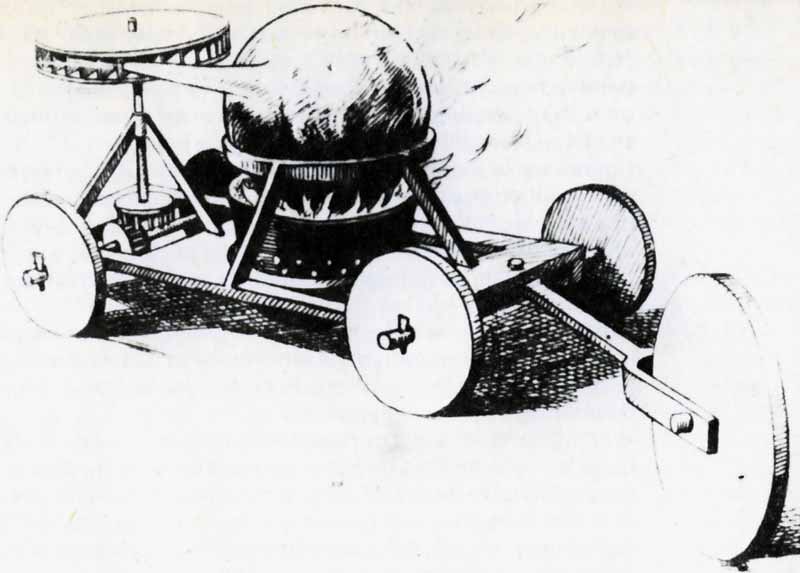
And then to top it all off, he constructed a totally cool toy to impress the Kangxi Emeror, because what’s a know-it-all nerdy friend without a few impressive gadgety toys?
What Verbiest designed was a steam-powered vehicle. It was designed without a driver in mind as it was only a little over 25 inches long and though he describes it in his book Astronomia Europea, it’s not clear whether or not he ever built it. Still (not to take any credit away from Karl Benz) this may have been, at least in concept, the world’s first ever self-propelled “car.”
SteamMachineOfVerbiestIn1678
So let’s skip ahead a few centuries. I don’t know whether or not you yourself have one of those nerdy know-it-all friends like Verbiest, but fortunately, we all have access to one. In our house, we call him “Google.” Thanks to our smart phones this “friend” now goes with us everywhere and he knows (or at least he thinks he does) pretty much everything about anything.
Of course you do have to be a little careful because he can’t always be counted on to give you an entirely correct answer. For example, you might ask him who invented the first car and he’ll direct you to some silly blog post about Ferdinand Verbiest, which you should probably just ignore.
But he has held up his end of the nerdy know-it-all friend bargain in the gadgety toy department. After all he did make you a pair of glasses that allow you to pretend to be the Terminator. And now he’s made you a self-propelled car that is designed without a driver in mind.
Just yesterday, Google announced that this summer, it will have about a hundred prototype vehicles ready for testing, without a gas pedal, steering wheel, or brake pedal among them. But don’t worry, your friend Google isn’t a complete idiot. He will include two seatbelts just in case some irresponsible driver of a regular old human-controlled car slams into you.
The new self-driving car seats two, won’t go over 25 miles per hour, and, frankly, looks kind of like a toy. Google hasn’t released a name yet for its newest gadget. I’m thinking it should be the Google Doodlebug. I’m also thinking, I probably won’t be lining up to drive ride in one any time soon.
If you spend much time on social media, then I’m sure I’m not the first person to wish you a happy palindrome week. In fact, I’m kind of late since it started last Thursday (4-10-14) and will be over after this Saturday (4-19-14). Of course it only works if you write the date like we do here in the US, with month/day/last two digits of the year, but I think you’re probably welcome to celebrate even if you prefer your dates in a different order.
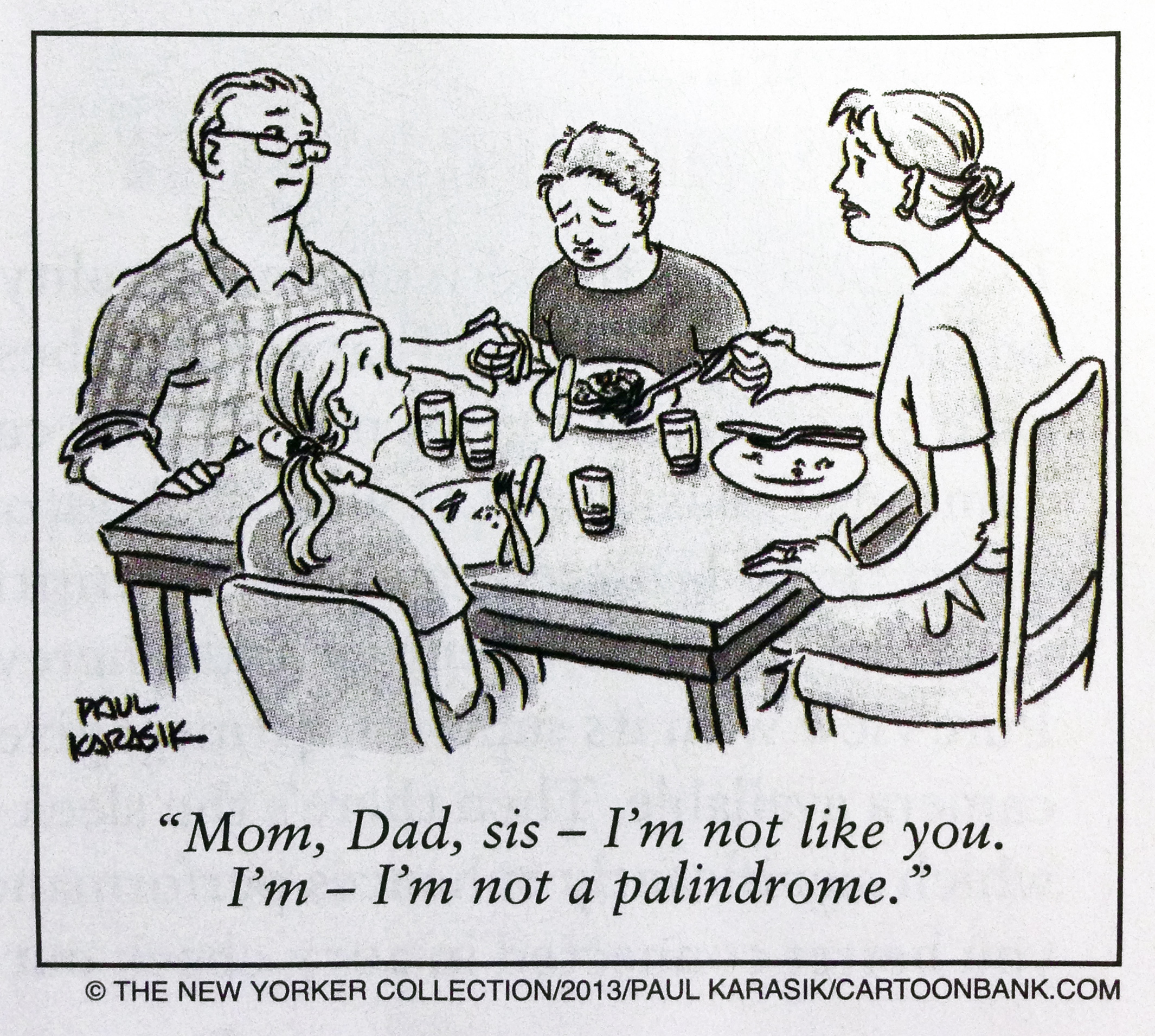
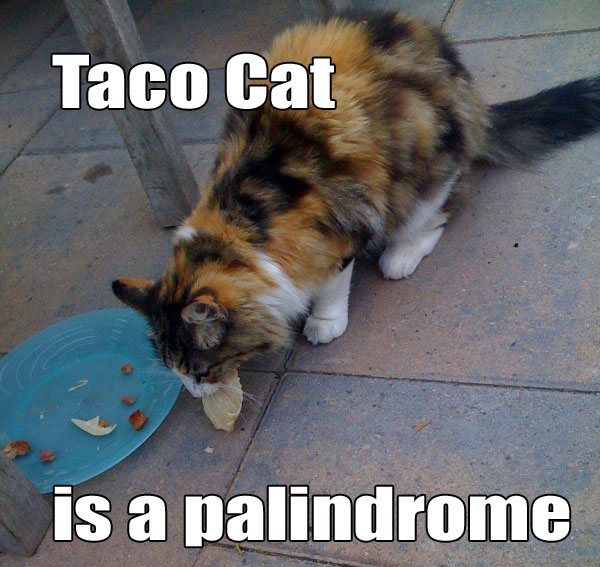
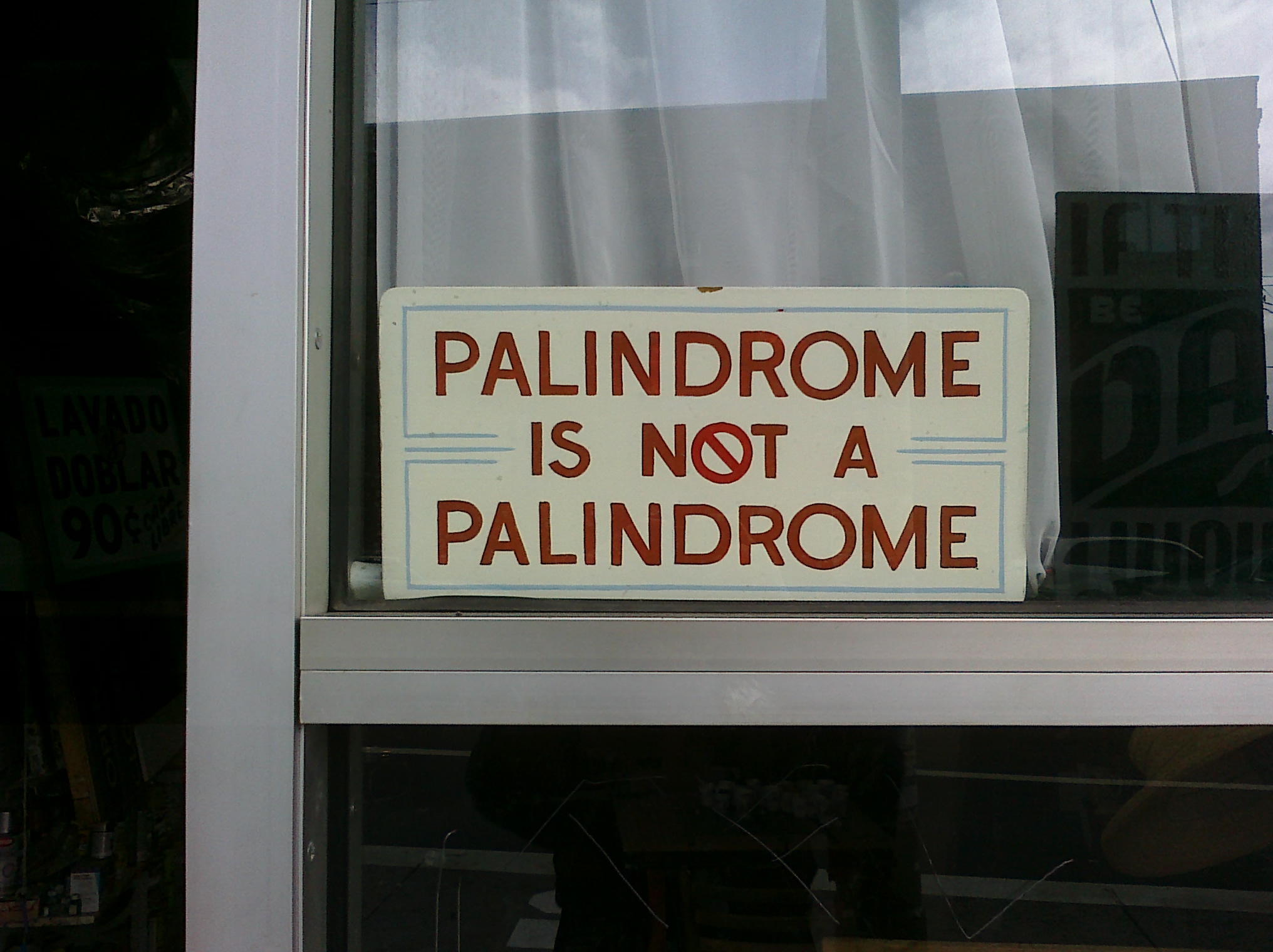
In case you are unfamiliar with the word “palindrome,” it refers to a word or phrase that is written the same forward and backwards. A few examples are “mom,” “racecar,” and “kayak.” You get the idea. Word nerds are fascinated by them, they’ve been around for millennia, and there are examples of them in almost every language on earth.
But because it can be quite a challenge to come up with a palindrome and because the longer they are, the more nonsensical they tend to be, there are a handful of highly celebrated ones from the minds of some very clever individuals with far too much time on their hands. One of the most noted in English comes from Leigh Mercer (also celebrated for his mathematical limericks, as I’m sure you were already aware) who published in the November 13, 1948 issue of Notes & Queries: “A man, a plan, a canal – Panama!”
And boy did that get the word nerds buzzing with excitement. Mercer’s palindrome spawned numerous spin-offs, including, but certainly not limited to:
“A man, a plan, a cat, a canal – Panama!”
“A man, a plan, a cat, a ham, a yak, a yam, a hat, a canal – Panama!”
And my personal favorite: “A man, a plan, a canoe, pasta, heros, rajahs, a coloratura, maps, snipe, percale, macaroni, a gag, a banana bag, a tan, a tag, a banana bag again (or a camel), a crepe, pins, Spam, a rut, a Rolo, cash, a jar, sore hats, a peon, a canal – Panama!”
All of this nerdy word fun is generally traced back to a poet of Ancient Greece named Sotades who is credited with making the palindrome a thing. He lived during the reign of Ptolemy II in the 3rd century BC and history remembers him best as Sotades the Obscene, since the majority of his poems began “There once was a man from Nantucket.”
Eventually, Sotades decided to turn his poetic attention to the love life of Ptolemy II, which was something of a hot mess. The king didn’t like the attention and had the poet arrested and, eventually, wrapped in lead and thrown into the sea.
Despite his untimely end and the questionable subject of his poems, Sotades is remembered as a genius with words, once allegedly rewriting the Iliad in palindromic verse, presumably changing the setting to Panama. Unfortunately, I can’t post any of the poet’s work here mostly because this is a family-friendly blog, but also because it was lost to history (possibly wrapped in lead and thrown into the sea).
But his legacy has been carried on by people like Mercer and by comedian and wordplay enthusiast Demitri Martin who recently penned a 500 word palindromic poem that mentions neither Panama nor Nantucket, but is, in the tradition of Sotades the Obscene, too dirty to post on this blog. Still, it’s a pretty impressive work, because, it turns out palindrom-ing is not as easy as it looks…Dang it!
A few weeks ago the boys chose to watch Harry Potter and the Sorcerer’s Stone for a family movie night. In it, the character Arthur Weasley (who has recently charmed the family car to make it fly) is delighted to meet young Harry Potter and almost immediately asks him to clarify, “What exactly is the function of a rubber duck?” The silly line always makes the boys giggle because, of course, rubber ducks don’t really have a function. Or so I thought.
Then I saw a headline that caused me to revisit the question. About a week ago a stunned crowd attending the Taoyuan Land Art Festival in Taoyuan County, northwestern Taiwan watched, heartbroken, as officials dragged to shore what is being called (on the infallibly accurate “Twitter”) the first victim of Taiwan’s recent 6.3-magnitude earthquake. The victim in question (as I’m sure you would expect) is a 59-foot tall yellow rubber ducky.
Rubber Duck and Florentijn Hofman (Photo credit: Jon@th@nC)
Designed by Dutch artist Florentijn Hofman, the deflated ducky was one of several that have been touring the world’s waterways since 2007. The duck’s pumps lost power after the earthquake causing the sculpture to deflate. It burst during the process of re-inflation.
Perhaps they should have used a pressure guage (Photo credit: Mark Morgan Trinidad B)
This isn’t the first time that one of the ducks has been damaged. They have been knocked around and accidentally deflated a few times. While on display in Belgium, one was even stabbed by (remarkably angry) vandals a total of 42 times.
But the fans in Taiwan have taken the demise of their web-footed friend hard indeed, lighting up social media with viral tributes to the beloved duck. The grief was sharp enough even for county councilor Chan Chiang-tsun to call for a 10-second silence in honor of the fallen, to which the county commissioner said, “Dude, it’s a rubber duck.”
Assuming that you are not the commissioner of Taoyuan County (or perhaps a remarkably angry Belgian), I’m guessing you have at least a twinge of appreciation for the giant rubber duck. With his project, Hofman is “spreading joy around the world.” He insists that “when we are living on one planet, all global waters become your bathtub.”
I think that me and my regular sized rubber ducky will stick to this, thank you very much. (Photo credit: Wikipedia)
Okay, eww. But I assume that what he means is that the rubber duck has become something of a worldwide symbol for childhood innocence. I can get behind that. The simple little (or not so little) bath toy is so ubiquitous that it has become difficult even to trace its origins. The rubber ducky simply is.
Rumor has it that the first rubber ducks were produced in New York. Of course Akron, Ohio also makes a claim to the favorite of all bath toys and (as it is the “rubber capitol of the world,”) I might have to give it the benefit of the doubt. Either way, what’s fairly obvious is that the rubber duck industry rose alongside the rubber manufacturing industry itself. Around 1900, tire giants Goodyear and Firestone established plants in Akron (because, after all, it’s the capitol).
Around the same time and for several decades after, rubber toy manufacturers also started popping up in Akron (again, the rubber capitol), producing all kinds of lovable characters, including the beloved rubber ducky.
This is important to understand because of a recent announcement made in the city of Akron. You see, in addition to being the rubber capitol of the whole entire world, Akron is also host to the Double-A Cleveland Indians affiliate baseball team, long known as the Akron Aeros. But for next season and beyond, the Aeros will now be known as the Akron Rubber Ducks.
Baseball’s Akron Monster Truck Tires, rolling over the competition since 2014. I could see it. (Photo credit: Enokson)
As you might well imagine this change has upset a few of the Aero faithful who complain that rubber ducks don’t really intimidate anyone (well, unless maybe they happen to be 59 feet tall). The team’s owner Ken Babby insists that the change was made to “[reflect] Akron’s heritage and the type of organization [they] are building, steeped in family fun and entertainment at an affordable price.”
So I get it. They could have chosen to call the team the Akron Monster Truck Tires (intimidating even to a 59-foot tall rubber duck, I would think) and I doubt anyone would have complained. But that probably would not have had as much draw for the lion share of their market, the young families who don’t yet have the money or the level of kiddo interest to invest in a trip to Cleveland just for a baseball game.
And it turns out that Taoyuan officials may have had a similar motivation for recovering their duck as quickly as possible. Their first call after the collapse of the floating sculpture was to the city of Kaohsiung to see if they could borrow the Hofman-designed duck on display there. The duck, which had been in Kaohsiung for about a month, had drawn 4 million visitors (and their money) to the city, during a typhoon!
Yes, that kind of typhoon, which, by the way, would make a much better mascot than would a rubber duck. (Photo credit: Wikipedia)
The function of a rubber duck, I think (at the risk of sounding like a remarkably angry Belgian), is to make a lot of money. Then again, perhaps that’s too cynical. Joe Wos, executive director of Pittsburgh’s Toonseum, which recently developed a rubber ducky exhibit to coincide with the city’s hosting of one of Hofman’s oversized quackers (a decision that I’m sure was NOT driven by any commercial considerations), had this to say about the project:
“It doesn’t need to bring about world peace; it doesn’t need to unite us. In the end, it’s a giant rubber duck, and there’s nothing wrong with that.”
So to my sons and to Mr. Weasley I guess I have to admit that a rubber duck really doesn’t have much of a function, unless of course it’s 59-feet tall and charmed to fly. I’d probably pay to see that. Just don’t fly it too close to Belgium.
This morning I sent my youngest son to his first day of first grade. He’s a smart boy, usually pretty well-behaved (or so I hear from other people), friendly, and very funny. I know that he will do well with school this year. But for some reason he is incredibly nervous about this venture into first grade.
The poor kid ate very little breakfast and wouldn’t say much. When I asked him what he wanted to wear for his big day, he thought for a while and then chose a camouflage tee-shirt because he wanted to be able to hide if he got scared. I gave him a hug and told him he would be a great first-grader. Then I told myself he would be fine. And I told my husband (apparently several times) that our little guy would be just fine.
I have to hand it to the brave little man. When it came time to go, he looked slightly panicked, but he shouldered his big blue backpack and went willingly into the building. I found myself whispering, “Here we go” and, once again, “he’ll be fine.” I started thinking back over this summer’s many adventures and smiled to realize that these were almost the same words I had whispered to him as I sat next to him on his first roller coaster ride.
In 1850, at the tender age of twelve, LaMarcus Adna Thompson successfully built his own butter churn and ox cart. But believe it or not, this was not the height of his mechanical prowess. After a time, young Thompson grew up (as all young men must), apprenticed as a carpenter, and designed a machine used for the production of ladies’ stockings.
He soon founded the Eagle Knitting Company in Elkhart, Indiana. Alas, as the well informed (which no doubt means you) will likely already realize, the ladies’ stocking industry is incredibly stressful and really is no place for a young man destined for greatness. For the sake of his health, Thompson took some time away from his growing company for a doctor-prescribed trip west.
He then apparently disregarded his doctor’s advice (or he was not a particularly competent map-reader) and found himself in Pennsylvania where he observed the Mauch Chunk, Summit Hill and Switchback Railroad. The railroad was a clever way to cart coal from Summit Hill to the Lehigh River at Mauch Chunk (today that’s Jim Thorpe, Pennsylvania).
What Thompson saw was a cart full of coal and a couple of bewildered mules, rushing on a track through a series of switchbacks down the mountainside as fast as gravity would carry it. At the bottom, the cart was unloaded so that mules could haul it the long way back uphill.
Switchback R.R. (railroad), Mauch Chunk, from Robert N. Dennis collection of stereoscopic views (Photo credit: Wikipedia)
And an idea began to form in the inventor’s mind. Perhaps he thought about the mules (likely more stubborn than stupid) that willingly took the carts back up the mountainside to repeat the process. Or maybe he observed them carefully as they flew downhill and noticed that though they screamed they also threw their hooves in the air and smiled as though someone might snap their picture on the hairpin switchback turns.
Whatever the reason, Thompson thought the railway looked like fun and he hatched a plan to design and build something similar for people. His “Switchback Railway” opened at Coney Island in 1884 and was an immediate success, giving LaMarcus Thompson a claim to the title “Inventor of the Modern Roller Coaster.”
Mind you Thompson doesn’t have a great claim to the title. Russians started slipping down huge ice slides as early as the seventeenth century and the French built the first wheeled coaster by 1817. Still, Thompson can take credit for the first successful introduction of the roller coaster to the United States, where it’s been soaring to higher, faster, and “upside-down-er” heights ever since.
And I, for one, am grateful for his contribution. I experienced my first roller coaster as soon as I was tall enough to pass the safety precautions and once I started, I never looked back. On more than one occasion I have arrived at the entrance of an amusement park in time to be among the first through the gate for the sole purpose of running to the back of the park and riding the best coaster two or three times before the rest of the crowd caught up and the line got long. I have also been the kid who chose to ride the coaster back-to-back-to-back many times over as the park neared the close of the day and no one else was left in line to take my place.
So I was thrilled to take my two sons to Six Flags this summer and introduce them to the rides that defined many of the summer days of my youth. My eight-year-old is tall for his age and would qualify to ride any coasters he cared to try. My six-year-old, though too short for some, seemed determined to conquer any rides that frightened him.
It turned out that they weren’t as brave as I had hoped. I did get my older son on a few rides, with mixed reviews (for some reason the feeling of his heart thumping in his ears and his stomach turning somersaults doesn’t especially appeal to him). My six-year-old took a long time to get up his nerve, but he surprised me in the end, choosing to ride one of the smaller wooden rollercoasters, one with a large hill and a dark tunnel. I admit I was concerned that he didn’t know what he was getting himself into. Still, once he had decided to give it a try, I doubt he could have been dissuaded (smart as he is, he is easily more stubborn than a mule).
As the lap bar lowered, I held him close and whispered, “We’ll be fine.” And as the train began to roll, “Here we go!” He did conquer his fear and though I don’t think he would say that he loved the ride, he is pretty sure he will try it again someday. I just hope he feels the same way about first grade.
Last week I got a call from a friend I hadn’t seen in a while asking me to substitute in her Bunco group that Friday. Because I haven’t been in my new community very long I don’t know a lot of people yet. So even though my friend lives on the other side of St. Louis (about an hour drive from me) I was flattered she’d thought of me and I readily agreed to join in.
Of course if I had been thinking of my history, I might not have been so eager. In May of 1885, Joseph Ramsden arrived in New York on vacation from Manchester, England. A successful businessman, Ramsden set out to explore the city and was delighted when just a day into his vacation he was recognized on the street. A gentleman claiming to be the nephew of the captain of the ship Ramsden had recently arrived on, told the flattered businessman that the captain had spoken well of him.
The new acquaintance, himself a successful manufacturer of women’s undergarments, offered Ramsden a guided tour of Broadway. The two found they had a lot to talk about (I’m guessing mainly women’s undergarments) and Ramsden (unwisely) agreed to accompany the captain’s nephew into a small second-floor office where he claimed he needed to buy a train ticket.
As the man dug around in his bag for the money he used to pay the ticket salesmen, he also pulled out items necessary to his business (perhaps samples of women’s undergarments?) to show a fascinated Ramsden. Then at the bottom of the bag, the man happened to discover that he also had a deck of cards. Logically, he showed his latest and greatest card trick to a suitably impressed Ramsden and ticket-salesman.
So the next step was for the ticket salesmen to ask the two new friends if they knew how to play three-card monte, a popular gambling game of the time, sometimes played with a combination of cards and dice. Ramsden (wisely for once) declined the ticket salesman’s invitation to play the game, which prompted the salesman to suggest that perhaps Ramsden didn’t have enough money to play (he may have also called him a chicken). Still Ramsden was (again, wisely) reluctant to play, but as his pride was at stake he (alas, unwisely) took ₤50 from his pocket to prove his worth. That’s when Ramsden’s new acquaintance (who it turned out was neither the captain’s nephew nor a manufacturer of women’s undergarments) snatched the money and ran.
Do not agree to buy underwear from this man. (Photo credit: Wikipedia)
Ramsden pursued the man to no avail and when he returned to the ticket office, he found only an abandoned room. Joseph Ramsden had been swindled by one of the most famous bunko men of the age, variously known as William Howard, John Astorhouse, Henry Post, Louis Alcaser, Charles Clayton, and most often as “Hungry Joe” Lewis. And Ramsden was in good company with military and political leader John A. Logan and poet and writer Oscar Wilde, both also bunkoed by Hungry Joe.
The game of bunko as it’s played today descended from a game called 8-dice cloth that was a popular social pastime in 18th century England. When the simple dice game arrived in the United States in the 1850’s, it had become a swindler’s game. At first referred to as Banko, the simple dice game merged with the Spanish card game “Banca” (called Monte in Mexico) and became a vehicle for elaborate set-ups designed to swindle money from gullible marks.
It wasn’t long until “bunko” came to refer to any con designed by a “bunko man” and perpetrated on the gullible who found themselves “bunkoed.”Seedy Bunko parlors sprang up all over the nation in the late 19th century and were resurrected in the speakeasies of Prohibition. Bunko men were common and city police departments maintained regular bunko squads to counter the problem.
But even though the bunko of today is essentially a game of chance, it really is more of a social outlet for (primarily) busy ladies (“bunko babes”) who for one night a month can pay $5 to leave their husbands in charge of the kiddos and enjoy a margarita with other busy ladies. If they are the big winner they may even get to take home a kitschy prize.
I am happy to report that my friend has never claimed to be a manufacturer of women’s undergarments (apparently an untrustworthy group of folks) and the invitation I received to play bunko wasn’t an elaborate set-up. I was not, however, the lucky winner when I played. After stringing together more than a dozen low scores in a row, I guess you could say I lost my shirt.
But Bunko has become a much friendlier game over the years. My spectacular loss meant that I went home with a prize, too. Actually as a substitute, I didn’t even have to pay $5 for dues. I think my friend’s group may have been bunkoed.


![By Tim Ross (Own work) [Public domain], via Wikimedia Commons](https://sarah-angleton.com/wp-content/uploads/2015/04/tree-frog.jpg)


![Zener Cards [Public domain], via Wikimedia Commons](https://sarah-angleton.com/wp-content/uploads/2014/08/zenercards.png)






 Author Sarah Angleton
.jpg)