Have it My Way

In 1924, while working at his family’s roadside sandwich stand, The Rite Spot, in Pasadena on a part of the famous Route 66, 16-year-old Lionel Sternberger made history when he placed the first slice of cheese ever to grace the top of a hamburger patty. Probably.

The Rite Spot, Pasadena, CA. Unknown (Provided by Don Sternberger), Public domain, via Wikimedia Commons

How exactly it happened is a little unclear. One story suggests that Lionel burned the patty and so he threw on the slice of cheese to cover up his mistake. A slightly less dramatic theory is that a clever, uncredited, customer asked for cheese on their burger and Lionel simply obliged.

But another entirely different tale of the invention of the cheeseburger comes from Kansas City, where a man named Charles Kaelin claimed in 1934 to have had the first genius idea to add tang to a hamburger by adding cheese, just a year before the owner of Denver’s Humpty Dumpty Drive-In first trademarked the word cheeseburger.

There are probably other origin stories as well, and we could certainly debate about them, and produce all kinds of memes and reels and righteously angry and potentially insensitive social media tirades, though somehow I doubt we’d get anywhere productive. I’d rather take today, National Cheesburger Day here in the US, to appreciate and celebrate what we have in common: this fine sandwich we all know and love.

Even veggies love their cheeseburgers.

Well, most of us probably love at least some version of it. What precisely goes on a cheeseburger is not always the same from burger stand to burger stand or from backyard grill to backyard grill.

We can all pretty much agree that it needs to include some sort of beef patty. Unless of course you don’t eat beef and prefer something like bison or venison or even turkey. Or I suppose you could be vegetarian and stick to a plant-based patty or replace it all together with a big beefy portibello mushroom, which I guess still counts.

A bun, too, is standard, either with sesame seeds or without, smeared with a little butter and toasted, or not. Maybe a gluten free bun is your jam or no bun at all. Some people, though surely not anyone I’d want to know, replace the bun with a couple large pieces of lettuce.

There’s also the question of what kind of cheese you use. The traditionalist might go with a cheddar or a melty American, but Pepper Jack can pack a nice punch or blue cheese, an odd funk, in case you’re into that sort of thing. If you’re a little pretentious, a Swiss or smoky Gouda could work, and then there are the vegans among us that I guess have to settle for some sort of not-a-cheese product.

And then we hit the question of toppings. Ketchup is pretty standard, unless you’re dead set against it. Mayonnaise is a contender, too, for those with no taste buds. Steak sauce might work, again, for the unapologetically pretentious. The indulgent might like to add bacon to theirs, and the vegetable obsessed will insist on lettuce, tomato, and pickles, while people who completely hate themselves might even consider raw onion a defensible choice.

With all of these certainly not exhaustive options, maybe the best thing to do would be to avoid confusion and standardize the cheeseburger. And if we do that, then we could make sure we are providing the ultimate cheeseburger experience to all people, regardless of their individual backgrounds and ill-informed biases.

We could use only the very best ingredients, too, and perhaps limit the consumption of cheeseburgers so that people don’t stress the healthcare system with their poor choices or shape the supply chain in a way that we suspect might overburden either the environment or the market.

Yes, it’s true that at first we could get some push back. Some cheeseburger stands and backyard cookouts may initially fail to comply, and will likely use hateful rhetoric to insist that they have a right to prepare and eat cheeseburgers the way they want. If these deplorable enemies of culinary taste get a chance they might even spew their venom in public debates in which they claim it could even be a good and useful thing to consider alternative ways of preparing cheeseburgers.

I believe, however, that if the truly good and hungry people of this nation fight hard enough and take to the streets to protest the non-compliant businesses and backyards, maybe squish up a few buns, torch a couple of grills, and throw a few ketchup bottles, we can silence the opposition. I bet. You know, for the good of all.

But of course, I jest.

In truth, I feel that if you want to ruin your otherwise perfectly delicious cheeseburger with a hunk of raw onion, you should be free to do so. We can even still be friends, provided you brush your teeth before standing close enough to, say, engage with me in a heated political debate. If, however, you try to put a hunk of raw onion on my cheeseburger, be forewarned that I just may say something hurtful on social media that I’ll probably regret and have to try to apologize for later.
Maybe We Should Taco ‘Bout It

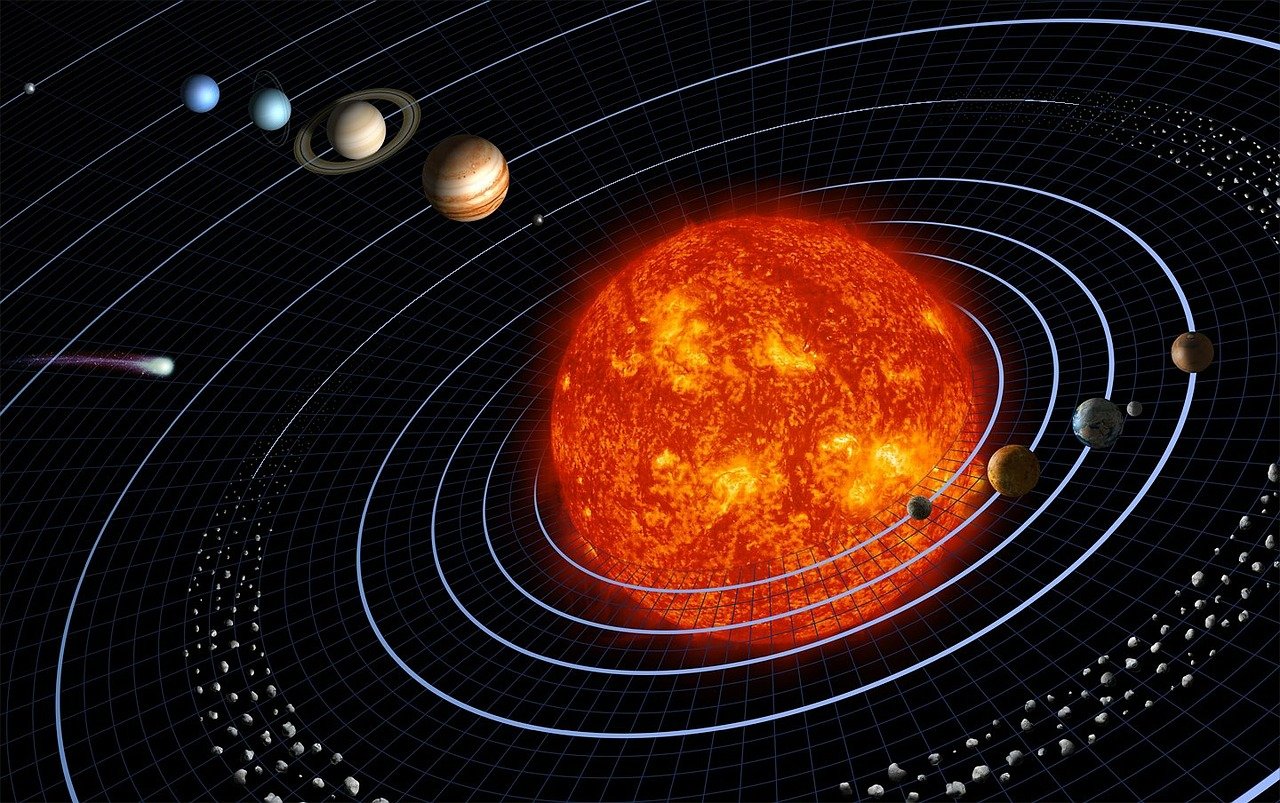
In 1632, Italian scientist Galileo Galilei published his book Dialogue Considering the Two Chief World Systems. Produced under a license issued by the Inquisition, the work presented a discourse between different points of view on a wide range of scientific topics of his day.

One of these conversations involved the competing theories of 2nd century Egyptian mathematician Ptolemy who believed the earth to be the stationary center of the solar system, and that of 16th century Prussian mathematician Nicolaus Copernicus who said, “Nuh-uh.”

Clearly this is heresy. Image by WikiImages from Pixabay

It turned out that Galileo, a devout Catholic who was clearly well versed in the arguments of each, and pretty handy with a telescope, kind of sort of agreed a little bit completely with Copernicus. In the course of his Dialogue, it started to sound that way to his readers, too. Among those readers was Father Vincenzo Maculano who was appointed by Pope Urban VIII to suss out the truth behind Galileo’s potential heresy, general bigotry, and absolute hatred of puppies. Probably.

And he did just that, because three hundred and ninety years ago today, under the threat of torture, Galileo made a public statement denouncing his ridiculous, data-fueled suspicion that Earth revolves around the sun.

The Catholic church at the time, supported by the questionable literal reading of several verses of Scripture, was thoroughly convinced this was an error that had been inappropriately and willfully spread by Galileo’s heretical work. Also that Galileo most likely had other incriminating documents locked up at his house, or possibly in a box tucked behind his Corvette.

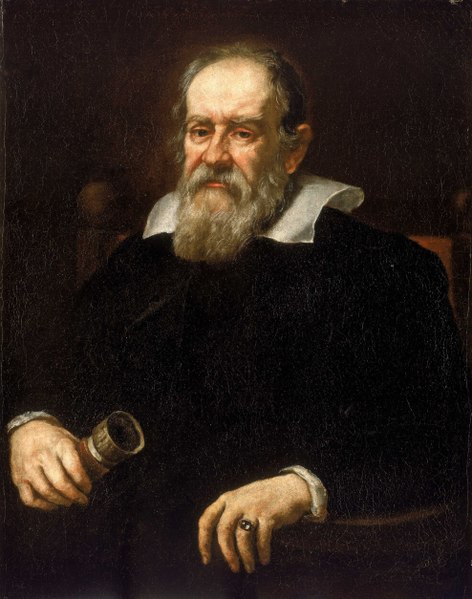
Although, the man really did know his way around a telescope. Justus Sustermans, Public domain, via Wikimedia Commons

It’s not hard to imagine why Galileo, sixty-nine years old at the time and not in the greatest of physical health, went ahead and stated for the record: “. . .with a sincere heart and unfeigned faith I abjure, curse, and detest the aforesaid errors and heresies, and generally every other error, heresy, and sect whatsoever contrary to the said Holy Church. . .”

The book was banned, which made the world much safer from thinking. That was a good thing since the world was already pretty busy revolving around the sun. Galileo himself was sentenced to penance and imprisonment that was soon softened to house arrest for the remainder of his life.

And it served him right, because troublemakers who float theories that go against the grain of societally accepted truth, and who are consequently bigots and puppy-haters who have obviously broken all the laws, deserve to be harshly judged and silenced.

Except that three-hundred and ninety years later, I think it’s safe to assume most of us would agree the trial and forced recantation of Galileo was wrong. It only took the Catholic church three hundred and fifty-nine years to officially come to that conclusion, remove his book from the list of the banned, and pardon the man so he could leave the house and get a taco. Tragically, he didn’t live long enough to see the day.

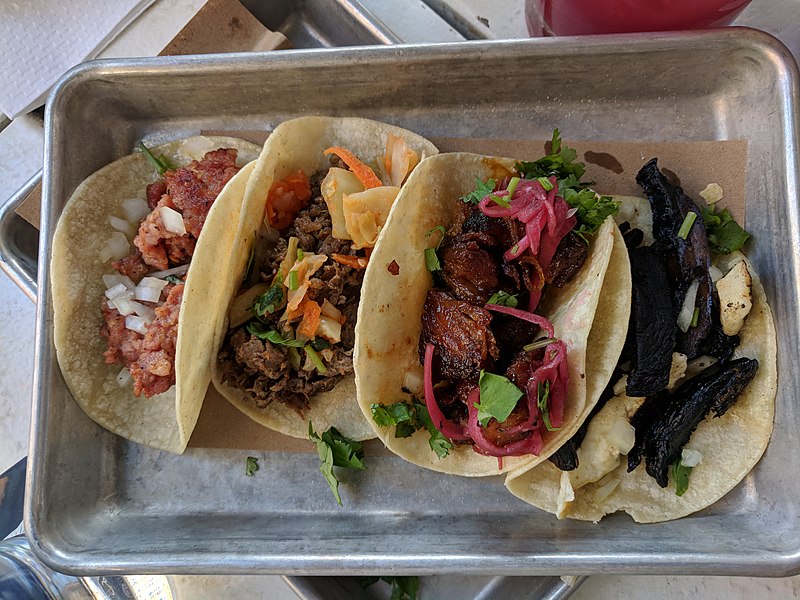
I’d probably be happy listening to any of your crazy ideas over a taco. Also, I might be a little bit hungry. Kurt Kaiser, CC0, via Wikimedia Commons

Still, it’s nice to know that given enough time, humans will listen to and consider the ideas of fellow humans without automatically assuming the person presenting those ideas hates puppies, which I should add, it’s entirely possible that Galileo did not.

I’d like to think we might even be able to swallow our pride enough to make an effort in fewer than three hundred and fifty-nine years, even though I know it can be pretty uncomfortable to listen to someone challenge a widely held idea that you personally think is pretty spot on.

But it might just be worth the effort to listen, because maybe the person on the other side of that discussion really is a bigot who hates puppies. Or it’s also possible that person actually shares most of your beliefs, but just has a telescope and some pretty good evidence that should also be considered. And that person would probably really like to go get a taco.  

Trending in History: Giants and Jerkfaces

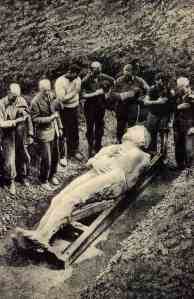
On October 16, 1869, on William Newell’s farm near Cardiff, New York, two men digging a well, hit something surprising with their shovels. What they eventually uncovered was a ten foot tall, 3,000 pound petrified man.

cardiff_giant_2
Someone clearly had an unfortunate run-in with geode water. Excavation of the Cardiff Giant, Public Domain, via Wikimedia.

For years, newspapers had been featuring reports of petrified men, believed to have come into contact with water from the inside of geodes. So no one had any doubt such a thing could happen. The good people of Cardiff flocked to see the giant, took selfies to post on Instagram and tweeted out the Syracuse Daily Standard article that dubbed the giant “a new wonder.”

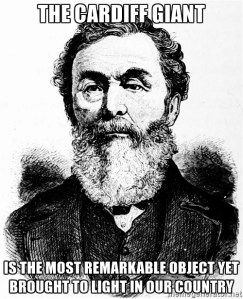
Of course there were a few skeptics. Among them was Dr. Boynton, a local science lecturer who assumed the find was actually a large statue of historical significance. Noteworthy geologist and paleontologist James Hall liked this theory, calling the find, “the most remarkable object yet brought to light in our country,” a quote that once added to a picture of the respected scientist became a meme netting more than 120,000 likes and 15,000 shares on Facebook.

giantmeme
Looks legit to me.

Many theologians got excited, too, pointing to the very large man as evidence supporting the literal interpretation of Genesis 6:4, which claims there were once giants on the earth. The news commentators and bloggers had a lot to work with.

But notably absent from most “media” coverage was the assessment of Yale paleontologist Othniel Marsh who stated upon seeing the Cardiff giant, “It is of very recent origin, and a most decided humbug…” Marsh wasn’t the only one to voice such outrageous ideas, but he might as well have not said anything, for all the good it did.

Most visitors adamantly claimed there was no way they would ever believe the giant had not once been a living, breathing creature. Because once a person’s decided to believe something, it’s hard to convince them not to.

Eventually, the man behind the humbuggery did confess. Cigar manufacturer, dedicated atheist, and cousin to Mr. Newell, George Hull admitted to having the statue commissioned and buried after engaging in a debate with a Methodist preacher over the literal interpretation of Genesis 6:4. He really just wanted to say, “Gotcha!”

As a bonus, he also made a pretty penny off his share in the scheme eventually selling his interest for nearly a half million adjusted 2017 dollars. He definitely fooled a lot of people and certainly supported the point that those who set out to make a point by fooling a lot of people, are kind of big jerkfaces.

Seriously, it was ALL OVER social media. #HumbugHull  #CardiffCon #GiantJerkface.

barnum
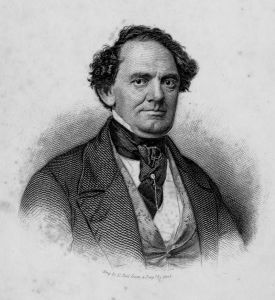
P.T. Barnum, America’s favorite son of humbuggery, offered to buy the Cardiff Giant. When his offer was refused, he commissioned his own gypsum giant and claimed the first was a forgery. Like a boss. Public Domain, via Wikimedia

But I do think, unwittingly, Hull made another point, too. Because his giant was the fakest fake news of the day. That’s right, folks. We’ve ALWAYS had fake news. Just like we’ve ALWAYS had biased news. Because none of us, members of the media included, lives in a vacuum. Our experiences, our intentions, and our personalities, whether individual or institutional, all serve to inform our biases.

The media attention given to the Cardiff Giant rarely included expert voices that contradicted the sensational because sensational sells and improves SEO as its shared widely across platforms evidently designed to make otherwise reasonable and more or less kind-hearted people seem completely insane. So media outlets use (among other tactics) carefully worded headlines, precisely cut-off quotes, and selective expert interviews to make that happen.

So how do we combat this? First, I think we would all benefit from a deep breath. Then, the next time you think about clicking “share,” take a minute to analyze three things:

  1. The bias of the source (and, yes, there is one, see the previous paragraph)
  2. Your goal in sharing the piece (if it’s either to taunt or to yell, “Gotcha!” it’s possible you should reconsider)
  3. Whether or not the piece will further civil discourse (or whether you’re just behaving like kind of a jerkface).

I don’t mean to sound like I’m coming off heavy-handed here, though I admit that’s exactly what I’m doing. I don’t deny that I have an agenda. I want my social media feeds to be kinder, more civil places today than they were yesterday. I want to have informed conversations with informed adults who don’t always agree with me, but whose opinions are interesting and worth giving some serious consideration. And I want the media to stop reporting about how biased the media is, because, frankly, that’s super old news.

So I hope you’ll remember George Hull and the Cardiff Giant and give some thought to my terribly biased interpretation of the way we should view his story. I hope, too, that at some point you will begin to question the authority of a history blogger who insists that #GiantJerkface was trending on Twitter in 1869. And, last but not least, I hope you are careful to avoid contact with geode water (which I think sells for $7 a bottle at Whole Foods), because I’d hate to see you get petrified, and I read somewhere that can happen.