Not Quite History Yet

I’ve been at this Thursday blogging thing for more than a decade now, which makes me feel terribly old. I’ve never figured out how to make money off it, though apparently some people do. I probably couldn’t anyway because I rarely share recipes or include bullet points that offer succinct strategies to improve your health or achieve your financial goals. This blog will rarely  promise you better sleep, space-saving hacks, or hot vacation tips. And I assure you, you will never ever read technology advice in this particular corner of the blogosphere.  

While I do harbor a vague hope that readers who stumble across my blog might be curious enough to buy one of my historical novels, I’m in this space primarily because I enjoy it. I enjoy playing with history and interacting with readers and being kind of silly and occasionally toying with an idea that might just turn out to be a little bit profound and spur some good thinking.

One such book. Excellent historical fiction for a middle schooler. Emotionally tough read for those who remember.

But once in a while, Thursday falls on a day when I’m not sure I have any words to offer. This is one of those Thursdays, because of course, twenty-four years ago today, a moment of national tragedy occurred here in the US and altered the way I think about the world. 

And I still don’t want to write about it. I don’t know if someday I will want to. In the past twenty-four years, several authors have ventured to do so, many in nonfiction formats, but also several now who have chosen to let the sad events of September 11, 2001 be the backdrop for fictional stories.

I’ve read a few such novels, and have appreciated them. Last year when I took some time off of writing and worked in a middle school library, I sometimes recommended them, discussed them, and shelved them—in the historical fiction section of the library.

Yes, we debated whether that was appropriate or not. After all, the Historical Novel Society, which seems as though it should be the authority on the genre, defines historical fiction as a story written at least fifty years after the events described or that has been written by someone who was not alive during the events, and so has approached them only via outside research. Their website does, however, also acknowledge that it’s complicated.

Most of the writers of the stories that bump up against the events of the September 11th terrorist attack in New York were alive when it occurred, and are certainly not fifty years removed from the event. Like me, they probably remember where they were when the news of the planes hitting the twin towers broke, and they shared in the shock of a nation that had been generally pretty lucky throughout its relatively short history not to have experienced too much terror on its own soil.

My adult children have no living memory of this event, but for me it’s still pretty raw. National Park Service, Public domain, via Wikimedia Commons

But the readers in the middle school library have no living memory of that awful day. Their older siblings likely have no living memory of it, either. And so they have no direct emotional connection with which to approach the subject matter. To them, it is just another historical event they learn about in school, like the Kennedy assassination, or the Apollo moon landing, or the attack on Pear Harbor were to me. 

I’m pretty sure I have written in this space, at least tangentially, about all three of those historical events, because even such huge moments in history are fairly easy to plumb for material that’s only vaguely worth writing about—my specialty in this space.

Today, however, is different. It’s a day when ridiculous historical tidbits that might be fun to write about are obscured by this other monstrous moment. And that one moment, at least for me, isn’t quite history yet.
Making a Big Splash

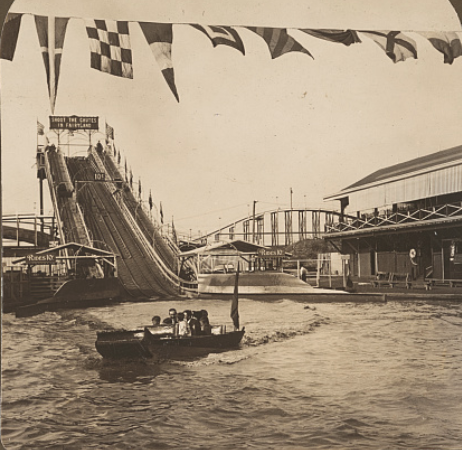
In 1882, owner of the Rock Island and Milan Steam and Horse Railway Company, Bailey Davenport took on a new business venture to drive more business. What he created was Watchtower Park, a leisure destination at the end of the line on the bluffs overlooking the Rock River at Rock Island, Illinois.

This recreational park, admission to which was included with the price of a trolley ticket, opened with groomed hiking trails, a grand pavilion with picnic tables, and what Davenport advertised as a healing spring. Eventually, it would expand to include live theater, vaudeville, tennis courts, and billiards tables.

Shoot the Chute on the Pike at the 1904 World’s Fair.

But the biggest attraction, built in 1884 by J. P. Newburg, was a five hundred foot greased wooden track built into a hill down which a wide flat-bottomed boat zoom toward the river where it created a satisfying splash and glided across the surface of the water. An attendant then used a pulley system to drag the boat back up the hill for another go.

Watchtowers “Shoot the Chute” ride was the first of its kind, but the design quickly took off, becoming a frequent feature of amusement parks throughout the United States and the world. It’s probably no surprise then that a Shoot the Chute ride popped up in 1904 in the entertainment section, known as the Pike, on the grounds of the World’s Fair in St. Louis.

What might be more surprising is that there were actually two such rides on the Pike—one for the fairgoers, and one for the elephants at Hagenbeck’s Zoological Paradise and Trained Animal Circus. And just as a visitor standing nearby the Shoot the Chute could expect to enjoy a cool splash on a hot, sticky St. Louis summer day, a visitor to Hagenbeck’s could get showered by the kerplunk of an 8,000 pound pachyderm.

The elephant slide sure did make a splash, and appears frequently as a highlight in fairgoer written accounts. One biographer of Hagenbeck elephant trainer Reuben Castang even recounts a shared story in which Castang took an accidental plunge with the giant animals, and lived to play it off as if it had been a planned stunt.

Now that’s how you make a splash.

A fictionalized version of this scene appears in my new historical mystery, Paradise on the Pike, which came sliding onto the market this past week. With any luck, and with a lot of help from wonderful people spreading the word and building the buzz, it’s making a big enough splash that readers will notice and take a chance on it.

Hagenbeck’s Zoological Paradise and Trained Animal Circus is central to the novel, which is populated by elephants and many other animals that were fun characters to write. And of course sometimes when researching, you come across something that you just can’t leave out. Because everyone loves a good Shoot the Chute ride and some stories just make a big splash.

If you’d like to read more about the real Hagenbeck elephant antics that appear in the book, check out my guest post featured by writer and very gracious host Roberta Eaton Cheadle on her blog Roberta Writes.

Malapropos of Nothing

I admit to being a little bit of a language snob. Of course I recognize that language evolves and a misspoken word today may be perfectly acceptable tomorrow, at least for some, but know that if you use a malapropism, I’ll probably judge you.

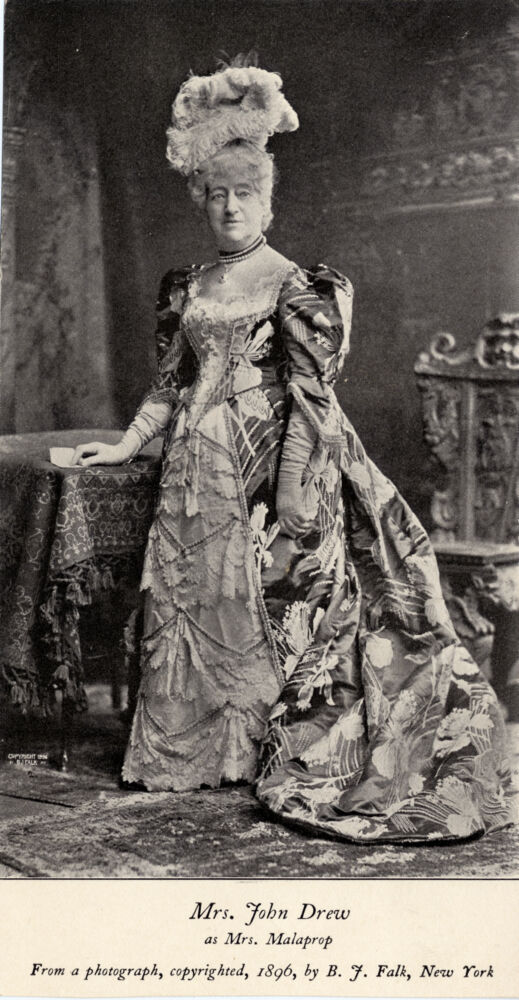
In case you are unfamiliar with the word malapropism, in lame man’s terms, it’s the mistaken replacement of a word with another that sounds similar. The term, derived from the French mal à propos, meaning inappropriate, got picked up in the English language because of playwright Richard Brinsely Sheridan. In his 1775 play The Rivals, a character named Mrs. Malaprop is notorious for muddling up her words. 

One version of Mrs. Malaprop looking “as headstrong as an allegory on the banks of the Nile,” which is one of her delightful lines. University of Illinois Urbana-Champaign University Library, Public domain, via Wikimedia Commons

That’s not to say that Sheridan was the only, or even the first, writer to make use of such a character trait, but I suppose that’s a moo point. For all intensive purposes, that’s when the concept entered the English language where it’s been driving language snobs like me bonkers ever since.

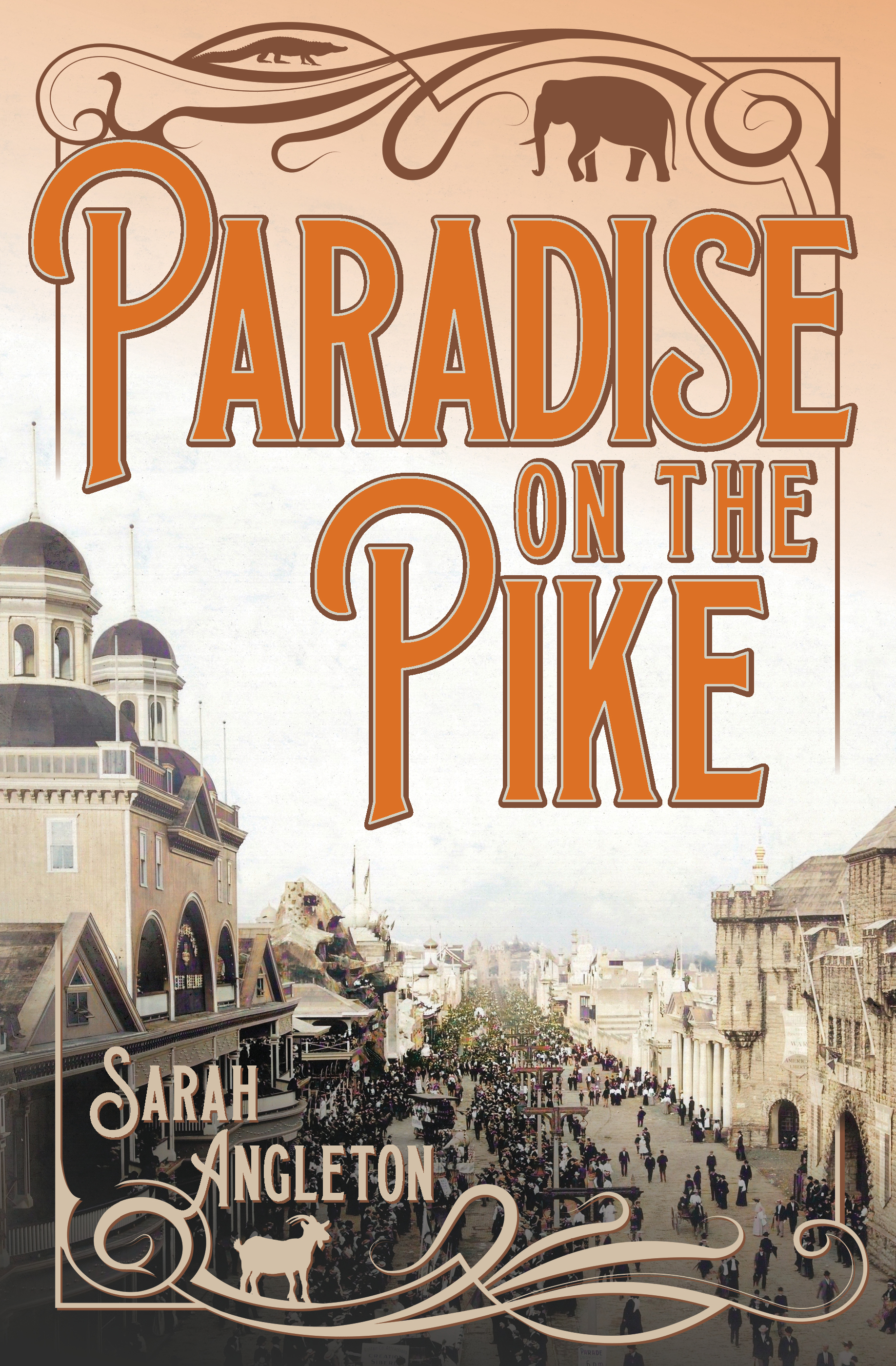
I’ve been thinking about malapropisms a lot lately because the publication date of Paradise on the Pike, my new historical novel set in the 1904 World’s Fair in St. Louis, is drawing near and I have discovered that not everyone is familiar with the word “pike.” 

If you happen to live in one of the handful of US states that contain a turnpike, you might be able to puzzle out that “turnpike” is another word for toll road and that “pike” is another word for a road. You might even be familiar with the phrase “coming down the pike,” meaning something is going to happen in the future. For example, I have a new novel coming down the pike. 

If you don’t happen to live near a turnpike, then you might mistakenly believe the phrase is “coming down the pipe,” in which case, I’m probably judging you. 

But this particular malapropism does make some logical sense because there is another phrase “in the pipeline” that also refers to something that is going to happen soon. I could, for example, tell you that I have a new novel in the pipeline. Conflating the two seems like a fairly innocuous mistake.

And of course you can go ahead and say whatever you like. It’s a doggy dog world and I don’t always get my way even if I do think malapropisms ought to be nipped in the butt whenever possible. Really, I could care less. Except that the expression, “coming down the pike,” may actually have its roots in the 1904 World’s Fair in St. Louis in which a mile long stretch of road along the north side of the fairgrounds that formed the main entertainment section of the fair was referred to as “the Pike.”

A new historical mystery coming down the pike on April 18, 2024.

The Pike contained all manner of concessions including battle reenactments, rides, a wax museum, fashion demonstrations, mock-ups of exotic locales, dancers, musicians, and animal shows. It was also the site of daily parades, leading to much excitement as people crowded around to catch a glimpse of what wondrous things might be coming down the Pike.

And so, the cover of my newest novel in the pipeline that will be coming down the pike on the 18th of April, just in time to celebrate the 120th anniversary of the 1904 World’s Fair, features a picture looking down the historical Pike. I hope you’ll forgive me for stringing out the cover reveal and keeping you on tender hooks for a few weeks. I also hope you’ll really enjoy the book when it’s finally here. And in the meantime, language snobbery aside, I hope you’ll love the book by its cover.

The Great American Book Cover

In 1925, the world was introduced to a young graphic artist who, up until that time, had remained somewhat obscure. Initially primarily a portrait painter, Francis Cugat was discovered in Chicago by conductor Cleofonte Camanini who connected the artist to numerous opera stars for whom he designed personalized posters.

From there, exactly how he came to the attention of publisher Maxwell Perkins isn’t really known, but in Cugat’s long career which eventually gravitated to film work, he designed only one book cover, and it is among the most recognizable in history.

In all its original glory.

Perkins asked him to sketch some ideas for a forthcoming novel by F. Scott Fitzgerald, tentatively titled Among Ash Heaps and Millionaires. Taking what little bit of information Perkins could give him about the incomplete book, Cugat came back with sketches that included bleak landscapes and various iterations of eyes in a wide expanse of sky.

The publisher then shared the sketches with Fitzgerald who apparently liked them a lot. In fact, after missing a deadline, the writer sent a letter to his publisher in which he wrote, “For Christ’s sake don’t give anyone that jacket you’re saving for me, I’ve written it into the book.”

The 1925 book, which ended up with the title The Great Gatsby, though not initially very commercially successful, has become one of the most critically acclaimed works of the twentieth century and, some would say, is in the running for the label of the Great American Novel. You probably read it in high school. I did. And my son who is a junior just did.

I can honestly say I don’t remember the book particularly well, but I do recall the voice of my junior year English teacher, Mr. K., as he discussed the imagery of the enormous eyes peering, bespectacled, from a faded billboard advertising the practice of T. J. Eckleburg, keeping God-like watch over the unfolding tragedy of Jay Gatsby and Daisy Buchanan, and mimicking the way Daisy’s disembodied face haunted the men who loved her.

I also remember that Mr. K.’s voice was particularly deep and soothing and that even though I adored his class, it was sometimes difficult to stay awake in that period, which immediately followed lunch. So, I have to assume that one of the reasons the imagery stuck with me as the rest of the novel and almost everything else I read that year faded in my memory like a long neglected and weathered billboard, is because of the eyes on the front cover. Not to judge the book by them or anything, but it turns out covers really do matter.

A future classic? Or at least a pretty book.

That’s why I am so excited to introduce to you the cover art for my newest book, coming out in just a couple of weeks. It wasn’t designed before the book was finished, but I think it does capture it really well and I couldn’t be happier with how it turned out.

Fitzgerald must have felt much the same way. The final cover didn’t have universal appeal. Ernest Hemingway, for one, thought it was garish. The Great Gatsby has been published with a few different covers over the years, including one featuring Leonardo Dicaprio, but the original always seems to make a comeback, and it is certainly the most recognized.

Whether the cover of my newest novel will ever become an iconic image remains to be seen. It probably depends on whether the book, in years to come, will be studied in English classes and will be in contention for becoming the Great American Novel. I don’t know that my aspirations are quite that high. But it does, I think, have a pretty nice cover.

Blurb’s the Word

In July of 1855, American essayist, poet, and all-around deep thinker Ralph Waldo Emerson picked up a book that some young upstart found the courage to send him unsolicited. The book, a somewhat pretentious collection of poetry self-published by an unidentified author, was called Leaves of Grass. Miraculously, the presumably quite busy Emerson opened the book.

He loved it. He searched the publication information and discovered the name of the copyright holder. Then he sat down to write to Walt Whitman. The letter is encouraging and poetic and Whitman had to be pretty psyched to receive it because up until then the reviews of his book hadn’t been especially kind.

emerson
Emerson’s response to Leaves of Grass. I’m a little surprised Whitman could even read it. By Ralph Waldo Emerson, from the Library of Congress, Public Domain, via Wikimedia Commons

Next Whitman did what any author would probably do. He sent the letter to a contact at the New York Tribune. When he later printed a second edition of Leaves of Grass, he included the letter as an appendix. Just to make sure no one could miss it, Whitman also placed the tiny excerpt, “‘I greet you at the beginning of a great career’—R. W. Emerson” right on the spine.

This was probably the first example of the now ubiquitous book blurb. Just about every book you pick up off the shelf at your friendly neighborhood bookstore has at least one on the cover. There’s often even a page or two of them in the front of the books of established or well-connected authors.

They also grace the top of every description on Amazon, where you’ll find them listed along with the label: “#1 Amazon Bestseller in Lesbian Clown Self-help Literature.”

And that’s how you know the author is much better at playing the Amazon marketing game than I am. I’m hopeless. Also probably not writing in the correct category to achieve such a claim to fame.

martinblurb
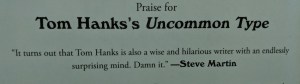
Now that’s a book blurb. Damn it.

But I do have a blurb on my cover and atop my book description. A few years ago I attended a writers conference in Arkansas and was lucky enough to get to talk with keynote speak and New York Times bestselling history writer Jeff Guinn. If you haven’t read his books, you should check them out. They’re well-researched, accessible, and fascinating—everything a great history book should be.

It was with trepidation that this upstart approached Mr. Guinn to ask for his opinion on her book. Fortunately, like Emerson, he was incredibly gracious and despite a busy schedule (filming for an upcoming documentary on Jonestown for Sundance TV), he agreed to take a look. About a week after I sent him the manuscript, the Jeff Guinn sent me this:

“Quality fiction and real history make a great match, and Sarah Angleton’s Gentleman of Misfortune offers the best of both. This is an engaging story with surprises on every page.”

—Jeff Guinn, New York Times bestselling author of The Last Gunfight and Manson

And that’s when I fainted.

freakgifOkay, I didn’t really faint, but my response was definitely a little undignified. Next I did what any author probably would. I sent the blurb off to my cover artist. And if I’d had any connections to major news outlets, I’d have probably sent it to them, too.
I know not everyone loves blurbs. Some in the publishing industry complain they’ve become so common they’re basically meaningless. Some readers ignore them. I don’t think a blurb alone would ever make me decide to read a book, but personally I like them. Knowing that someone whose work I have enjoyed or respected thought enough of a book to allow their name to be associated with it is something I find compelling.

I’m so grateful to Mr. Guinn and to the handful of other authors who offered lovely words about Gentleman of Misfortune. Each of them also has produced great works that I hope readers of my book will look up if they’re unfamiliar with them. I’m grateful to be even a small part of a generous industry full of Emersons willing to help out their emerging fellows.

So, what about you? Do book blurbs make any difference to you?

A Few Quiet Moments Under a Mattress

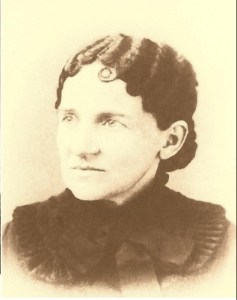
On April 24, 1874, after waiting through a nine-year engagement and defying the wishes of her parents, Zee Mimms donned a white silk dress, walked into her sister’s parlor, and stood beside her waiting groom. It might have been a beautiful scene typical of the era—an intimate wedding in a family home, a pretty young woman marrying her handsome cousin.

Zerelda_(Zee)_Mimms_James
The real Zerelda “Zee” James. By Unknown – James Farm Museum, Kearney, Missouri, Public Domain

But before the couple could say “I do,” a warning arrived and the bride found herself whisked from the room and hidden under a feather mattress. The groom, notorious outlaw Jesse James, rushed out of the house and took off on horseback leading pursuing detectives on a wild chase through the woods.

He returned to the house a little more than an hour later and made Zee his wife. With little time to celebrate, the newlyweds dashed off into a future that would involve a lot of evading, some assuming of false identities, a fair amount of heartache, and deep and undeniable love.

I have to assume it’s not easy to love an outlaw. If detectives had crashed my wedding, I might have taken those few quiet moments under the mattress to reconsider the choices that had led to my current predicament. But not Zee.

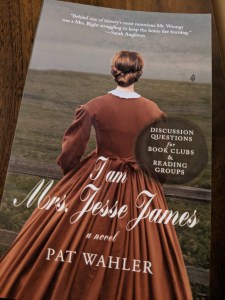
That’s hard for me to imagine. And thankfully I don’t have to, because author Pat Wahler has done that for me. Her new book, I Am Mrs. Jesse James, is out this week and if you’re a fan of historical fiction like I am, I think you’ll enjoy it. The book tells the story of Zee James, no small task given the scant records the James family left behind, and the little scholarly research that has been focused specifically on her.

I Am Mrs. Jesse James
The fictional Zee James. Also you may recognize the author whose insightful quote graces the cover.

The story of Zee hiding under the mattress comes from the writings of Stella McGown James, daughter-in-law to Zee and Jesse. When I asked Pat to share with me her favorite true story from Zee’s life, this is the one she chose. And rightly so. Just picture it.

Weddings can be stressful events, and brides worry about a lot of things, but being forced into hiding under a mattress is probably not often one of them. Then again, I would guess these days just as few women marry famous outlaws as marry their first cousins. Neither of those options seems very wise. But Zee certainly made her choice with her eyes wide open and her heart full of longing. Her story makes for a delightful read.

Also, if you like historical fiction, and you are looking for a good read, in just SEVEN MORE DAYS my new historical novel, Gentleman of Misfortune (sneak peek here), hits the shelves (mostly metaphorically—you will probably have to order it). By then, you should be just about finished with I Am Mrs. Jesse James.

Coming Soon . . .

In 1913, Marcus Loews, founder of Loew’s Theatres and later the Metro-Goldwyn-Mayer (MGM) film studio, hired a young press agent named Nils Granlund to market a vaudeville show called Hanky Panky. Granlund must have turned out to be pretty good at his job because he was soon promoted to publicity manager for all of Loew’s Theatres.

In this position, Granlund used live revues to encourage more interest in some of Loew’s underperforming theaters. Then he thought further outside the box and spliced together some rehearsal footage from the Broadway show The Pleasure Seekers and tacked it onto the end of a film. The viewing audience was intrigued. People whispered furiously to one another to express whether or not they might want to see the play and to ask for their turn with the ultra-large mega-tub of popcorn with extra butter.

buttery movie popcorn
And now I’m wondering how popcorn became so linked to movies. Also I’m a little bit hungry. via Pixabay

Okay, I don’t really know about that last part. The history of movie popcorn is another post. But the point is, the movie trailer was born. And it caught on with other promoters who, eventually moving it to the front end of the film so an audience would suffer through it, used them across the United States and throughout the world.

Of course we see trailers everywhere now. Thanks to the genius of Nils Granlund, trailers make up the first fifteen minutes of any movie-going experience. That’s just about enough time for you and your friends to get through the ultra-large mega-tub of extra buttery popcorn. Don’t worry. It comes with free refills.

Trailers are also some of the most emotionally stirring ads on television, the conversation pieces shared across social media platforms, and the third most watched type of video on the Internet, behind news and I guess maybe those hours-long YouTube productions featuring some guy playing a video game in his mother’s basement.

And though it took nearly a century for it to catch up, the book industry is now making trailers, too. Most aren’t as fancy as the slick media masterpieces made by people who know what they’re doing. Many are created by the authors themselves on shoestring budgets and with no discernible talent for movie-making.

But they serve the same purpose as both that early collection of rehearsal footage slapped together by Nils Granlund and the first glimpses of the most highly anticipated thirty-seventh retelling of the story of Spiderman. They stir in us an emotional response, and spark in us a desire to share in the enthusiasm of an artist who has poured time and energy and heart into his or her art.

So, of course, I made one.

Exactly two weeks from today my novel will make its official entrance into the world. I know that it won’t be for all of you. Every book has its reader and every reader has his or her book. But I hope you’ll watch the trailer I made on a shoestring budget and with no discernible talent for movie-making. If you do find yourself emotionally stirred or mildly interested or even if you just want to show your friends the worst example of a book trailer you’ve ever seen, I hope you’ll share it.

Thanks!


Commas and Em Dashes

Good Thursday morning to you all! This post isn’t really a post. It’s really just an explanation of why I am not posting this week…Because I’m editing!

editing-1756958__340
This is not my novel. This is a picture from Pixabay. No sneak peeks! Unless perhaps you are the kind of person who likes to review books. If that’s the case, we should talk.

Or rather, I’m carefully following 98.9% of the advice offered by a much more talented editor than me, one who doesn’t fling commas around willy-nilly, use inappropriate ellipses, and who knows her way around an em dash. I cringe to think what she would do with that last sentence.

So, what am I editing? Thank you for asking. I’m editing a book. To be precise, I’m editing my book, a (an? you can see why I need help) historical novel that will be published in early September, when it will immediately climb to the bestseller lists because of its prodigious use of em dashes. Also mummies. Did I mention it has mummies? And murder. Maybe a little bit of mayhem, too. And even a hint of romance.

Have a great week!

A Fine Specimen of a Novel Except for not Having a Head

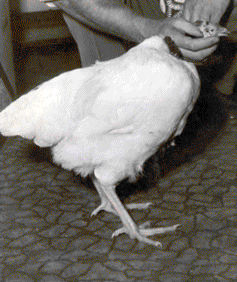
On September 10, 1945, a farmer by the name of Lloyd Olsen was expecting his mother-in-law for a visit and so he set about doing the unsavory work of killing a chicken for dinner. He scooped up a young rooster scratching and pecking its way through the barnyard and dealt the fatal blow.

Mike_headless_chicken
Mike the Miracle Chicken posing with his head. Photo via http://www.miketheheadlesschicken.org

Except that it wasn’t. The rooster staggered like any freshly killed chicken might, but unlike most, this one never stopped. Astonished, Lloyd decided not to serve the determined bird for dinner that night and the next morning found it sleeping soundly with its phantom head tucked under its wing.

The farmer knew at that point he had a genuine oddity on his hands. With an eyedropper he managed to feed his headless wonder chicken, whom he named Mike, a mix of grain and water. Soon, the Olsens and Mike were headed out on tour across the country, delighting sideshow crowds with what Lloyd referred to as “a fine specimen of a chicken except for not having a head.”

A group of skeptical headless chicken experts at the University of Utah agreed with him. It seems when Lloyd lopped off Mike’s head, the farmer somehow managed to miss the jugular vein and a very lucky clot kept Mike from bleeding out. With most of his brain stem still attached (though the larger part of his head would soon reside in a jar), Mike was still a remarkably healthy rooster. It probably doesn’t come as much of a surprise to the average chicken farmer,  but it turns out chickens (which have bird brains to begin with) don’t actually need great deal of brain power to get by.

Mike lived quite happily, raking in a tidy little sum for the Olsens (his would-be murderers), until he finally managed to choke to death eighteen months later in a motel in the middle of Arizona. But don’t be sad, because Mike’s determined spirit remains alive and well in his hometown of Fruita, California where every year on the first weekend in June, they celebrate the Mike the Headless Chicken Festival.

That’s right. This very weekend (since I’m sure you don’t have better things to do), you can hop over to Fruita and run a 5K or participate in a disc golf tournament. If you have a prize chicken of your own (headless or not), you can enter it into a poultry show, or you can try your hand at rooster calling, chicken dancing, or peep eating.

Because people will celebrate pretty much anything.

For example, just a few of the quirky celebrations you could attend in the United States this summer include: the Mosquito Festival in Clute, Texas, the Humongous Fungus Festival in Crystal Falls, Michigan, and the Road-Kill Cook off Festival in Marlinton, West Virginia.

I think that’s great. It’s all in good fun, and I do love a good quirky celebration (except for maybe that last one). And in fact, I’m doing a little celebrating of my own. If you visit this blog very often, you may have noticed, it looks a little different since the last post. More changes are coming in the near future, but for now, I am using a moderately fancier theme, and if you look to the top, there is a new page as well: “Coming Soon! A Book!”   

book galley
A book galley. Without a head.

I am delighted to announce that this fall (maybe as early as October), I will finally become a traditionally published novelist, a goal I’ve been working toward for a very long time.

I hope you’ll take a moment to click on the new page, celebrate with me, and maybe even sign up to receive an occasional e-mail about the progress of the project and some other fun stuff. I won’t be holding a mosquito calling contest (which just sounds like a bad idea) or crowning anyone “Miss Roadkill” (or “Miss Practical Historian” because that tiara is all mine). But I will be letting readers in on some exclusive content that I’m sure you’d hate missing out on even more than you’d hate missing the opportunity to don your mask and snorkel to attend the Underwater Music Festival in the Florida Keys National Marine Sanctuary.

The book, a historical novel, has no official title yet, because my publisher and I haven’t yet agreed on the perfect fit, and it has no cover yet because the brilliant graphic designer I’m working with is patiently awaiting a title so he can finish his lovely design. But I assure you that what I do have is a fine specimen of a novel except for not having a head.

While the truth of the existence of Mike the Headless Chicken has occasionally been called into question, despite the testimony of several of Utah’s finest headless chicken experts, I assure you, the book really is coming soon. And headless or not, I think  it’s worth celebrating.

A Writer’s Tour on Wyatt Earp’s Birthday

Mr. Earp will just have to wait for his feature post. Maybe next birthday.
Mr. Earp will just have to wait for his feature post. Maybe next birthday. Licensed under Public Domain via Wikimedia Commons – http://commons.wikimedia.org/wiki/File:Wyatt_Earp.jpg#/media/File:Wyatt_Earp.jpg

On March 19th, 1848 in the little town of Monmouth, Illinois, the gunslinger who would one day become the central figure in the famous shootout at the OK Corral, Wyatt Earp came screaming into the world.

But I’m not going to write about Earp this week. In fact, I’m not going to write about any historical figure at all, because a while back, a fellow blogger was kind enough to extend an invitation for me to participate in a writer’s tour.

So, first, I want to thank Camille Gatza of Wine and History Visited for including me on the tour. I have been enjoying Camille’s blog almost since I started out blogging myself.  Her posts often detail her travels through the US including wonderful background on historic sites and national and state parks. Along the way she always seems to discover unique restaurants and wineries and over the years, she has taught me pretty much everything I pretend to know about wine.

So here are the questions put forward on the tour:

What are you currently working on?

I’m always researching for both my blog and my fiction projects. The blog jumps through time and space from week to week, through the stories that I find interesting at any given time, with really very little rhyme or reason. I find that kind of research, which is admittedly not always very thorough, to be kind of a refreshing break from the research I do for my fiction projects. That is thorough and time consuming and while interesting, doesn’t always yield the kind of lighter stories I like to share in this space.

Okay, okay. Next week. I promise.   photo credit: 79109 Colby City Showdown via photopin (license)
Okay, okay. Next week. I promise. photo credit: 79109 Colby City Showdown via photopin (license)

Currently as a blogger, I am looking into the story behind LEGOS because this weekend my family and I will be attending the traveling LEGO Festival as it visits St. Louis. In my other “writerly” role, I am working through a first full draft of a novel that will hopefully serve as a companion to my first that was recently accepted for publication (!). As part of that process I am reading everything I can get my hands on about the Pennsylvania canal system in 1833, which, while interesting, and will supply wonderful historical details for the novel, is not exactly good material for this particular blog.

How does your work differ from others in your genre?

A lot of history blogs I read (and I do read a lot of them) are very information dense. Often they cite references and speak with a good deal of authority within a fairly narrow scope. I love that. And those kinds of blogs are exactly what history blogs should be.

But this isn’t that kind of blog. In fact I hesitate sometimes to even call it a history blog, because in some ways that’s not what it is. I do share stories from history, and I do spend a good amount of time (or at least some) researching my chosen topic in an attempt to provide readers with tidbits worthy of sharing at cocktail parties. But there’s also a lot of me on the pages of this blog. There’s a lot about my life and the things I find funny, or interesting, or just worthwhile. I try not to claim a great deal of authority in this space, because, frankly, I have none to claim.

But I do hope the posts are fun to read. I have a great time writing them.

Why do you write what you do?

When I was younger, history always seemed either dull or tragic to me. I’ve never been very good at memorizing dates and it seemed all I ever learned about in history class was how one group of people exploited another group of people to become the dominant people. And, really, human history can be boiled down to that if you let it be. But as I grew older and studied more literature, I began to see history through a different lens. When fleshed out with the little details that make up the experiences of individuals, suddenly each moment in history becomes many moments with many perspectives and far-reaching implications. In other words, it becomes a story. And a story, our story, is worth telling.

That realization led me to writing historical fiction, a genre that I fell in love with very quickly as a reader as well as a writer. And this blog is an extension of that. As this wonderful article in The Onion so eloquently points out, there are more stories within the history of human experience than I can possibly tell, or that any of us can possibly tell or ever know. But with this blog, each week, I get to take a stab at illuminating a little bit more.

How does your writing process work?

photo credit: Tapping a Pencil via photopin (license)
Some weeks are just like that. photo credit: Tapping a Pencil via photopin (license)

For the most part, I write what’s on my mind. If I have experienced or will be experiencing a particular event, I may use that as a jump-off for some historical research, and often the structure of the post itself will reveal that. Some weeks, something I come across in the news sends me down a trail I think might be worth sharing. And, of course, like anyone else, I have weeks when I struggle to find something to say.

Typically I start out with a very general idea of what I want to write and just start typing because I never know exactly what I’m going to want to write until I’ve already written it. After that I polish it up, trim the word count, insert what I hope are a few clever lines, throw in a few pictures, and post. Then I just sit back and wait for millions of thoughtful comments to come rolling in.

Well, okay, so that last part doesn’t really happen, but I realize that this blog is a little hard to categorize and it is sure to appeal to a fairly specific kind of reader. I am delighted that so many of you quirky, creative, thoughtful people have found it. Thank you!

And now on with the tour!

For the next stops on the tour, I’ve chosen two writers whose blogs I appreciate very much. They also both happen to be writers of historical fiction, but they each approach blogging differently than I do. I doubt they’ll be writing about Wyatt Earp this week either (although you never know). Still, I hope you’ll visit their sites, and maybe read their books as well, because it will be well worth the effort.

sam

Samuel Hall grew up in the American Heartland.
He lives with his wife near Salem, Oregon. Their three adult children continue to teach him about family relationships and authenticity, core subjects of his novel.

Visit his website at www.samhallwriter.com.

Sign up for the newsletter at www.ashberrylane.com to hear the latest about Sam’s book, Daughter of the Cimarron.

blogtourphotoAdrienne Morris lives in the country, milks goats, chases chickens and sometimes keeps the dogs off the table while writing books about the Weldon and Crenshaw families of Gilded Age Englewood, New Jersey. Her first novel, The House on Tenafly Road was selected as an Editors’ Choice Book and Notable Indie of the Year by The Historical Novel Society.