Making a Big Splash

In 1882, owner of the Rock Island and Milan Steam and Horse Railway Company, Bailey Davenport took on a new business venture to drive more business. What he created was Watchtower Park, a leisure destination at the end of the line on the bluffs overlooking the Rock River at Rock Island, Illinois.

This recreational park, admission to which was included with the price of a trolley ticket, opened with groomed hiking trails, a grand pavilion with picnic tables, and what Davenport advertised as a healing spring. Eventually, it would expand to include live theater, vaudeville, tennis courts, and billiards tables.
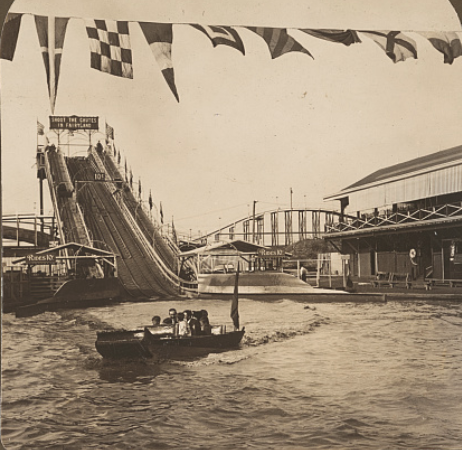
Shoot the Chute on the Pike at the 1904 World’s Fair.

But the biggest attraction, built in 1884 by J. P. Newburg, was a five hundred foot greased wooden track built into a hill down which a wide flat-bottomed boat zoom toward the river where it created a satisfying splash and glided across the surface of the water. An attendant then used a pulley system to drag the boat back up the hill for another go.

Watchtowers “Shoot the Chute” ride was the first of its kind, but the design quickly took off, becoming a frequent feature of amusement parks throughout the United States and the world. It’s probably no surprise then that a Shoot the Chute ride popped up in 1904 in the entertainment section, known as the Pike, on the grounds of the World’s Fair in St. Louis.

What might be more surprising is that there were actually two such rides on the Pike—one for the fairgoers, and one for the elephants at Hagenbeck’s Zoological Paradise and Trained Animal Circus. And just as a visitor standing nearby the Shoot the Chute could expect to enjoy a cool splash on a hot, sticky St. Louis summer day, a visitor to Hagenbeck’s could get showered by the kerplunk of an 8,000 pound pachyderm.

The elephant slide sure did make a splash, and appears frequently as a highlight in fairgoer written accounts. One biographer of Hagenbeck elephant trainer Reuben Castang even recounts a shared story in which Castang took an accidental plunge with the giant animals, and lived to play it off as if it had been a planned stunt.

Now that’s how you make a splash.

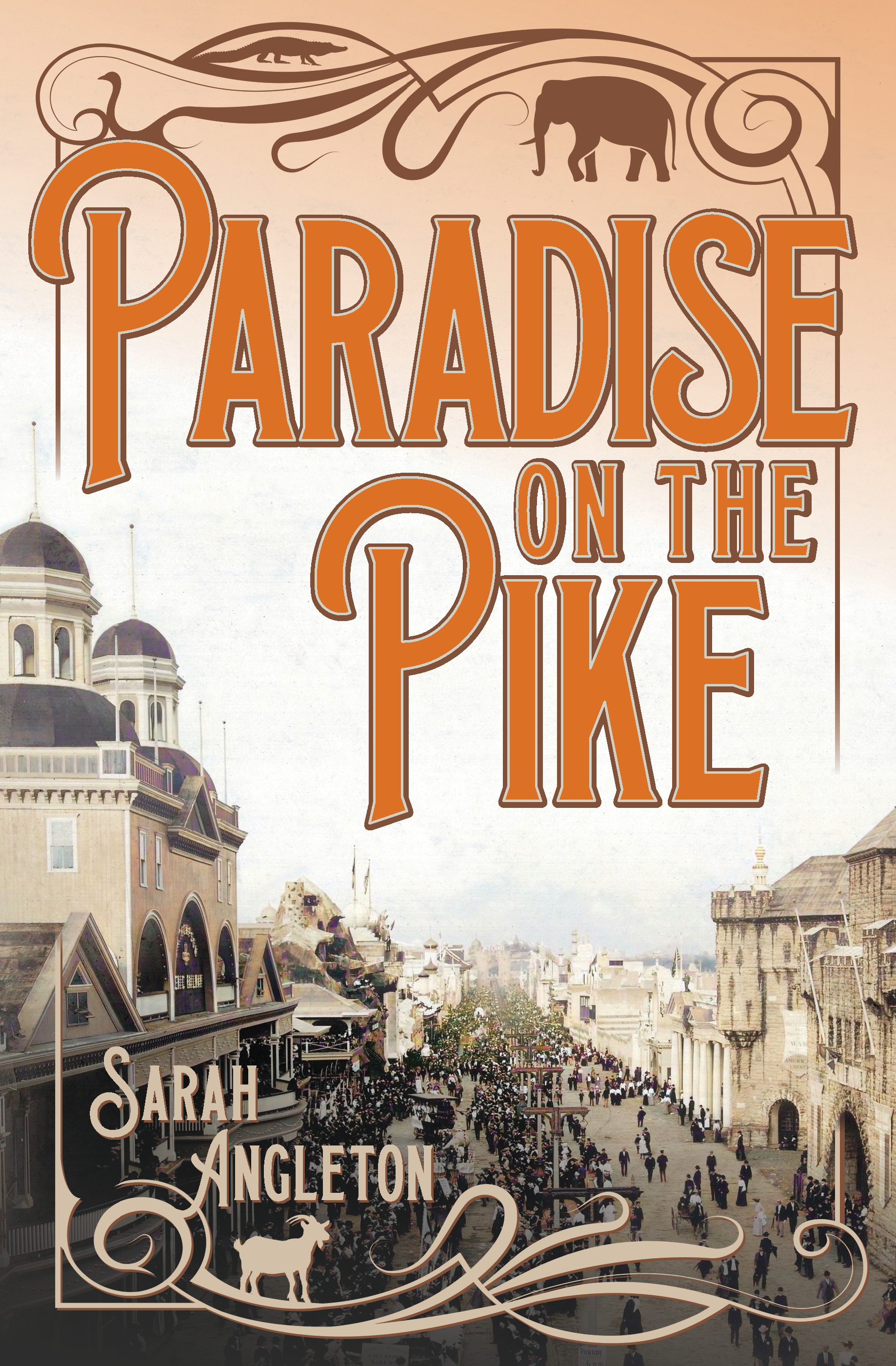
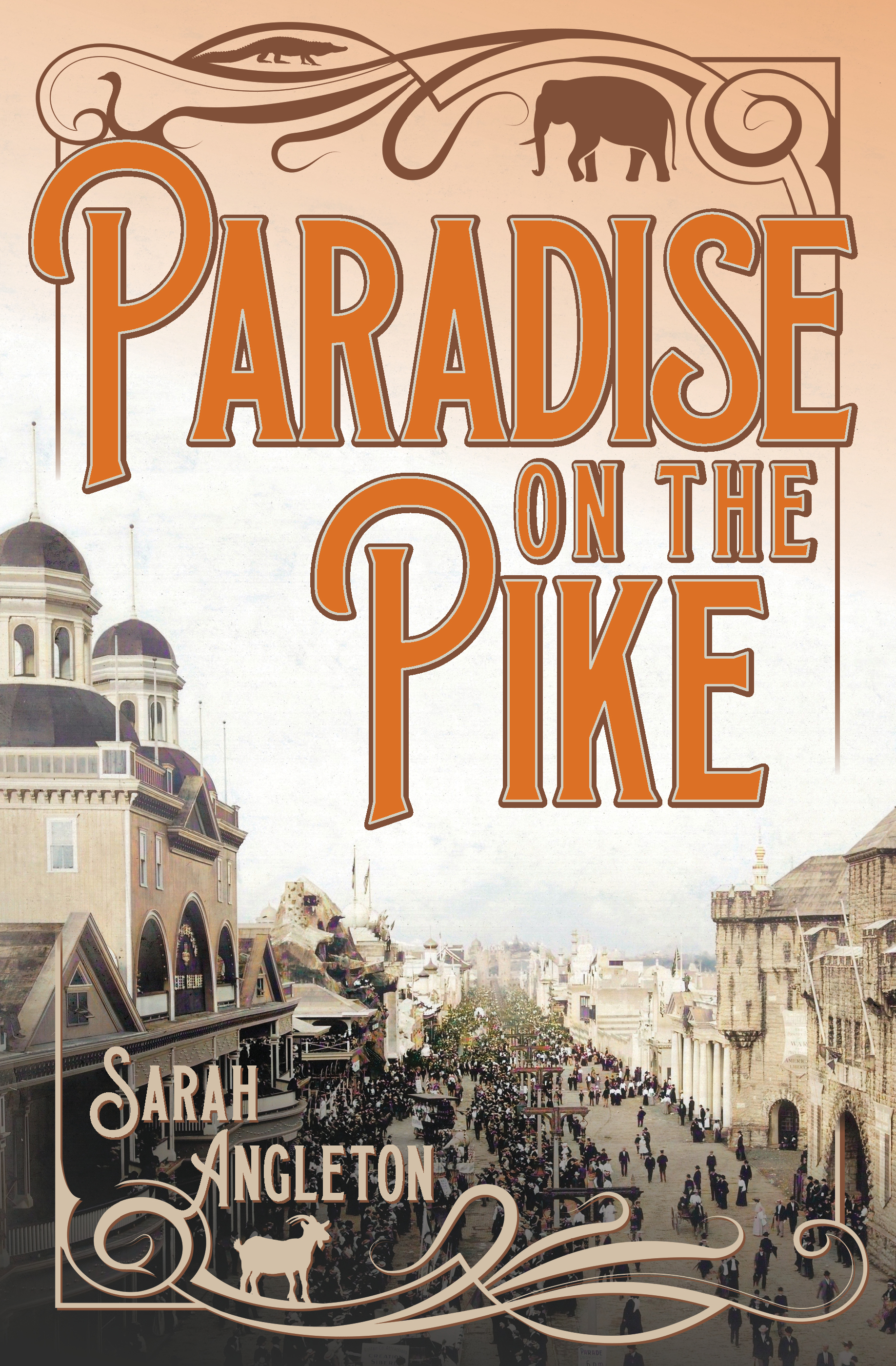
A fictionalized version of this scene appears in my new historical mystery, Paradise on the Pike, which came sliding onto the market this past week. With any luck, and with a lot of help from wonderful people spreading the word and building the buzz, it’s making a big enough splash that readers will notice and take a chance on it.

Hagenbeck’s Zoological Paradise and Trained Animal Circus is central to the novel, which is populated by elephants and many other animals that were fun characters to write. And of course sometimes when researching, you come across something that you just can’t leave out. Because everyone loves a good Shoot the Chute ride and some stories just make a big splash.

If you’d like to read more about the real Hagenbeck elephant antics that appear in the book, check out my guest post featured by writer and very gracious host Roberta Eaton Cheadle on her blog Roberta Writes.

Meet Me at the Fair

On November 22, 1944 after schedule delays, numerous script rewrites, budget woes, and a leading lady still unhappy with her role, a new Christmas musical debuted on the big screen in St. Louis, the city at the film’s heart. 

The song “Meet Me in St. Louis,” well known today because of the musical, is actually from 1904 and was written specifically for the World’s Fair. Public Domain, via Wikimedia Commons

Despite the mess of getting to that moment, Meet Me in St. Louis enjoyed immediate success, becoming Metro-Goldwyn-Mayer’s second highest grossing film up to that point, coming in only behind Gone With the Wind. After the premiere, Judy Garland even decided she liked it after all and commented to the producer, “Remind me not to tell you what kinds of pictures to make.”

The screenplay is based on a series of semi-autobiographical short stories by St. Louis native Sally Benson who wrote of an upper middle-class family that lived at 5135 Kensington Avenue during the construction of the 1904 World’s Fair on the grounds of Forest Park in St. Louis.

I confess, I saw the movie for the first time later in life than I should have, having grown up within easy reach of St. Louis. My childhood summers included trips to downtown to watch the Cardinals play at Busch Stadium where the musical’s title song is still played by the organist at every game and the crowd sings along as the words scroll across the jumbotron. 

I’ve been many times to the wonderful outdoor Muny theater in Forest Park where the stage adaptation of Meet Me in St. Louis, originally produced in 1989, is performed every few years. I even got engaged in that park on the very grounds of the actual 1904 World’s Fair.

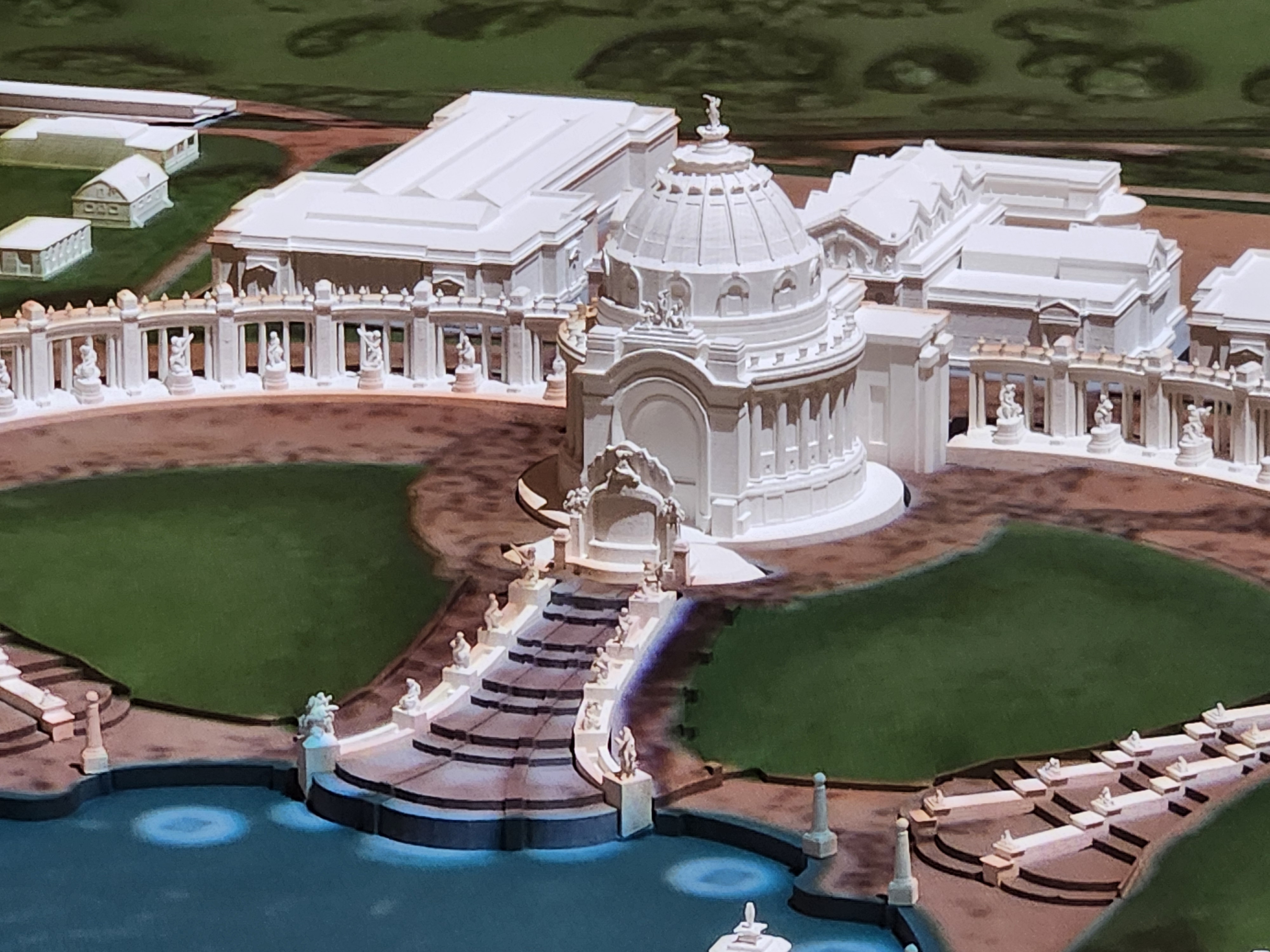
I was lucky enough to get a sneak peek at the new exhibit, open to the public on April 27th. It contains a scale model of the entire fairgrounds. And it’s spectacular.

Officially known as the Louisiana Purchase Exposition, the Fair is a big deal in St. Louis history. It transformed the city, launching it for about seven months into the center of the world’s attention. 

And it’s still a big deal, today. One-hundred and twenty years later the World’s Fair looms large in the community memory carried now by not a single living person who was there to see it, sparking excitement whenever it comes up in conversation, which is kind of weirdly a lot.

It’s especially on everyone’s minds right now because at the end of this month, just in time to celebrate the 120th anniversary of the opening of the Fair, the Missouri History Museum will reveal a newly re-imagined permanent World’s Fair exhibit. 

Equally exciting for everyone who either lives in my house or happens to be my mother, is the release of my new historical mystery set on the grounds of the 1904 World’s Fair in St. Louis. 

Paradise on the Pike is available for the first time today. The story takes place in the enchanting world of Hagenbeck’s Zoological Paradise and Trained Animal Circus on the Pike, which is the entertainment strip within the Fair. It’s not a light, sentimental sort of story like Sally Benson’s, but it does contain elephants and lions and a pair of cantankerous goats. It also allowed me, and will hopefully allow you, to spend some time strolling through the Fair, which was almost entirely constructed of temporary buildings meant to disappear.

Available today! Order from your favorite independent bookstore or slightly bigger bookstore or Amazon.

And maybe that’s why, one hundred and twenty years later, it still takes up space in our imaginations, because we’re a little like six-year-old Tootie at the end of Benson’s stories when the family marvels over the lights and fountains on the fairgrounds and her sister Agnes asks if it’ll ever be torn down.

Tootie emphatically replies, “They’ll never tear it down. It will be like this forever.”

Agnes, relieved, exclaims, “I can’t believe it. Right here where we live. Right here in St. Louis.”

Forest Park retains very few physical reminders of the enormous event that once filled its every corner and held the attention of the world, but in the hearts of the St. Louisans who stroll through the grounds and wish they could have seen those lights shining, it will never be torn down. It’ll be like this forever.

You can find more information about Paradise on the Pike at this link.

Shooting for the Moon with A Lot of Help

Even astronauts need a little help from 400,000 friends. NASA, Public domain, via Wikimedia Commons

On July 16 of 1969, at 9:32 AM approximately one million people gathered on Florida beaches to witness the launch of Apollo 11. Many of them had camped out for multiple days to claim a spot. I imagine their enthusiasm was palpable.

Millions more people watched on television. Excitement mounted in the first few days of the mission and by the time Neil Armstrong took that first small step, 650 million people tuned in to see it happen, making the event the most widely watched television broadcast in history.

And it couldn’t have happened if NASA’s first female launch controller JoAnn Morgan hadn’t been in the control room, or electrical engineer Tom Sanzone hadn’t designed and monitored the backpack life support systems worn by the moon-walkers, or if astronaut Frank Borman hadn’t used a personal connection to assure that the Luna 15 Soviet spacecraft wouldn’t interfere with the Apollo mission, or if diver Clancy Hatleb hadn’t been on scene to welcome the returning astronauts to earth by whisking them into quarantine in case of space germs.

A new historical mystery set against the backdrop of the 1904 World’s Fair in St. Louis, for fans of Water for Elephants and Devil in the White City.

In all, NASA estimates that approximately 400,000 people contributed to the success of the Apollo 11 moon landing, from thousands of engineers working throughout the world to the janitors and caterers that kept the facilities running smoothly. Every successful launch requires coordinated effort from a lot of people.

That statement is true when applied to Apollo 11, and it’s true when applied to a new book. My fourth historical novel, Paradise on the Pike, a mystery set against the backdrop of the 1904 World’s Fair in St. Louis, will officially launch on April 18 and it’s taken a lot of people to get it this far, from critique partners, beta readers, and cheerleaders to cover artist, formatter, and editor. It maybe hasn’t taken 400,000 people, but it’s been a lot.

And I still need help to get the book off the ground because no matter how enthusiastic I am about this book launch, I can’t make it successful by myself. I could really use an enthusiastic crowd to camp out on the beach and cheer loudly in hopes that even more people will become curious enough to tune in.

If you are interested in being part of that first, important crowd, I would love for you to join my launch team on Facebook. Participation is simple. You’ll receive an advance digital copy of the book to review (along with some helpful guidance if you’re not too sure how to do that) and some graphics to share on social media, There will also be some fun and chances to win prizes along the way. Sign up to be part of the group at this link:  https://forms.gle/psi7ctZ6fNK88dbB9

Or if Facebook isn’t your thing, but you happen to be a NetGalley reviewer, you can request a review copy of the book at this link: https://www.netgalley.com/catalog/book/354539

I probably won’t be able to pull together a million, or even 400,000, people to help me with this, though feel free to share the opportunity with anyone you think might be interested. Of course I also wouldn’t be terribly surprised if somewhat fewer than 650 million people eventually read my book. Still, it takes a lot of help to shoot for the moon.

Seven More Years of Wrinkles and Gray Hair

Today marks exactly four weeks until my fifth book launches into the world. It’s been nearly seven years since I published my first, a collection developed from the first five years of this blog. That book, called Launching Sheep & Other Stories from the Intersection of History and Nonsense, is part history, part memoir, and a good part made-up silliness. The cover features a picture of me in period costume.

This picture has served me well, but it’s time to age up a little bit. Image by KarenAndersonDesigns

That was my first professional author photograph. My second was taken not long after in preparation for the release of my first novel, which happened about five months later. That one is a tad bit more professional and includes much less ridiculous clothing. I’m smiling, but not too much. I look like an approachable but also knowledgeable and literary lady in her thirties.

Most of those things, I hope I am. One of them, I definitely am not. And that’s why I recently had some new photos taken. Having portraits taken is uncomfortable for me. I don’t exactly run from the camera, but as a typical mom and keeper of memories, I am more often behind the lens than in front of it.

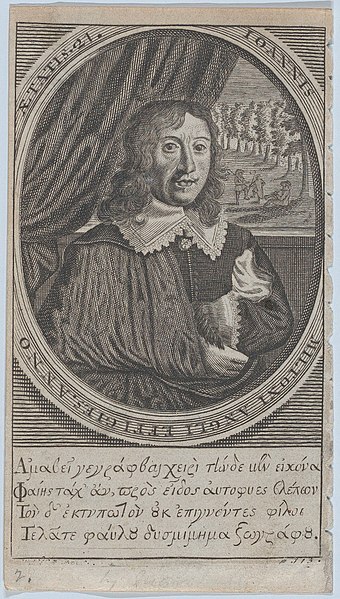
But I’ve earned nearly seven more years of wrinkles and gray hair since the last set of head shots, and readers have been expecting author portraits since the papyrus scrolls of Ancient Egypt. I couldn’t avoid them any more than John Milton could have when his printer Humphrey Moseley insisted the poet include one with his first collection of poems in 1645.

Maybe not the most flattering portrait ever. William Marshall, Public Domain, via Wikimedia Commons

Milton enlisted the help of renowned engraver William Marshall to create a frontispiece including an author portrait. At the time, Milton was thirty-seven years old, but the standard of the day was to include a picture of the poet at a younger age. Alas, that is no longer the standard.

According to the words engraved around the portrait, William aimed to depict Milton at the age of twenty-one. According to the overly large nose, greasy hair, puckered lips, and swollen right eye of the portrait, he missed.

The picture was so unflattering and Milton so upset about it, that the poet asked the engraver to include the following lines in Greek (a language that Marshall allegedly could not read) beneath the portrait:

“Looking at the form of the original, you could say, perhaps that his likeness has been drawn by a rank beginner; but, my friends, since you do not recognize what is pictured here, have a chuckle at a caricature by a good-for-nothing artist.”

An approachable, knowledgeable, literary lady with seven more years of wrinkles and gray hair, looking pretty darn okay. Image by Karen Anderson Designs.

When the collection was updated in 1673, the portrait was no longer included, but Milton, apparently still bitter about the worst head shot ever, moved his added poetic words to the interior of the book and slapped a title on them: “On the Engraver of his Portrait.”

Fortunately, my good friend and photographer is much more pleasant to work with than William Marshall apparently was. She doesn’t bat an eye when I ask her to photograph me in period costume holding a laptop, or to meet me in Forest Park in St. Louis so we can get a hint of the 1904 World’s Fair into the pictures.

She makes it as easy as possible for an awkward, squinty-eyed person such as myself to look pretty darn okay. I can trust that she’d never make my nose appear too large, my eye swollen, or my hair extra greasy. She’d probably even digitally remove my wrinkles and gray hair if I asked her to, but I didn’t. And she can trust that I’ll never include an insulting poem about her work in my book.

Malapropos of Nothing

I admit to being a little bit of a language snob. Of course I recognize that language evolves and a misspoken word today may be perfectly acceptable tomorrow, at least for some, but know that if you use a malapropism, I’ll probably judge you.

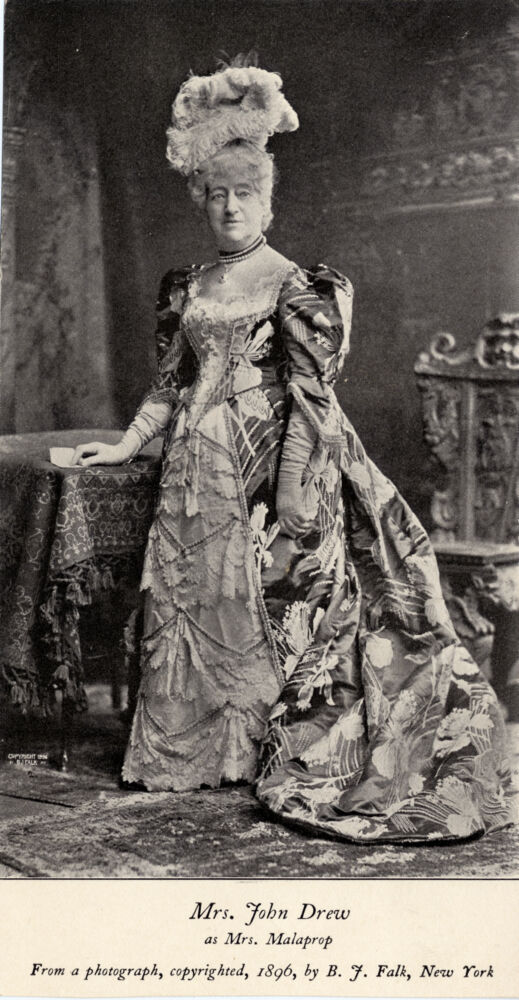
In case you are unfamiliar with the word malapropism, in lame man’s terms, it’s the mistaken replacement of a word with another that sounds similar. The term, derived from the French mal à propos, meaning inappropriate, got picked up in the English language because of playwright Richard Brinsely Sheridan. In his 1775 play The Rivals, a character named Mrs. Malaprop is notorious for muddling up her words. 

One version of Mrs. Malaprop looking “as headstrong as an allegory on the banks of the Nile,” which is one of her delightful lines. University of Illinois Urbana-Champaign University Library, Public domain, via Wikimedia Commons

That’s not to say that Sheridan was the only, or even the first, writer to make use of such a character trait, but I suppose that’s a moo point. For all intensive purposes, that’s when the concept entered the English language where it’s been driving language snobs like me bonkers ever since.

I’ve been thinking about malapropisms a lot lately because the publication date of Paradise on the Pike, my new historical novel set in the 1904 World’s Fair in St. Louis, is drawing near and I have discovered that not everyone is familiar with the word “pike.” 

If you happen to live in one of the handful of US states that contain a turnpike, you might be able to puzzle out that “turnpike” is another word for toll road and that “pike” is another word for a road. You might even be familiar with the phrase “coming down the pike,” meaning something is going to happen in the future. For example, I have a new novel coming down the pike. 

If you don’t happen to live near a turnpike, then you might mistakenly believe the phrase is “coming down the pipe,” in which case, I’m probably judging you. 

But this particular malapropism does make some logical sense because there is another phrase “in the pipeline” that also refers to something that is going to happen soon. I could, for example, tell you that I have a new novel in the pipeline. Conflating the two seems like a fairly innocuous mistake.

And of course you can go ahead and say whatever you like. It’s a doggy dog world and I don’t always get my way even if I do think malapropisms ought to be nipped in the butt whenever possible. Really, I could care less. Except that the expression, “coming down the pike,” may actually have its roots in the 1904 World’s Fair in St. Louis in which a mile long stretch of road along the north side of the fairgrounds that formed the main entertainment section of the fair was referred to as “the Pike.”

A new historical mystery coming down the pike on April 18, 2024.

The Pike contained all manner of concessions including battle reenactments, rides, a wax museum, fashion demonstrations, mock-ups of exotic locales, dancers, musicians, and animal shows. It was also the site of daily parades, leading to much excitement as people crowded around to catch a glimpse of what wondrous things might be coming down the Pike.

And so, the cover of my newest novel in the pipeline that will be coming down the pike on the 18th of April, just in time to celebrate the 120th anniversary of the 1904 World’s Fair, features a picture looking down the historical Pike. I hope you’ll forgive me for stringing out the cover reveal and keeping you on tender hooks for a few weeks. I also hope you’ll really enjoy the book when it’s finally here. And in the meantime, language snobbery aside, I hope you’ll love the book by its cover.

Charles Dickens is in Good Company

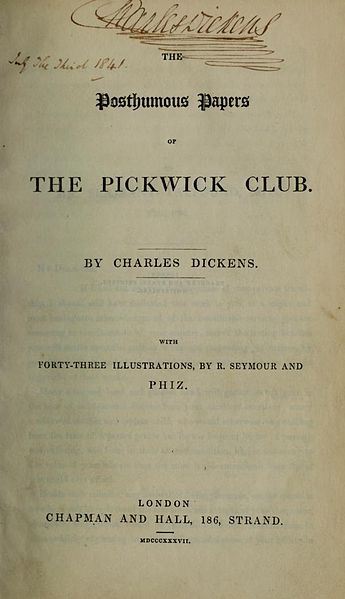
On the last day of May in 1837, avid readers of The Posthumous Papers of the Pickwick Club were disappointed. The story had been published in installments by Chapman & Hall at the end of every month since March of 1836 and by this time was approaching a print run of 40,000 for each part. It was perhaps the first truly and widely popular piece of literature to hit the London scene, spawning bootlegged copies, theatrical renditions, circulating jokes, and a wide range of merchandise.

Charles Dickens was living the dream. He’d hit the publishing market just right and given the reading public exactly what it wanted at exactly the moment it wanted it. Then in May of 1837, as it so often does, life happened and Dickens missed a deadline when his sister-in-law Mary, to whom he was close, died suddenly. He also missed a deadline for a new serial novel called Oliver Twist.

A story written by a some guy named Charles Dickens, who, much like author Sarah Angleton, was known to serialize his novels. Public domain, via Wikimedia Commons

Dickens did manage to publish a section of his Pickwick Papers the following month and an anxious readership was happy to get it. The work, which was later published as a single novel, originally reached its readers as a series of nineteen issues published over twenty months.

The idea of the serial novel wasn’t entirely new, but it hit its stride with Dickens who had begun his career publishing his Sketches by Boz in various newspapers before they were later bundled into a single work.

Readers liked the format because it was cheaper to buy a short piece than a full novel. Publishers liked it because it was cheaper and less risky to produce short pieces, which allowed them to respond to market demand rather than try to predict it. And lots of authors throughout the nineteenth century and into the early twentieth century did it, including Harriet Beecher Stowe, Fyodor Dostoevsky, Henry James, Upton Sinclair, Ernest Hemingway, and many, many others. All the cool kids were doing it.

Some guy named Charles Dickens who published serialized novels, similarly to author Sarah Angleton. National Library of Wales, Public domain, via Wikimedia Commons

Then serial fiction kind of fell out of fashion, with only the occasional experimental foray by a well-known author here or there. But now it’s making a comeback. It’s happening on blogs, of course, and podcasts, and now on more and more online publishing platforms. Even Amazon decided to get a piece of the action.

Last week saw the launch of Amazon’s newest self-publishing platform Kindle Vella. For now, it’s only available in the US and I don’t entirely understand how it works just yet, but basically, it’s an app to which authors publish their stories an “episode” at a time, and readers cash in-app coins they’ve purchased in order to continue with the next episode. I think it’s supposed to be interactive, too. That’s the part I don’t have quite figured out yet.

But I assume I will figure it out before too long, because I have begun publishing a story on Vella. This novel-in-pieces is a little different than my others that got published as plain ol’ books. Those are historical novels that most likely appeal to the kind of people who like to read historical novels, which I know because I’m so great at marketing.  Or at least they probably appeal to people who like history or novels or who have ever had a conversation with my mom or dad.

This story might not appeal to the same crowd. It’s a dystopian, sci fi story I started cooking up several years ago, in which, unsurprisingly, there is a teenage girl who is destined to become a hero and do heroic things, fall in love and possibly become embroiled in a love triangle, and learn something about herself on the way to saving the world.

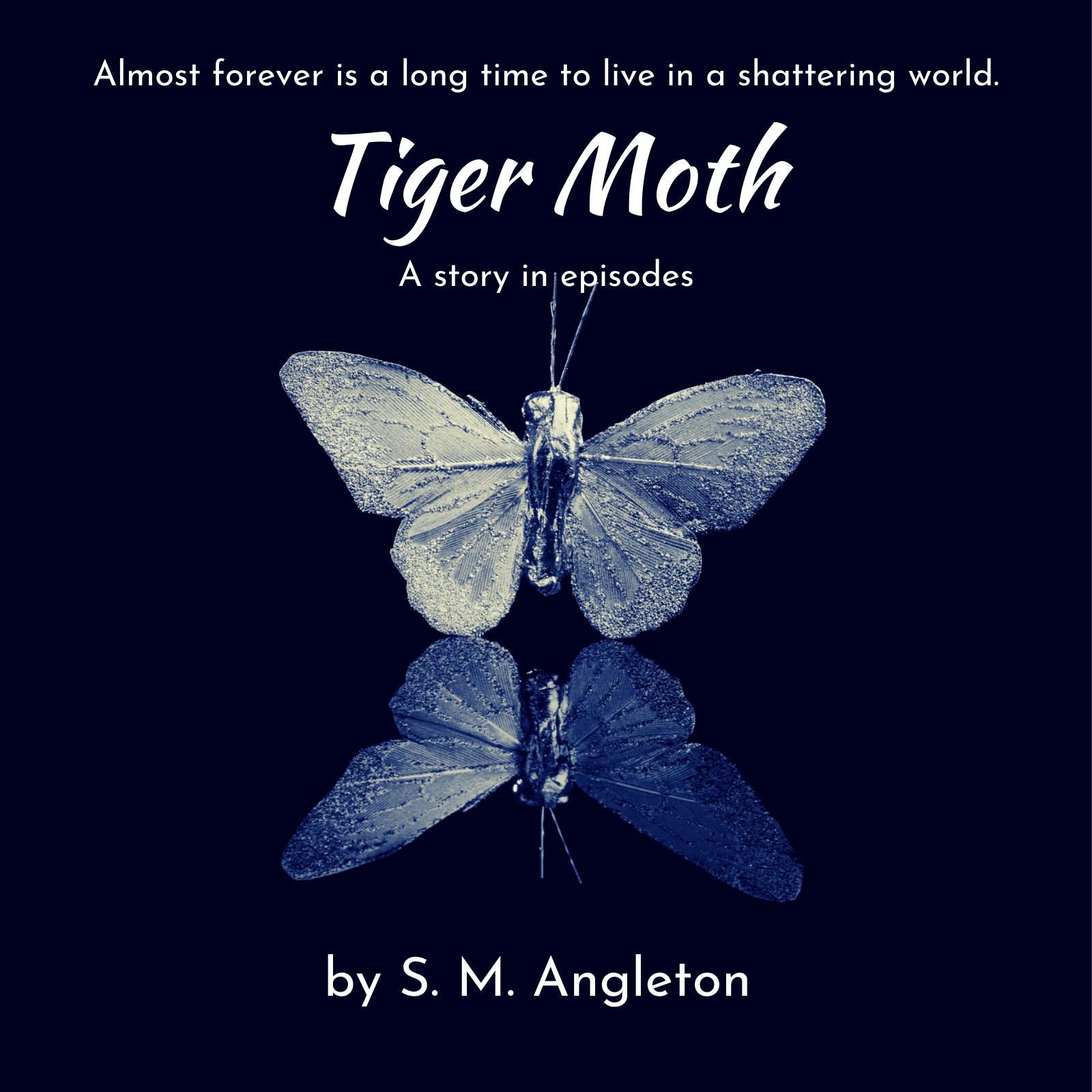
A serialized novel by Sarah Angleton (aka S. M. Angleton)

Probably. But as I post episodes and get reader feedback, I suppose it could always change a little bit. What I can state with a fair amount of confidence is that I am on schedule to upload episodes far enough in advance that if life happens, as it did last week when I failed to post in this space, new episodes should still drop each Wednesday.

Here’s the description you will find on Vella:

Built on the ashes of St. Louis, Becca’s dystopian world centers on a dark faith dedicated to pushing the limits of the human lifespan. After an unnaturally prolonged childhood, she faces the ritual that will determine her vocation and launch her initiation into adulthood, a ritual that two years prior, her brother sacrificed his life to protest. When Becca’s own ceremony takes a wrong turn, she finds herself in a world preserved by lies and a tangled history that threatens everyone she loves.

If you’re into that kind of thing, please check it out at this link to read the first few episodes for free. It’s an experiment, but I’m kind of excited about it. Maybe by the time I get to the last episode, 40,000 people will be waiting anxiously for it. It might spawn jokes, theatrical renditions, bootlegged copies, and a wide range of merchandise. Someday, I might even publish it as a book. The only thing I know for certain is that I have now joined the ranks of Charles Dickens. And I think he’s in pretty good company.

Four Score and Seven Words to Go

On November 2, 1863, a man named David Wills, writing on behalf of the governor of Pennsylvania, asked then president of the United States Abraham Lincoln if he might consider making “a few appropriate remarks” at the November 19th consecration ceremony of a new cemetery for the many soldiers who had died at the Battle of Gettysburg.

Gettysburg address
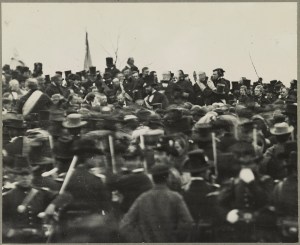
Lincoln’s in there somewhere making a few appropriate remarks. Just upper left of center, I think. Photographer attributions vary from unidentified (William Frassanito) to Mathew Brady (NARA) and David Bachrach (1845-1921) (Center for Civil War Photography). [Public domain]
The main speaker was to be Edward Everett, who allegedly spoke eloquently for nearly two hours, as everyone pretty much expected. History books rarely recount what he said. Then it was Lincoln’s turn. The president spoke relatively few words. Not even three hundred, in fact. And, diagnosed not long after with smallpox, he probably wasn’t feeling very well at the time. Still, most American school children could recite at least some of them.

Rumors have long circulated that the president dashed off the speech while on the train to the event, but that probably isn’t quite true. I don’t doubt that he fine-tuned and finalized a little of his phrasing on that train, but he’d known for a couple of weeks that he’d have to say something. Various observations place him scribbling notes between photo shoots and presidential responsibilities in the days leading up to the event. Most likely he thought a great deal about the words he would say.

I can’t speak for all writers and orators, but I know that for me much composition occurs in my head, swirling in the background of whatever essential tasks I’m completing. Sometimes I dash off a note or two to help me remember later, and then when I finally get a few dedicated moments, I have someplace to start and a great deal to pull together.

I think this is probably how it worked for Lincoln when he delivered what has become his most remembered address.

I was hoping something similar would happen with my blog post this week. You see, it’s been busy around here. I’m getting ready to launch a new book in a little less than a week, which means I have been spending a lot of time preparing. I’ve been upping my game on social media, sending off press releases, scheduling events, cranking out posts for an upcoming blog tour, and designing graphics. I even made a book trailer.

And then there’s my family, still busy doing all the many things they do while also expecting to occasionally eat and/or spend time together.

So, I was definitely hoping for some inspiration for this week’s practical history blog post. Unfortunately, if ideas were swirling somewhere in the background while I was busy elsewhere, I didn’t get them scribbled down.

But Abraham Lincoln is pretty inspiring as historical figures go. And though I think I can be fairly certain that “the world will little note, nor long remember” what I’ve written here, I can at least say I got it done.

5 more days until publication! Follow this link to check out more information about the book, or follow this one to sign up to receive occasional email updates.

What to Do in the Meantime

In 1912, rare books dealer Wilfrid Voynich added to his collection of his London shop the strangest book he never read. It’s not entirely clear how the manuscript came into Voynich’s possession, but it most likely came from the Jesuit Order, which around that time, sold some of its holdings from the library of the Roman College (by then Pontifical Gregorian University) to the Vatican and apparently to a few others as well.

Voynich2
Ohhhh… so that’s what it says. Excerpt from the Voynich Manuscript. Public Domain, Wikimedia Commons.

The Jesuits didn’t read it either, not even the scholar Athanasius Kircher, who was likely responsible for the inclusion of the manuscript in the collection.

Before him, the two hundred-plus-page manuscript probably belonged to a physician by the name of Johannes Marcus Marci, who likely received it from alchemist and antique collector George Baresch, who may have gotten it from Jacobus Horcicky de Tepenecz, who served as the personal physician to Emperor Rudolph II of Germany. Emperor Rudolf assumed the manuscript was the work of 13th century philosopher Roger Bacon and purchased it for a fairly large sum.

But none of these men ever read the book.

Because they couldn’t. What came to be known in the 20th century as the Voynich Manuscript is an enduring puzzle. Its vellum pages have been carbon-dated to the early fifteenth century, which means Bacon didn’t write it. They are filled with an unknown language or code, written by a single, careful hand, and accompanied by lots of strange pictures of unidentifiable plants, weird symbols, and plenty of naked ladies.

Voynich1
I chose not to highlight one of the pages with naked ladies, as this is a family-friendly blog. Illustration from the Voynich Manuscript. Public Domain, via Wikimedia Commons

Housed today in Yale’s Beinecke Library, and available to view online if you want to take a stab at it, the Voynich Manuscript has been defying translators for pretty much as long as it has existed. Recent attempts at translation by television writer Nicholas Gibbs and University of Bristol research assistant Gerard Cheshire have been pretty quickly shot down by Voynich scholars and enthusiasts. And in 2016, even AI failed to convince those in the know that it could crack the code.

It’s been suggested that the book is a medical guide of some sort, that it’s written in Hebrew anagrams, that it’s nothing more than an elaborate hoax, or that it’s of otherworldly origin. All we know for certain is that it’s weird, oddly fascinating, and unreadable. Perhaps it contains the answers to the greatest mysteries of the universe.

But as frustrating as it is that there’s this one book that has remained unread by everyone except, presumably, its author, I can’t help but think there are probably a lot of books no one has ever been able to read. Most languish on hard drives or exist only as scribbles in tattered notebooks. Others have been locked up in contracts with defunct presses, trapped away from the public by copyright law.

Hopefully that last possibility doesn’t apply to too many books. Very soon it will apply to one fewer, as the copyright of my first historical novel, Smoke Rose to Heaven, will be returning to me in the coming weeks. What this means is that very soon (February 4th to be exact), I will be releasing it finally into the world for anyone to read.

SmokeFrontCover
Coming soon!

I can’t promise that it contains the answers to the greatest mysteries of the universe, but it’ll be fairly easy to read because it’s written in English without anagrams, strange symbols, or unidentifiable plants. For better or worse, it doesn’t have any pictures of naked ladies, either.

I’ll have a lot more to share about this most elusive of my books in the coming weeks. You can’t read it just yet,* but maybe while you’re waiting, you can decipher the Voynich Manuscript.


*Okay, you can actually get a sneak peek if you would like to commit to giving Smoke Rose to Heaven an honest review. If that’s something that interests you, drop me a line at s_angleton@charter.net before the publication date and I’ll happily send you a complimentary e-book. You can check out the back cover blurb and read a sample here.