Don’t Call it a Comeback

Hello blogosphere! I know it’s been a hot minute since I appeared in this space. It turned out I needed the break. I also have had less time to write as I spent the last school year working full-time at a middle school where I learned to use phrases like “it’s been a hot minute.” I had a great year and would happily return for another, but life is shifting again, as it does. 

For well over a year now, my husband has been dealing with a long commute for a job that he loves. With our youngest son’s graduation from high school this spring, we’ve been looking to escape the bustling suburb that has been our home for more than a decade, searching for more land, a smaller house, and a shorter drive.

I’m pleased to report that we found all three, but as his route to work is shortening, mine is lengthening too much for my position to be practical. And that’s okay, because now, in between renovation projects on our new kind of weird house that sits on the pretty much perfect land, I can spend more time writing again.

Because when I see a majestic creature like this, the first thing I think is that it sure would look good in a hat. Minette Layne from Seattle, Washington, USA, CC BY 2.0 https://creativecommons.org/licenses/by/2.0, via Wikimedia Commons

I’m excited to be back. I’ve missed this sharing of vaguely historical and occasionally hysterical tidbits, kind of like one misses the hottest trends of their childhood. I’m seriously at least as excited as I would be if celebrities suddenly started wearing acid wash jeans again, we all decided to walk like an Egyptian, or whales donned dead salmon hats

Okay, so you may not have been entirely hip to Orca culture of the late 1980s like I have recently pretended to be, but yes, apparently, there was a brief window of time in 1987 when trendy killer whales, particularly those who frequented the Puget Sound, placed jaunty dead fish on their enormous heads.

Why they did this researchers aren’t sure, but then acid wash jeans didn’t make a lot of sense either. Some suggest it was a clever way to save some food for later during times of abundance. Orcas have been known to swim with large chunks of food tucked under a fin, a mode of transportation that isn’t terribly practical for a relatively small fish like a salmon. That fits much better as a hat. 

Or it could just be a playful fashion statement that this year has seen a little bit of a comeback. It’s definitely not as wide-spread as it was in 1987, but then I suppose the retro look isn’t for everyone. 

In case you want to dress like a fashionable Orca, Amazon has you covered.

Still, there have been a few instances over the past several months of Orcas once again sporting dead fish hats, enough to get some in the whale fashion industry to declare it a hot trend of the season, similar to the boat rudder disabling challenge that cropped up a couple years ago or the orca kelp massage fad surging right now, that is surely the result of a whale lifestyle influencer.

And why not bring back a little bit of fun, like a silly hat in a great big briny sea, or one more hopefully amusing, poorly researched, sort-of history blog written by a real human being drifting in a metaphorical sea of the artificially intelligent web.

I mean, I’m not walking like an Egyptian, but I am pretty excited to be back.

Abbott of the Stanley Cup

It has come to my attention recently that there is a trend in the world of drinking vessels. It’s all the rage and has frankly gotten a little out of hand, this bizarre obsession that has captured the enthusiasm of people all over the globe and has even caught the attention of celebrity.

I’m speaking of course of the cups made from human skulls that litter our history like the red Solo cups of last night’s frat party. 

I wouldn’t camp out in a Target parking lot for it, but that’s one fancy cup. Nicolas Perrault III, CC0, via Wikimedia Commons

It all started about 15,000 years ago in a cave in Somerset, England where ancient human remains include skulls that show signs of being carefully cleaned of bodily gunk and intentionally smoothed around the edges to offer a comfortable drinking experience for those who are into that kind of thing.

At this point you might be asking who would be into that sort of thing. It turns out maybe a good number of people, because skull cups have been dug up from lots of cultures and lots of time periods throughout Europe, Asia, and the Middle East. Writings about such things abound, or at least exist from multiple sources, which is significant when considering ancient texts.

Why people might have chosen to drink from human skulls is a little tougher to determine. Most researchers assume it was an act of ceremony, whether honoring the dead or drinking the blood of an enemy. It’s difficult to know for sure.

Rumor has it, Byron also wanted to make a cup with his friend Percy Bysshe Shelley’s skull, but his family said no. Then Mary Shelley allegedly kept her husband’s heart in a drawer. As one does. National Portrait Gallery, Public domain, via Wikimedia Commons

Perhaps there’s an answer in one of the more recent and high profile celebrity uses of a skull cup from the early 19th century when a gardener uncovered a human skeleton at Newstead Abbey, the home of the bad boy of English poetry Lord Byron. 

Byron did what any slightly imbalanced hot mess of a celebrity would do and took the skull of what he assumed was “some jolly friar or monk” to an (I have to think surprised) artisan to commission a skull cup. The poet then dubbed himself “Abbott of the Skull,” drank to his heart’s content, and wrote a poem about how it’s better for a skull to hold wine than worm castings.

So it was a noble pursuit. Or perhaps Lord Byron just wanted to stay really well hydrated like all of the people who are losing their minds right now over the Stanley Quencher. This steel vacuum cup, with reusable straw, holds up to 64 fluid ounces, fits nicely in a standard cup holder, causes stampedes at Target every time there’s a new limited edition collaborative design released, and keeps the blood of your enemies warm for hours.

Okay, so they do look like pretty great cups, and while I still wouldn’t camp out in the Target parking lot, I might be lying if I said I didn’t kind of want one. Photo courtesy of my niece who is clearly much cooler than I am.

Honestly, I don’t understand either trend, but there’s no doubt the Stanley Cup has become a sensation recently. The obsession apparently started with TikTok and has spawned a Stanley Cup Buy, Sell, Trade, and Raffle group on Facebook with more than 68,000 members, as well as another group called Stanley Cup Hunters Anonymous Support for Spouses. 

The wild fad has spurred sales for the Stanley company, which has been in the business of making steel water bottles since 1913, to grow from $94 million in 2020 to $750 million in 2023. 

If you camped out at Target to get one and you want to make a few bucks, the resale value of $45 limited edition Quenchers is currently in the neighborhood of $200. Given that Lord Byron’s skull cup sold at auction a few years ago for only somewhere around £1,000, that feels like a pretty substantial markup. 

As far as I could find, no one has yet started penning verses about the Stanley Quencher. My promised year of not attempting to write poetry is over, so I might see if I can come up with something about staying ultra-hydrated by sipping the well insulated blood of my enemies through a straw. “Abbott of the Stanley Cup” sure has a nice ring to it. Maybe the company would consider a collab and etch my poem on the outside of a limited edition Quencher available only at Target.

Thinking About the Roman Empire

I’ve been at this blogging thing for going on twelve years now, which is long enough to lose a little steam, and also to not always remember what territory I’ve already covered in this space. I am pretty sure, however, that in the first eleven years, I never once wrote specifically about chickens*. Now in year twelve, I have so far found myself writing about them twice.

Oh, maybe this is why all of the men are thinking about the Roman Empire! Public Domain, via Wikimedia Commons

It’s not that chickens aren’t fascinating creatures. I’m sure they are. I just never realized they held much of a significant role in history. That is until we all started thinking about the Roman Empire so much.

Actually, maybe you haven’t been thinking about the Roman Empire all that much lately. It started as an Instagram post turned Tik-Tok trend with a couple of Swedish influencers challenging women to ask the men in their lives how often they think about the Roman Empire. An oddly large percentage of men responded that they do think about the Roman Empire fairly often.

I’m a little late to the game because I don’t spend a great deal of time on either Instagram or Tik-Tok, but still several of the men in my life have played along and posted more than once that they are thinking about the Roman Empire again, which in turn makes me think about chickens.

Because chickens were pretty important to the Roman Empire, particularly the sacred chickens from the Greek Island of Euboea, whose opinions on foreign policy held great sway. Rightly so, because there was at least one incidence when their advice was not taken and disastrous results followed.

The story goes that during the First Punic War between Rome and Carthage, Roman consul and naval commander Publius Claudius Pulcher decided to attack the Carthaginian fleet at in the harbor of Drepana off the western coast of Sicily. As one evidently does while in Rome, he consulted the sacred chickens.

He asked his friendly neighborhood pullarius (Latin for chicken priest, just in case that ever comes up in conversation), who offered feed to the chickens and waited to see what would happen. If the chickens decided to eat, that would have been a sign of good luck. If not, then perhaps Pulcher would have been better off planning his attack for another day.

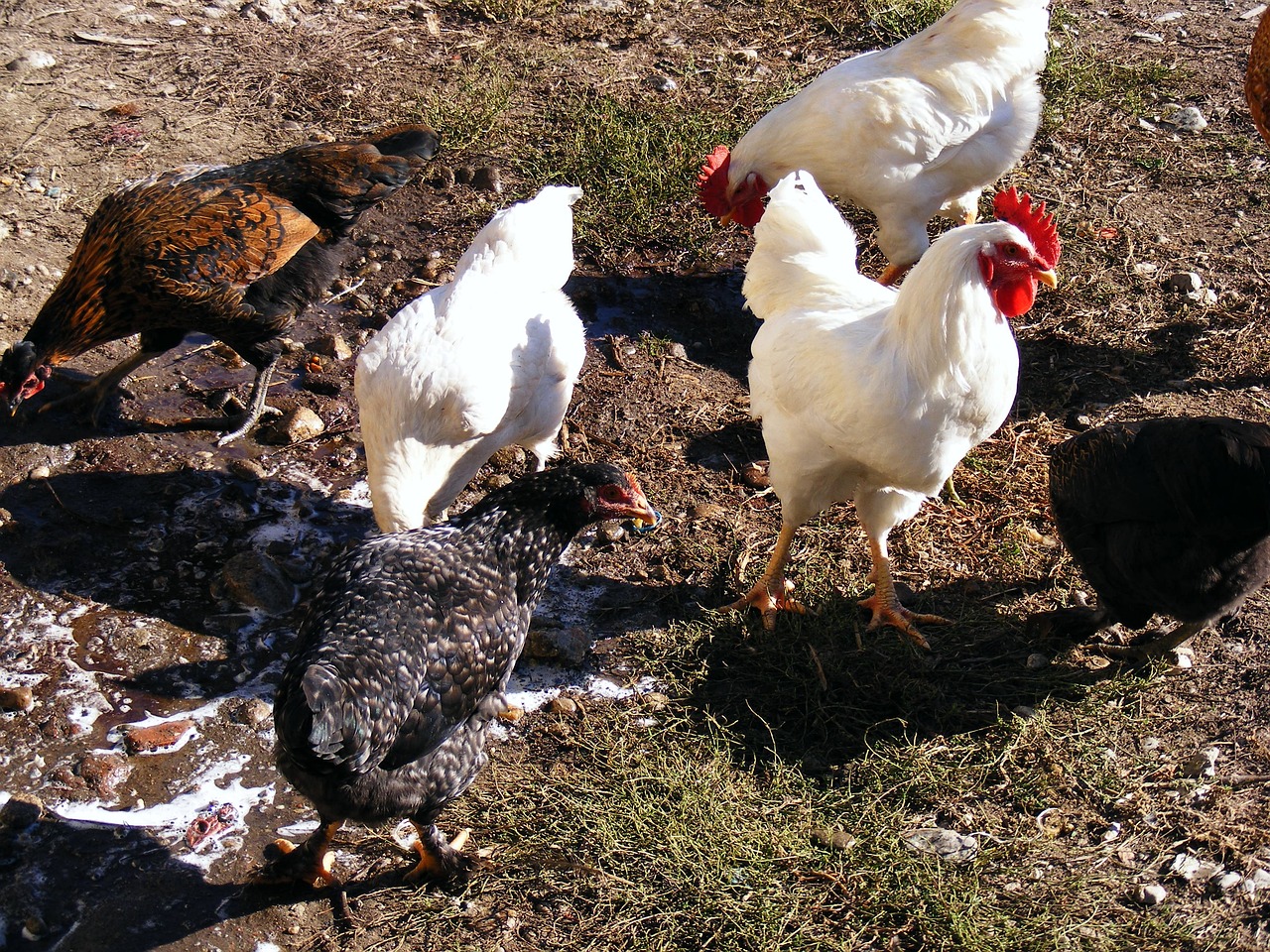
It seems reasonable to assume that if these creatures don’t feel like eating, it might be an ominous sign. Image by Emilian Robert Vicol from Pixabay

On this particular day, the chickens did not prove hungry, but Pulcher was not going to be told what to do by a bunch of bird-brained soothsayers. He allegedly responded to the chicken priest’s report that if the chickens didn’t want to eat, perhaps they could drink, and he ordered them all thrown overboard. He then went on to suffer the greatest naval defeat of the war and returned to Rome in shame.

It turns out that thinking about the chickens may be a worthwhile endeavor after all. If you spend much time thinking about the Roman Empire, they’re bound to come up eventually. Maybe even twice in only a few months.

I don’t know that I would say I spend an inordinate amount of time thinking about the Roman Empire, at least not as much as many of the men in my life apparently do. But I would bet that the time I spend writing blog posts about chickens is above average.

*After writing this post, it occurred to me that I did write about Mike the Headless Chicken once, back in June of 2016. You can begin to see why the topics are not coming as easily these days.