Research, Cannons, and Great Big Nerds

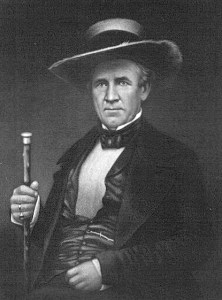
On March 10, 1842 president of the short-lived Republic of Texas Sam Houston overstepped the limits of his office when he ordered the national archives to be removed from the capital city of Austin and taken to Houston.
Samuel_houston
Sam Houston, a man who is no match for a determined archivist with a cannon. By National Portrait Gallery of Distinguished Americans. Philadelphia: D. Rice & A. N. Hart, 1854., Public Domain

A few days earlier Austin had been the site of a camp of nearly a thousand invading Mexican troops under the command of General Rafael Vásquez, but the army had been run out of the city by the time Houston issued his order. And when the wagons arrived to finally carry it out in December of that year, the danger had certainly passed. Since Houston’s goal was most likely to move the capital to his namesake city, that didn’t much matter to him.

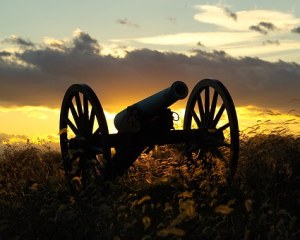
It did, however, matter very much to the people of Austin who took their responsibility to house and protect the archive material seriously—so seriously that vigilante Angelina Eberly (not an archivist by trade but certainly one in her heart) led the charge by firing on the government thieves with a cannon.

Few shots were fired overall in what came to be known as the Archive War and no significant blood was shed, but the documents remained in Austin as did the distinction of being the capital city, even after the Republic of Texas became the State of Texas.

Archives are serious business, as those who care for them will not hesitate to tell you. Personally, I am grateful for their vigilance. Because I’m going to confess something to you, dear reader, that you probably won’t find too hard to believe.

I’m a great big nerd.

star-wars-1724901__340
Darth Vader. Also probably no match for a determined archivist with a cannon.

I don’t mean that I spend all my time playing video games on YouTube or that I collect replica medieval weaponry or that I know every detail there is to know about the Star Wars Galaxy. Not that there’s anything particularly wrong with those pursuits. Except maybe the YouTube thing.

My brand of nerdiness mostly shines through in my obsessive research. I know, if you’ve read this blog much then you are probably giggling about now. It’s true that most of the posts in this space are only sort of researched, and frankly, kind of shoddily. But I make a distinction between what I do in this space and what I do when pursuing the details that inform my historical fiction projects.

I can’t promise I never make a mistake, because I’m sure I do. I probably even overlook the occasional silly anachronism. Some reader somewhere will call me out on it one day and say I should write in a different genre if I can’t even manage to take thirty seconds to Google the etymology of the phrase plays it close to the vest to discover that my character wouldn’t have said that in 1834. As a reader of the historical fiction genre myself I can go ahead and admit we’re a little nerdy and occasionally a little mean.
cannon
I probably won’t face cannon fire to gain access to the archive material I need, but if I make a historical mistake in my novel all bets are off.

So, I do my best to pursue the research as far as I can. For my current work-in-progress, I especially wanted to put my eyeballs on a diary written by one of my historical persons of interest. He’s not a widely known figure and I only discovered the existence of the unpublished diary because of a reference in the bibliography of another book. When I contacted the university library where the source was said to be housed, they couldn’t find it.

I assumed I’d have to give up. Then, not long back, while searching around on the Internet for something else, I found a blog post (some blogs can be a valuable sources of information, just usually not this one) that briefly mentioned the existence of the diary. That’s when I kind of nerded out.

I contacted the library again to find out that the archivist who had written the blog post is now at a different university. I reached out to him there, sent him the link to his post, and a few days later, I had the complete record in my inbox. All I had to do next was send it back to the original library and hope.

And wait, which is what I’m doing now. Because the archivist currently in charge of the diary in question is consulting with an expert to determine whether the physical integrity of the document will allow for safe scanning. If it doesn’t, I may have to travel to the library, which will require a possibly unreasonable amount of effort on my part.

But I get it. I do believe that archives are important enough to protect and maybe even defend with cannon fire if necessary. Because I’m a great big nerd.
 

The Queen of Strength and Beauty

Just two years after he organized what is largely considered the world’s first bodybuilding competition in 1901, acclaimed German muscle man Eugen Sandow met his match in a woman. The story goes that it was at a performance of feats of strength in New York when strongwoman Catherine Brumbach challenged anyone in the audience to outlift her.

sandwina1
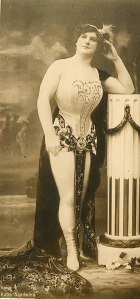
Also known as the “Lady Hercules,” Katie Sandwina was known for being feminine as well as uncommonly strong. University of Washington [Public domain]
Sandow allegedly jumped onto the stage and proceeded to lift a 300-pound barbell to chest height. Catherine then lifted the same weight over her head with one hand. Some historians question the truth of the tale that pits the two heavy lifters against one another. When one considers that Katie spent much of her life working for master promoter P.T. Barnum, it’s easy to suspect it may be little more than a load of hogwash.

But there’s no question Catherine Brumbach, whose stage name became Katie Sandwina after her rumored victory over one of the world’s strongest men, was a powerhouse. Katie grew up in a circus, performing with her very large family. When she was a teenager, her father offered a prize to any man who could outwrestle her. None ever did, but one man did fall in love and propose.

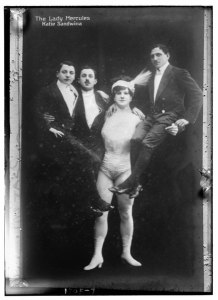
Happily married for more than fifty years, Katie incorporated her husband Max into the show, lifting his 165-pound body above her head with one arm and then tossing him about with ease.

I’m impressed by this woman, whose 5’9”, 200 lb. frame was considered by many to be the ideal image of perfect womanhood. She was even known as “Europe’s Queen of Strength and Beauty.”

sandwina2
She’s lifting three grown men. And she’s wearing heels. I’d say the title of queen is well deserved. Bain News Service, publisher [Public domain]
I can’t exactly relate, but I have recently begun lifting with my husband. Of course I don’t mean that I’m lifting him over my head like Katie Sandwina would do with her Max. But we do try to get to the gym together about three times a week where he lifts the kind of large weights a large man might lift and then I show him how it’s done by lifting much lighter weights. Super impressively.

And I am getting stronger, though I’m pretty sure no one is referring to me as America’s Queen of Strength and Beauty. Or even Missouri’s. Yet. Katie still has quite a bit of size and strength on me, and I’m a lot more interested in being a little bit healthier and a little bit stronger than I am in becoming the strongest woman in the world. She was, by the way, her record unbroken until 1987 by American weightlifter Karyn Marshall.

Katie performed with Barnum & Bailey’s Circus until she was sixty years old. Then she and Max retired to run a restaurant in New York. There this queen of beauty and strength cooked up a storm and occasionally acted as formidable bouncer until her death in 1952.

Perhaps that should be my goal. By the time we retire, I plan to be strong enough to literally throw someone out of my kitchen should the need arise. Like a queen. And of course, I’ll look beautiful doing it.

Ford, Edison, and the Quest for the World’s Largest

I love that my children are back in school and that our sense of routine has returned. Still, a couple weeks in, I also have to admit that I miss the open road. This was a summer of lots of travel for us.

spam
Unfortunately, due to time constraints and general lack of family interest, I once again missed the Spam Museum in Austin, MN. photo credit: Dick Thomas Johnson Monty Python’s Spamalot at Akasaka ACT Theater via photopin (license)

We didn’t go the huge distances we have in some years, but we made it to New Orleans so my kids could cross Louisiana off the list of states they’ve visited. We spent family time in Minnesota fishing and exploring. We took off to Madison, Wisconsin to participate in an Insane Inflatable 5K, and later the boys and I spent a week in Chicago. Rarely did a week pass us by when we didn’t set out in the old family truckster for an adventure at least a couple hours away.

I really couldn’t imagine passing the summer any other way, and I’m not alone. According to a 2019 AAA poll, 100 million Americans planned to vacation this year. Sixty-eight percent of those had plans to travel during the summer months and more than half of all travelers intended to pack up their cars and hit the road.

Ford_1921
Henry Ford and the original family truckster. New York, Public Domain, via Wikimedia Commons

It makes sense. A road trip is almost certainly cheaper for a family than air travel, there’s plenty to see across this great big country, and a good car trip means hours of forced family togetherness searching for state license plates. Plus there’re plenty of convenient amenities along the way like gas stations and restaurants and hotels. And how else are you going to see all those quirky tourist attractions like the world’s largest turkey?

A hundred years ago or so when the American road trip was just getting its start, life on the road wasn’t quite as convenient, nor were there as many roads to choose from. Prior to the invention of the automobile, the average American never traveled more than 12 miles from his or her home. I’d probably travel that far to buy a bag of my favorite potato chips.

redwing-1294702_960_720
Minnesota is the home to many of the world’s largest road trip attractions, including the biggest ball of twine in Darwin, the world’s largest turkey in Frazee, and this enormous boot in Redwing.

It’s likely not surprising that the American road trip developed in large part because of Henry Ford. When in 1908, Ford began producing the Model T (I think the “T” stood for truckster), suddenly families with modest incomes could afford a motor vehicle and they started to get an itch to see the world’s largest ball of twine.

But it was more than just Ford’s cars that inspired a new freedom to the American public. Along with his famous buddies Thomas Edison, Harvey Firestone, and John Burrows, Henry Ford embarked on a series of more or less annual road trips across various parts of the country between the years 1914 to 1924.

vagabonds
Guinn’s book peeks behind the scenes of these early road trips to explore the motives and strong personalities behind them. It’s a great read!

Because I never take a road trip without a few good books to read, I picked up The Vagabonds: The Story of Henry Ford and Thomas Edison’s Ten-Year Road Trip by Jeff Guinn this summer. The book is fascinating and it made me grateful for the amenities I enjoyed along the way. When the “Vagabonds” first started road tripping, it was pretty rough going, even with an entourage of personal servants to set up camp and cook gourmet meals.

In the pre-Kardashian era of the early twentieth century Ford and his gang were what passed for celebrities. As such their highly publicized trips gained a lot of attention. Soon the American public caught on to the idea and as the traffic increased, so did the infrastructure to support it, including the world’s largest light bulb in Edison, New Jersey. Maybe I’ll hit the road and go see that one next summer.

Fruit-Plants, Cheap Coconuts, and the Need for a Brilliant Editor

The kids are back in school this week and I am back in my little hidey hole in the basement where I churn out silly blog posts and the occasional book. It’s a big year for us. My oldest is starting high school. My youngest is headed to middle school. And I’m, well, probably going to pen the next great American novel or something.

Actually, I am pretty busy trying to get back into the swing of things, starting with some novel editing. If you’ve been following along with this blog for very long, you might recall I wrote what I refer to as a lost novel. It’s a long story (the “lost” part, not the novel, which is pretty average length), but basically, a publisher did me wrong and a book that was supposed to come out never did.

hidey hole
It’s possible that I should also spend some time cleaning up the hidey hole in the basement.

Fortunately, the lost book saga is nearly at an end. The rights will return to me early next year and I hope to release the book myself in February. And that means that right now, I’m spending a lot of time editing.

This is not as difficult as it sounds. Mostly I just have to read through the book for the 4,782nd time and acknowledge that I am incredibly lucky to work with a brilliant editor who calls me out on all my silly mistakes.

She’s also very kind. While I’m sure she rolls her eyes as she corrects my nineteenth dialog formatting error in the space of four pages, not once has she called me idiot, or even made me feel like she might. I really don’t know how she does it. I’d go cross-eyed and just start throwing in commas between every other word.

But that’s why I need a brilliant editor. Because sometimes I do that. And as small and inconspicuous as commas seem, they really do matter.

I recently stumbled on the story of a very important comma that once lost the US government about 2 million dollars. I realize that if you are a politician and not just a normal person, $2 million may not sound like that much money, so let me explain that this was in 1872. Really, that $2 million was more like $40 million in today’s money.commas save lives

Okay, if you are a politician, you’re probably still not all that impressed, but to us regular folk, that’s a pretty pricy comma.

The problem started with a tariff act passed that year which specified that on August 1, 1872, the following imported goods would be duty-free: “fruit, plants tropical and semi-tropical for the purpose of propagation or cultivation.”

If like me, you’re not so great with commas, you might gloss over the fact that this list seems to suggest that all imported tropical and semi-tropical fruits are no longer subject to tariff. Since the previous tariff act placed a 20% tax on lemons, oranges, pineapples, and grapes, and a 10% tax on limes, bananas, mangoes, pomelos, and coconuts, this had people in the business of pineapple importation pretty excited.

richardson
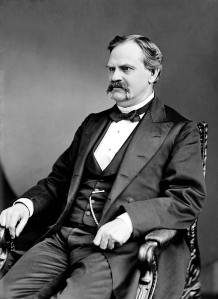
William Adam Richardson, probably not the best Secretary of the Treasury the US has ever had, and definitely in need of a brilliant editor. Public Domain, via Wikimedia Commons

Then Secretary of the Treasury William Richardson was less excited as he explained the act contained a clerk’s typo and that the comma after fruit was meant to be a hyphen. It was fruit-plants, he insisted, that were duty free, and not bananas. The threat of litigation made him roll back his statement and it took two years before an angry congress managed to correct the mistake with a new tariff act. In the meantime, a whole lot of potential government revenue helped line the pockets of some grammar enthusiast pomelo importers.

I’m pretty sure none of my comma mistakes are going to cost me that kind of money. Then again maybe my potential book sales are more substantial than I think. Like A LOT more substantial. Just in case, I’m combing through my almost-found-again book at least one more time with the help of a brilliant editor who I’m pretty sure would also not let me get away with using the word “fruit-plants.”

Still Faster than Spit

Okay, okay. So I know it’s been longer than two weeks since I last wrote in this space. Yes, I did set the goal of posting every other week through the summer. Obviously, I didn’t make it. Instead, I have spent the last month or so enjoying summer with my boys, now twelve and fourteen. We’ve done a fair bit of traveling and playing and adventuring. Most recently we took a family trip up to Minnesota.

Having spent a little time earlier in the summer exploring New Orleans, where the mighty Mississippi River comes to its end in the Gulf of Mexico, we thought we might wander up to the start of the great river just so we could say we’d travelled its length.

schoolcraft
Henry Rowe Schoolcraft, a man who is not too proud to ask for directions. Public Domain, via Wikimedia Commons

Obviously we’re not the first to have searched for the headwaters. In the late eighteenth century, the Mississippi River determined the western border of the young United States and several geologists attempted to determine exactly where the river began.

That wasn’t a simple task. The source has been placed variously at Lake Pepin, Leech Lake, Lake Julia, and Cass Lake, because the Mississippi starts in the “Land of 10,000 Lakes,” many of which connect to one another. And just to confuse matters, every explorer who “discovered” the source took it upon himself to rename it, which makes tracing the history of discovery of the source of the Mississippi nearly as convoluted as the source itself.

It was finally in 1832 with the help of an Obijewe guide that Henry Rowe Schoolcraft, evidently the only explorer man enough to stop and ask for directions from the locals who had identified the source long before that, found the once and forever, entirely indisputable source of the great river at Lake Omashkoozo-zaaga’igan. He swiftly renamed it Lake Itasca by taking a couple letters out of each of the Latin words for truth and head. It sounded pretty cool to him.

Itasca1
Lake Itasca, and some very slippery rocks.

Schoolcraft wasn’t wrong about that. He may, however, have been wrong about the once and forever, entirely indisputable source of the Mississippi River. Because four years later, a man by the name of Joseph Nicollet found a creek running into Itasca, which was, of course, named Nicollet Creek. That cracked open the debate again. It wasn’t until 1888 that a detailed survey was taken and Itasca regained its title since it turned out that the creeks running into the lake occasionally run dry.

On April 20, 1891, the Minnesota state legislature established Itasca State Park and now there’s a large brown sign that makes it very easy to spot the once and forever indisputable source of the Mississippi River.

Itasca2
I found it pretty easy to spot the source of the Mississippi.

Despite the sign, there are some hydrologists who even today insist the source is actually Hernando de Soto Lake because it is connected to Lake Itasca by underground aquifers. But nobody likes those people very much.

Every year about a half million visitors flock to Itasca to walk across the slippery rocks where it all begins. If you can’t count yourself among them, you can still enjoy a view of the headwaters via a super riveting live webcam. It’s also a great place to kayak, and some crazy, adventurous kayakers put in there to begin a 2,348 mile journey to the Gulf of Mexico. That is definitely not on my bucket list.

My family was happy enough to wade a bit, take a few pictures, and learn some fun Mississippi River facts that are posted throughout the park, including in all of the bathrooms. For instance, did you know that it takes a single drop of water starting in Lake Itasca, about ninety days to make the journey to the Gulf of Mexico? What that means then, is that if on the last day I posted to this blog space I had also spit into the Mississippi headwaters, that spit would still not have reached the Gulf of Mexico by the next time I posted. So, I’m still faster than spit.


School’s Out. Time for Dessert!

Finally, the last day of school is almost here. Originally students in our district would have been finished tomorrow afternoon, after a few fairly useless hours of turning in textbooks, cleaning out lockers, and signing yearbooks. They might also have watched a movie while teachers scrambled to input final grades.

fritz's
Worth the wait.

By shortly after noon, the streets of my town would have been overtaken by roving bands of celebrating adolescents, joining in the chorus of Alice Cooper’s School’s Out as it blares from the overtaxed speakers in the dented cars driven by their older and luckier classmates. And it would have taken upwards of an hour to get through the line at the local frozen custard stand.

Thanks to long forgotten snow days, all that joyful chaos will have to wait until next week, but my kids are ready. Their teachers are ready. And even this mama, facing a long summer of chronically bored children itching for a fight, is ready.

Because sometimes when you’ve been stuck for a long time having to meet high expectations, follow stuffy rules, and continually set aside the things you want to do for the things you have to do in order to demonstrate all that you can do, you find yourself exhausted and it’s nice to just cut loose for a little while.

amelia and eleanor
Kindred spirits Amelia Earhart and Eleanor Roosevelt, a little underdressed here for a spontaneous night flight to Baltimore. By Harris & Ewing – Public Domain, via Wikimedia Commons

First Lady Eleanor Roosevelt found that to be true. Never exactly the conventional wife of a president, taking a far more active role in politics than did her predecessors, Mrs. Roosevelt spent much of her life fighting to break from the expectations placed on her by others and demonstrating through tireless effort all that she and, by extension, all women could be capable of. I’m sure it was an exhausting job. And I’m sure sometimes she just wanted to have a little fun.

During a formal White House dinner party she hosted on the evening of April 20, 1933, she seized an opportunity to do just that. In attendance was her relatively new friend Amelia Earhart, another woman accustomed to breaking through societal expectations. As the two talked that evening, they decided that rather than eating dessert, they’d very much like to take a night flight to Baltimore and back.

The two of them, attired in their fanciest duds, rallied the other dinner guests and the whole party made its way to Hoover Field where they borrowed a plane for their flight of fancy. Because really, who is going to tell evening gown-clad Amelia Earhart and Eleanor Roosevelt they can’t borrow an airplane?

The flight, covered in detail by the Baltimore Sun, was a success. All the dinner guests made it safely back to the ground, and yes, after the surprise adventure they did return to the White House for dessert. I imagine the atmosphere was looser and the conversation lighter.

I hope our summer break can be as rejuvenating and spontaneous. Maybe we’ll blast a little Alice Cooper and hop a flight to Baltimore wearing our fanciest duds. One thing I know for sure is that we will not be skipping dessert, even if it means waiting an hour in line at the local frozen custard stand.

On a related side note, this mostly once a week blog will become a mostly every other week blog for the summertime. As the pace of motherhood picks up for the season and as I work toward a novel polishing goal, I’m not sure I can maintain a weekly blog schedule. Also, this mama could do with a little summertime fun.

A Classy Post about a Loyal Dog with an Unfortunate Name

On the night of May 29, 1805 in the Montana wilderness, a group of intrepid and weary explorers got a shock when a large buffalo bull came charging across a river, pushed off a long, wooden canoe, and crashed his way through camp. The agitated beast stomped within eighteen inches of the heads of several of the sleeping men, causing a ruckus throughout the company before anyone had time to really react.

lewisclarkseaman
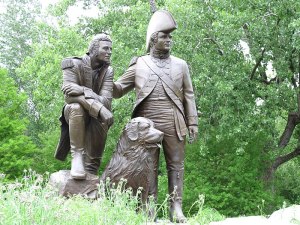
Lewis and Clark and Seaman. St. Charles, Missouri. Public Domain, via Wikimedia Commons

Captain Meriwether Lewis journaled about the scare, expressing both his relief that none of the members of the Corps of Discovery had been hurt in the incident and his pride in his dog, whose fierce and heroic reaction to the buffalo had convinced it to change direction and run out of the camp. The dog referred to was a large black Newfoundlander named Seaman.

Said to be the only animal to have made the entire trip, Seaman was evidently a pretty special pooch. Lewis purchased his doggo for twenty dollars in Pittsburgh in 1803 while awaiting the completion of the boats for his upcoming journey through the vast wilderness of the Louisiana Purchase and to the Pacific Coast.

lewisandclarktrail
There may not be any Seaman on this sign, but we know he was all over the place on the trail.

Seaman was a great defender of his pack, a pretty good hunter of tasty squirrels, and a fearless retriever of whatever the men managed to shoot. He must have been an impressive animal because a Shawnee man wished to purchase him for three beaver pelts, an offer that made Lewis scoff.

The Newfie shows up sporadically in Lewis’s writings, but it’s clear from the mentions that Seaman was a favorite of all, filling the role of mascot for the expedition. And that’s kind of how he’s portrayed now, too. You can find Seaman statues and monuments all along the Lewis and Clark Trail, including St. Louis, Missouri; Lincoln, Nebraska; Washburn, North Dakota; Great Falls, Montana; Seaside, Oregon; and many others.

seamanpostoffice
A less classy blogpost might find humor in stating that you can find Seaman all over the city of St. Charles.

You can also find him in St. Charles, Missouri, where the Corps of Discovery met up with Captain Lewis and Seaman to officially begin the journey to the west.

There, on the bank of the Missouri River, stands a fifteen-foot tall bronze statue of Lewis and Clark with their trusty canine companion. And in the last week or so, a lot more statues of Seaman have cropped up throughout the town, which this year celebrates its 250th anniversary.

To commemorate its Sestercentennial, the city commissioned local artists to decorate twenty-five statues of the famous dog that are now placed at local businesses throughout the town and that are starting to light up my Facebook feed as friends stumble on them and share obligatory pictures.

And I’m trying to be high-minded enough not to picture the meeting in which a member of the city’s promotions department pitched the idea that they should cover the whole town in Seaman. A number of other bloggers and journalists have been unable to resist the built-in, low-brow jokes. I find myself wondering whether the person who came up with the idea got fired, or got a raise.

Because people sure are talking about St. Charles, Missouri and its abundance of Seaman. I wasn’t the only person hunting him down for pictures on a pretty Wednesday afternoon. He is cute. And everyone loves a good doggo, even one with a possibly kind of funny-sounding name. You don’t have to be a dog person yourself to appreciate the aww factor of man’s best friend.

seamanpopcorn
Purple Seaman covered in popcorn on the streets of St. Charles.

The men of the Corps of Discovery certainly did. Even though hard times forced them to consume more than two hundred dogs during the expedition, Seaman made the entire journey alive and well.

Though it’s not entirely clear what happened to him after the trip, an 1814 account by Clergyman Timothy Alden writing about (then deceased) Meriwether Lewis, mentions the man’s dog who refused food and comfort, eventually dying of grief at the grave of his master.

It’s not a huge leap to assume that Seaman was the broken-hearted canine, a loyal pet that chased away a rampaging buffalo and became one of the greatest mascots in American history. He’s the kind of trusty companion worth remembering on the 250th anniversary of the town where his epic journey began, even if his name sounds a little funny. I mean, if you’re into that kind of humor.


A Modern-Day Not-a-Fish Story

When in July of 1891, the ship Star of the East made it to port in Connecticut after a two-and-a-half-year journey, it brought with it a story of Biblical proportions. Among the ship’s crew was a relatively new sailor by the name of James Bartley, who had, in his short time at sea, become the center of one of the biggest fish stories ever told.

whale
Yes, dear reader, I am perfectly aware that this is a marine mammal and not actually a big fish. Thank you for your concern.

The previous February of that same year, the Star of the East, found itself whaling off the coast of South America, near the Falkland Islands. There, two longboats full of sailors tangled with a large whale. One of the two boats became upset by the harpooned creature, which was understandably also pretty upset. The crew believed two of the men, including James Bartley, lost to the deep.

That might have been the end of James Bartley’s story, but the crew managed at last to haul the great not-a-fish aboard their vessel and began the long process of dressing their catch, harvesting the valuable blubber. Before long, they noticed something strange—the dead whale’s stomach writhed as though it were about to birth an alien.alien birth

Because as anyone who has ever seen Alien can tell you, nothing good ever burst out of a creature where it didn’t belong in the first place, the sailors took their time getting the stomach opened up. When they did, out spilled James Bartley, alive, if not especially well.

Bleached by the whale’s intestinal juices, Bartley’s skin was white and shriveled and he spent the rest of his life mostly blind. As you might expect, he wasn’t in the best frame of mind either, and suffered the emotional effects of his marine mammal imprisonment for some time afterward. But apparently by July, he was ready to tell the world about his harrowing adventure and fulfill his role as the modern-day Jonah.

You might be a little skeptical of this story and you wouldn’t be alone. But the crew of the Star of the East backed up the sailor’s claims and Bible literalists jumped at the opportunity to share what they saw as scientific proof that anyone who wished to paint the Biblical Jonah story as allegorical was a dunderhead of the first rate.

Dubious details or not, the public loved the story of James Bartley and the whale. Even after the wife of Star of the East captain John Killam claimed in a letter fifteen years later that the story was entirely invented, the tale persisted, popping up every few years in small publications, Bible commentaries, and in Ripley’s Believe it or Not comic strip, complete with insistent claims that unnamed sailors and scientists say people get swallowed by whales all the time.

jonah
Jonah is Spewed Forth by a Whale by Gustave Doré [Public domain]
Because it’s the kind of miraculous story people want to believe. So, it was pretty exciting when South African wildlife photographer Rainer Schimpf recently had a similar experience. While diving and photographing a sardine run near Port Elizabeth Harbor, Schimpf found himself head first inside the mouth of Bryde’s Whale.

Still, when I say it was a similar event, there were some important differences. First, there’s photographic evidence of the event. A colleague of Schimpf’s managed to snap a great shot of his flippered legs dangling from the side of the creature’s mouth. Also, this modern-day Jonah was not swallowed whole. In fact, in post-event interviews, the photographer confessed that he knew the whale could not swallow him. His only real concern was that the animal might drag him into the deep where he would surely drown.

Fortunately, the whale was clever enough to realize he didn’t care for the taste of wetsuit and was quick to spit out his accidental nibble as if it were a chicken bone, unharmed and with a great not-a-fish story to tell.

chicken bones
Not a bowl of sardines.

Because it is a great story. And so is the tale of James Bartley, even though it almost certainly didn’t contain even an ounce of truth. In 1991, a professor at Messiah College in Pennsylvania named Edward B. Davis investigated the claim. He discovered that there really was a ship, though not a whaling vessel, called the Star of the East, and that it is plausible the ship might have been near the Falklands at the time of the alleged event. But what he also found is that among the thorough records available was not a single mention of a sailor by the name of James Bartley.

And that is where the not-a-fish story of James Bartley really does come to an end.

The Greatest Shoe-Buying Orgy in History

On June 17th, 1943, the New York Times printed an editorial speculating that the United States found itself on the verge of the “the greatest shoe buying orgy in the history of the nation.” This was about four months into the U.S. Office of Price Administration’s institution of shoe rations.

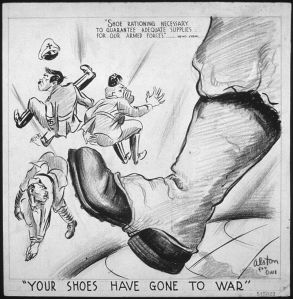
The OPA, the same people who brought the US rations on sugar and gasoline and an outright (albeit short-lived) ban on sliced bread, called for shoe rations because rubber and leather were in short supply during World War II. In their great wisdom, they suggested members of the American public could get by with no more than three new pairs of shoes per year. Also, these shoes would only come in four colors—black, white, dark brown, and light brown, and under no circumstances were shoes to be multicolored. Because war.

shoe rations
By Charles Henry Alston, 1907-1977, Artist (NARA record: 3569253) – U.S. National Archives and Records Administration, Public Domain, via Wikimedia Commons

There were some exceptions. Police officers and others who relied heavily on a sturdy pair of shoes to complete their essential tasks were excused from the rationing, and allowances were made for orthopedic shoes and in cases of lost or damaged footwear due to theft or fire. But families with fast-growing little feet had to make due by creatively distributing their ration cards from adult family members to the youngsters.

There were some other restrictions as well, including the prohibition of boots taller than ten inches, all golf spikes, and shoes with heels higher than two-and five-eighths inches, which had the added bonus of greatly increasing American foot comfort.

The shoe rationing was a logical move by the OPA, and one that the American public handled fairly well, even through a further restriction down to two pairs per year, and all the way until the rations were entirely lifted on October 30, 1945. The used shoe business surged, as did the seedy shoe black market. Some inventive entrepreneurs turned to non-rationed supplies, growing the plastic, recycled carpet, and whatever-material-one-could-find-lying-around-in-one’s-basement shoe industry. Whatever the solution, Americans spent a couple of years contemplating what might have been an unhealthy obsession with what they put on their feet.

shoe rations2
By Unknown – https://collections.carli.illinois.edu/cdm/singleitem/collection/nby_teich/id/9676, Public Domain, via Wikimedia Commons

Because there’s no question Americans like shoes. Estimates of the average number of shoes owned by today’s American woman fall somewhere between twenty-one and twenty-eight pairs, with the men polling surprisingly close behind them.

I have to admit, I scoffed a little at that. As a highly practical person who mostly wears comfy tennis shoes, I definitely don’t own such a ridiculous amount of footwear. I mean sure, I sometimes don a pair of dress flats, which I own in several sensible colors. Also, sometimes I wear boots, either black or brown, or with a dress or skirt I might occasionally put on a pair of heels to match. And everyone has to have a pair of hiking shoes, and a pair of tough summer sandals, or fun flip-flops appropriate for beach-going, or strappy little sandals for wearing with a cute summer dress.

That’s right. In an attempt to prove that I’m far superior to the average American woman, I went into my closet and started counting. Imagine my surprise when I discovered that I am, well, let’s just say above average. I walked out of my closet a little humbler, and I started to think about whether I would feel good about limiting my new shoe purchases to two or three pairs a year.

shoes
Not my closet. But it probably could be. Image from Pixabay

Of course, if I had to, I could do it. I do, after all, have a pretty good supply of shoes already. I’d probably benefit from a new pair of tennis shoes at some point during the year because they don’t last forever and I’m old enough to suffer aches and pains if I push a pair too far. I’d also probably have to give up at least one new pair for myself to get an extra for one of my growing boys.

I’d like to think that if, like the Greatest Generation before me, I had to limit myself in a patriotic effort to help out my country, I would do it without full-on panicking. Because despite a little grumbling from podiatrists and the fear expressed in the New York Times that rations would lead to hordes of crazed women engaging in shoe-buying orgies, there doesn’t seem to be much evidence that the rationing was too much of an issue.

But to be fair, I haven’t found evidence of any greater shoe-buying orgies in American history, so I guess maybe that panicked, shoe-obsessed Times writer might not have been entirely wrong.

So Cold: The Secret to My Success

Occasionally someone will ask—either at a reading event or in casual conversation—whether I find it difficult to work at home. They wonder if I get distracted by the dishes or the errands or the dirty socks my children have inevitably left stuffed behind the couch cushions.

Of course, I have to admit that sometimes I do. Sitting behind a computer screen with no one to talk to except the dog (a good listener) and the chorus of characters (not great listeners) competing for attention in my head can get a little tiresome. Then the household stuff calls to me. It’s a convenient distraction—one I can always justify because those things need to get taken care of, too.

I generally reply that I get by because I’m list-maker and dedicated time manager, and I am, but I also have a special, motivational weapon in my arsenal, especially this time of year.

I’m cold.

Like seriously cold. All. The. Time.

thermostat
One study suggests that a third of all couples argue over the temperature setting in their homes, and 40% of women admit to secretly turning up the heat when their significant other isn’t looking. photo credit: EE Image Database Woman giving the thumbs-up sign and pointing to a thermostat on the wall in her home via photopin (license)

People have been finding clever ways to keep our environments warm pretty much since the invention of people, when cave men and cave women argued about how much to build up the campfire.

In ancient Rome, some buildings evidently used systems of pipes to force hot air from pockets of empty space beneath a fire into walls as a clever method of using radiant heat to warm up a room.

After a few dark and chilly centuries when heating returned to a more primitive style, other solutions began to emerge. In 13th century Europe, the Cistercian Order of monks began using diverted and heated river water to warm their monasteries. Better stoves and chimneys were developed through the 15th, 16th, and 17th centuries. Then Benjamin Franklin invented his (appropriately named) Franklin Stove in 1741, which proved to be a somewhat effective way to force warmth and smoke into a room in greater amounts than your average fireplace.

ozziesun
My dog’s favorite solar powered heating system.

Over the next hundred years or so, Scotsman James Watt came up with a steam-driven heating system, Russian Franz San Galli invented the radiator, and American professor Warren Johnson patented the first thermostat, because he was tired of classrooms that were either too hot or too cold. I think we’ve all been there.

Just a few short years later in 1919, Alice H. Parker patented the first central heating system that used natural gas. An African American woman enduring harsh New Jersey winters, Parker said she developed the idea that formed an important basis for the convenient and safer heating systems of today because she was cold and her fireplace just wasn’t cutting it. I hear that.

office attire
Dressed for a day at the office.

According to a 2015 Dutch study, most women probably do. On average, the researchers found, ladies tend to be comfortable with a warmer ambient temperature than their gentleman counterparts do. The findings (which surprised absolutely no one who has ever attempted to share a home with a member of the opposite sex), sparked a discussion of whether office thermostats are sexist. Or something like that.

The idea was that back in the day when offices contained mostly men in three-piece suits, temperature levels were set for the comfort of those men. Today, as offices tend to contain more equal numbers of men and women, the temperatures remain set for ideal manly comfort standards. There’s a fancy formula engineers use to determine the optimal level of temperature comfort as determined by humidity, air temperature, and mean metabolic rates, etc. The problem, according to the study, is that the formula overestimates the amount of heat produced by a resting woman.

The differences have been attributed to estrogen production and muscle mass to fat ratios, which tend to be different between men and women. I don’t know that I would go so far to call the thermostat a source of inherent workplace sexism, but the struggle is real, and lots of women throughout the workforce carry an extra sweater to the office.

space heater
The secret to my success: a closed door and a space heater.

As someone who works primarily at home, I use the problem to my advantage, because I am the lone female living with three males. Through the winter, my house is always at least 2 (or 3 or 4) degrees colder than I’d like it to be. Yes, when my sons head off to school and my husband to work, I could turn up the thermostat and no one would complain.

Instead, I walk down the stairs and through a long hallway to my hidey hole office in the basement where I close the door and turn on my own personal space heater, before sitting down to work. Pretty soon, the dishes and the errands and the dirty socks begin to call to me, when the words don’t want to flow and the character voices have gone silent. When that happens, all I have to do is step outside of my office into my cold, cold house. I don’t stay there for long.