November is well under way and here in Missouri that means we’ve experienced our first cold snap and snow accumulation event, which we never get this early, except that this is the third year in a row it’s happened. And last week I wrote about how the menfolk are participating in their annual celebration of manliness by growing out their stubble for “No Shave November.”
Ouch! Image courtesy of Pixabay
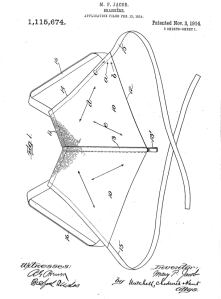
This week, for balance, I want to take a moment to recognize the genius of women, particularly one woman—Mary Phelps Jacob. In 1910, at the age of nineteen, Mary was living the American debutante lifestyle, preparing to attend yet another high society ball. Like she’d surely done many times before, she put on her stiff whalebone corset and sucked in while her maid cinched it tight before struggling into her fancy dress.
Then she examined herself in the mirror and didn’t like the way her look all came together. Or maybe it was just that she realized she couldn’t really breathe. Somewhat rashly, she asked her maid to bring her two pocket handkerchiefs, some ribbon, and a sewing kit.
So much better than a corset. By Mary Phelps Jacob – Public Domain, via Wikimedia Commons
That night Mary traded her corset for her homemade hanky contraption and was the easiest, breeziest belle at the ball. Many significantly less comfortable women took notice and, gasping for air, wanted to know her secret. It didn’t take Mary long to realize she was on to something big.
On November 3, 1914, Mary Phelps Jacobs, who would eventually become known as Caresse Crosby, received the first patent for the modern bra. Women everywhere abandoned their restrictive corsets and celebrated with a collective and blissfully deep sigh.
Jacobs wasn’t the first or only person to tackle the terrible problem of women’s undergarments, but I love her story the most because I can just picture it—the moment when comfort and practicality won over fashion.
I bet she’s not wearing a corset, either. Image courtesy of Pixabay.
I imagine it was a lot like that moment you kick off the ridiculous high heels at the wedding reception so you can actually dance or later when you trade the confining cocktail dress for your trusty old yoga pants. If there are any bewhiskered menfolk still reading at this point, I suspect this feeling is also similar to loosening your necktie.
The story of Mary Phelps Jacob is great because it’s kind of universal. And because as we head through the month of November when we stop shaving, and here in the US, we don our stretchy turkey pants and prepare to tuck in for the long, cold winter ahead, it’s nice to pause and remember that sometimes it’s the necessity of comfort that is the mother of the greatest inventions.
The weather has at last begun to turn a bit cooler here in the Midwestern US. Our peak temperatures missed their mark a little bit this year, arriving in early September rather than mid to late August and it frankly made us all kind of cranky. When you steel yourself for 95° F and humid as a bowl of soup by August 15th, and you’re dealing with it instead when all the kids are back in school and pumpkin spice has taken over the grocery shelves, it can be a little disconcerting.
But finally, we’ve arrived and we’re all celebrating. Especially my dog. And my vacuum cleaner. This lengthy summer has been hard on both of them. In fact, one of them didn’t make it through the stress.
This has been a sleeping-on-top-of-your-blanket kind of a fall. Also, you may not be able to tell from this picture, but I’m pretty sure this dog is practically bald.
Because even though the most extreme temperatures of the season were a little delayed, slightly less miserably hot and humid is still pretty hot and humid if you always wear a thick, black dog hair sweater.
Ozzie faced summer the way dogs do. He slept a lot, most often our air-conditioned house. When he did have to go outside, he found shady spots and never stayed out for too long. And he shed. A lot.
And I mean A LOT. For a while, we were brushing him twice a day and disposing of at least a toy poodle’s entire coat worth of hair each time. Of course, we were also vacuuming regularly, throwing away lots of poodles, until the vacuum decided one day it just couldn’t take it anymore.
The old vacuum lived a good long life. For years it cleaned up baby-slobber covered Cheerios, mislaid LEGO bricks, and various broken bits. It survived moves halfway across the country and back with the ripped-up scars of multiple “Load Last” stickers to show for it. It wore several belts, tangled with birthday balloon ribbons, and chased away quivering dust bunnies from beneath couch cushions and under beds.
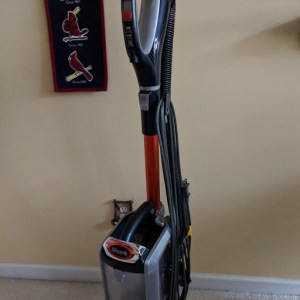
So far the new vacuum really sucks, which in this case is a good thing.
A good vacuum is one of those things you probably don’t think about too much until you need one and don’t have it. And like most great inventions it’s also one of those things you don’t invent until you realize it’s exactly what you need and you don’t have it.
That was certainly the case for Anna and Melville Bissell. In 1876, the couple ran a crockery shop in Grand Rapids, Michigan, where they received shipments of delicate goods packed carefully in boxes of sawdust.
The sawdust worked great for keeping the fine china safe, but it also made a giant mess on the floor. Mechanical carpet sweepers had been around for more than sixty years and the Bissells had one. It just didn’t work that well when facing all that sawdust.
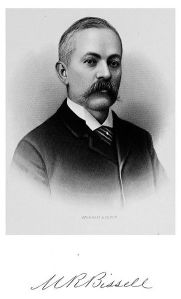
Melville Bissell, a man who outsmarted sawdust because his wife told him to. Public Domain, via Wikimedia Commons
Melville decided to design one himself. His sweeper did the job much better. It worked so well, in fact, that customers began to ask for it and a new Bissell business was born. When Melville died at only age 45 in 1889, Anna took over the company as the first female CEO in the US and successfully led Bissell to become a worldwide force in the carpet sweeping industry.
Powered vacuums were introduced at the turn of the century and eventually took over much of the market, but Bissell expanded into those as well. And today the company is still the most popular producer of carpet sweepers used most widely in the restaurant industry because of their quiet unobtrusiveness.
When our vacuum decided it couldn’t handle the dog hair and finally gave up the ghost with a loud death rattle no belt replacement could fix, we didn’t buy a carpet sweeper. We didn’t even replace it with a Bissell. But we did find a vacuum that could do the job much better. Still, I bet it’s as grateful as Ozzie is that the cooler fall weather is finally here.
Of course, I have to admit that sometimes I do. Sitting behind a computer screen with no one to talk to except the dog (a good listener) and the chorus of characters (not great listeners) competing for attention in my head can get a little tiresome. Then the household stuff calls to me. It’s a convenient distraction—one I can always justify because those things need to get taken care of, too.
I generally reply that I get by because I’m list-maker and dedicated time manager, and I am, but I also have a special, motivational weapon in my arsenal, especially this time of year.
I’m cold.
Like seriously cold. All. The. Time.
One study suggests that a third of all couples argue over the temperature setting in their homes, and 40% of women admit to secretly turning up the heat when their significant other isn’t looking. photo credit: EE Image Database Woman giving the thumbs-up sign and pointing to a thermostat on the wall in her home via photopin (license)
People have been finding clever ways to keep our environments warm pretty much since the invention of people, when cave men and cave women argued about how much to build up the campfire.
In ancient Rome, some buildings evidently used systems of pipes to force hot air from pockets of empty space beneath a fire into walls as a clever method of using radiant heat to warm up a room.
After a few dark and chilly centuries when heating returned to a more primitive style, other solutions began to emerge. In 13th century Europe, the Cistercian Order of monks began using diverted and heated river water to warm their monasteries. Better stoves and chimneys were developed through the 15th, 16th, and 17th centuries. Then Benjamin Franklin invented his (appropriately named) Franklin Stove in 1741, which proved to be a somewhat effective way to force warmth and smoke into a room in greater amounts than your average fireplace.
My dog’s favorite solar powered heating system.
Over the next hundred years or so, Scotsman James Watt came up with a steam-driven heating system, Russian Franz San Galli invented the radiator, and American professor Warren Johnson patented the first thermostat, because he was tired of classrooms that were either too hot or too cold. I think we’ve all been there.
Just a few short years later in 1919, Alice H. Parker patented the first central heating system that used natural gas. An African American woman enduring harsh New Jersey winters, Parker said she developed the idea that formed an important basis for the convenient and safer heating systems of today because she was cold and her fireplace just wasn’t cutting it. I hear that.
Dressed for a day at the office.
According to a 2015 Dutch study, most women probably do. On average, the researchers found, ladies tend to be comfortable with a warmer ambient temperature than their gentleman counterparts do. The findings (which surprised absolutely no one who has ever attempted to share a home with a member of the opposite sex), sparked a discussion of whether office thermostats are sexist. Or something like that.
The idea was that back in the day when offices contained mostly men in three-piece suits, temperature levels were set for the comfort of those men. Today, as offices tend to contain more equal numbers of men and women, the temperatures remain set for ideal manly comfort standards. There’s a fancy formula engineers use to determine the optimal level of temperature comfort as determined by humidity, air temperature, and mean metabolic rates, etc. The problem, according to the study, is that the formula overestimates the amount of heat produced by a resting woman.
The differences have been attributed to estrogen production and muscle mass to fat ratios, which tend to be different between men and women. I don’t know that I would go so far to call the thermostat a source of inherent workplace sexism, but the struggle is real, and lots of women throughout the workforce carry an extra sweater to the office.
The secret to my success: a closed door and a space heater.
As someone who works primarily at home, I use the problem to my advantage, because I am the lone female living with three males. Through the winter, my house is always at least 2 (or 3 or 4) degrees colder than I’d like it to be. Yes, when my sons head off to school and my husband to work, I could turn up the thermostat and no one would complain.
Instead, I walk down the stairs and through a long hallway to my hidey hole office in the basement where I close the door and turn on my own personal space heater, before sitting down to work. Pretty soon, the dishes and the errands and the dirty socks begin to call to me, when the words don’t want to flow and the character voices have gone silent. When that happens, all I have to do is step outside of my office into my cold, cold house. I don’t stay there for long.
On May 1, 1633, thirty-two-year-old beauty Venetia Stanley Digby was found dead in bed in her London home. A popular lady at court, her surprising demise set the city abuzz with rumors, many of them focused on her husband, the grief-stricken Sir Kenelm Digby.
Sir Kenelm Digby, father of wine snobbery. And Pinterest wine bottle centerpieces. [Public domain], via Wikimedia CommonsA popular man himself, Digby was a scholar, an off-and-on Catholic, and a former privateer. He was also a noted chef, alchemist, and enthusiastic supporter of sympathetic medicine (in which treatment was applied to the injury-causing instrument, rather than to the injured).
He was kind of like your favorite crazy uncle who dabbles in a little bit of everything. And who might accidentally kill his wife in the process. Of course this is a hypothetical uncle. I certainly have no such uncle. My uncles are wonderful men who occasionally read this blog.
Though he wasn’t a particularly faithful husband, Digby took Venetia’s death pretty hard. He retreated from his life at court, renewed his devotion to Catholicism, and found solace by throwing himself into his studies. He found greatness at the bottom of a wine bottle. Also in its sides and neck.
Don’t get me wrong. I’m a big fan of drinking wine pretentiously. photo credit: NwongPR The Somm Team via photopin (license)
Because it was around this time that England faced a wood shortage that led to an increase in hotter coal-burning furnaces rather than the wood-fed ones typically used for glassmaking. Digby fired up his furnace and went to work producing a dark, thick bottle suited for elegantly storing wine.
Up until this point in history glass hadn’t been up to the task, and if it held wine at all, it was for presentation purposes only. Since the early days of its development in about 3000 BC, glass was generally too thin and delicate for wine.
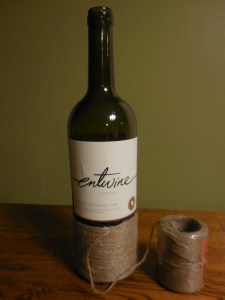
This bottle was mocking me.
That is until Sir Kenelm Digby became the father of the modern wine bottle. It’s a good thing he did, too, because before his thick-glassed bottle, wine didn’t get stored and savored and swirled and pretentiously sipped. And even more important than that, there weren’t thousands of empty, standard-sized bottles awaiting magical Pinterest transformation into dreamy wedding centerpieces.
It’s Sir Digby, then, I can thank for the hours and hours I have spent these past few weeks collecting, rinsing, and wrapping wine bottles in yards of twine. One of my nieces is a soon-to-be bride. She needs centerpieces for her reception, and I’m kind of like that favorite crazy aunt who will volunteer to do just about any tedious wedding-related task you require without complaint, though not without a blog post.
Best. Aunt. Ever. Not that it’s a competition. That I’m totally winning.
Of course my niece has many wonderful aunts who occasionally read this blog, and she has never publicly declared that I am her favorite. But I think we all know.
I also think the bottles turned out pretty well. I know the centerpieces will be beautiful, the ceremony will be perfect, and my niece and her groom will remember their special day for all of their long, happy lifetime together. I also think Sir Kenelm Digby would have been pleased to know to what great use his bottles had been repurposed, as part of a celebration of marriage and love.
Early last year I wrote about a fitness challenge I had joined, pledging to walk 2,017 miles in the year 2017. In case you’re curious and don’t like to do math, that comes out to around five and a half miles per day. It’s doable for a fairly active person, which I generally am.
Still, I didn’t make my goal last year. I was close enough that if I assumed I’d walked about twenty miles on a couple of days I missed recording and averaged twelve miles each day for the last two weeks, I would have made it. It didn’t seem worth it. Honestly, I’d done really well until November when I became more focused on writing a novel and eating turkey.
I don’t know…that looks like a lot of work. Picture by profivideos, via Pixabay
It definitely takes consistent effort and I think it’s safe to say we all have those days when we’re sick, or lazy, or sitting in a chair writing a novel, or driving across the country. It’s stringing too many of those days together that’s the problem.
But as I discovered on a recent road trip to visit my parents in Illinois that last obstacle isn’t so bad. It takes me about two hours to get to their house pretty much regardless of the route I take. Each option comes with drawbacks. The most direct route takes me across the Mighty Mississippi on a scary, crumbly bridge so narrow I’ve seen truck drivers back up rather than meet a vehicle coming across in the other direction.
This time I wisely chose to go another way with thicker traffic, but a much nicer bridge, and then a two lane highway in Illinois that could use a little love and attention and provides plenty of broken, bumpy adventure. But this road has a hidden benefit for those drivers wearing their fitness bands. In the hour I was dodging potholes on that lonely Illinois road, my fitness band credited me with six hundred steps.
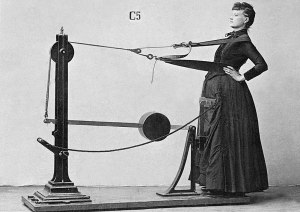
And why shouldn’t it? I may not have done the walking myself, but my body surely benefited from the jiggling. At least it might have according to Swedish physician and inventor Gustav Zander, who in the latter half of the 19th century invented some of the earliest forms of gym equipment. Included among Dr. Zander’s creations was the first belt vibrator machine (if you Google that, use caution).
This contraption had a belt you’d place around your waist or arm or leg, or I guess wherever your problem areas may be and then it magically vibrated the fat away. Dr. Zander’s wonderful machine provided healthful massage, relieved mental fatigue, rid the body of harmful toxins, and toned muscles. Or it didn’t.
The use of passive exercise machines like the belt vibrator peaked in the early part of the 20th century and surged again through the 1950s and 60s. There’s just something really appealing about getting into shape without wearing legwarmers or doing any actual work at all.
Who needs workout equipment? Picture by Antranias, via Pixabay
Even today there are numerous products on the market designed to move your muscles for you while you read a book or give yourself a pedicure. Today’s devices generally stimulate muscle contraction using targeted electrical pulses. And though such gadgets may offer some therapeutic benefits, providing you with that beach ready body isn’t one of them. For that, they’re about as effective as Dr. Zander’s original passive jiggle apparatus or my car on a bumpy road.
So maybe jostling car steps shouldn’t count, but since my fitness tracker is just as likely to ignore a quick jaunt across the room or a climb up sixteen flights of stairs, I’m going to assume it more or less evens out. This year’s goal is 2,018 miles and by the time November rolls around, I may decide to sit in a chair and write a novel while eating my body weight in turkey. I’ll need every extra jiggly step I can get.
And speaking of novels, there’s exciting news coming down the bumpy pike on that score. I can’t promise you any free steps, but if you want to be among the first in the know, you can sign up to receive email news from me here: http://eepurl.com/b3olY1
In 1948, former Royal Navy WWII pilot, accountant, and avid nudist Edward Craven Walker sat in a pub in Dorset County, England and noticed an inventive homemade device bubbling away on a stovetop in the pub’s kitchen. What he saw was an egg timer created by a regular customer using a cocktail shaker and two immiscible liquids, one of which danced before his eyes like some kind of alien blob.
Tech security company Cloudflare has a wall of Lava Lamps in its San Francisco office that it uses to generate random seeds for its encryption algorithms. It also adds a pretty chill vibe to the place. photo credit: niwasan Lava lamp Gallery – colección invierno 2009-2010 via photopin (license)
Walker was entranced by the bubbly display and mulled it over for a long time after, deciding to experiment with the concept himself in hopes of finding a way to make a lamp device that worked in a similar fashion. He retreated to his mancave shed where, presumably naked, he tried different containers and liquid combinations until he found something that worked.
In 1963, he introduced the world to his Astro Lamp. Just one year later, a US Patent was filed and in 1965 the Lava Manufacturing Corporation in Chicago bought the American rights to what they would call the Lava Lite Lamp, because groovy alliteration sells. Or at least it did in the late 60s and 70s.
I mention lava lamps today, because according to several websites devoted to listing “this day in history” events, like brainyhistory.com, on-this-day.com, and some random guy on Facebook (who, admittedly comes off a little sleazy and maybe not entirely legit) insist that April 5, 1965 was the celebration of “Lava Lamp Day.”
Groovy. And maybe that’s reason enough to celebrate.
Try as I might, I cannot determine why this particular date is important in the history of the Lava Lamp. It’s not the day the US Patent was filed. I suppose it could be the day the American rights were purchased, or even the day the lamps hit the US market, but I’m not able to verify either of those guesses. I also can’t find any reference to an actual celebration either in 1965 or beyond, that revolved around the Lava Lite Lamp. What I’m left with, then, is the assumption that it might be entirely made up and lifted and shared, as so many things on the Internet tend to be.
Still, when you come across a Lava Lamp (if you ever have then you know what I’m talking about), it’s hard to look away. And though the popularity of Walker’s psychedelic invention waned through the eighties as people became mesmerized instead by big hair and shoulder pads, it enjoyed a resurgence in the late nineties and well into today.
The Internet is pretty quiet about how the original Lava Lamp Day was celebrated, but I imagine it looked something like this.
My son, who was not alive in sixties or seventies, even has one in his bedroom. If you felt so inclined, you could probably find your own right now at your local discount store. Or your basement. And if you’re the crafty type, you can try to make your own. There are plenty of instructions available on the Internet, most of which don’t even require nudity, but then Walker’s exact formula for perfect lava-tude is a proprietary secret. Also, as previously demonstrated, the Internet may occasionally be less than reliable.
Earlier this week, social media giant Facebook, which has dramatically altered the way we interact with the kid we used to sit next to in second grade, announced that it has also invented time. The idea comes from designer Christopher Horvath, who first brought up the notion in a Facebook post in October of 2016.
How else would you ever keep track of the fascinating life of that counselor you met one weekend thirty-seven years ago at Scout Camp?
Because Facebook has been useful for connecting people with similar concerns, the post generated a large, productive response. A whole bunch of geeks chimed in and more or less agreed that a new division of time would be a pretty handy tool for more precisely synching media frames.
The new time measurement is 1/705,600,000 of a second, which makes it just enough bigger than a nanosecond that it evidently makes a difference to those in the know. These tiny units of time are called “flicks,” not to be confused with “Netflix,” a unit of time defined as the span of one full night of binge-watching The Walking Dead instead of sleeping.
Perhaps, like me, you’re not a media geek, and fail to see how this particular invention will affect you. And you can relax, because most experts who have bothered to comment on the new time division agree that it really won’t.
The flick might make some of your video experiences just a little bit crisper, but your alarm clock isn’t suddenly going to start going off 1/705,600,000 of a second earlier. Most of us ignorant schlubs will go happily on with our lives until sometime at a trivia night we’ll be asked, “What is the smallest unit of time that is still larger than a nanosecond?” and we’ll say, “Shoot. ..I think I read about that once.”
So there are 42,336,000,000 flicks in a minute and 2,540,160,000,000 flicks in an hour, in case you do happen to give a flick.
But because time measurements are imposed human constructs that help us make sense of our world, it’s not always been easy for humankind to be so nonchalant. From Ancient China’s 100 “mark” day measured between midnights, to the 12 hour day and 3-4 watch night of the Ancient Greeks, every culture has attempted to mark the passage of time through the signs of nature and habits of the population in their particular corners of the world.
And so throughout most of history, everybody just did their own thing. That resulted in a confusing assortment of time systems, but it kind of worked up until 1876 when Scottish-Canadian railroad engineer and manager Sandford Fleming missed a train in Ireland because he couldn’t figure out the local time. Miffed, he joined a movement to standardize time, proposing a universal “cosmic time” based on a common meridian from which twenty-four time zones would spread out across the world.
To me it’s really all just more wibbly-wobbly, timey- wimey stuff. photo credit: Rooners Toy Photography The Victorious via photopin (license)
Fleming shared his idea with anyone who would listen, including the 1884 Prime Meridian Conference where it was partially accepted. The conference liked the idea of Greenwich Mean Time, which adopted the Royal Observatory in Greenwich, England as the center. Worldwide standard time zones, however, were harder to impose.
It turns out time, and how it’s calculated and divided and used, is pretty central to unique cultural identity. The system took some tweaking over the years and the occasional leap second adjustment, and it actually wasn’t until 1972 that every major world nation had finally jumped on the time zone wagon.
So if you aren’t too sure you’re ready to embrace this latest adjustment to the now standard divisions of time, and you’d rather Facebook just stuck to reintroducing you to those friends you haven’t seen in more than a few flicks, it might be that you’re following in the footsteps of history.
This week brought with it at least two stunning pieces of news. The first is that highly decorated Olympic swimmer Michael Phelps does not swim as fast as a great white shark, even if he wears a simulated shark skin wetsuit and a ridiculous fin. The second, equally shocking revelation, is that within ten years, our dogs could be speaking to us.
According to consumer futurologist William Higham (whose job is not nearly as made up as it sounds), the market demands a product that will allow the translation of dog barking. And it turns out Northern Arizona University biology professor emeritus and author of a book called Chasing Dr. Doolittle: Learning the Language of Animals, Con Slobodchikoff thinks it may be possible. And frankly, his job sounds way less made up.
Alexander Graham Bell, inventor of the talking dog. And the telephone. By Moffett Studio, Public Domain, via Wikimedia Commons
A few days ago, Amazon got super excited about this and said that when there is such a product, they will be happy to ship it to you via drone and then hound you for a review. And as anyone who has ever tried to sell a book can tell you, the market lives and dies on the word of Amazon. But it got me thinking whether I really do want to know what my dog has to say.
Alexander Graham Bell, of telephone inventing fame, decided when he was a young man of twenty that he did want to know what his dog Trouve had to say. With both an elocutionist for a father and a mother who was nearly deaf, Bell became fascinated at an early age with how sound could be transformed by the shape of one’s mouth.
So he did what I’m sure any of us would have done. He taught his skye terrier to produce a sustained growl on command and then manipulated the dog’s mouth to approximate the words “How are you, Grandmama?” I imagine the interpretation took a little bit of imagination, but the discovery that it could be done led Bell in some interesting directions in his studies of speech and sound transmission.
Sometimes I do wish my dog could speak English, or at least that we could understand one another a little better. Almost two weeks ago, my family and I went out of town for the weekend and Ozzie got to spend a couple days in the kennel.
We have a great kennel and Ozzie is a very social dog, so he gets really excited when we take him there, but this time, the poor thing caught a cold. Several days after we got back, we noticed he had begun to sneeze more often than normal, and even cough a little. He was especially sleepy and didn’t seem to feel very well. We took him to the vet.
Ozzie came home with antibiotics he was not convinced he wanted to take. I wished I could explain to him the importance of the pills and that they will help him feel better, or at least prevent him from feeling even worse. Instead, I have to break them open and mix the medicine with peanut butter. And all I can do is let him lay his head on my lap so he can breathe a little easier while I scratch behind his ears.
So, I suppose we communicate just fine. Whether he understands that I’m trying to help or that the yuck he’s feeling is temporary, I don’t know. But he likes peanut butter (even when it’s laced with amoxicillin) and I think he at least knows I care.
Hopefully Trouve understood that, too. According to Bell, the dog enjoyed the attention and the treats that came along with his elocution lessons. Despite rumors to the contrary, Bell’s terrier never became a great orator. The inventor admitted he was never able to train the dog to make the sounds on his own. Of course it’s always possible that Trouve was just kind of a jerk who didn’t really care how Grandmama was doing.
In a week or so, when he’s feeling better, I bet Ozzie will be saying, “Hey, lady, where’s my peanut butter?”
And that’s the real concern I think. Because what if, after the Amazon drone delivers my dog interpretation device, I discover that I don’t care much for what my furry companion has to say. Ozzie is pretty expressive already. He tells me quite clearly when he needs to spend some private time outside and when it’s time for me to give him a treat. He can’t resist happily howling along when the boys play the piano, but seems to care not at all for the guitar and ukulele. He rests at my feet as I write, and stares at me with kind brown eyes when I read to him from my work, or pretend that I’m talking to him and not just to myself.
I suppose I’m just afraid to know what he’s really thinking at those times. What if he calls me names when I’m slower than he’d like to let him out or get him a treat? What if the lyrics he’s put to the piano tunes have no sense of poetry? What if he’s critical of my words? All things considered, I think I like our relationship the way it is. I like telling him how much I love him with a scratch behind the ears. And I like assuming that he does care very much how Grandmama is doing.
What I really need is a do-over. At the start of the summer, all those sunny weeks and lazy days ago, I had visions of happy kids and chore charts and nutritious picnics, followed by well-sunscreened adventures to swimmin’ holes, bike trails, or the ballpark. During the long, relaxed evenings, we were going to harvest the latest offerings from our garden and work together to prepare a nice meal followed up by a pie we made with the abundant fruit we picked at the local orchards.Of course, even in my fantasy my children wouldn’t eat said pie because fruit is NOT dessert. Sigh.
But you get the idea. This was supposed to be a highly organized, smooth running summer to remember. And it was all to start with that Day 1, when the biggest thing on our agenda, before all the fun could officially begin, was the organizing of all the random junk they brought home from school at the end of the year.
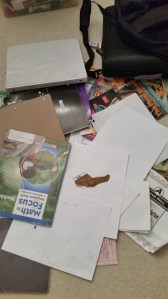
An actual picture of my actual office floor. Well, or what you can almost see of it.
Scheduled to take place in what is, throughout the school year when I have more time, my writing office, Day 1 never quite happened the way I hoped it would. The boys did follow my instructions and dump their well-worn backpacks, scribbled-on notebooks, and eraserless pencil nubs in the middle of the floor so we could sort the reusable supplies from the detritus. Somehow that’s as far as we got.
Each had his own idea of how he wanted to spend his first day of summer, and this was definitely not it. And so the pile of school year castoffs remained.
From there it was all downhill. We had a packed June with a fabulous family vacation and then camps and VBS and a mission trip for my oldest, and somehow that summer chore chart never got posted or enforced. I still can’t see the floor of my office. We haven’t been to the orchard or baked a pie my children won’t eat. And the math workbooks I bought so my children’s brains wouldn’t turn to mush over the summer break? Filled with nothing but unsolved problems and the best of intentions.
I feel like I just let the whole thing run away from me to become a disorganized mess, like the pile of crap in my office, or even like the US Patents office prior to 1836. That’s when Maine Senator John Ruggles formed a bill designed to revolutionize the US patent system, which until then had been kind of a hot mess and was in definite need of a do-over.
Prior to the 1836 act, patents required signatures from the Secretary of State, the Attorney General, and the POTUS, in the age long before a simple fax between these extremely busy people might have done the trick. Patents weren’t issued for months after they were filed, weren’t tracked effectively enough to protect an inventor from having his idea stolen, patented by someone else, and marketed falsely, and were limited to US citizens. These patents weren’t widely available to the public, held in duplicate, or even issued an identification number.
The 1877 fire in the new and improved fireproof US Patent Building. By Timothy H. O’Sullivan original photographer – Library Of Congress Public Domain, via Wikimedia Commons
The new act set up a Patent Office, run by a designated Commissioner of Patents. It required newly filed patents to be a matter of public record throughout libraries in the nation, allowed anyone to apply for a patent in the US, and demanded that applications be submitted in duplicate. The new patents were to be assigned identification numbers, with Patent Number 1 awarded to Senator Ruggles for his unique take on train wheel design. The previous patents were then retroactively numbered with “X” placed at the beginning, earning them the name “X-Patents,” and a new fireproof building was commissioned to house the records, which turned out to be timely since a few months after the act passed, the temporary patent office burned to the ground.
There was a lot of great history lost in that 1836 fire that swallowed nearly 10,000 records, including the original patent for the fire hydrant. The majority of the X-Patent records weren’t recovered. The new building, not entirely completed until 1867, didn’t catch fire until 1877. Models and records (including that of an improved fire hydrant system) went up in that blaze as well. But by then the Patent Office had gotten its act together and no records were entirely lost to history.
As many of my friends are lamenting the presence of school supplies in stores, I’m considering just torching all the X-supplies and starting fresh.
Now when I say I want a do-over, I certainly don’t mean to suggest that our summer has been a complete bust so far. We had a great family vacation and we’ve done a lot of fun things. We have ridden our bikes and done lots of swimming and made some delicious meals with the harvest from our garden. We’ve caught lightning bugs and completed summer library reading logs and been to the ballpark and gotten together with friends. I don’t want to burn the memory of those things.
But with about a month until school starts up again, I am feeling the need to start fresh. So today, on the 181st anniversary of the issuance of US Patent Number 1, I’m going to declare this Summer Day Number 1, the beginning of a refocused, more organized summer break. Everything that came before, I’m just going to call those the X-Days.
On November 16, 1874, an Indiana man by the name of William Blackstone gave his wife what might at first sound like the worst birthday gift ever. A manufacturer of farm equipment, Blackstone was definitely one of those handy fellas to have around, and what he made for the missus was perhaps the first in-home washing machine.
It consisted of a wooden tub that held water and contained pegs designed to agitate the clothing when Mrs. Blackstone turned a hand crank. And though it would be another thirty-four years until the first electric washer came along, and then another forty years or so before the electric washer started to become a common home appliance, I think it’s safe to say that the gift made the woman’s life a little easier.
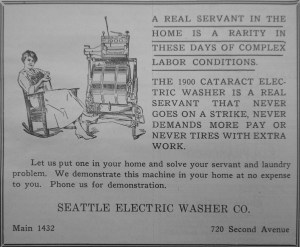
Yep, that’s when women really had it made, just whiling away the day rocking and sewing in their high heels, not having to deal with any of those pesky servants demanding raises. By Seattle Electric Washer Co. – The Argus (Seattle), April 24, 1920, p. 6. Public Domain, https://commons.wikimedia.org/w/index.php?curid=7183460
Because according to Catharine Beecher, sister to writer Harriet Beecher Stowe and promoter of education of and by women (as long as they didn’t go so far as to think they ought to get to vote), laundry was (and I’m paraphrasing a bit here), “The biggest pain in the housewife’s bustle.”
I don’t doubt that it was. Before the washing machine, women could be found on laundry day soaking their family’s clothes and then scrubbing them with caustic lye soap against washboards or pounding them around with a stick in a barrel, then boiling (while stirring to prevent scorching), rinsing, rinsing again, drying, and ironing (without the benefit of a handy steam iron that plugs into the wall, and yet still sees little use in my house).
Obviously, these women didn’t get much else done on laundry day. I can relate. Sort of. If you are an especially wonderful person who reads this blog regularly, you may have noticed I failed to post last week. And if you also follow me on any other forms of social media (like Twitter or Facebook, and if you do, then you are an absolutely amazingly wonderful person), then you might have noticed I’ve been pretty silent on those as well.
A few generations after the first Blackstone, but good to know that it has a “smooth-running, dependable motor, built [just] for the woman to operate.” photo credit: JoeInSouthernCA 1933 Maytag Washing Machine Newspaper Advert via photopin (license)Initially that’s because I was on a vacation trip with my family, though lately, my absence has been more directly related to the piles and piles of laundry produced by such a trip. Honestly, I don’t know how four people, at least two of whom most of the time couldn’t care less whether or not they wear clean clothes, can produce so much laundry. I’ve tried to do that math. It doesn’t work out.
Of course I haven’t just been doing laundry. I’ve also been trying to organize and unpack everything else, while working to get back to some semblance of a summer routine, in which I arrange my children’s social lives, constantly fighting them on their use of electronics. I’ve also been exercising to try to lose the extra five vacation pounds I just put on. And I’ve been working on putting together a syllabus for a class I’ll be teaching in the fall, when I haven’t taught the course in more than ten years. And I’ve been catching up on e-mails, and volunteer stuff, and my reading/reviewing backlog, and short stories with looming deadlines, and, and, and…
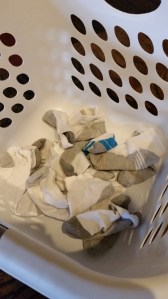
Finally, all that remains of the vacation laundry is one mostly empty basket of clean, unmatched socks. Surely someone has invented a machine that would take care of this for me. Now, that’s something I’d want for my birthday!
So as the person who does most of the laundry in my house, I am definitely grateful for the ability to toss the clothes in the washer and forget about them until they smell mildewy and I have to run the cycle again. Actually, I’m not sure the convenience saves me that much time, though. Because if I had to spend a full day soaking and scrubbing and rinsing and ironing, maybe I wouldn’t try so hard to overextend myself in other ways.
I hope that’s not what Mrs. Blackstone found when her husband gave her a washing machine for her birthday, when all she probably really wanted was jewelry a chance to read a book without having to listen to a child drone on and on and on about Minecraft/Star Wars/Lord of the Rings.
I may be projecting a little bit there.
I’m sure Mr. Blackstone’s wife loved her gift. It wasn’t long until the neighbors got wind of it and soon he was out of the farm equipment business and into the manufacturing of washing machines instead. The invention was a success, and I hope it helped Mrs. Blackstone get what she really wanted for her next birthday, just a little extra time to post to her blog, or to at least read a few chapters of a good book in peace.






















 Author Sarah Angleton