The Summer of Flying Whatsists

We are approaching the anniversary of a very big week for the United States and for the world because between July 19th and July 27th of 1952 was the peak of intense UFO sightings in a year that had been filled with them. Over the course of the previous four years the US Air Force had recorded observations of 615 UFOs. In 1952 alone, that number jumped to 717.

USA National Archives and Records Administration, Public Domain, via Wimikedia Commons.

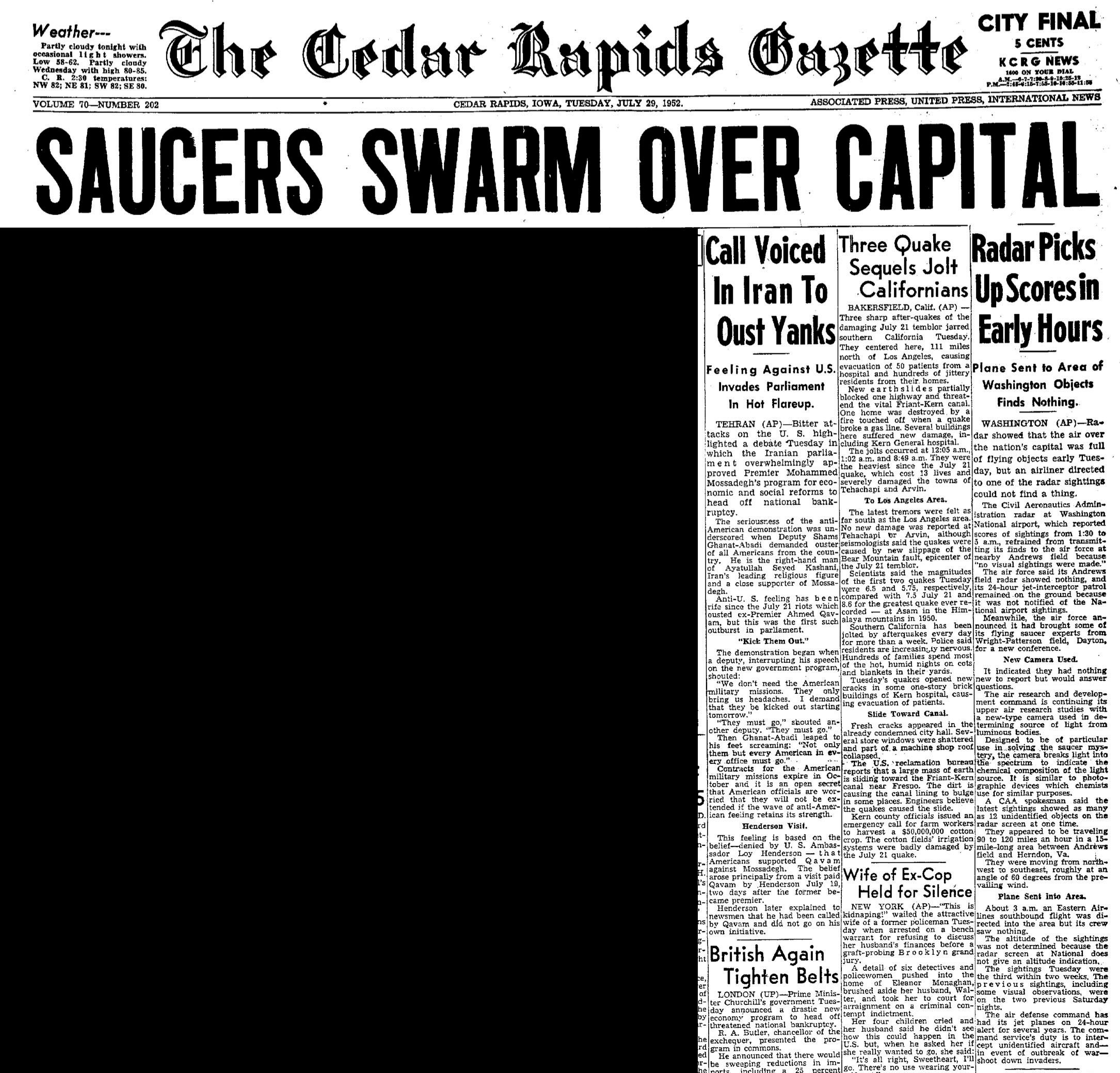
The media noticed, particularly in that one week in July when many of the reported UFOs were spotted in the air over Washington DC. Headlines across the nation proclaimed the news. The Cedar Rapids Gazette announced: “SAUCERS SWARM OVER CAPITAL.” The front page of the Standard-Sentinal out of Hazelton, Pennsylvania declared: “RADAR SPOTS MORE ‘FLYING WHATSITS’ OVER WASHINGTON, and in Monroe, Louisiana, the front page of the Monroe News-Star featured the headline: “RADAR SPOTS ‘FLYING SAUCERS’ IN BACKYARD OF NATIONAL CAPITAL.”

Of course most of the articles do acknowledge various versions of the official government response, provided in the largest Pentagon press conference since World War II, that there was no national security concern at all, and that the sightings could be attributed to natural phenomenon like air temperature inversions and meteorite activity.

The UFO media frenzy seems to have been touched off by an April article in Look magazine that asked the question, “HAVE WE VISITORS FROM SPACE?” Then it steadily built because the eyewitnesses to UFOs weren’t just the usual crazies, but also included more credible people like both military and civilian pilots as well as air traffic controllers, some of whom were insistent that their observations didn’t perfectly fit the explanations.

I did see a series of UFOs earlier this spring over my house. That is until my husband identified them as a Space X satellite launch. Still a pretty cool thing to get to see.

Of course the most likely truth rarely gets in the way of a good sensational headline, or even a slanted story, of the variety that will sell a lot of news to the hysterical people who most want to consume it. That was certainly true in 1952, just as it was during the Summer of the Shark in 2001, when everyone became so afraid to go into the water that the number of shark attacks was down a little bit, and just as it has been every single year, before or since, that there has been nationwide media coverage. 

Yes, that includes now. But before you get mad at me, it also includes every year the other political flavor held more power, too. Because media is a business designed, like all businesses, to make a grab for our attention and resources. It’s most successful when we’re scared and angry and maybe a little irrational, which is why it works very hard to keep us that way. 

Am I suggesting that there isn’t any truth to the sensational, terrible, nation-ending, world altering stories we are consuming in the media every day? Well, not exactly, but often with a little distance and the slight change in perspective it might offer, we can start to see things a bit more clearly.

I suppose I can’t really say for certain that DC wasn’t visited by flying saucers in July of 1952, but I have read that when digital filters were added to radar equipment in the 1970s, there was a sharp reduction in reported UFO sightings. And that really can only mean one thing. Clearly, flying saucer cloaking technology also saw vast improvement at that time.

Just Don’t Tell the Historians

Many things likely happened in the year 1404. Numerous babies took their first breaths and plenty of people surely took their last. Battles were waged and both won and lost. Some powerful people became more powerful, while the power of others began to decline. And in Korea, the second king of the Joseon Dynasty, King Taejong, fell off his horse.

Taejong was on a deer hunt when it happened. As he drew his bow, his horse stumbled and the king took a tumble. History knows of the incident because of the Veritable Records, an important feature of the Joseon Dynasty, the last royal house to rule Korea. The records, written in Classical Chinese, were maintained by hired historians tasked with extensive and entirely neutral preservation of events related to the monarchy and the state.

And I mean the truth is, if Taejong hadn’t asked the historians not to write about the fall, they still might have, but we probably wouldn’t be talking about it 620 years later. Image by Joachim_Marian_Winkler from Pixabay

Historians in this role were guaranteed legal protection from the king for what they wrote, and in fact, he wasn’t allowed to see them at all. Only other historians could take a look. They were sworn to secrecy and faced severe punishment if they failed to keep it under wraps. To avoid any potential royal interference, the documents remained sealed until after the king’s death and the new king’s coronation.

So when Taejong fell from his horse that fateful day, we not only know that it happened, but we also know that he tried to hide it from the historians. Because they wrote about that part, too.

It’s an astonishing story, not that a powerful man fell from his horse, as I’m sure that could happen to anyone. And not that a powerful man would want to hide an embarrassing incident from history. But that powerful people believed so firmly in the importance of free and accurate reporting that they took pains to ensure it could happen, even when it meant they might wind up being the butt of the joke.

The Veritable Records are now digitized. With the exception of the those of the last two Joseon monarchs, which are believed to have been unduly influenced by the Japanese and are considered less reliable, they are part of the National Treasures of South Korea, and are included in the Memory of the World register of the the United Nations Educational, Scientific, and Cultural Organization (UNESCO).

I’m cynical enough not to suggest that the Veritable Records are one hundred percent impartial. History is, after all, always written from the perspective of whatever imperfect human recorded it. It honestly wouldn’t surprise me if the story was thrown in just to lend credibility to the rest.

Um, yeah. Probably not. Image by Gerd Altmann from Pixabay

But I still find it astonishing from a modern perspective. Because today it’s not uncommon to find out that a story that could show a powerful person in a bad light has been ignored, suppressed, or tweaked by an allegedly free press to suggest a secret organization of assassin horse trainers clearly has it out for a powerful person. Probably because the powerful person is racist. Or something.

Or, just as bad, that this allegedly free press has amplified, distorted, or misrepresented a story in order to make it seem like a tumble from a horse might just be a character-revealing act of animal cruelty by a person undeserving of power. And who is also probably a racist. Or something.

It’s a confusing place to be as a society, not to know if there are any trustworthy media sources out there, free from influence of the powerful attempting to control the flow of information to those of us schlubs that make up the confused masses.

I’m just cynical enough to believe that there aren’t.

Bathed in Journalistic Integrity

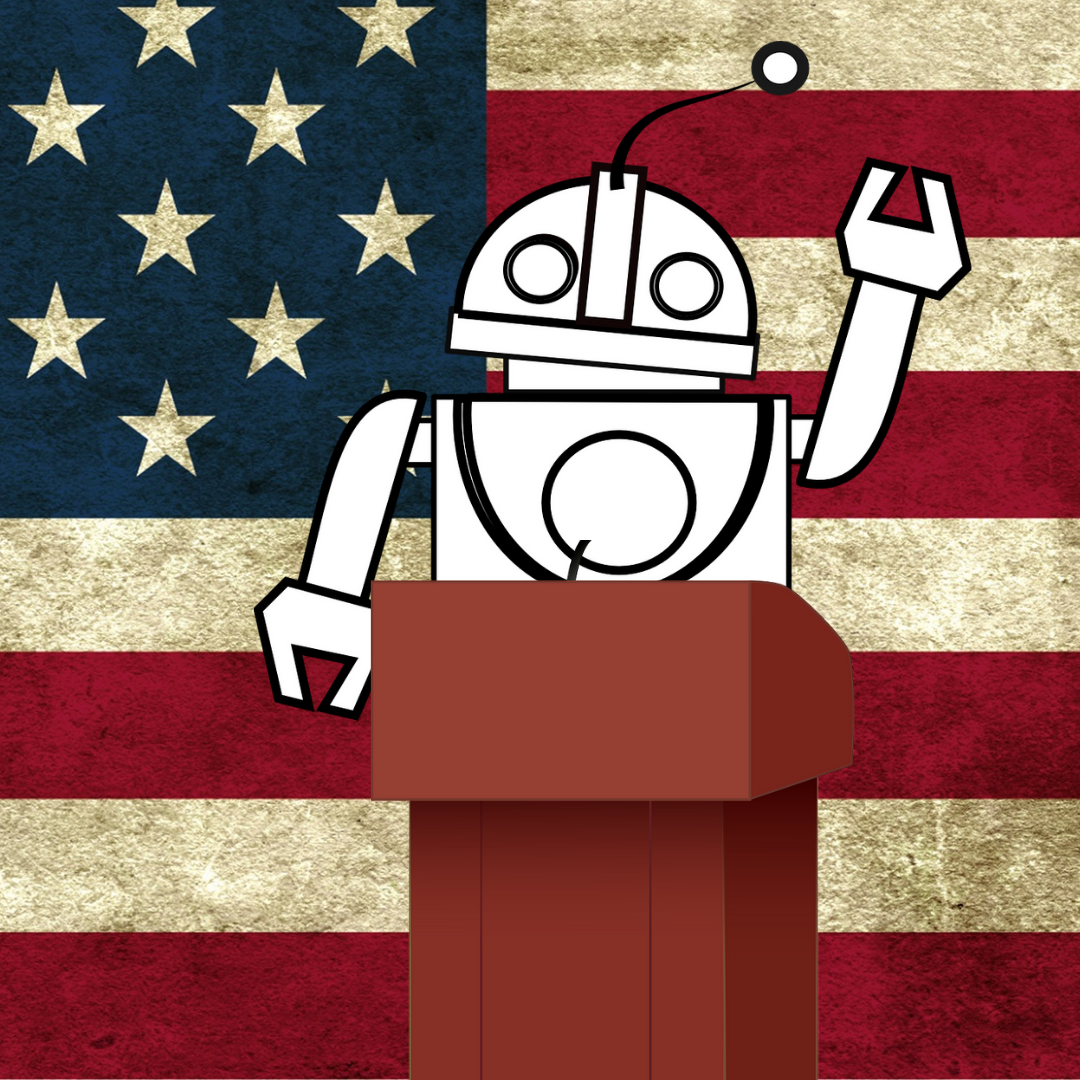
You might have noticed that the world right now is a pretty messy place. I suppose that’s always true to some extent, but in this moment, it feels especially difficult to discuss important things without a misstep sure to incur the wrath of someone. Of course, this particular blog doesn’t enjoy a terribly wide audience anyway and so I doubt there would be much public outcry were I to accidentally presume an incorrect gender pronoun or commit an inadvertent microaggression or innocently inquire whether a particular bumbling world leader is in fact a malfunctioning animatron.

It’s a good thing this blog audience is small because this is how rumors get started.

Not that I would do any of those things. As I have stated numerous times, this blog is rarely about anything important, but there are moments in history when open, honest, and nuanced conversation is of critical importance. It’s at times such as these that those with public platforms of any size have a sacred duty to explore the stories that truly matter and that have the potential to shape public discourse and affect the world.

As you no doubt have assumed, I’m talking about stories such as the history of bathtubs.

It was during the lead up to WW I, another difficult moment in history, when long-successful journalist H. L. Mencken discovered that his sympathies for the German culture and its people, outside of the scope of its politics, could find no place in the media. Amid a sea of reports that universally painted German citizens as inherently monstrous, there was no room for the more balanced approach of Mencken’s writing.

Image by JillWellington , via Pixabay.

And so, he decided to go in a different direction. On December 28, 1917, the New York Evening Mail published his article lamenting the fact that on December 20th of that year, the nation had failed to celebrate the momentous seventy-fifth anniversary of the introduction of the bathtub in the United States.

The leap forward in American hygiene, Mencken attributed to a Cincinnati businessman named Adam Thompson, whose world travels had led him to appreciate the ingenious tub his fellow countrymen so desperately feared. Thompson hired cabinetmaker James Cullness to make him a bathtub of his own, a project which soon gained a great deal of attention and spawned a rapidly growing controversy that resulted in numerous American cities enacting ordinances governing the use of the dangerous bathing contraptions.

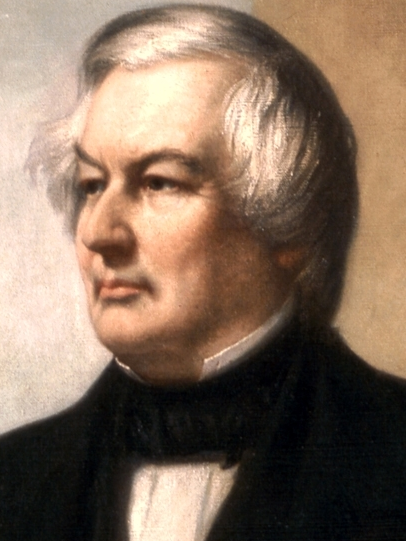
Had that been the end of the story, the bathtub may have fallen out of use and been lost to the complexities of history, but its path toward greatness crossed with that of then vice president Millard Fillmore, who decided that taking a bath maybe wasn’t as bad as the outcry from the medical community suggested.

Millard Fillmore, looking like a man who recently took a bath. George Peter Alexander Healy, Public domain, via Wikimedia Commons

When he later became president upon the death of Zachary Taylor, one of Fillmore’s first acts as the new occupant of the White House, was to add a bathtub, a terribly presidential action that served to help normalize the tub’s usage and forever alter the hygiene habits of the American public.

The article was well-received. More than a hundred years later, Mencken’s work remains a frequently quoted authoritative source on the fascinating history of the bathtub. It stands as a brilliant testament to the same kind of journalistic integrity we expect to see today.

And by that, I mean he made the entire thing up. It was Mencken’s stated intention to provide lighthearted distraction during a time of tough news, though many have suggested that he was fed up with his own struggles to get his more serious work out there and wanted to provide evidence of just how easily a journalist such as himself can feed pretty much any information to a gullible public as long as he isn’t asking them to think too hard about it. He came clean about the fabricated history in 1926, but by then Millard Fillmore’s place in bathtub history was sealed. It still isn’t difficult to find the tale splashed across the internet or even occasionally in serious books written by serious people.

We may never know Mencken’s motivation for certain, but what we do know is that currently the White House contains thirty-five bathrooms. As I think it’s safe to assume that at least some of those bathrooms probably contain tubs, I might know a way to get to the truth of this malfunctioning animatron rumor.

Big Ben Takes a Tumble

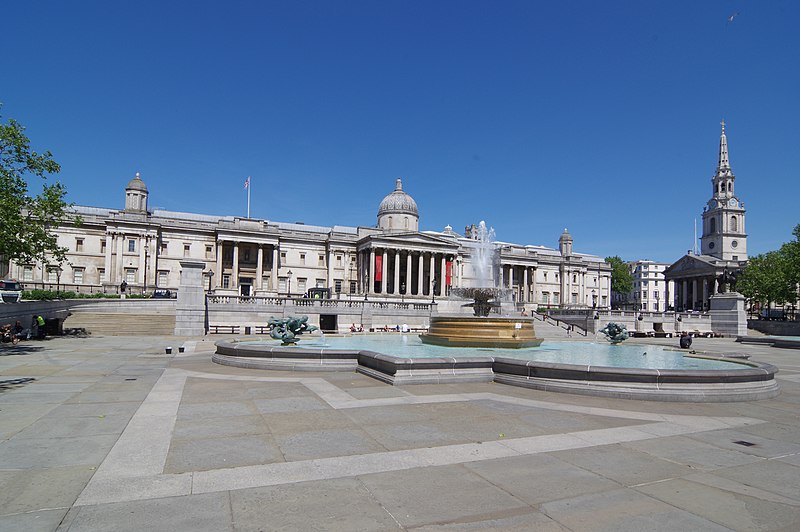
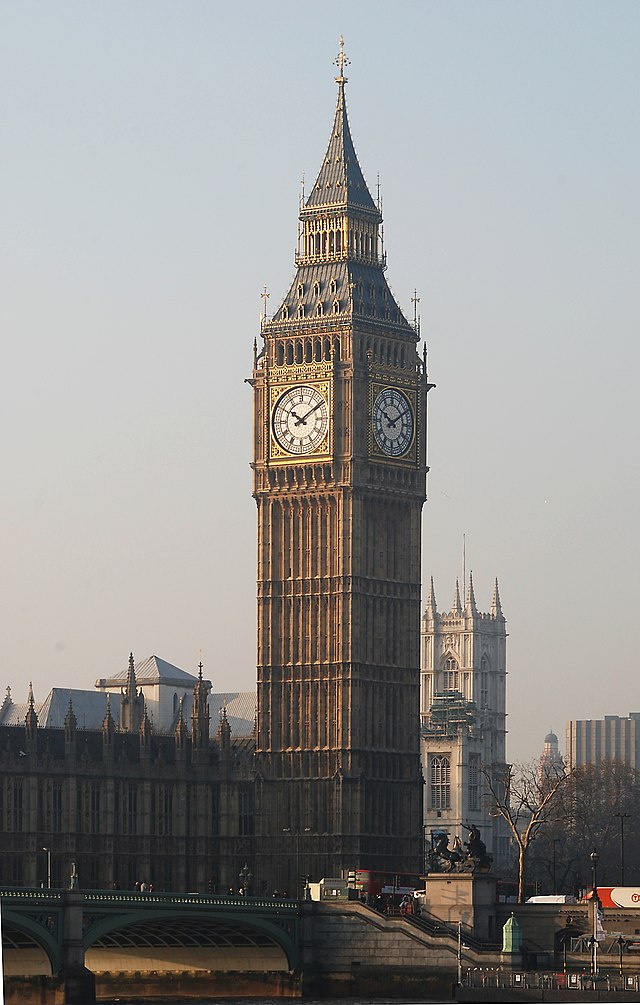
It has been nearly ninety-six years since that fateful Saturday night when a previously peaceful unemployment demonstration in London’s Trafalgar Square turned into a violent mob ransacking the National Gallery and the Houses of Parliament, and knocking down the clock tower containing the famous Big Ben.

A shock, for sure, the wireless report from the BBC may not have been entirely unexpected by a nation made nervous by the recent 1917 Russian revolution. England had elected its first Labour Government in 1922 and the country was in the grip social change.

Trafalgar Square with approximately the same amount of mob violence as was seen on January 16, 1926. Charlie Forman, CC BY-SA 4.0 https://creativecommons.org/licenses/by-sa/4.0, via Wikimedia Commons

Dumbfounded wireless listeners followed the breaking news story until the final moments when the BBC’s London station was overrun and the broadcast faded into assorted music. The audience was left to anxiously wait for their newspapers to arrive the next morning with more details of what had befallen their capitol city.

Then, heavy snows the following day in London delayed those newspapers to many of the more isolated rural areas, leaving some in great suspense, imagining the charred ruins of the Savoy Hotel and the terrible lynching of Minister of Traffic Mr. Wotherspoon.

Of course, astute listeners may have understood that there was, in fact, no such position as the Minister of Traffic in the English government of 1926 and that “Mr. Wotherspoon” is kind of a silly name, as is that of Mr. Popplebury, the Secretary of the National Movement for Abolishing Theatre Queues and ringleader of the violence.

Standing tall. Alvesgaspar, CC BY-SA 3.0 https://creativecommons.org/licenses/by-sa/3.0, via Wikimedia Commons

In addition, those listeners who had tuned in from the very start would have heard the preface explaining that the fictitious news account they were about to hear came from the imagination of brilliant satirist, Catholic priest, and maybe slightly ironic lover of cozy mysteries Father Ronald Knox, whose tongue was so firmly implanted in his cheek that it was surprising he could talk at all.

Knox’s performance piece Broadcasting the Barricades was a smash hit eliciting a huge number of responses which were about nine to one positive, and included only one report of a stress-induced fainting. The piece, written by the same man who would later come up with the “10 Commandments of Detective Stories,” one of which says that “No Chinaman must figure in the story,” encouraged the BBC to begin its long and glorious tradition of April Fools pranks a few months later, and most likely influenced the War of the Worlds radio play presented by Orson Welles in 1938.

And today it serves as a good example of why, when you hear something terribly upsetting on the news, you probably ought to take a deep breath and look for another source, from a different perspective before you pass out from the stress. Because surprising, terrible, scary things do sometimes happen, but there are probably also a lot of snarky priests out there, good detective stories involving Chinese characters, and, it seems, fake news reports.

Weight for It

A recent study published on the JAMA Network platform of the American Medical Association on March 22 found that on average American adults gained 0.6 pounds every ten days of pandemic-related lockdowns. I’m delighted to be able to say that I am below average, but like most of us, this bizarre year has not been particularly kind to my waistline.

I’ve kept it in check as well as I have only because I started a running challenge. If you’ve been reading this blog for a long time or if you’ve read my book, Launching Sheep & Other Stories from the Intersection of History and Nonsense, then you may recall that I think running is stupid.

Prove me wrong. A good friend of mine likes to say he’ll believe running isn’t stupid when he sees someone both running and smiling. Image by Ryan McGuire from Pixabay

But it is easy to do. All you need is a good pair of tennis shoes and a healthy dose of self-loathing. Also, it’s convenient because you don’t have to go anywhere. That’s literally true in my case since I run pretty much exclusively on a treadmill, both because my knees don’t care for downhills or uneven surfaces and because I don’t like looking like a wheezing idiot in public.

It’s going more or less okay. Of course, I wonder when I can stop with every single step, but my pants still fit and at least some of my below average weight gain could reasonably be attributed to an increase in muscle mass. The rest of it, not so much. So, I wouldn’t mind shedding a few pandemic pounds.

But I have a plan.

This very morning, Thursday April 1, 2021, at 9:47 AM, the earth will experience what scientists refer to as the Jovian-Plutonian Gravitational Effect. That’s when the sadly demoted dwarf planet of Pluto will align directly behind Jupiter and produce a combined gravitational effect that will be noticeable on Earth.

1…2…3…Jump! Image by lena dolch from Pixabay

Some astronomers have suggested that the best way to experience this unusual phenomenon will be to jump into the air at that precise time, allowing yourself to hover just a bit longer than you normally would and experience a slight floating sensation. It’s expected that the hang time of an average human jump will increase from 0.2 seconds to as much as 3 whole seconds which, scientifically speaking, you’d have to be a pretty big fool not to notice.

That sounds fun and all, but I have a better idea. At precisely 9:47 this morning, I will be stepping on my bathroom scale, where I expect to note a loss of at least 0.6 pounds for each one of you who is gullible enough to jump in the air and expect to float.

It’s hard not to trust a man wearing a monocle. Sir Patrick Moore. South Downs Planetarium, CC BY-SA 3.0 via Wikimedia Commons

That’s right. I’m sad to have to let you know that the Jovian-Plutonian Gravitational Effect isn’t really real. It was first presented to the world in 1976 by well-known and highly-respected astronomer Patrick Moore who was a Fellow of the Royal Astronomical Society, a war hero, and the longtime host of the BBC’s The Sky at Night program which aired for fifty-five years.

He also had a sense of humor and was credentialed enough to pull off a good April Fool’s prank for the BBC, which is well known for its April Fool’s pranks. I mean, this was no record-setting spaghetti harvest or flying penguin video, but it was pretty good.

And it got people jumping up and down and having a good time. The extra exercise may have even helped them lose a little weight, like an average of 0.6 pounds every ten days they tried again and again to experience the Jovian-Plutonian Gravitational Effect. But as far as I know, no one has done a study on that.

A Lot of Nerve

In March of 1903 the city of Buffalo, New York was intrigued by the recent murder of successful businessman Edwin L. Burdick. Rumors suggested that Burdick and his social circle were embroiled in activities of questionable morality that had led to several divorces, including Burdick’s own. The story included plenty of soap-opera worthy subplots and culminated in a bloody head bashing-in with a golf club by a never definitively identified angry woman with one heck of a follow-through. The public couldn’t get enough of the whole lurid circus and photographers ended up banned from the inquest.

But this wasn’t much of an obstacle to hobbyist-turned-professional photographer Jessie Tarbox Beals, who had been hired by both the Buffalo Inquirer and The Buffalo Courier, making her the world’s first female photojournalist. Disallowed from the room, Beals boldly shoved a bookcase into position so that she could climb up and snap a few photos through a transom window.

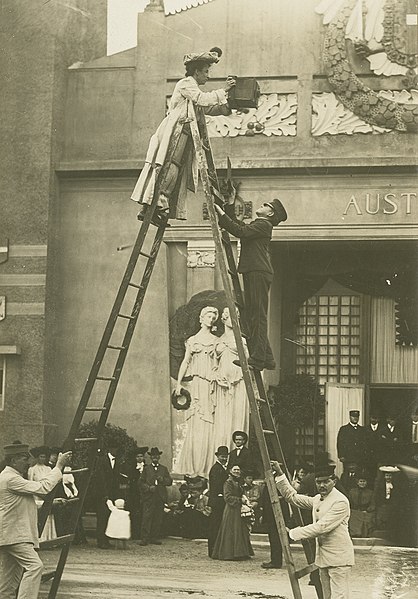
Jessie Tarbox Beals at the Louisiana Purchase Exhibition, 1904. Taking great photos. On a ladder. In a skirt. Bold. Public domain, via Wikimedia Commons

It was this kind of tenacity that brought her success at the 1904 Louisiana Purchase Exposition in St. Louis, where copious amounts of iced tea were consumed, ice cream cones were almost certainly not invented, and possibly history’s most disorganized marathon took place.

Beal arrived in St. Louis with her husband (who served as her assistant) in time to beg her way onto the pre-exposition grounds after initially being denied any press credentials by fair officials. Once there she absolutely wowed the skeptical officials with her incredible eye for candid images that captured the essence of the fair more than they could have imagined and unfolded a story that sparked imagination and drew people to the exposition.

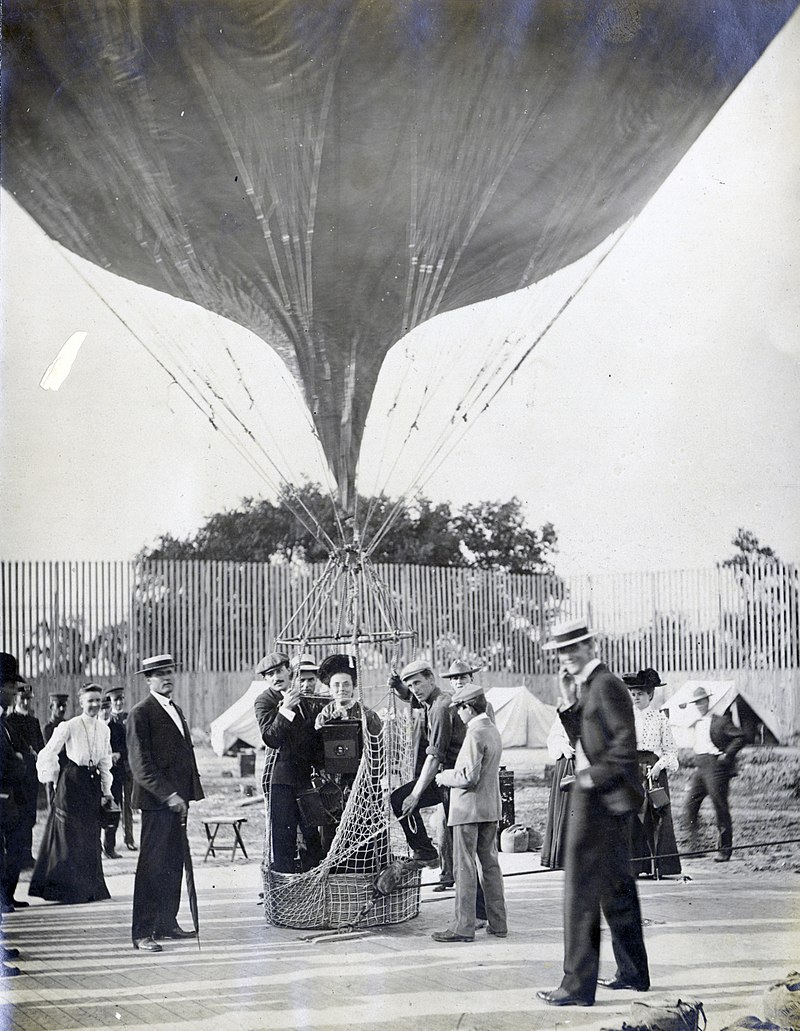
Of course, she also drove them kind of crazy. She thought nothing of scurrying up a commandeered twenty-foot ladder in her heavy skirt or recruiting fairgrounds employees to hold it steady for her while she grabbed shots of parades and crowds of fairgoers. When her request to take aerial pictures from a hot air balloon was denied because she was far too delicate for such a risky activity, she did it anyway.

She also snapped many beautiful photographs of the subjects of ethnographic exhibits, displaying a universal humanity that didn’t entirely support the tale of racial superiority the fair’s organizers had expected to tell.

Jessie Tarbox Beals: A female photographer with a lot of nerve. Unknown author, Public domain, via Wikimedia Commons

And when President Theodore Roosevelt arrived at the fair and the male photographers respectfully hung back to await their chances, she didn’t hesitate to approach him to ask for a photo op. Then she pursued him relentlessly throughout the day to snap at least thirty more photographs of the president and his entourage. She was one bold lady.

I came across Jessie Tarbox Beals while doing some research for my newest novel project. She won’t be in the book, or really even tangential to it outside of sharing an era, but she leapt out at me anyway as someone I wouldn’t mind knowing more about.

Every new historical novel I write begins with a bit of trepidation. The task of immersing myself into a time and place different than my own is daunting, as is making those many tiny decisions about when to cling tightly to known historical facts and when to play a little fast and loose for the benefit of shaping a story. Then there’s the balance to consider between historically representative attitudes and remarkably different modern sensibilities. I often find myself questioning just what and how much I am really allowed to do.

And I think that’s why the story of Jessie Tarbox Beals appeals to me so much. This week, when we have just marked International Women’s Day and as I take those first careful steps onto the blank page, I am trying to take a lesson from the tenacious lady photojournalist who climbed a bookcase, hopped into a hot air balloon, and chased down a president.

She told great stories with her photos and when asked whether the male-dominated profession of photography was really a good place for a woman she answered that as long as that woman had “a good supply of nerve, good health, and the ability to pick out interesting subjects and handle them in an interesting manner” that she saw no reason why it shouldn’t be. She was one bold lady. With a lot of nerve.

A Nude Horse is a Rude Horse

It’s been kind of a rough week here in the United States. Anxieties are running high as we wait for the final results of what looks to be an incredibly tight hot mess of a presidential election between one guy that half the nation finds terrifying and another guy that the other half of the nation finds terrifying. I don’t think it’s much of a stretch to say we’re all a little stressed out.

So, I want to take a moment to harken back to a time sixty years or so ago when a political movement of critical importance took the country by storm and caused the well-informed citizens of the United States to scratch our heads and in one more or less unified voice, say, “Wait, what?”

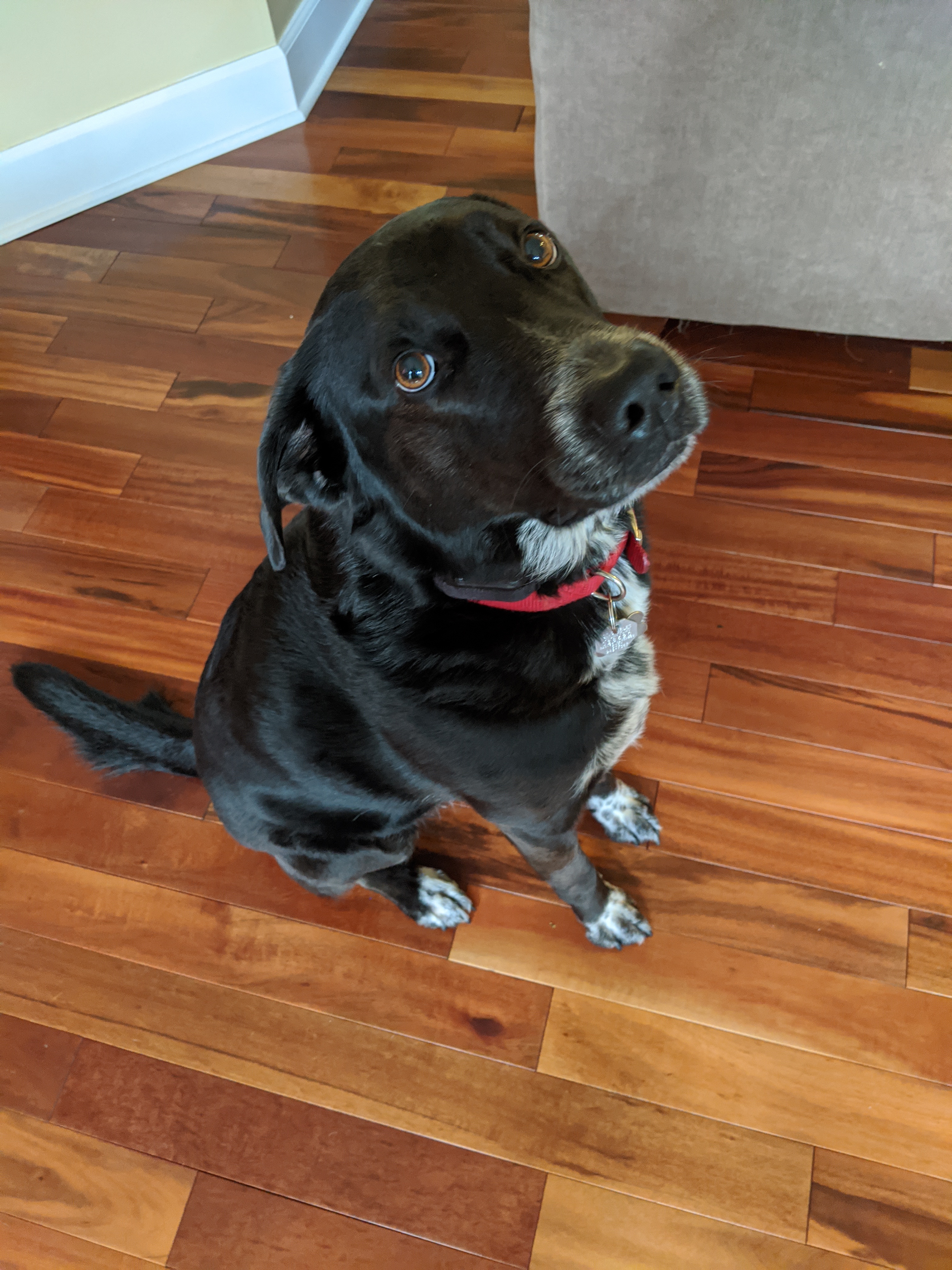
My dog Ozzie, just as brazenly pantsless as the day he was born.

I refer, of course, to the great cause of the Society for Indecency to Naked Animals (SINA), which actually traces its roots back even further to a man named G. Clifford Prout, Sr. who was tired of seeing indecency in the fields and backyards full of frolicking, naked pets, livestock, and wild animals.

It was in May of 1959 when G. Clifford Prout, Jr. finally broke into the mainstream to continue the important work his father had begun, with an appearance on the Today Show on NBC. There he explained that SINA was pushing for the clothing of “any dog, cat, horse, or cow that stands higher than four inches or longer than six inches,” and touted the SINA slogans: “Decency today means morality tomorrow” and my personal favorite, “A nude horse is a rude horse.”  

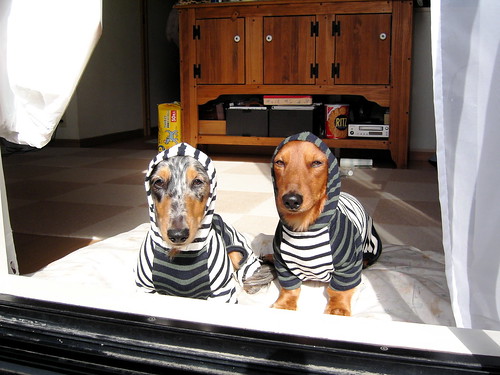
Finally. Decency. photo credit: Hanafan It is no dog? via photopin (license)

The American media was intrigued, and so was the public. Prout worked for several years to spread the message that to allow naked animals to run amok, causing all manner of accidents as motorists become distracted by fields of naked cows and bulls, was not only irresponsible, but immoral.

Based in New York, SINA gained momentum, claiming branch offices in Chicago, St. Louis, San Francisco, and even London. Anyone could join as long as they desired to decently clothe their pets, and if they could get away with it, their neighbor’s pets, too. The organization would not accept money, however, because Prout was independently wealthy and the bylaws disallowed it.

Does one have to apply for the job of hoakster? Because I think I might enjoy that. Alan Abel by Cranky Media Guy at English Wikipedia, Public Domain, https://commons.wikimedia.org

Of course, good journalism is hard work rarely done, and so it took a while for anyone to uncover the fact that G. Clifford Prout, Jr. was less nutter than fictional. He was a character portrayed by actor, writer, and director Buck Henry and created by hoaxter and mockumentary filmmaker Alan Abel who played the part of SINA’a vice president Bruce Spencer.

After CBS aired an interview with Prout, conducted by America’s most trusted newsman Walter Cronkite, in which Cronkite displayed amazing fortitude by not laughing out loud at his ridiculous guest, some members of the crew put two and two together. They recognized Henry, who at the time, actually worked at CBS. Cronkite was furious, but word was out.

Time broke the story of the hoax shortly after that in 1963, the animals took off their pants, and everyone (except Walter Cronkite) had a good laugh about it.

SINA was one of the most successful hoaxes Abel ever pulled off, though far from the only one. He was the man behind Omar’s School for Beggars, Euthanasia Cruises, Ltd., and a mass coordinated fainting episode that briefly cleared the audience from a taping of The Phil Donahue Show. He even made a fake run for Congress on the platform of selling ambassadorships, infusing the water in the drinking fountains in the senate with truth serum, and eliminating Wednesday to create a four-day work week. Actually, I’m in favor of at least one of those.

If he hadn’t passed away in 2018, I might assume he was behind the cluster that is the 2020 presidential election, too. At least I kind of hope it’s a hoax. That sure would make the journalists mad, but I’d probably laugh. Because this is seriously as ridiculous as insisting that horses wear pants.

Facebook to Ban Benjamin Franklin for Inciting Violence

On October 22 of 1730 The Pennsylvania Gazette ran a truly incendiary story. It was an account of a good old-fashioned witch trial, and it displayed a great deal of unforgivable misjudgment on the part of the newspaper to run it at all.

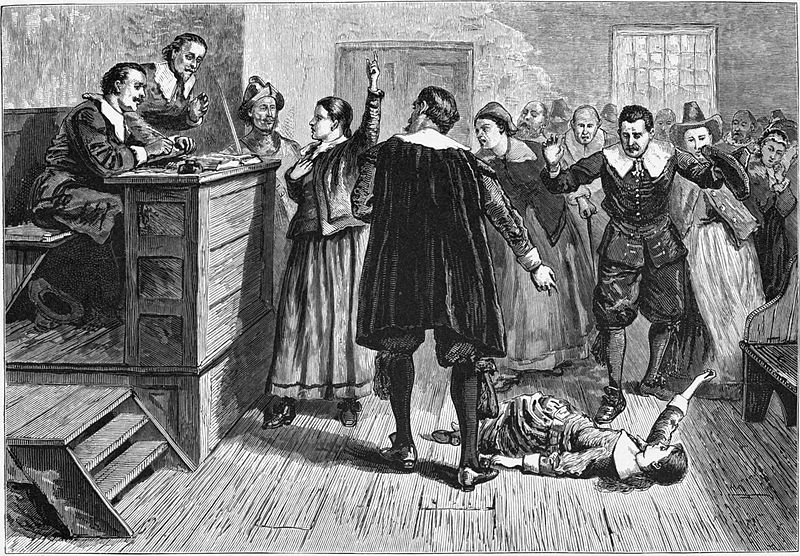
Two defendants, a male and female stood accused, but were clever enough to willingly subject themselves to the trial on the condition that two of their accusers stood with them. The four, then, were first weighed against the largest Bible anyone could find. As everyone surely knows, the Bible will outweigh any soulless witch. Of course, it didn’t. Not even the smallest of them.

That’s a witch if I ever saw one. Or at least one of these people probably is. unattributed, Public domain, via Wikimedia Commons

The next part of the trial, before six hundred peers of the accused, took place at the mill pond since, logically, witches float. The two men and two women were bound and dunked. If they drowned, then they clearly couldn’t be witches. If they managed to surface, they’d best be burned at the stake.

But that didn’t go exactly as planned, either. The first to surface was the male accuser who explained that if he was a witch, he certainly had no knowledge of it. It’s hard to fault a guy for that. And then there were the ladies whose flimsy shifts must surely have made them more buoyant, as 18th century women’s clothing tended to do. The appropriate decision was made to postpone the trial for a warmer day when the ladies could be presented naked, just to reassure the crowd of highly proper Puritans that nothing improper was going on.

Because the article was clearly entirely factual, not satirical in the least bit, and inflamed such violence against, well someone, probably, Facebook decided to take it down and immediately suspend any ability for The Pennsylvania Gazette to share content on its massive and far-reaching platform.

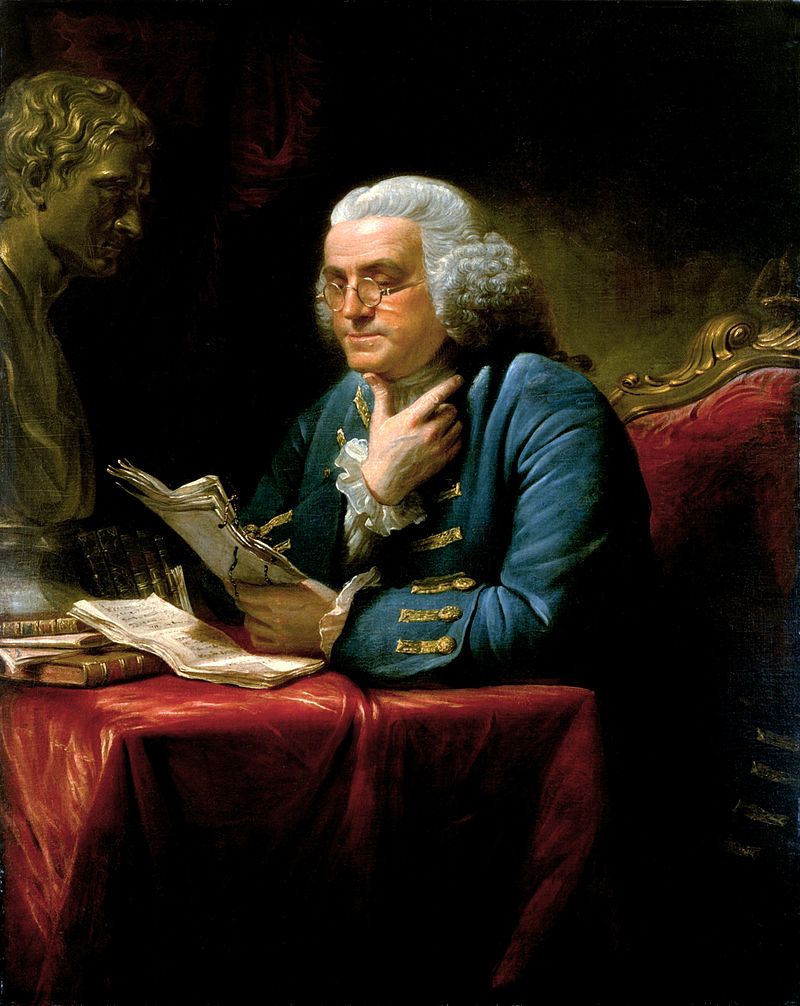
Yes, that Benjamin Franklin. He was much funnier than he looks. By David Martin – The White House Historical Association, Public Domain, https://commons.wikimedia.org/w/index.php?curid=9390044

Obviously, I jest. As far as I know Facebook never did any such thing to The Pennsylvania Gazette or to the author of the satirical “A Witch Trial at Mount Holly.” That author happened to be the young polymath Benjamin Franklin who would go on to help birth a nation, invent bifocals, and make questionable choices regarding electricity and poultry. He also was fond of writing satire and of making a little fun of the hypocrisy in Puritan culture.

And in 1730, Facebook could take a joke.

But apparently not in 2020.

This past week, Facebook removed a post by the Babylon Bee, a publication that, to the best of my knowledge, has never electrocuted a turkey and has only ever been known as a satire site. We’re talking really silly stuff here, like the recent articles: “Senators Vow to Hold Big Tech Accountable by Flying them to D. C. and Saying Mean Things to Them” and “Embarrassed Pope Realizes He’s Been Reading the Bible Upside Down this Whole Time.”

To be fair, neither of those is the really disturbing article that made Facebook demonetize the Babylon Bee’s page with cries that their article incites violence. The truly dangerous post was about the entirely factual senate confirmation hearing for supreme court nominee Amy Coney Barrett in which she was accused of being a witch by Senator Hirono of Hawaii, who is wise in the ways of science, and who insisted the nominee’s soul be weighed against a duck.

Oh wait, that can’t be right. That’s a schtick from Monty Python and the Holy Grail. You know, I bet Senator Hirono didn’t even say anything about Amy Coney Barrett being a witch just because she has so much poise and apparently no need for notes in order to answer hard-hitting questions that she literally legally cannot answer.

Huh. I see what they did there. That’s clever. It’s probably even worth a chuckle. And violence. So much violence. Actually, I am feeling a little incited here. Thank goodness for Facebook’s censorship, or who knows what I might do.

Well, what I might do is get put into Facebook prison for this post, which frankly, would be a badge of honor. So feel free to share away, and let’s just see what happens.

My Immediate Travel Plans

I don’t know about you, but all this social distancing and isolation has given me a bit of wanderlust. It’s unclear at this point when we might be able to incorporate travel into our lives again, but there’s no question in my mind where I would go if I could.

As soon as it becomes safe and possible, you’ll find me on a plane headed for the Indian Ocean, to a pair of small islands northeast of Sri Lanka. In fact, as travel to the nation of San Seriffe isn’t currently restricted, I might find a way to leave even sooner.

travel-778338__340
Someday this will be me again. Image courtesy of KatyVeldhorst, via Pixabay.

It’s a great little place, consisting of the curvy southern island of Lower Caisse, and to the north the circular Upper Caisse which features the beautiful white sand Cocobanana Beach along its west coast. Home to about 1.8 million people of European and native Flong decent, San Seriffe possesses a rich cultural history dating all the way back to 1977 when it was dreamt into existence by Philip Davies, director of Special Reports for the Guardian newspaper.

Davies was thinking of the frequent special reports in the Financial Times, that highlighted the attributes of small countries he’d almost never heard of, when the idea for an over-the-top April Fool’s prank came to him. He pitched his imaginary island nation to regular staff members Geoffrey Taylor, Stuart St. Clair Legge, Mark Arnold-Forster, and Tim Radford.

The single-page joke feature rapidly expanded into a seven-page supplement that included articles about economic opportunities, political history, and the rapidly growing tourism industry in San Seriffe. The J Walter Thompson Ad Agency even sold ad space, which included a contest sponsored by Kodak requesting snapshots from trips to the islands and with a submission cutoff one day before the piece ran.

Semicolon
An artist’s rendering of the approximate geographical shape of San Serriffe, featuring the islands of Upper Caisse and Lower Caisse.

What was no more than an elaborate joke filled with puns that prior to the presence of desktop publishing software in most homes, weren’t very familiar outside the publishing industry, became a news-worthy story as readers flooded the newspaper’s office with calls for more information.

The report took on a life of its own then when more astute readers began sending in recollections of trips taken to the fictitious islands. The Guardian published an angry letter to the editor in which a member of the San Serriffe Liberation Front expressed concern about the paper’s clear pro-government bias. Real complaints came from travel agents and airlines, which had a hard time convincing people there was no such place.

It was a fairly perfect April Fool’s prank—one that captured readers’ imaginations and spawned an entire genre of jokes, including “I’ve Been to San Serriffe” bumper stickers, a joke article on WikiTravel, and several books, including The Most Inferior Execution Known Since the Dawn of the Art of Marbeling Collected by the Author During a Five Year Expedition to the Republic of San Serriffe written by Theodore Bachaus and probably available from a library near you.

ZoomBeach
This is the island beach from which I will be attending all Zoom meetings, as soon as I can figure out how to do it. It’s probably Cocobanana.

This year April Fool’s Day came and went with less frivolity. The world in 2020 is a little more scared, a little more serious, and a lot more sensitive about invented news. As much as I suspect we’d all love to call up a travel agent that’s now working from home, and book what would likely be a very inexpensive flight to San Serriffe, doing so is even less possible than it was in 1977.

But like the duped readers of the Guardian all those years ago, we can imagine. We can change our Zoom backdrops and pretend to attend meetings from somewhere on an island beach. Hopefully we can still laugh and appreciate a good joke, even while many of us are feeling scared and trapped. And we can dream of the trips we might take when this strange season of social distancing and travel restrictions is finally over, when we’re free once again to enjoy a beautiful day relaxing on Cocobanana Beach.


Live ReadingDon’t forget, it’s still a great time to pick up a book and transport yourself to new fictional worlds! If you want, you can join me on my Facebook page where through the month of April, I will be livestreaming my newest historical novel, Smoke Rose to Heaven, one chapter each evening at 7 pm Central US time read by me. Previously read chapters are available for catching up.
Trending in History: Giants and Jerkfaces

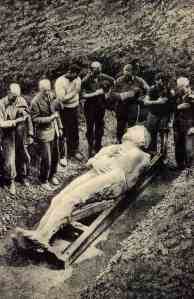
On October 16, 1869, on William Newell’s farm near Cardiff, New York, two men digging a well, hit something surprising with their shovels. What they eventually uncovered was a ten foot tall, 3,000 pound petrified man.

cardiff_giant_2
Someone clearly had an unfortunate run-in with geode water. Excavation of the Cardiff Giant, Public Domain, via Wikimedia.

For years, newspapers had been featuring reports of petrified men, believed to have come into contact with water from the inside of geodes. So no one had any doubt such a thing could happen. The good people of Cardiff flocked to see the giant, took selfies to post on Instagram and tweeted out the Syracuse Daily Standard article that dubbed the giant “a new wonder.”

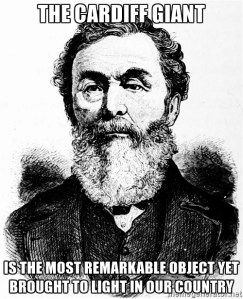
Of course there were a few skeptics. Among them was Dr. Boynton, a local science lecturer who assumed the find was actually a large statue of historical significance. Noteworthy geologist and paleontologist James Hall liked this theory, calling the find, “the most remarkable object yet brought to light in our country,” a quote that once added to a picture of the respected scientist became a meme netting more than 120,000 likes and 15,000 shares on Facebook.

giantmeme
Looks legit to me.

Many theologians got excited, too, pointing to the very large man as evidence supporting the literal interpretation of Genesis 6:4, which claims there were once giants on the earth. The news commentators and bloggers had a lot to work with.

But notably absent from most “media” coverage was the assessment of Yale paleontologist Othniel Marsh who stated upon seeing the Cardiff giant, “It is of very recent origin, and a most decided humbug…” Marsh wasn’t the only one to voice such outrageous ideas, but he might as well have not said anything, for all the good it did.

Most visitors adamantly claimed there was no way they would ever believe the giant had not once been a living, breathing creature. Because once a person’s decided to believe something, it’s hard to convince them not to.

Eventually, the man behind the humbuggery did confess. Cigar manufacturer, dedicated atheist, and cousin to Mr. Newell, George Hull admitted to having the statue commissioned and buried after engaging in a debate with a Methodist preacher over the literal interpretation of Genesis 6:4. He really just wanted to say, “Gotcha!”

As a bonus, he also made a pretty penny off his share in the scheme eventually selling his interest for nearly a half million adjusted 2017 dollars. He definitely fooled a lot of people and certainly supported the point that those who set out to make a point by fooling a lot of people, are kind of big jerkfaces.

Seriously, it was ALL OVER social media. #HumbugHull  #CardiffCon #GiantJerkface.

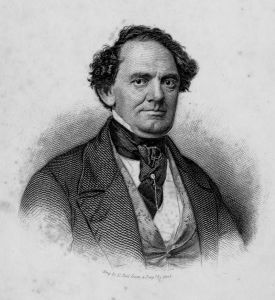
barnum
P.T. Barnum, America’s favorite son of humbuggery, offered to buy the Cardiff Giant. When his offer was refused, he commissioned his own gypsum giant and claimed the first was a forgery. Like a boss. Public Domain, via Wikimedia

But I do think, unwittingly, Hull made another point, too. Because his giant was the fakest fake news of the day. That’s right, folks. We’ve ALWAYS had fake news. Just like we’ve ALWAYS had biased news. Because none of us, members of the media included, lives in a vacuum. Our experiences, our intentions, and our personalities, whether individual or institutional, all serve to inform our biases.

The media attention given to the Cardiff Giant rarely included expert voices that contradicted the sensational because sensational sells and improves SEO as its shared widely across platforms evidently designed to make otherwise reasonable and more or less kind-hearted people seem completely insane. So media outlets use (among other tactics) carefully worded headlines, precisely cut-off quotes, and selective expert interviews to make that happen.

So how do we combat this? First, I think we would all benefit from a deep breath. Then, the next time you think about clicking “share,” take a minute to analyze three things:

  1. The bias of the source (and, yes, there is one, see the previous paragraph)
  2. Your goal in sharing the piece (if it’s either to taunt or to yell, “Gotcha!” it’s possible you should reconsider)
  3. Whether or not the piece will further civil discourse (or whether you’re just behaving like kind of a jerkface).

I don’t mean to sound like I’m coming off heavy-handed here, though I admit that’s exactly what I’m doing. I don’t deny that I have an agenda. I want my social media feeds to be kinder, more civil places today than they were yesterday. I want to have informed conversations with informed adults who don’t always agree with me, but whose opinions are interesting and worth giving some serious consideration. And I want the media to stop reporting about how biased the media is, because, frankly, that’s super old news.

So I hope you’ll remember George Hull and the Cardiff Giant and give some thought to my terribly biased interpretation of the way we should view his story. I hope, too, that at some point you will begin to question the authority of a history blogger who insists that #GiantJerkface was trending on Twitter in 1869. And, last but not least, I hope you are careful to avoid contact with geode water (which I think sells for $7 a bottle at Whole Foods), because I’d hate to see you get petrified, and I read somewhere that can happen.