Dirty Little Secrets of the Common Cold

The end of the school year is nearly upon us. The teachers and students are counting the days and hours remaining, looking forward to the final bell. I’m counting, too, but I’m a little more panicked than my children are. I am looking forward to lazy summer mornings and family adventures to far-flung places, but there’s no question my schedule and the way I approach getting things done is about to change dramatically. It takes some planning. And it takes not getting a stupid cold two weeks before the crazy summer begins.

sneeze2
Ah…spring. photo credit: califmom ‘Snot Funny via photopin (license)

I’ve been incredibly lucky so far this year. I avoided the dreaded flu that took many of my friends and neighbors completely out of commission for a week or more. While others coughed and sniffled their ways through the winter, I breathed easy. Then a few days ago, I woke up with an excruciatingly sore throat at the start of what has been a goopy-headed, achy, tired week with a lengthy to-do list.

As you probably know, there are quite a few suggested remedies out there for colds, none of which work most of the time, and no actual cure. I get that. Nobody is going to win the Nobel Prize for curing the common cold. The world has bigger problems.

But I was curious to see what solutions people came up with in the past. Frankly, I didn’t come across much that I wanted anything to do with. I did, however, find some relief of sorts in a book by William Buchan, a Scottish physician who in 1769 became the Dr. Spock of his day. For those of you who are younger than me, Dr. Spock is the physician who wrote the household medicine book your mother would have kept on a shelf in the kitchen before she had access to Dr. Google.

spock
Not that Spock. photo credit: Tom Simpson Dr. McCoy and Mr. Spock animation cel from Star Trek: The Animated Series (1973) via photopin (license)

Long before Spock’s Baby and Childcare, there was Buchan’s Domestic Medicine: or, a Treatise on the Prevention and Cure of Diseases by Regimen and Simple Medicines. The book sold more than 80,000 copies in nineteen editions before his death in 1805, and was the most popular medical book sitting on the kitchen shelves of mothers across Europe.

Dr. Buchan had a lot to say about the dreaded common cold, most of it having to do with sweat. The man was obsessed with perspiration, insisting that you must never neglect the crucial process of sweating and must also at all times remain completely dry. That may sound like contradicting information, but think of it like reading a study that concludes drinking coffee will prolong your life, and then the next day reading another study that insists coffee will give you cancer. So yeah, it’s definitely contradictory.

towel
Forget hand sanitizer. If you want to stay healthy, grab a towel! Picture by Pexels, via Pixabay.

But Buchan’s main concern in focusing so much attention on sweat has mostly to do with temperature. Common diseases, including the ever-aggravating head cold, he claims, are caused most often by exposure to drastic changes in temperature. And that would totally explain why an otherwise perfectly healthy person might suddenly develop a cold in the middle of spring, when the temperature is at its most wishy-washy. That is, if you happen to be an eighteenth century doctor with no concept of viruses and disease transmission.

To keep from catching a cold, then, the good doctor says one should change his or her clothes immediately after sweating, to avoid rapid cooling. Also if one finds oneself overheated, he or she should, under no circumstances, drink something cold or, to be extra safe, anything at all. That’s also true when a carelessly wet person inevitably develops a cold. Never drink. Not spirits. Not water. Not anything. Also avoid particularly cool, juicy fruit. Vegetables are okay, as tolerated.

By far Dr. Buchan’s most dire warning is about sleeping in a damp bed, which you definitely don’t want to do. By damp, of course he means one that has not been in proper use for some time, and so has absorbed moisture from the air. Always, he says, put guests in rooms with beds that have been thoroughly slept in and not carefully cleaned. In fact, he recommends completely avoiding spending much time at all in rooms that have been recently cleaned.

messy bed
Because nothing says “Welcome to my home” like a guest bed that looks like this. photo credit: Edna Winti Sunrise via photopin (license)

And this I think is the one piece of advice in this little book that may be beneficial to me, because on my long list of to-dos is to prepare my house for hosting folks who will be staying with us for a large family event coming up right after school lets out. Normally this would involve a lot of washing and scrubbing and sanitizing. Since I’m still fighting this cold, I don’t really have the energy for all of that.

Thanks to Dr. Buchan’s medical wisdom, I know I can just relax and rest up instead. I’ll be a thoughtful and responsible hostess, by welcoming my guests into a healthful and dry, filthy home, with a cup of coffee that may or may not give them cancer.

Get Off My Lawn!

On May 7, 1947 real estate lawyer Abraham Levitt, along with his two sons William and Alfred, announced a plan to build a community of middle class homes on Long Island. Responding to a growing urgency in the US for family housing after World War II and the corresponding baby boom, the Levitts built nearly identical slab homes just as fast as they could. By 1951, they had produced more than 17,000 houses in Levittown and surrounding areas.

Levittown_houses._LOC_gsc.5a25988
The houses and nice lawns weren’t the only things that looked the same in Levittown. The building project also carried a legacy of racial discrimination for many years. By Gottscho-Schleisner Collection [Public domain or Public domain], via Wikimedia Commons
Each Levitt house came complete with a television, a well-manicured lawn, and plenty of rules to maintain the right sort of neighborhood vibe. People snapped up the houses as soon as they could be built. The project was so successful that in many ways it became a model for suburban housing developments all across the US.

And with them spread the idea of the Homeowners Association with all its various limitations on backyard chicken farms and exactly how long the stupid grass is allowed to be in order to maintain the look of turf lawn perfectionism. I’m sure I don’t have to tell you at this point, but man, I hate to mow.

We had a long, cold early spring here in the Midwestern US. If you know anyone from this corner of the world, I’m sure you heard about it. The weather was all anyone could talk about for a while. For weeks, I couldn’t go to the grocery store without a stranger stopping me to discuss the cold. I even blogged about how March was throwing a toddler-worthy tantrum.

weather meme
Actually the worst part may have been the steady stream of weather memes. So. Many. Memes.

I hate to be one of those people who is never happy, no matter what the weather does, but frankly now that our nice warm spring is finally here, with stunning blossoms, and the constant drone of suburban lawn care, I kind of wonder what we were all complaining about.

The Levitts certainly weren’t the first people to ever have grass lawns. Researchers point to the need for our ancestors on the savannah and later tucked inside medieval European castles to be able to see oncoming threats. Like lions. And invading armies. And door-to-door missionaries.

reaper-2026350__340
Medieval lawn care service. Or the black plague. It was hard to tell. Image via Pixabay

But for a long time, personal lawn space was a luxury unavailable to other than the wealthiest individuals, who could afford to hire an army of scythe-wielding caretakers, didn’t need to dedicate every available patch of land to growing food, and had time to play lawn darts.

But now we have lawn mowers, grocery stores with shelves full of Doritos, plenty of time for lawn darts, and persnickety homeowners associations that make those of us in suburbia promise not to hang our laundry out to dry in the sun, raise chickens in our back yards, or let our grass grow three feet high.

grazing
How people used to mow their lawns. Also against the rules of my HOA. Sigh.photo credit: Tambako the Jaguar Grazing Highland cows via photopin (license)

Most of the time, I don’t mind. Even though I’d like to know I have freedom to do so, I don’t really want to raise live chickens. And if I’m being perfectly honest, my husband does most of the mowing because for some reason he finds it kind of enjoyable. When he’s too busy or when this crazy beautiful weather we’re finally having leaves us with jungle grass every other day, I grumble and step up to keep the HOA off my back. These are tradeoffs I’m willing to make at this point in my life for good schools and quick access to city amenities.

Someday perhaps I’ll move further away from the city where I can dry my laundry on a clothesline in the sun and raise as many chickens as I want (still probably zero, but the freedom is the thing). Then I suppose I won’t have anything to complain about. Except for the tract-wielding missionaries that snuck up on me through the waving prairie grass. And of course the weather. I’ll always be able to complain about that.

Every Jiggly Step I Can Get

Early last year I wrote about a fitness challenge I had joined, pledging to walk 2,017 miles in the year 2017. In case you’re curious and don’t like to do math, that comes out to around five and a half miles per day. It’s doable for a fairly active person, which I generally am.

Still, I didn’t make my goal last year. I was close enough that if I assumed I’d walked about twenty miles on a couple of days I missed recording and averaged twelve miles each day for the last two weeks, I would have made it. It didn’t seem worth it. Honestly, I’d done really well until November when I became more focused on writing a novel and eating turkey.

treadmill
I don’t know…that looks like a lot of work. Picture by profivideos, via Pixabay

It definitely takes consistent effort and I think it’s safe to say we all have those days when we’re sick, or lazy, or sitting in a chair writing a novel, or driving across the country. It’s stringing too many of those days together that’s the problem.

But as I discovered on a recent road trip to visit my parents in Illinois that last obstacle isn’t so bad. It takes me about two hours to get to their house pretty much regardless of the route I take. Each option comes with drawbacks. The most direct route takes me across the Mighty Mississippi on a scary, crumbly bridge so narrow I’ve seen truck drivers back up rather than meet a vehicle coming across in the other direction.

This time I wisely chose to go another way with thicker traffic, but a much nicer bridge, and then a two lane highway in Illinois that could use a little love and attention and provides plenty of broken, bumpy adventure. But this road has a hidden benefit for those drivers wearing their fitness bands. In the hour I was dodging potholes on that lonely Illinois road, my fitness band credited me with six hundred steps.

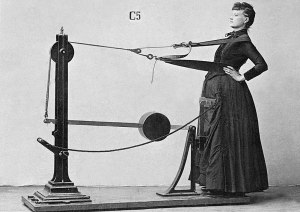
And why shouldn’t it? I may not have done the walking myself, but my body surely benefited from the jiggling. At least it might have according to Swedish physician and inventor Gustav Zander, who in the latter half of the 19th century invented some of the earliest forms of gym equipment. Included among Dr. Zander’s creations was the first belt vibrator machine (if you Google that, use caution).

belt vibrator
Her workout clothes are way fancier than mine. By Unknown – https://digitaltmuseum.se/021016402498/balstrackning, Public Domain, vis Wikimedia Commons

This contraption had a belt you’d place around your waist or arm or leg, or I guess wherever your problem areas may be and then it magically vibrated the fat away. Dr. Zander’s wonderful machine provided healthful massage, relieved mental fatigue, rid the body of harmful toxins, and toned muscles. Or it didn’t.

The use of passive exercise machines like the belt vibrator peaked in the early part of the 20th century and surged again through the 1950s and 60s. There’s just something really appealing about getting into shape without wearing legwarmers or doing any actual work at all.

broken road
Who needs workout equipment? Picture by Antranias, via Pixabay

Even today there are numerous products on the market designed to move your muscles for you while you read a book or give yourself a pedicure. Today’s devices generally stimulate muscle contraction using targeted electrical pulses. And though such gadgets may offer some therapeutic benefits, providing you with that beach ready body isn’t one of them. For that, they’re about as effective as Dr. Zander’s original passive jiggle apparatus or my car on a bumpy road.

So maybe jostling car steps shouldn’t count, but since my fitness tracker is just as likely to ignore a quick jaunt across the room or a climb up sixteen flights of stairs, I’m going to assume it more or less evens out. This year’s goal is 2,018 miles and by the time November rolls around, I may decide to sit in a chair and write a novel while eating my body weight in turkey. I’ll need every extra jiggly step I can get.


And speaking of novels, there’s exciting news coming down the bumpy pike on that score. I can’t promise you any free steps, but if you want to be among the first in the know, you can sign up to receive email news from me here: http://eepurl.com/b3olY1

Dancing Like She’s Never Danced Before

It’s prom season here in the great state of Missouri. Every Saturday night from now until early May, dinner out at any local chain restaurant in the area (McDonald’s included) will come with a red carpet-worthy display of colorful chiffon and smart waistcoats.

I kind of love it. Even though I’d rather muck out horse stalls with a pair of chopsticks than watch the Oscars, I do enjoy seeing people dressed up in their finest frills. Since my own children aren’t old enough to participate in that grand old tradition yet, I soak up the images of the overly fancy diners and photos of my friends’ teenage kids posted on social media, with the advantage that I don’t have to be the one up all night worried that they’re not making good choices.

prom-2205139__340
To be clear, I don’t know any of these people, but don’t they look nice? photo by Ilhabela, via Pixabay

I do hope they all have a wonderful time, that they make it home safe with their hearts and their dignities intact, and that they dance their socks off. Because they have a fair amount of pressure and angst in their lives and most of them could use a night of cutting loose on the dance floor to work some of that out of their systems.

Just maybe, on a larger and more tragic scale, that’s what it was all about on a steamy July day in 1518, when Frau Troffea of Strasbourg in Alsace began to dance. She did so in the middle of the street, to a tune that played only in her head, without explanation or regard for anyone who might be watching. She simply danced.

And she didn’t stop.

After a few days, people began to join her. Within a week, thirty-four dancers had danced into the danger zone on the streets of Strasbourg. A month later the crowd had swelled to four hundred, still without any logical explanation.

Absent any better ideas, the authorities directed the building of a stage and enlisted the services of local musicians to provide an environment suitable for those getting’ jiggy with it to work the jiggy out of their systems.

dancegif
If people around you start dancing for no apparent reason, I think you just have to go with it.

Eventually, and after a large number of the afflicted dropped dead from sheer exhaustion, the massive, spontaneous flash mob stopped.

We know of Frau Troffeau from the writings of Swiss physician and alchemist Theophrastus von Hohenheim (whose historical stage name is Paracelsus). He arrived in Strasbourg a few years after the event with an eye to establishing a medical practice there. Paracelsus believed that the epidemic most likely stemmed from the vengefulness of unhappy wives, citing Herr Troffea, who allegedly hated nothing more than his wife’s dancing.

And while Paracelsus’s explanation probably seems as strange as the dance epidemic itself, historians and physicians today don’t have much to offer as a better explanation. One prevalent theory is that the symptoms were caused by Claviceps purpurea, a fungus that infects rye and other grains, served as the basis for the development of LSD, and has been known to cause people to go a little loopy.

But another maybe plausible suggestion is that this was a social psychological disorder stemming from the trauma of living in a time of frequent plague, natural disaster, and generally poor living conditions. I guess I sort of get that. Like Meghan Trainor, I feel better when I’m dancin.’

The citizens of Strasbourg weren’t the only victims of this most unusual epidemic, either. From the eleventh century to the middle of the seventeenth, numerous accounts of similar incidents pop up throughout Europe. Most of these are well documented. This actually happened. A lot of people really did dance themselves to death. And then it just stopped.

But all things considered, maybe in the Middle Ages that wasn’t such a bad way to go. Dancing can definitely be therapeutic, as can getting dressed up in your fanciest duds and going out to dinner with your friends. So have fun, kids.

Just remember to stop before you drop.

Running is Still Stupid: A Tale of Perseverance as Told by an Ugly Guy

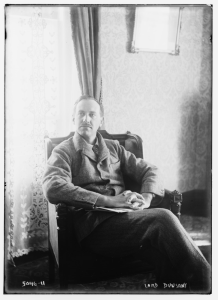
In 1915, Edward John Moreton Drax Plunkett, the 18th Baron of Dunsany and a prolific writer known to his readers simply as Lord Dunsany, produced an updated version of another prolific storyteller’s work. He titled the tale “The True History of the Tortoise and the Hare.” Part of Aesop’s Fables, the original story tells of a plucky tortoise, who though slow and steady, defeats an arrogant hare in a foot race.

It provides a wonderful lesson in perseverance, or at least that’s how I always heard it. But Lord Dunsany’s version turns out a little differently. In it the hare thinks the whole idea of the race is remarkably stupid and he refuses to run. Later, after the tortoise has claimed his victory, the two are on a high hill and seeing a distant forest fire, decide the fastest of them should warn the forest creatures. All of the witnesses to the race event then perish, which is why few had heard the real end of the story before.

Lord Dunsany
Lord Dunsany, looking very smug after killing off all the forest animals. By Bain News Service, publisher – Library of Congress Catalog, Public Domain, via Wikimedia Commons

This may not have been Aesop’s original intention, but then, this may not have been Aesop’s story. Over the years, the collection of Aesop’s fables (or the Aesopica, which is a pretty great word) has grown to include more than seven hundred tales, many of which can be traced to origins that do not in any way coincide with Aesop’s life. So really, to credit a fable to Aesop is more about assigning a genre.

Also it’s not entirely clear there was an Aesop at all. Aristotle, along with other contemporary sources, describes a slave who loved to tell stories, born around 620 BC. About where exactly he was born or whose slave he might have been, sources disagree. It’s not until the 1st century AD that there was an effort to write a sort of biography, known as The Aesop Romance. From this account, attributed to no single author and freely expanded by many for hundreds of years, we learn that Aesop was an exceptionally ugly man who received his gift of storytelling from the goddess Isis.

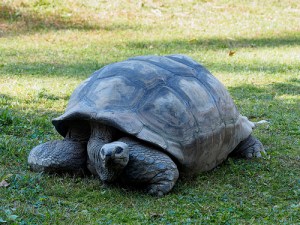
tortoise
Speedy. photo credit: Riccardo Palazzani – Italy Testuggine delle Seychelles via photopin (license)

And that, I think, is as likely as a tortoise outrunning a hare.

So it’s probably safe to say that Lord Dunsany, or any other writer, can pretty much do whatever he wants with the story. Though I like the message that perseverance pays off in the end, I’m fond of the 1915 version as well, in which the moral is obviously that tortoise brains are as thick as their shells and there’s nothing slow and steady about a forest fire. Also, from the hare we learn that running is stupid.

If you’ve been reading this blog for a while, or if you’ve read Launching Sheep, then you may recognize this as my personal running mantra. Also, you may recall that I only need a running mantra because I am a sucker for a goofy event. I really do despise running.

bunnyrun
I only run for the tutus.

But when I recently saw there would be a Bunny Run 5k close by, including a costume contest, I decided to participate. I even did a little bit of training to prepare so I didn’t injure or embarrass myself. Then I worked on my costume. At the suggestion of my very clever husband, I decided to be the tortoise among the bunnies.

Race day dawned dreary and dull. And stormy. And cold. But because I had worked so hard on my costume (and trained a little for the run itself), I pulled myself out of bed on that awful Saturday morning and ran.

This slow and steady tortoise definitely did not win her race, but I did win the prize for best costume and I finished in a time that made me happy, ahead of a good number of bunnies. Also, no one died in a forest fire. Because it was raining.

Running is stupid.

Basically a Toddler

Finally it’s March. I don’t know about you, but by the time we reach this point in the year, I usually feel pretty chewed up by winter. As I age, too, I find it harder and harder to endure the cold, dark months between Christmas and March. Yes, I do realize there are only two. And that one of them is short. That doesn’t make me dislike them any less.

Truthfully, though, I’m not that big a fan of March either, because in my part of the world, it behaves a little bit like a toddler. One moment it’s the sweetest: all babbling brooks and birdsong, blowing sunshine kisses. The next minute the sky starts grumbling, the temperature drops thirty degrees and before you know it every tiny hint of a bud is covered in two inches of full on tantrum ice.

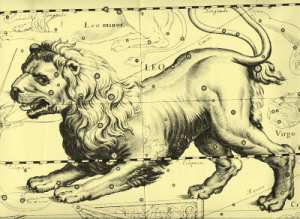
starlion
The saying, “March comes in like a lion and goes out like a lamb,” may be astrological in origin. Or maybe some Sumerian blogger was just getting poetic. By John Hevelius 1690, Public Domain, via Wikimedia Commons

But even though I think my analogy is pretty spot on and should probably become a thing, no one has ever said March is basically a toddler. Or if they did, no one ever repeated it, which is a shame. No, instead it comes in like a lion and goes out like a lamb.

That sort of works, too. Even though lions take a lot of naps and from a distance can resemble lazy old housecats on bad hair days, they also have scary teeth, loud roars, and are generally pretty willing to chew you up if given the chance. And lambs? Well, they’re just cute and stupid, the kind of animal you don’t have to give a lot of thought to except to say, “Awww.”

lamb
Awww. Photo courtesy of cathy0952, via Pixabay.

I suppose I can get behind the adage since people have evidently been using it for so long. According to this article in The Paris Review, the earliest known written reference to the saying is found in a book published in 1732 called Gnomologia: Adagies and Proverbs; Wise Sentences and Witty Sayings, Ancient and Modern, Foreign and British by Thomas Fuller. So then the saying was first used either in the early 18th century or in Ancient Mesopotamia or possibly somewhere in between, which narrows it down quite a bit.

Because I so painstakingly dedicate myself to thorough-ish research on this blog, I did, of course, take the time to search through the book, just to make sure the phrase was in there. Or at least that’s what I meant to do. Fuller includes thousands of sayings. Some of them we still use today. Many of them I probably heard my grandma say once or twice. Others strike this modern reader as just plain silly. I admit, I got a little lost.

Some of my favorites:

mustard
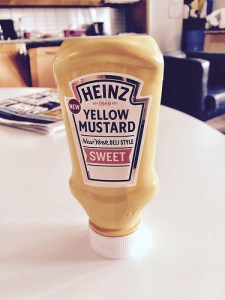
What exactly am I supposed to do with this mustard?  photo credit: Marthinshl Heinz Mustard Heinz Mustard Photography IPhoneography Product Photography via photopin (license)

“An apple may be better given than eaten.”

“He who is born a fool, is never cured.”

“If an ass goes traveling, he’ll not come home a horse.”

“If the old dog barks, he gives counsel.”

“Tailors and writers must mind the fashion.”

“After meat, mustard.”

I never did find a reference to March coming in like a lion and going out like a lamb, but it’s probably there. I also didn’t find any sayings suggesting that “March is basically a toddler,” so I think I may have coined it. And really, some years, March starts out a little more lamb-like and some years the nasty cold rages right into April, behaving just like a toddler that refused to take his afternoon nap. It’s a thing.

Here Be Dragons at the Edges of the Map

I don’t know about you, but to me it feels like the world gets to be a little bit scarier every day. This probably has a lot to do with our 24-hour news cycle. That opens up space for the regional tragedies of which many of us might have remained blissfully unaware, preoccupied with the goings-on in our own little corners of the world. More news also invites more commentary, creating increased competition to place the most sensational spin on every big (or not so big) event, whether it carries a ring of truth or not.

It can get overwhelming, and there’s little doubt, at least here in the US, we are more stressed out than we were when we didn’t have to pay as much attention. A glance at our social media feeds might suggest, too, that we’re not as kind and gentle with one another, either. Because the world is a more frightening place when the dragons in the fairy tales become real.

Encased in an armillary sphere among the rarest of rare collections in the New York Public Library is a sphere about five inches in diameter, which carries this dire Latin warning: HIC SUNT DRACONES or “Here Be Dragons.”

globe
Illustration of Hunt-Lenox globe.By Kattigara (Own work) [CC BY-SA 3.0 (https://creativecommons.org/licenses/by-sa/3.0)%5D, via Wikimedia Commons
Known as the Hunt-Lenox Globe, the hollow sphere of engraved bronze is one of the oldest existing globes produced since Columbus originally sailed the ocean blue in 1492. Though it bears no date, people who know about these things have placed it somewhere in the 1504 to 1511 range, when the Pacific Ocean didn’t yet exist and the continent that would come to be known as North America was no more than a spattering of islands.

But what I find most exciting about the Hunt-Lenox globe is that it warns of the dragons of Southeast Asia. Dragons weren’t an uncommon sight on maps of the era, often gracing the edges or wide open spaces, but this is the only globe (with exception of a matching one created on an ostrich eggshell and probably the original from which the Hunt-Lenox was casted) that actually bears the warning.

dragon
Okay, maybe they’re not all scary. Image courtesy of cocoparisienne, via Pixabay

The expression is probably borrowed from maps of Ancient Rome, that often displayed the phrase “Here Be Lions” in unknown territories. Of course everyone knows dragons are scarier. And I mean everyone.

From pretty much every corner of the world, comes a fairy tale or two in which a dragon kidnaps a princess or guards a mystical treasure or becomes a frozen zombie creature north of the wall. Whether being slain by St. George, or ending a drought, or befriending a runaway foster child named Pete, dragons are everywhere in the stories people have been telling for millennia.

It’s no wonder the phrase “Here be dragons” has come to symbolize the frightening unknown on our maps.

komodo
Komodo Dragon. No wings. No fire breathing. Kind of cute. Might just eat you if given the chance.

Except that it hasn’t. Not really. It’s just this one globe. And there’s even an outside chance that the unidentified cartographer was referring to literal dragon-like creatures in Southeast Asia, where the Komodo Dragon can be found. Though it has yet to breathe fire, this creature is pretty cantankerous and can give you a nasty infection. And maybe eat you.

I would prefer to think the creator of the Hunt-Lenox globe, like the ancient cartographers before him, chose to issue a warning a little more vague in nature. Like the rest of us, he’d surely heard tales of dangers unknown. And maybe sometimes that’s quite enough to cope with. There’ve always been dragons at the edges of the map. We just haven’t always had to attempt to slay them all at once, all day, every day.

So this coming Monday, February 26, to celebrate National Tell a Fairy Tale Day, I’m going to take a little time to ignore the dangers and nastiness that threaten to infect and consume me. Instead I’m going to turn off the news and let the dragons recede, for just a little while, to the edges of the map.

Rosewater, Wine, Sugar…and Tomato Sauce?

In November of 1493, intrepid Italian Christopher Columbus ruined pizza when, on his second voyage to the New World, he discovered piña de Indes, or Indian pine, which the Carib people called ananas, because it’s not a pinecone and they lived nowhere near India.

What he found was a spiky headed fruit that Spanish historian Gonzalo Fernandez de Oviedo y Valdes, writing in 1513, called “the most beautiful fruit of any of the fruits I have seen” and what today we know (thanks in part to Columbus) as the pineapple.

Sugar hungry Europeans generally thought this discovery was pretty neat, and almost immediately they began attempting to cultivate the pineapple a little closer to home. That proved pretty tough, because a tropical climate is something Europe definitely doesn’t have.

Charles-pineapple
Charles II looking super excited to be receiving a pineapple. Hendrick Danckerts [Public domain], via Wikimedia Commons
It was the Dutch that discovered the trick first, probably because the Dutch West Indies Company had a stranglehold on the pineapple importation business. And it may have been economist and businessman Pieter de la Court who, by the late 17th century, did it best in his innovative hot house that kept the soil and air temperatures in the range most conducive to pineapple cultivation.

Of course De la Court is remembered today not so much for his pineapple cultivating prowess, but rather for his writings in support of a thriving free market and his general disdain for the Caribbean shipping monopoly held by the Dutch West Indies Company. It seems likely then that he may have succeeded with the pineapple out of spite.

pizza-hawaiian-1329621_960_720
Gross.

Coincidentally, I assume spite is the same reason otherwise seemingly reasonable people sprinkle pizza with a fruit described by 17th century English Botanist John Parkinson as tasting “as if Rosewater, wine, and sugar were mixed together.”

I admit pineapple is not my favorite fruit. It’s fine for garnishing fruity drinks when you’ve run out of cocktail umbrellas, but I just find it too sweet unless it’s cut with something a little less cloying. And no, I don’t mean tomato sauce, cheese, and ham. Yuck.

Steve pineapple
I can’t argue with this use of pineapple.

Actually, I think early pineapple enthusiasts in both Europe and America of the 18th and 19th centuries might have been on to something when they tended to see the pineapple as more decorative than consumable. Importing the perishable tropical fruit from the Caribbean was costly, often prohibitively so. If a host could get his hands on one to place in the middle of an elegant table display, it was sure to impress.

washingtonpineapple
I don’t know if the rumor is true, but I think I’d like to live in a world in which people used to rent pineapples in order to impress their friends.

The pineapple then became a symbol of hospitality, gracing not only table displays, but also frequently as a feature of art and design. And if the Internet’s favorite pineapple rumor can be believed, the fruit was even available to rent for a special occasion, only to be later sold to the extremely wealthy who could actually afford to eat it.

By the early 1900s, James Dole had come along and begun his Hawaiian Pineapple Company (later the Dole Fruit Company), which soon made canned pineapple widely available, for a long time supplying more than 75% of the world’s pineapple needs. And now it’s so easy to get hold of, we even put it on pizza. Just to be clear, by we, I mean people who evidently have no taste buds and who are definitely not me.

So really maybe James Dole should get the blame. I suppose I can let Columbus off the hook for this one.

Trendy Escapes and Impressive Cleverness

At 7:15 on the morning of June 12, 1962, the guards of Alcatraz prison made a surprising discovery. During the night, three inmates had escaped the allegedly escape-proof prison. Frank Lee Morris, John William Anglin, and Clarence Anglin made it out of their cells, onto the roof of the prison and into the San Francisco Bay without detection. The escape required teamwork, resourcefulness, and a great deal of cleverness.

Alcatraz11
Alcatraz Island. Photo by Jon Sullivan, public domain, via Wikimedia Commons

And it turned out these guys were pretty clever. They drilled out the ventilation systems in their cells, work performed mostly by hand with rudimentary tools, though for a while they did attempt to use a makeshift drill run by a vacuum motor one of them managed to come by.

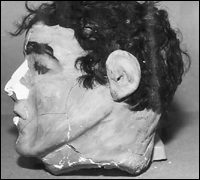
Using soap and toilet paper they fashioned crude paper-mache dummy heads painted with supplies from prison craft kits and topped with hair harvested from the prison barber shop. These they placed in their beds in order to avoid early detection.

With glue they stole from the prison glove factory, they joined pieces of rubber raincoats to make a raft and life vests. They may even have converted a concertina into a bellows to aid in the inflation of the raft.

Dummy_head
Dummy head found in Frank Morris’s cell. Not bad at all for crude paper-mache. FBI, public domain

Really, if these men had applied their ingenuity and resourcefulness to more societally accepted occupations, they probably could have done well for themselves, and spent significantly less time in prison. But it’s a fascinating story, certainly worthy of a book and a Clint Eastwood film.

I’ve had escapes on the brain lately. It’s a hot trend right now in education and entertainment. Patterns for classroom “break-out” boxes have spattered the Internet and full, themed escape rooms have been popping up across the country. They’re all pretty similar, requiring participants to gather clues and decode puzzles to solve problems, open locks, and escape the room within a time limit.

DSCN0605
Since the boys had access to a time machine, we figured fifteen extra minutes wasn’t really a big deal.

When my oldest son turned 13 recently, I decided to design an escape room for him and his friends, based on the quirky and beloved British sci fi show Doctor Who, which they all seem to love. If I were a different sort of blogger I would offer a step-by-step, photo-illustrated how-to guide to constructing your own Doctor Who escape room, but I’m not nearly ambitious enough to be that kind of blogger. Still, if you’re interested and want details, drop me an e-mail.

It was a big success, and so about a week and a half later when I got the opportunity to go to an escape room myself, I thought it might be nice to see someone else’s version. Along with my sister and my husband, I was “locked” into a room designed to look like an attic and tasked with opening a secure treasure box. We had an hour and no idea where to start.

DSCN0580
My crude paper-mache project was a Dalek piñata that the boys exterminated in less than two minutes.

Fortunately, we’re a good team of pretty resourceful people. And we’re also fairly clever. We uncovered our treasure and made it out of the room with twelve minutes to spare. The boys in the Dr. Who room were not quite as quick, but to be fair, their team consisted of six thirteen-year-old, hyperactive boys. Cleverness can only compensate for so much. They did make it out in about an hour and fifteen minutes with some occasional redirection.

Morris and the Anglins made their escape, too, becoming the only people to have ever successfully escaped from Alcatraz. Of course there was never any physical evidence that they managed to survive the cold water of the Bay and make it all the way to the freedom they wanted. Enough circumstantial evidence turned up to suggest to the FBI that the men perished in the attempt, and that became the official finding. Even so, it was an impressively clever escape.

A Shocking Rerun

In October of 1951, the beloved sit com I love Lucy aired for the first time and, according to the most extensive research I could accomplish in five minutes, became the first television show to air as reruns. Now nearly seventy years later, you can still probably catch them from time to time. And that’s good, because even a little dated, they’re still pretty funny.lucy

So to show my appreciation for the innovative thinking of Lucille Ball and Desi Arnaz, and maybe also a little because it’s still November and I am not yet finished with my 50,000 word NaNoWriMo goal, I am going to participate in the noble tradition of the rerun.

Originally posted on November 20, 2013, this is my favorite practical history post about Thanksgiving. A fair number of readers have discovered this little corner of the blogosphere over the last four years, so for many of you this will be brand new old material. And those who have read and possibly vaguely remember it, will hopefully still enjoy a chuckle or two. Just no spoilers!

A Shocking Turkey Recipe

The holiday season is nearly upon us, beginning here in the US with Thanksgiving next week. And if, like us, you’re hosting family for the big day that means it’s time to make plans for your turkey. We tend to prefer the Alton Brown brine method at our house, but I bet a fair few hosts are thinking of getting up at the crack of dawn to continually check and baste their birds until they are roasted to golden brown perfection. Other more adventurous sorts may be considering rigging up a deep fryer and spending the holiday at the hospital being treated for third degree burns.

benjamin franklin
Benjamin Franklin, reviewing his collection of turkey recipes.

But history suggests there may be an even better (and possibly more dangerous) way.
In 1750, before he famously tied a key to a kite string and invented the lightning rod, Benjamin Franklin hosted a Christmas dinner party. Interested as he was with exploring the properties of electricity, Franklin decided to educate and entertain as well as feed his guests. His theory was that by electrocuting his roasting turkey, he could produce a more tender meat.

And he wasn’t wrong. In fact, his discovery is still important to the meat industry today, but it did come at a the expense of some personal pain and humiliation. As he was setting up an electrical jack he had designed specifically to meet all of his poultry electrocution needs, the plucky inventor received a pretty good shock himself. The gathering of witnesses to the experiment-gone-wrong reported a flash of light and a loud crack.

Whereas I would have tried to pretend the incident never happened and certainly would never mention it again (Okay that’s not true. I’d totally blog about it), Franklin wrote about the failure to his brother just two days later. In the letter he describes in detail how the event made him feel, which was more or less bad. Numb in his arms and on the back of his neck until the next morning and still achy a couple days later, Franklin seems to have decided that electricity, though hilarious, is not necessarily something to trifle with (chalk up one more important discovery for Franklin). He makes no mention as to whether or not he felt tenderized by the experience.

lightning experiment
Benjamin Franklin, determined to carry on despite his shocking turkey set-back.

Now I can hear the objections already: “But, Sarah, that can’t be right. Benjamin Franklin was a friend to the turkey. He had great respect for it and even fought for its adoption as the symbol of the United States of America.” I hear you, Dear Reader. And I understand your concern. I, like many of you, was an American school child so I am familiar with that story. If you don’t wish to have your image of Benjamin Franklin as the great turkey advocate shattered, then feel free to stop reading at this point and assume that I’m just full of it.

But for those of you who want to know what’s what, I’m going to share the real story with you. Even though Benjamin Franklin was a part of the original committee charged with choosing a design for the Great Seal of the United States, he recommended a rattlesnake to represent the young nation. Not once did he suggest a turkey.

Proposedseal
Franklin also proposed this image of Moses and Pharaoh at the Red Sea for the Great Seal. Imagine the controversy that would have caused!

The idea that he did comes from an unrelated letter to his daughter written some years later when he was serving as an American envoy in Paris. To give some perspective, this was two years after the official adoption of the Great Seal, and six years after Franklin had served on the committee, again, making no mention of the turkey. He wrote the letter in response to his daughter’s question as to his opinion of the newly forming Society of the Cincinnati, a fraternity of officers of the Continental Army.

The society, founded in May of 1783, adopted for its symbol a bald eagle, claimed by some to look somewhat more like a turkey. Though Franklin didn’t oppose the society and eventually accepted an honorary membership in it, what he did not approve was the desire of some to make membership hereditary. This, he claimed, established an “order of hereditary knights,” which contradicted the ideals set forward by the newly formed republic.

But to openly mock or question the intentions of the brave men whose leadership had won the United States its freedom was simply not Benjamin Franklin’s style. Instead he focused on the turkey-eagle:

I am…not displeased that the figure is not known as a bald eagle, but looks more like a turkey. For in truth, the turkey is in comparison a much more respectable bird…He is besides, though a little vain and silly, a Bird of Courage, and would not hesitate to attack a Grenadier of the British Guards who should presume to invade his Farm Yard with a red coat on.

origin_8410286654
I’m kind of partial to the bald eagle myself. photo credit: Thomas Hawk via photopin cc

I have to assume that despite his reference to the farmyard, Franklin would not wish the symbol of our nation or its high ranking officers to be the comically large-breasted domesticated flightless bird that graces our Thanksgiving tables. Perhaps he meant to suggest wild turkey, which is a full flavored, barrel-aged, American original that tends to give one courage. Or perhaps he meant the wild turkey, which hunters suggest is a slippery foe, difficult to sneak up on and evidently tricky to electrocute.

Whatever his true intentions, I think it is clear that though Benjamin Franklin was certainly a great American who helped to shape the United States and provide all of its half-blind citizens with bifocals, he could also, at times, be a bit of a turkey.


I hope you enjoyed this encore performance! Since next Thursday is Thanksgiving here in the US, I will be engaging in another grand tradition borrowed from the television industry and preempting my blog post for the Macy’s Thanksgiving Day Parade. See you just in time for the December sweeps! That’s a thing, right?